Articles by Chuck Price — Page 4
by Chuck Price | Sep 26, 2026 | Class B RV
You can camp a Class B RV in developed campgrounds, on national forest and Bureau of Land Management (BLM) land, and at designated sites or areas in national parks. As of September 2026, dispersed stays usually cap at 14 days on BLM land and in national forests.
Last updated: September 26, 2026
Chuck Price has 35+ years of RV camping experience and owns a 2018 Hymer Aktiv Class B.
At a glance
- Trip Killers: National Park Service rules prohibit “Camping outside of designated sites or areas.” The Caribou-Targhee National Forest sends all wastewater tanks, gray included, to a designated dump station.
- Confirm Before You Go: Stay limits vary by forest, state and field office, so contact the nearest district or field office before your trip.
How a Class B’s size affects where you can camp
Most Class B vans run 17 to 24 feet long, per Thor Motor Coach. Thor’s 2020 post puts the same vans at 9 to 11 feet tall and 8 feet wide. A posted limit applies only to the road or site that posts it, so compare your own van’s specs with each posting. On Glacier National Park’s Going-to-the-Sun Road, the National Park Service prohibits vehicles longer than 21 feet (including bumpers) or wider than 8 feet (including mirrors) between Avalanche Creek and Rising Sun. The park adds that vehicles over 10 feet tall may have difficulty driving west from Logan Pass to the Loop because of rock overhangs. A van at the long end of Thor’s 17-to-24-foot range would exceed that 21-foot limit.
Check each site’s listing on Recreation.gov for its length and clearance figures. For example, site C31 at Seawall Campground in Acadia National Park lists “Caravan/Camper Van (Max length: 35 ft.)” with a 37-foot gravel driveway and 11 feet of overhead clearance.
Length, height and tank sizes for three Class B models, from each manufacturer’s spec page (opened September 26, 2026)
| Model |
Length |
Height |
Fresh water |
Gray tank |
Black tank or cassette |
Spec notes |
| Winnebago Revel 44E |
19 ft 7 in |
10 ft |
35 gal |
21 gal |
5 gal cassette |
2026 model year, 7 ft 5 in wide |
| Thor Tellaro 20L |
20 ft 11 in |
9 ft 6 in |
22 gal |
13 gal |
13.5 gal |
Model year not stated. Length without ladder, height with A/C, 6 ft 9 in wide without mirrors |
| Airstream Interstate 19GTX |
20 ft 1 in |
9 ft 11 in |
20 gal |
16 gal |
9 gal |
2027 model year, height with A/C |
For the basics, see what a Class B RV is, and compare layouts in our guide to Class B floor plans.
The four places you can camp, and the rules for each
Each type of campsite follows a different land manager’s rules. Stay limits and distance-from-water rules change with the agency and often with the local unit. The BLM states, “Dispersed camping is for short-term recreation, not long-term living.” The figures below are as of September 2026. Land access, permits, road conditions, and site availability change. Verify all information with the relevant land management agency before your trip.
Class B campsite types compared, as of September 2026 (agency sources linked in each row)
| Campsite type |
Who manages it |
Facilities |
Stay limit |
Minimum distance from water |
Where to check |
| Developed campground |
Federal agencies and state parks |
From restrooms, water, tables and hookups to “very primitive” (BLM) |
Set by each campground or park. California State Parks: 30 nights per calendar year at most parks. New York State Parks: 14 continuous nights |
Use the designated site |
The campground’s listing on Recreation.gov or the state park site |
| National forest dispersed |
USDA Forest Service |
No piped water, toilets or trash removal (Pacific Southwest Region) |
Usually 14 days. Caribou-Targhee and Rio Grande: 14 days in any 30 |
100 ft (Caribou-Targhee) or 150 ft (Pacific Southwest Region, Rio Grande) |
Nearest ranger district office |
| BLM dispersed |
Bureau of Land Management |
None listed. Pack it in, pack it out |
Generally 14 days in any 28, varies by state and field office (BLM) |
200 ft from lakes, rivers and streams |
Local BLM field office |
| National park |
National Park Service (NPS) |
Camping only at designated sites or areas (36 CFR 2.10) |
Check the park |
100 ft from a flowing stream, river or body of water, and 25 ft from a water hydrant or main road, except as designated |
Park website or the NPS app (NPS) |
Developed campgrounds (federal and state)
Recreation.gov is the reservation system for 14 federal agencies, and nine of them take reservations. Its booking windows vary by facility, set as “the number of days, weeks, or months prior to the first reservable date.” BLM developed campgrounds are typically first-come, first-served, though some take reservations through Recreation.gov.
- California State Parks caps stays at 30 nights per person per calendar year at most parks, and each campground also sets a consecutive-night limit.
- New York State Parks allows 14 continuous nights, followed by 48 hours away. You can reserve up to nine months ahead. A New York site holds “2 tents or 1 unit of hard-wheeled camping equipment and 1 tent (unless otherwise noted).”
National forest dispersed camping
Dispersed camping means camping anywhere in a national forest outside a designated campground, per the USDA Forest Service Pacific Southwest Region. Dispersed sites have no services such as piped water, toilets or trash removal. Most national forests and grasslands are open to dispersed camping unless restricted, according to the Forest Service. It is usually free and needs no permit, but heavily used areas may require a permit and fee.
The Pacific Southwest Region says the stay limit is “usually 14 days, but this can be further limited.” The Caribou-Targhee National Forest allows 14 days, then requires a move of at least 5 road miles. Caribou-Targhee also allows no more than 14 of any 30 days at one area.
The Pacific Southwest Region bars dispersed camping near developed recreation areas. The Caribou-Targhee National Forest allows dispersed camping outside a one-mile perimeter of campgrounds. Contact the nearest district office before your trip for current restrictions, as the Pacific Southwest Region advises.
BLM dispersed camping and LTVAs
Most BLM lands allow dispersed camping unless posted “Closed to Camping,” per the BLM camping page. BLM dispersed camping is “generally limited to 14 days within any 28-day period, though specific stay limits vary by state and field office.” After the limit, the BLM says to move “often at least 25 to 30 miles away.”
- Stay on designated roads and trails, and camp within 150 feet of designated routes.
- Do not camp within 1 mile of campgrounds, trailheads or picnic areas.
- Pack it in, pack it out.
Federal rule 43 CFR 8365.1-2, current on eCFR as of September 24, 2026, bars camping “longer than the period of time permitted by the authorized officer.”
The BLM runs Long-Term Visitor Areas (LTVAs) in California and Arizona, including Hot Spring, Tamarisk, Pilot Knob, Mule Mountain, Midland, La Posa and Imperial Dam. Winter visitors with a permit may camp there up to seven consecutive months, as of September 2026.
National parks: designated sites or areas only
National Park Service rule 36 CFR 2.10 prohibits “Camping outside of designated sites or areas.” The eCFR showed the rule as current as of September 24, 2026. The park superintendent may require permits and designate sites. Many NPS campgrounds require reservations through Recreation.gov, and the NPS names park websites or the NPS app as the best sources of camping information.
Campground or boondocking: how to decide
Choose a developed campground when you need services or a reserved site. Choose dispersed camping when your van can hold its own wastewater and carry out its own trash for the whole stay. In this guide, boondocking means dispersed camping without hookups. Either way, stay limits apply, and 14 days in any 28 is the general dispersed limit on BLM land as of September 2026.
Work through these criteria in order, since the first one rules out the most sites.
- Is camping legal here? Look for “Closed to Camping” postings on BLM land, and use designated sites or areas in national parks.
- Do you need a dump station, water or toilets at the site? If so, dispersed sites are out, since they have none.
- How long do you want to stay? Past the unit’s limit, usually 14 days for dispersed sites, you must move on.
- Do you need a reservation? If so, book a developed campground within its booking window, which varies by facility on Recreation.gov.
Choose a developed campground when you need hookups, water or a reserved site
- Choose it when you need hookups or water at the site, which some BLM developed campgrounds provide.
- Choose it when you want a reserved date, and book within the facility’s window on Recreation.gov or the state park site.
- Choose it inside a national park, where federal rules limit camping to designated sites or areas.
Choose dispersed camping when your van is self-contained and you can stay within 14-day limits
New to dispersed camping? Start with boondocking basics and our roundup of apps for finding free campsites.
How to pick the spot once you arrive
Pick a site that is already in use, level and durable, then check its distance from water and roads. The USDA Forest Service puts it this way in a 2026 feature: “A great camp site is found, not made. Look for a spot that is on a level, durable surface with minimal vegetation.”
- Pick a durable surface. Leave No Trace lists established trails, campsites, rock, gravel, dry grasses or snow as durable surfaces.
- Use the site as you find it. National park rules prohibit “Digging or leveling the ground at a campsite” (36 CFR 2.10).
- Stay on existing roads. The Caribou-Targhee National Forest says not to drive on meadows and to keep camp within 150 feet of a roadway. The Rio Grande National Forest keeps vehicles within 300 feet of the center line of a designated road.
- Measure your distance from water by the local rule. The table above lists each agency’s figure.
- Look up before you park. The Forest Service says, “Avoid parking or camping in areas where trees could fall.” It also says to avoid dense patches of dead trees.
- Stay off low ground by streams. The National Weather Service warns, “Never camp on low ground next to streams since a flash flood can catch you while you’re asleep.”
A road that allows camping may still have no usable spot. The Rio Grande National Forest says, “Just because camping is allowed along a road does not mean there will be sites available or suitable for camping.” Conditions in remote areas can be hazardous. Assess your skill level and equipment before heading to a remote site.
Gray water, black water and trash rules
On national forest land, federal rule 36 CFR 261.11(d) treats waste water as garbage you must remove or leave at places provided for it, so gray water goes to a dump station along with black water. The Caribou-Targhee National Forest states, “All wastewater tanks need to be emptied at a designated dump station.” Federal forest regulation 36 CFR 261.11 also bans placing pollutants in or near water (eCFR, current as of September 24, 2026). Other agencies word the gray water rule differently, so read the rule for the land you are on.
Here is how each source words it, as opened September 26, 2026.
- USDA Forest Service, Rio Grande National Forest: “Always dump sewage from trailers and motor homes at designated dump stations.”
- BLM regulation 43 CFR 8365.1-1 (eCFR, opened September 26, 2026): bars draining sewage or petroleum products and dumping “refuse or waste other than wash water from any trailer or other vehicle except in places or receptacles provided for that purpose.”
- New York State Parks: dispose of gray water in designated areas.
Because the wording differs, this guide advises the cautious practice: empty gray and black tanks at a designated dump station wherever you camp. That is our advice, not a rule quoted from any one agency. To plan stops, see our guide to finding a dump station on the road.
For trash, Leave No Trace says, “Pack it in, pack it out.” For human waste and dishwater away from your van’s toilet, Leave No Trace gives this guidance.
- Leave No Trace: dig catholes 6 to 8 inches deep, at least 200 feet from water, camp and trails.
- Leave No Trace: pack out toilet paper or bury it deep.
- Leave No Trace: carry dishwater 200 feet from streams or lakes, and scatter strained dishwater.
Cathole distances from water differ too: 100 feet on the Caribou-Targhee and in the Pacific Southwest Region, 150 feet on the Rio Grande, and 200 feet for Leave No Trace. The BLM says to use a portable toilet or pack out your waste if possible, and to bury it 6 to 8 inches deep, at least 200 feet from water and trails, only in some locations.
Private and membership options
Harvest Hosts is a paid membership whose hosts include farms, wineries, breweries, distilleries and attractions. Harvest Hosts lists 9,600+ locations on its how-it-works page, opened September 26, 2026. Most stays are one night. The page says some hosts allow extra nights for a fee, but it gives the cap two ways, as “up to four total nights” and as “up to four extra nights,” so confirm the limit with each host. The first night carries no camping fee, and Harvest Hosts asks members to buy something from the host as a thank-you.
Harvest Hosts accepts Class B RVs and camper vans. Every RV must be self-contained, with “an interior toilet and built-in holding tanks or bladders for wastewater.” Tents and sleeping in cars are excluded.
Connectivity, weather and planning tools
Federal tools can show which roads allow vehicles, where carriers report coverage and what the forecast holds. The Motor Vehicle Use Map (MVUM) is a free map of roads open to motor vehicles in a ranger district. The Rio Grande National Forest says to get the MVUM “to learn where dispersed camping is allowed.” Map rules apply unit by unit, so get the MVUM for the district you plan to visit. For a walk-through of finding dispersed sites on agency map layers, see how to find free dispersed camping using BLM and USFS map layers.
- The BLM Visit page offers an activity and location search and an interactive map.
- The FCC National Broadband Map shows provider-reported 3G, 4G LTE and 5G-NR mobile coverage based on propagation modeling, outdoors or in a moving vehicle. The FCC cautions that “a user’s actual, on-the-ground experience may vary due to factors such as the end-user device used to connect to the network, cell site capacity, and terrain.”
- The National Weather Service says to check the forecast before you leave. It also says, “NOAA Weather Radio is the only direct means to receive warnings from the National Weather Service.”
Frequently asked questions
Can I camp anywhere on BLM land in a Class B RV?
Not anywhere. Most BLM lands allow dispersed camping unless posted “Closed to Camping,” and you must stay on designated roads and trails, per the BLM. As of September 2026, stays are generally limited to 14 days in any 28-day period, and limits vary by state and field office. Verify current rules with the local field office before departure.
How long can I stay at a dispersed site in a national forest?
Usually 14 days, but a forest can set a shorter limit, per the USDA Forest Service Pacific Southwest Region. As of September 2026, the Caribou-Targhee National Forest allows 14 days in any 30-day period, then requires a move of at least 5 road miles. Verify current limits with the ranger district office before departure.
Can I dump gray water on the ground?
Not on national forest land. The Caribou-Targhee National Forest says all wastewater tanks need to be emptied at a designated dump station, and federal rule 36 CFR 261.11 includes waste water in its disposal rules. The BLM rule, 43 CFR 8365.1-1, words its vehicle dumping ban differently. The cautious practice is a dump station everywhere.
Can I boondock in a national park?
Not outside designated sites or areas. National Park Service rule 36 CFR 2.10 prohibits camping outside of designated sites or areas. Many park campgrounds take reservations through Recreation.gov, and the NPS points to each park’s website or the NPS app for camping details. Check the park’s website before departure, since the superintendent designates sites and may require permits.
How far from water should I camp?
It depends on the land manager, as of September 2026. The Caribou-Targhee National Forest uses 100 feet, and the NPS rule uses 100 feet from a flowing stream, river or body of water. The Pacific Southwest Region and Rio Grande National Forest use 150 feet. The BLM and Leave No Trace use 200 feet. Verify the local rule before departure.
Do Harvest Hosts accept Class B vans?
Yes, if the van is self-contained. Harvest Hosts requires every RV to have “an interior toilet and built-in holding tanks or bladders for wastewater.” A paid membership is required, and most stays are one night. Some hosts allow extra nights for a fee, so confirm the limit with the host. Confirm current details on the Harvest Hosts site before departure.
How do I check cell coverage before I go?
Use the FCC National Broadband Map, which shows provider-reported 3G, 4G LTE and 5G-NR mobile coverage. The FCC says real-world service may vary with your device, cell site capacity and terrain. For weather alerts, the National Weather Service calls NOAA Weather Radio the only direct means to receive its warnings.
by Chuck Price | Sep 26, 2026 | Blog
Eight documented incidents show what can go wrong at camp: a flash flood, generator exhaust, two bear encounters, hantavirus, lightning, desert heat and a dust storm. Each is paired below with the safety rule from the National Park Service (NPS), National Weather Service (NWS) or CDC.
Last updated: September 26, 2026
Chuck Price has 35+ years of RV camping experience and owns a 2018 Hymer Aktiv Class B.
These are documented camping incidents, most of them not RV-specific, and each account links to its source. Only two of the source records mention an RV: a generator death at a Maryland fairground and a 19-vehicle pileup on Interstate 10 in Arizona. The rest happened at campgrounds, park lodging, a wilderness camp and a trailhead. The hazards apply off-grid too. See also the most dangerous national parks.
Flash flood: 20 campers died at Albert Pike
A 2010 flash flood killed 20 sleeping campers at Albert Pike, Arkansas. It struck the Ouachita National Forest recreation area early on June 11, 2010, along the Little Missouri River and Brier Creek, per the U.S. Geological Survey (USGS). The NWS office in Little Rock says nearly 300 sleeping campers “were caught unprepared and 20 lost their lives.” Many campsites there are in low-lying, remote areas, and NWS says the Weather Radio signal cannot reach everywhere.
USGS modeling estimated mean inundation depths of 3.8 to 12.5 feet across the camp areas. NWS urged campers to check the forecast before a trip and test a NOAA Weather Radio before setting up.
What NWS says to do
The NWS flood safety page says, “If you live in a flood prone area or are camping in a low lying area, get to higher ground immediately.”
- “If told to evacuate, do so immediately.”
- Do not walk through flood water. Six inches of moving water can knock you off your feet.
- “It is NEVER safe to drive or walk into flood waters” (NWS Turn Around Don’t Drown).
NWS pages differ on vehicle depths. Turn Around Don’t Drown says 12 inches carries away most cars and 2 feet carries away SUVs and trucks. The flood safety page says 12 inches can float a car or small SUV and 18 inches can carry away large vehicles. Neither makes a crossing safe in a motorhome or tow vehicle. For an emergency plan, see our boondocking emergency and first aid guide.
Carbon monoxide: a generator pointed at an RV
Carbon monoxide (CO) from a gas generator killed a 75-year-old man in his RV in Maryland in 2013. On the night of August 7 to 8, he and his 76-year-old wife started it near the rear of the RV at a Cresaptown fairground before going to sleep. The generator sat several feet away with its exhaust pointed at the RV, and fumes got inside, according to an Associated Press report carried by CBS Baltimore. His wife was hospitalized.
What CDC says to do
The Centers for Disease Control and Prevention (CDC) warns, “People who are sleeping, drunk, or under the influence of other substances can die from CO poisoning before they have symptoms.”
- Run portable generators “outside, more than 20 feet away from any windows, doors, and vents,” per CDC.
- Common CO symptoms are headache, dizziness, weakness, upset stomach, vomiting, chest pain and confusion.
- Check CO detector batteries when you change your clocks each spring and fall.
- Never use a portable gas camp stove indoors.
Each year more than 400 Americans die from unintentional CO poisoning not linked to fires, per CDC. That annual U.S. count covers all settings and is not specific to RVs. For propane and fire precautions, see our RV fire safety guide.
Bears: a tent at Elkmont and a grizzly at Grand Teton
In both national park bear incidents below, bears were drawn by food smells or got food at or near campsites. Food storage rules are set park by park, so the rule depends on where you camp.
A black bear enters a tent at Elkmont
At about 5:20 a.m. on June 12, 2022, a black bear entered an Elkmont Campground tent holding a family of five and their dog, according to NPS. The bear injured a 3-year-old girl and her mother. Wildlife biologists captured the 350-pound male, and the park euthanized it on June 13, citing “extreme food-conditioned behavior and lack of fear of humans.” NPS said the bear “was likely attracted to food smells throughout the area, including dog food at the involved campsite.”
A grizzly gets campsite food at Grand Teton
From June 11 to 13, 2021, a male grizzly about 2.5 years old walked through a Grassy Lake Road campsite, was fed by visitors from a vehicle south of Lizard Creek Campground, then got unattended trash and a drink at a Headwaters Campground campsite, per NPS. The person who left the trash and drink received a food storage citation with a mandatory court appearance. The bear was captured, collared and moved by boat to the west side of Jackson Lake.
On July 20, 2021, a federal magistrate judge ordered an Idaho woman to pay $5,826.99 in restitution after she failed to properly store garbage and beverages at a Grand Teton campsite, according to the U.S. Attorney’s Office for the District of Wyoming. A grizzly got the items and was tranquilized, collared and relocated by boat. Neither release says whether the two records involve the same bear or visitor.
Food storage rules differ by park
To a bear, anything with a scent is food, including drinks, toiletries, trash, sunscreen, bug repellent and fuel, per NPS. NPS says, “Always check with the parks you plan to visit to learn their regulations.” Never store food in a pickup truck bed. Yosemite National Park rules state, “Food may not be stored in pop-up or tent trailers, or other soft-sided campers” (Yosemite bear rules).
Campground food storage rules in four national parks (NPS pages, as of September 26, 2026)
| Park |
Where food may go |
Not allowed |
Use case |
Source |
| Great Smoky Mountains |
Sealed in a vehicle (preferably the trunk) or solid-walled camping unit when not in use |
Food, cookware, coolers, scented items or water containers left out when not in use |
Elkmont and seven other campgrounds have a limited number of lockers |
Campground regulations |
| Grand Teton |
Bear-resistant food storage locker, or a hard-sided vehicle with doors locked and windows closed, day and night |
Food, drinks, trash, coolers, cookware, toiletries, fuel, bug spray, sunscreen or pet food left unattended or stored elsewhere |
Grand Teton campgrounds |
Grand Teton bear safety |
| Yosemite |
Out of sight in hard-sided trailers and RVs, with windows, doors and vents closed. Cars in daylight only |
Soft-sided campers. Cars or trucks after dark |
Hard-sided RVs and trailers |
Yosemite bear rules |
| Rocky Mountain |
Food storage lockers first. If full, a trunk with windows closed and doors locked, or low and covered from sight if trunkless |
Food or coolers left unattended or improperly stored (violation notice) |
Bear boxes in all campgrounds. Soft-sided vehicles and convertibles are encouraged to use them |
Food storage at campgrounds and trailheads |
The NPS servicewide page says some parks allow food in a car only in daylight and others require lockers.
Bear spray and encounters
If any bear attacks you in your tent, the NPS bear safety page says to fight back and not play dead. The Smokies black bear page warns, “Violations can result in fines up to $5,000 and jail time up to six months.” For more on wildlife at camp, see our guide to boondocking with wildlife.
Hantavirus: mice in the Yosemite tent cabins
Ten people who stayed overnight in Yosemite National Park between June 3 and July 23, 2012, were confirmed with hantavirus infection, per a report in the CDC journal Emerging Infectious Diseases. Of the 8 patients with hantavirus pulmonary syndrome, 3 died. Nine of the 10 stayed in a signature tent cabin in Curry Village, lodging the report found “significantly associated with becoming infected.” Rodent nests and tunnels were found in the cabins’ wall insulation. Deer mice carry Sin Nombre virus, which people mainly catch by breathing in airborne droppings and urine. The outbreak involved park lodging, not RVs.
CDC says, “Avoiding exposure to rodents and their urine and feces is the best way to prevent infection.” Its rodent cleanup guide has separate steps for “cars, trucks, campers, and other vehicles.” For a camper, CDC says to do this.
- Open the hood, doors and trunk and let the vehicle air out for 20 minutes.
- Wear plastic gloves and a long-sleeved shirt.
- Spray droppings, urine and nesting material with disinfectant until soaked and let it sit 5 minutes, or as the label says.
- Do not use a vacuum or high-pressure sprayer until the area is disinfected.
CDC also says, “Don’t vacuum or sweep rodent urine, droppings, or nesting materials.”
Lightning: a tent is not shelter
A 22-year-old man camping in Teton County, Wyoming, was killed by lightning in his tent on August 2, 2022, per the NWS 2022 lightning fatality list. He was a student on a National Outdoor Leadership School course in the Teton Wilderness near Yellowstone, FOX Weather reported. A group leader, also reportedly injured by the bolt, tried cardiopulmonary resuscitation (CPR).
The NWS lightning safety page says, “The only completely safe action is to get inside a safe building or vehicle.” A hard-topped vehicle with the windows closed counts as safe shelter. A tent offers no protection. Wait 30 minutes after the last thunder before you go back outside. Avoid ridge tops, hilltops and tall isolated trees.
Heat: 119°F at a Death Valley trailhead
Hyperthermia killed a 57-year-old hiker in Death Valley National Park on August 1, 2024, per NPS. After the one-mile round-trip Natural Bridge Trail, bystanders said his responses did not make sense. He then drove off a steep 20-foot embankment at the edge of the trailhead parking lot. Furnace Creek recorded 119°F that afternoon.
Summer 2024 was Death Valley’s hottest on record, with an average of 104.5°F from June through August, per NPS. Death Valley rangers give this advice.
- Stay in or near air conditioning (NPS).
- Do not hike at low elevations after 10 a.m.
- Drink plenty of water and eat salty snacks.
- Stay within a 10-minute walk of an air-conditioned vehicle (NPS).
- Wear a hat and sunscreen.
Dust storm: 19 vehicles, one RV, on I-10
On October 29, 2013, a dust storm cut visibility on Interstate 10 near Picacho Peak, Arizona, per a Fox News report. Nineteen vehicles crashed, including one recreational vehicle, 10 commercial vehicles and a tanker. The Arizona Department of Public Safety reported 3 dead and at least 12 hurt. NWS says haboobs and dust storms are most common in the Southwest.
If a dust storm catches you on the road, NWS gives these steps.
- Pull off the pavement as far as possible.
- Stop, turn off your lights and set the emergency brake.
- Take your foot off the brake so your tail lights are dark.
- Never stop on the traveled roadway.
Incident and lesson summary
If you often camp alone, see our solo female camping guide.
Eight documented incidents and the agency rule for each
| Hazard |
Incident (date, place) |
Agency rule |
| Flash flood |
2010, Albert Pike, Arkansas |
Get to higher ground immediately (NWS) |
| Carbon monoxide |
2013, Cresaptown, Maryland |
Generators more than 20 feet from windows, doors and vents (CDC) |
| Black bear |
2022, Elkmont, Great Smoky Mountains |
Food sealed in a vehicle or solid-walled unit (park rules) |
| Grizzly bear |
2021, Grand Teton |
Food in a bear locker or a locked, closed hard-sided vehicle, day and night (park rule) |
| Hantavirus |
2012, Curry Village, Yosemite |
Do not vacuum or sweep rodent waste (CDC) |
| Lightning |
2022, Teton County, Wyoming |
Shelter in a building or hard-topped vehicle, not a tent (NWS) |
| Heat |
2024, Natural Bridge trailhead, Death Valley |
Stay within a 10-minute walk of an air-conditioned vehicle (NPS) |
| Dust storm |
2013, I-10, Arizona |
Pull off, lights off, foot off the brake (NWS) |
Rules and conditions change, so check your park’s rules, the NWS forecast and current alerts before you go.
Frequently asked questions
Is boondocking safe?
No source cited here gives a risk rate for boondocking. The same hazards reach off-grid camps. In a flood, move from low ground to higher ground at once (NWS). Keep generators more than 20 feet from windows, doors and vents (CDC). Never shelter from lightning in a tent (NWS).
How should you store food in bear country when you camp in an RV?
Follow your park’s rule. As of September 26, 2026, Yosemite allows food out of sight in closed-up hard-sided RVs, but not in pop-up, tent or other soft-sided campers. Grand Teton requires a bear locker or a hard-sided vehicle with doors locked and windows closed, day and night. Verify current rules before departure.
How far should a generator be from an RV?
CDC says to run portable generators outside, more than 20 feet away from any windows, doors and vents. Sleeping people can die from carbon monoxide before they have symptoms. Check your CO detector batteries when you change your clocks each spring and fall.
What should you do if a flash flood threatens your campsite?
NWS says to get to higher ground immediately if you camp in a low-lying area and to evacuate at once if told to. Six inches of moving water can knock you off your feet. NWS says it is never safe to drive or walk into flood water.
Is a tent safe in a thunderstorm?
No. NWS says a tent offers no protection from lightning. The only completely safe action is to get inside a safe building or a hard-topped vehicle with the windows closed. Wait 30 minutes after the last thunder before going back out.
How do you clean mouse droppings out of a camper?
CDC groups campers with vehicles. Open the hood, doors and trunk for 20 minutes, wear plastic gloves and a long-sleeved shirt, then spray droppings and nesting material with disinfectant until soaked and let it sit 5 minutes. Do not vacuum or use a high-pressure sprayer until the area is disinfected.
What happens if you leave food out at a national park campsite?
Yosemite lists fines up to $5,000, impoundment or removal from your campsite. Great Smoky Mountains says violations can bring fines up to $5,000 and six months in jail. In a 2021 Grand Teton case, a federal magistrate ordered an Idaho woman to pay $5,826.99 in restitution for improperly storing garbage and beverages.
by Chuck Price | Sep 26, 2026 | Resources
Last updated: September 26, 2026
Chuck Price has 35+ years of RV camping experience and owns a 2018 Hymer Aktiv Class B.
This is not legal advice, so read your policy and contact your state insurance department if you have a dispute.
Each state sets its own claims rules, and both you and your insurer must follow them (NAIC, 2022). In Texas, your own insurer must accept or reject your claim within 15 business days of getting all the information it needs, or it can take 45 days if it tells you why (TDI, updated December 11, 2025). Texas denials must be in writing.
Most of the state consumer pages cited below describe auto claims, not RV claims. Your RV policy form can differ from a car policy, and the wording of your own policy controls.
Quick answers
How an RV claim moves, and where it stalls
Your policy decides what is covered and how you file. The NAIC consumer auto guide (2022) calls your policy “your guide to the types of losses that will and will not be covered and to filing claims.”
The people you deal with vary too. Adjusters may be company employees or independent contractors, according to the NAIC. Progressive’s RV claims page says its estimator can inspect your RV where you choose, such as a repair shop, campground or home. That is one insurer’s process, not a rule for every company.
Keep records from the first call.
- Note the date of every conversation with your agent or adjuster, as the NAIC advises.
- Keep your policy number, documents and bills together, and log every email, letter and phone call with its date and time (NAIC complaint guidance, March 10, 2026).
If the loss happens on the road, our guide to RV emergency preparedness covers the safety steps that come before any claim.
Claim deadlines insurers must meet, by state
There is no single national claim clock. Texas, New York and California each publish their own deadlines for insurers. These pages describe auto claims, and your RV policy wording controls. Each clock starts at a different event, such as notice of the loss, proof of claim or an agreed settlement.
Insurer claim deadlines on three state regulator consumer pages. Sources: Texas Department of Insurance auto guide (updated December 11, 2025), New York DFS own-policy claims page (undated, checked September 26, 2026), California Department of Insurance accident guide (revised December 2024).
| State |
First step |
Decision |
Payment |
Applies to |
| Texas (TDI, Dec 11, 2025) |
Acknowledge within 15 days of notice |
Accept or reject within 15 business days of getting all needed information. An insurer that needs more time can take 45 days if it tells you why |
Check within 5 business days after agreeing to pay |
Claims on your own policy, not another driver’s insurer |
| New York (DFS, undated) |
Inspect and make a good faith offer within 6 business days of notice of the loss, if the car is available for inspection |
Written reason for delay if not settled within 30 days of notice |
Within 5 business days of an agreed settlement |
Physical damage claims under your own auto policy |
| California (CDI, Dec 2024) |
Acknowledge and start investigating within 15 days of notice |
Accept or deny within 40 days of proof of claim |
Within 30 days of settlement |
Auto accident claims covered by the CDI guide |
California’s Department of Insurance (December 2024) says an insurer must accept or deny a claim “in no event later than 40 days after receiving proof of claim.” The CDI defines proof of claim as documents that support the claim and the amount of the loss, such as repair estimates or a police report indicating theft. California insurers must also respond to your messages within 15 days.
Texas adds a limit. The TDI (December 11, 2025) says its prompt payment law does not apply when another driver’s insurer is paying. That insurer must still act in good faith and try to settle quickly and fairly.
If an insurer misses a clock, your state insurance department can investigate unfair claim delays or denials for free (NAIC, March 10, 2026).
Working with the adjuster: estimates, supplements, shops and parts
You can question an adjuster’s decision and ask for it in writing. The NAIC consumer auto guide (2022) tells you not to feel rushed and says “your insurer doesn’t have the last word.” It also advises asking the adjuster for a written explanation of each decision. The state rules below come from auto consumer pages, so check how your RV policy handles each point.
When a shop finds more damage, these state rules apply to the estimate.
- Texas: if damage turns out worse than the adjuster thought, you or the shop can ask to raise the estimate (TDI, December 11, 2025).
- California: the shop contacts the insurer for approval of the added cost, and the insurer may re-inspect (CDI, December 2024).
Shop choice rules:
- Texas: an insurer can give you a list of preferred shops but cannot require you to use one (TDI, December 11, 2025).
- New York: you keep the right to choose the shop, and on request the insurer must name a nearby shop that will do the repair at its estimate, with a written guarantee backed by the insurer (DFS, undated, checked September 26, 2026).
- California: an insurer cannot require a specific shop or cut reasonable repair costs to its recommended shop’s price (CDI, December 2024).
- Washington: the choice of shop is typically yours (OIC, undated, checked September 26, 2026).
Parts rules:
- Texas: the insurer must pay for parts of like kind and quality, not necessarily original manufacturer (OEM) parts (TDI, December 11, 2025).
- California: non-OEM parts must be comparable to OEM parts in kind, quality, safety, fit and performance, and the invoice must label each part type (CDI, December 2024).
- Washington: if you demand new OEM parts, you may have to pay the difference (OIC, undated).
Progressive says it will work with any repair shop you like. Progressive also says you can skip repairs and take a check for the estimate minus your deductible, though if you finance the RV, your lender may require repairs.
Repairs can run long. The Washington OIC (undated) says auto repair delays have risen nationwide due to parts and staffing shortages, and that repairs may take as long as six months. To avoid storage fees, it suggests picking up the vehicle soon or letting the insurer move it. Our guide to RV maintenance and repair records covers upkeep between claims.
When the RV is totaled: how value is set
The New York and Washington regulators say a totaled car pays actual cash value (ACV). Several state regulators publish rules for how that value is figured. These rules come from auto pages in four states, and RV policies may offer other settlement options. In Texas, a totaled vehicle pays its value minus depreciation, per the TDI (December 11, 2025).
- Texas: the insurer might raise its offer if you show the vehicle would sell for more, using written quotes for similar vehicles from used dealers (TDI, December 11, 2025). If you keep the vehicle, its salvage value comes off the settlement. A vehicle issued a nonrepairable title cannot be retitled or registered in Texas.
- New York: the insurer pays ACV, meaning retail value plus sales tax, subject to depreciation and deductions, or replaces it with a substantially similar vehicle (DFS, undated, checked September 26, 2026).
- California: settlement must include taxes, license and transfer fees and reflect a comparable vehicle of like kind and quality (CDI, December 2024). If you keep the salvage, deductions for it must be fair, measurable and discernible.
- Washington: the insurer owes ACV, and if you cannot agree on the value, it must follow state total loss rules (OIC total loss page, undated, checked September 26, 2026). If it cannot find comparable vehicles where you normally park, it may widen the search 25 miles at a time until it finds two or more. With your permission, it may search beyond 150 miles. It must add taxes, license fees and transfer fees.
Ask for the valuation report. The Washington OIC says to request a “total loss valuation report,” and notes the insurer might not provide one unless you ask. The same page says gap insurance covers the difference between what you owe on a vehicle or motorhome and what it is worth.
RV policies can go beyond ACV. Progressive says it may pay for a brand-new RV if a qualified new motorhome or travel trailer is totaled in an accident, subject to policy terms and a deductible. National General lists five settlement options in its RV underwriting guide.
RV total loss settlement options in the National General Countrywide RV and Motorhome underwriting guide (dated July 15, 2026). The guide says availability and specifics vary by state. This is one insurer’s guide, not a legal rule.
| Option |
Who it fits, per the guide |
| Actual Cash Value (National General) |
Pays market value. All RV types |
| Total Loss Replacement |
Current model year and 4 prior years if original cost new is under $300,000, or current model year and 2 prior years if $300,000 to $500,000 |
| Purchase Price Guarantee |
Current model year and 9 prior years, on new business or when the coverage is first added |
| ACV Plus |
Pays up to 20% above ACV. Model year 20 years old or newer |
| Agreed Value |
Unique or highly customized motorhomes, not over $300,000 |
To compare these options before a loss, see what RV insurance coverage you actually need.
The appraisal clause: for disputes over the amount
An appraisal clause is a policy process for disagreements over the amount of a loss. As the Texas and California regulators describe it, each side picks an appraiser, and an umpire resolves what they cannot agree on. It only applies if your policy contains the clause. If you disagree about the value of a claim, the NAIC (2022) says to check your policy for one.
- Texas: appraisal is for disputes about the amount of your claim (TDI, December 11, 2025). The umpire’s decision binds you and the insurer. You pay your appraiser and half the umpire’s expenses. You cannot use it against another person’s insurer.
- California: the CDI says most standard policies contain an appraisal provision and either side can demand it (CDI, December 2024). The CDI discusses it in the context of total loss amount disputes. Each party pays its own appraiser, and the umpire fee is shared.
- Washington: the OIC lists appraisal as an option for a totaled vehicle if your policy has it (OIC, undated).
The California guide puts the result plainly: “An amount that any two agree upon is binding.” In Texas and California the result binds both sides, so read your policy’s appraisal wording before you invoke it.
Diminished value after repairs
Diminished value is the gap between a vehicle’s market value before an accident and after repair, as the Washington OIC (undated, checked September 26, 2026) defines it. Whether an insurer owes it depends on your state and on whose insurer you claim against. None of the sources below addresses RV policy forms.
- Washington: you typically file a diminished value claim against the at-fault party’s insurer, not your own, and some policies do not cover it (OIC, undated). The OIC says “The insurer doesn’t automatically pay you for diminished value.” You must prove the market value dropped even after repair, and the insurer may still argue against it.
- Texas: the TDI position is that an insurer is “not obligated to pay a first party claimant for diminished value when an automobile is completely repaired to its pre-damage condition” (TDI Bulletin B-0027-00, April 6, 2000). The same bulletin says an insurer may owe a third-party claimant for lost market value regardless of repair, and may owe under uninsured or underinsured motorist coverage. The bulletin addresses insurers writing private passenger auto insurance under the standard Texas policy.
If the claim is denied or stuck: the escalation path
A denied or stalled claim can go up a set ladder, from the adjuster to your state regulator. The NAIC and the Georgia OCI both describe going to the insurer first, then to the state insurance department. The details below are state-specific, and your policy terms still control.
- Ask the adjuster for a written explanation of the decision, as the NAIC advises (NAIC, 2022). In Texas, a denial must state its reason in writing (TDI, December 11, 2025).
- Gather your policy number, documents, bills and a log of every contact with dates and times (NAIC, March 10, 2026).
- File a complaint with your state insurance department, which investigates for free (NAIC, March 10, 2026). The department forwards your complaint, the insurer must respond, and the department decides whether the insurer was fair based on your policy.
- Use appraisal if the dispute is about value and your policy has the clause. You can also hire an attorney or a public adjuster, and states that allow public adjusters require them to be licensed (NAIC, 2022).
- Consider court. In Texas, claims under $20,000 can go to Justice Court (TDI, December 11, 2025).
State complaint details:
- Texas: complaints must be in writing, and you can use the TDI Online Complaint Portal. The TDI says it cannot decide fault or set damage amounts (TDI, December 11, 2025).
- California: the CDI Consumer Hotline is 1-800-927-4357 (CDI, December 2024). If the insurer pursues subrogation, it must include your deductible unless you already recovered it.
- Georgia: contact your insurer first, then file on the Office of Commissioner of Insurance and Safety Fire complaint portal or call (800) 656-2298 (Georgia OCI, undated, checked September 26, 2026).
- North Carolina: unfair claim practices under G.S. 58-63-15 include trying to settle for less than a reasonable person would believe they were owed (NCDOI Bulletin 24-B-07, May 29, 2024).
Before you escalate, you can check an insurer’s record. The NAIC compiles closed, confirmed complaints from state insurance departments, searchable by state, company and insurance type for the past three years (NAIC, September 1, 2022).
Before you file a small claim
The NAIC (2022) says how often you file and the types of claims you file often affect your premium and renewal. If the repair costs little more than your deductible, the NAIC says you may want to pay it yourself. The NAIC says most insurers report auto claims to private nationwide databases such as CLUE, and that you have a right to a free copy of your CLUE report.
Georgia adds one protection for auto policies. The Georgia OCI auto insurance guide (undated, checked September 26, 2026) says a policyholder of at least three years cannot be non-renewed for one claim, even an at-fault accident.
Frequently asked questions
How long does an RV insurance claim take?
There is no national clock. Texas (TDI, 2025) gives your own insurer 15 days from notice to acknowledge, 15 business days from full information to decide (45 days with a stated reason) and 5 business days from agreement to pay. California (CDI, 2024) allows 15 days from notice, 40 days from proof of claim and 30 days from settlement.
Can I choose my own RV repair shop?
In Texas (TDI, 2025), New York (DFS, undated), California (CDI, 2024) and Washington (OIC, undated), the regulator says you can choose the shop. Texas and California insurers cannot require a shop on their list. Washington warns you may pay extra if you demand new OEM parts. Progressive says it works with any shop. Check your RV policy.
What is an RV appraisal clause?
An appraisal clause is a policy term for disputes over the amount of a loss. Each side picks an appraiser, and an umpire settles differences. Texas (TDI, 2025) and California (CDI, 2024) say the result binds both sides and the umpire’s cost is shared. In Texas it works only against your own insurer. Your policy must contain the clause.
Can I claim diminished value on my RV?
It depends on your state and whose insurer pays. A Texas bulletin (TDI, April 6, 2000) says insurers need not pay first-party diminished value after a complete repair, under private passenger auto policies. Washington’s OIC (undated) says it is usually claimed from the at-fault party’s insurer and needs proof. Neither addresses RV policy forms.
How is a totaled RV valued?
New York (DFS, undated) and Washington (OIC, undated) say a totaled car pays actual cash value, and Texas (TDI, 2025) says value minus depreciation. New York, California (CDI, 2024) and Washington add sales tax or taxes and fees. Progressive and National General offer RV replacement options, and National General says its options vary by state.
What can I do if my RV claim is denied?
Ask for the reason in writing, which Texas requires for denials (TDI, 2025). Escalate inside the insurer, then file a free complaint with your state insurance department (NAIC, 2026). The department forwards it and the insurer must respond. For value disputes, check for an appraisal clause. An attorney or licensed public adjuster is another route.
by Chuck Price | Sep 26, 2026 | Boondocking-Guide
Last updated: September 26, 2026
Chuck Price has 35+ years of RV camping experience and owns a 2018 Hymer Aktiv Class B.
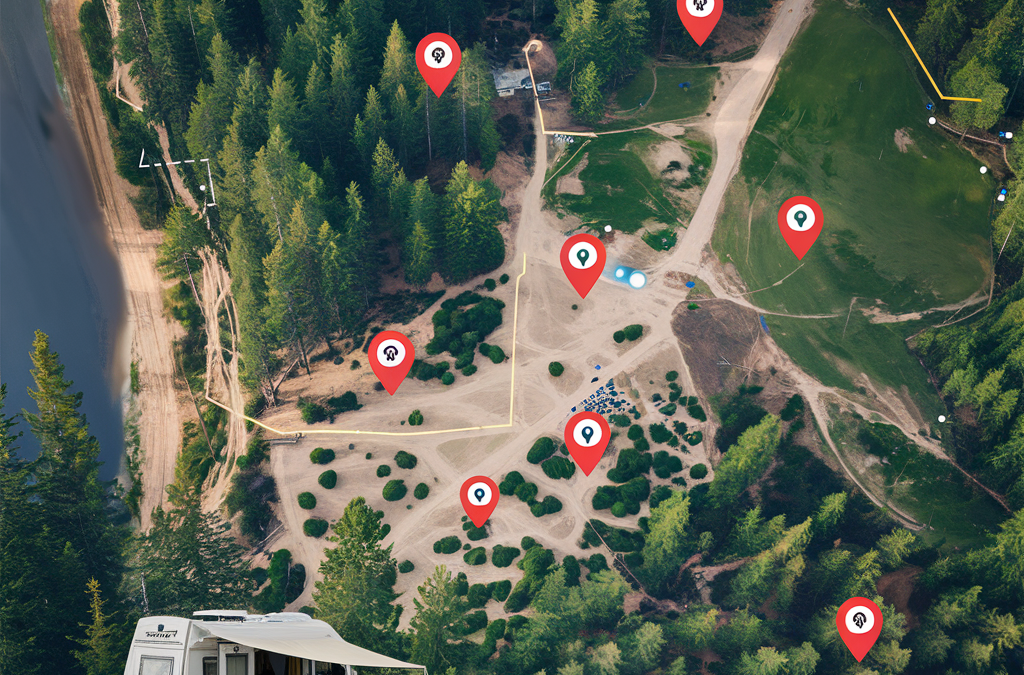
Google Maps satellite and terrain views help you spot dirt roads and cleared sites, but the map does not show whether camping there is legal. Bureau of Land Management (BLM) guidance allows dispersed camping on most BLM land unless an area is posted closed or has other restrictions, generally for 14 days in any 28-day period.
- Must-know: Google Maps is for scouting. On national forests, a road missing from the Motor Vehicle Use Map (MVUM) is closed to vehicles, per the USDA Forest Service.
- Trip killers: National Park Service (NPS) regulation bars camping outside designated sites or areas, per 36 CFR 2.10.
- Best for: Finding existing clearings and turnouts with the Satellite layer, then reading elevation on the Terrain layer, per Google Maps Help.
- Confirm before you go: Stay limits, water setbacks and fire restrictions come from the local BLM field office or national forest, not from the map.
Land access, permits, road conditions, and site availability change. Verify all information with the relevant land management agency before your trip.
What Google Maps can and cannot tell you
Google Maps shows imagery, roads and terrain, and it does not show where camping is allowed. Google Maps Help describes the Satellite layer as aerial pictures and the Terrain layer as contour lines that show elevation. Google Earth Help states, “Images aren’t in real time, so you won’t see live changes.”
That Google Earth Help page says each image is collected at a specific date and time. It adds that one mosaic can combine images from multiple days or months. A gate, washout or closure that came after the image date will not appear. Treat the map as a scouting tool, and let the land manager’s rules decide where you camp. If you are new to camping off the grid, start with boondocking basics.
Check the road on the Motor Vehicle Use Map before you drive it
On national forests, a road missing from the MVUM is closed to vehicles. The USDA Forest Service says a route or area not listed on the MVUM is not open to motorized travel, even if it appears usable. A two-track that shows clearly on satellite imagery can still be closed. On BLM land, BLM says vehicles must stay on designated roads and trails unless an area is designated for off-road vehicle use.
- MVUMs show the roads, trails and areas designated for motor vehicle use. The Forest Service states, “It is your responsibility to know which routes and areas are designated for motor vehicle use.”
- National forests and grasslands must post their MVUMs online, and maps also may be found at visitor centers, per the Forest Service maps page.
- The San Juan National Forest in Colorado offers free MVUMs that show where you can camp outside a developed campground. In its designated dispersed areas, you may drive up to 300 feet off an open road if you cause no resource damage (page updated May 2, 2025).
Stay limits and water setbacks set by the agency
The local unit’s posted rule controls how long you stay and how far you camp from water. The BLM states, “Dispersed camping is generally limited to 14 days within any 28-day period” (BLM Camping on Public Lands). That figure is guidance, and BLM says limits vary by state and field office. The federal regulation, 43 CFR 8365.1-2, bars camping longer than the period the authorized officer permits (Electronic Code of Federal Regulations, or eCFR, current as of September 24, 2026). For stays longer than 14 days, BLM long-term visitor areas let you camp up to seven months for one fee.
Water setbacks on the units below run from 100 feet to 200 feet, and Death Valley National Park requires more than 100 yards. BLM and the Forest Service Intermountain Region both publish 200 feet.
Stay limits and water setbacks by agency and unit. The local unit’s posted rule controls. Sources are linked in each row, all opened September 26, 2026.
| Agency |
Unit |
Stay limit |
Water setback |
Other distance rules |
Source and date |
| BLM |
Nationwide guidance |
Generally 14 days within any 28-day period, varies by state and field office |
At least 200 feet from lakes, rivers and streams |
Vehicles stay on designated roads and trails unless an area is designated for off-road use |
BLM Camping on Public Lands, undated page |
| BLM |
Federal regulation 43 CFR 8365.1-2 |
No longer than the period the authorized officer permits |
See the local unit |
See the local unit |
eCFR, current as of September 24, 2026 |
| BLM |
Utah |
14-day limit while occupying any campsite |
See the local unit |
At least 300 feet from range improvements, previously disturbed sites only, designated routes only |
BLM Utah handout, undated (2023 file) |
| Forest Service |
Intermountain Region |
Number of days set by each forest |
At least 200 feet from any stream or other water source |
Vehicle access defined on each forest’s MVUM |
Intermountain Region, updated July 15, 2026 |
| Forest Service |
Apache-Sitgreaves National Forests, Arizona |
No more than 14 days in a 30-day period |
At least 100 feet from any stream or other water source |
Campsite within 300 feet of a roadway |
Apache-Sitgreaves, updated September 22, 2025 |
| Forest Service |
San Juan National Forest, Colorado |
Up to 16 days, then move at least 5 road miles |
At least 100 feet from any stream or other water source |
Campsite within 150 feet of a roadway |
San Juan, updated May 2, 2025 |
| NPS |
Default regulation 36 CFR 2.10 |
Superintendent sets conditions |
Not within 100 feet of a flowing stream, river or body of water, except as designated |
Designated sites or areas only, not within 25 feet of a water hydrant or main road |
eCFR, current as of September 24, 2026 |
| NPS |
Death Valley National Park |
See the park page |
More than 100 yards from any water source |
Roadside backcountry camping on dirt roads at least 1 mile past any paved road or day-use-only dirt road |
Death Valley, updated April 16, 2025 |
BLM land
Most BLM land allows dispersed camping unless an area is posted “Closed to Camping” or has specific restrictions for land use or conservation, per BLM. BLM tells you to check with your local office for area-specific rules. Fire restrictions can change through the year, so check current rules before you go. Pack out all trash and belongings.
State and field offices publish their own rules, such as the BLM Utah handout in the table. In an April 26, 2022 release, the BLM Moab Field Office finalized rules for the Klondike Bluffs area that limit camping to designated areas. Those rules also require a portable or established toilet for human waste and prohibit wood cutting and collecting. For more on recent changes, see our guide to current BLM camping rules.
National forests
Each national forest sets its own dispersed stay limit, per the Forest Service Intermountain Region. The same page asks for a campsite at least 200 feet from any stream or other water source. It says to dig catholes 6 to 8 inches deep and at least 200 feet from water, camp and trails. Campfires are permitted unless a restriction has been issued. Large groups may need a special use permit, which has no fee and comes from the nearest Forest Service office.
Rules differ between forests, as the table shows. On the Apache-Sitgreaves National Forests in Arizona, groups of over 75 people need a special use permit. For forest-by-forest trip ideas, see our guide to camping in national forests.
Scout sites with satellite and terrain views
Use the Satellite layer to look for existing cleared sites along roads the agency map shows as open. BLM Utah asks campers to use only previously disturbed sites, so an existing clearing is the spot to look for there.
- On a computer, click Layers at the bottom left and choose Satellite, per Google Maps Help.
- On Android, tap Layers at the top right, then tap the map type you want, per Google Maps Help for Android.
- Switch to Terrain to see contour lines for elevation and gray numbers for altitude, per Google Maps Help. On a computer, Terrain sits under More in the Layers menu.
- On a computer, right-click your starting point, choose Measure distance, then click to add points, per Google Maps Help. Distance shows in miles and kilometers, and the tool does not work in Lite mode.
- On Android, touch and hold a spot to drop a red pin, tap Measure distance, then tap Add point, per Google Maps Help for Android.
- Compare the distance to water with your unit’s setback, such as at least 200 feet on BLM land per BLM.
For map tools Google has added recently, see our roundup of newer Google Maps features.
Save pins and download offline maps before you lose signal
Offline Google Maps can guide your drive only if the entire route is inside the downloaded area, per Google Maps Help for Android. Offline mode has no transit, bicycling or walking directions. If you drive offline, you get no traffic info or alternate routes. Download maps and save sites while you still have a signal.
- To save a site, touch and hold the spot, tap its name, tap Save and choose a list, per Google Maps Help. Sign in to your Google Account and you can find saved places on any computer, phone or tablet.
- A list can be Private, which only you can view and edit, or Shared through a link to view or edit, per Google Maps Help.
- To download an area on Android, search for a place, swipe right in the place sheet, tap More, then Download offline map. You can also tap your profile picture, then Offline maps, then Select your own map, per Google Maps Help.
- You must update downloaded offline maps before they expire, per Google Maps Help. When a map expires in 15 days or less and you are on Wi-Fi, Google Maps tries to update it automatically.
National parks follow different rules
BLM and national forest dispersed rules do not carry over to national parks. NPS regulation 36 CFR 2.10 lists this as prohibited: “Camping outside of designated sites or areas.” Under the same section, each park superintendent may require permits, designate sites or areas, and set conditions for camping. Unless a park designates otherwise, the regulation bars camping within 100 feet of a flowing stream, river or body of water. The eCFR text was current as of September 24, 2026.
Death Valley National Park shows how a park can designate more (page updated April 16, 2025). The park allows backcountry camping along dirt roads at least one mile past the junction with any paved road or day-use-only dirt road. Campsites must be more than 100 yards from any water source.
- The park’s backcountry camping page bars camping along paved roads, in pullouts or parking lots, on the valley floor from Ashford Mill to 2 miles north of Stovepipe Wells, at Eureka Dunes, and in Greenwater Canyon.
- Permits are mandatory in Echo Canyon, Hole in the Wall, the Cottonwood and Marble Canyon area, and Greenwater Valley. They cost $10 per night and can be booked online up to 6 months ahead. For all other roadside camping, backpacking and canyoneering, the park lists a free permit as recommended.
Check the specific park’s website before you plan an overnight stop.
Cross-check with other map apps
Other map apps give you a second check on a site. None of them sets camping rules, so the agency’s posted rule still controls.
- onX Offroad says property boundaries are typically accurate within 20 feet, depending on the county. onX says it sources trail data from agencies and MVUMs and updates private and government land data every one to two years.
- iOverlander describes its listings as “data by humans” and shows 250,000 places in 190 countries on its homepage as of September 2026. Offline maps in iOverlander require a paid subscription.
- Campendium covers free camping at dispersed public land sites, and its user reviews include a cell coverage rating.
For a side-by-side look, see our guide to apps for finding free campsites. If you prefer no-cost software, see our list of free and open-source tools.
Before-you-go checklist
- Confirm which agency manages the land and check that office’s stay limit, which BLM says varies by state and field office.
- Check every road you plan to drive against the forest’s MVUM, since a route not on it is closed, per the Forest Service.
- Check current fire restrictions, which BLM says can change through the year.
- On a national forest, ask whether your large group needs a special use permit, per the Intermountain Region.
- Download offline maps that cover your entire route, per Google Maps Help.
- Measure the distance from your planned site to water and compare it with the unit’s setback.
Before departure, verify current conditions with the BLM field office, the nearest Forest Service office or the park that manages the land.
Frequently asked questions
Can Google Maps show you where dispersed camping is allowed?
No. Google Maps shows satellite imagery, roads and terrain, not camping rules, and Google Earth Help says its images are not real time. As of September 2026, BLM says most of its land allows dispersed camping unless an area is posted closed or has other restrictions. On national forests, check the Motor Vehicle Use Map. Verify current status before departure.
How far from water do you have to camp when dispersed camping?
It depends on the unit, as of September 2026. BLM and the Forest Service Intermountain Region say at least 200 feet. The Apache-Sitgreaves and San Juan National Forests say at least 100 feet. Death Valley National Park requires more than 100 yards. The local unit’s posted rule controls, so verify it before departure.
How long can you stay at a dispersed campsite?
As of September 2026, BLM guidance generally limits dispersed camping to 14 days in any 28-day period, and limits vary by state and field office. In the Forest Service Intermountain Region, each forest sets its own limit. The San Juan National Forest allows 16 days, then requires a move of at least 5 road miles. Verify current limits before departure.
What is a Motor Vehicle Use Map?
A Motor Vehicle Use Map (MVUM) shows the national forest and grassland roads, trails and areas designated for motor vehicle use. As of September 2026, the Forest Service says a route not listed on it is closed to motorized travel, even if it appears usable. Forests post it online, and visitor centers may also have it. Verify current status before departure.
Does Google Maps work offline for camping trips?
Yes, for driving, if the entire route is inside an offline map you downloaded, per Google Maps Help. Offline mode has no transit, bicycling or walking directions, and no traffic info or alternate routes. Offline maps expire. Google Maps tries to update them on Wi-Fi when they expire in 15 days or less.
Can you dispersed camp in national parks?
Generally no. As of September 2026, NPS regulation 36 CFR 2.10 prohibits camping outside designated sites or areas, and each superintendent may designate sites or areas. Death Valley National Park allows camping along dirt roads at least one mile past the junction with any paved road or day-use-only dirt road. Verify current status with the park before departure.
by Chuck Price | Sep 26, 2026 | Boondocking-Guide
Last updated: September 26, 2026
Chuck Price has 35+ years of RV camping experience and owns a 2018 Hymer Aktiv Class B.
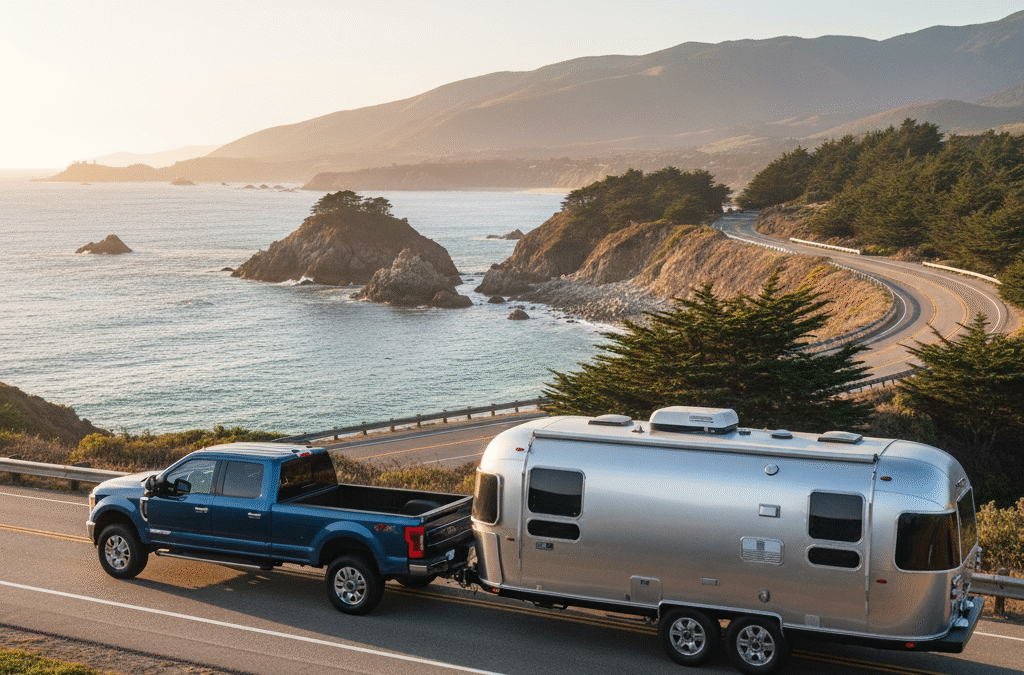
Safe trailer towing comes down to four checks. Keep conventional tongue weight at 10% to 15% of loaded trailer weight, per Chevrolet and three hitch makers. Stay under every rating on your door label and towing guide. Set weight distribution per your truck maker. Meet each state’s brake law.
Check your vehicle’s towing guide, your hitch manual and the current law in every state you tow through. This guide covers conventional travel trailers and fifth wheels pulled by a pickup or SUV. For flat towing a car behind a motorhome, see our guide to flat towing a car behind a motorhome.
- Must-Know: Tongue weight counts against your truck’s GVWR and payload, per Chevrolet.
- Trip Killers: Tongue weight under 10% can let the trailer sway, per CURT. Another is a breakaway cable attached where the kit maker says not to, such as the chains or ball on a CURT kit.
- Best For: Owners of conventional travel trailers and fifth wheels who tow with a pickup or SUV.
- Confirm Before You Go: Weigh the fully loaded truck and trailer, as Ford and Chevrolet both advise, and check brake laws in every state on your route.
Know the weight ratings before you hitch
Tongue weight counts against your truck’s GVWR and payload, per Chevrolet. Chevrolet’s gross vehicle weight rating (GVWR) includes “the as-equipped weight of the vehicle plus the cargo, passengers and trailer tongue weight”. Ratings differ from one truck to the next, so read them from your own label and towing guide. Federal rule 49 CFR 567.4 puts the certification label on “the hinge pillar, door-latch post, or the door edge that meets the door-latch post, next to the driver’s seating position” (eCFR).
That label shows the GVWR and the gross axle weight rating (GAWR) for each axle, front to rear.
Tow vehicle weight ratings, defined in the 2026 Ford and Chevrolet towing guides, label rules from 49 CFR 567.4 (sources linked in each row)
| Rating |
What it limits |
Where to find it |
When you use it |
| Gross vehicle weight rating (GVWR) |
The “maximum allowable weight of the fully-loaded vehicle” (Ford), which includes trailer tongue weight (Chevrolet) |
Door certification label (49 CFR 567.4) |
Checking the truck’s weight with the trailer hitched |
| Gross axle weight rating (GAWR) |
The “maximum weight to be carried by a single axle (front or rear)” (Ford) |
Door certification label, front and rear axle (49 CFR 567.4) |
Checking each axle reading on a scale ticket |
| Gross combined weight rating (GCWR) |
The “maximum allowable weight of the towing vehicle and the loaded trailer” (Ford) |
Your vehicle maker’s towing guide |
Checking the whole rig’s gross weight |
| Payload |
The “combined maximum allowable weight of cargo and passengers” (Ford), with tongue weight counted in (Chevrolet) |
Your vehicle maker’s towing guide |
Deciding how much you can carry in the truck |
Chevrolet’s guide states, “The only way to be sure to not exceed any of these ratings is to weigh the tow vehicle and trailer combination, fully loaded for the trip, getting individual weights for each of these items” (Chevrolet). Ford also tells owners to have the fully loaded vehicle, passengers included, and trailer weighed. If you are shopping for a rig, read our notes on matching a trailer to your tow vehicle when buying. Electric pickups raise their own questions, covered in our piece on towing a trailer with an EV.
Tongue weight: the 10 to 15 percent range and how to measure it
Conventional trailer tongue weight should be 10% to 15% of loaded trailer weight, per Chevrolet, CURT, Equal-i-zer and Blue Ox. Ford states 10% of loaded trailer weight for conventional trailers over 2,000 lb. For trailers up to 2,000 lb, Ford caps tongue load at 200 lb. Fifth-wheel and gooseneck trailers use higher figures, shown in the table below. As an example, a 6,000 lb loaded trailer puts 600 lb on the hitch at 10% and 900 lb at 15%.
Tongue and pin weight guidance by source, 2026 vehicle maker guides and hitch maker pages (sources linked in each row)
| Source |
Conventional trailer |
Fifth wheel or gooseneck |
Who it applies to |
| Ford 2026 RV and Trailer Towing Guide |
10% of loaded trailer weight over 2,000 lb, 200 lb maximum up to 2,000 lb |
15% of loaded trailer weight (king pin) |
Ford tow vehicles |
| 2026 Chevrolet Trailering Guide |
10% to 15% of loaded trailer weight, with a 10% maximum when towing the maximum trailer weight |
15% to 25%, with a 15% maximum when towing the maximum trailer weight |
Chevrolet tow vehicles |
| CURT |
About 10% to 15% of gross trailer weight |
Not given on the page cited |
General coupler and hitch guidance |
| Equal-i-zer |
10% to 15% of gross trailer weight |
Not given on the page cited |
Equal-i-zer hitch owners |
| Blue Ox |
10% to 15% of total trailer weight |
Not given on the page cited |
General tongue weight guidance |
Where your tow vehicle’s own guide gives a different figure, follow that guide.
Why the range matters
Below 10%, “the trailer may tend to sway back and forth,” per CURT. Above 15%, “your vehicle may become less responsive, especially when turning and braking,” CURT says. Equal-i-zer’s owner’s manual puts it more directly: “Towing with a tongue weight more than 15% or less than 10% of gross trailer weight greatly increases the likelihood for loss of vehicle control” (Equal-i-zer).
Three ways to measure tongue weight
- Ford method: disconnect the trailer and place only the tongue on a scale at hitch ball height (Ford).
- Blue Ox tongue scale method: with the trailer fully loaded on level ground, set the scale under the tongue jack, lower the jack onto it, then unhitch the trailer and read the scale (Blue Ox).
- Blue Ox commercial scale method: weigh the vehicle without the trailer, then weigh it again hitched with the trailer wheels off the scale (Blue Ox). The hitched weight minus the solo weight “equals your trailer tongue weight,” Blue Ox says.
If the reading is over the limit, Ford says to move cargo rearward. If it is under the minimum, move cargo forward.
Loading the trailer
Ford advises placing about 60% of the allowable cargo weight in the front half of the trailer. The other 40% goes in the rear half, per the same 2026 Ford guide.
Setting up a weight-distributing hitch
Ford‘s setup method uses front fender height to set how much weight the load bars return to the front axle. The front axle load restoration (FALR) figures below come from Ford’s 2026 guide and apply to Ford models only. Chevrolet and Equal-i-zer give no restoration percentage in the guides cited here, so other brands should follow their own manuals.
For Super Duty trucks, Ford writes, “If using load bars for weight distribution, Ford recommends 50% front axle load restoration (FALR).”
When Ford requires one
Ford defines Class III as trailers of 3,501 to 5,000 lb and Class IV as trailers over 5,000 lb (Ford). Ford lists a weight-distributing hitch as “Required for certain Class III and all Class IV applications.”
Ford’s fender-height method, step by step
- Load the trailer the way it will be loaded for the trip, with 10% tongue load, and park on level ground (Ford).
- Use the tongue jack to set the trailer level or just slightly nose down, and load the tow vehicle the way you will use it on the trip.
- Set the ball mount height per the hitch maker’s instructions so the ball matches the coupler height with the trailer unhitched.
- Measure from the ground to the top of the front fender lip, above the center of the wheel. Record it as H1.
- Hitch the trailer with no weight-distribution bars attached and the tongue jack fully retracted, then measure again. Record it as H2.
- Subtract H1 from H2, then multiply by your model’s correction factor. The result is the reduction.
- Subtract the reduction from H2 to get the target height.
- Adjust the bars “per manufacturer’s instructions” until the fender lip reaches the target height and the trailer sits level to slightly nose down.
- Finish latching the coupler and connect the wiring, safety chains and breakaway system.
Ford weight-distribution figures by model, 2026 Ford RV and Trailer Towing Guide (source linked in each row)
| Ford model |
Figure in Ford’s guide |
How it is used |
| F-250, F-350 and F-450 Super Duty pickups, F-350 to F-600 Super Duty Chassis Cab |
50% FALR (Ford) |
Recommended when using load bars |
| F-150, F-150 Raptor, Expedition, F-250 and F-350 Super Duty, F-450 Super Duty Crew Cab, Super Duty Chassis Cab |
50% correction factor (Ford) |
Step 6 of the fender-height method |
| F-450 Super Duty pickup, Regular Cab |
25% correction factor (Ford) |
Step 6 of the fender-height method |
| Mustang, Bronco Sport, Escape, Bronco, Explorer, Maverick and Ranger |
“Not Required” (Ford) |
Ford lists no correction factor |
| Transit |
“Use Not Recommended” (Ford) |
Entry in Ford’s correction factor table |
What Chevrolet and Equal-i-zer say
If a trailer needs weight distribution, Chevrolet says to “use a frame-mounted, weight-distributing hitch and sway control of the proper size.” Chevrolet’s 2026 guide gives no FALR percentage. The Equal-i-zer installation guide has you measure from the ground to the wheel well above the front axle three times. Take one reading before coupling, one coupled without weight distribution, and one with it engaged. Equal-i-zer gives no fender-height target in the guide cited here.
Equal-i-zer 6K-14K models are rated at 600 lb tongue and 6,000 lb trailer, 1,000 and 10,000 lb, 1,200 and 12,000 lb, and 1,400 and 14,000 lb (Equal-i-zer). The hitch ball must be rated at or above the trailer’s gross vehicle weight, per the Equal-i-zer installation guide.
Weighing your rig at a CAT Scale
A CAT Scale ticket gives axle and gross weights for your truck and trailer (CAT Scale). CAT Scale says its scales “cannot weigh each corner of the vehicle.” CAT Scale lists more than 1,675 locations in the U.S. and Canada. Prices below are as of September 2026.
- Load the truck and trailer the way you will travel, passengers included (Chevrolet).
- Pull on with the steer axle on platform 1, the drive axle on platform 2 and the trailer axles on platform 3 (CAT Scale).
- Compare the steer and drive axle weights with the front and rear GAWR on the door label.
- Compare the gross weight on the ticket with your GCWR.
As of September 2026, the CAT Scale FAQ lists $15.25 for a first weigh and $5.25 for a reweigh. The reweigh price applies to the same vehicle, with the full-price ticket presented, at the same scale, within 24 hours.
Trailer brakes, breakaway systems and safety chains
Your truck maker may require trailer brakes at a lower weight than a state law does. Chevrolet requires trailer brakes above 2,000 lb on Silverado, Suburban and Tahoe, and above 1,500 lb on all other models. That is a vehicle maker requirement, not a law. State brake laws are separate, so follow both your maker and each state’s rule. Ford writes, “Ford Motor Company recommends that a separate functional brake system be used on any towed vehicle.”
Breakaway systems
A breakaway system applies the trailer brakes if the trailer separates from the tow vehicle. CURT’s breakaway kit instructions say to attach the cable “to a suitable location on the frame of the tow vehicle” (CURT). CURT adds, “Do not attach the breakaway switch cable to mounting hooks, trailer safety chains or the trailer ball.” The California DMV handbook (Rev. 11/2011) instead says the cable is “looped around a stationary hitch component on the tow vehicle,” and its coupling checklist says a breakaway switch “must be connected to the first link of the safety chain” (California DMV). The two sources differ, so follow the instructions for your own breakaway kit.
- Check the breakaway battery charge with the Test button before connecting for towing (CURT).
- When preparing to tow, test the system by pulling firmly on the breakaway cable, CURT says.
- CURT’s post-installation test lifts the trailer on a jack and jack stands, with the 7-way connector unplugged, and leaves the pin pulled for 15 minutes. After 15 minutes, “The trailer brakes should still be applied and the wheels should not be able to spin,” CURT says. Recharge the breakaway battery before first use after that test, per CURT.
- Disconnect the trailer connector before the test to avoid damaging the brake controller, CURT says.
Safety chains
Ford says to always use safety chains and to cross them under the tongue. Crossed chains keep the tongue from hitting the ground if the trailer separates, per Ford. Leave only enough slack for full turns, and do not let the chains drag. Chevrolet crosses conventional-trailer chains under the tongue so it is “less likely to drop and hit the road” if the trailer separates from the hitch. The California DMV handbook (Rev. 11/2011) requires safety chains on travel trailers but not on fifth wheels, crossed in an “X” below the ball mount (California DMV).
Federal chain and breakaway rules cover commercial vehicles
The federal chain and breakaway rules in 49 CFR Part 393 are commercial-vehicle rules. They apply to “employers, employees, and commercial motor vehicles that transport property or passengers in interstate commerce,” per 49 CFR 390.3 (eCFR, current as of September 24, 2026). The same section exempts “The occasional transportation of personal property by individuals not for compensation and not in the furtherance of a commercial enterprise.” For most private RV towing, look to state law instead.
Trailer brake laws by state: a partial table
Among the seven states checked, brake thresholds run from trailers over 1,000 lb unladen in New York and 1,500 lb in California to 3,000 lb in Minnesota and 4,500 lb in Texas. Minnesota also requires brakes when the trailer outweighs the empty tow vehicle. Michigan, Montana and Pennsylvania use 3,000 lb, each with a condition tied to 40% of the towing vehicle’s gross weight. Each state writes its own rule, and several add conditions such as trailer age or towing-vehicle weight. This is a partial list, checked September 26, 2026.
Check your own state and every state you drive through at that state’s own code or DMV.
Trailer brake and breakaway rules in 7 states. Partial list, checked September 26, 2026. Primary source linked in each row.
| State |
Brakes required |
Breakaway rule |
Source and date |
Use case note |
| California |
Brakes are required on any trailer coach or camp trailer of 1,500 lb gross weight or more. |
Breakaway switches are required on trailers of 1,500 lb gross or more made after Dec. 31, 1955. |
California DMV Recreational Vehicles and Trailers Handbook DL 648, Rev. 11/2011 (agency handbook, statute text not opened) |
Trailer coaches and camp trailers |
| Michigan |
New trailers sold in Michigan need brakes on all wheels, except a trailer “of less than 3,000 pounds gross weight need not be equipped with brakes if the gross weight of a trailer … does not exceed 40% of the gross weight of the towing vehicle”. A separate 40% test applies to a semitrailer, “part of the load of which rests upon the towing vehicle”. Trailers of 15,001 lb or more need brakes on all wheels applied from the cab. |
No breakaway provision found in the section checked. |
MCL 257.705, as amended by 2011 PA 151 |
New trailers sold in Michigan |
| Minnesota |
Brakes are required on a trailer “with a gross vehicle weight of 3,000 or more pounds, or a gross weight that exceeds the empty weight of the towing vehicle”. |
Over 3,000 lb, brakes must stop and hold the trailer “whenever it becomes detached from the towing vehicle.” |
Minnesota Statutes 169.67, subd. 3, 2025 Minnesota Statutes |
Two triggers, trailer weight or a trailer heavier than the empty tow vehicle. Surge brakes qualify. |
| Montana |
Every vehicle needs brakes on all wheels, except trailers “of a gross weight not exceeding 3,000 pounds” whose total weight does not exceed “40% of the gross weight of the towing vehicle when connected” and whose combination meets the stopping standard in 61-9-312. |
Trailers over 3,000 lb gross made after Jan. 1, 1966 need brakes on all wheels that apply “automatically and promptly, and remain applied for at least 15 minutes upon breakaway”. |
Montana Code Annotated 61-9-304 and 61-9-305, Montana Code Annotated 2025 |
40% condition applies at 3,000 lb or less |
| New York |
Brakes are required on trailers “weighing more than one thousand pounds unladen” and on trailers made on or after Jan. 1, 1971 whose registered maximum gross weight, actual gross weight, or unladen weight plus the maker’s recommended carrying capacity is “in excess of three thousand pounds”. |
No breakaway provision found in the section checked. |
New York Vehicle and Traffic Law 375, most recent revision Aug. 28, 2026 |
Two tests, unladen weight and gross weight |
| Pennsylvania |
“A trailer shall be equipped with a service brake system,” with brakes acting on all wheels. The listed exceptions include “A trailer of a gross weight not exceeding 3,000 pounds, if the gross weight of the trailer does not exceed 40% of the gross weight of the towing vehicle.” |
Trailers equipped with brakes or over 3,000 lb gross need a breakaway system that stops and holds the trailer automatically. |
67 Pa. Code 175.123, PennDOT Publication 45, no revision date shown (agency publication, 75 Pa.C.S. 4502 not opened) |
Recreational, semi and utility trailers |
| Texas |
Brakes are not required at 4,500 lb gross or less, or over 4,500 lb up to 15,000 lb when drawn at not more than 30 mph. |
Not verified at a primary source this review. |
Texas Department of Public Safety, “Brakes Required”, page last updated Aug. 19, 2020 (agency page, statute text not opened) |
Speed condition applies over 4,500 lb up to 15,000 lb |
Before you drive and at the first stop
Recheck the hitch, lights, lug nuts and engine oil after about 50 miles, per Ford. Your own trailer, hitch and brake controller manuals may add further steps, so work through those as well.
- Weigh the fully loaded vehicle, passengers included, and trailer before the trip (Ford).
- Check the breakaway battery with the Test button before you connect for towing (CURT).
- Attach the breakaway cable to the tow vehicle frame, not the chains, hooks or ball (CURT).
- Cross the safety chains under the tongue, with slack only for full turns and no dragging (Ford).
- After about 50 miles, stop and recheck the hitch attachment, lights, wheel lug nuts and engine oil (Ford).
For the full walk-around, use our pre-trip checklist for travel trailers. For general upkeep, see our RV maintenance and repair guide. Before your next trip, open your truck’s towing guide, your hitch manual and the brake rule for each state on your route, and weigh the loaded rig.
Frequently asked questions
What percentage of trailer weight should tongue weight be?
Chevrolet, CURT, Equal-i-zer and Blue Ox say 10% to 15% of loaded trailer weight for conventional trailers. Ford states 10% for conventional trailers over 2,000 lb and a 200 lb maximum for trailers up to 2,000 lb. Chevrolet caps tongue weight at 10% when towing the maximum trailer weight. Where your truck’s towing guide gives its own figure, follow that guide.
How much pin weight does a fifth-wheel trailer put on the truck?
Ford states that king pin weight is 15% of loaded trailer weight for fifth-wheel trailers. Chevrolet gives a range of 15% to 25% for gooseneck and fifth-wheel trailers. The two guides differ, so use the figure in the towing guide for your own truck and count pin weight against payload.
How do I measure tongue weight?
Blue Ox describes two methods. With the trailer fully loaded, set a tongue scale under the jack, lower the jack onto it, then unhitch and read the scale. Or weigh your vehicle alone, then again hitched with the trailer wheels off the scale, and subtract. Ford places only the tongue on a scale at hitch ball height.
How much should a weight-distributing hitch restore to the front axle?
Ford recommends 50% front axle load restoration on its Super Duty pickups and chassis cabs when using load bars. Ford’s fender-height correction factor is 50% for the F-150, Expedition and most Super Duty models, and 25% for the F-450 Super Duty Regular Cab. Chevrolet’s 2026 guide gives no percentage, so for other brands follow your vehicle and hitch manuals.
At what weight does a trailer need brakes?
It depends on the state. Among seven states checked on September 26, 2026, thresholds run from over 1,000 lb unladen in New York to over 4,500 lb in Texas, which adds a speed condition. Chevrolet requires trailer brakes above 1,500 lb or 2,000 lb depending on the model. Check each state on your route before departure.
Where should the breakaway cable attach?
Attach it to a suitable location on the frame of the tow vehicle, per CURT. CURT says not to attach the breakaway switch cable to mounting hooks, trailer safety chains or the trailer ball. CURT also says to check the breakaway battery charge with the Test button before connecting the trailer for towing.
Do FMCSA safety chain and breakaway rules apply to my RV?
The Federal Motor Carrier Safety Administration (FMCSA) rules cover commercial motor vehicles that carry property or passengers in interstate commerce, per 49 CFR 390.3 (eCFR). They exempt occasional transport of personal property by individuals not for compensation and not for a commercial enterprise. State law governs most private RV trailers.
How much does a CAT Scale weigh cost?
As of September 2026, the CAT Scale FAQ lists $15.25 for a first weigh. A reweigh costs $5.25 when it is the same vehicle, at the same scale, within 24 hours, with the full-price ticket presented. Confirm current prices at the scale before you weigh.