Boondocking means dispersed camping on U.S. public land away from developed campgrounds. Stay limits in the sources this guide checked run 14 to 16 days, some areas set shorter limits, and each agency or unit sets its own rules.
Last updated: October 22, 2026
Chuck Price has 35+ years of RV camping and travel experience and owns a 2018 Hymer Aktiv Class B. He has also been featured on CBC Radio’s Cost of Living.
Land access, permits, road conditions, and site availability change. Verify all information with the relevant land management agency before your trip. Conditions in remote areas can be hazardous. Assess your skill level and equipment before you camp off-grid. To budget a trip, see our boondocking cost breakdown.
Quick answer
- Must-know: Most BLM land allows dispersed camping unless posted closed or restricted, generally for 14 days in any 28-day period (BLM).
- Trip killers: National park rules prohibit camping outside designated sites or areas (36 CFR 2.10).
- Best for: Campers who can go without piped water, toilets or trash removal, which dispersed sites do not provide (USDA Forest Service).
- Confirm before you go: BLM says rules vary by state or local area, so follow posted signs and check with your local BLM office.
What is boondocking?
The Bureau of Land Management (BLM) states, “Camping on public lands away from developed recreation facilities is called dispersed camping.” The Forest Service’s Pacific Southwest Region describes it as camping anywhere in a national forest outside a designated campground (USFS Region 5). The same region says dispersed camping means no services, such as piped water, toilets or trash removal. This guide covers four kinds of federal land: BLM land, national forests, national parks and U.S. Army Corps of Engineers lakes. Private land and state land are outside its scope.
Where boondocking is legal on U.S. public lands
Most BLM land allows dispersed camping unless an area is posted “Closed to Camping” or has specific restrictions (BLM). BLM manages 245 million acres of public lands, which the agency says is one in ten acres in the country (BLM). The Forest Service manages 193 million acres of national forests and grasslands (USDA Forest Service). The agency that manages the land sets where and how long you can camp. BLM’s camping page says, “Rules can vary by state or local area, so always comply with posted signs and verify specifics with your local BLM office.”
BLM land
Federal regulation 43 CFR 8365.1-2 bars camping “longer than the period of time permitted by the authorized officer.” The regulation sets no fixed number of days.
BLM’s camping page says dispersed camping is generally limited to 14 days within any 28-day period, and that specific stay limits vary by state and field office (BLM). After you reach the limit, BLM says you must move to a new location, often at least 25 to 30 miles away. Snowbirds should look at LTVA camping in Arizona and California for cheap winter stays.
National forests
Dispersed camping stay limits vary by forest and region. The Forest Service’s Intermountain Region says campers “may camp in a dispersed area for a limited number of days set by the forest” (USFS Region 4, updated July 15, 2026). In California, the Pacific Southwest Region says the limit is usually 14 days, and some national forest areas limit it further (USFS Region 5, updated January 27, 2026). Region 5 says to check with the nearest District Office.
Three forest examples show how much the rules vary:
- San Juan National Forest (Colorado): up to 16 days, then move at least 5 road miles (San Juan NF, updated May 2, 2025). Keep your campsite within 150 feet of a roadway and outside a one-mile perimeter from campgrounds.
- Apache-Sitgreaves National Forests (Arizona): no more than 14 days in a 30-day period, then move off the forest for at least 16 days (Apache-Sitgreaves NFs, updated September 22, 2025). Camp within 300 feet of a roadway. Dispersed camping is generally prohibited within one mile of developed campgrounds.
- Coronado National Forest (Arizona): dispersed, primitive camping is allowed across most of the forest for free (Coronado NF, updated May 5, 2026).
Where you may drive to camp is defined on each forest’s Motor Vehicle Use Map (MVUM), per USFS Region 4.
National parks
National parks allow camping only in designated sites or areas. Federal regulation 36 CFR 2.10 prohibits “Camping outside of designated sites or areas.” The same rule lets the superintendent require permits, designate sites or areas, and set conditions for camping. That eCFR text is current as of September 24, 2026.
Death Valley National Park allows roadside vehicle camping “along dirt roads at least one mile down the road from the junction with any paved road or ‘day use only’ dirt road” (Death Valley NP, updated April 16, 2025). Most Death Valley roadside camping is free, and the park recommends a free permit. Roadside camping at Echo Canyon, Hole in the Wall, Cottonwood/Marble Canyons and Greenwater Valley requires a $10 per night permit, reserved online only through Recreation.gov up to 6 months ahead. For park-by-park detail, see whether you can boondock in national parks.
Army Corps of Engineers lakes
At U.S. Army Corps of Engineers (USACE) projects, federal regulation 36 CFR 327.7 states, “Camping is permitted only at sites and/or areas designated by the District Commander.” The same rule prohibits camping more than 14 days in any 30-consecutive-day period at one project without the District Commander’s written permission.
From the author: In 35+ years of camping, I have never had ranger contact.
Stay limits at a glance
Dispersed camping stay limits in the sources checked for this guide run from 14 to 16 days, and the Forest Service Pacific Southwest Region says some areas are shorter. The move rules differ: BLM says often at least 25 to 30 miles, San Juan National Forest says at least 5 road miles, and Apache-Sitgreaves National Forests say to move off the forest for at least 16 days.
| Agency or unit | Stay limit | Move rule | Source and page date | Use case |
|---|---|---|---|---|
| BLM (federal regulation) | Set by the authorized officer, no fixed number of days | Not stated | 43 CFR 8365.1-2, current as of Sept. 24, 2026 | Legal baseline on BLM public lands |
| BLM (agency guidance) | Generally 14 days within any 28-day period, varies by state and field office | Often at least 25 to 30 miles | BLM Camping, no date shown | Planning a BLM stay |
| USFS Pacific Southwest Region (California) | Usually 14 days, shorter in some areas | Not stated | USFS Region 5, Jan. 27, 2026 | California national forests |
| USFS Intermountain Region | Set by each forest | Not stated | USFS Region 4, July 15, 2026 | Check the specific forest first |
| San Juan NF (Colorado) | Up to 16 days | At least 5 road miles | San Juan NF, May 2, 2025 | Southwest Colorado forest camping |
| Apache-Sitgreaves NFs (Arizona) | 14 days in a 30-day period | Move off the forest for at least 16 days | Apache-Sitgreaves NFs, Sept. 22, 2025 | Eastern Arizona forest camping |
| USACE projects | 14 days in any 30-consecutive-day period at one project, unless the District Commander gives written permission | Not stated | 36 CFR 327.7, current as of Sept. 24, 2026 | Corps lake camping, designated sites only |
How far to camp from water
No single federal distance-from-water rule for dispersed camping turned up in the sources checked for this guide. Each agency or unit publishes its own number. The published figures range from 100 feet to more than 100 yards. Use the number for the unit where you camp, and check it before you go.
- BLM recommends you “Stay at least 200 feet from lakes, rivers, and streams to protect water quality,” as a best practice (BLM).
- The Forest Service Intermountain Region asks you to place your campsite at least 200 feet from any stream or other water source (USFS Region 4).
- The Forest Service Pacific Southwest Region (California) asks you to place your campsite at least 150 feet from any stream or other water source (USFS Region 5).
- San Juan National Forest asks you to place your campsite at least 100 feet from any stream or other water source (San Juan NF).
- Apache-Sitgreaves National Forests ask you to place your campsite at least 100 feet from any stream or other water source (Apache-Sitgreaves NFs).
- Death Valley National Park requires campsites more than 100 yards from any water source (Death Valley NP).
How to find boondocking spots
Start with the managing agency’s own maps. Apps can point you to candidate spots, but an app listing is not an agency rule. Check any spot against the agency map and posted signs before you stay.
Agency maps
- BLM’s maps page offers the National Data map viewer, a BLM Recreation Opportunities Interactive Map and georeferenced PDF maps (BLM Maps).
- Forest Service Motor Vehicle Use Maps (MVUMs) show designated roads, trails and areas for motor vehicle use (USFS Maps). MVUMs are free, and you can print them from forest websites.
- Coronado National Forest’s MVUM shows its dispersed camping corridors (Coronado NF).
Satellite scouting with Google Maps
Our guide to finding dispersed sites with Google Maps walks through satellite scouting step by step. Confirm any spot you find this way against the MVUM or BLM map and posted signs.
For choosing a site once you arrive, see how to choose a camping spot for a Class B RV.
Boondocking apps compared
Prices change, so check the app for current pricing.
| App | Free option | Paid plan | Listed features | Use case |
|---|---|---|---|---|
| The Dyrt | 7-day free trial of PRO | PRO $59.99/yr | Over 20,000 staff-verified free camping locations | Searching verified free camping locations |
| Campendium | Free plan includes free & dispersed camping search | RV PRO $59.99/year or $19.99/month | Live traffic, smoke and public land overlays, and cell coverage maps by carrier. Offline maps listed as coming soon. | Public land overlays and cell coverage checks |
| iOverlander | Free plan with ads, offline maps not included | Pro $59.99/year, Unlimited $99.99/year (USD, check the app for your region) | Pro includes offline maps, 3 at a time | Offline maps on a paid plan |
| AllStays Camp & RV (allstays.com, App Store) | App is free with in-app purchases | Pro $49.99/year or $189.99 for 5 years (allstays.com). App Store options include Pro $34.99, Pro Annual $49.99 and Pro Monthly $13.99. | App Store listing says data can be looked up without service | Lookups without cell service |
Does rig length limit where you can boondock?
Yes. The longer your rig, the fewer dispersed sites you can reach and turn around in. In an r/RVLiving thread, a travel nurse planning a year of full-timing asked whether a 34-foot travel trailer, about 54 feet with the truck, could find good spots out west. Owners who had boondocked in 34- and 35-foot rigs said it was hard to find spots and that dirt roads shook the rig. They had more luck after downsizing to a 30-foot Class C.
A few habits help any size rig:
- Scout first. One owner parks the motorhome and checks a road in the towed car before committing.
- Check the turnaround before you drive in, not after.
- Run a generator as little as you can. Noise carries far in quiet places. One owner ran theirs about 30 minutes every few days to top off batteries.
Bigger rigs bring trade-offs that some owners accept. One remote-working couple moved from a 22-foot trailer to a 35-foot Class A for a real desk and larger tanks. They gave up some favorite spots and found new ones. If you travel with dogs, see our guide to RVing with dogs.
Your first trip: power, water and internet
Your first boondocking trip tests three systems: power, water and connectivity. Plan each one before you leave pavement.
Here is what a first trip looked like for one travel trailer owner, who wrote it up on r/traveltrailers in July 2026. He bought the trailer in May. His early trips used state parks and a power pole at his uncle’s lake cabin. Then he spent a weekend on the Red River along the Texas and Oklahoma line with no hookups at all, and his daughter’s family brought their own trailer. A Westinghouse iGen5000 generator handled power. They rationed water harder than they needed to, which he decided beat running out. A Starlink Mini let him finish his work week from the riverbank.
That is a good first trip. Each choice he made maps to one of the systems below.
Power
Decide how you will make power before you need it. Most first trips run on one of two setups: a portable generator, or batteries charged by solar panels. A generator sized for your loads can run heavy appliances such as air conditioning. Solar and batteries run quietly, but you have to size them to your daily use. In the same thread, another owner said 600 watts of solar topped off his batteries every day on a four-day trip on the California coast. He never ran his generator, and he did not need air conditioning there. Our guide to RV power options compares generators, solar and portable power stations.
Water
Start full and conserve from the first day. Fill your fresh tank and empty your gray and black tanks before you leave. Rationing harder than you need to is the safer mistake on a first trip. After one trip you will know your real daily use, and you can plan longer stays around it. Our boondocking water management guide covers tank math and refills, and our dump station guide shows where to empty when you leave.
Internet
If you work from the road, test your connection at the site before you set up. Satellite internet needs a clear view of the sky, so tree cover and canyon walls matter. Cell signal varies from one pullout to the next. See our RV internet setup guide to choose a setup, and our guide to where your Starlink data goes before a long workweek in camp.
First-trip checklist
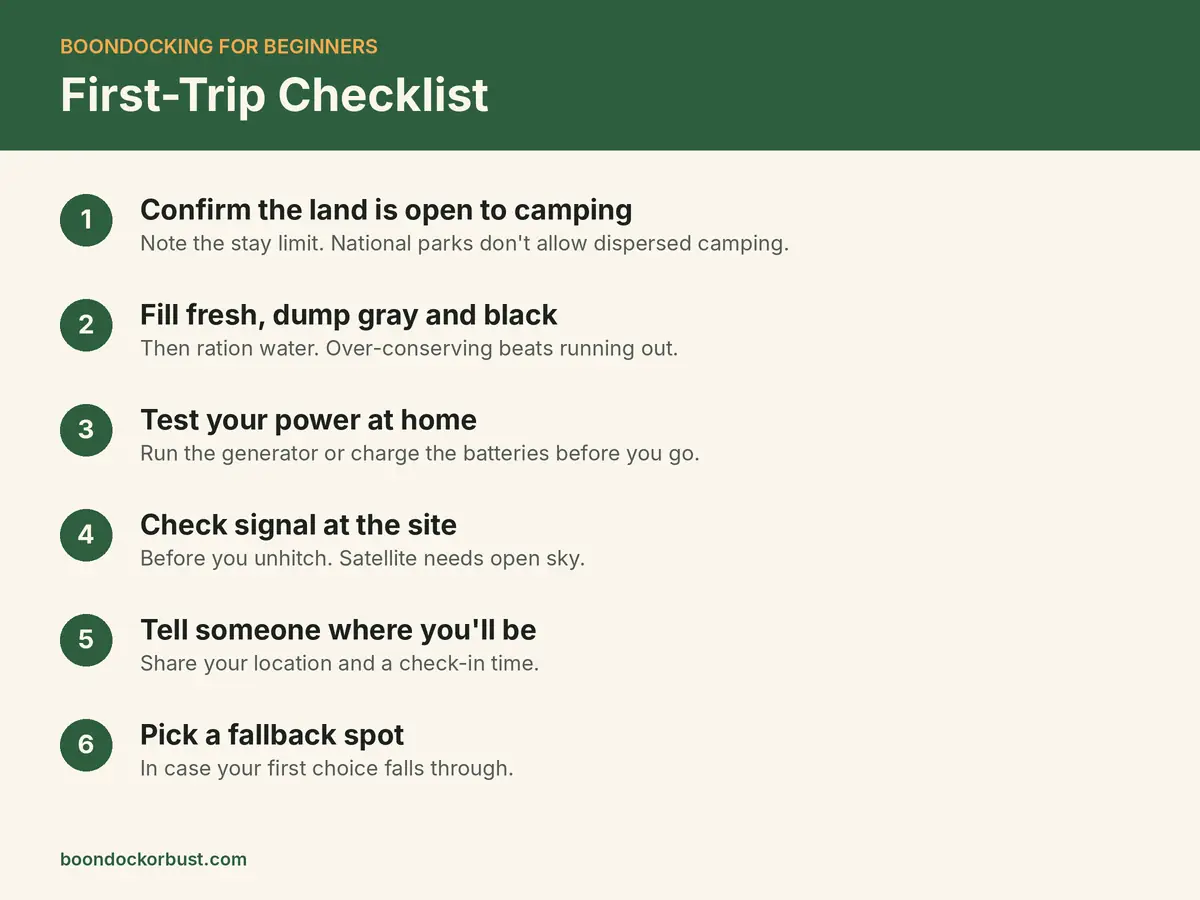
- Confirm the land is open to camping and note its stay limit. Our dispersed camping map guide shows how.
- Skip national parks when you look for dispersed sites. Federal rules allow park camping only where the superintendent designates it. See can you boondock in national parks.
- Fill fresh water. Empty gray and black tanks.
- Test your generator or charge your batteries at home.
- Check signal at the site before you unhitch.
- Tell someone where you will be. Our solo camping safety guide covers check-ins and when to leave a site.
- Pick a fallback spot for the night in case your first choice falls through.
This checklist covers a weekend trip. Longer stays need more planning for water refills, waste and stay limits.
Leave No Trace, waste and fire
Leave No Trace publishes seven principles that it says “give you a simple way to think about your impact and how to reduce it” (Leave No Trace). They are guidance, not agency regulations. Agency fire rules are separate and vary by season, state and forest. The seven principles are:
- Plan Ahead & Prepare
- Travel & Camp on Durable Surfaces
- Dispose of Waste Properly
- Leave What You Find
- Minimize Campfire Impacts
- Respect Wildlife
- Be Considerate of Others
BLM’s guidance for dispersed campers is “Pack It In, Pack It Out” (BLM). For human waste, BLM says, “If possible, use a portable toilet or pack out your waste.” BLM also says to camp in spots that are already disturbed to protect plants and soil.
BLM says fire restrictions can vary throughout the year, so check current regulations before you go (BLM). San Juan National Forest and Apache-Sitgreaves National Forests allow campfires unless fire restrictions are in effect (San Juan NF, Apache-Sitgreaves NFs). In California, the Pacific Southwest Region requires a free campfire permit year-round for campfires, charcoal barbecues, gas stoves and lanterns outside developed recreation areas (USFS Region 5). This is a California rule from the Pacific Southwest Region page, not a national one.
Bear and wildlife safety
The National Park Service (NPS) says to identify yourself to a bear by “talking calmly so the bear knows you are a human” (NPS, updated September 8, 2025). This is NPS bear encounter guidance, so also follow any local rules posted where you camp. NPS lists these steps:
- Do not run. If the bear follows, stop and hold your ground.
- “Do not make any loud noises or screams.”
- If the bear is stationary, move away slowly and sideways.
- Pick up small children immediately.
- “Do NOT allow the bear access to your food.”
Have a backup plan
Pick more than one possible campsite before you set out, in case your first choice is occupied, closed or posted. Check each option against the agency map and its stay limit. Our guide to interstate rest areas covers what to check before you plan a night at one. For other low-cost overnight options and their trade-offs, see the hidden costs of free RV parking.
Before you leave, check the website or call the BLM field office, forest ranger district or park that manages your destination for current stay limits, closures and fire restrictions.
If hunting is part of your public-land trip, use our guide to hunting from an RV basecamp to plan legal access, campsite separation, secure transport and game-meat storage.
Frequently asked questions
What is boondocking?
Boondocking is camping on public land away from developed recreation facilities, which the Bureau of Land Management calls dispersed camping. The USDA Forest Service says dispersed camping means no services, such as piped water, toilets or trash removal. BLM asks you to pack out what you bring and, if possible, to use a portable toilet or pack out your waste.
How long can you camp on BLM land?
Federal regulation 43 CFR 8365.1-2 leaves the limit to the BLM authorized officer and sets no fixed number of days. BLM says dispersed camping is generally limited to 14 days within any 28-day period, then you move, often at least 25 to 30 miles away. As of September 2026, verify with the local BLM office before you go.
How long can you dispersed camp in a national forest?
Limits vary by forest and region. San Juan National Forest in Colorado allows up to 16 days, then a move of at least 5 road miles. Apache-Sitgreaves National Forests in Arizona allow no more than 14 days in a 30-day period, then you must move off the forest for at least 16 days. As of September 2026, verify the limit with the forest’s district office before you go.
Can you boondock in a national park?
Only in designated sites or areas. Federal regulation 36 CFR 2.10 prohibits camping outside them and lets each superintendent designate sites or areas. Death Valley National Park allows roadside vehicle camping on dirt roads at least one mile from the junction with any paved road or day-use-only dirt road. As of September 2026, check the park website before you go.
How far from water should you camp?
It depends on the land unit. BLM recommends at least 200 feet from lakes, rivers and streams. San Juan and Apache-Sitgreaves National Forests ask for at least 100 feet, and the Forest Service Pacific Southwest Region in California asks for at least 150 feet. Death Valley National Park requires more than 100 yards. No single federal rule turned up in the sources checked for this guide. As of September 2026, verify the rule where you camp.
How do I find legal boondocking spots?
Start with agency maps, such as BLM’s interactive and PDF maps and the free Forest Service Motor Vehicle Use Map for your forest. Then cross-check apps such as The Dyrt, Campendium, iOverlander or AllStays. An app listing is not an agency rule. Confirm each spot against the agency map and posted signs before you stay.
What should I do if I see a bear?
The National Park Service says to identify yourself by talking calmly so the bear knows you are a human. Do not run, and if the bear follows, stop and hold your ground. Do not make any loud noises or screams. Pick up small children immediately, and if the bear is stationary, move away slowly and sideways. Do not allow the bear access to your food.


