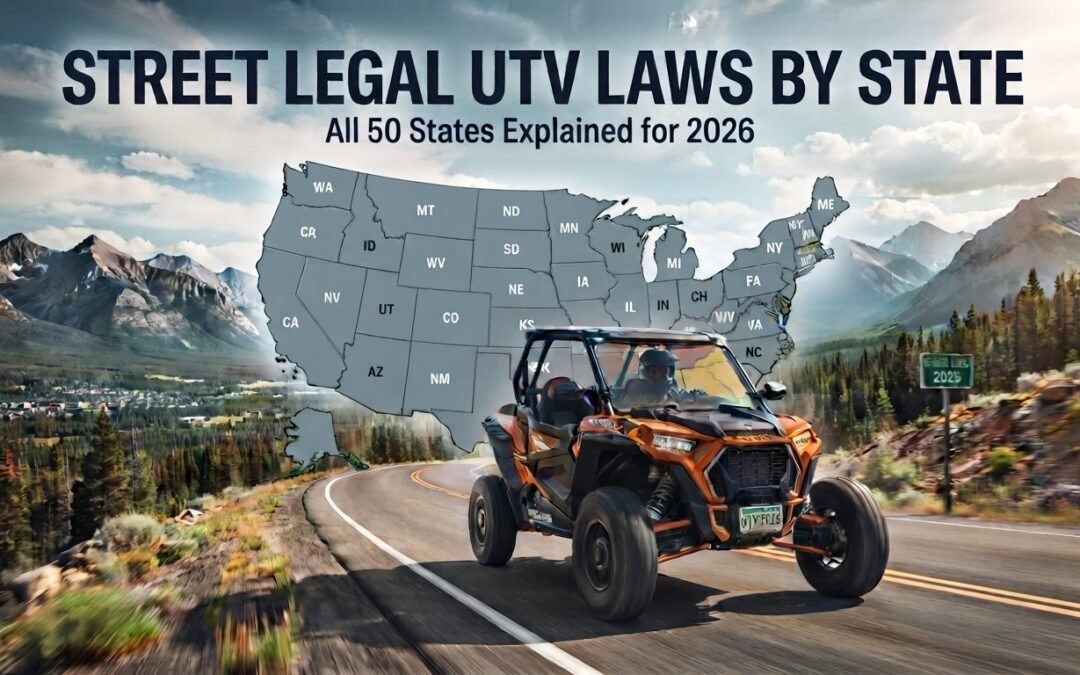
Street legal UTV laws at a glance
Tap a group to jump to its table. South Carolina moves to limited road use when its new law takes effect November 18, 2026.
Quick Reference
- Must know: Six of 50 states offer a statewide street-legal registration path for side-by-sides, as of September 30, 2026. Thirteen allow limited road use. The other 31 allow no statewide road access without local approval.
- Main limits: Local governments can prohibit road use in West Virginia, Alaska, Nevada, and Tennessee. Georgia limits registered machines to county roads. Tennessee caps speed at 35 mph. South Carolina road use stays illegal until November 18, 2026.
- Best for: Riders in Arizona, Montana, South Dakota, Utah, West Virginia, or Wyoming who want a plate. Riders in the 13 limited-use states who stay on the road types listed in the Group 2 table.
- Confirm before you go: Read your state’s agency page, then your county or city ordinance. Statutes listed here were checked on September 30, 2026.
Land access, road rules and registration requirements change. Verify all information with your state motor vehicle agency and local government before you register or ride. This guide summarizes statutes and agency pages. It is not legal advice.
Six of 50 states let you register a side-by-side (also called a utility terrain vehicle, or UTV) for road use statewide. Thirteen more allow limited road use. The other 31 allow no statewide road access without local approval. Each was checked against statutes and agency pages on September 30, 2026. The state-by-state tables link the statute or agency page behind every state.
If you carry a side-by-side to reach dispersed sites, these rules apply on the roads between camp and trailhead. Start with our boondocking guide for finding sites, then read our guide to off-road RV boondocking. If you camp on BLM land, read our guide to BLM camping rules for stay limits before you unload.
State-by-State Road Access for Side-by-Sides (September 2026)
Group 2 limits come from road class, posted speed, county population, or distance. The grouping test is one question. Without a local opt-in, does state law let a qualifying side-by-side use some class of public road for general travel? Farm, work, hunting, emergency, and crossing exceptions do not count. Laws not yet in effect appear as dated notes and are not counted.
Group 1: Statewide registration path (6 states)
| State | Road path | Key limits | Fits if | Source |
|---|---|---|---|---|
| Arizona | Street-legal registration through the Motor Vehicle Division. A $25 yearly off-highway decal applies separately. | Title-only registration allows off-highway use only. Highways include pavement and graveled maintained roads. | You want a plate for maintained roads | Arizona Game and Fish, Arizona MVD. Checked Sept. 30, 2026. Verify with state and local officials before you ride. |
| Montana | On-highway registration under MCA 61-3-301. | Controlled-access highways need on-highway registration and a driver’s license. | You want on-highway registration and will hold a license | Montana FWP, MCA 23-2-824. Checked Sept. 30, 2026. Verify with state and local officials before you ride. |
| South Dakota | License as a motorcycle under SDCL 32-20-13. | Four or more wheels and 200 cc or more, or battery-electric. Motorcycle lights and brakes required. No interstates. | Your machine meets the engine or electric test | SDCL 32-20-13. Checked Sept. 30, 2026. Verify with state and local officials before you ride. |
| Utah | Street-legal ATV registration under Utah Code 41-6a-1509, current version effective July 1, 2026. | No interstates, and no first-class-county highways next to grade-separated segments posted over 50 mph. Top speed is the posted limit or 50 mph, whichever is lower. Motor vehicle insurance applies. | You want a registration path with a fixed equipment list | Utah Code 41-6a-1509. Checked Sept. 30, 2026. Verify with state and local officials before you ride. |
| West Virginia | Street-legal special purpose vehicle registration under W.Va. Code 17A-13-1. | Motorcycle-size plate. Title required. Counties, cities, and the Division of Natural Resources may prohibit. | Your county or city has not opted out | W.Va. Code 17A-13-1. Checked Sept. 30, 2026. Verify with state and local officials before you ride. |
| Wyoming | Register with the county treasurer under W.S. 31-2-232. | Fee matches the motorcycle rate. Confirm road and equipment rules with the Wyoming Department of Transportation. | You register in person at the county | WY HB 18 (2022). Checked Sept. 30, 2026. Verify with state and local officials before you ride. |
Group 2: Limited road use (13 states)
| State | Road path | Key limits | Fits if | Source |
|---|---|---|---|---|
| Alaska | Title and register an all-purpose vehicle (APV), which includes UTVs, with the Alaska Division of Motor Vehicles. Road use allowed since January 1, 2022. | Roads posted 45 mph or less. Class D license and liability insurance. Lights, reflectors, brakes, and muffler. Passengers wear helmets. Local law can prohibit. Anchorage, Fairbanks, Homer, Juneau, Kenai, Palmer, Soldotna, and Wasilla prohibit, as listed by Alaska DMV. Check your city. | You ride roads posted 45 mph or less outside prohibiting cities | Alaska DMV, 13 AAC 02.325. Checked Sept. 30, 2026. Verify with state and local officials before you ride. |
| Georgia | Voluntary registration as a multipurpose off-highway vehicle since December 1, 2023. | County road system roads, or as O.C.G.A. 40-6-362 otherwise allows. Driver’s license and liability insurance. Capable of 25 to 65 mph, 80 inches wide or less, under 4,000 pounds gross weight, four or more wheels, built after January 1, 2000. | Your rides stay on county roads | Georgia DOR, Ga. Comp. R. & Regs. 560-10-23. Checked Sept. 30, 2026. Verify with state and local officials before you ride. |
| Idaho | Restricted vehicle plate from the Idaho Transportation Department (ITD) plus a certificate of number from Idaho Parks and Recreation (IDPR). | Roads that are not state or interstate highways. State highways inside city limits and one mile out where posted 60 mph or less. Up to 5 continuous miles of rural state highway posted 65 mph or less to reach trails or services. Top speed is the posted limit or 45 mph, whichever is less. | You ride local roads and short connectors | Idaho Code 49-426. Checked Sept. 30, 2026. Verify with state and local officials before you ride. |
| Iowa | Iowa Department of Natural Resources (DNR) registration as an ATV or off-road utility vehicle. Iowa issues no road plate. | Unpaved secondary roads statewide. Paved secondary roads need county approval, and city streets need city designation. Short direct trips on undivided two-lane primary highways. 35 mph or less. Valid driver’s license. Operator 18 or older, with financial liability coverage and proof carried. | You ride unpaved county roads | Iowa Code 321I.10, 321.234A. Checked Sept. 30, 2026. Verify with state and local officials before you ride. |
| Kansas | No road plate. Kansas does not register ATVs or work-site utility vehicles. You get a $10 nonhighway title. | State law bans ATVs and work-site utility vehicles on interstate, federal, and state highways, except crossings and farm use on highways posted 65 mph or less. City streets are closed unless the city allows them. County and township roads are not on the banned list. Motorcycle-style lights are required after sunset. State insurance law does not apply to nonhighway-titled vehicles. | You ride rural county or township roads in daylight | K.S.A. 8-15,100, 8-15,109, 8-198, Leavenworth County Sheriff. Ask your county sheriff about local limits. Checked Sept. 30, 2026. Verify with state and local officials before you ride. |
| Minnesota | Minnesota DNR ATV registration, not a road plate. | Right shoulder or extreme right side of county and county state-aid highways. Applies only to side-by-sides 65 inches wide or less and 2,000 pounds or less dry weight. Class 1 machines need a steering wheel, seat belts, and rollover protection. No interstates or freeways. | Your machine fits Minnesota’s ATV size limits | Minn. Stat. 84.928, 84.92. Checked Sept. 30, 2026. Verify with state and local officials before you ride. |
| Missouri | No state road plate. Cities and counties may issue a $15 special permit. | Only within 3 miles of your own primary residence and outside towns that have not allowed it. The allowance does not help riders visiting Missouri. License, headlamp, tail lamp, roll bar or cage, and a seat belt worn. | You ride near home | RSMo 304.033. Checked Sept. 30, 2026. Verify with state and local officials before you ride. |
| Nevada | Register a large all-terrain vehicle (ATV) with seating for two abreast under NRS 490.0825 with insurance. | General or minor county roads only. Cities and counties may prohibit. Main county roads and small-city streets need local authorization. | You ride on designated county roads | NRS 490, Nevada OHV Program. Checked Sept. 30, 2026. Verify with state and local officials before you ride. |
| North Carolina | Register as a modified utility vehicle (MUV) with the Division of Motor Vehicles. | Roads posted 55 mph or less. Machine must be 110 by 58 by 60 inches or larger, capable of 40 mph, and built or upfitted by a licensed manufacturer, dealer or modifier. See the full section below. | Your machine meets the MUV definition | N.C. Gen. Stat. 20-4.01, N.C. Gen. Stat. 20-121.1. Checked Sept. 30, 2026. Verify with state and local officials before you ride. |
| North Dakota | Off-highway vehicle (OHV) registration with the North Dakota Department of Transportation, not a motor vehicle plate. | Gravel, dirt, and loose-surface roads, and paved highways posted 55 mph or less. A licensed driver over 16 may run a registered class III OHV on paved highways posted 65 mph or less. Paved use requires 30 mph capability. No controlled-access highways. | You ride rural gravel roads | N.D.C.C. ch. 39-29. Checked Sept. 30, 2026. Verify with state and local officials before you ride. |
| Oklahoma | Registration, plate, and yearly decal from Service Oklahoma for a machine that meets the street-legal utility vehicle spec. Current spec and road rules in effect since November 1, 2025. | Streets and highways, including U.S. highways, in counties under 75,000 population. In larger counties, only U.S. highway stretches posted 50 mph or less, and check city rules. Never interstates. Operator 16 or older with a valid Oklahoma driver license. | You live in a county under 75,000 people | 47 O.S. 1115.3, 1-171.1, 11-1116. Checked Sept. 30, 2026. Verify with state and local officials before you ride. |
| Tennessee | Title, register, and insure. Public Chapter 255 took effect April 24, 2025. The off-highway plate fee is $15 for Class I and $16 for Class II. | Any county road, plus state highways posted 45 mph or less. No interstates or controlled-access highways. Top speed 35 mph. Daylight only, including 30 minutes before dawn and after dusk. Operator 16 or older with a full license, not a permit. Helmets required, except in Class I and II off-highway vehicles on county roads. Counties, cities, and the Tennessee Department of Transportation can close roads for safety. A 2026 law exempts farm use from the road limits. | You ride county roads in daylight | Tenn. Code Ann. 55-8-185, Public Chapter 255 (2025), Public Chapter 663 (2026). Checked Sept. 30, 2026. Verify with state and local officials before you ride. |
| Washington | On-road registration of a wheeled all-terrain vehicle (WATV) with the Department of Licensing (DOL). | Roads posted 35 mph or less. Most Washington residents live where a local ordinance must approve roads first. Counties of 15,000 or more people and every city and town approve roads by ordinance. Smaller counties are open unless closed by ordinance. Check your county or city website. Dealer safety inspection and driver license. | Your county or city lists approved roads | RCW 46.09.455, Washington DOL. Checked Sept. 30, 2026. Verify with state and local officials before you ride. |
Some of these states issue a plate or permit that works only on roads a local government has opened (Kentucky, New Mexico, Ohio, Texas). South Carolina is scheduled to move to Group 2 when its new law takes effect on November 18, 2026.
Group 3: No statewide road access without local approval (31 states)
| State | What state law says | Fits if | Source |
|---|---|---|---|
| Alabama | No statewide road registration path. Alabama Law Enforcement Agency (ALEA) registration covers off-road public areas and private use, not roads. SB 303 (2026) failed in the House on April 7, 2026, on a 43 to 44 vote, as reported by the Alabama Reflector. | You trailer to designated off-road areas | ALEA, Ala. Code 32-12A-1. Checked Sept. 30, 2026. Verify with state and local officials before you ride. |
| Arkansas | Act 922 of 2025, approved April 21, 2025, lets a city ordinance or county judge order open a street to UTVs. On a designated street the UTV must be registered, insured, and equipped. Never on roads over 55 mph, divided four-lane highways, or state park roads. | Your city or county has designated streets | Act 922 of 2025. Checked Sept. 30, 2026. Verify with state and local officials before you ride. |
| California | An off-highway vehicle with an OHV plate or sticker may use a highway only to cross it, on an unplowed road closed to registered vehicles, or while towed (Vehicle Code 38025). Local, federal, or state park authorities may designate combined-use road segments of up to 3 miles to link trails and services (38026). Needles and Red Rock Canyon State Park may run 10-mile pilot routes. | You trailer to the trailhead or ride posted combined-use segments | Cal. Veh. Code 38025, 38026. Checked Sept. 30, 2026. Verify with state and local officials before you ride. |
| Colorado | Off-highway vehicles may not use public roads except crossings, designated routes that are not state highways, and farm, emergency, event, and utility use. An out-of-state plate does not create an exemption. A violation carries a $50 fine. | You ride designated routes only | HB21-1138, C.R.S. 33-14.5-108. Checked Sept. 30, 2026. Verify with state and local officials before you ride. |
| Connecticut | ATVs may not run on public highways. A licensed operator may cross at about 90 degrees after a stop, never on limited-access highways. | You trailer to the trailhead | Conn. Gen. Stat. ch. 255. Checked Sept. 30, 2026. Verify with state and local officials before you ride. |
| Delaware | OHVs may not use public highways, streets, sidewalks, or rights-of-way except when pushed across with the drivetrain disengaged, or at permitted events. No powered-crossing exception was found in 6814. | You trailer to the trailhead | 21 Del. C. 6814. Checked Sept. 30, 2026. Verify with state and local officials before you ride. |
| Florida | No statewide street-legal path. SB 356 (2026) died in committee on March 13, 2026. | You trailer to the trailhead | Florida Senate. Checked Sept. 30, 2026. Verify with state and local officials before you ride. |
| Hawaii | Street use only as farm equipment between agriculture-zoned properties or by on-duty government workers, on two-lane streets posted 35 mph or less, in daylight. Hawaii lawmakers considered changes in 2026 (SB 2172). Its final status was not confirmed, so check the Hawaii Legislature before relying on this row. | You use the machine for farm work | HRS 286-12. Checked Sept. 30, 2026. Verify with state and local officials before you ride. |
| Illinois | Non-highway vehicles, including recreational off-highway vehicles, are barred from streets and highways unless a local government or the Illinois Department of Transportation (IDOT) authorizes roads it controls. Authorized use is limited to streets posted 35 mph or less. License and insurance required. | Your town or county has passed an ordinance | 625 ILCS 5/11-1426.1. Checked Sept. 30, 2026. Verify with state and local officials before you ride. |
| Indiana | Off-road vehicles are barred from public highways except listed cases, including county-designated highways outside city or town limits. The Bureau of Motor Vehicles (BMV) will not issue a plate regardless of modifications. | Your county has designated roads | Indiana BMV, Indiana DNR, IC 14-16-1-20. Checked Sept. 30, 2026. Verify with state and local officials before you ride. |
| Kentucky | Kentucky issues a motorcycle plate for street-legal special purpose vehicles. You may ride only where your city or county has passed an ordinance allowing them. A certified inspector designated by the sheriff inspects the vehicle. Motorcycle-level liability insurance is required. No more than 20 miles on a highway with centerline markings. No interstates, parkways, or other controlled-access highways. Current text effective July 15, 2026. | Your city or county has passed an ordinance | KRS 186.077, 186.050, 186A.115. Checked Sept. 30, 2026. Verify with state and local officials before you ride. |
| Louisiana | UTVs may use only parish roads or municipal streets that the parish or municipality designates, and may cross roads posted over 35 mph at intersections. Operator 21 or older, license, and liability insurance. | Your parish or town has designated roads | La. R.S. 32:299.3. Checked Sept. 30, 2026. Verify with state and local officials before you ride. |
| Maine | ATVs may not use maintained public ways except crossings up to 500 yards and locally designated ATV-access routes. The Secretary of State farm permit covers farm use only. LD 557 (2025) was not enacted. | Your town has designated an access route | 12 MRSA 13157-A, 29-A MRSA 501. Checked Sept. 30, 2026. Verify with state and local officials before you ride. |
| Maryland | No statewide road path. Maryland law counts steering-wheel, bench-seat side-by-sides as all-terrain vehicles. Allegany and Garrett Counties may allow riding on up to 5 miles of county highway at 25 mph or less, plus crossings and routes to trails and fields. A driver’s license is required on any allowed road. The machine must be titled and registered with the Motor Vehicle Administration. | You ride in Allegany or Garrett County on approved routes | Md. Code, Transp. 11-103.3, 25-102, 16-101. Checked Sept. 30, 2026. Verify with state and local officials before you ride. |
| Massachusetts | Recreation vehicles, including recreation utility vehicles, are barred from state, county, city, and town ways except marked crossings, travel beside the road to reach a riding area, and designated segments up to 4 miles. | You ride posted designated segments | M.G.L. c. 90B, 25. Checked Sept. 30, 2026. Verify with state and local officials before you ride. |
| Michigan | Off-road vehicles (ORVs) may use county roads only where a county, township, or municipality has adopted an ordinance. Then ride on the far right at 25 mph or less. | Your county or township has an ordinance | MCL 324.81131. Checked Sept. 30, 2026. Verify with state and local officials before you ride. |
| Mississippi | No statewide road use. State law says its off-road vehicle chapter does not authorize ATVs or side-by-sides on a public road or highway. Cities may allow golf carts and low-speed vehicles only. Bills to open roads died in 2025 and 2026. | You trailer to private land or riding areas | Miss. Code Ann. 63-31-3(6), 63-32-3. Checked Sept. 30, 2026. Verify with state and local officials before you ride. |
| Nebraska | Outside town limits, UTVs may use highways only when the trip is incidental to farm use. Inside a city or village, use needs a local ordinance, or a county resolution for an unincorporated village. Modified UTVs cannot be registered as motor vehicles. Statute as amended through July 18, 2026. | You farm, or your town has an ordinance | Neb. Rev. Stat. 60-6,356, 60-6,355. Checked Sept. 30, 2026. Verify with state and local officials before you ride. |
| New Hampshire | Off-highway recreational vehicles (OHRVs) are barred from public ways except as the chapter allows. Towns may open sidewalks and class IV, V, and VI highways after a public hearing. No interstate, toll, or limited-access class I highways. | Your town has opened local roads | RSA 215-A:6. Checked Sept. 30, 2026. Verify with state and local officials before you ride. |
| New Jersey | ATVs are barred from limited-access highways and from public streets and their rights-of-way, except crossings after a full stop and parallel travel when reaching a riding area is otherwise impracticable. Whether a given side-by-side meets New Jersey’s ATV definition was not checked. | You trailer to the trailhead | NJ Attorney General guidance, N.J.S.A. 39:3C-17. Checked Sept. 30, 2026. Verify with state and local officials before you ride. |
| New Mexico | OHVs may not use limited-access highways or paved streets except crossings, or where a local authority or the state transportation commission authorizes paved-road use. There, a titled and registered machine with the Motor Vehicle Division (MVD) paved-road-use plate may use those roads. New Mexico law addresses paved roads, so ask your county about unpaved roads. | Your city or county has authorized paved roads | New Mexico MVD, NMSA 66-3-1011. Checked Sept. 30, 2026. Verify with state and local officials before you ride. |
| New York | ATVs may cross highways directly and may use highways designated and posted as open by the agency in charge. Confirm your machine meets New York’s ATV definition. | You ride posted connector routes | N.Y. VTL 2403, 2405. Checked Sept. 30, 2026. Verify with state and local officials before you ride. |
| Ohio | Utility vehicles may use streets posted 35 mph or less only where a local authority grants permission, after local inspection, registration, and title. All-purpose vehicles, which include most recreational side-by-sides, may use county or township roads only where the local authority permits. Statute as amended June 30, 2025. | Your local authority has granted permission | R.C. 4511.214, 4511.215, 4519.41. Checked Sept. 30, 2026. Verify with state and local officials before you ride. |
| Oregon | Riding an off-road vehicle on a highway is a Class B violation except crossings, highways posted open, designated routes, and farm transport. Oregon Parks and Recreation Department (OPRD) says side-by-sides cannot be made street legal. | You trailer to the trailhead | ORS 821, OPRD. Checked Sept. 30, 2026. Verify with state and local officials before you ride. |
| Pennsylvania | ATVs are barred from streets and highways not designated and posted as ATV roads, except emergencies, bridge crossings, and direct crossings. | You ride posted ATV roads | 75 Pa.C.S. 7721. Checked Sept. 30, 2026. Verify with state and local officials before you ride. |
| Rhode Island | Recreational vehicles, including all ATV classes, are barred from highway rights-of-way and interstates. Only 90-degree crossings and snow emergencies are allowed. | You trailer to the trailhead | R.I. Gen. Laws 31-3.2-7. Checked Sept. 30, 2026. Verify with state and local officials before you ride. |
| South Carolina | South Carolina’s new UTV road law takes effect November 18, 2026. Until then, the South Carolina Department of Public Safety (SCDPS) says operating a UTV on the road is illegal. From that date, a titled, registered, insured, and plated UTV may use secondary highways posted 55 mph or less within 10 miles of its registration address. | You can wait until November 18, 2026 | SCDPS, S. 222 (Act 164 of 2026). Checked Sept. 30, 2026. Verify with state and local officials before you ride. |
| Texas | The Department of Motor Vehicles may not register an off-highway vehicle for highway use. An off-highway plate exists for limited local exceptions. | You ride within a permitting city or a master planned community | Tex. Transp. Code ch. 551A. Checked Sept. 30, 2026. Verify with state and local officials before you ride. |
| Vermont | ATVs may not use a public highway unless the town has opened it to ATV travel. Crossings and farm, forestry, and utility use are the other exceptions. Side-by-sides wider than 72 inches, or 2,500 pounds or more dry weight, may fall outside Vermont’s ATV definition. | Your town has opened roads to ATVs | 23 V.S.A. 3506, 3501. Checked Sept. 30, 2026. Verify with state and local officials before you ride. |
| Virginia | Section 46.2-915.1 bars ATVs from public highways except as authorized, crossing, and emergency use. Whether a side-by-side counts as an ATV depends on its design. | You trailer or ride where authorities allow | Va. Code 46.2-915.1. Checked Sept. 30, 2026. Verify with state and local officials before you ride. |
| Wisconsin | ATVs and UTVs are barred from roadways except crossings, seasonally unmaintained roads, designated routes, farm use, and certain hunting travel. Towns, villages, cities, and counties designate routes by ordinance. Wisconsin passed ATV/UTV legislation in 2025 that this guide did not review. Check DNR for current route rules. | You ride posted local routes | Wis. Stat. 23.33(4), Wisconsin DNR, WisDOT. Checked Sept. 30, 2026. Verify with state and local officials before you ride. |
How State Law Classifies Your Side-by-Side
The legal class in your state’s statute decides which road rules apply to your machine. A side-by-side can be an ATV in one state, a utility vehicle in another, and outside every road class in a third. The size and weight limits below come from state sources read on September 30, 2026, and apply only in the state named. For example, Minnesota’s county-road rule covers only side-by-sides 65 inches wide or less and 2,000 pounds or less dry weight (Minn. Stat. 84.92).
- North Carolina registers road-legal side-by-sides as modified utility vehicles, not ATVs. The machine must be at least 110 by 58 by 60 inches and capable of 40 mph (N.C. Gen. Stat. 20-4.01).
- Georgia’s multipurpose off-highway vehicle must be 80 inches wide or less, under 4,000 pounds gross weight, and capable of 25 to 65 mph (Georgia DOR).
- Ohio separates utility vehicles, which carry a cargo bed, from all-purpose vehicles, which include most recreational side-by-sides. Check which class your machine falls in (R.C. 4511.214, 4511.215).
- Louisiana’s UTV rule covers machines 50 to 74 inches wide and 700 to 3,500 pounds (La. R.S. 32:299.3).
- Arkansas defines a UTV as 80 inches wide or less with rollover protection (Act 922 of 2025). Alabama’s recreational off-highway vehicle class is 80 inches or less and 3,500 pounds dry weight or less (Ala. Code 32-12A-1).
- Kansas defines a work-site utility vehicle as 48 inches or wider, over 800 pounds, with a steering wheel and side-by-side seating (K.S.A. 8-126).
If your state uses a term not listed here, read its definition section before you buy parts.
Low-Speed Vehicles (LSVs) Are a Separate Category
Federal rules define a low-speed vehicle by three tests. It has four wheels. Its top speed in one mile is more than 20 mph and not more than 25 mph on a paved level surface. Its gross vehicle weight rating is less than 3,000 pounds (49 CFR 571.3). Most side-by-sides can go faster than 25 mph, so they fail the speed test. NHTSA has said a vehicle with “a speed capability above 25 mph” is not an LSV under federal law.
An LSV must also meet FMVSS No. 500. That standard requires headlamps, front and rear turn signals, taillamps, stop lamps, red reflex reflectors, mirrors, a parking brake, a windshield that meets FMVSS No. 205, a VIN, and a seat belt at each designated seat.
Bolting on parts does not make a vehicle an LSV. NHTSA says modifying a golf cart for public roads creates a motor vehicle and treats the modifier as the manufacturer. The modifier must then certify that the vehicle meets every applicable safety standard, and a certified vehicle carries a permanent certification label. States set the road rules. Florida, North Carolina, and Georgia limit LSVs to roads posted 35 mph or less.
A Plate From Another State Does Not Change Your Home State’s Road Rules
The state where you ride decides where a registered side-by-side can go. Colorado law gives out-of-state plates no exemption from its road ban (C.R.S. 33-14.5-108). These rules were read on September 30, 2026. Nevada and Tennessee each tie road use to registration under their own laws.
- North Carolina: the DMV registers a road-use MUV, and G.S. 20-50 requires registration for a vehicle intended for its highways. Ask the DMV before you rely on another state’s plate or an LLC filing.
- Nevada: a large ATV must be registered by the Department of Motor Vehicles under NRS 490.0825 to use designated county roads (NRS 490.105).
- Tennessee: the machine must be titled and registered under chapters 3 and 4 of Title 55 of the Tennessee Code (Tenn. Code Ann. 55-8-185).
- Oregon: out-of-state ATV plates are not valid on Oregon streets, according to the Oregon Parks and Recreation Department (OPRD).
- Missouri: the 3-mile allowance applies only around your own primary residence, so it does not help visitors (RSMo 304.033).
- Arizona: the Game and Fish Department says residents and non-residents who drive on Arizona highways must register as street legal through the Motor Vehicle Division when their home state or province offers no street-legal registration (Arizona Game and Fish). That rule covers Arizona roads, not roads in your home state.
Private filing services are not motor vehicle agencies. Confirm the agency that issues your plate matches the agency named in the table.
How to Register a Side-by-Side for Road Use in Five Steps
Road registration requires a state that offers it and a machine that meets that state’s definition. Start with the tables, because no equipment purchase changes a state with no road path. Texas law bars its Department of Motor Vehicles from registering an off-highway vehicle for highway use (Tex. Transp. Code 551A.052). Oklahoma shows what a registration step looks like. Under 47 O.S. 1115.3(E), a street-legal utility vehicle “shall be required to receive a certificate of registration, license plate and yearly decal before operation on the streets, county roads and state highways” (OSCN). As of September 30, 2026, the steps below apply to the 17 Group 1 and Group 2 states with a registration step. Kansas and Missouri have none.
- Find your state in the tables. If it sits in Group 3, a state registration alone will not open roads. Ask your city or county whether it has opened any.
- Check that your machine qualifies. North Carolina requires 110 by 58 by 60 inches and 40 mph. Georgia requires 25 to 65 mph capability and under 4,000 pounds gross weight. Nevada requires seating for two abreast. Oklahoma requires a 400 cc or larger engine able to hold 50 mph.
- Add the equipment your state lists. Lists differ, so use the equipment table below.
- Buy insurance where required. Alaska, Georgia, Nevada, and Tennessee require liability insurance. Iowa requires financial liability coverage. Utah applies its motor vehicle insurance law.
- Register with the agency in the table. North Carolina asks for the title or the manufacturer’s certificate of origin. Wyoming registers through the county treasurer. Arizona registers through the Motor Vehicle Division. Washington requires a dealer safety inspection first. Idaho needs both an ITD plate and an IDPR certificate of number.
These steps do not cover machines that fail a state’s definition. Verify each step with the named agency before you pay a fee.
Group 3 Details: Local Plates, Failed Bills, and Pilot Routes
Thirty-one of 50 states allow no statewide road access for side-by-sides without a local or agency approval first. Many still allow crossings, locally designated routes, or narrow farm and work exceptions. Illinois shows the default rule. Its statute says “it is unlawful for any person to drive or operate a non-highway vehicle upon any street, highway, or roadway in this State” unless a local government or IDOT has authorized that road (625 ILCS 5/11-1426.1(b)). These rows reflect statute or legislative records checked on September 30, 2026.
- Texas: cities may allow unregistered off-highway vehicles on roads posted 35 mph or less inside city limits. Counties may do the same only in limited cases the statute names. The plate costs up to $10 and does not expire (Tex. Transp. Code 551A.052, 551A.053).
- Texas master planned communities: an unregistered off-highway vehicle may operate in a master planned community with restrictive covenants and an approved plat (551A.055).
- Florida: Senator Tom Wright, the SB 356 sponsor, told WUSF that UTVs are not permitted for street use in Florida (WUSF). A similar bill passed the Senate in 2025 and died in the House. The 2026 bill died on March 13, 2026.
- Mississippi: state law says nothing in its off-road vehicle chapter authorizes operation “on a public road or highway” (Miss. Code Ann. 63-31-3). Five bills to create a road path died in committee in 2025 and 2026 (HB 529, HB 151, and SB 2258 in 2025, and SB 2265 and SB 2628 in 2026). Check with your county and city before riding.
- California: combined-use segments take effect only once signs are posted (Cal. Veh. Code 38026). The Needles pilot ends January 1, 2028 and the Red Rock Canyon pilot ends January 1, 2030 unless extended (38026.2, 38026.3).
- New York: ATVs may cross a highway at about 90 degrees after a complete stop. Posted designated highways are also open (N.Y. VTL 2403 and 2405).
Equipment Lists Differ by State
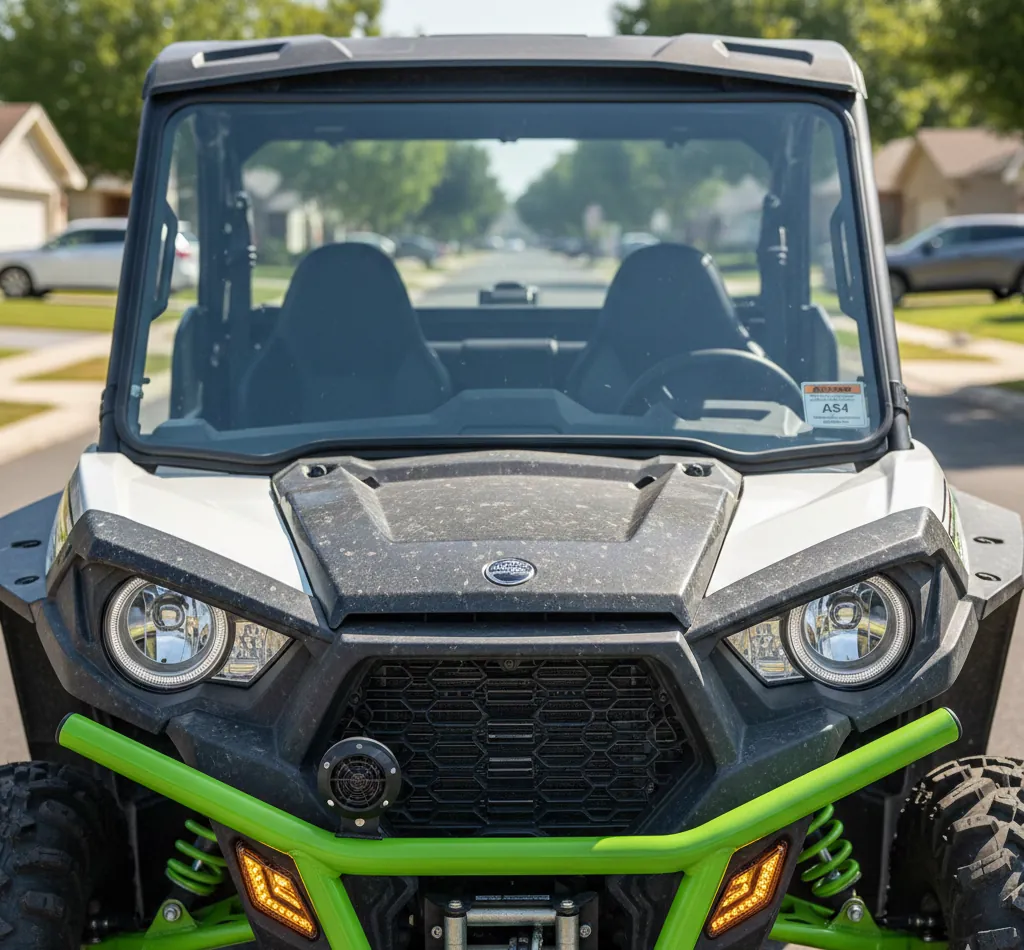
No single side-by-side equipment list applies across states. Utah, North Carolina, and Tennessee each name different items, and five more states add their own lists. The table compares the items named in each state source as of September 30, 2026. Meeting a list does not register your machine or open a road. Check the current text before you buy parts.
| State | Items named in the source | Fits if | Source |
|---|---|---|---|
| Utah (text effective July 1, 2026) | Headlamps, tail lamps, plate lamp, red rear reflectors, stop lamps, turn signals, brakes, horn, muffler, left and right mirrors, windshield or eye protection, speedometer. Side-by-side seating requires seat belts. Tire height 44 inches or less for type II and III vehicles. | You are building a machine for Utah registration | Utah Code 41-6a-1509 |
| North Carolina | Headlamps, tail lamps, stop lamps, turn signal lamps, reflex reflectors, parking brake, rearview mirrors, speedometer, seat belts, vehicle identification number. Without a windshield and wipers, everyone aboard wears a helmet meeting Federal Motor Vehicle Safety Standard 218. | You are registering as a modified utility vehicle | N.C. Gen. Stat. 20-121.1 |
| Tennessee | If the machine has any of these from the maker, or they are added later, they must work and be used: brakes, two taillights, stoplights and headlights, turn signals, horn, roll bar, seat belts, spark arrester, muffler, and windshield. Without a windshield, occupants wear eye protection. Operator and passengers wear helmets, except in Class I and II off-highway vehicles on county roads. | Your machine already carries factory equipment | Tenn. Code Ann. 55-8-185 |
| Alaska | Lights, reflectors, brakes, and muffler. Passengers wear helmets. | You register an APV for roads posted 45 mph or less | Alaska DMV |
| Kentucky | Headlight, taillight, brake light, plate light, red rear reflector, front and rear turn signals, brakes other than a parking brake, horn, muffler, left and right mirrors, windshield or eye protection, a speedometer lit for night riding, roll bar or cage, seat belts at each seat on multi-passenger models, and tires with at least 2/32 inch of tread. | Your city or county allows plated UTVs | KRS 186.077 |
| North Dakota | Mirror, horn, speedometer and odometer, brake light, headlamp, and a motor of 350 cc or more. | You ride paved highways as allowed | N.D.C.C. ch. 39-29 |
| Oklahoma | Bench or side-by-side seating, four wheels, a 400 cc or larger engine able to hold 50 mph, federal-standard seat belts for each occupant, and all equipment under 47 O.S. 12-201 to 12-232. | You register a street-legal utility vehicle | 47 O.S. 1-171.1 |
| Washington | Lights, signals, mirrors, horn, windshield or eye protection, and seat belts for utility-type machines. | You pass the dealer safety inspection | Washington DOL |
Fees, Fines, and Insurance Named in Official Sources
State sources name these fees and fines. Some are road plates and some are off-road registrations, and the table says which is which. Figures reflect pages read on September 30, 2026 and may change. Parts and installation costs vary by machine and retailer, so no total cost appears here. Confirm the current fee with the agency before you pay.
| State | Fee or fine | What it covers | Source |
|---|---|---|---|
| Alabama | $45 plus $2.50 issuance for 3 years (public use). $15 plus $2.50 (private use). | Off-road registration, not a road plate | ALEA |
| Alaska | $10 for 2 years, $20 for 4 years, $30 for 6 years | Off-highway vehicle registration, not the APV road registration | Alaska DMV |
| Arizona | $25 a year | Off-highway vehicle decal | Arizona MVD |
| Colorado | $50 fine | Operating an OHV on a public road | C.R.S. 33-14.5-108 |
| Connecticut | $30 every 3 years | ATV registration, off-road | Conn. Gen. Stat. ch. 255 |
| Delaware | $6 for 3 years | OHV registration, off-road | 21 Del. C. ch. 68 |
| Georgia | $20 a year | Multipurpose off-highway vehicle registration | Georgia DOR |
| Hawaii | $250 fine | Violating the street-use limits | HRS 286-12 |
| Idaho | $12 certificate of number, plus $3.75 per plate | IDPR certificate of number plus the ITD restricted plate. Idaho amended its registration fee statute in 2026, so confirm with ITD. | Idaho Code 67-7122, 49-450 |
| Iowa | $15 a year, plus a writing fee | ATV registration, expires December 31 | Iowa Code 321I.4 |
| Kansas | $10, one time | Nonhighway certificate of title. No road registration. | K.S.A. 8-198 |
| Kentucky | $10 a year, plus a one-time $25 inspection fee paid to the sheriff’s office | Street-legal registration and certified inspection | KRS 186.050, 186A.115 |
| Maine | $4 | Secretary of State farm-use permit | 29-A MRSA 501 |
| Minnesota | $60 for 3 years, plus an issuing fee | DNR ATV registration | Minnesota DNR |
| Missouri | $15 | City or county special permit | RSMo 304.033 |
| Montana | $53.25 one time for street-legal only, or $114.50 for street-legal and off-highway use. Add a $16 safety fee, a $10 Highway Patrol fee, and a $12 plate fee. | Permanent quadricycle registration | Montana MVD |
| Nevada | $20 a year, plus $2 for VIN assignment | Road registration decal for a large ATV. Nevada liability insurance required. The off-highway decal is a separate $20. | Nevada DMV form OHV-001E |
| North Carolina | $46.25 a year | Modified utility vehicle registration, same as a private passenger vehicle | N.C. Gen. Stat. 20-87 |
| North Dakota | $5 for 2 years, plus a $15 OHV trail tax | OHV registration | N.D.C.C. ch. 39-29 |
| South Carolina | $10 every 2 years, from November 18, 2026 | UTV road registration under the new law | S. 222 |
| Tennessee | $15 (Class I) or $16 (Class II) a year, plus county clerk fees | Off-highway vehicle plate | Tenn. Code Ann. 55-4-111 |
| Texas | Up to $10, does not expire | Off-highway plate for local exceptions | Tex. Transp. Code ch. 551A |
| Utah | Up to $72 a year, set by the DMV, plus a uniform fee | Street-legal ATV registration. No local emissions compliance fee as of July 1, 2026. | Utah Code 41-22-8, 41-1a-1223 |
| Washington | $12 on-road, $18 off-road | WATV registration | RCW 46.17.350 |
| West Virginia | $16 a year, or $32 for 2 years | Street-legal special purpose vehicle plate | West Virginia DMV |
| Wisconsin | $30 for 2 years (public use), $15 (private use) | DNR ATV and UTV registration | Wisconsin DNR |
| Wyoming | $25 state fee, plus county fees | County registration at the motorcycle and multipurpose vehicle rate | W.S. 31-3-101 |
Insurance: the sources read for this guide require liability insurance in Alaska, Georgia, Louisiana, Nebraska, Nevada, and Tennessee, and on designated Arkansas roads. Illinois and New Mexico require insurance, and Kentucky requires motorcycle-level liability insurance. Iowa requires financial liability coverage. South Carolina requires insurance from November 18, 2026. Utah applies its motor vehicle insurance law to street-legal ATVs. Insurance rules in other states were not read as of September 30, 2026.
If you trailer your UTV between trailheads, our guide to safe and efficient trailer towing covers hitch and load basics.
North Carolina UTV Street Legal Rules: Modified Utility Vehicle (MUV) Requirements
Some side-by-sides can be street legal in North Carolina. The machine must qualify as a modified utility vehicle (MUV) and be titled, registered and insured through the North Carolina Division of Motor Vehicles (DMV). The DMV must refuse to register a standard ATV or utility vehicle (G.S. 20-54(8)). A registered MUV may run on roads posted 55 mph or less.
Does your side-by-side qualify as an MUV?
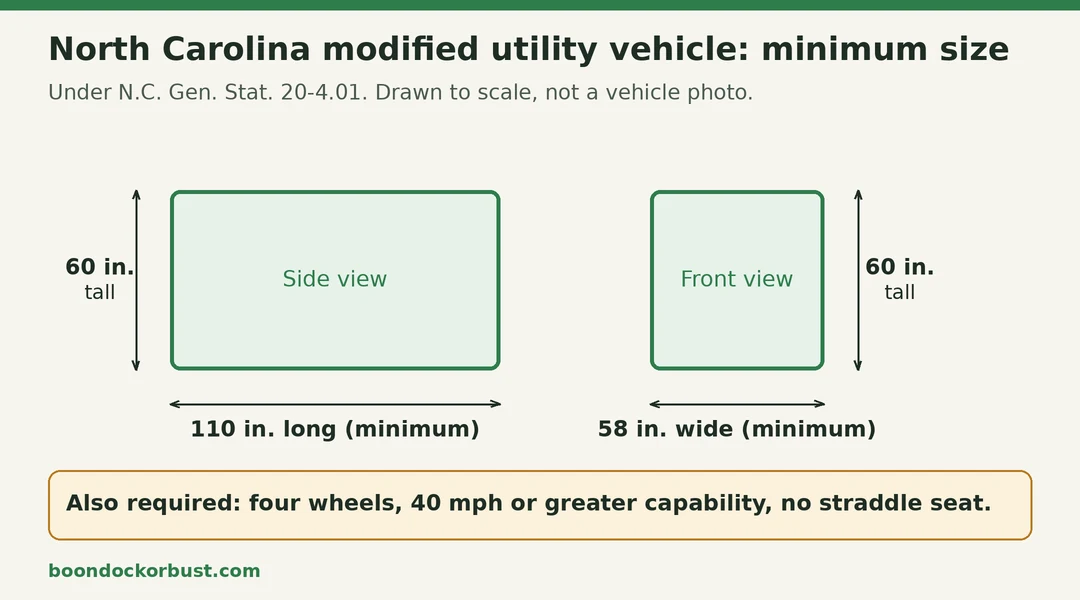
To register as an MUV in North Carolina, your machine must meet all of these criteria under N.C. Gen. Stat. 20-4.01:
- Manufactured or upfitted for off-road use by a licensed manufacturer, dealer, or person or business engaged in vehicle manufacturing or modification, with the equipment required by G.S. 20-121.1(2a)
- Four wheels
- Overall length of 110 inches or greater
- Overall width of 58 inches or greater
- Overall height of 60 inches or greater
- Maximum speed capability of 40 mph or greater
- No requirement for the operator or a passenger to straddle a seat
The statute excludes ATVs, golf carts, utility vehicles and riding lawn mowers from the MUV definition. A side-by-side below the size thresholds or under 40 mph does not meet the definition.
Where you can drive an MUV
A registered MUV may operate on streets and highways posted 55 mph or less, and may cross a higher-speed road at an intersection (N.C. Gen. Stat. 20-121.1). The North Carolina Department of Transportation can prohibit MUV use on a specific road for safety. Check city and county rules before you ride local roads.
An ATV is different. Unless other law permits it, no one may operate an ATV on a public street, road or highway except to cross it, and no one may operate an ATV on an interstate or limited-access highway (G.S. 20-171.19(e) and (f)).
Exceptions that do not make a machine street legal
Any person may operate an ATV or utility vehicle on a public street while engaged in farming operations (G.S. 20-171.22(a1)). County and municipal employees may operate agency-owned ATVs, including utility vehicles, on public highways posted 35 mph or less under the conditions in G.S. 20-171.24. These are narrow uses. They are not general road access for a recreational rider.
Local rules
Session Law 2021-97 lets Banner Elk, Beech Mountain, Cramerton, North Topsail Beach, Seven Devils, Spencer, Conover and Lowell regulate utility vehicles on their streets by ordinance, including registration and equipment (S.L. 2021-97). This guide did not check for later local acts. Ask your town or county before you ride.
Required equipment
State law requires an MUV to carry the following, all in working order: headlamps and tail lamps, stop lamps, turn signal lamps, reflex reflectors, parking brakes, rearview mirrors, a speedometer, seat belts, and a vehicle identification number. The Division of Motor Vehicles assigns a VIN if your machine has none. If the MUV has no windshield and windshield wipers, the operator and every passenger must wear a helmet that meets Federal Motor Vehicle Safety Standard 218.
Registration and insurance
Title, register, and insure the vehicle through the North Carolina Division of Motor Vehicles (G.S. 20-121.1(3)). For an MUV, the DMV lists the manufacturer’s certificate of origin or a properly assigned title, the title application (MVR-1), and the Modified Utility Vehicle Affidavit (MVR-59). The MVR-59 must be signed by the licensed manufacturer, dealer, or person or business engaged in off-road vehicle manufacturing or modification, and the form has a notary block. See the DMV’s documents and forms page.
Since October 1, 2024, an owner of an ATV, MUV or utility vehicle may apply for a title (G.S. 20-53.6). A title alone does not make an ATV or utility vehicle street legal, because the DMV must refuse to register them. North Carolina requires a vehicle intended for its highways to be registered with the DMV (G.S. 20-50). Do not assume that a plate from another state, or an out-of-state LLC, covers North Carolina roads. Ask the DMV in writing before you ride.
The MUV definition was rewritten effective October 1, 2021 (S.L. 2021-33). The 55 mph road limit and the titling rule took effect October 1, 2024 (S.L. 2024-46).
Frequently Asked Questions
Are UTVs street legal?
It depends on the state. Of 50 states checked on September 30, 2026, six offer statewide street-legal registration, 13 allow limited road use, and 31 allow no statewide road access without local approval. The state where you ride sets the rules. Confirm with your state motor vehicle agency and local government before you ride.
What states are UTVs street legal?
Arizona, Montana, South Dakota, Utah, West Virginia, and Wyoming offer statewide registration paths as of September 30, 2026. Alaska, Georgia, Idaho, Iowa, Kansas, Minnesota, Missouri, Nevada, North Carolina, North Dakota, Oklahoma, Tennessee, and Washington allow limited road use. Local governments can prohibit use in several of them, so check your city or county.
Can you drive a side-by-side on the road in Florida or Texas?
Florida has no statewide street-legal path, and SB 356 died on March 13, 2026. Texas does not register off-highway vehicles for highway use. Texas cities may allow unregistered machines on roads posted 35 mph or less. Verify with your city before you ride.
Are side-by-sides street legal in North Carolina?
Yes, if you register it as a modified utility vehicle with the North Carolina DMV. It must be at least 110 inches long, 58 inches wide, and 60 inches tall, reach 40 mph, and have no straddle seat. A registered MUV can use roads posted 55 mph or less. Confirm with the DMV and your local government before you ride.
When can you drive a UTV on the road in South Carolina?
South Carolina’s new UTV road law takes effect November 18, 2026. Until then, the South Carolina Department of Public Safety says operating a UTV on the road is illegal. From that date, a titled, registered, insured, and plated UTV may use secondary highways posted 55 mph or less within 10 miles of its registration address. Verify before you ride.
Does registering in another state make my UTV street legal?
No. The state where you ride decides where you can drive. North Carolina requires registration in North Carolina for road use, and a Montana LLC does not change that. Colorado law gives out-of-state plates no exemption from its road ban, and Oregon says out-of-state ATV plates are not valid on Oregon streets.
What do I need to make a UTV street legal?
You need a state with a road registration path, a machine that meets that state’s definition, the equipment on that state’s list, insurance where required, and registration with the named agency. As of September 30, 2026, 17 states have a road registration step. Equipment lists differ by state, so use your state’s own list.
Does my auto insurance cover a street-legal UTV?
Alaska, Georgia, Nevada, and Tennessee require liability insurance on road-registered machines, per sources read September 30, 2026. Ask your insurer in writing whether your policy covers a registered side-by-side used on public roads. Coverage terms differ by insurer and state, so get the answer before you ride.
Sources and References
All sources accessed September 30, 2026.
Show all 137 sources
- Alabama Law Enforcement Agency. (n.d.). ATV/UTV registration. https://www.alea.gov/dps/driver-license/atvutv-registration
- Alabama Reflector. (2026, April 8). Speed camera, off-road vehicle bills divide Alabama House GOP. https://alabamareflector.com/2026/04/08/speed-camera-off-road-vehicle-bills-divide-alabama-house-gop/
- Alaska Division of Motor Vehicles. (n.d.). Off-highway and all-purpose vehicles. https://dmv.alaska.gov/vehicle-services/off-highway-all-purpose-vehicles/
- Arizona Department of Transportation, Motor Vehicle Division. (n.d.). Off-highway vehicles (OHV) and boating registration. https://azdot.gov/mvd/services/vehicle-services/vehicle-registration/ohv-and-boating-registration
- Arizona Game and Fish Department. (n.d.). OHV decals. https://www.azgfd.com/off-highway-vehicle/ohv-register-and-renew-your-license/ohv-decals/
- Arkansas General Assembly. (2025). Act 922 of 2025 (HB 1606). https://arkleg.state.ar.us/Home/FTPDocument?path=%2FACTS%2F2025R%2FPublic%2FACT922.pdf
- California Legislative Information. (n.d.). Vehicle Code 38025: Operation of identified vehicles on highways. https://leginfo.legislature.ca.gov/faces/codes_displaySection.xhtml?lawCode=VEH§ionNum=38025
- California Legislative Information. (n.d.). Vehicle Code 38026.2: City of Needles pilot project. https://leginfo.legislature.ca.gov/faces/codes_displaySection.xhtml?lawCode=VEH§ionNum=38026.2
- California Legislative Information. (n.d.). Vehicle Code 38026.3: Red Rock Canyon State Park pilot project. https://leginfo.legislature.ca.gov/faces/codes_displaySection.xhtml?lawCode=VEH§ionNum=38026.3
- California Legislative Information. (n.d.). Vehicle Code 38026: Combined-use highway designation. https://leginfo.legislature.ca.gov/faces/codes_displaySection.xhtml?lawCode=VEH§ionNum=38026
- Colorado General Assembly. (2021). House Bill 21-1138. https://www.leg.colorado.gov/bills/hb21-1138
- Connecticut General Assembly. (n.d.). General Statutes chapter 255. https://www.cga.ct.gov/current/pub/chap_255.htm
- Delaware General Assembly. (n.d.). Delaware Code title 21, chapter 68. https://delcode.delaware.gov/title21/c068/index.html
- Electronic Code of Federal Regulations. (n.d.). 49 CFR 567.4: Requirements for manufacturers of motor vehicles. https://www.ecfr.gov/current/title-49/subtitle-B/chapter-V/part-567/section-567.4
- Electronic Code of Federal Regulations. (n.d.). 49 CFR 571.205: Standard No. 205, Glazing materials. https://www.ecfr.gov/current/title-49/subtitle-B/chapter-V/part-571/subpart-B/section-571.205
- Electronic Code of Federal Regulations. (n.d.). 49 CFR 571.3: Definitions. https://www.ecfr.gov/current/title-49/subtitle-B/chapter-V/part-571/subpart-A/section-571.3
- Electronic Code of Federal Regulations. (n.d.). 49 CFR 571.500: Standard No. 500, Low-speed vehicles. https://www.ecfr.gov/current/title-49/subtitle-B/chapter-V/part-571/subpart-B/section-571.500
- FindLaw. (n.d.). Code of Alabama 32-12A-1: Definitions. https://codes.findlaw.com/al/title-32-motor-vehicles-and-traffic/al-code-sect-32-12a-1/
- Florida Legislature. (n.d.). Florida Statutes 316.2122. https://www.leg.state.fl.us/statutes/index.cfm?App_mode=Display_Statute&URL=0300-0399/0316/Sections/0316.2122.html
- Florida Senate. (2026). SB 356: Utility terrain vehicles. https://flsenate.gov/Session/Bill/2026/356/ByVersion
- Georgia Department of Revenue. (n.d.). Registering a multipurpose off-highway vehicle. https://dor.georgia.gov/registering-multipurpose-highway-vehicle
- Georgia Secretary of State. (n.d.). Rules and Regulations of the State of Georgia, chapter 560-10-23. https://rules.sos.ga.gov/gac/560-10-23
- Hawaii State Legislature. (n.d.). Hawaii Revised Statutes 286-12. https://data.capitol.hawaii.gov/hrscurrent/Vol05_Ch0261-0319/HRS0286/HRS_0286-0012.htm
- Idaho Legislature. (n.d.). Idaho Code 49-402. https://legislature.idaho.gov/statutesrules/idstat/title49/t49ch4/sect49-402/
- Idaho Legislature. (n.d.). Idaho Code 49-426. https://legislature.idaho.gov/statutesrules/idstat/title49/t49ch4/sect49-426/
- Idaho Legislature. (n.d.). Idaho Code 49-450. https://legislature.idaho.gov/statutesrules/idstat/title49/t49ch4/sect49-450/
- Idaho Legislature. (n.d.). Idaho Code 67-7122. https://legislature.idaho.gov/statutesrules/idstat/title67/t67ch71/sect67-7122/
- Illinois General Assembly. (n.d.). 625 ILCS 5/11-1426.1. https://www.ilga.gov/Documents/legislation/ilcs/documents/062500050K11-1426.1.htm
- Indiana Bureau of Motor Vehicles. (n.d.). Off-road vehicles and snowmobiles. https://www.in.gov/bmv/registration-plates/off-road-vehicles-and-snowmobiles
- Indiana Department of Natural Resources. (n.d.). Off-roading on county roads. https://www.in.gov/dnr/state-parks/recreation/trails/off-roading/off-roading-on-county-roads/
- Iowa Legislature. (2026). Iowa Code chapter 321I: All-terrain vehicles. https://www.legis.iowa.gov/docs/code/2026/321I.html
- Iowa Legislature. (n.d.). Iowa Code 321.234A. https://www.legis.iowa.gov/docs/code/321.234A.pdf
- Iowa Legislature. (n.d.). Iowa Code 321I.10. https://www.legis.iowa.gov/docs/code/321I.10.pdf
- Justia. (2024). Tennessee Code 55-4-111. https://law.justia.com/codes/tennessee/title-55/chapter-4/part-1/section-55-4-111/
- Justia. (2025). Georgia Code 40-6-362. https://law.justia.com/codes/georgia/title-40/chapter-6/article-13/part-5/section-40-6-362/
- Justia. (2025). Mississippi Code 63-31-3. https://law.justia.com/codes/mississippi/title-63/chapter-31/section-63-31-3/
- Justia. (2025). Mississippi Code 63-32-3. https://law.justia.com/codes/mississippi/title-63/chapter-32/section-63-32-3/
- Justia. (2025). Tennessee Code 55-8-185. https://law.justia.com/codes/tennessee/title-55/chapter-8/part-1/section-55-8-185/
- Justia. (2025). Utah Code 41-22-8. https://law.justia.com/codes/utah/title-41/chapter-22/section-8/
- Justia. (2025). Wyoming Statutes 31-3-101. https://law.justia.com/codes/wyoming/title-31/chapter-3/section-31-3-101/
- Justia. (n.d.). 13 Alaska Admin. Code 02.325. https://regulations.justia.com/states/alaska/title-13/part-1/chapter-02/article-7/section-13-aac-02-325
- Justia. (n.d.). Colorado Revised Statutes 33-14.5-108. https://law.justia.com/codes/colorado/title-33/parks/article-14-5/section-33-14-5-108/
- Justia. (n.d.). Indiana Code 14-16-1-20. https://law.justia.com/codes/indiana/title-14/article-16/chapter-1/section-14-16-1-20/
- Justia. (n.d.). New Jersey Statutes 39:3C-17. https://law.justia.com/codes/new-jersey/title-39/section-39-3c-17/
- Justia. (n.d.). New Mexico Statutes 66-3-1011. https://law.justia.com/codes/new-mexico/chapter-66/article-3/part-11/section-66-3-1011/
- Kansas Office of Revisor of Statutes. (n.d.). K.S.A. 8-126: Definitions. https://www.ksrevisor.gov/statutes/chapters/ch08/008_001_0026.html
- Kansas Office of Revisor of Statutes. (n.d.). K.S.A. 8-15,100. https://ksrevisor.gov/statutes/chapters/ch08/008_015_0100.html
- Kansas Office of Revisor of Statutes. (n.d.). K.S.A. 8-15,109. https://ksrevisor.gov/statutes/chapters/ch08/008_015_0109.html
- Kansas Office of Revisor of Statutes. (n.d.). K.S.A. 8-198. https://ksrevisor.gov/statutes/chapters/ch08/008_001_0098.html
- Kentucky General Assembly. (2025). SB 63 bill record. https://apps.legislature.ky.gov/record/25RS/sb63.html
- Kentucky General Assembly. (n.d.). KRS 186.050. https://apps.legislature.ky.gov/law/statutes/statute.aspx?id=56307
- Kentucky General Assembly. (n.d.). KRS 186.077. https://apps.legislature.ky.gov/law/statutes/statute.aspx?id=57813
- Kentucky General Assembly. (n.d.). KRS 186A.115. https://apps.legislature.ky.gov/law/statutes/statute.aspx?id=56308
- Kentucky General Assembly. (n.d.). KRS effective dates. https://legislature.ky.gov/Law/Statutes/Pages/KrsEffDates.aspx
- Leavenworth County Sheriff’s Office. (2024). Unconventional vehicles on Kansas roadways. https://www.lvsheriff.org/press-releases/unconventional-vehicles-on-kansas-roadways
- LegiScan. (2025). Tennessee SB 728 (Public Chapter 255). https://legiscan.com/TN/bill/SB0728/2025
- LegiScan. (2026). Tennessee SB 2596 (Public Chapter 663). https://legiscan.com/TN/bill/SB2596/2025
- Louisiana State Legislature. (n.d.). La. R.S. 32:299.3. https://legis.la.gov/Legis/Law.aspx?d=962467
- Maine Legislature. (2025). LD 557, 132nd Legislature: text and status. https://legislature.maine.gov/legis/bills/display_ps.asp?LD=557&snum=132
- Maine Legislature. (n.d.). 12 MRSA 13157-A. https://legislature.maine.gov/statutes/12/title12sec13157-A.html
- Maine Legislature. (n.d.). 29-A MRSA 501. https://legislature.maine.gov/statutes/29-A/title29-Asec501.html
- Maryland General Assembly. (n.d.). Transportation Article 11-103.3. https://mgaleg.maryland.gov/mgawebsite/Laws/StatuteText?article=gtr§ion=11-103.3&enactments=false
- Maryland General Assembly. (n.d.). Transportation Article 11-140.1. https://mgaleg.maryland.gov/mgawebsite/Laws/StatuteText?article=gtr§ion=11-140.1&enactments=false
- Maryland General Assembly. (n.d.). Transportation Article 16-101. https://mgaleg.maryland.gov/mgawebsite/Laws/StatuteText?article=gtr§ion=16-101&enactments=false
- Maryland General Assembly. (n.d.). Transportation Article 25-102. https://mgaleg.maryland.gov/mgawebsite/Laws/StatuteText?article=gtr§ion=25-102&enactments=false
- Massachusetts Legislature. (n.d.). General Laws chapter 90B, section 25. https://malegislature.gov/Laws/GeneralLaws/PartI/TitleXIV/Chapter90B/Section25
- Michigan Legislature. (n.d.). MCL 324.81131. https://www.legislature.mi.gov/Laws/MCL?objectName=mcl-324-81131
- Minnesota Department of Natural Resources. (n.d.). Off-highway vehicle registrations and fees. https://www.dnr.state.mn.us/licenses/ohv/index.html
- Minnesota Office of the Revisor of Statutes. (n.d.). Minnesota Statutes 84.92. https://www.revisor.mn.gov/statutes/cite/84.92
- Minnesota Office of the Revisor of Statutes. (n.d.). Minnesota Statutes 84.928. https://www.revisor.mn.gov/statutes/cite/84.928
- Mississippi Legislature. (2025). House Bill 151 history. https://billstatus.ls.state.ms.us/2025/pdf/history/HB/HB0151.xml
- Mississippi Legislature. (2025). House Bill 529 history. https://billstatus.ls.state.ms.us/2025/pdf/history/HB/HB0529.xml
- Mississippi Legislature. (2025). Senate Bill 2258 history. https://billstatus.ls.state.ms.us/2025/pdf/history/SB/SB2258.xml
- Mississippi Legislature. (2026). Senate Bill 2265 history. https://billstatus.ls.state.ms.us/2026/pdf/history/SB/SB2265.xml
- Mississippi Legislature. (2026). Senate Bill 2628 history. https://billstatus.ls.state.ms.us/2026/pdf/history/SB/SB2628.xml
- Missouri Revisor of Statutes. (n.d.). RSMo 304.033. https://revisor.mo.gov/main/OneSection.aspx?section=304.033
- Montana Fish, Wildlife and Parks. (n.d.). Off-highway vehicles. https://fwp.mt.gov/activities/off-highway-vehicles
- Montana Legislature. (n.d.). Montana Code Annotated 23-2-824. https://mca.legmt.gov/bills/mca/title_0230/chapter_0020/part_0080/section_0240/0230-0020-0080-0240.html
- Montana Motor Vehicle Division. (n.d.). Motorcycle and quadricycle registration and fees. https://mvdmt.gov/vehicle-registration/motorcycle-and-quadricycle-registration-and-fees/
- National Highway Traffic Safety Administration. (2004). Interpretation: Zozloski_1635. https://www.nhtsa.gov/interpretations/zozloski1635
- National Highway Traffic Safety Administration. (2008). Interpretation: 07-005545as. https://www.nhtsa.gov/interpretations/07-005545as
- Nebraska Legislature. (n.d.). Neb. Rev. Stat. 60-6,355. https://nebraskalegislature.gov/laws/statutes.php?statute=60-6,355
- Nebraska Legislature. (n.d.). Neb. Rev. Stat. 60-6,356. https://nebraskalegislature.gov/laws/statutes.php?statute=60-6,356
- Nevada Department of Motor Vehicles. (2023). OHV-001E application for OHV registration. https://dmv.nv.gov/pdfforms/ohv001e_packet.pdf
- Nevada Legislature. (n.d.). Nevada Revised Statutes chapter 490: Off-highway vehicles. https://www.leg.state.nv.us/NRS/NRS-490.html
- Nevada OHV Program. (n.d.). Frequently asked questions. https://ohv.nv.gov/faq
- New Hampshire General Court. (n.d.). RSA 215-A:6: Operation of all OHRVs. https://gc.nh.gov/rsa/html/XVIII/215-A/215-A-6.htm
- New Jersey Office of the Attorney General. (2023, May 22). ORV and ATV guidance. https://www.nj.gov/oag/dcj/agguide/2023-0522_ORV-ATV-Guidance-FINAL.pdf
- New Mexico Motor Vehicle Division. (2026). Chapter 16: Off-highway motor vehicles. https://www.mvd.newmexico.gov/chapter-16-off-highway-motor-vehicles/
- New York State Senate. (n.d.). Vehicle and Traffic Law 2403. https://www.nysenate.gov/legislation/laws/VAT/2403
- New York State Senate. (n.d.). Vehicle and Traffic Law 2405. https://www.nysenate.gov/legislation/laws/VAT/2405
- North Carolina General Assembly. (n.d.). N.C. Gen. Stat. § 20-4.01. Definitions (27) g2. Modified utility vehicle. https://www.ncleg.gov/EnactedLegislation/Statutes/HTML/BySection/Chapter_20/GS_20-4.01.html
- North Carolina General Assembly. (n.d.). N.C. Gen. Stat. § 20-121.1. Operation of a low-speed vehicle, mini-truck, or modified utility vehicle on certain roadways. https://www.ncleg.gov/EnactedLegislation/Statutes/HTML/BySection/Chapter_20/GS_20-121.1.html
- North Carolina General Assembly. (n.d.). N.C. Gen. Stat. § 20-54. Authority for refusing registration or certificate of title. https://www.ncleg.gov/EnactedLegislation/Statutes/HTML/BySection/Chapter_20/GS_20-54.html
- North Carolina General Assembly. (n.d.). N.C. Gen. Stat. § 20-53.6. Titling of all-terrain vehicles and utility vehicles. https://www.ncleg.gov/EnactedLegislation/Statutes/HTML/BySection/Chapter_20/GS_20-53.6.html
- North Carolina General Assembly. (n.d.). N.C. Gen. Stat. § 20-171.19. Prohibited acts by owners and operators. https://www.ncleg.gov/EnactedLegislation/Statutes/HTML/BySection/Chapter_20/GS_20-171.19.html
- North Carolina General Assembly. (n.d.). N.C. Gen. Stat. § 20-171.22. Exceptions. https://www.ncleg.gov/EnactedLegislation/Statutes/HTML/BySection/Chapter_20/GS_20-171.22.html
- North Carolina General Assembly. (n.d.). N.C. Gen. Stat. § 20-171.24. Motorized all-terrain vehicle use by municipal and county employees. https://www.ncleg.gov/EnactedLegislation/Statutes/HTML/BySection/Chapter_20/GS_20-171.24.html
- North Carolina General Assembly. (n.d.). N.C. Gen. Stat. § 20-50. Owner to secure registration and certificate of title. https://www.ncleg.gov/EnactedLegislation/Statutes/HTML/BySection/Chapter_20/GS_20-50.html
- North Carolina General Assembly. (2021). Session Law 2021-33 (Senate Bill 241). https://www.ncleg.gov/EnactedLegislation/SessionLaws/HTML/2021-2022/SL2021-33.html
- North Carolina General Assembly. (2021). Session Law 2021-97 (House Bill 23). https://www.ncleg.gov/EnactedLegislation/SessionLaws/HTML/2021-2022/SL2021-97.html
- North Carolina General Assembly. (2024). Session Law 2024-46 (House Bill 155). https://www.ncleg.gov/EnactedLegislation/SessionLaws/HTML/2023-2024/SL2024-46.html
- North Carolina Division of Motor Vehicles. (n.d.). Vehicle documents and forms. https://www.ncdot.gov/dmv/title-registration/vehicle/Pages/documents-forms.aspx
- North Carolina Division of Motor Vehicles. (2026). MVR-59 Modified utility vehicle affidavit (04/26). https://www.ncdot.gov/dmv/downloads/Documents/MVR-59.pdf
- North Carolina General Assembly. (2024). N.C. Gen. Stat. 20-121.1. https://www.ncleg.gov/enactedlegislation/statutes/pdf/bysection/chapter_20/gs_20-121.1.pdf
- North Carolina General Assembly. (2024). N.C. Gen. Stat. 20-4.01: Definitions. https://www.ncleg.gov/enactedlegislation/statutes/pdf/bysection/chapter_20/gs_20-4.01.pdf
- North Carolina General Assembly. (n.d.). N.C. Gen. Stat. 20-87. https://www.ncleg.gov/EnactedLegislation/Statutes/HTML/BySection/Chapter_20/GS_20-87.html
- North Dakota Legislative Branch. (n.d.). North Dakota Century Code chapter 39-29. https://ndlegis.gov/cencode/t39c29.pdf
- Ohio Legislative Service Commission. (n.d.). Ohio Revised Code 4511.214. https://codes.ohio.gov/ohio-revised-code/section-4511.214
- Ohio Legislative Service Commission. (n.d.). Ohio Revised Code 4511.215. https://codes.ohio.gov/ohio-revised-code/section-4511.215
- Ohio Legislative Service Commission. (n.d.). Ohio Revised Code 4519.41. https://codes.ohio.gov/ohio-revised-code/section-4519.41
- Oklahoma State Courts Network. (n.d.). 47 O.S. 1-171.1. https://www.oscn.net/applications/oscn/DeliverDocument.asp?CiteID=488239
- Oklahoma State Courts Network. (n.d.). 47 O.S. 11-1116. https://www.oscn.net/applications/oscn/DeliverDocument.asp?CiteID=440000
- Oklahoma State Courts Network. (n.d.). 47 O.S. 1115.3. https://www.oscn.net/applications/oscn/DeliverDocument.asp?CiteID=443642
- Oregon Legislature. (2025). Oregon Revised Statutes chapter 821. https://www.oregonlegislature.gov/bills_laws/ors/ors821.html
- Oregon Parks and Recreation Department. (n.d.). ATV frequently asked questions. https://www.oregon.gov/oprd/atv/pages/atv-faq.aspx
- Pennsylvania General Assembly. (n.d.). 75 Pa.C.S. 7721. https://www.legis.state.pa.us/WU01/LI/LI/CT/HTM/75/00.077.021.000..HTM
- Rhode Island General Assembly. (n.d.). R.I. Gen. Laws 31-3.2-7. https://webserver.rilegislature.gov/Statutes/TITLE31/31-3.2/31-3.2-7.HTM
- South Carolina Department of Public Safety. (n.d.). UTV law. https://scdps.sc.gov/drivinginsc/utv-law
- South Carolina Legislature. (2026). S. 222: Utility terrain vehicle. https://www.scstatehouse.gov/sess126_2025-2026/bills/222.htm
- South Dakota Legislature. (n.d.). SDCL 32-20-13. https://sdlegislature.gov/api/Statutes/32-20-13.html?all=true
- Texas Legislature. (n.d.). Transportation Code chapter 551A: Off-highway vehicles. https://statutes.capitol.texas.gov/Docs/TN/pdf/TN.551A.pdf
- Utah Legislature. (2026). Utah Code 41-1a-1223, effective July 1, 2026. https://le.utah.gov/xcode/Title41/Chapter1a/C41-1a-S1223_2026050620260701.pdf
- Utah Legislature. (2026). Utah Code 41-6a-1509, effective July 1, 2026. https://le.utah.gov/xcode/Title41/Chapter6a/C41-6a-S1509_2026050620260701.pdf
- Vermont General Assembly. (n.d.). 23 V.S.A. 3501: Definitions. https://legislature.vermont.gov/statutes/section/23/031/03501
- Vermont General Assembly. (n.d.). 23 V.S.A. 3506. https://legislature.vermont.gov/statutes/section/23/031/03506
- Virginia General Assembly. (n.d.). Code of Virginia 46.2-915.1. https://law.lis.virginia.gov/vacode/title46.2/chapter8/section46.2-915.1/
- Washington State Department of Licensing. (n.d.). Registering wheeled all-terrain vehicles (WATV). https://dol.wa.gov/vehicles-and-boats/vehicles/vehicle-registration/register-road-vehicles/registering-wheeled-all-terrain-vehicles-watv
- Washington State Legislature. (n.d.). RCW 46.09.455. https://app.leg.wa.gov/RCW/default.aspx?cite=46.09.455
- Washington State Legislature. (n.d.). RCW 46.17.350. https://app.leg.wa.gov/RCW/default.aspx?cite=46.17.350
- West Virginia Division of Motor Vehicles. (n.d.). Special purpose vehicles. https://dmv.wv.gov/vehicle-services/atvs/special-purpose-vehicles
- West Virginia Legislature. (n.d.). W.Va. Code 17A-13-1. https://code.wvlegislature.gov/17A-13-1/
- Wisconsin Department of Natural Resources. (n.d.). ATV and UTV registration. https://dnr.wisconsin.gov/permits/registrations/atv
- Wisconsin Department of Transportation. (n.d.). ATVs and UTVs on state highways. https://wisconsindot.gov/Pages/doing-bus/real-estate/permits/atvs-utvs-state-highways.aspx
- Wisconsin State Legislature. (n.d.). Wis. Stat. 23.33(4). https://docs.legis.wisconsin.gov/statutes/statutes/23/33/4
- WUSF Public Media. (2026, January 22). Florida lawmakers consider making UTVs street-legal. https://www.wusf.org/transportation/2026-01-22/florida-lawmakers-consider-making-utvs-street-legal
- Wyoming Legislature. (2022). HB 18 enrolled act. https://www.wyoleg.gov/2022/Enroll/HB0018.pdf
Last reviewed: October 1, 2026


