
Last updated: October 16, 2026
Chuck Price has 35+ years of RV camping experience and owns a 2018 Hymer Aktiv Class B. He was featured on CBC Radio’s Cost of Living discussing what full-time RV life costs.
Most Bureau of Land Management (BLM) land allows dispersed camping, and BLM’s camping page names fees only for some developed campgrounds. BLM generally limits dispersed stays to 14 days in any 28-day period. Your real boondocking costs are fuel, food, propane, power gear, memberships and mail. Fuel and propane prices on this page load automatically from the U.S. Energy Information Administration (EIA) when it publishes new data. Other prices were checked September 26, 2026, and prices change.
- Must-know: In the one-month example below, USDA moderate-cost food is $776.60 of the $819.73 total.
- Trip killers: U.S. diesel averaged $6.276 a gallon for the week of October 19, 2026, per the EIA. BLM stay limits vary by state and field office, and when you hit one you must move, often at least 25 to 30 miles away (BLM).
- Best for: Self-contained rigs, since Midland Long-Term Visitor Area requires campers to be “100% self-contained for waste and gray water” (BLM Midland LTVA).
- Confirm before you go: Contact the BLM field office or Forest Service ranger station, because stay limits vary by field office. The USDA Forest Service says “It’s always best to call ahead.”
What does it cost to camp when you boondock?
BLM allows dispersed camping on most of its land unless an area is posted “Closed to Camping” or has specific restrictions, and it is generally limited to 14 days in 28. BLM states that “Dispersed camping is generally limited to 14 days within any 28-day period, though specific stay limits vary by state and field office.” After you reach the limit, BLM says you must move, often at least 25 to 30 miles away. These rules cover BLM and Forest Service land only, as of September 26, 2026. Land access, permits, road conditions, and site availability change, so confirm with the field office or ranger station before your trip.
- Most BLM areas need no permit or reservation, but some regions require permits for large groups or campfires, such as the California Campfire Permit.
- Some BLM campgrounds charge a fee, and BLM does not list one amount for all of them.
- USDA Forest Service dispersed camping “is usually permit-free and fee-free,” but heavily used areas may require a permit and fee (USDA Forest Service).
- Where the Forest Service needs a permit, you get it from the ranger station or Recreation.gov.
To find no-fee spots, see how to find free dispersed sites with Google Maps. National parks follow different rules from BLM and Forest Service land.
When you do pay for a federal campground, only the Senior Pass and the Access Pass give a 50% discount on some federal camping fees. Our America the Beautiful pass guide shows which passes qualify, and our senior camping discount breakdown runs the break-even math.
Long-Term Visitor Areas
BLM runs Long-Term Visitor Areas (LTVAs) in California and Arizona where winter visitors may camp up to seven consecutive months with a permit (BLM). At Midland LTVA in California, the long-term permit costs $180 for 7 months and the short-term permit costs $40 for 1 to 14 consecutive days (BLM Midland LTVA). Midland requires permits from September 15 to April 15. La Posa LTVA in Arizona charges the same $180 long-term and $40 short-visit prices for September 15 to April 15 (BLM La Posa LTVA). Spread over 7 months, the $180 permit works out to $180 / 7 = $25.71 a month. The $40 short-visit permit works out to $40 / 14 = $2.86 a day. Our LTVA camping guide covers all seven sites, decals and self-containment rules.
Off-season rules differ by site, so no single summer rule covers every LTVA. From April 16 to September 14, Midland allows camping “at no cost, but the standard 14 day limit applies” (BLM Midland LTVA). In the same window, La Posa charges $10 per vehicle for day use and $15 per vehicle a night or $75 a year to camp (BLM La Posa LTVA). La Posa’s off-season limit is 14 days in a 28-day period, with $1 per extra guest beyond five.
| Option | Fee | Stay rule | Source | Best for |
|---|---|---|---|---|
| BLM dispersed camping | No fee stated | Generally 14 days in 28, varies by state and field office | BLM Camping | Stays that can move on at the limit, often at least 25 to 30 miles away |
| Forest Service dispersed camping | Usually free, heavily used areas may charge | Not stated, ask the ranger station | USDA Forest Service | Stays the local ranger station has confirmed need no permit |
| Midland LTVA, CA (Sept. 15 to April 15) | $180 for 7 months or $40 for 1 to 14 days | Permit required | BLM Midland LTVA | Rigs 100% self-contained for waste and gray water, since vault toilets are not provided |
| Midland LTVA, CA (April 16 to Sept. 14) | No cost | Standard 14-day limit | BLM Midland LTVA | Short off-season stays |
| La Posa LTVA, AZ (Sept. 15 to April 15) | $180 long-term or $40 for 14 consecutive days | Permit required | BLM La Posa LTVA | Winter stays with vault toilets, water faucets and dump stations on site |
| La Posa LTVA, AZ (April 16 to Sept. 14) | $15 a night or $75 a year per vehicle | 14 days in a 28-day period | BLM La Posa LTVA | Off-season stays near on-site facilities |
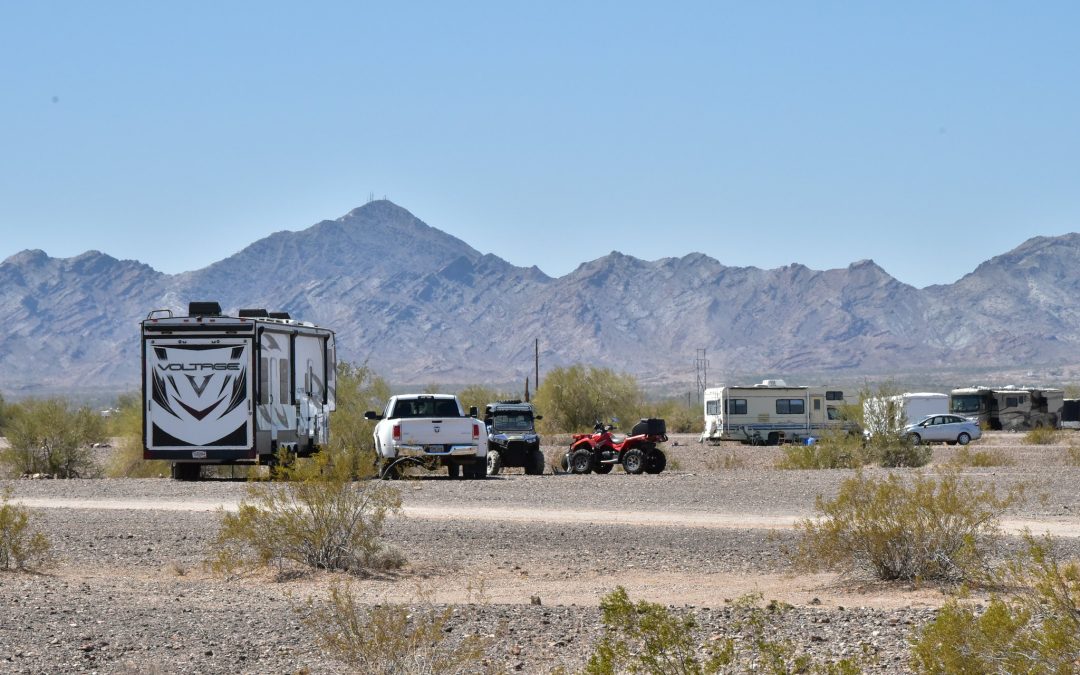
Midland offers trash disposal and a dump station, and it does not provide vault toilets (BLM Midland LTVA). La Posa lists 10 ADA accessible vault toilets, 8 water faucets, a dry dump station, a dump station with water and trash services (BLM La Posa LTVA). Neither page lists a separate fee for water or dumping.
What does boondocking cost us in a Class B?
Last season we moochdocked at friends’ houses, stayed at Harvest Hosts and went to biker rallies. Rallies were our only camping fee, at $50 to $200 for four days. These are our own numbers from a 2018 Hymer Aktiv Class B, not a national average. Your rig, route and season will change every line below.
- Fuel: Our Hymer averages about 15 mpg in real-world driving. That is about 6.7 gallons every 100 miles. For a gas rig at 15 mpg, 100 miles costs about $28.56 at the EIA U.S. regular gas average for the week of October 19, 2026.
- Propane: The Hymer Aktiv carries a 5.9-gallon propane tank. One fill typically lasts us at least 30 days. At the EIA U.S. residential propane average, a full 5.9 gallons costs about $15.87, excluding taxes. That is a home heating price, not a campground fill price. EIA collects propane prices weekly from October through March and monthly the rest of the year (EIA Heating Oil and Propane Update).
- Dumping: Our Hymer has a cassette toilet, so our dump fees are typically nil. We empty it at porta-potties and public restrooms. Check that the facility allows it before you do.
- Water: Our 30 gallons of fresh water goes a long way, and we typically find free water as we need it.
- Harvest Hosts: No camping fee. We do spend money at the host business, but that is shopping, not a camping fee, so it is not counted here.
- Moochdocking: Staying with friends cost us $0 in camping fees.
A rig with a black tank may pay to dump. Non-guest fees listed in directories run $10 to $50 at the Northeast and Mid-Atlantic sites in our RV dump station guide, checked September 29, 2026.
How much will fuel cost?
EIA put U.S. on-highway diesel at $6.276 a gallon for the week of October 19, 2026 (EIA Gasoline and Diesel Fuel Update). U.S. regular gas averaged $4.284 the same week. These are weekly retail averages including taxes, and the figures on this page update when EIA publishes new prices. Your pump price depends on region and station.
Monthly fuel cost = miles driven / your miles per gallon (MPG) x the EIA price per gallon for your region. This guide found no public source for RV fuel economy, so use your own MPG. Ours is about 15 mpg in the Hymer. Regional prices below come straight from EIA and refresh automatically.
| EIA region | Regular gas | Diesel | Best for |
|---|---|---|---|
| U.S. average | $4.284 | $6.276 | Trips that cross several regions |
| New England (PADD 1A) | $4.249 | $6.470 | Trips mostly within this region |
| Central Atlantic (PADD 1B) | $4.312 | $6.508 | Trips mostly within this region |
| Lower Atlantic (PADD 1C) | $3.860 | $5.740 | Trips mostly within this region |
| Midwest (PADD 2) | $4.145 | $6.352 | Trips mostly within this region |
| Gulf Coast (PADD 3) | $3.784 | $5.903 | Trips mostly within this region |
| Rocky Mountain (PADD 4) | $4.468 | $6.422 | Trips mostly within this region |
| West Coast (PADD 5) | $5.557 | $7.394 | Trips mostly within this region |
| West Coast less California | $5.007 | $6.659 | West Coast trips that skip California |
| California | $6.031 | $8.242 | Trips mostly in California, which EIA reports separately |
Estimate your trip cost with live EIA prices
The calculator below loads the latest EIA gas, diesel and propane prices for the region you pick. Enter your miles, real MPG, propane gallons and any fees, and it totals the trip and the cost per night. EIA prices are regional averages, so edit any price to match what you actually pay. Food uses USDA’s August 2026 plans for a couple. For example, 1,000 miles at 15 mpg uses about 66.7 gallons of fuel.
Enter miles and MPG to start.
How much should you budget for food?
Using USDA’s Official Food Plans and its 2-person adjustment, groceries for a couple aged 19 to 70 come to $624.47 to $1,006.50 a month, depending on plan and age. The figures are U.S. average costs of food at home for August 2026, from the USDA Cost of Food at Home report. USDA’s individual figures assume a 4-person household, and USDA says to “add 10 percent” for a 2-person household. Each couple figure below adds the two individual amounts and multiplies by 1.10. We answer whether full-time RV living is cheaper than a house with a line-item budget.
| USDA plan | Couple aged 19-50 | Couple aged 51-70 | Best for |
|---|---|---|---|
| Low-cost | ($317.20 + $275.70) x 1.10 = $652.19 | ($299.00 + $268.70) x 1.10 = $624.47 | Tight budgets that cook most meals |
| Moderate-cost | ($398.10 + $336.10) x 1.10 = $807.62 | ($375.00 + $331.00) x 1.10 = $776.60 | A middle planning figure |
| Liberal | ($486.20 + $428.80) x 1.10 = $1,006.50 | ($448.80 + $399.20) x 1.10 = $932.80 | A cautious upper bound |
The individual inputs are male and female figures from the same USDA report. A single traveler adds 20 percent to one individual figure instead, per USDA.
What does solar and battery power cost up front?
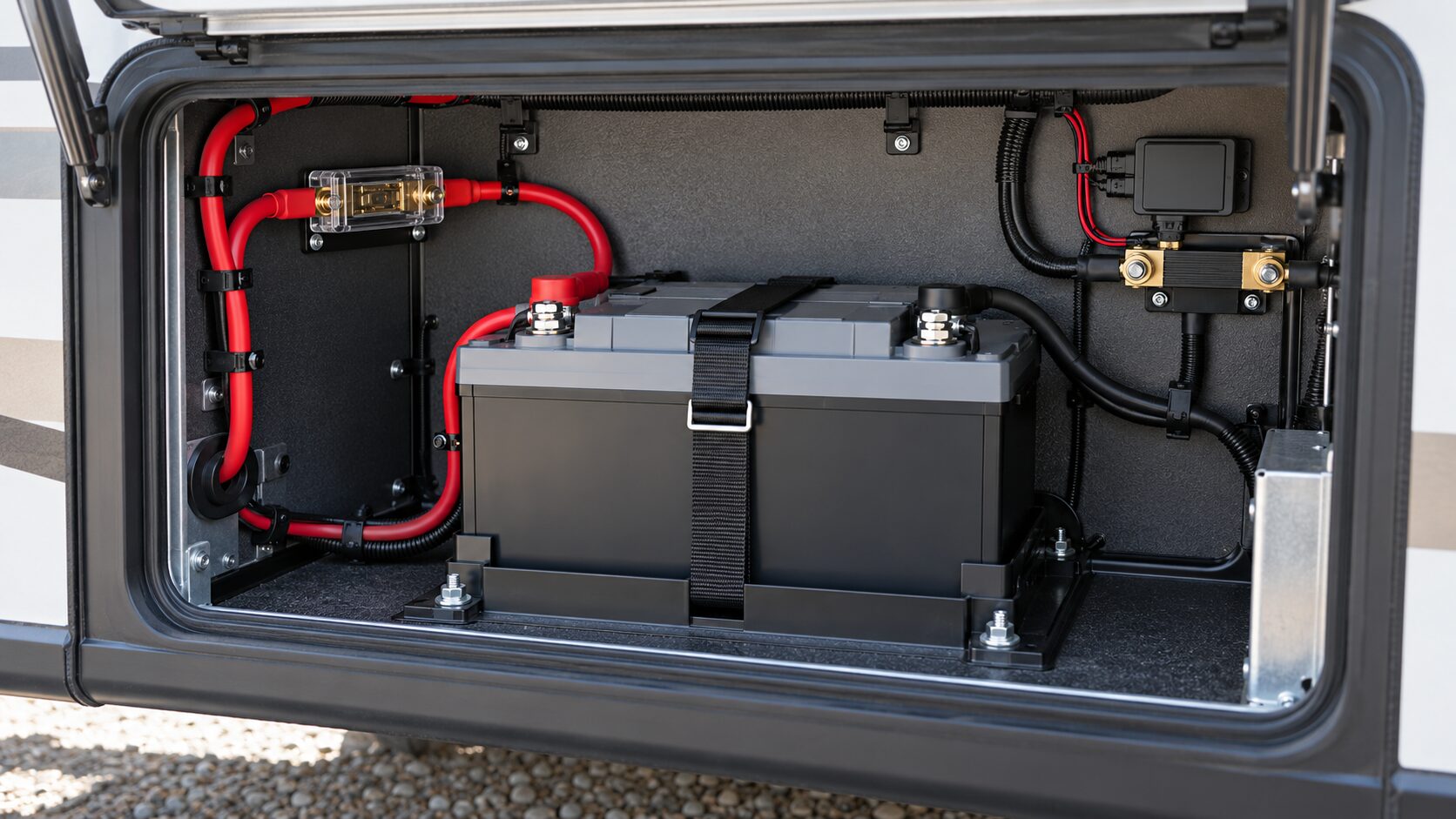
A basic solar and lithium battery parts list priced at $1,174.26 on September 26, 2026. That total covers one panel, one controller, one battery, one inverter and one monitor, at prices the makers and one retailer listed that day, including LiTime’s sale price. It excludes wiring, fuses, mounting and installation, which no source here prices, and it does not size a system for your loads. Prices change often, and Renogy “from” prices are the lowest variant on each collection page. For system design, read the RV solar power guide.
For reference, our Hymer runs on 250 watts of roof solar and two Epoch 300Ah lithium batteries. If you would rather skip a built-in install, our RV power options comparison prices power stations against lithium banks and a generator by daily amp-hour need.
- Panels: Renogy’s 200W N-Type rigid panel starts at $179.99, and its 200W flexible panel starts at $311.99 (Renogy solar panels).
- Charge controllers: Renogy’s pulse width modulation (PWM) controllers run $32.99 to $82.99 (Renogy charge controllers). Its maximum power point tracking (MPPT) controllers start at $87.99 for the Rover Li 20/30/40A, $249.99 for the Rover Lite 60A and $399.99 for the Rover 60A.
- Inverters: Renogy’s 12V pure sine P2 inverters cost $175.99 for 1000W and start at $285.99 for 2000W (Renogy inverters). Its Pro inverters with Bluetooth start at $222.99, $333.99 and $455.99 for 1000W, 2000W and 3000W.
- Battery monitor: a Victron SmartShunt 500A/50mV listed at $100.30 at the retailer solar-electric.com.
- Generator: Honda lists the EU2200i at a $1,199 manufacturer’s suggested retail price (MSRP), with 2200W max and 1800W rated output (Honda EU2200i). Honda rates it at 3.2 hours at rated load and 8.1 hours at 1/4 load on a 0.95-gallon tank.
Lithium vs AGM cost per usable amp-hour
The Renogy 12V 100Ah absorbent glass mat (AGM) battery costs $208.99, but Renogy advises not discharging it below 50%. Renogy rates it for 500 cycles at 50% depth of discharge (DOD). At 50 usable amp-hours (Ah), that is $208.99 / 50 = $4.18 per usable Ah. Lithium iron phosphate (LiFePO4) batteries cost $3.15 to $9.49 per rated Ah across two brands on the check date. Cycle ratings come from each maker and are not tested here.
| Battery | Price | Math | Maker’s cycle rating | Use this row if |
|---|---|---|---|---|
| Renogy 12V 100Ah AGM | $208.99 | $208.99 / 50 usable Ah = $4.18 | 500 cycles at 50% DOD | You want the lowest up-front price and will stop at 50% |
| LiTime 12V 200Ah Xtra Mini (sale) | $629.99 | $629.99 / 200 = $3.15 | 6000+ cycles at 100% DOD | You buy while the sale price holds |
| LiTime 12V 200Ah Xtra Mini (regular) | $919.99 | $919.99 / 200 = $4.60 | 6000+ cycles at 100% DOD | You pay the regular price |
| Battle Born 100Ah 12V LiFePO4 (sale) | $799.00 | $799 / 100 = $7.99 | 3,000 to 5,000 cycles | You want this brand at its listed price |
| Battle Born 100Ah 12V LiFePO4 (regular) | $949.00 | $949 / 100 = $9.49 | 3,000 to 5,000 cycles | You pay the regular price |
Example parts list
Example only, prices checked September 26, 2026. Wiring, fuses, mounting and installation are excluded.
- Renogy 200W rigid panel: $179.99
- Renogy Rover Li MPPT controller, from $87.99
- LiTime 12V 200Ah battery (sale): $629.99
- Renogy P2 1000W inverter: $175.99
- Victron SmartShunt: $100.30
Math: $179.99 + $87.99 + $629.99 + $175.99 + $100.30 = $1,174.26. Adding a Honda EU2200i at $1,199 MSRP brings the total to $2,373.26.
Memberships, mail and health coverage
Harvest Hosts and RV Overnights charge a yearly fee for overnight stays, and these prices were checked September 26, 2026. Harvest Hosts says most stays are one night, though many hosts offer extra nights up to four total. We used Harvest Hosts last season and paid no camping fee at the hosts, though we did spend money at their businesses. Confirm current details at each company’s site before you pay.
- Harvest Hosts Classic: $99.00 a year, or $99 / 12 = $8.25 a month, and $84.15 on sale when checked.
- Harvest Hosts + Boondockers Welcome: $169.00 a year, $143.65 on sale.
- Harvest Hosts All Access: $179.00 a year, $152.15 on sale. All Access includes an Escapees RV Club membership that Harvest Hosts values at $49.95.
- Harvest Hosts plans list “No Camping Fees.”
- RV Overnights: $49.99 a year for a new 12-month membership, or $49.99 / 12 = $4.17 a month (RV Overnights membership). RV Overnights lists 1,450+ locations in the U.S. and Canada for one-night stays.
- RV Overnights gives military, veterans, retirees, first responders and Family RV Association members 40% off, at $29.99 a year (RV Overnights Help Center). It says “The rate you join at is your rate for life, as long as your membership stays active.”
For how the two clubs now connect, see Harvest Hosts and Escapees.
Mail forwarding
Escapees Mail Service Category A, covering all mail types, costs $110 a year (Escapees Mail Service rates). Category B costs $130, Category C costs $150 and Business costs $175. Temporary Category A service costs $40 for 2 months, $50 for 3, $60 for 4 and $70 for 6. Mail scanning, to view and manage mail online, costs $10 a month or $100 a year, discounted from $120. New accounts normally pay a $50 one-time enrollment fee and a $50 postage deposit. When checked, a promotion waived the $50 enrollment fee for new subscribers, and Escapees says it “may end or change at any time without notice.” Without the promotion, year one of Category A comes to $110 + $50 = $160 in fees, or $210 paid up front with the deposit. With it, you pay $110 + $50 deposit = $160 up front. The $110 plan equals $110 / 12 = $9.17 a month. The service is available only to Escapees members, and the membership price is not on the rates page.
Health coverage
KFF puts the 2026 U.S. average marketplace benchmark premium at $625 a month, up from $497 in 2025 (KFF benchmark premiums). KFF defines that figure as the second-lowest-cost silver premium for a 40-year-old, weighted by county plan selections. It is a pre-subsidy price for one person, not a couple’s cost. KFF explains that “The premium tax credit works by limiting the amount an individual must contribute toward the premium for the ‘benchmark’ plan.” Under the Affordable Care Act (ACA), premiums can vary by location, family size, tobacco use and age, with older adults charged no more than three times younger adults (KFF Health Policy 101). Plan options are covered in health insurance for RVers.
Example: sourced fixed costs for one month
Example: sourced fixed costs for a couple aged 51-70, one month at an LTVA in season, total $819.73. Every input comes from the sections above. This example is arithmetic on published prices, not our spending. Our own costs are in the Class B section above. It applies to a Midland or La Posa long-term permit between September 15 and April 15.
- LTVA long-term permit: $180 / 7 = $25.71
- USDA moderate-cost food, couple aged 51-70: $776.60
- Escapees Mail Service Category A: $110 / 12 = $9.17
- Harvest Hosts Classic at regular price: $99 / 12 = $8.25
Math: $25.71 + $776.60 + $9.17 + $8.25 = $819.73 a month. The example excludes fuel, propane, vehicle insurance, internet, maintenance, repairs, health coverage and Escapees dues. Add fuel and propane with the calculator above. The expenses free camping still brings are covered in hidden costs of free RV parking.
Costs this guide cannot price for you
Some real costs have no current source that gives a usable number, so this guide gives no figure for them. Price these yourself before you set a budget, and add them to the calculator’s other costs field.
- Vehicle insurance, registration and domicile costs.
- Internet and cell plans.
- Maintenance, repairs and an emergency fund.
- Dump and water fees at sites other than the two LTVAs and the directory listings above.
- Developed campground and RV park nightly rates.
- Your propane fill price. EIA reports a residential heating price, and campground or station fill prices differ.
Your next step: before you camp, call the BLM field office or Forest Service ranger station for the area to confirm stay limits, permits and fees (USDA Forest Service). Land access, permits, road conditions, and site availability change. Verify all information with the relevant land management agency before your trip. Conditions in remote areas can be hazardous. Assess your skill level and equipment before you go.
Frequently asked questions
How much does boondocking cost per month?
No single figure applies to everyone. Most BLM land allows dispersed camping, and BLM names fees only for some developed campgrounds. One sourced example for a couple aged 51-70 at an LTVA, with USDA moderate food, Escapees mail and Harvest Hosts Classic, comes to $819.73 a month before fuel, propane, insurance, internet, repairs and health coverage. Prices were checked September 26, 2026.
Is boondocking really free?
The USDA Forest Service says dispersed camping “is usually permit-free and fee-free,” but busy areas may need a permit and fee. BLM allows dispersed camping on most of its land, names fees only for some developed campgrounds and generally limits stays to 14 days in 28. Rules were checked September 26, 2026. Call the field office or ranger station before you go.
How much does an LTVA permit cost?
At the Midland and La Posa Long-Term Visitor Areas, BLM charges $180 for a long-term permit covering September 15 to April 15. A short-visit permit costs $40 for 14 consecutive days. Off-season rules differ, with Midland free under a 14-day limit and La Posa at $15 a night or $75 a year. Checked September 26, 2026, so verify before departure.
How much is diesel for an RV right now?
The EIA U.S. average for on-highway diesel was $6.276 a gallon for the week of October 19, 2026. Regular gasoline averaged $4.284 that week. Among EIA regions, West Coast diesel was highest at $7.394 and Lower Atlantic was lowest at $5.740. California, reported separately, was $8.242. This answer updates when EIA publishes new weekly prices.
How much propane does a Class B RV use while boondocking?
Our 2018 Hymer Aktiv carries a 5.9-gallon propane tank, and one fill typically lasts us at least 30 days. Use depends on season, furnace use and which appliances run on propane. EIA put the U.S. residential propane average at $2.689 a gallon, excluding taxes, for the week of October 19, 2026. That is a home heating price, not a fill price.
How much should a couple budget for groceries?
USDA’s August 2026 moderate-cost food plan works out to $776.60 a month for a couple aged 51-70. For a couple aged 19-50 it works out to $807.62. Both figures include USDA’s 10 percent adjustment for a 2-person household. They are U.S. averages from USDA’s Cost of Food at Home report.
What does a basic solar setup cost?
One example parts list priced September 26, 2026 totals $1,174.26. It includes a Renogy 200W panel, a Renogy MPPT controller, a LiTime 200Ah lithium battery, a Renogy 1000W inverter and a Victron SmartShunt. Wiring and installation are extra. A Honda EU2200i generator adds $1,199 MSRP.
Is lithium worth it over AGM?
On price per usable amp-hour, Renogy’s 100Ah AGM costs $4.18 when used to 50% depth of discharge. LiTime’s 200Ah lithium battery costs $3.15 to $4.60 per amp-hour, and Battle Born costs $7.99 to $9.49. The makers rate the AGM at 500 cycles at 50% depth of discharge, LiTime at 6,000+ cycles at 100% and Battle Born at 3,000 to 5,000 cycles. Prices were checked September 26, 2026.
How much do Harvest Hosts and RV Overnights cost?
Harvest Hosts Classic costs $99 a year at regular price, and it was $84.15 on sale when checked. RV Overnights costs $49.99 a year for new members. Military, veterans, retirees, first responders and Family RV Association members pay $29.99. Prices were checked September 26, 2026. Confirm current details at each company’s site.
How do I estimate RV fuel cost for a trip?
Divide your trip miles by your RV’s real miles per gallon, then multiply by the price per gallon. A rig that gets 15 mpg, like our Hymer, burns about 6.7 gallons every 100 miles. On regular gas at the EIA U.S. average of $4.284 for the week of October 19, 2026, 100 miles costs about $28.56. The calculator here uses live EIA prices.
Sources
- Bureau of Land Management. (n.d.). Camping. Retrieved September 26, 2026, from https://www.blm.gov/programs/recreation/camping
- Bureau of Land Management. (n.d.). La Posa Long-Term Visitor Area. Retrieved September 26, 2026, from https://www.blm.gov/visit/la-posa-long-term-visitor-area
- Bureau of Land Management. (n.d.). Midland Long-Term Visitor Area. Retrieved September 26, 2026, from https://www.blm.gov/visit/midland-long-term-visitor-area
- U.S. Department of Agriculture, Food and Nutrition Service. (2026). Official USDA food plans: Cost of food at home, August 2026. https://www.fns.usda.gov/sites/default/files/resource-files/CostofFoodAug2026LowModLib.pdf
- U.S. Department of Agriculture, Forest Service. (n.d.). No reservation, no problem. Retrieved September 26, 2026, from https://www.fs.usda.gov/about-agency/features/no-reservation-no-problem
- U.S. Energy Information Administration. (2026). Gasoline and diesel fuel update [Weekly data, loaded automatically]. https://www.eia.gov/petroleum/gasdiesel/
- U.S. Energy Information Administration. (2026). Heating oil and propane update [Weekly and monthly data, loaded automatically]. https://www.eia.gov/petroleum/heatingoilpropane/


