Last updated: September 30, 2026
Chuck Price has 35+ years of RV camping experience and travels in a 2018 Hymer Aktiv Class B. Federal and state rules on this page were checked against agency sources on September 30, 2026.
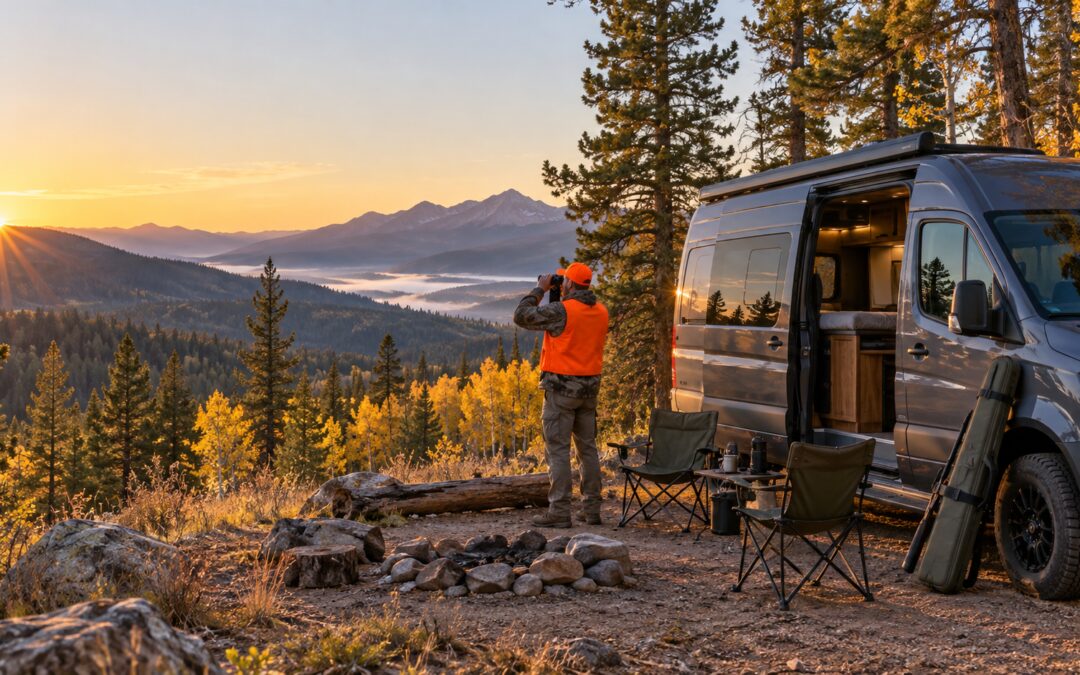
Yes, you can hunt from a boondocking basecamp. The Bureau of Land Management (BLM) says over 99 percent of its lands are open to hunting, fishing and recreational shooting. You still need a license from the state where you hunt, and you shoot in the unit, not from camp.
- Must-know: Most BLM and National Forest land is huntable with a license from the state where you hunt.
- Trip killers: Missed spring draw deadlines, the Forest Service 150-yard discharge rule, and carcass import bans in states you drive through on the way home.
- Best for: Self-contained rigs that can move camp on the managing agency’s schedule. BLM dispersed stays are generally limited to 14 days in any 28-day period, set by state and field office, and the BLM says the move is often at least 25 to 30 miles. Forest Service limits are set by each forest.
- Confirm before you go: Your state wildlife agency regulations, the local BLM field office or Forest Service ranger district, and the Motor Vehicle Use Map for your forest.
Affiliate disclosure: Boondock or Bust earns a commission if you buy through TideWe links on this page, at no extra cost to you. See our affiliate disclosure for details.
Where can you legally hunt from a boondocking basecamp?
BLM land and National Forests are common RV basecamp options: many areas allow dispersed camping, and hunting may be allowed under state rules, subject to local closures, access restrictions and permits. Check the local field office or ranger district. The BLM states, “Unless specifically prohibited, public lands managed by the BLM are open to hunting.” For BLM public lands and National Forest System lands, 43 U.S.C. 1732(b) preserves state wildlife authority and bars a general federal hunting-permit requirement, while still allowing area or period closures and other unit-specific rules. National Parks are the main exception. Closures still apply by area and season, so check with the local office before you plan a unit around a campsite.
- BLM land: BLM manages 43 million acres of elk habitat and 131 million acres of mule deer habitat, per its hunting and fishing page. Every hunter on BLM land needs the required state license, so verify requirements with the state wildlife agency.
- National Forests: The U.S. Forest Service tells hunters to “Follow the state laws and regulations pertaining to hunting, including seasons, dates and licensing.” Individual forests can close areas to hunting. Our National Forest boondocking guide covers the camping side.
- National Parks: Federal rule 36 CFR 2.2 allows hunting in park areas only where federal statute mandates or authorizes it. Some units, such as certain national preserves, allow it. Most parks do not. See whether you can boondock in National Parks.
- State trust land: Access and permit rules vary by state. Check the state land office before you hunt or camp on it.
- Private land: BLM says private land is open to hunting only with the landowner’s permission. Checkerboard land in the West makes an offline land-ownership map worth carrying.
How far from camp can you shoot on public land?
On National Forest land, you cannot discharge a firearm within 150 yards of a campsite, under 36 CFR 261.10(d). That rule comes from the Forest Service, not the BLM, and it is often misquoted as a BLM-wide limit. BLM instead bans firearm discharge on developed recreation sites unless authorized, and field offices can add local rules. Either way, a dispersed campsite, yours or a neighbor’s, is not a shooting position. Glass from camp. Shoot in the unit.
Forest Service rule: 36 CFR 261.10(d) prohibits discharging a firearm “within 150 yards of a residence, building, campsite, developed recreation site or occupied area.” The same rule bans shooting across or on a National Forest System road or an adjacent body of water, and into a cave.
BLM rule: 43 CFR 8365.2-5 prohibits discharging firearms on developed recreation sites and areas unless otherwise authorized. It sets no national yardage for dispersed areas, so the field office’s supplementary rules and state law fill that gap. Call the BLM field office that manages your camp area for the specific rule where you camp. General camping rules are on the BLM camping page.
Long-Term Visitor Areas (LTVAs): These are designated BLM camping areas, so treat them like developed sites. Confirm discharge rules with the managing field office before you uncase a firearm nearby. Our LTVA camping guide covers permits and locations.
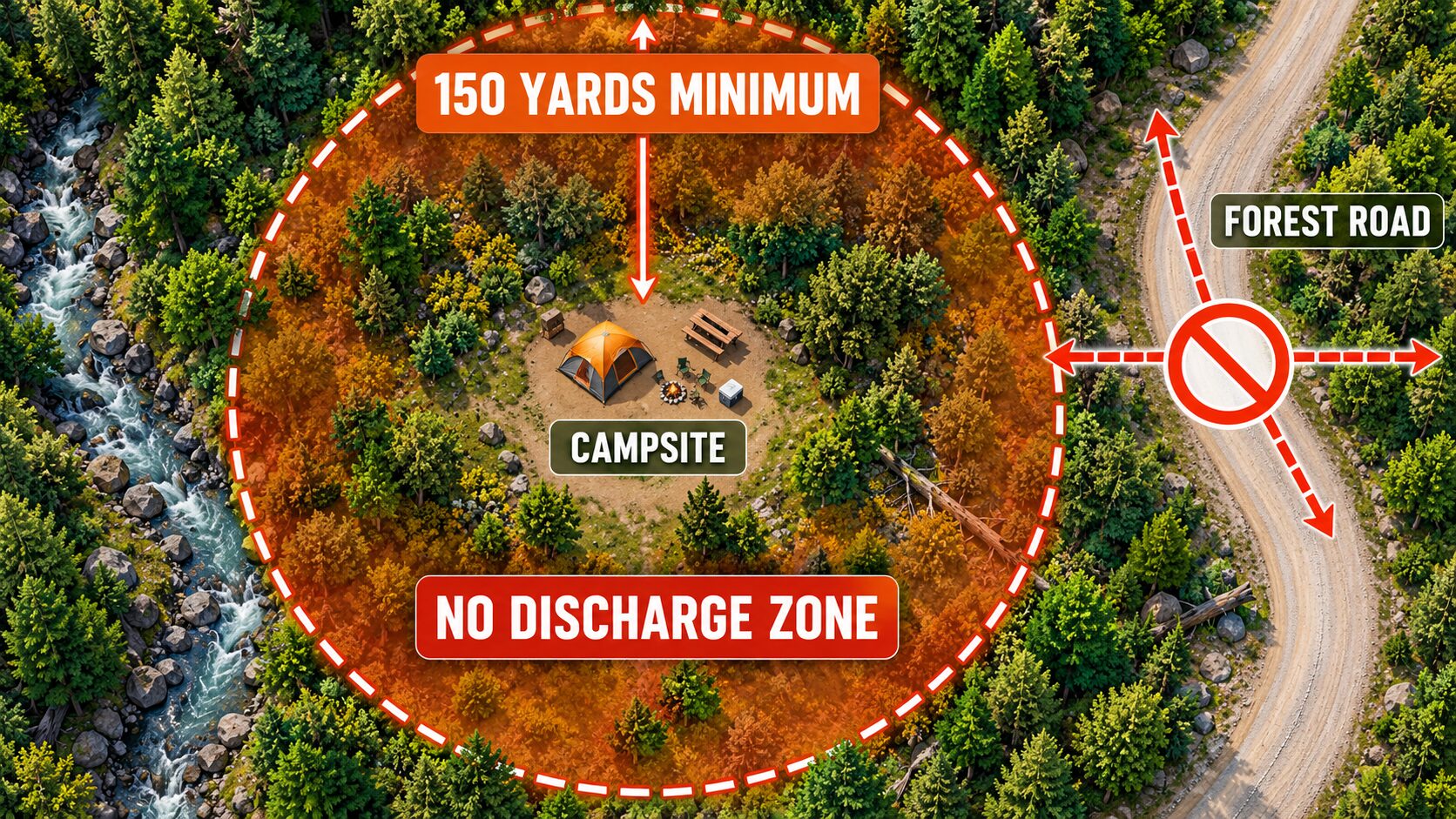
Forest Service rule 36 CFR 261.10(d) sets a 150-yard no-discharge buffer around campsites and occupied areas.
How do you legally transport a firearm in an RV?
Federal law protects interstate travel for a lawful purpose with an unloaded firearm that is not reachable from the passenger compartment. A motorhome has no separate trunk, and the statute addresses that case directly. Under 18 U.S.C. 926A, the firearm or ammunition “shall be contained in a locked container other than the glove compartment or console.” The protection only applies if you can lawfully possess and carry the firearm at both your origin and your destination.
- Motorhomes and vans: Keep the firearm unloaded and in a locked container. The glove compartment and console do not qualify.
- Tow vehicles and trucks: The statute requires that neither the firearm nor the ammunition be readily or directly accessible from the passenger compartment.
- Overnight stops: The statute covers the trip. It does not say how long a stop can last, so check the law of every state where you plan to stop overnight.
- Parked at camp: Once you are parked, state law governs storage, loaded firearms and safe-storage rules. The federal transport rule does not answer those questions.
A practical setup is a lockbox cabled or bolted to the RV frame, with a cable lock through the action. Store ammunition separately in a second locked container.
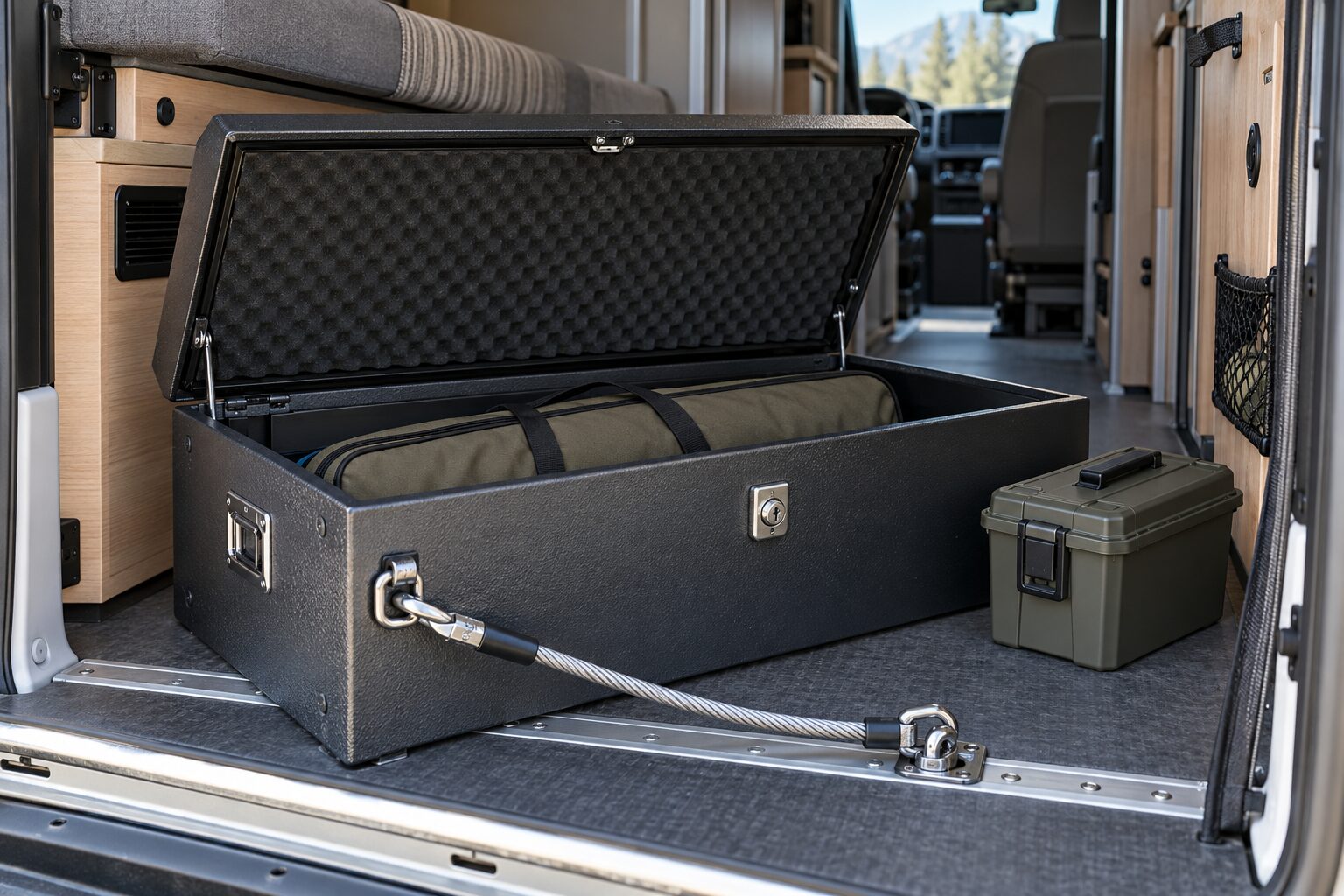
In a motorhome, federal law calls for a locked container other than the glove compartment or console.
What licenses and deadlines shape an RV hunting season?
Your hunting license comes from the state where you hunt, not the state on your registration. Nonresident big game tags in many western states are drawn by lottery months before the season opens. For the 2026 season, Colorado’s primary draw application deadline was April 7, 2026, at 8 p.m. Mountain Time, per Colorado Parks and Wildlife (CPW). A fall loop starts with a spring application calendar.
- Qualifying licenses: Colorado requires applicants to buy or hold a qualifying license before applying for the primary or secondary draw, per CPW.
- Over-the-counter changes: Nonresidents can no longer buy over-the-counter archery elk licenses for game management units west of Interstate 25 and GMU 140, per Colorado Parks and Wildlife. Those units now use limited nonresident hunt codes applied for in the draw. Plans built on old OTC habits need a fresh check every year.
- Hunter education: Colorado requires an approved hunter education course for anyone born on or after January 1, 1949, before applying for or buying a license, per CPW. CPW says proof of hunter education from another state may be accepted. Find your card or order a replacement before you apply.
- Guide requirements: Wyoming requires nonresidents to have a licensed guide or resident companion to hunt big or trophy game in federally designated wilderness, per the Wyoming Game and Fish Department. Alaska requires nonresidents hunting brown bear, grizzly bear, mountain goat or sheep to be accompanied by a licensed guide or a qualifying resident relative under Alaska Statute 16.05.407.
Quick recap before the logistics: Hunt BLM or National Forest land with a license from the state where you hunt. On National Forest land, never shoot within 150 yards of a campsite. Travel with firearms unloaded and, in a motorhome, in a locked container. The next sections cover camp, meat and gear.
How do you pick and run a hunting basecamp?
Pick a basecamp near the unit, on a route you can legally drive, with a stay limit that fits your season. On BLM land, dispersed camping is generally limited to 14 days in any 28-day period, and limits vary by state and field office, per the BLM camping page. Forest Service stay limits are set by each forest. A six-week season means at least two planned moves, so schedule move days the way you schedule tag dates.
Use the Motor Vehicle Use Map (MVUM). The MVUM is the Forest Service’s official map of roads and trails open to motor vehicles. The Bighorn National Forest states that routes not shown on the MVUM are not open to public motor vehicle travel. The Bighorn page says the MVUM is free to the public, updated annually in January, and available as a free download in the Avenza Maps app for offline use. Check your own forest’s MVUM page for its schedule. Our roundup of apps for finding free campsites covers the rest of the scouting stack.
Provision for a long sit. A hunting stay runs longer than a weekend stop, so plan water by the week, not the day. Our RV water management guide covers the math. October nights at elevation can drop below freezing, which puts propane and battery capacity on the planning list. See our guide to camping below freezing.
Keep camp quiet. Dawn is glassing time. Run the generator or charge batteries midday, keep lights low, and move on foot or in the tow vehicle while the rig stays parked.
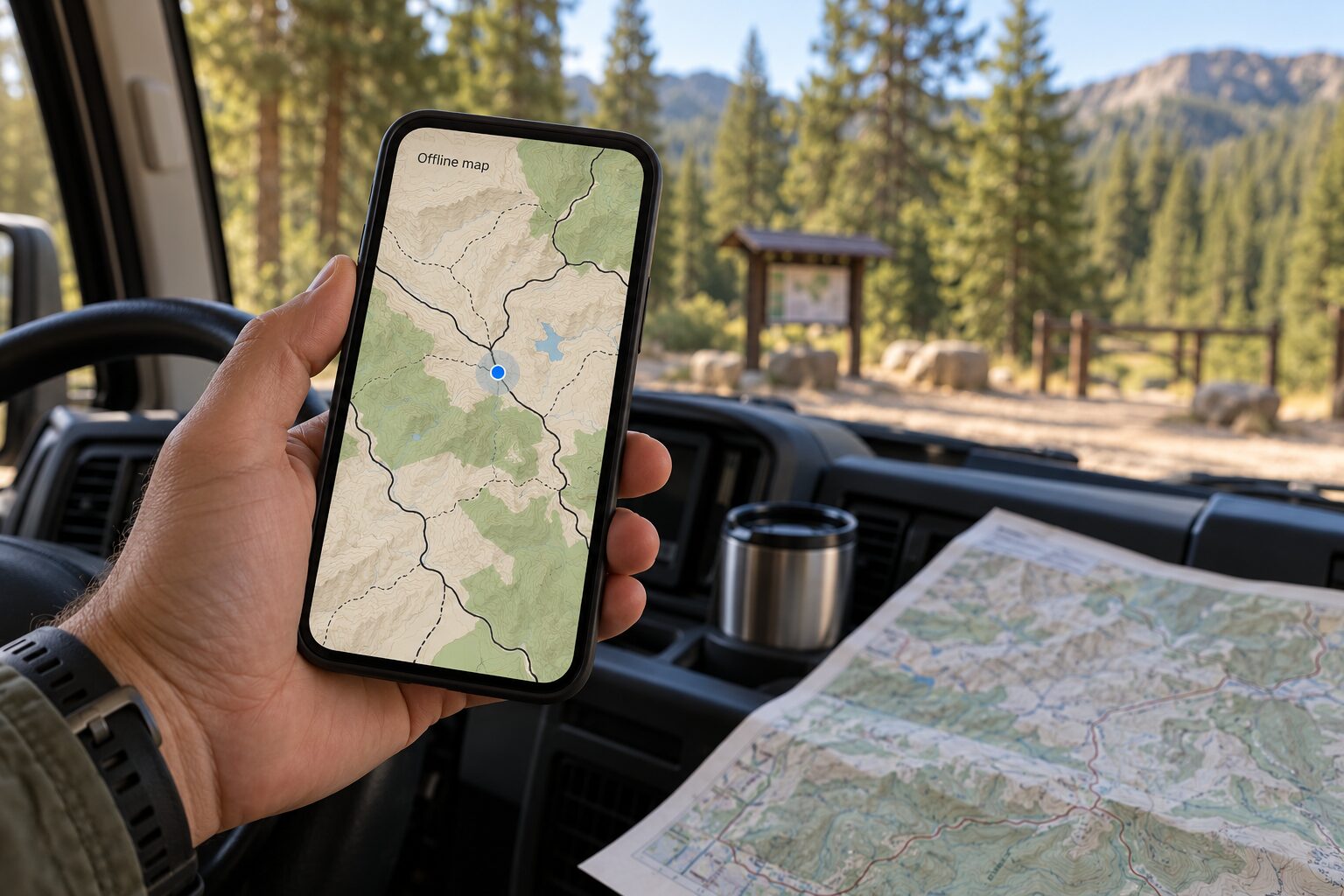
Routes not shown on the MVUM are closed to public motor vehicles. Download it before you lose signal.
How do you handle game meat and carcass rules from an RV?
Carcass rules determine what you can legally drive home. Many states ban importing whole deer or elk carcasses from areas with chronic wasting disease (CWD). The CWD Alliance advises checking the rules in your home state, the state where you hunt, and every state you pass through on the way home. That last group is the one RVers miss.
- Read the rules at the source: Read the carcass transport rules published by the wildlife agency of your home state, your hunt state, and every state on your route.
- A strict example: Since August 1, 2019, Virginia has prohibited importing whole deer carcasses from anywhere outside Virginia. It allows boned-out cut and wrapped meat, quarters with no spinal column or head, hides or capes with no skull attached, and cleaned skull plates, each labeled, per the Virginia Department of Wildlife Resources.
- Tagging and evidence of sex: Many states require specific parts to stay attached until the meat reaches its destination. Read the tagging section of your hunt state’s regulations before you start boning out.
- Cooling capacity: Measure your RV freezer and cooler space in cubic feet before opening day and compare it to your processor’s yield estimate for the species. Dry ice extends your window, and a second cooler gives you room to split the load.
Scent control in a small space. Hunting clothes should not share air with the galley. Store them in sealed totes in an outside bay or the tow vehicle, wash them in scent-free detergent, and keep them sealed until you walk in.
Bears share the fall calendar. Store food and game meat so a bear cannot reach it, and check state rules before you carry deterrents. Our guide to non-lethal protection for RV campers covers bear spray and storage.
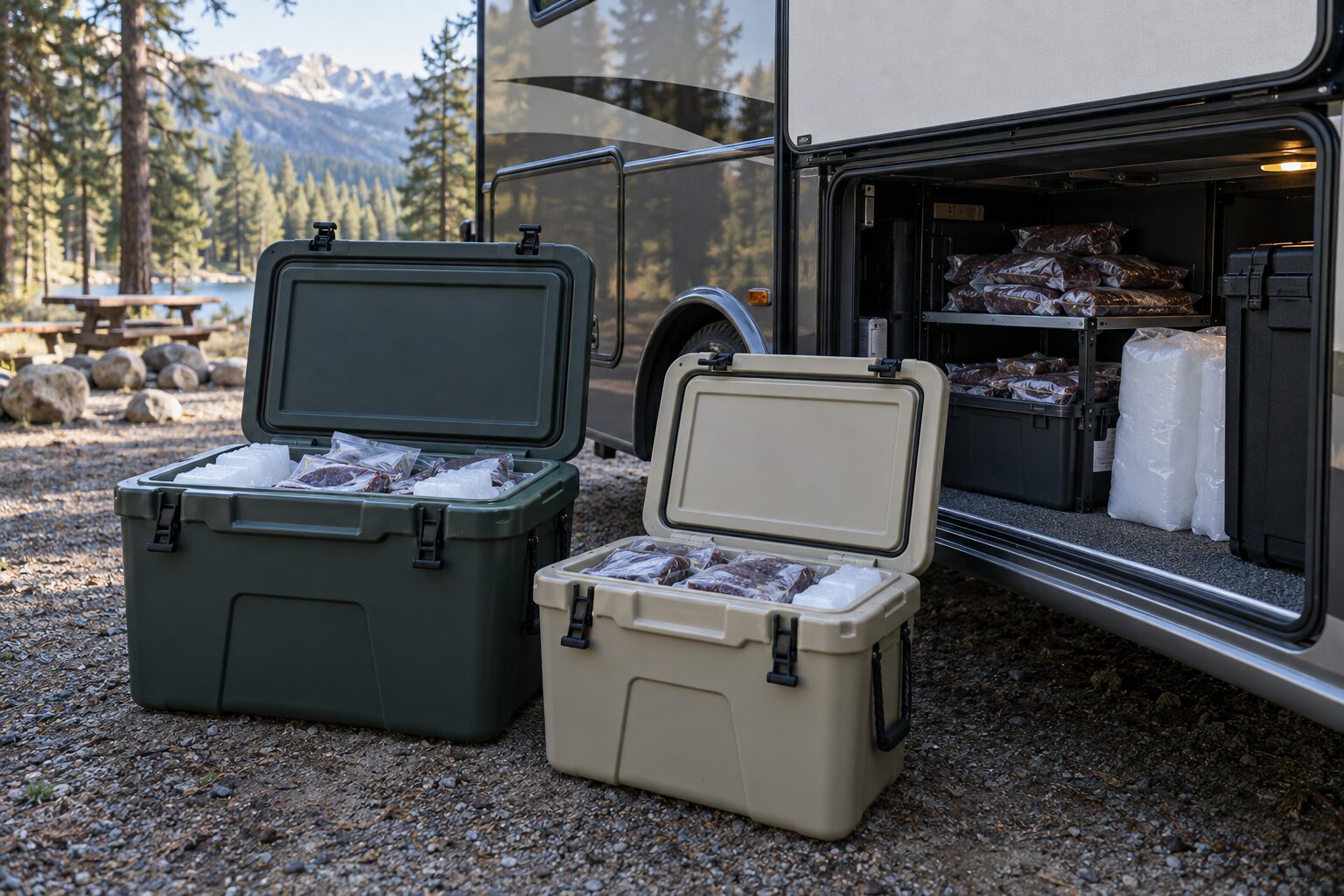
Boned-out meat travels through most CWD carcass rules. Whole carcasses often do not.
Which hunting gear earns storage space in an RV?
Every item in an RV hunting kit should solve a specific basecamp problem, because storage is fixed and weight counts against cargo capacity. The list below matches gear to the problem it solves. Hunter orange comes first because it is a legal requirement in many states during firearm seasons, and the amount required varies by state. The Forest Service advises wearing hunter orange as your outermost layer. Check your hunt state’s regulations for the exact requirement.
| Basecamp problem | Gear that solves it | Best use case | TideWe option |
|---|---|---|---|
| Sitting exposed on short morning hunts near camp | Pop-up ground blind | Walk-in units near basecamp where you move camp every two weeks | Vis360 360° see-through blind or the smaller 270° see-through one-person blind |
| Waterfowl near stock tanks, creeks or marshes | Panel-style waterfowl blind | Duck and goose seasons on a loop with water access | Waterfowl panel blind |
| Misjudged shot distance | Rangefinder | Open western country where distance is hard to judge by eye | Hunting rangefinder or the 270° blind plus rangefinder bundle |
| Binoculars bouncing on long glassing days | Binocular harness | Spot-and-stalk hunts with hours behind the glass | Binocular harness chest pack |
| Cold dawn sits | Insulated mid-layer | Early and mid-season hunts with freezing mornings | Camo mid-layer hunting jacket |
| Coldest late-season sits | Heated jacket | Long motionless sits in a blind or on a stand | TideWe heated jackets or the heated jacket for women |
| Noisy fabric on the stalk | Quiet outer layer | Close-range bow and still hunting | Altus ultra silent hunting suit |
| Mountain weather turning mid-hunt | Packable rain suit | Any hunt more than an hour from the rig | Portable and breathable rain suits |
| Standing in cold water before sunrise | Chest waders with boots | Marsh and creek duck hunts on cold mornings | Insulated bootfoot chest waders or Marsh Warrior chest waders |
| Carrying layers, water, knife and game bags | Hunting pack | Day hunts from basecamp | Camo hunting backpack |
| A seat that squeaks when you shift | Quiet blind chair | Blind sits of two hours or more | TideWe hunting chairs |
If you want a blind line built around a fixed camp, TideWe also sells a Basecamp blind series. Check dimensions against your storage bay before you buy. A folded blind that does not fit the bay ends up on the bed.
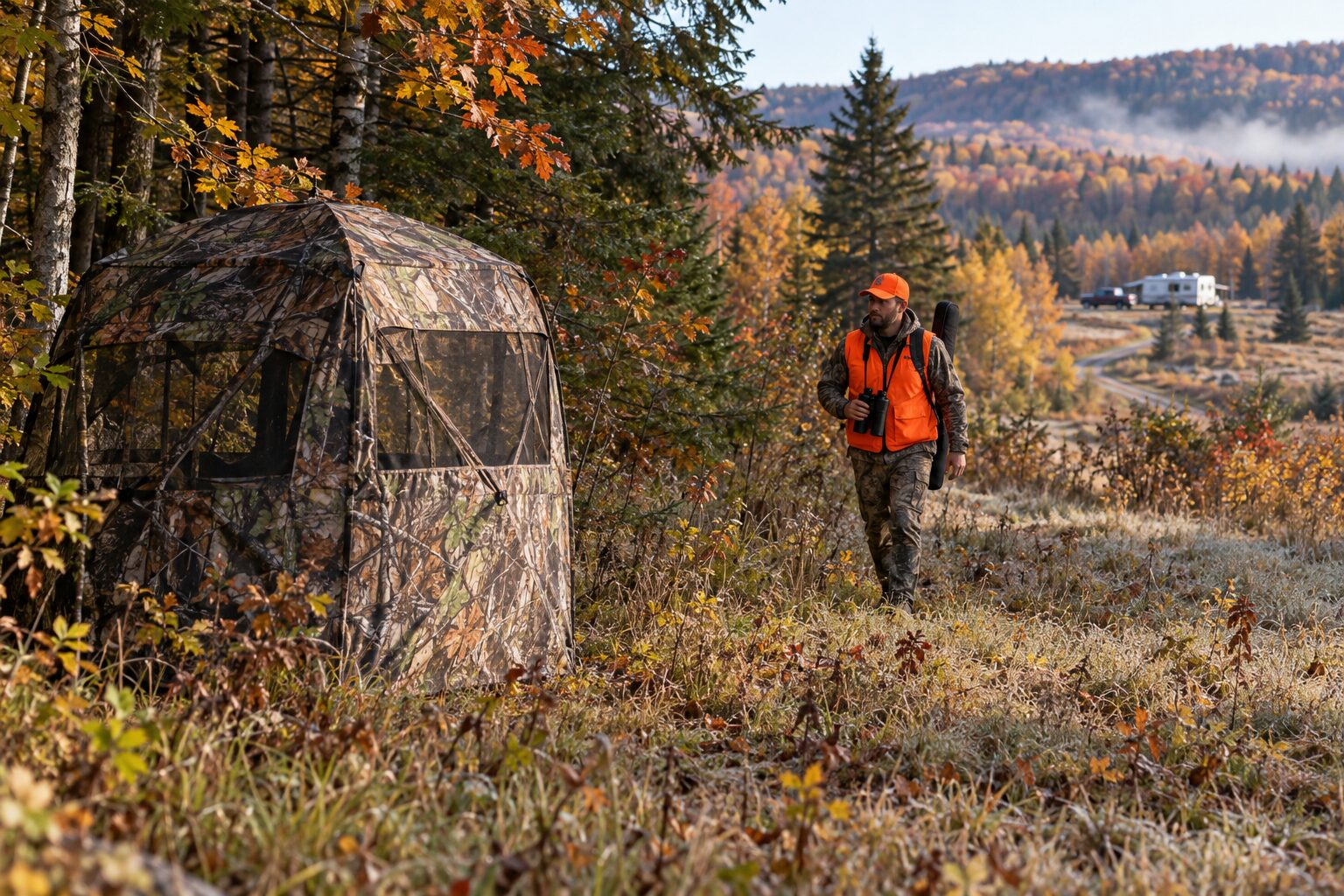
A pop-up blind sets up fast, which matters when the field office or forest stay limit forces a camp move.
What does a DIY public-land hunt from an RV cost?
Your largest fixed costs are the nonresident license, tag and application fees, set by each state and published in its regulations brochure. Campsite fees on dispersed BLM and National Forest land are usually zero, which removes the lodging line a hotel or guided camp would carry. Developed campgrounds and some areas charge fees, so confirm with the managing office. Fuel, propane, meat processing and transit nights make up the rest. Fees change every license year, so price the trip from the current brochure, not last season’s numbers.
Our boondocking cost breakdown prices fuel, food and power for a month on public land. Add your state’s license and tag fees from its current brochure, plus processing if you don’t butcher your own.
Frequently asked questions
Can you hunt on BLM land?
Yes. BLM says public lands it manages are open to hunting unless specifically prohibited, and over 99 percent of BLM-managed lands are open to hunting, fishing and recreational shooting. You need the required license from the state where you hunt. Local closures apply, so contact the BLM field office before your trip. Checked September 30, 2026.
Can you hunt in National Forests?
Hunting is generally allowed in National Forests under state law, subject to area closures. The U.S. Forest Service tells hunters to follow state laws on seasons, dates and licensing. Check with the local ranger district for closures and the Motor Vehicle Use Map for legal access roads. Checked September 30, 2026. Verify current status before departure.
Can you shoot near your campsite on National Forest land?
No, not within 150 yards. Forest Service rule 36 CFR 261.10(d) bans discharging a firearm within 150 yards of a residence, building, campsite, developed recreation site or occupied area. It also bans shooting across or on a National Forest System road. BLM uses different rules, set by regulation and local field offices.
How do you transport a gun in a motorhome?
Under 18 U.S.C. 926A, keep the firearm unloaded and, in a vehicle without a separate trunk, in a locked container other than the glove compartment or console. The protection applies only between places where you can legally possess the firearm. State law governs storage once you park, so check each state on your route.
Do nonresidents need a guide to hunt in Wyoming?
Only in federally designated wilderness. The Wyoming Game and Fish Department says nonresidents need a licensed guide or resident companion to hunt big or trophy game in those areas. The rule does not cover small game, game birds or coyotes. Outside designated wilderness, nonresidents can hunt big game without a guide. Checked September 30, 2026.
Can you bring a deer or elk carcass across state lines?
Often not whole. Many states restrict whole carcasses from areas with chronic wasting disease. Virginia, for example, allows boned-out meat, quarters without spine or head, and cleaned skull plates, each labeled. Check the wildlife agency rules for your home state, the state where you hunt and every state you drive through. Verify current rules before departure.
What to do before your first RV hunting trip
Start with the state wildlife agency for the state you want to hunt. Put its draw deadline on your calendar, confirm your hunter education card, and read its carcass transport rules. Then call the BLM field office or Forest Service ranger district for the unit, download the MVUM, and plan camp moves around the stay limit. When those four items are confirmed, build the gear list. More public-land planning guides are in our boondocking guide hub.
Sources
- Alaska Legislature. (2024). AS 16.05.407: Nonresident hunting big game animals must be accompanied. Justia. https://law.justia.com/codes/alaska/title-16/chapter-05/article-3/section-16-05-407
- Bureau of Land Management. (n.d.). Camping. Retrieved September 30, 2026, from https://www.blm.gov/programs/recreation/camping
- Bureau of Land Management. (n.d.). Hunting and fishing. Retrieved September 30, 2026, from https://www.blm.gov/programs/recreation/recreation-activities/hunting-fishing
- Chronic Wasting Disease Alliance. (n.d.). Carcass transportation regulations. Retrieved September 30, 2026, from https://cwd-info.org/carcass-transportation-regulations-in-the-united-states-and-canada/
- Colorado Parks and Wildlife. (n.d.). Nonresidents. Retrieved September 30, 2026, from https://cpw.state.co.us/activities/hunting/nonresidents
- Colorado Outdoors. (2026, February 13). What’s new: 2026 Colorado big game hunting. https://coloradooutdoorsmag.com/2026/02/13/whats-new-2026-colorado-big-game-hunting/
- National Park Service. (n.d.). 36 CFR 2.2: Wildlife protection. Legal Information Institute. https://www.law.cornell.edu/cfr/text/36/2.2
- U.S. Bureau of Land Management. (n.d.). 43 CFR 8365.2-5: Public health, safety and comfort. Legal Information Institute. https://www.law.cornell.edu/cfr/text/43/8365.2-5
- U.S. Congress. (1976). 43 U.S.C. 1732: Management of use, occupancy, and development of public lands. Legal Information Institute. https://www.law.cornell.edu/uscode/text/43/1732
- U.S. Congress. (1986). 18 U.S.C. 926A: Interstate transportation of firearms. U.S. House of Representatives. https://uscode.house.gov/view.xhtml?edition=prelim&num=0&req=granuleid%3AUSC-prelim-title18-section926A
- U.S. Forest Service. (n.d.). 36 CFR 261.10: Occupancy and use. Legal Information Institute. https://www.law.cornell.edu/cfr/text/36/261.10
- U.S. Forest Service. (n.d.). Hunting. Retrieved September 30, 2026, from https://www.fs.usda.gov/visit/know-before-you-go/hunting
- U.S. Forest Service, Bighorn National Forest. (n.d.). Motor vehicle use map. Retrieved September 30, 2026, from https://www.fs.usda.gov/r02/bighorn/maps-guides/motor-vehicle-use-map
- Virginia Department of Wildlife Resources. (n.d.). Transporting carcasses into and out of Virginia. Retrieved September 30, 2026, from https://dwr.virginia.gov/wildlife/diseases/cwd/transporting-carcasses-into-and-out-of-va/
- Wyoming Game and Fish Department. (n.d.). Is it true nonresidents cannot hunt in national forest wilderness areas without a guide? Retrieved September 30, 2026, from https://wgfd.wyo.gov/it-true-nonresidents-cannot-hunt-national-forest-wilderness-areas-without-guide
This guide covers general federal rules and selected state examples. It is not legal advice. Hunting, firearm transport and carcass laws vary by state and change every license year. Land access, permits, road conditions, and site availability change. Verify all information with the relevant land management agency and state wildlife agency before your trip.


