Articles by Chuck Price — Page 3
by Chuck Price | Sep 26, 2026 | Blog
July 2024 news, with member details checked September 26, 2026.
Harvest Hosts announced on July 19, 2024 that it had acquired the membership and events portion of Escapees RV Club. Escapees Mail Service and Escapees RV Parks were excluded, per the Carr family’s letter as published by RV PRO on July 18, 2024. As of September 26, 2026, the only Harvest Hosts plan that includes Escapees membership is All Access.
Last updated: September 26, 2026
Chuck Price has 35+ years of RV camping experience and owns a 2018 Hymer Aktiv Class B.
At a glance
- Best For: All Access is the only Harvest Hosts plan that lists an Escapees RV Club membership, shown as a $49.95 value (plans page).
- Confirm Before You Join: All Access lists at $179.00 a year, and the plans page showed a lower price on September 26, 2026. Check the current price before you buy.
What Harvest Hosts bought from Escapees
Harvest Hosts acquired the Escapees RV Club membership and events business in July 2024, per its July 19 announcement. The deal covered the club, not every business that uses the Escapees name. The three official statements describe the scope in different words, so the table below quotes each one.
What transferred and what stayed out, in each source’s own words (sources linked in each row)
| Source and date |
What transferred to Harvest Hosts |
What stayed out |
| Carr family letter, published by RV PRO and RVBusiness on July 18, 2024 |
“the management and operations of Escapees RV Club’s membership, support services, educational programs and events” |
“the Escapees Mail Service and Escapees RV Parks, which will remain under existing management and ownership” |
| Harvest Hosts blog, July 19, 2024 |
“the membership and events portion of Escapees RV Club” |
“Travis and Melanie Carr continue to oversee the mail forwarding and Escapees RV parks.” |
| PR Newswire release, Aug. 13, 2024 |
“the Escapees membership platform, including memberships, events, education and community services” |
The Carrs “will continue to operate the mail service and campgrounds without interruption.” |
Harvest Hosts said on July 19, 2024 that the two would “continue to operate as separate entities.”
What stayed with the Carr family
Escapees Mail Service and Escapees RV Parks did not transfer to Harvest Hosts. The Carr family’s letter, as published by RV PRO on July 18, 2024, says, “This transition excludes the Escapees Mail Service and Escapees RV Parks, which will remain under existing management and ownership.” The same letter says, “SKP Co-Ops will continue to be an Escapees RV Club member-only benefit owned and managed by members of the Co-Ops.” It was signed by Cathie and Bud Carr and Travis and Melanie Carr.
The split still held in 2025. Harvest Hosts’ help center, updated Oct. 2, 2025, says, “Escapees RV Club and Escapees Mail Service are two separate companies.” The same page says Escapees Mail Service “remained under the original ownership.” It also calls mail service “an add-on to an Escapees membership” that is billed separately.
What each side said
The Carr family letter (published July 18, 2024)
In the version RV PRO published on July 18, 2024, the Carrs wrote, “Current benefits and services as Escapees RV Club members will continue without interruption.” They explained the choice this way: “Harvest Hosts is a company that shares our values and dedication to the RV community.” The letter says CEO Joel Holland “has been an Escapees member for several years.”
Harvest Hosts (July 19 and Aug. 13, 2024)
In the July 19, 2024 blog post, Joel Holland wrote, “I’m thrilled to announce that Escapees RV Club is now part of the Harvest Hosts family.” The post told Harvest Hosts members, “Your current Harvest Hosts memberships and benefits remain unchanged.” It said there were “no immediate plans to increase membership fees for either Harvest Hosts or Escapees members.” It also said “Over 25% of Escapees members are already part of the Harvest Hosts family” at the time of the announcement.
In the Aug. 13, 2024 release, Holland said, “With a shared passion for enhancing the RV lifestyle through exceptional experiences and a vibrant community, it was a natural fit to bring the two organizations together.” Travis and Melanie Carr, identified in the release as the former President/Co-CEO and Vice President/Co-CEO of Escapees RV Club, said, “With Harvest Hosts, we have found a partner whose vision and dedication to the RV community aligns with our own.”
What it means for members now
Escapees membership is included in only one Harvest Hosts plan, All Access. On September 26, 2026, the Harvest Hosts plans page listed “Escapees RV Club Membership ($49.95 value)” under All Access. Prices and plan contents change, so check harvesthosts.com/plans before you buy.
Harvest Hosts plans and Escapees, as listed on the Harvest Hosts plans page on September 26, 2026
| Plan |
List price |
Includes Escapees membership |
| Classic |
$99.00/year |
No |
| Harvest Hosts + Boondockers Welcome |
$169.00/year |
No |
| All Access |
$179.00/year |
Yes, listed as a $49.95 value |
The plans page showed a lower price than the list price for each plan on September 26, 2026, with no promotion explained. Harvest Hosts says memberships run “a full 365 days from the day you join, renewing on that same date each year.”
A standalone Escapees membership costs $49.95 a year, per Harvest Hosts’ help center, updated Feb. 27, 2025. The same page says the membership is free for active-duty US military. This review found no source saying an Escapees-only membership includes Harvest Hosts locations.
For how host stays work, see how Harvest Hosts works. To weigh other memberships, see how Harvest Hosts compares with Good Sam and RVO.
If you are weighing a paid membership against free overnight spots, read the hidden costs of free RV parking.
Background on both organizations
Escapees RV Club
Joe and Kay Peterson launched Escapees in 1978 as a 5-page newsletter for 164 RVing friends and founding members, per the club’s own guide. Harvest Hosts’ 2024 release agrees, calling the club “Founded 46 years ago by Joe and Kay Peterson.” The Escapees guide, dated Dec. 5, 2022, put membership at “over 70,000 RV enthusiast members.” The same guide defines SKP as “A nickname for Escapee, an abbreviation used to describe a club member.” For what the club offers, see our guide to Escapees RV Club.
Harvest Hosts
Don and Kim Greene founded Harvest Hosts in 2010, per its About page. Joel and Mary Ashley became the owners in 2018, and Joel has served as CEO since 2018. The page calls its guiding principle “to make people’s lives happier through road travel.”
In August 2024, the release credited Harvest Hosts with 9,000+ locations across a portfolio that included Boondockers Welcome, CampersCard, CampScanner and Brit Stops. The About page now says Hosts grew “from 600 in 2018 to over 9,700 in 2026.” The 2024 figure counts locations across the portfolio, and the 2026 figure counts Hosts.
Frequently asked questions
Did Harvest Hosts buy Escapees RV Club?
Yes. Harvest Hosts announced on July 19, 2024 that it acquired the membership and events portion of Escapees RV Club (Harvest Hosts). Its Aug. 13, 2024 release describes the membership platform, including memberships, events, education and community services (PR Newswire).
Does Harvest Hosts own the Escapees Mail Service?
No. The Carr family’s letter, published by RV PRO and RVBusiness on July 18, 2024, said the Mail Service and Escapees RV Parks would remain under existing management and ownership (RV PRO). Harvest Hosts’ help center, updated Oct. 2, 2025, says the club and the Mail Service are two separate companies (help center).
Do I need an Escapees membership to use Escapees mail forwarding?
Yes. Harvest Hosts’ help center says the mail service is an add-on to an Escapees membership and is billed separately (help center). Check current terms with Escapees Mail Service before you sign up.
Which Harvest Hosts plan includes Escapees?
Only All Access. On September 26, 2026, the plans page listed Escapees RV Club Membership as a $49.95 value in All Access, and not in Classic or Harvest Hosts + Boondockers Welcome (plans page). Check the plans page before you buy.
How much is Harvest Hosts All Access?
All Access lists at $179.00 a year. On September 26, 2026, the plans page showed a lower price with no promotion explained (plans page). Prices change, so confirm on harvesthosts.com/plans before you buy.
Does an Escapees membership give me Harvest Hosts locations?
No source found in this review says it does. Harvest Hosts sells host access through its own plans, and Escapees appears only as an included benefit in All Access (plans page). A standalone Escapees membership is listed at $49.95 a year (help center).
Did prices go up after the acquisition?
In July 2024, Harvest Hosts said there were no immediate plans to increase fees for Harvest Hosts or Escapees members (Harvest Hosts). This review found no official statement on later changes.

by Chuck Price | Sep 26, 2026 | Resources
Last updated: September 26, 2026
Chuck Price has 35+ years of RV camping experience and owns a 2018 Hymer Aktiv Class B.
Whether you can sleep at a rest area depends on the state. Of 25 states verified on September 26, 2026, three ban overnight parking: Maryland, Tennessee and Virginia. Fifteen of those 25 states set a stated stay limit, from 2 hours to 24 hours. Seventeen ban camping in the source checked.
Rules change, and individual rest areas post their own limits. Check the posted signs before you settle in for the night. This page covers state rules for public highway rest areas only.
At a glance
- Must-know: The federal rest area rule, 23 CFR 752, sets no stay limit or overnight rule.
- Trip killers: Maryland, Tennessee and Virginia ban overnight parking at rest areas. Nebraska defines camping as temporary lodging out of doors in a shelter such as a tent, trailer, station wagon or other vehicle, and bans it on roadside areas outside designated campsites. Tennessee and the Jugtown Mountain rest area on Route NJ 173 set 2-hour limits, per TDOT and an NJDOT traffic order.
- Best for: Drivers and RVers planning a rest stop or overnight stop in one of the 25 verified states.
- Confirm before you go: Read the posted signs at the rest area and check the state DOT website.
Rest area overnight parking laws by state
The table lists the 25 states whose rest area rules were verified at a state statute, state rule or state DOT page on September 26, 2026. Each row gives the time limit, the overnight or sleeping rule and the camping rule as the source states them. “Not stated” means the opened source is silent on that point. It does not mean the practice is allowed.
Rest area rules in the 25 verified states only, each checked at the linked state source on September 26, 2026
| State |
Time limit |
Overnight or sleeping rule |
Camping rule |
Source |
Verified |
| Arizona |
No hour limit listed |
Not stated |
Camping and campfires prohibited |
ADOT Rest Area Rules |
Sep 26, 2026 |
| California |
8 hours in any 24-hour period |
Not stated |
Prohibited |
Caltrans Project Development Procedures Manual, Ch. 29 (2018), citing 21 CCR Div. 2, Ch. 20 |
Sep 26, 2026 |
| Florida |
3 hours, up to 10 hours for commercial drivers under hours-of-service rules |
Not stated |
Prohibited |
Fla. Admin. Code R. 14-28.002 |
Sep 26, 2026 |
| Idaho |
10 consecutive hours at interstate rest areas, 16 hours at US and state highway rest areas |
Not stated |
Prohibited, including plugging camping devices into outlets or hooking hoses to faucets |
ITD Rest Areas FAQ |
Sep 26, 2026 |
| Illinois |
3 hours, with lower limits possible when posted near capacity |
Not verified |
Not verified |
92 Ill. Adm. Code 533.20 |
Sep 26, 2026 |
| Kentucky |
4 hours in any 24-hour period at limited-access rest areas |
Not stated |
Not addressed |
603 KAR 5:040 |
Sep 26, 2026 |
| Maryland |
3 hours without a permit from the caretaker or the Maryland State Police |
Overnight parking prohibited |
Prohibited |
COMAR 11.04.07.07 and COMAR 11.04.07.11 |
Sep 26, 2026 |
| Massachusetts |
As shown on official signs, with vehicles left unattended over 30 consecutive minutes subject to towing where signs are posted |
Not stated |
Not addressed |
700 CMR 9.00 |
Sep 26, 2026 |
| Minnesota |
4 hours where posted, up to 10 hours for commercial drivers under 49 CFR 395 |
Not stated |
Not stated |
MnDOT Rest Area Governances |
Sep 26, 2026 |
| Montana |
12 hours, one parking space per vehicle |
Overnight parking allowed |
Prohibited by MDT |
MDT Rest Areas and MCA 60-6-202 |
Sep 26, 2026 |
| Nebraska |
None in the statute |
Camping includes temporary lodging in a shelter such as a station wagon, trailer or other vehicle |
Prohibited except at designated campsites |
Neb. Rev. Stat. 39-312 |
Sep 26, 2026 |
| Nevada |
18 hours in any 2-week period |
Occupancy counts toward the 18 hours |
Camping counts toward the 18 hours |
NDOT, quoting NAC 408.595 |
Sep 26, 2026 |
| New Hampshire |
None found |
No sleeping on the ground on public right-of-way or property without permission |
No tents or camping devices on public right-of-way or property without permission |
RSA 236:58 |
Sep 26, 2026 |
| New Jersey |
2 hours at the Jugtown Mountain rest area on Route NJ 173 (single-facility order, not statewide) |
Not stated |
Not stated |
NJDOT traffic order, Route NJ 173 |
Sep 26, 2026 |
| North Carolina |
None stated |
Not stated |
No tents, booths or structures for camping |
NCDOT GO-7 |
Sep 26, 2026 |
| Ohio |
None stated, but no leaving a vehicle unattended for 3 hours without permission |
Not addressed |
Prohibited |
Ohio Adm. Code 5501:2-4-01 |
Sep 26, 2026 |
| Oregon |
12 hours in any 24-hour period |
Not stated |
Prohibited, including tents |
ODOT TripCheck, citing OAR 734-030-0010 |
Sep 26, 2026 |
| South Dakota |
Resting in a vehicle up to 3 consecutive hours, 10 hours for commercial drivers |
Resting in a vehicle allowed within the limit |
Prohibited at interstate rest areas |
SDCL 31-7-15 and SDCL 31-7-17 |
Sep 26, 2026 |
| Tennessee |
2 hours |
No overnight parking |
Not stated |
TDOT Welcome Centers and Rest Areas |
Sep 26, 2026 |
| Texas |
Up to 24 hours |
Not stated |
Not stated |
TxDOT, citing Transp. Code 545.411 |
Sep 26, 2026 |
| Utah |
No maximum stated, with extended stays monitored by staff and the Highway Patrol |
Extended stays permitted |
All rest areas posted for no overnight camping |
UDOT Rest Areas |
Sep 26, 2026 |
| Vermont |
None in the statute |
Not stated |
No overnight camping unless the facility is designated for it |
23 V.S.A. 1106 |
Sep 26, 2026 |
| Virginia |
None stated |
No overnight parking, and no sleeping in the rest area building |
Prohibited |
24VAC30-51-30 and 24VAC30-51-10 |
Sep 26, 2026 |
| Washington |
8 hours in any 24-hour period, 48 hours for disabled vehicles, and commercial vehicles up to an hour beyond federally mandated rest periods |
No tent or other sleeping accommodation |
Prohibited |
RCW 47.38.020 |
Sep 26, 2026 |
| Wisconsin |
24 hours or the posted limit, whichever is shorter |
Limit applies whether or not the vehicle is occupied |
Prohibited |
WisDOT Rest Area Guidelines |
Sep 26, 2026 |
Rules for Alabama, Alaska, Arkansas, Colorado, Connecticut, Delaware, Georgia, Hawaii, Indiana, Iowa, Kansas, Louisiana, Maine, Michigan, Mississippi, Missouri, New Mexico, New York, North Dakota, Oklahoma, Pennsylvania, Rhode Island, South Carolina, West Virginia and Wyoming were not verified at a primary source for this update, so check posted signs and the state DOT before you stop in those states. In Michigan, MDOT has proposed rules that would allow overnight parking for 48 hours or as signed, with no camping, but those rules are not in effect.
Counts from the 25 verified rows:
- 3 states ban overnight parking: Maryland, Tennessee and Virginia.
- 15 states set a stated stay limit. Seven of those limits are 4 hours or less. Eight are 8 hours or more.
- 17 states ban camping or camping devices in the opened source.
- Montana is the only verified state whose source says overnight parking is allowed, for a maximum of 12 hours.
- Ohio and Massachusetts use an unattended-vehicle rule instead of a stay limit.
Time limit, overnight ban and camping ban are three different rules
A time limit, an overnight parking ban and a camping ban are separate rules. Maryland is the only verified state whose rules set all three: a 3-hour limit, an overnight parking ban and a camping ban.
- Time limit: caps how long you stay. California caps stays at 8 hours in any 24-hour period, per Caltrans.
- Overnight ban: bars parking overnight. Maryland’s COMAR 11.04.07.11 states, “Camping and overnight parking are prohibited.”
- Camping ban: turns on how the state defines camping. Nebraska’s definition names vehicles as camping shelters, as the next section explains.
Montana shows how two sources can set different figures. Montana Department of Transportation (MDT) allows overnight parking for up to 12 hours and prohibits camping at rest areas. The state statute, MCA 60-6-202, bans overnight camping on state highway right-of-way. That statute exempts “a designated rest area, parking area, or pullout specifically authorized for temporary parking and rest in compliance with department rule, not to exceed 24 hours.” The 12-hour cap comes from MDT’s own rest area page, not the statute.
Where the rules speak to sleeping at a rest area
Three of the 25 verified sources come closest to the question. Nebraska’s camping definition names vehicles, South Dakota protects temporary resting in a vehicle, and Virginia bans overnight parking and sleeping in the rest area building.
Neb. Rev. Stat. 39-312 states, “It shall be unlawful to camp on any state or county public highway, roadside area, park, or other property acquired for highway or roadside park purposes except at such places as are designated campsites”. The statute then defines camping. “Camping means temporary lodging out of doors and presupposes the occupancy of a shelter designed or used for such purposes, such as a sleeping bag, tent, trailer, station wagon, pickup camper, camper-bus, or other vehicle”. Under that wording, spending the night in a car, van or RV at a Nebraska roadside area outside a designated campsite fits the statute’s definition of camping. A violation is a Class V misdemeanor.
South Dakota’s SDCL 31-7-15 bans camping at interstate rest areas. SDCL 31-7-17 adds, “No person temporarily resting in any vehicle is in violation of the provisions of § 31-7-15.” Temporary resting means up to 3 consecutive hours, or 10 hours for commercial motor vehicle operators under federal rules.
Virginia rule 24VAC30-51-30, effective March 11, 2026, states, “No overnight parking is permitted in rest areas.” The same rule bars sleeping in any section of the rest area building at any time.
States with the shortest limits
Seven of the 25 verified states set a stay limit of 4 hours or less. Tennessee has the shortest statewide limit in the table at 2 hours, and TDOT also bans overnight parking. Florida, Illinois and Maryland allow 3 hours, per Fla. Admin. Code R. 14-28.002, 92 Ill. Adm. Code 533.20 and COMAR 11.04.07.07. South Dakota allows resting in a vehicle for up to 3 consecutive hours, per SDCL 31-7-17. Kentucky allows 4 hours in any 24-hour period at limited-access rest areas, per 603 KAR 5:040. Minnesota allows 4 hours where posted, per MnDOT. Posted signs can set a lower limit in Illinois. New Jersey’s 2-hour limit applies only at the Jugtown Mountain rest area on Route NJ 173, under an NJDOT traffic order.
Florida and Illinois set short limits, but neither opened rule text states an overnight parking ban. Massachusetts sets no rest-area hour count. Under 700 CMR 9.00, no one may park on a state highway longer than official signs allow. Where signs are posted, a vehicle left unattended over 30 consecutive minutes at a safety rest area falls under the no-parking and tow rules. The same rules allow towing of a vehicle parked on a state highway over 24 consecutive hours without the Department’s written permission.
States that allow a longer stop
Eight of the 25 verified states allow stays of 8 hours or more. Six of those eight still ban camping. California and Washington allow 8 hours in any 24-hour period, per Caltrans and RCW 47.38.020. Idaho allows 10 consecutive hours at interstate rest areas and 16 hours at US and state highway rest areas, per ITD. Oregon allows 12 hours in any 24-hour period, per ODOT, citing OAR 734-030-0010. Nevada allows 18 hours in any 2-week period for parking, camping or occupancy combined, per NDOT quoting NAC 408.595. Texas allows up to 24 hours under Texas Transportation Code 545.411, per TxDOT. Wisconsin allows 24 hours or the posted limit, whichever is shorter, whether or not the vehicle is occupied, and WisDOT reports long-term parking to the State Patrol.
Montana is the only verified state whose source says overnight parking is allowed. MDT states, “Overnight parking is allowed but limited to one parking space per vehicle and for a maximum of 12 hours.” Utah sets no maximum. UDOT states that “extended stays are permitted and are monitored by the on-site staff and the Highway Patrol,” and it posts all rest areas for no overnight camping.
Truck drivers and hours-of-service exceptions
Four of the 25 verified states give commercial drivers a longer stay. Florida, Minnesota and South Dakota allow up to 10 hours for commercial motor vehicle operators subject to hours-of-service rules, per Fla. Admin. Code R. 14-28.002, MnDOT and SDCL 31-7-17. Other motorists get 3 hours in Florida and South Dakota and 4 hours where posted in Minnesota. In Washington, RCW 47.38.020 states, “Commercial vehicles may park up to an hour beyond federally mandated rest periods.” Other vehicles there are limited to 8 hours in any 24-hour period.
For overnight options off the rest area system, see our guide to overnight RV parking at truck stops.
What federal rules say
The federal rest area regulation, 23 CFR 752, defines a safety rest area but sets no time limit or overnight rule. 23 CFR 752.3 defines a safety rest area as “A roadside facility safely removed from the traveled way with parking and such facilities for the motorist deemed necessary for his rest, relaxation, comfort and information needs.” Section 752.5 states, “No charge to the public may be made for goods and services at safety rest areas except for telephone and articles dispensed by vending machines.” The eCFR text checked for this update was current as of September 16, 2026.
Before you pull in: how to check a state not on the list
If your state is not in the table, check three places before you plan a night at a rest area.
- Read the signs at the rest area entrance and in the parking area.
- Find the rest area rules page on the state DOT website.
- Search the state’s statutes and administrative code for rest area or roadside park rules.
If a state bans overnight parking or camping at rest areas, plan the night somewhere else. Our Walmart overnight RV parking policy by state and our guide to where you can still stay overnight for free cover other options.
Before you count on any free spot, read the hidden costs of free RV parking. Then confirm the rule for your exact stop on the posted signs and the state DOT page.
Frequently asked questions
Can you sleep at a rest area?
It depends on the state. Of 25 states verified on September 26, 2026, Maryland, Tennessee and Virginia ban overnight parking at rest areas. Nebraska defines camping to include temporary lodging in a vehicle and bans it outside designated campsites. Montana allows overnight parking for up to 12 hours. Check posted signs before you sleep.
How long can you stay at a rest area?
Among the 15 verified states with a stated stay limit, limits run from 2 hours in Tennessee to 24 hours in Texas and Wisconsin. Nevada allows 18 hours in any 2-week period. California and Washington allow 8 hours in any 24. These rules were checked on September 26, 2026. Check posted signs.
Is sleeping in your car at a rest area the same as camping?
In Nebraska it can be. Neb. Rev. Stat. 39-312 lists a station wagon, trailer, pickup camper or other vehicle as camping shelters. Among the 25 verified states, only Nebraska’s source counts a vehicle as a camping shelter. South Dakota lets you rest in a vehicle for up to 3 consecutive hours. Rules checked September 26, 2026. Check posted signs.
Which states ban camping at rest areas?
Seventeen of the 25 states verified on September 26, 2026 ban camping or camping devices in the source checked. They are Arizona, California, Florida, Idaho, Maryland, Montana, Nebraska, New Hampshire, North Carolina, Ohio, Oregon, South Dakota, Utah, Vermont, Virginia, Washington and Wisconsin. Some bans are narrower, such as Vermont’s ban on overnight camping. Check posted signs.
Do truck drivers get longer at rest areas?
Yes, in 4 of the 25 verified states. Florida, Minnesota and South Dakota allow commercial drivers under federal hours-of-service rules up to 10 hours. Washington lets commercial vehicles park up to an hour beyond federally mandated rest periods. Rules checked September 26, 2026. Check posted signs.
Is there a federal rest area time limit?
No. The federal rule, 23 CFR 752, defines safety rest areas and bars charges for most goods and services, but it sets no stay limit or overnight rule. The limits in this guide come from state statutes, rules and DOT pages checked on September 26, 2026. Check posted signs at each stop.
What if my state is not in the table?
Its rules were not verified at a state statute, rule or DOT page on September 26, 2026, so this guide gives no row for it. Check posted signs at the rest area and the state DOT website before you stop. Michigan has proposed rest area rules, but they are not in effect.
by Chuck Price | Sep 26, 2026 | Boondocking-Guide
Last updated: September 26, 2026
Chuck Price has 35+ years of RV camping experience and owns a 2018 Hymer Aktiv Class B.
Leashed dogs can hike all but fewer than 20 of the 500+ trail miles in Shenandoah National Park and 100 miles of trails plus 45 miles of carriage roads in Acadia National Park. Federal rules cap pet leashes at six feet in every national park.
- Must know: New River Gorge and Congaree national parks allow pets on all trails, as of September 2026.
- Trip killers: National park rules bar pets from public buildings, public transportation vehicles and swimming beaches (36 CFR 2.15). Great Smoky Mountains allows leashed dogs on only two trails.
- Confirm before you go: The National Park Service (NPS) says different parks may have different rules and tells visitors to check park websites.
Land access, permits, road conditions, and site availability change. Verify all information with the relevant land management agency before your trip. For travel and campground planning with a dog, see our guide to RVing with dogs.
The federal rule every national park starts from
National park regulations cap every pet leash at six feet. The federal pet rule, 36 CFR 2.15, prohibits “Failing to crate, cage, restrain on a leash which shall not exceed six feet in length, or otherwise physically confine a pet at all times.” This rule covers National Park Service units, not state parks. Each park can close more areas to pets, and the NPS says “different parks may have different rules” and tells visitors to “check park websites for park-specific information.”
Under the same regulation, pets may not enter these places:
- Public buildings
- Public transportation vehicles
- Swimming beaches
- Any area the park superintendent closes to pets
Guide dogs and hearing dogs are exempt from those closures (36 CFR 2.15). The rule also bars leaving a pet unattended and tied to an object, except in designated areas or under conditions the superintendent sets. Pets may not make unreasonable noise, or noise that frightens wildlife. The NPS says, “Many parks allow pets in developed areas.”
Why dog-friendly park trails can feel hidden
Great Smoky Mountains National Park allows leashed dogs on only two trails. Those two are the Gatlinburg Trail and the Oconaluftee River Trail, per the park’s pet page. The same page states, “Many large national parks that have extensive backcountry areas do not allow dogs on trails.” In California, the state park default is also no. California State Parks says, “In general, dogs are not allowed on trails, near rivers or creeks, in the open forest and meadows, or in the environmental campsites.”
Each park in the next two sections allows dogs on trails, where many parks do not. That is the only sense in which this guide calls them hidden, and the list is not a ranking.
National parks where dogs can hike the trails
The 10 national parks below allow leashed dogs on at least some trails, per each park’s own pet page. Trail access still varies, from all trails at Congaree to trails above the rim only on the Grand Canyon’s South Rim. Rules are as of September 2026, and each entry gives the date its park page was last updated. For trails outside national parks, see our list of dog-friendly hiking trails. If you plan to visit several of these parks, read our guide to the America the Beautiful pass.
Pet trail rules by national park, from each park’s official pet page, checked September 26, 2026
| Park |
Where leashed dogs can go |
Where dogs cannot go |
Park page last updated |
| Shenandoah, Virginia |
Most trails, including the Appalachian Trail, plus campgrounds. The banned list totals fewer than 20 of 500+ trail miles. |
11 listed trails, including Old Rag area trails, Dark Hollow Falls, Stony Man and Bearfence Mountain |
June 25, 2025 |
| Acadia, Maine |
100 miles of hiking trails and 45 miles of carriage roads |
Some trails are closed or not recommended for pets. Avoid ladder and rung trails. |
September 10, 2026 |
| Cuyahoga Valley, Ohio |
Over 100 miles of hiking trails and the Towpath Trail |
Park buildings, the Cuyahoga Valley Scenic Railroad, East Rim mountain bike trails, Virginia Kendall Hills during sledding |
May 27, 2026 |
| New River Gorge, West Virginia |
All trails |
Park buildings, visitor centers, ranger-led programs |
June 17, 2023 |
| Congaree, South Carolina |
All trails, including the boardwalk, plus the campgrounds |
No areas listed on the park page. Federal closures, such as public buildings, apply. Pets may not be left unattended. |
February 23, 2023 |
| Hot Springs, Arkansas |
All 26 miles of trails and Bathhouse Row |
Inside federal buildings |
August 18, 2024 |
| Mammoth Cave, Kentucky |
All surface trails |
Caves and park buildings |
May 26, 2026 |
| Petrified Forest, Arizona |
Any paved road or trail and all designated wilderness area |
Park buildings (service animals only) |
September 19, 2024 |
| Grand Canyon, Arizona |
South Rim trails above the rim and developed areas. North Rim bridle trail (greenway) and part of the Arizona Trail. |
Below the rim (inner canyon trails) and park shuttle buses |
September 25, 2025 |
| Great Sand Dunes, Colorado |
The Preserve (including Mosca Pass Trail), Piñon Flats Campground, Dunes Overlook Trail, Medano Pass Primitive Road |
The dunefield backcountry beyond the first high ridge, the visitor center, backpacking campsites in the national park |
February 17, 2026 |
Shenandoah National Park, Virginia
The Shenandoah pet page states “Pets are allowed, if leashed, on most trails” and lists 500+ miles of trails. Pets need a physical leash no longer than six feet. Pets are allowed in campgrounds, and pet-friendly lodging is available.
Shenandoah bars pets from these 11 trails:
- Fox Hollow (mile 4.6)
- Stony Man (mile 41.7)
- Limberlost (mile 43)
- Post Office Junction to Old Rag Shelter
- Old Rag Ridge
- Old Rag Saddle
- Ridge Access Trail (Old Rag area)
- Dark Hollow Falls (mile 50.7)
- Story of the Forest (mile 51)
- Bearfence Mountain (mile 56.4)
- Frazier Discovery (mile 79.5)
The Stony Man approach follows the Appalachian Trail, where dogs are allowed. Per the park, “you cannot make the turn onto the blue-blazed Stony Man Trail to the summit with a pet.” These rules are as of September 2026, from a page last updated June 25, 2025.
Acadia National Park, Maine
Acadia National Park says, “There are 100 miles (161 km) of hiking trails and 45 miles (72 km) of carriage roads in the park where pets are permitted.” Leashes can be no longer than six feet (2 m). Some Acadia trails are closed to pets or not recommended for them. Keep dogs off ladder and rung trails. See the Acadia pet page for which trails are closed or not recommended. These rules are as of September 2026, from a page last updated September 10, 2026.
Cuyahoga Valley National Park, Ohio
Cuyahoga Valley National Park says, “Pets are allowed on over 100 miles of hiking trails as well as on the multi-use Towpath Trail.” Leashes must be six feet or shorter on all park lands. Pets are not allowed in these places:
- Park buildings (service animals only)
- The Cuyahoga Valley Scenic Railroad (service animals only)
- East Rim mountain bike trails (no pets or service animals)
- Virginia Kendall Hills during sledding
The park also says, “Owners must clean up pet waste and throw it in a trash can.” These rules are as of September 2026, from a page last updated May 27, 2026.
New River Gorge National Park and Preserve, West Virginia
The New River Gorge pet page states, “Pets are allowed on all trails at New River Gorge National Park and Preserve.” Pets are not allowed in park buildings or visitor centers, or at ranger-led programs. Use a physical leash no longer than six feet. These rules are as of September 2026, from a page last updated June 17, 2023.
Congaree National Park, South Carolina
Congaree National Park says, “Pets are allowed on all trails, including the boardwalk, as well as in the campgrounds.” The maximum leash length is six feet. Pets may not be left unattended for any period of time. These rules are as of September 2026, from a page last updated February 23, 2023.
Hot Springs National Park, Arkansas
Hot Springs National Park says, “Dogs are welcome on all 26 miles” of park trails. The park invites visitors to walk a dog on Bathhouse Row or any park trail. Dogs are not allowed inside federal buildings. The leash can be no longer than six feet. Pet waste stations sit at both ends of Bathhouse Row and in the campground. These rules are as of September 2026, from a page last updated August 18, 2024.
Mammoth Cave National Park, Kentucky
Mammoth Cave National Park says, “Leashed pets are allowed on all surface trails in the park”. Pets are not allowed in the caves or in park buildings. The leash can be up to six feet long. The park offers pet-friendly Woodland Cottages. The Lodge runs a self-service outdoor day kennel during daylight hours, and it requires proof of vaccination. These rules are as of September 2026, from a page last updated May 26, 2026.
Petrified Forest National Park, Arizona
Petrified Forest National Park says, “Pets are allowed on any paved road or trail as well as all designated wilderness area”. The leash must be six feet or less. Only service animals are allowed in park buildings. These rules are as of September 2026, from a page last updated September 19, 2024.
Grand Canyon National Park, Arizona
On the South Rim, the Grand Canyon pet page says, “Leashed pets are allowed on trails above the rim, Mather Campground, Desert View Campground, Trailer Village, and throughout developed areas.” Pets are not allowed below the rim on inner canyon trails, or on park shuttle buses. The leash can be up to six feet long.
The North Rim is narrower. Per the park, “Leashed pets are only allowed on the bridle trail (greenway) that connects the North Kaibab Trail, and the portion of the Arizona Trail north to the park entrance station.” A kennel for dogs and cats operates on the South Rim near Maswik Lodge, and it requires proof of vaccination. The pet page also links a North Rim status page for closures after the Dragon Bravo Fire, so check it before a North Rim visit. These rules are as of September 2026, from a page last updated September 25, 2025.
Great Sand Dunes National Park and Preserve, Colorado
Great Sand Dunes National Park and Preserve permits leashed pets in the Preserve, including Mosca Pass Trail. Pets are also permitted at Piñon Flats Campground, on the Dunes Overlook Trail and on Medano Pass Primitive Road. The leash must be 6 feet (2 m) or less. Pets are not permitted in these places:
- The visitor center and bathrooms
- “The backcountry of the dunefield, beyond the first high ridge of dunes”
- Off the Dunes Overlook Trail
- North of Castle Creek Picnic Area, except on Medano Pass Primitive Road
- North of Point of No Return, including the Sand Ramp Trail
- Backpacking campsites inside the national park
The park warns that summer sand surface temperatures “up to 150 degrees F can occur from late morning through late afternoon.” The park advises visiting in early morning or evening and protecting paws with booties or socks. These rules are as of September 2026, from a page last updated February 17, 2026.
State parks where dogs can use the trails
In general, California State Parks does not allow dogs on trails. Some California parks are named exceptions to that default. Dogs must be on a leash of six feet or less at all times, per California State Parks. Dogs must not be left unattended, and overnight campers must keep a dog in a tent or vehicle. California State Parks advises calling the park ahead of a visit. This section covers California only, the one state park system verified for this guide. For more on camping with a dog, see our tips and campgrounds for RVing with pets.
South Yuba River State Park, California
The South Yuba River State Park page states, “Dogs allowed on all trails and shoreline areas of South Yuba River State Park, except the area known as Family Beach.” Dogs are also not allowed “from the covered bridge at Bridgeport, 200 feet downstream on both sides of the river.” These rules are as of September 2026, from a page last checked September 4, 2026.
Folsom Lake State Recreation Area, California
The California State Parks dog page lists Folsom Lake State Recreation Area (SRA) as an exception. It states, “Dogs allowed on trails and in water. Dogs not allowed in swim area at Black Miners Bar, at swim area in Granite Bay, in swim area at Beals Point, in swim area at Nimbus Flat and on the turf area at Nimbus Flat.” That page shows no update date, so call the park ahead, as of September 2026.
The B.A.R.K. Ranger program
B.A.R.K. Ranger is a National Park Service program for pets. The letters stand for “Bag your pet’s waste, Always leash your pet, Respect wildlife, Know where you can go” on the NPS B.A.R.K. Ranger page. The NPS pets page puts it this way: “Yes your pet can be a B.A.R.K. Ranger too. Visit a park. Take the pledge. Get a badge.” The NPS says each park designs its own program, which may be a ranger-led walk, a pledge or an honor system.
Heat and trail safety for dogs
The American Veterinary Medical Association (AVMA) advises, “Don’t walk, run, or hike with a dog during the hottest parts of the day or on particularly warm days.” The AVMA says to “Avoid hot surfaces, such as asphalt, that can burn your pet’s paws.” Give your dog unlimited fresh water and shade.
The AVMA lists these heatstroke signs:
- Anxiousness
- Excessive panting
- Restlessness
- Excessive drooling
- Unsteadiness
- Abnormal gum and tongue color
- Collapse
The AVMA says, “Overweight pets and short-nosed dog breeds have higher risk of problems with warm-weather exercise.”
The AVMA also warns, “Never leave a pet in the car, even in the shade or with windows cracked.” White Sands National Park says, “Within just ten minutes, the inside vehicle temperature will become 25 degrees warmer than the outside temperature.” The park’s example: at 75°F outside, the inside of a car reaches 100°F within 10 minutes.
Before you go
Use this checklist for any park in this guide.
- Open the park’s pet page and read where dogs can and cannot go.
- Pack a leash no longer than six feet.
- Bring bags for pet waste.
- For a California state park, call the park ahead.
- In hot weather, skip the hottest parts of the day, per the AVMA.
Frequently asked questions
Which national parks allow dogs on trails?
As of September 2026, New River Gorge and Congaree national parks allow leashed pets on all trails. Hot Springs welcomes dogs on all 26 miles of its trails, and Mammoth Cave allows them on all surface trails. Shenandoah allows pets on most of its 500+ miles of trails. Check each park’s pet page before you go.
How long can a dog leash be in a national park?
No longer than six feet. The federal pet rule for national parks, 36 CFR 2.15, prohibits a leash that exceeds six feet in length. Every park pet page checked for this guide in September 2026 repeats the six-foot limit. Shenandoah and New River Gorge also require a physical leash.
Can dogs hike in the Grand Canyon?
Yes, in limited areas, as of September 2026. On the South Rim, leashed pets may use trails above the rim but not inner canyon trails or park shuttle buses. On the North Rim, leashed pets may use only the bridle trail greenway and part of the Arizona Trail. Check the Grand Canyon pet page before you go.
Are dogs allowed on trails in Great Smoky Mountains National Park?
Only on two trails, as of September 2026. Great Smoky Mountains National Park allows leashed pets on the Gatlinburg Trail and the Oconaluftee River Trail. The leash can be no longer than six feet. Check the park’s pet page before you go.
Are dogs allowed on trails in California state parks?
In general, no. California State Parks says dogs are generally not allowed on trails, near rivers or creeks, in open forest and meadows, or in environmental campsites. South Yuba River State Park and Folsom Lake State Recreation Area are exceptions, as of September 2026. Dogs need a leash of six feet or less. Call the park ahead.
How do I keep my dog safe from heat on the trail?
The American Veterinary Medical Association (AVMA) advises against hiking with a dog during the hottest parts of the day or on particularly warm days. Avoid hot surfaces such as asphalt, and give your dog unlimited fresh water and shade. Never leave a pet in a parked car, even in the shade or with the windows cracked.
by Chuck Price | Sep 26, 2026 | Boondocking-Guide
Free overnight RV parking is permission, not a right. Walmart lets each store manager decide, based on space and local laws. California limits state rest area stays to 8 hours in any 24 (21 CCR § 2205). Virginia bans overnight rest area parking (24VAC30-51-30).
Last updated: September 26, 2026
Chuck Price has 35+ years of RV camping experience and owns a 2018 Hymer Aktiv Class B.
Quick answers
- Must-know: Walmart permits RV parking “as we are able,” and each store manager makes the call (Walmart FAQ).
- Trip killers: Virginia bans overnight parking at its rest areas (24VAC30-51-30). Florida allows the general public three hours, and commercial motor vehicle operators subject to hours-of-service regulations ten (Fla. Admin. Code R. 14-28.002).
- Best for self-contained rigs: Harvest Hosts and Boondockers Welcome both require a fully self-contained RV with an interior toilet (Harvest Hosts, Boondockers Welcome).
- Confirm before you go: Ask the store manager, read posted signs and check the state DOT before you stop.
What “free” RV parking actually costs you
Free RV parking trades a camping fee for conditions: no hookups, no guaranteed space and a clock. Walmart states that “we do not offer electrical service or accommodations typically necessary for RV customers” (Walmart). This guide covers U.S. retail lots, state rest areas and truck stops only. It does not cover casinos or city ordinances, because no official policy for either was reviewed.
The costs show up in three places.
- No hookups: Walmart offers no electrical service for RVs, so you run on your own batteries and tanks (Walmart).
- No guaranteed space: a store manager can grant or withhold permission based on space and local law.
- Time limits: among the seven states reviewed below, rest area rules range from no overnight parking in Virginia to up to 24 hours in Texas (TxDOT).
Walmart and other retail lots: whose rule applies
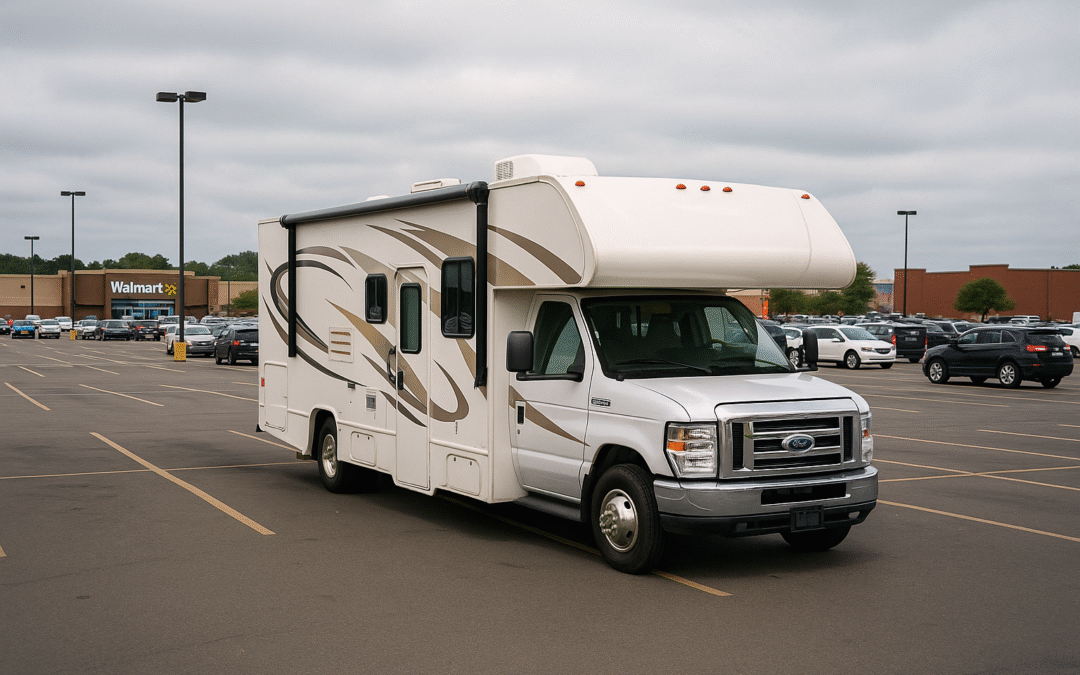
Walmart’s corporate FAQ says, “Permission to park is extended by individual store managers, based on availability of parking space and local laws” (Walmart). The same FAQ says Walmart permits RV parking on its lots “as we are able.” The corporate FAQ lists no time limit and no fee. Walmart asks RV owners to contact management at each store before parking.
This guide does not cover other retail chains, because no official overnight policy page was reviewed for them. For notes by state, see our Walmart overnight parking rules by state.
Rest area overnight rules by state (partial list)
Rest area time limits are set state by state, and the seven states below range from no overnight parking to 24 hours. The Florida Department of Transportation (FDOT) states, “Florida Administrative Code (FAC) Rule permits a period of three hours for the general public, and a period of ten hours for commercial motor vehicle operators subject to hours-of-service regulations” (FDOT). The rule was last amended December 5, 2018 (Florida rules portal). This table covers state-run rest areas in seven states only. It does not cover turnpike service plazas or private lots.
California’s rule reads, “Vehicles shall not be parked and persons shall not remain for more than eight (8) hours in any twenty-four (24) hour period” (21 CCR § 2205).
State rest area time limits, partial list of seven states. Each rule was opened September 26, 2026. Check posted signs and the state DOT before you stop.
| State |
Time limit |
Camping |
Rule and date |
Applies to |
| California |
8 hours in any 24-hour period |
Prohibited |
Cal. Code Regs. tit. 21, § 2205, operative April 6, 1995 |
State safety roadside rest areas |
| Oregon |
12 hours within any 24-hour period |
Prohibited, including setting up a tent or other structure |
OAR 734-030-0010, quoted by ODOT TripCheck |
State rest areas |
| Florida |
3 hours for the general public, 10 hours for commercial motor vehicle operators subject to hours-of-service regulations |
Prohibited |
Fla. Admin. Code R. 14-28.002, last amended December 5, 2018 |
Rest areas and welcome centers |
| Texas |
Up to 24 hours |
Not stated in the cited source |
TxDOT, citing Texas Transportation Code 545.411 |
Safety rest areas |
| Ohio |
No stay limit stated. Leaving a vehicle unattended for three hours without permission of the state highway patrol or the department is prohibited |
Prohibited |
Ohio Adm. Code 5501:2-4-01, effective May 15, 2023 |
Rest areas and roadside parks under Ohio Department of Transportation jurisdiction |
| Virginia |
No overnight parking |
Not stated. Sleeping in the rest area building is banned at all times |
24VAC30-51-30, effective March 11, 2026 |
State rest areas |
| Arizona |
No hour limit listed on the ADOT page |
Camping and campfires prohibited |
Arizona Department of Transportation (ADOT) rest area rules |
State rest areas |
For states not listed here, see our rest area overnight rules for every state, then confirm the rule with that state’s DOT.
Truck stops: RV parking and why truck spaces matter
Pilot and Love’s both publish RV services, but neither company’s pages reviewed list a nightly parking rate. Truck parking matters because federal surveys found drivers short of safe spaces, especially at night. This section covers only the Pilot Company and Love’s Travel Stops pages and two Federal Highway Administration (FHWA) surveys.
For more detail, read our guide to overnight RV parking at truck stops.
What Pilot and Love’s publish for RVs
- Pilot’s RV services page says, “Park in our overnight spaces for a safe travel break” (Pilot Company).
- Pilot lists RV dump stations, RV fuel lanes, and cylinder and bulk propane.
- Pilot offers Good Sam members “Discounted Dumping Fees,” but the page lists no dump or parking prices.
- Love’s lists more than 100 RV Stops, booked through camplife.com, with propane refills and RV dump among the amenities (Love’s).
Why truck spaces run short at night
FHWA’s 2015 Jason’s Law survey and its 2019 update asked different groups, so their figures are reported separately below.
- 2015 survey, drivers and logistics staff: 90 percent “reported struggling to find safe and available parking during night hours” (FHWA 2015 executive summary). The summary reports that figure in its driver perceptions section, which covers truck drivers and logistics personnel, and does not give the number of respondents.
- 2015 survey, state DOTs: “Almost half of the State DOTs reported unofficial and/or illegal parking on freeway interchange ramps and shoulders of highways,” per the same executive summary. An FHWA release dated August 21, 2015 called truckers being forced onto those ramps and shoulders a safety issue (FHWA release).
- 2019 update, parking supply: FHWA counted about 313,000 truck parking spaces nationally (FHWA 2019 update, presented December 1, 2020). About 40,000 were at public rest areas and about 273,000 at private truck stops.
- 2019 update, drivers: “98 percent of drivers reported problems finding safe parking.” The 2019 driver survey drew 11,696 responses, per the same presentation.
- 2019 update, timing: shortages were reported most often from 4 PM to 5 AM, Monday through Thursday.
Federal hours-of-service rules let property-carrying drivers drive a maximum of 11 hours after 10 consecutive hours off duty (FMCSA, page updated March 28, 2022). Where a truck stop offers RV spaces or a reservable RV Stop, use those and leave truck spaces to drivers.
Paid alternatives: what memberships cost in 2026
Harvest Hosts lists its Classic plan at $99 per year as of September 26, 2026 (Harvest Hosts plans). On that date, Harvest Hosts showed lower prices for your first year (Harvest Hosts). Boondockers Welcome lists its own plan at $79 per year (Boondockers Welcome plans). RV Overnights lists $49.99 per year (RV Overnights). All prices are company-published and subject to change. Harvest Hosts says renewal taxes depend on your billing address (Harvest Hosts help).
Overnight membership programs, list prices shown on each company’s site on September 26, 2026, subject to change. Sources: Harvest Hosts plans, Harvest Hosts how it works, Boondockers Welcome plans, Boondockers Welcome guest rules, RV Overnights membership, RV Overnights help.
| Program |
Annual list price |
Stay limit |
Rig requirement |
Purchase from host |
Extra fees |
Use case |
| Harvest Hosts Classic |
$99 |
Most stays one night. Harvest Hosts describes extra nights as both “up to four total nights” and “up to four extra nights” |
Fully self-contained, interior toilet and onboard waste tanks |
Many members choose to buy, per Harvest Hosts |
Extra nights are “for a fee,” and hookups are offered “for a small fee” |
Harvest Hosts network only, excludes Boondockers Welcome and Campground Partners |
| Harvest Hosts + Boondockers Welcome |
$169 |
Harvest Hosts rules above, plus the Boondockers Welcome cap below |
Fully self-contained |
Many members choose to buy at Harvest Hosts, per Harvest Hosts |
Same as the two programs’ own rules |
Harvest Hosts and Boondockers Welcome networks, plus Campground Partners |
| Harvest Hosts All Access |
$179 |
Harvest Hosts rules above, plus the Boondockers Welcome cap below |
Fully self-contained |
Many members choose to buy at Harvest Hosts, per Harvest Hosts |
Same as the two programs’ own rules |
Adds Boondockers Welcome, golf courses, Campground Partners and Escapees RV Club membership, which Harvest Hosts values at $49.95 |
| Boondockers Welcome |
$79 |
5 nights in a 90-day window with the same host |
Fully self-contained, interior toilet and built-in holding tanks or bladders |
Not stated on the pages cited |
Hosts may ask for costs if you use hookups, and free parking without hookups must stay an option |
Unlimited overnight stays with no camping fees |
| RV Overnights |
$49.99, or $29.99 with the Hero or FRVA discount |
One-night stays |
Not stated on the pages cited |
Members support the business with a purchase |
Not stated on the pages cited |
1,450+ locations in the U.S. and Canada |
RV Overnights renews annually, can be cancelled anytime and carries a 90-day money-back guarantee (RV Overnights help). RV Overnights says discount codes work only on website purchases, not memberships bought through the Apple App Store or Google Play.
Harvest Hosts: 20% off membership, not every trip cost
BOONDOCK20 saves new members 20% on any Harvest Hosts plan for the first year only. At the list prices above, that is $79.20 for Classic, $135.20 for Harvest Hosts + Boondockers Welcome, or $143.20 for All Access. The offer link applies the code automatically; these prices were displayed September 29, 2026. This lowers the initial membership bill but does not eliminate host-support spending, optional hookups, extra-night charges, taxes, or detours. Future renewals are at the then-current rate. Do not assume other promotions stack.
Save 20% on Harvest Hosts
Affiliate disclosure: Boondock or Bust may earn a commission at no extra cost to you. Confirm the final price and renewal terms at checkout.
For a side-by-side look at the programs, see Good Sam, Harvest Hosts and RVO compared. For host rules and common mistakes, read how Boondockers Welcome works.
How to confirm before you park
The checks below apply to U.S. retail lots, state rest areas, Pilot and Love’s locations, and the three membership programs covered above.
- Walmart: contact store management before you park, as Walmart’s FAQ asks (Walmart).
- Rest areas: look up the rule for each state on your route and read posted signs.
- Truck stops: reserve a Love’s RV Stop through camplife.com, or use Pilot’s overnight spaces where offered.
- Memberships: confirm your RV has an interior toilet and holding tanks before you join Harvest Hosts or Boondockers Welcome.
- Checkout: confirm the current price and any tax, since Harvest Hosts taxes vary by billing address.
For options that still allow free overnight stays, see where you can still park free overnight.
Frequently asked questions
Is free RV parking really free?
Free RV parking usually has no fee, but it comes with conditions. Walmart store managers grant permission based on space and local laws, and Walmart offers no electrical service for RVs (Walmart). State rest areas cap stays, from 8 hours in any 24 in California to no overnight parking in Virginia, per rules opened September 26, 2026.
What are Walmart’s overnight parking rules?
Walmart’s corporate FAQ says it permits RV parking on store lots “as we are able” (Walmart). Individual store managers grant permission based on available space and local laws. Walmart asks RV owners to contact management at each store before parking. The FAQ lists no time limit and no fee, so ask the store directly.
Can you sleep overnight at a rest area?
As of rules opened September 26, 2026, California allows 8 hours in any 24, Oregon 12 hours in any 24, and Florida 3 hours for the general public and 10 for commercial motor vehicle operators subject to hours-of-service regulations. Texas allows up to 24 hours, and Virginia allows no overnight parking. Check posted signs and the state DOT before departure.
Can RVs park overnight at truck stops?
Pilot’s RV services page invites RVers to “Park in our overnight spaces for a safe travel break” (Pilot Company). Love’s lists more than 100 RV Stops reserved through camplife.com. FHWA’s 2019 update found 98 percent of truck drivers surveyed reported problems finding safe parking. Use RV spaces where offered and leave truck spaces to drivers.
How much does Harvest Hosts cost in 2026?
As of September 26, 2026, Harvest Hosts lists Classic at $99 per year, Harvest Hosts plus Boondockers Welcome at $169 and All Access at $179 (Harvest Hosts). BOONDOCK20 gives new members 20% off any Harvest Hosts plan for the first year only: $79.20, $135.20, and $143.20 respectively at those list prices, as displayed September 29, 2026. Renewal taxes depend on your billing address. Confirm current pricing at harvesthosts.com before you join.
How much does RV Overnights cost?
RV Overnights lists its membership at $49.99 per year, renewing until cancelled (RV Overnights). Active duty, veterans, retirees and first responders can pay $29.99 per year through its Hero discount, and a separate FRVA discount carries the same price. The company offers a 90-day money-back guarantee, per its help center as updated August 27, 2026.
Do you have to buy something at Harvest Hosts or RV Overnights?
Harvest Hosts says many members choose to support their host by purchasing wine, produce, beer, gifts or experiences (Harvest Hosts). RV Overnights states that members support the business with a purchase of food, drinks, products or other offerings from the host (RV Overnights). Check each host’s listing before you arrive.
How long can you stay with Boondockers Welcome?
Boondockers Welcome allows a maximum of 5 nights in a 90-day window with the same host, for insurance purposes (Boondockers Welcome). Your RV must be fully self-contained, with an interior toilet and built-in holding tanks or bladders. Hosts may ask you to cover costs if you use their hookups, as long as free parking without hookups stays an option.
by Chuck Price | Sep 26, 2026 | Boondocking-Guide
Last updated: September 26, 2026
Chuck Price has 35+ years of RV camping experience and owns a 2018 Hymer Aktiv Class B.
Federal rule 36 CFR 2.10 allows camping in a national park only at sites or areas the superintendent designates. Under 36 CFR 1.4, parking an RV for overnight occupancy counts as camping. Death Valley, Big Bend and Canyonlands allow backcountry vehicle camping under their own permit rules. For planning a Yosemite RV trip in 2026, start with the reservation calendar.
Land access, permits, road conditions, and site availability change. Verify all information with the relevant land management agency before your trip. Conditions in remote areas can be hazardous. Assess your skill level and equipment before you go.
Quick answer
- Trip killers: Yellowstone bans overnight vehicle parking in pullouts and parking areas (Yellowstone). Big Bend says RVs and trailers cannot reach its River Road sites (Big Bend).
- Best for: High-clearance vehicles, plus small RVs under 30 feet and trailers under 25 feet at named Big Bend sites, depending on availability and road conditions (Big Bend).
- Confirm before you go: Read the park’s website for its camping rules (NPS). Each superintendent keeps a written list of park designations, closures and permit rules, available on request (36 CFR 1.7).
Is boondocking legal in national parks?
National park rules allow camping only at sites or areas the superintendent designates. Federal regulation 36 CFR 2.10(b)(10) prohibits “Camping outside of designated sites or areas.” That eCFR text is up to date as of September 24, 2026. The same rule lets the superintendent require permits, designate sites or areas, and set camping conditions. This rule covers National Park Service (NPS) units only. Bureau of Land Management (BLM) land and national forests follow their own rules, covered below. Our guide to camping during a government shutdown explains what stays open.
Overnight parking is camping under federal rules. Under 36 CFR 1.4, camping includes the “parking of a motor vehicle, motor home or trailer … for the apparent purpose of overnight occupancy.”
Three other parts of 36 CFR 2.10 matter for vehicle campers.
- Camping without a permit, where the park requires one, is prohibited.
- Digging or leveling the ground at a campsite is prohibited.
- Leaving camping equipment, site alterations or refuse after you depart is prohibited.
A person convicted of violating 36 CFR parts 1 through 7 faces the criminal penalties in 18 U.S.C. 1865, per 36 CFR 1.3(a). The law sets up to 6 months in prison, a fine, or both, plus the cost of the proceedings (18 U.S.C. 1865(a)). That statute text reflects laws in effect on September 23, 2026.
National parks that allow backcountry roadside camping
Some parks designate backcountry roads or sites where you may camp from a vehicle. Death Valley allows it on some dirt roads, while Big Bend and Canyonlands require a permit for all backcountry camping. This section covers only these three parks, checked on nps.gov on September 26, 2026. Rules change, so check the park website before you go.
Death Valley: one mile past paved or day-use roads
Death Valley allows roadside camping “along dirt roads at least one mile down the road from the junction with any paved road or ‘day use only’ dirt road.” That rule comes from the park’s backcountry camping page, last updated April 16, 2025. For more on the park, see camping in Death Valley.
The Death Valley page rules out roadside camping in these places:
- Paved roads, pullouts and parking lots
- The valley floor from Ashford Mill to 2 miles north of Stovepipe Wells
- Eureka Dunes and Greenwater Canyon
- Day-use-only roads: Titus Canyon, Mosaic Canyon, West Side, Wildrose, Skidoo, Aguereberry Point, Cottonwood Canyon (first 8 miles), Grotto Canyon, Racetrack (Teakettle Junction to Homestake Dry Camp), Natural Bridge Canyon, Desolation Canyon, Pinion Mesa and Big Pine (22 miles inside the park) roads
Permits are mandatory, at $10 per night, for 4×4 roadside camping in designated sites at Echo Canyon, Hole in the Wall and Cottonwood/Marble Canyons, and for roadside camping in Greenwater Valley (Death Valley). You book these permits online only, through Recreation.gov, up to 6 months ahead. Everywhere else, permits are free and recommended, from Furnace Creek Visitor Center, Stovepipe Wells Ranger Station or online.
The same Death Valley page also lists these rules:
- Group size is limited to 12 people and no more than 4 vehicles.
- Camp only in previously disturbed areas, more than 100 yards from any water source.
- Off-road driving is prohibited.
- Campfires are allowed only in metal fire rings or firepans, and camp stoves and propane grills are allowed.
Big Bend: 67 designated roadside sites
Big Bend says “the park offers 67 primitive campsites along backcountry roads” (Big Bend). The park states, “No shade, toilets, or other amenities are provided.” For trip planning, read our Big Bend guide.
“A backcountry permit is required for ALL backcountry camping in Big Bend National Park,” per the park’s permit page, last updated July 20, 2026. The permit costs $10 per night for overnight use, or $5 with a Senior or Access pass. Recreation.gov lists some roadside sites, but the park says that until further notice all backcountry campsites can only be obtained in person at Panther Junction Visitor Center.
Big Bend sets these stay limits (Big Bend):
- 14 consecutive nights per permit
- 14 nights per site per year
- 28 nights in the park per calendar year
- 14 nights total in the park from January 1 to April 15
Canyonlands: designated 4WD campsites by permit
The Canyonlands backcountry camping page, last updated April 29, 2025, says, “All backcountry camping requires a permit, which can be reserved online at recreation.gov.” White Rim Road, Elephant Hill, Lavender Canyon and Peekaboo/Horse Canyon roads need permits for day and overnight trips. Permits open four months ahead and close two days before the trip starts. The park releases them at 8 am Mountain Time in quarterly blocks.
The overnight four-wheel-drive (4WD) fee is a “$36 Permit Reservation fee (includes $6 Recreation.gov fee) + $5 per person, per night” (Canyonlands). The park entrance fee is charged on top of that.
Backcountry roadside camping rules in three national parks, checked September 26, 2026 (sources: NPS park pages linked in each row)
| Park |
Where you may camp |
Permit and fee |
Vehicle |
Page last updated |
Best for |
| Death Valley |
Dirt roads at least one mile from paved or day-use-only roads |
$10 per night at Echo Canyon, Hole in the Wall, Cottonwood/Marble Canyons and Greenwater Valley, free recommended permits elsewhere |
No vehicle type or length limit listed |
April 16, 2025 |
Roadside camping without a reservation outside the listed permit areas |
| Big Bend |
67 primitive campsites along backcountry roads |
$10 per night ($5 with Senior or Access pass), in person only until further notice |
High-clearance, usually 4WD |
July 20, 2026 |
Rugged vehicles, and small RVs or trailers at named sites |
| Canyonlands |
Designated sites on 4WD roads, by permit |
$36 reservation fee plus $5 per person per night, plus entrance fee |
High-clearance, low-range 4WD |
April 29, 2025 |
Drivers with low-range 4WD and rough-road experience |
Can you take an RV to these backcountry sites?
Big Bend says “A sturdy high-clearance and usually 4-wheel drive is necessary to safely reach most of them” (Big Bend). These size limits apply only to the named Big Bend sites below. The park says, “Small RVs (less than 30 feet) and trailers (less than 25 feet) may be accommodated at the following sites depending on availability and road conditions.”
- Croton Springs 1
- Grapevine Hills 1 and 2
- Hannold Draw
- K-Bar 1 and 2
- Nugent Mountain
- Nine Point Draw
- Paint Gap 2
River Road is different. The park’s River Road page says, “You will NOT be able to access these campsites with a passenger car, mini-van, RV, or trailer.” “The use of generators is prohibited in the backcountry,” per Big Bend.
Canyonlands says “A high-clearance, low-range four-wheel-drive vehicle is required along with experience driving rough roads” (Canyonlands). All-terrain vehicles (ATVs) and off-highway vehicles (OHVs) are prohibited. Group limits are 15 people and 3 vehicles at Island in the Sky, 10 people and 3 vehicles in The Needles, and 9 people and 3 vehicles in The Maze. The park adds, “Vehicle limits include motorcycles and trailers.” Death Valley’s backcountry page lists no vehicle type or length limit and no night limit.
What happens if you sleep in a pullout or parking lot?
Sleeping in your RV in a pullout or lot counts as camping, and it is prohibited unless the park designates that spot. The Yellowstone campgrounds page, last updated February 25, 2026, puts it in writing: “No car camping or overnight vehicle parking is allowed in pullouts, parking areas, picnic grounds, or any place other than a designated campground within Yellowstone National Park.”
Yellowstone campsites must be reserved in advance, except Mammoth Campground, which is first-come, first-served from October 15 to April 1. Reservations open six months before the stay date.
Where to boondock near national parks instead
Public land run by the BLM and the USDA Forest Service is where dispersed camping is broadly allowed. Dispersed camping means camping outside a designated, prepared campsite (Forest Service). Stay limits on both vary by state, field office or forest. To scout spots, learn to find dispersed sites with Google Maps.
BLM land
“Most BLM lands allow dispersed camping unless an area is posted ‘Closed to Camping’ or has specific restrictions for land use or conservation,” per the BLM camping page, checked September 2026. For more, see our summary of BLM camping rules.
- Stay limit: “Dispersed camping is generally limited to 14 days within any 28-day period, though specific stay limits vary by state and field office.”
- Federal rule 43 CFR 8365.1-2(a) sets no number and prohibits camping longer than the authorized officer permits.
- After the limit, you must move, often at least 25 to 30 miles away, per the BLM.
- Most areas need no permit or reservation, though some regions require permits for large groups or campfires.
- Camp within 150 feet of designated routes and at least 200 feet from lakes, rivers and streams.
National forests
“Dispersed camping is allowed on the vast majority of national forests and grasslands,” and it is “usually permit-free and fee-free” (Forest Service). Heavily used areas may require permits and fees through ranger stations or Recreation.gov. Read more in our guide to national forest camping.
The Forest Service Intermountain Region lists these rules for its forests, and other regions may differ (Intermountain Region).
- “You may camp in a dispersed area for a limited number of days set by the forest.”
- “Please place your campsite at least 200 feet from any stream or other water source.”
- Each forest’s “motorized visitor use map” defines where you may drive to camp.
Park passes and camping fees
The America the Beautiful pass covers “entrance fees and standard amenity (day-use) fees” at NPS, U.S. Fish and Wildlife Service, Forest Service, BLM, Bureau of Reclamation and Army Corps of Engineers sites (NPS passes page, last updated January 5, 2026). The federal pass store’s FAQ says, “The Resident Annual Pass does not cover Expanded Amenity fees such as camping, boat launching, parking, special tours, special permits or ferries.”
The Senior Pass “may provide a 50 percent discount on some amenity fees charged for facilities and services such as camping” (NPS). At many sites, the Access Pass gives a discount on expanded amenity fees such as camping (USGS Store). Big Bend’s backcountry permit shows how that works: $10 per night, or $5 with a Senior or Access pass (Big Bend). Our America the Beautiful pass guide covers buying and using the pass.
How to check a park’s camping rules before you go
Each park sets its own camping rules, so check that park before you drive in. New to camping off the grid? Start with boondocking basics for beginners.
- Open the park’s website and find its camping information (NPS).
- Ask for the superintendent’s compendium, the written list of designations, closures and permit rules that federal rule requires each park to update every year (36 CFR 1.7(b)).
- Check whether backcountry or campground sites need a permit or a Recreation.gov reservation (NPS).
- For BLM or national forest land, stop at the local ranger station for current information (Forest Service).
Before you leave, confirm current road conditions, closures and permit status with the park or land agency directly.
Frequently asked questions
Can you sleep in your RV in a national park parking lot?
No, unless the park designates that lot for camping. Federal rule 36 CFR 1.4 counts parking a motor home or trailer for overnight occupancy as camping. Camping is allowed only at designated sites or areas. Yellowstone bans overnight vehicle parking in pullouts, parking areas and picnic grounds, as of its February 25, 2026 page. Verify current rules before departure.
Is dispersed camping allowed in national parks?
Only where a park designates backcountry sites or areas. As of September 26, 2026, Death Valley allows roadside camping on dirt roads at least one mile past the junction with any paved or day-use-only road. Big Bend and Canyonlands require permits for all backcountry camping at designated sites. Other parks set their own rules, so verify current status before departure.
Do you need a permit to camp at a backcountry roadside site?
It depends on the park. As of September 26, 2026, Big Bend and Canyonlands require a permit for all backcountry camping. Death Valley requires permits at Echo Canyon, Hole in the Wall, Cottonwood/Marble Canyons and Greenwater Valley. Elsewhere in Death Valley, permits are free and recommended. Verify current status before departure.
How much does backcountry roadside camping cost in national parks?
As of September 26, 2026, Big Bend charges $10 per night, or $5 with a Senior or Access pass. Death Valley charges $10 per night at Echo Canyon, Hole in the Wall, Cottonwood/Marble Canyons and Greenwater Valley. Canyonlands charges a $36 reservation fee plus $5 per person per night, plus the entrance fee. Verify current fees before departure.
Can an RV reach Big Bend’s roadside campsites?
Most sites need a high-clearance vehicle and usually 4WD. Small RVs under 30 feet and trailers under 25 feet may fit at Croton Springs 1, Grapevine Hills 1 and 2, Hannold Draw, K-Bar 1 and 2, Nugent Mountain, Nine Point Draw and Paint Gap 2, depending on availability and road conditions. Verify before departure.
What happens if you camp in the wrong place in a national park?
Camping outside designated sites or areas violates federal rule 36 CFR 2.10. Under 36 CFR 1.3, a conviction carries the criminal penalties in 18 U.S.C. 1865. That law sets up to 6 months in prison, a fine, or both, plus the cost of the proceedings. Check the park’s designated sites before you park for the night.
Where can you boondock near a national park for free?
Look at BLM land and national forests. The BLM generally limits dispersed camping to 14 days within any 28-day period, but limits vary by state and field office. National forest dispersed camping is usually permit-free and fee-free, with stay limits set by each forest. Check with the local office before departure.
Does the America the Beautiful pass cover camping?
No. As of the NPS page updated January 5, 2026, the pass covers entrance fees and standard amenity (day-use) fees. The USGS pass store says the Resident Annual Pass does not cover expanded amenity fees such as camping. Senior and Access pass holders may get camping discounts at some sites. Confirm the discount with the campground before you book.