Updated October 3, 2026.
Buy a filter for the job it has to do. For taste and chlorine at a campground spigot, an inline filter in the $27 to $38 range is usually enough. For sandy or muddy sources, add a sediment pre-filter first. For water that is not marked potable, no filter on this page makes it safe on its own.
This is a spec comparison, not a lab test. Every price, micron rating, and certification claim below comes from the linked manufacturer or retailer page. Prices checked September 30, 2026. If you boondock, read this next to our guides on RV boondocking water management and freshwater management for RV boondocking.
Quick picks by job
| Job | Model | Published spec | Price | Source |
|---|---|---|---|---|
| Everyday spigot filter | Clear2O CRV1005 | 5 micron solid carbon block. The page lists no NSF certification. | $37.99 | Clear2O |
| Lower-cost two-stage | Clear2O 2IN1 | 10 micron solid carbon block plus 15 micron pre-filter | $26.99 | Clear2O |
| Listed NSF/ANSI 42 and 53 | Camco TastePURE 40043 | Camco lists a 20 micron sediment filter and says the product is certified to NSF/ANSI 42 and 53. Its lead-free construction is certified to NSF/ANSI 372. | $34.99 | Camco |
| Sandy or muddy sources | Clear2O DirtGUARD CPF1000-10 | 10 micron sediment pre-filter | $49.99 | Clear2O |
| Staged filtration | Clear2O canister systems | Single canister $129.99, dual $249.99, triple $349.99 | $129.99 to $349.99 | Clear2O |
Prices checked September 30, 2026. Clear2O prices come from the manufacturer. The Camco price and specifications come from the manufacturer.
Inline hose filter or whole-rig canister?
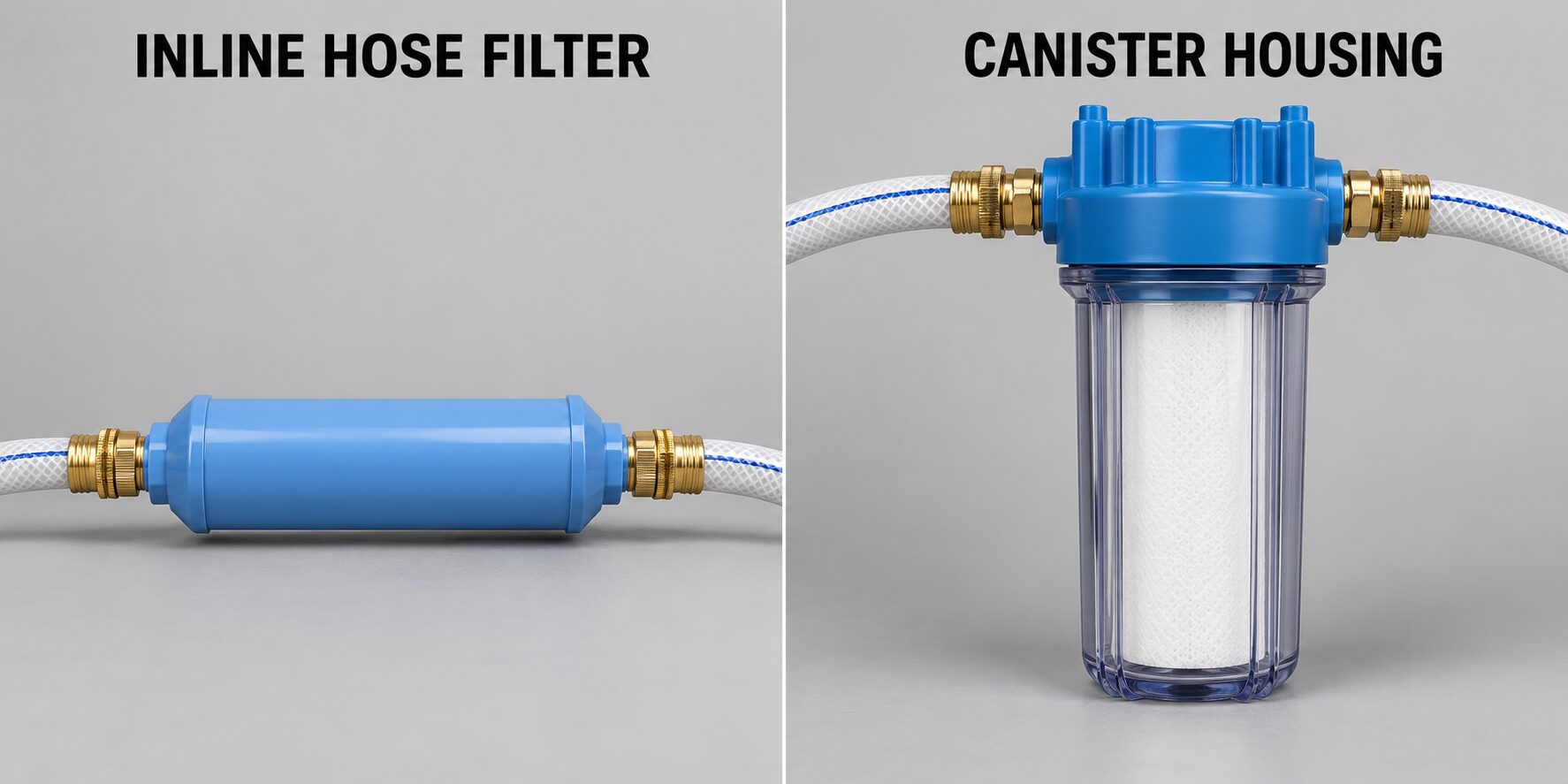
An inline hose filter threads onto the spigot hose. It is one sealed unit, so you replace the whole filter. Clear2O lists the CRV1005 as outdoor use only and not for use under the faucet cabinet. On this list they cost $26.99 to $37.99.
A canister system uses a housing that holds replaceable cartridges. That lets you put a sediment cartridge ahead of a carbon cartridge. Clear2O sells single, dual, and triple canister systems from $129.99 to $349.99.
Pick an inline filter if you fill at campground spigots and want a low cost and a fast swap. Pick a canister system if you want staged filtration and you will keep the setup for years. That is a judgment call, not a manufacturer claim.
Micron ratings: what the number tells you
A micron is one millionth of a meter. The rating tells you the particle size a filter is built to trap. A lower number traps finer particles and clogs faster. That is why high-sediment areas need a pre-filter. Clear2O says some areas with high sediment may need a pre-filter to prevent low flow and clogging.
The micron number does not tell you what the filter removes chemically or biologically. The CDC puts it plainly: “Most portable water filters will remove parasites, but not viruses or bacteria.” The National Park Service filter-and-disinfect steps call for a 1 micron filter, followed by disinfection. The spigot filters on this page are sold for taste, odor, chlorine, and sediment.
Camco lists the TastePURE 40043 at 20 micron and says it is certified to NSF/ANSI 42 and 53, with lead-free construction certified to NSF/ANSI 372. Certification still applies only to the specific reduction claims in the listing, so check the exact model before buying.
NSF/ANSI 42 vs 53: read the claim, not the logo
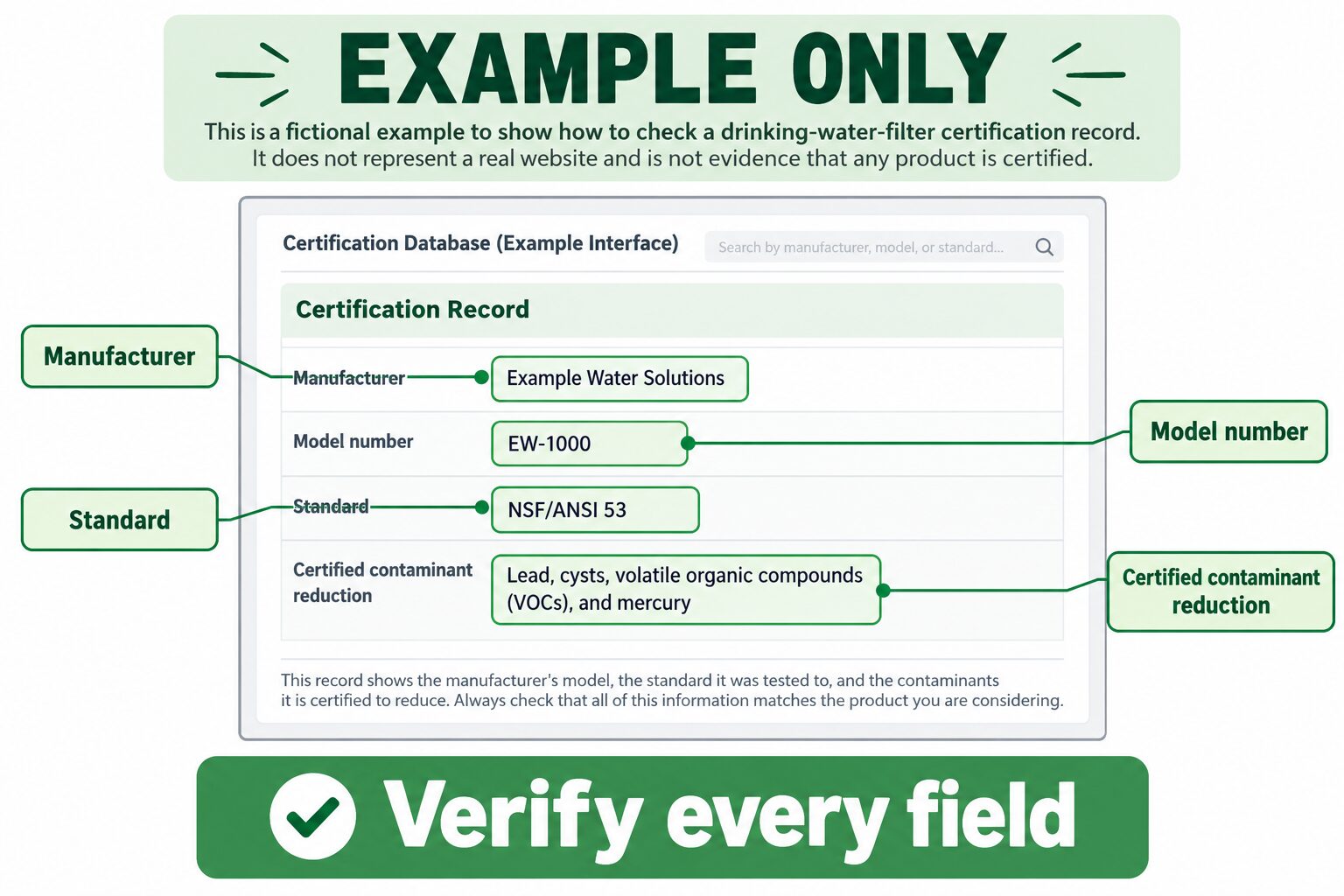
NSF/ANSI 42 covers aesthetic effects such as chlorine, taste, and odor. NSF/ANSI 53 covers health effects. NSF warns that certification “does not mean that a filter, purifier or treatment system will reduce all possible contaminants.” Each certification applies to the specific contaminants named on the listing.
That means “NSF 42” is a taste claim. It is not a lead claim and it is not a germ claim. NSF/ANSI 55 covers ultraviolet treatment systems that inactivate bacteria, viruses, and cysts. Standard 42 and 53 filters are a different category.
To verify a model, search the NSF certified drinking water treatment unit listings by manufacturer and model. Treat any filter you cannot find there as uncertified, whatever the packaging says. The CRV1005 page lists no NSF certification, so this page does not call it certified.
Set up your RV water filter in this order
RV water hookup order
Flush first
Controls pressure
Spigot side of hose
To RV inlet
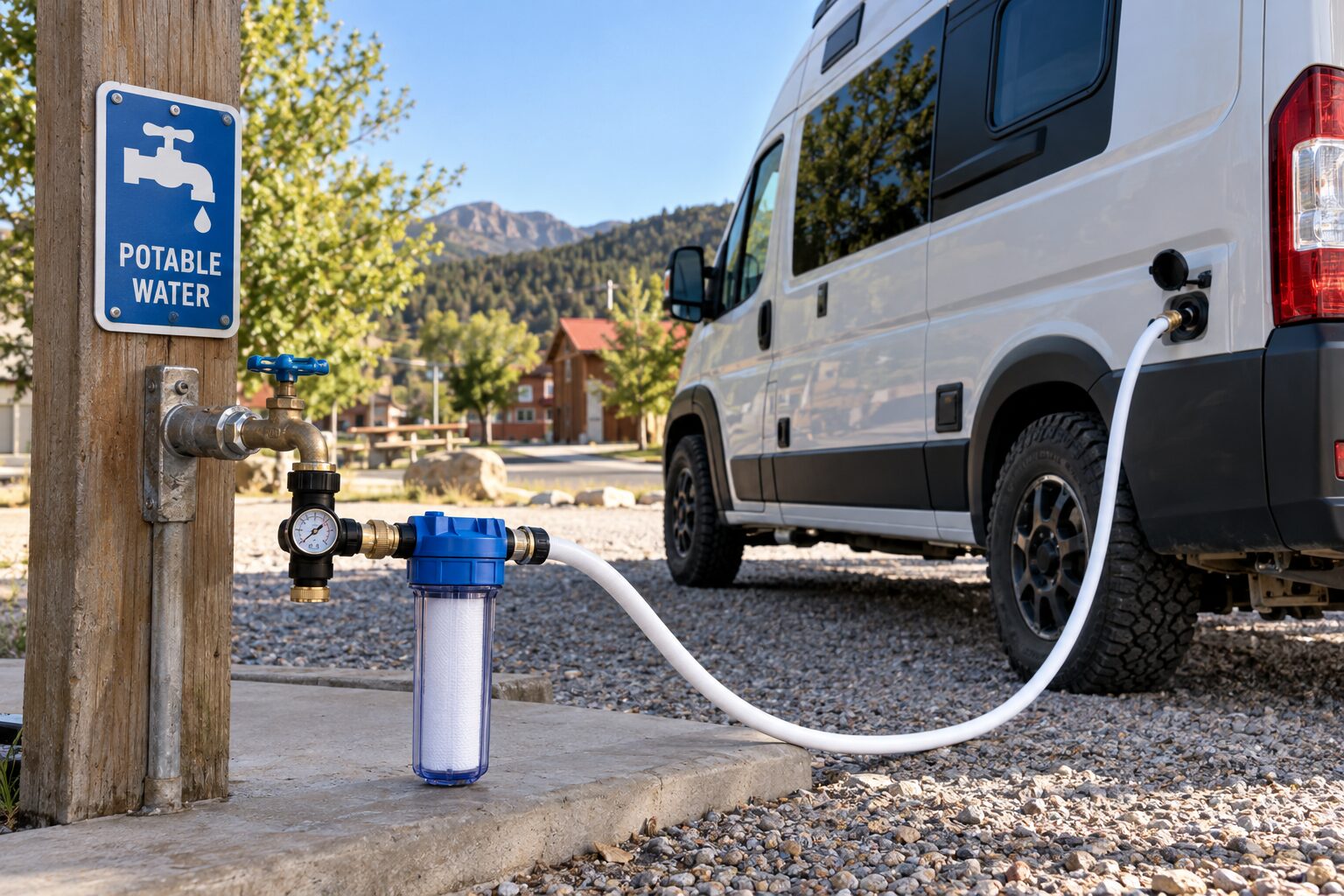
- Spigot. Confirm it is meant for drinking water. Flush it before you attach anything. Clear2O says flushing helps avoid clogging the filter.
- Pressure regulator. Clear2O says to use a water pressure regulator with its inline filter.
- Filter. Clear2O recommends installing its inline filter on the spigot side of the hose, not at the RV water inlet. Add a sediment pre-filter ahead of it when the source is sandy or muddy.
- Drinking-water-safe hose. Use a hose sold for drinking water, then connect to your RV inlet.
This order is our own setup recommendation. Clear2O says only to use a regulator and to put its filter on the spigot side of the hose.
For where to find safe fills on the road, see where to find potable water while boondocking.
What a filter costs per year
None of the manufacturer pages checked list a gallon rating for these models. Clear2O says filter life varies with local water and volume used. So this table shows cost per year for one, two, and four filter changes. Camco says its basic inline filters can last up to 3 months, so four changes per year is a reasonable upper-end replacement schedule.
| Filter | Price per change | 1 change per year | 2 changes per year | 4 changes per year |
|---|---|---|---|---|
| Clear2O CRV1005 (5 micron carbon block) | $37.99 | $37.99 | $75.98 | $151.96 |
| Clear2O 2IN1 (10 micron carbon plus 15 micron pre-filter) | $26.99 | $26.99 | $53.98 | $107.96 |
| Camco TastePURE 40043 | $34.99 | $34.99 | $69.98 | $139.96 |
| Clear2O DirtGUARD replacement pre-filter RDG201 (10 micron) | $27.99 | $27.99 | $55.98 | $111.96 |
Prices checked September 30, 2026. Sources: Clear2O CRV1005, Clear2O collection page, and Camco. Math is price times number of changes. Canister housings cost $129.99 to $349.99 up front, and the table does not include them.
Change a filter sooner when flow drops. Clear2O links low flow and clogging to high-sediment water.
When a filter is not enough for boondocking tank water
A filter is a fill-hose tool for taste and sediment. Clear2O says not to use its filters on water that is microbiologically unsafe. The CDC says the next best option after boiling is to filter and then disinfect. It says to filter before using UV light.
| Water source | What to do | Filter alone enough? |
|---|---|---|
| Marked potable campground or municipal spigot | Flush the spigot, then use an inline filter for taste and sediment if you want one. | For taste and sediment, yes |
| Unmarked, rural, or unknown spigot | Treat it as untrusted. Boil it, or filter and then disinfect, before drinking. | No |
| Stream, lake, or pond | Do not run it through a spigot filter into your tank. Boil it, or filter and then disinfect. Skip water with a posted algal bloom. | No |
For boiling, the CDC says bring clear water to a rolling boil for 1 minute, or 3 minutes above 6,500 feet. The Minnesota Department of Health adds that backcountry treatment devices cannot remove algal bloom toxins, and that boiling “will not remove toxins and can increase toxin levels.”
For safe places to fill, use our guide to finding potable water while boondocking. Use it before you fill from an unmarked source.
Winter and freezing
Clear2O says to shake the water out of its inline filter before freezing starts and not to let it freeze. Freezing water can damage the filter. Remove your filter and drain it before a freeze. These steps cover inline filters only. They do not cover canister housings. For the rest of your system, follow our RV winterizing guide.
RV water filter FAQ
Do I need an RV water filter?
A filter helps with taste, chlorine, and sediment at a campground spigot. It does not make unknown or untreated water safe to drink. If the source is not marked potable, treat the water first.
What micron RV water filter should I buy?
No single rating fits every source. Lower micron numbers trap finer particles and clog faster. Clear2O lists its CRV1005 at 5 micron, and its DirtGUARD pre-filter at 10 micron for sediment-heavy sources. Match the rating to your water, then confirm any NSF claim in the NSF listing.
Does an RV water filter remove bacteria and viruses?
Usually not. The CDC says most portable water filters remove parasites but not viruses or bacteria. For untreated water, boil it for 1 minute (3 minutes above 6,500 feet) or filter first and then disinfect.
What order do RV water filter parts go in?
Spigot, pressure regulator, filter, then a drinking-water-safe hose to your RV. Flush the spigot before you attach anything. Clear2O recommends a regulator and installing its inline filter on the spigot side of the hose.
How often should I change an RV water filter?
Manufacturers say filter life depends on your water and how much you use. Clear2O gives no fixed interval for its inline filters. Camco says its basic inline filters can last up to 3 months. Change sooner if flow drops or bad taste returns.
Sources
- Camco Outdoors. (n.d.). TastePURE water filter [Product page, price checked September 30, 2026]. https://camcooutdoors.com/products/tastepure-rv-water-filter
- Centers for Disease Control and Prevention. (2025, November 24). About water treatment options when hiking, camping, or traveling. https://www.cdc.gov/drinking-water/prevention/water-treatment-hiking-camping-traveling.html
- Clear2O. (n.d.). CLEAR2O RV and marine inline water filter CRV1005 [Product page, price checked September 30, 2026]. https://www.clear2o.com/products/clear2o%C2%AE-rv-and-marine-inline-water-filter-crv1005
- Clear2O. (n.d.). Recreational vehicle products [Collection page, prices checked September 30, 2026]. https://www.clear2o.com/collections/recreational-vehicle
- Minnesota Department of Health. (2025, December 24). Preventing illness while camping, hiking, and traveling. https://www.health.state.mn.us/diseases/waterborne/prevention/backcountry.html
- National Park Service. (n.d.). Backcountry health. https://home.nps.gov/subjects/healthandsafety/backcountry-health.htm
- NSF. (2025, July 21). NSF standards for water treatment systems. https://www.nsf.org/consumer-resources/articles/standards-water-treatment-systems
- NSF. (n.d.). NSF certified drinking water treatment units. https://info.nsf.org/Certified/DWTU/


