
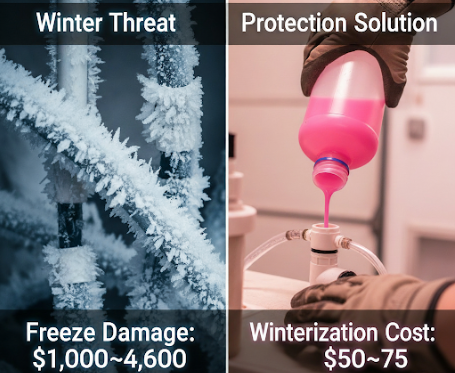
Winterize your RV before the first night at or below 32°F, the temperature NOAA’s National Centers for Environmental Information (NCEI) uses to define a freeze. Camping World warns that one freezing night is enough to damage RV plumbing. You can protect the system with RV antifreeze alone, or blow the lines out with compressed air and then add antifreeze to the drains. Airstream calls some combination of an air compressor blow-out and a non-toxic RV antifreeze flush essential.
Last updated: September 26, 2026
Chuck Price has 35+ years of RV camping experience and owns a 2018 Hymer Aktiv Class B.
Where manufacturers disagree on a number, this guide gives each figure and names who publishes it. Follow your RV’s owner’s manual wherever it differs from the steps below. For year-round upkeep, see our RV maintenance and repair guide.
When to winterize your RV
Water left in RV plumbing freezes at 32°F, and one freezing night is all it takes to cause damage (Camping World). When water freezes and expands inside a fitting, the fitting often develops a hairline crack, per Camping World. NCEI describes a freeze as a time when “surface air temperature is expected to be 32°F or below over a widespread area for a climatologically significant period of time”. Your first-freeze date depends on where you store the rig, so check it for your own area.
NCEI publishes first-fall-freeze maps based on the 1991-2020 Climate Normals. The median map shows the date by which a freeze arrives in 5 of 10 years. The earliest map shows a date so early that a freeze arrives by then in only 1 of 10 years.
If you want a dealer to do the work, Camping World advises booking 3 to 4 weeks before temperatures dip into the 40s. If you plan to camp through the cold instead of storing the rig, read our tips on staying warm while boondocking in winter.
RV antifreeze: which type and how much
Use propylene glycol RV antifreeze. Never put ethylene glycol automotive antifreeze in RV plumbing. Camco’s winterization brochure, in a dealer-hosted copy, states, “Most automotive antifreezes are made from ethylene glycol, which is highly toxic.” Keystone RV says automotive antifreeze is poisonous and not suitable for potable water systems. Poison Control says it is dangerous to swallow antifreeze, even in small amounts. If someone swallows antifreeze, call Poison Control at 1-800-222-1222.
- RV antifreeze is made from propylene glycol, which Camco says the U.S. government considers “GRAS (Generally Regarded As Safe)” (Camco brochure).
- Federal rule 21 CFR 184.1666 lists propylene glycol as a direct food substance affirmed as GRAS, with use limits by food category (eCFR).
- That GRAS listing does not make RV antifreeze something to drink. Camping World says RV antifreeze is not meant for consumption by humans or animals. Camping World says your first step should always be reading the product label.
- Stores sell propylene glycol blends that contain ethanol and ethanol-free propylene glycol formulas (Camping World).
- Camco says a system winterized properly with -50 RV antifreeze should show a freeze point around +10°F, which indicates burst protection to -50°F.
Plan on 2 to 6 gallons of RV antifreeze, depending on the rig. Camping World says most RVs use 2 to 4 gallons, Camco’s checklist lists 2 to 4 gallons, and Keystone RV lists 4 to 6 gallons. Bypassing the water heater saves as much as 6 to 8 gallons, per Camco. Camco also notes that RV water heaters hold 6 to 10 gallons.
| Source | Gallons | When it applies |
|---|---|---|
| Camping World | 2 to 4 | Most RVs, including what goes down the sinks |
| Camco brochure (dealer-hosted copy) | 2 to 4 | Checklist amount, which Camco says may vary |
| Keystone RV | 4 to 6 | Keystone’s antifreeze winterizing guide |
| Camco brochure (dealer-hosted copy) | Saves as much as 6 to 8 | When you bypass the water heater |
How to winterize an RV with antifreeze, step by step
The antifreeze method drains the system, bypasses the water heater and pumps RV antifreeze through every line until it reaches each fixture. Keystone RV estimates the job at approximately two hours. Steps and valve layouts differ by model, so check each step against your owner’s manual. The sequence below draws on Winnebago, Keystone RV, Airstream, Dometic and Camco instructions.
- Empty the fresh, gray and black tanks, and drain the water heater (Winnebago).
- Turn the water heater off for both gas and electric modes (Keystone RV). Let the water cool before you remove the drain plug (Dometic manual).
- Turn the water heater bypass valve to the bypass position (Airstream).
- Bypass any in-line or undersink water filtration systems (Camco brochure). Keystone RV removes and discards the filter cartridge, drains the base and reinstalls it.
- Remove the low point drain caps for the water lines and open all faucets and the outside shower, if equipped (Keystone RV). After the fresh water tank drains, reinstall the low point drain caps and close any open faucets and valves before you pump (Keystone RV).
- Pump antifreeze in from inside with a water pump conversion kit or from outside with a hand pump (Camco brochure). Keystone RV installs a bypass hose on the suction side of the water pump and connects it directly to the antifreeze container.
- Open the cold-water side of each faucet one at a time until antifreeze comes out, then repeat on the hot side (Keystone RV).
- Flush the toilet until antifreeze flows into the bowl (Keystone RV).
- Pour RV antifreeze down each drain and into the toilet bowl to protect the P-traps (Winnebago).
- Leave the antifreeze in the lines until spring and do not drain it (Camco brochure).
Sources disagree on how much antifreeze each drain needs. Airstream says a cup, and Camco’s blog says about a cup. Camco’s brochure says at least 2 pints. Keystone RV says about one quart per drain, P-trap and toilet. For model-specific upkeep on a van-based rig, see our Class B RV maintenance guide.
Water heater bypass
Bypass the water heater before you add antifreeze (Winnebago). Turn the water heater off before you open the pressure-temperature relief valve to let air in (Dometic manual). Dometic says the approximately two quarts of water left in its tank after draining will not damage the tank if it freezes.
Manufacturers disagree on when to drain the heater. Winnebago, Keystone RV and Airstream drain it at the start. Camco’s brochure says “DO NOT DRAIN THE WATER HEATER until after you have filled your pipes with antifreeze” and opens the drain plug at the end. Follow the order in your owner’s manual.
Ice makers, washers and tankless heaters
- If your RV has a residential refrigerator, do not add antifreeze to the ice maker water line. Drain the line along with the rest of the water lines instead (Keystone RV).
- If you have an ice maker or washing machine, check its manual for specific winterization steps (Camco).
- If your rig has a tankless water heater, Keystone RV refers you to the operator’s manual.
Holding tanks
Drain and flush the holding tanks thoroughly before storage. Airstream says frozen sewage in the tanks could seriously damage them. The CDC lists protective gear for workers who handle human waste or sewage. That guidance is general, not RV-specific (CDC). The list covers goggles, a face mask or splash-proof face shield, liquid-repellent coveralls, waterproof gloves and rubber boots. Wash your hands with soap and water immediately after you handle human waste or sewage (CDC).
How to blow out RV water lines with compressed air
A blow-out pushes water out of the lines with compressed air instead of filling them with antifreeze. Camco attaches a blow-out plug to the water intake fitting and applies air pressure from an oilless air compressor. Keystone RV and Winnebago both finish a blow-out by adding RV antifreeze to the drains. Winnebago says this protects the traps.
Manufacturer air pressure limits range from 30 to 50 pounds per square inch (psi). Keystone RV says to set the air pressure to “no more than 30 PSI”. Winnebago says around 40 to 50 psi max and warns that higher pressure can damage your lines. Use the figure in your owner’s manual. If you have no figure, the lowest limit here, 30 psi, is the cautious choice.
| Manufacturer | Pressure | How the source frames it |
|---|---|---|
| Keystone RV | 30 psi | No more than 30 PSI |
| Winnebago | 40 to 50 psi | Around 40 to 50 psi max, higher can damage lines |
| Camco | 50 psi | Never exceed 50 PSI |
| Airstream | 50 lb | Apply 50 lb of air pressure at the city water inlet |
- Remove the low point drain caps and open all faucets and the outside shower, if equipped (Keystone RV).
- Drain the fresh water tank. Turn the water heater off, remove its drain plug and open the pressure relief valve. Empty the holding tanks and set the water heater bypass valves to bypass (Keystone RV).
- Attach the blow-out plug at the city water inlet and apply air from an oilless compressor (Camco brochure).
- Hold the toilet valve open until the water clears from the toilet supply line (Keystone RV).
- Run a washer fill cycle on warm to open both hot and cold valves, and let air blow through until no more water comes out (Keystone RV).
- Pour RV antifreeze into each drain, P-trap and toilet. Keystone RV uses about one quart for each.
- Reinstall the drain caps and plugs, and close any valves to keep critters out of the fresh water system (Keystone RV).
RV battery storage in cold weather
Charge RV batteries fully and disconnect them before winter storage. Battle Born says to bring batteries to a full charge, then disconnect them with the disconnect switch or by removing the positive main battery cable. Camco says to remove batteries for storage on a tender or turn off the RV’s battery disconnect switch. Airstream says to store removed batteries in a cool, dry place and keep them fully charged. Lead-acid and lithium batteries handle cold differently, so check which type you have.
Lead-acid batteries
- A fully charged lead-acid starter battery (specific gravity 1.265) freezes at -67°F, per Battery Council International figures cited by Battery University.
- A discharged lead-acid battery (specific gravity 1.15) freezes at 5°F, per the same figures (Battery University).
- Battery University says flooded lead-acid batteries tend to crack the case and leak if frozen.
- Battle Born warns that a discharged lead-acid battery in the cold can freeze solid and even explode.
- Battery University gives a lead-acid charge window of -4°F to 122°F (-20°C to 50°C).
- Rolls Battery rates flooded lead-acid capacity at 77°F. Its bank-sizing multiplier rises as temperature drops, to 1.37 at 30°F and 2.17 at 0°F (Rolls Battery).
Lithium (LiFePO4) batteries
Lithium charging limits vary by battery and by its battery management system (BMS). Battle Born says its batteries will not accept a charge when their internal temperature is below 24°F. A separate Battle Born article says charging a lithium-ion battery when its internal temperature is below 25°F can cause long-term and permanent damage. Battery University says consumer lithium-ion batteries cannot be charged below 32°F (0°C). Check your battery maker’s spec before you charge in the cold. Battle Born lists a storage range of -15°F to 140°F for its LiFePO4 batteries. Battle Born puts their self-discharge rate at 2-3% a month on average.
Propane, tires, pests and moisture
Plumbing is only part of winter storage. Propane, tires, rodents and condensation each need a step before you walk away from the rig. If you are heading out instead, our list of winter boondocking essentials covers gear for cold-weather camping.
Propane
Shut off the propane tanks, as Airstream‘s winter storage checklist directs.
Tires
Michelin’s RV tire brochure (2017, a dealer-hosted copy) gives these storage steps.
- Place a barrier such as plastic, plywood, cardboard or rubber mats between the tire and the storage surface.
- If the rig sits outdoors, cover the tires to block direct sunlight and ultraviolet (UV) rays.
- Inflate tires to the maximum inflation pressure shown on the sidewall.
- Store the rig away from electric generators or transformers.
- For storage longer than 3 months, consider a monthly highway drive of about one hour.
Mice and other rodents
- Mice can fit through a hole the width of a pencil, 1/4 inch or 6 millimeters across (CDC).
- Fill small holes with steel wool, then hold it in place with caulk or use spray foam (CDC).
- Keep food sealed in thick plastic, metal or glass containers with tight lids (CDC).
Moisture and condensation
Jayco’s owner’s manual says proper ventilation or a dehumidifier will help control condensation. Winnebago says to flip up mattresses and cushions to keep condensation from building up.
What RV winterization costs
As of September 2026, Camping World puts a dealer blow-out at $75 to $100 and a complete antifreeze package at $125 to $150. Doing it yourself runs roughly $30 to $80 the first year, per the same source. These are one retailer’s ranges, so ask your local shop for a quote.
| Item | Price range | Who it applies to |
|---|---|---|
| Basic blow-out service | $75 to $100 | Owners using a dealer or service center |
| Complete antifreeze package | $125 to $150 | Owners using a dealer or service center |
| DIY, first year | $30 to $80 | Owners who winterize themselves |
| DIY antifreeze, later years | $20 to $30 | Owners who winterize themselves after the first year |
| RV antifreeze | $4 to $8 per gallon | Anyone buying antifreeze |
| Professional de-winterization | $50 to $100 | Spring startup at a dealer |
Camping World lists repair ranges for skipped winterization. Burst water lines run $200 to $1,500+, a water heater tank $600 to $1,200+, and extensive water damage $5,000 to $15,000+.
De-winterizing your RV in spring
Flush the antifreeze out of the fresh water system before you use it again. Camping World says to repeat the flush at least 2-3 times and let the system sit and soak between each. For refilling and tank care afterward, see our guide to managing your fresh water system.
If mice got in over the winter, follow the CDC cleanup steps.
- Open all doors and windows for 30 minutes before cleaning.
- Do not vacuum or sweep droppings.
- Wear rubber or plastic gloves.
- Mix 1.5 cups of bleach per gallon of water, a 1:9 ratio, and let it soak 5 minutes.
Frequently asked questions
How much antifreeze do I need to winterize an RV?
Camping World says most RVs use 2 to 4 gallons of RV antifreeze, and Camco’s checklist lists 2 to 4 gallons. Keystone RV lists 4 to 6 gallons. Bypassing the water heater saves as much as 6 to 8 gallons, per Camco. Plan on 2 to 6 gallons depending on your rig.
Can I use car antifreeze in my RV?
No. Automotive antifreeze is usually ethylene glycol, which Camco calls highly toxic and Keystone RV calls poisonous and unsuitable for potable water systems. Use propylene glycol RV antifreeze. If someone swallows antifreeze, call Poison Control at 1-800-222-1222.
Is RV antifreeze safe?
RV antifreeze is propylene glycol. Federal rule 21 CFR 184.1666 lists propylene glycol as generally recognized as safe (GRAS) as a direct food substance, within set limits. It is still not meant to drink. Read the product label, and flush the lines at least 2 to 3 times in spring.
What psi should I use to blow out RV water lines?
Manufacturer limits range from 30 psi (Keystone RV) to around 40 to 50 psi (Winnebago) and 50 psi (Camco). Airstream’s guide applies 50 lb of air pressure at the city water inlet. Use the figure in your owner’s manual. If you have none, the lowest limit, 30 psi, is the cautious choice.
When should I winterize my RV?
Winterize before the first night at or below 32°F. NCEI first-freeze maps show typical first-freeze dates for your area. Camping World suggests booking a service 3 to 4 weeks before temperatures dip into the 40s.
How much does RV winterization cost?
As of September 2026, Camping World lists $75 to $100 for a dealer blow-out and $125 to $150 for a complete antifreeze package. Doing it yourself costs roughly $30 to $80 the first year and about $20 to $30 in later years.
Do I still need antifreeze if I blow out the lines?
Yes, for the drains. Keystone RV and Winnebago both add RV antifreeze to the drains and P-traps after the blow-out. Keystone RV uses about one quart per drain, P-trap and toilet.
Should I disconnect my RV battery for winter?
Yes. Charge the batteries fully first. Camco says to remove them for storage on a tender or turn off the disconnect switch. Battle Born says to use the disconnect switch or remove the positive main battery cable. A discharged lead-acid battery freezes at 5°F, per Battery University.


