
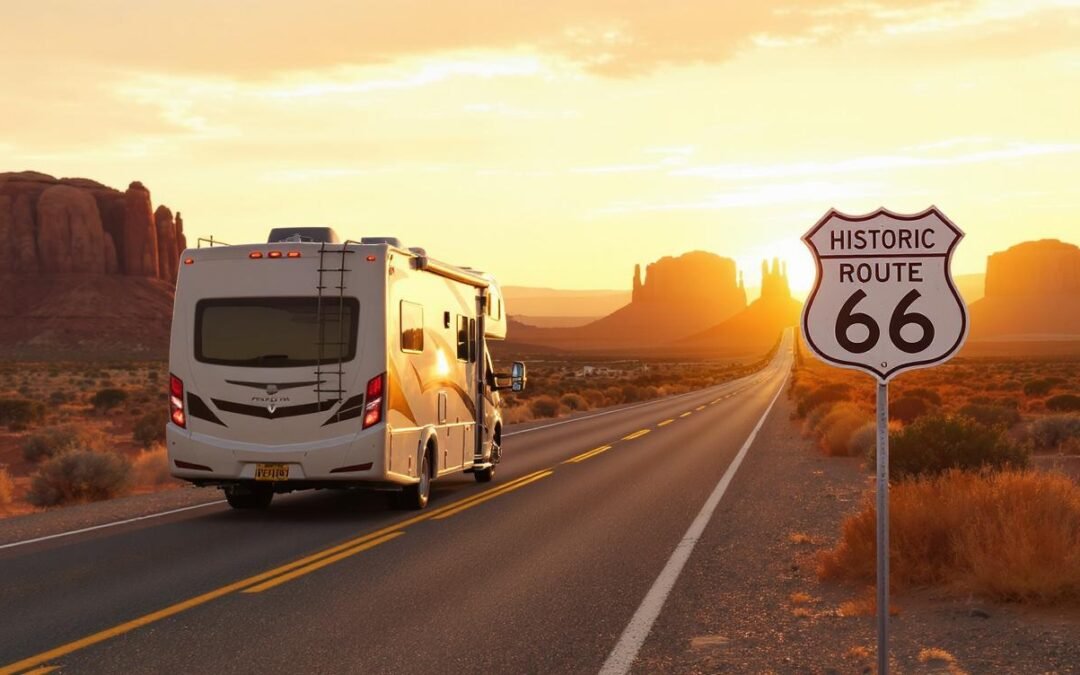
Route 66 RV Planning 2026: Oatman Grade, Stops, Costs
Driving Route 66 by RV is one of those “someday” trips—until it isn’t. When you finally commit, you quickly discover there’s no single truth about RVing the Mother Road. Some say it’s easy. Others warn it’ll shake your axles loose. Some insist big rigs can’t do it; others do it every year.
The reality: Route 66 is absolutely RV-friendly when you understand its constraints.
This guide cuts through the noise using a blend of:
- On-the-ground reports from real travelers, including a high-signal Facebook thread led by Anthony J. Mignella, who completed Route 66 towing a 30-foot travel trailer.
- 35+ years of RV travel experience applied to the specific challenges of Route 66.
- Authoritative sources like the National Park Service, state DOTs, and RV-specific tools.
- Modern RV strategy for length limits, parking, routing, and reservations.
This isn’t a listicle. It’s a deep, route-by-route RV planning framework for tackling Route 66 in a motorhome, trailer, or camper van.
Quick Answer: Can You Drive Route 66 in an RV?
Yes, Route 66 is RV-friendly with these key facts:
- ✅ Roughly 80–90% of the drivable Route 66 corridor is suitable for modern RVs.
- ✅ Class A motorhomes up to about 40 feet can complete the trip with a few smart detours.
- ⚠️ The Oatman Grade (Sitgreaves Pass) in Arizona is the main problem area for big rigs.
- 🏙️ Urban parking in Chicago, St. Louis, Santa Fe, and Los Angeles is often harder than the driving itself.
- 🏕️ Most RVers mix KOAs with small private parks and book only key hubs (like Santa Fe and Malibu) in advance.
- ⏱️ A comfortable pace is 21–30 days; a rushed trip can be done in 10–14 days.
If you’re worried about where you can legally stop on long driving days, see our store-by-store guide to where to park your RV for free on a road trip.
If you respect length limits, plan for parking, and give yourself time, Route 66 is one of the most rewarding RV trips in North America.
Table of Contents
- Why Route 66 Is a Perfect (and Challenging) RV Trip
- 2025 Route 66 RV Difficulty Map & Ratings
- The 3 Route 66 RV Travel Archetypes
- Essential RV Constraints (Length, Height, Parking, Fuel, Water, Terrain)
- Real Traveler Insights (Quotes & Commentary)
- State-by-State Route 66 RV Guide (Illinois to California)
- Verified Campground Stops (State-by-State)
- Three Ready-to-Use Route 66 RV Itineraries
- Seasonal Timing, Weather & Safety Considerations
- What Does It Cost to RV Route 66?
- Fuel Gaps, Dump Stations & Alternate Routes
- Should You Bring a Toad?
- Myth vs Reality: What RVers Get Wrong About Route 66
- Route 66 RV FAQ
- Authoritative References & Planning Resources
1. Why Route 66 Is a Perfect (and Challenging) RV Trip

Route 66 isn’t a single road—it’s a patchwork of alignments, main streets, and bypasses layered over nearly 100 years. For RVers, that means you’re not just following a line on a map. You’re constantly choosing between:
- Historic two-lane segments vs faster bypasses
- Downtown main streets vs truck-friendly arterials
- Iconic landmarks vs realistic daily mileage
Compared to straight interstate travel, the Mother Road demands:
- Slower speeds and more frequent turns
- Awareness of length and grade limits on steep or narrow sections
- Extra thought for parking in older downtowns
- Flexible overnight planning for busy periods and small-town parks
That’s exactly why RVers love it. You’re not just driving from A to B—you’re threading a big, modern rig through the remains of an earlier road-trip era.
2. 2025 Route 66 RV Difficulty Map & Ratings

We’ve generalized the route into major segments based on lane width, grades, and traveler feedback (including Anthony J. Mignella and others). Use this table as a planning tool, not as a substitute for local conditions or current DOT updates.
| Route Segment | RV Rating | Primary Constraint | Best Rig Size |
|---|---|---|---|
| Chicago, IL → St. Louis, MO | 🟢 Easy | Urban congestion; expensive or limited big-rig parking in Chicago. | Any (Class A OK) |
| St. Louis, MO → Oklahoma City, OK | 🟢 Easy | Older downtown streets in some towns; generally wide and manageable. | Any (Trailers OK) |
| Oklahoma City, OK → Tucumcari, NM | 🟢 Easy | Mostly flat plains; wind can be a factor for tall rigs. | Any (including big Class A) |
| Tucumcari, NM → Flagstaff, AZ | 🟡 Moderate | Elevation: climbs toward 7,000 ft; watch engine and transmission temps. | Any (but check brakes & cooling) |
| Flagstaff, AZ → Kingman, AZ | 🟡 Moderate | Mountain weather; some steeper grades and curves. | Any, with mountain-driving experience |
| Kingman, AZ → Oatman (Sitgreaves Pass) | 🔴 Difficult | Steep grades and hairpin turns; minimal shoulders. | Under 30′ strongly recommended |
| Kingman, AZ → Needles, CA (I-40) | 🟢 Easy | Heat in summer; long grades but wide, modern highway. | Any (big rigs OK) |
| Needles, CA → Barstow → LA → Santa Monica | 🟢 Road / 🟡 Traffic | High heat near Needles; heavy traffic closer to Los Angeles. | Any, with big-city driving comfort |
Key Oatman detail: the posted limit is about 40 feet, but the combination of steep grades, tight curves, and lack of shoulders means that in practice, 30 feet or under is the safer choice for that alignment. Most big rigs should avoid it entirely and use the interstate plus a west-side approach.
3. The 3 Route 66 RV Travel Archetypes

Before you book a single campground, decide which traveler profile you fit. Your expectations will shape how you experience Route 66.
A) Fast-Track Traveler (10–14 Days)
- Hits only the major icons (Cadillac Ranch, Chain of Rocks, Oatman, Santa Monica Pier).
- Prefers KOAs and larger private RV parks with easy in/out.
- Average daily mileage: 200–350 miles.
- Best suited for: Class A or big fifth wheels wanting a “check it off the list” version.
B) Immersion Traveler (21–30 Days)
- Mixes neon, museums, diners, and small-town main streets.
- Stays multiple nights in Santa Fe, Flagstaff, or Tulsa.
- Average daily mileage: 100–200 miles with built-in zero-days.
- Best suited for: Class C or mid-size trailers that want a balance of depth and comfort.
C) Collector (4–8 Weeks)
- Seeks surviving alignments, abandoned motels, and vintage neon.
- Stops at lesser-known museums and interpretive centers.
- Will happily reroute for ghost towns or obscure signage.
- Best suited for: Smaller Class C or Class B camper van with high parking flexibility.
The rest of this guide works for all three archetypes. The itineraries later on give specific day-by-day structures for each style.
4. Essential RV Constraints on Route 66

4.1 Length & Grade Limits (Especially Near Oatman)
The most important constraint on Route 66 for RVers is the steep, narrow section into Oatman, Arizona, via Sitgreaves Pass. In the Facebook thread that inspired this guide, traveler Anthony J. Mignella noted:
“There is a 40 ft length limit on 66 approaching Oatman from the east.”
Beyond the posted numbers, real-world reports from RVers are consistent: it’s simply not a place for big rigs. Tight switchbacks, steep grades, and limited room for error make the eastern approach a poor choice for anything long or heavy.
The practical takeaway: treat 40 feet as the hard upper limit and 30 feet or under as the realistic safe zone for that grade. If you’re in a large Class A or towing a long trailer, skip the eastern approach entirely.
Safer Oatman strategy for RVs:
- Run Kingman → Needles via I-40 with your RV.
- Drop the RV at a park or in Needles/Kingman.
- Backtrack into Oatman from the west side with a smaller vehicle if you have one.
Always verify current restrictions with the Arizona Department of Transportation:
https://azdot.gov/travel.
4.2 Parking: The Hidden Difficulty
Several travelers mentioned that the real pain point isn’t the highway—it’s parking in cities and small downtowns.
“Parking a problem sometimes, but I bought the RV in part to do this trip… We didn’t see everything but never expected to.” – Anthony J. Mignella
Parking is especially tight in:
- Chicago (Route 66 starting point)
- St. Louis
- Santa Fe and parts of Albuquerque
- Los Angeles and Santa Monica
Many RVers stage outside the city in KOAs or larger RV parks, then use Uber, Lyft, or a toad to explore. In Chicago, some RVers overnight at the McCormick Place Truck Marshaling Yard (very industrial but central):
official yard info.
If you’re trying to decide whether to lean on store lots vs campgrounds along your route, read our store-by-store guide to free overnight RV parking at Walmart, Home Depot, Cracker Barrel and more.
4.3 Fuel, Water & Dump Access
Route 66 is generally well-serviced, but there are stretches where large, easy-in/out fuel stops and dump stations are farther apart than you might like.
Typical “watch your gauges” stretches include:
- High desert sections in New Mexico between larger towns.
- Segments in northern Arizona between Holbrook, Winslow, and Flagstaff.
- Desert corridors around Needles and Barstow in California.
In practice, that can mean 60–90 miles between truly RV-friendly fuel stops if you’re picky about approach angles and lot size.
Practical approach:
- Top off fuel before leaving major cities such as Amarillo, Albuquerque, and Kingman.
- Use apps like Campendium and
AllStays to locate dump stations and propane. - Plan around KOAs and larger private parks for dump/water, even if you mix in small-town parks or Harvest Hosts stays.
If you like to mix in free public-land camping where it’s legal, our step-by-step guide to using Google Maps to find free dispersed camping sites will slot neatly into this planning process.
4.4 Road Conditions & Pavement Reality
One commenter in the thread argued that towing a travel trailer on Route 66 would be catastrophic:
“You would have lost the axles out of it. Be true to your story.”
Multiple travelers pushed back.
“We just got back from a two week trip on the route using the Route 66 app, and we must have missed the parts of the road you speak of.” – Sondra Burlingame
“The roadways of Route 66 are fine for RVs. There are some rough short segments, but it’s not going to be a problem… Motorcycles have it worse.” – Scott McCoy, who tows a 17-foot travel trailer while updating his Route 66 guide.
The consensus from people who have actually done it is clear: you’ll hit some rough patches, but nothing a modern RV can’t handle when driven sanely.
5. Real Traveler Insights (and What They Actually Mean)

5.1 Reservations: Day-Of vs Months in Advance
Anthony’s approach was relaxed:
“We booked most places the day we were arriving—only Joliet, Santa Fe and Malibu in advance.”
By contrast, another traveler, Tim Daugherty, shared:
“My wife is a worrier and had me book the entire trip months in advance.”
Both worked. What they really highlight is this:
- High-demand stops like Santa Fe and Malibu are worth booking in advance.
- Smaller towns along the route usually have day-of or short-notice availability outside peak holidays.
A practical hybrid strategy:
- Reserve Chicago/Joliet, Santa Fe, and Malibu early.
- Keep the rest of your nights flexible so you can adjust mileage, weather, and side trips on the fly.
5.2 Rig Size and “Nimbleness”
Another traveler, Steve Rice, did Route 66 with a 19-foot travel trailer and enjoyed it, but shared future plans:
“We’re going back next summer w/o the trailer, flying to LA and driving east. Looking forward to being a little more nimble.”
The pattern across RV groups is simple:
- Smaller rigs (Class B, short Class C, under-20′ trailers) get more spontaneous side trips and easier parking.
- Larger rigs (30–40′) get more comfort and storage but require more planning, especially in cities and historic downtowns.
5.3 Would You Do It Again in an RV?
For some people, Route 66 is a once-in-a-lifetime trip.
“I enjoyed it… but I also don’t plan on doing it a second time.” – Anthony J. Mignella
I see that a lot: RVers are grateful they did it, but a second trip might happen in a car, on a motorcycle, or just in smaller segments.
6. State-by-State Route 66 RV Guide (Illinois to California)

This overview blends real traveler experiences with official guidance from the
National Park Service Route 66 program.
Illinois: Chicago to Springfield
Difficulty: 🟢 Easy
- Chicago traffic and parking are the only major issues; the roads themselves are fine for RVs.
- Many RVers overnight in Joliet and visit Chicago as a day trip.
- The route includes classic downtown stretches, Route 66 signage, and historic stops.

Missouri: St. Louis to Carthage
Difficulty: 🟡 Moderate
- Older town centers can have tight street parking and smaller convenience store lots.
- St. Louis itself is busy; many RVers stay at St. Louis NE / Granite City KOA and drive in.
- Great stops include Route 66 State Park and Meramec Caverns.
Kansas: Short but Charming
Difficulty: 🟢 Easy
- Kansas only has about 13 miles of Route 66, but it’s scenic and easy for RVs.
- Galena and Baxter Springs offer small-town charm and classic road-trip photo ops.
Oklahoma: Miami to Oklahoma City
Difficulty: 🟢 Easy
- Some of the best-paved and best-marked segments for RVs.
- Tulsa and Oklahoma City have good services and multiple RV park options.
- Plenty of roadside attractions and Route 66 museums to break up drive days.
Texas: Shamrock to Amarillo
Difficulty: 🟢 Easy
- Flat, open, and RV-friendly.
- Don’t miss Cadillac Ranch and the Route 66 historic district in Amarillo.
New Mexico: Tucumcari to Gallup
Difficulty: 🟡 Moderate
- Mix of high plains and mountain driving, especially around Santa Fe.
- Tucumcari offers classic neon motels and RV park options, including KOA.
- The Santa Fe KOA near Las Vegas, NM, earned praise from Anthony for location and access.

If you like to mix in free or low-cost spots between RV parks, bookmark our roundup of the best apps for finding free campsites—the same tools work great across New Mexico and the high plains.
Arizona: Holbrook to Kingman, Oatman & Beyond
Difficulty: 🟡 to 🔴
- Most of I-40-adjacent segments are fine for any RV.
- The Meteor Crater RV Park near Winslow is a popular stop; details at
Meteor Crater Visitor Info. - The critical red-zone is the Oatman Grade eastbound via Sitgreaves Pass. Large rigs should avoid this alignment.

Arizona is also where our Google Maps method for finding dispersed camping starts to shine, especially in areas where public land and national forests intersect the Route 66 corridor.
California: Needles to Santa Monica
Difficulty: 🟢 Easy (Road) / 🟡 Moderate (Traffic & Heat)
- Road quality is generally fine; summer heat is the main hazard near Needles and Barstow.
- Malibu Beach RV Park (often called Malibu RV Park or Surf Outpost) offers pricey but spectacular coastal views.
- Santa Monica can be a zoo for RV parking; many end the “Route 66 journey” just outside the pier and visit it by car or rideshare.

7. Verified Campground Stops (State-by-State)

Traveler Anthony J. Mignella shared his full campground list after towing a 30-foot travel trailer along Route 66 and beyond. We’ve reorganized his stops by state and region to make planning easier.
If you’re evaluating whether a campground membership is worth it for trips like this, our comparison of RV club memberships that actually save money will help you prioritize KOA, Good Sam, Passport America, and others.
📍 Ohio
- Streetsboro, OH: KOA Streetsboro – convenient first stop outbound from the Northeast.
- Zanesville, OH: National Road Campground – used on the return leg.
📍 Illinois & Missouri
- Joliet, IL: Martin’s Camping Ground – practical base for a Chicago day trip without driving the RV into downtown.
- Springfield, IL: KOA Springfield – positioned near classic Route 66 attractions.
- Granite City, IL: St. Louis NE / Granite City KOA – big-rig friendly and used twice (outbound and return) as a St. Louis hub.
- Carthage, MO: Ballards Campground – useful one-night transit stop.
📍 Oklahoma & Texas
- Tulsa, OK: Mingo RV Park – convenient for a city stop with full hookups.
- Shamrock, TX: Texas 66 RV Park – right along the Route 66 corridor.
📍 New Mexico
- Tucumcari, NM: Tucumcari KOA – near the famous neon motel strip.
- Las Vegas, NM (serving Santa Fe): Santa Fe KOA – Anthony’s multi-night base for exploring Santa Fe; located off I-25 but aligned with the Route 66 corridor.
- Gallup, NM: USA RV Park – popular full-service stop on many Route 66 itineraries.
📍 Arizona
- Near Winslow, AZ: Meteor Crater RV Park – convenient for visiting Meteor Crater and exploring the area around Winslow (“standing on a corner” photo ops optional).
📍 California
- Needles, CA: Desert View RV Resort – used while rerouting around the Oatman length restriction.
- Twentynine Palms, CA: 29 Palms RV Resort – basecamp for a Joshua Tree National Park side trip.
- Malibu, CA: Malibu Beach RV Park (Surf Outpost) – Anthony’s most expensive but most scenic stop, overlooking the Pacific.
📍 Nevada, Utah & Colorado (Return Trip)
- Pahrump, NV: Preferred RV Resort – used as a base for exploring the Death Valley region.
- Las Vegas, NV: Oasis Las Vegas RV Resort – large, well-appointed resort with easy Uber access to the Strip.
- Kanab, UT: Grand Plateau RV Park – ideal for visiting Zion and Bryce Canyon on a side trip.
- Bluff, UT: Cadillac Ranch RV Park – positioned for Monument Valley and Four Corners excursions.
- Durango, CO: Durango RV Park – springboard for the Durango & Silverton train or local mountain activities.
- Colorado Springs, CO: Pikes Peak RV Park – tight sites but close to town and local attractions.
- Salina, KS: Salina Campground – practical overnight stop near I-70.
You don’t need to duplicate Anthony’s exact route, but his list proves that a 30-foot trailer can successfully string together KOAs and independent parks across the entire corridor.
8. Three Ready-to-Use Route 66 RV Itineraries

8.1 12-Day “Fast Track” Itinerary (Big-Rig Friendly)
This option favors RV-friendly routing and bigger daily mileage, aiming to hit the major highlights without lingering long in each stop.
| Day | Segment | Approx. Miles | Notes |
|---|---|---|---|
| 1 | Chicago → Joliet | 45 | Start Route 66, overnight in Joliet. |
| 2 | Joliet → Springfield, IL | 200 | Historic stops and Route 66 museums. |
| 3 | Springfield → St. Louis / Granite City | 100 | Visit Chain of Rocks Bridge, stay at KOA. |
| 4 | St. Louis → Carthage, MO | 280 | Scenic Missouri segments, classic diners. |
| 5 | Carthage → Tulsa, OK | 120 | Easy driving, settle into Oklahoma rhythm. |
| 6 | Tulsa → Oklahoma City | 120 | Spend extra time in OKC if desired. |
| 7 | OKC → Shamrock, TX | 165 | Cross into Texas Panhandle. |
| 8 | Shamrock → Tucumcari, NM | 115 | Neon motel row and RV parks. |
| 9 | Tucumcari → Santa Fe area (Las Vegas, NM) | 185 | Stay at Santa Fe KOA, day trip into town. |
| 10 | Santa Fe → Gallup, NM | 200 | Scenic high-desert stretches. |
| 11 | Gallup → Kingman, AZ (via I-40) | 310 | Optional Meteor Crater stop near Winslow. |
| 12 | Kingman → LA / Santa Monica (I-40 & freeways) | 345 | End at Santa Monica Pier, then find RV-appropriate overnight. |
Before you pull out of the driveway, pair this itinerary with our printable pre-trip checklist for motorhomes and travel trailers so you’re not chasing last-minute fixes mid-route.
8.2 21-Day “Immersion” Itinerary
Double the time, same route, much deeper experience. You’ll add:
- Zero-days in Tulsa, Santa Fe, and Flagstaff.
- Extra time in Oklahoma museums and Arizona national parks or monuments off-route.
- More downtown walks and local diners instead of always cooking in the rig.
Structure is similar to the 12-day plan but with every 2–3 drive days followed by a lighter or zero day. Most RVers using this style aim for 100–200 miles on drive days and add at least one extra night in the places they like most.
As you slow the pace down, your campsite routine matters more. Our RV campsite setup and cleanup checklist keeps arrivals and departures predictable even when you’re tired.
8.3 30-Day “Collector” Itinerary
This is where you start chasing specific alignments, neon, ghost towns, and interpretive centers documented by the
NPS Route 66 itinerary.
Expect:
- Multiple nights in key hubs like Springfield, Tulsa, Santa Fe, Flagstaff, and Barstow.
- High mileage on some days, followed by multiple short days of only 50–90 miles.
- Intentional detours to sites that aren’t directly on Route 66 but are part of the broader story.
9. Seasonal Timing, Weather & Safety Considerations

9.1 Best Seasons for RV Travel
Spring (March–May): Often the sweet spot—milder temperatures, lower crowds, and manageable winds.
Summer (June–August): School holidays, more traffic, and serious heat in the desert segments around Needles and Barstow. Air conditioning load, tire temperatures, and coolant all need attention.
Fall (September–October): Cooler nights, pleasant days, and fewer crowds. Great time for photography and hiking detours.
Winter (November–February): Limited services in some small towns. Snow and ice possible in Illinois, Missouri, New Mexico high country, and northern Arizona.
9.2 Wind, Heat, and Storm Risk
- High winds on the plains and high desert can make travel uncomfortable (or unsafe) for tall Class A rigs.
- Heat waves in the Mojave region make midday breakdowns more serious—carry extra water and keep your rig well-maintained.
- Severe storms in shoulder seasons can bring hail and heavy rain in parts of Oklahoma and Texas.
The
NPS Route 66 “Plan Your Visit” page offers maps and park connections you can use to layer in national park stops safely.
10. What Does It Cost to RV Route 66?

Exact costs vary based on your rig, fuel prices, and how often you eat out, but you can build a reasonable ballpark with a few assumptions.
10.1 Simple Cost Framework (Example for a 3-Week Trip)
- Distance: Roughly 2,400–2,800 miles when you include side trips and repositioning.
- Fuel: If your RV averages 8–10 mpg and fuel averages $3.50–$4.25 per gallon, you’re looking at roughly $900–$1,500 in fuel for the core trip.
- Campgrounds: Many RVers pay $35–$70 per night, mixing KOAs with private and municipal parks. Over 21–25 nights, that’s roughly $900–$1,750.
- Food: Groceries vs restaurants changes this the most. A modest restaurant/grocery mix might add another $600–$1,000 over three weeks.
- Attractions: Museums, tours, and parks can range from free to $30–$40 per person; budget a few hundred dollars if you like doing “all the things.”
With those assumptions, a typical couple can easily land in a range of roughly $2,500–$4,000+ for a 3-week Route 66 RV trip. You can spend less by boondocking more and cooking in the rig, or more by staying at premium resorts and eating out frequently.
11. Fuel Gaps, Dump Stations & Alternate Routes

11.1 Fuel Planning
Most of Route 66 runs close to I-40 and other major corridors, but fuel prices and availability vary, especially for diesel and larger diesel islands.
A conservative fuel strategy:
- Refuel when you hit half a tank in New Mexico and Arizona, particularly between Tucumcari, Santa Rosa, Albuquerque, Gallup, and Winslow/Flagstaff.
- Avoid relying on tiny crossroads stations with a single pump if you have a large diesel rig.
- Expect higher prices in desert segments around Needles and Barstow; topping off earlier can save money and stress.
If you rely heavily on tech for locating fuel, dump stations, and RV-friendly exits, our in-depth AllStays Camp & RV app guide shows exactly how to filter for big rigs, low bridges, and services along a multi-state route.
11.2 Dump & Water Strategy
- Plan to use KOAs and bigger private parks for guaranteed dump/water access.
- Supplement with city parks, travel centers, and occasionally fairgrounds when available.
- Use filters in Campendium and
AllStays to map dump stations along your route.
11.3 Alternate Routes (When to Bail Off Historic Alignments)
There’s no prize for forcing a big RV down a narrow, poorly marked historic alignment if you’re uncomfortable. In practice, most savvy RVers:
- Favor business loops and frontage roads that carry the Route 66 designation but are better maintained.
- Drop onto I-40 when storms, wind, or traffic make side roads a bad idea.
- Avoid the Oatman east approach entirely in large rigs and use the I-40 / west-approach combo instead.
12. Should You Bring a Toad?

Whether to bring a toad (towed car) is one of the biggest Route 66 RV decisions.
When a Toad Helps
- You’re in a Class A or large Class C and want to explore dense cities like Chicago, St. Louis, Santa Fe, and LA.
- You prefer to leave the RV in a stable campground for several days and day-trip out.
- You plan to visit side attractions with limited parking, such as small museums or urban restaurants.
When You Can Skip It
- You’re traveling in a Class B or compact Class C and are comfortable threading it through older downtowns.
- Your itinerary leans more toward small towns, viewpoints, and roadside stops with easier parking.
- You’re happy to rely on rideshare in the largest urban centers instead of towing.
Several travelers mentioned that parking can be annoying but manageable if you accept that you won’t see everything in a single RV pass. A toad simply widens your options.
If your long-term goal includes more national park-heavy trips, see how we handle parking tags, size limits, and access in our Great Smoky Mountains National Park RV guide.
13. Myth vs Reality: What RVers Get Wrong About Route 66
Myth 1: “Route 66 Will Destroy Your RV.”
Reality: While there are rough patches, travelers like Scott McCoy report that modern RVs handle the route just fine. You’ll drive slower, but you’re not sacrificing your axles to the road gods.
Myth 2: “You Can’t Do Route 66 in a Big Rig.”
Reality: Anthony’s 30 ft travel trailer completed the route with only a few workarounds, and plenty of Class A owners report similar experiences. The key is respecting the Oatman grade and tight urban parking.
Myth 3: “You Need Every Night Reserved Months in Advance.”
Reality: Some RVers book nearly everything ahead of time; others do day-of reservations except for a handful of high-demand stops. Both have worked. Seasonal timing and your personal risk tolerance matter more than any universal rule.
Myth 4: “You Have to See Every Alignment to ‘Do It Right.’”
Reality: There is no single “correct” Route 66 experience. For many RVers, safety, comfort, and a handful of favorites beat chasing every historic lane.
If you’re also planning more general boondocking or off-grid trips, your next stops should be our guides to the best apps for finding free campsites and best internet options for RV living in 2025—both written from a real-world, full-trip perspective.
🔑 Key Takeaways
- Route 66 is roughly 80–90% RV-accessible for modern rigs.
- The Oatman Grade is the only major alignment most big rigs should avoid.
- Urban parking requires more planning than road conditions.
- Book Chicago/Joliet, Santa Fe, and Malibu in advance; keep the rest flexible.
- 21–30 days is a realistic timeline for an enjoyable trip.
14. Route 66 RV FAQ
Is Route 66 RV-friendly?
Yes. Around 80–90% of the drivable Route 66 corridor is suitable for modern RVs, including large motorhomes. The main exception is the steep, narrow Oatman Grade eastbound into town, which most big rigs should avoid.
If you’re brand new to long-distance RV travel, start by learning how to use Google Maps to find free dispersed camping sites and where you can safely park your RV for free overnight at major chains.
What size RV is best for Route 66?
Anything in the 22–30 ft range is a sweet spot—big enough for comfort, small enough to be nimble in towns and parking lots. Larger rigs can still do the route with more planning and a few detours.
How long does an RV trip on Route 66 take?
Fast-track trips can be done in 10–14 days, but most RVers are happier with 21–30 days. That gives room for weather, repairs, and side trips without feeling rushed.
Do I really need reservations?
You should reserve in high-demand locations like Santa Fe and Malibu, and during peak summer or holiday windows. Outside those hotspots, same-day or short-notice booking often works.
What’s the safest way for a big rig to visit Oatman?
Run I-40 between Kingman and Needles with your RV, then approach Oatman from the west in a toad or smaller vehicle if you want to experience the town and the burros without taking a large rig over Sitgreaves Pass.
15. Authoritative References & Planning Resources

- National Park Service – Travel Route 66:
https://www.nps.gov/subjects/travelroute66/index.htm - NPS Route 66 Travel Itinerary & Maps:
https://www.nps.gov/subjects/travelroute66/visit.htm - Plan Your Visit – Route 66 (National Trails Office):
https://www.nps.gov/orgs/1453/plan-your-visit-route-66.htm - Arizona DOT Travel Info (for restrictions and closures):
https://azdot.gov/travel - Meteor Crater Visitor Info (Arizona):
https://meteorcrater.com/info/ - Campendium – Campgrounds & Dump Stations:
https://www.campendium.com - AllStays – RV Parks, Services, and Truck Stops:
https://www.allstays.com/ - McCormick Place Truck Marshaling Yard Info:
https://www.mccormickplace.com/exhibitors/freight-truck-marshalling/ - Malibu Beach RV Park (Surf Outpost):
https://www.maliburv.com/ - Harry’s Roadhouse – Santa Fe Favorite:
https://www.harrysroadhousesf.com/


