by Chuck Price | Jan 9, 2026 | Resources
A Complete Financial Analysis
Social media shows stunning sunset campsite photos, but the spreadsheets tell a different story. Full-time RV living in 2026 costs between $2,500 and $5,000 monthly—and that figure hides a capital investment trap that catches most aspiring full-timers off guard.
I analyze North American RV market trends by cross-referencing industry reports from the RV Industry Association, KOA’s camping studies, and government housing data with qualitative insights from thousands of active full-timers in communities like r/GoRVing, the Escapees RV Club forums, and iRV2.com.
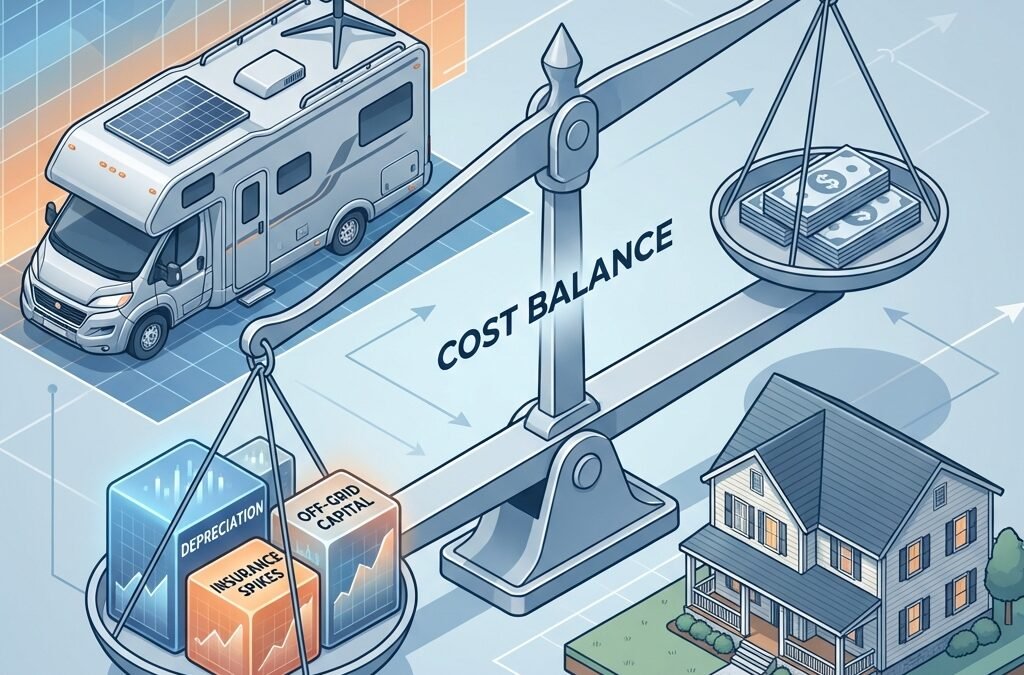
This combination reveals what the statistics alone miss: insurance jumped 22% nationally in 2024 but regional variations push Alberta and Florida full-timers 30-40% higher. “Free” boondocking actually requires $5,000-20,000 upfront. And the depreciation trap works differently than your financial planner expects.
The economics have fundamentally shifted since 2020. Understanding whether RV living saves money versus traditional housing requires looking past both the Instagram lifestyle marketing and the doom-and-gloom cost calculators to examine the actual financial mechanisms at work.
📊 Want to run your own RV living cost comparison?
I built a custom GPT to help you do just that. It uses real-world data from 2020–2026 to analyze full-time RV costs, boondocking tradeoffs, and how it all stacks up against traditional housing.👉
Try the Full-Time RV Cost Analyst GPT
RV living costs climbed across every category from 2020-2025

Insurance premiums for full-time RVers increased 22% nationally in 2024 compared to 2023, while campground industry revenue grew at 8.3% annually since 2020.[1][2] Fuel, maintenance, and storage costs followed similar trajectories. The pandemic-era RV boom created demand pressures that persisted even as shipment volumes corrected downward by 40% from their 2021 peak.
The 22% insurance increase represents a national average. Regional risk factors create dramatic variations. Community reports from the Escapees RV Club forums document significantly higher increases in hurricane-prone Florida and hail-prone Alberta, with some full-timers reporting premium increases of 30-40% when seeking quotes in high-risk areas. One forum member documented receiving quotes from five carriers—three declined coverage outright for summer stays in high-risk areas, while the two willing insurers charged premiums 35% higher than comparable policies in lower-risk regions.
Campground fees climbed alongside insurance costs. KOA, North America’s largest private campground chain, charges $40-80 per night in 2026 depending on location and season, with Colorado locations averaging around $59 nightly and premium tourist destinations reaching $100-200 per night.[1] Parks Canada implemented a 4.1% fee increase in January 2024, with typical campgrounds ranging $40-75 CAD nightly.[3] Monthly rates offer better value at $500-1,000, but availability has become the constraint rather than price. The Dyrt’s 2025 camping report found that 56.1% of campers struggled to find available campsites in 2024, up from 45.5% reporting sold-out conditions in 2023.[4]
This scarcity gives campground operators continued pricing power. While the percentage of campgrounds raising rates fell from 45.3% in 2023 to 38.9% in 2024, those that did increase prices cited inflation as the primary driver.[4] Over one-third of properties planned additional rate increases for 2025-2026. Operators point to rising property taxes, utilities, insurance premiums, employee wages, and capital investments in pools, spas, and glamping amenities as cost pressures they must pass along.
Maintenance represents another category where national averages mask individual volatility. Experts recommend annual budgets of $1,500-5,000 or 10-15% of the RV’s purchase price.[5] RV shop labor rates typically hit $120+ per hour, higher than automotive mechanics, because technicians need expertise spanning plumbing, electrical, HVAC, appliances, and construction. Major repairs are particularly punishing: roof replacements run $7,000-10,000, slide-out mechanism repairs cost $2,500-9,000, and engine overhauls can exceed $10,000.[6] One full-timer documented spending $4,000+ in first-year maintenance on a 2017 Forest River Georgetown, while another owner’s extended warranty offset $5,721 in repairs that would have totaled $17,981 without coverage.[7]
Fuel costs provided the one category where prices improved rather than worsened. After spiking to $3.61 per gallon in April 2024, U.S. gasoline averaged $3.15 per gallon in May 2025—down 12.6% year-over-year.[8] Diesel followed a similar trajectory at $3.50 per gallon, down 8.5% from the previous year. For Class A motorhomes getting 6-10 MPG and Class C units averaging 8-14 MPG, this matters: a 1,000-mile trip in a Class A costs roughly $390 in fuel at current prices, consuming $300-700 monthly for typical travel patterns.
The cumulative effect of these increases transformed the economics of full-time RV living. Campground industry revenue reached $10.9 billion in 2025, reflecting the 8.3% compound annual growth rate that has held steady since 2020.[1] The RV Industry Association’s data shows total RV ownership declined from approximately 11 million households in 2021-2022 to 8.1 million in 2025, yet paradoxically the number of full-time RV dwellers appears to have grown based on community forum activity and campground operator reports.[9] This suggests two distinct markets: recreational owners exiting after pandemic enthusiasm waned, and necessity-driven full-timers entering despite rising costs.
Purchase prices stabilize as market enters reset phase

The RV market enters 2026 in what industry analysts call a “reset phase” rather than the correction many predicted. RV shipments are projected to reach 332,000 to 366,000 units in 2026, representing modest growth from 2025’s approximately 340,000 units but remaining well below the pandemic peak.[9] Prices haven’t returned to pre-pandemic levels because the cost structure itself changed—lumber, aluminum, chassis, and electronics all remain significantly above 2019 baselines, while skilled labor shortages keep wages elevated.
The manufacturing cost reality explains why waiting for prices to drop has proven futile. Lumber, which spiked dramatically during the pandemic, has not returned to earlier lows and remains a significant cost driver for RV frames and interiors according to industry analysis.[10] Steel and aluminum prices have stayed well above pre-pandemic levels despite some correction from 2021 peaks. Chassis and frame costs increased due to global metal demand, continued tariffs, and supply constraints that manufacturers cannot easily circumvent.
Technology expectations added another cost layer. Wi-Fi boosters, smart appliances, safety systems, backup cameras, and entertainment systems are increasingly standard features rather than premium add-ons. Industry sources estimate this drives up electronic component costs by approximately 15-20% compared to pre-pandemic models.[10] Labor shortages in skilled trades—welding, electrical work, plumbing—forced manufacturers to pay higher wages to attract workers, while supply bottlenecks for specialty parts and imported goods continue to add costs and delays even in 2026.
Used RV values normalized from pandemic peaks, creating negotiating opportunities for buyers. Used RV values have softened significantly—towable values especially are declining as 2024-2025 hold-over units enter the market. Dealers are offering 20-30% discounts off manufacturer’s suggested retail prices to move inventory, and used RVs show stronger buyer interest with searches up 14% year-over-year. However, this softening hasn’t translated to bargain-basement pricing. A 30% discount off an inflated 2024 MSRP often still exceeds what the same model commanded in 2019. Used values remain 15-25% above pre-pandemic levels. The dealers aren’t being generous—they’re working through expensive inventory purchased during the boom years at prices that today’s buyers resist paying in full.
RV shipments surged 40% from 2020 to 2021, reaching a record 600,000 units, with first-time buyers accounting for 50-80% of purchases.[11] This created a pipeline of high-priced inventory that took years to clear. Manufacturers reduced production in 2023 and 2024 to avoid oversupply, which prevented prices from collapsing but also meant fewer discounted units for buyers hoping to time the market. The 2026 market represents stabilization rather than bargain hunting—better deals exist than 2021-2023, but far from the pre-pandemic baseline many hoped would return.
Financing costs compound the sticker price challenge. Interest rates remain elevated with mortgage rates forecast to average around 6.3% in 2026, down slightly from 6.6% in 2025 but still well above pandemic-era levels. RV buyers in 2026 typically face financing rates of 5-8%, raising monthly payments substantially.[10] A $60,000 RV financed at 7% over 15 years costs $539 monthly just in principal and interest, before insurance, maintenance, or operational expenses. That same RV financed at 3% in 2019 would have cost $415 monthly—a $124 difference driven entirely by interest rate environment.
The depreciation curve makes financing particularly punishing. RVs depreciate 30-50% in the first five years, unlike homes that typically appreciate. Someone financing a $60,000 RV discovers after three years they owe $40,000 but the RV is worth only $35,000-40,000. They’re underwater, paying interest on a rapidly depreciating asset. This creates a trap: they cannot sell without bringing cash to closing, yet continuing to pay compounds the wealth destruction as depreciation continues.
Industry analysts at Morton on the Move noted in their 2025 buying guide that new RV prices “haven’t plummeted to pre-pandemic levels” and dealers are still working through expensive inventory.[12] Used RV prices have softened, but many pandemic-era buyers are holding onto their rigs rather than selling at losses, which keeps used inventory tight in quality units. The correction everyone predicted never fully materialized because the cost inputs—materials, labor, financing—didn’t correct proportionally. The 2026 market represents stabilization at a higher price plateau rather than a return to 2019 economics.
Boondocking networks expanded—but “free” camping requires major capital investment
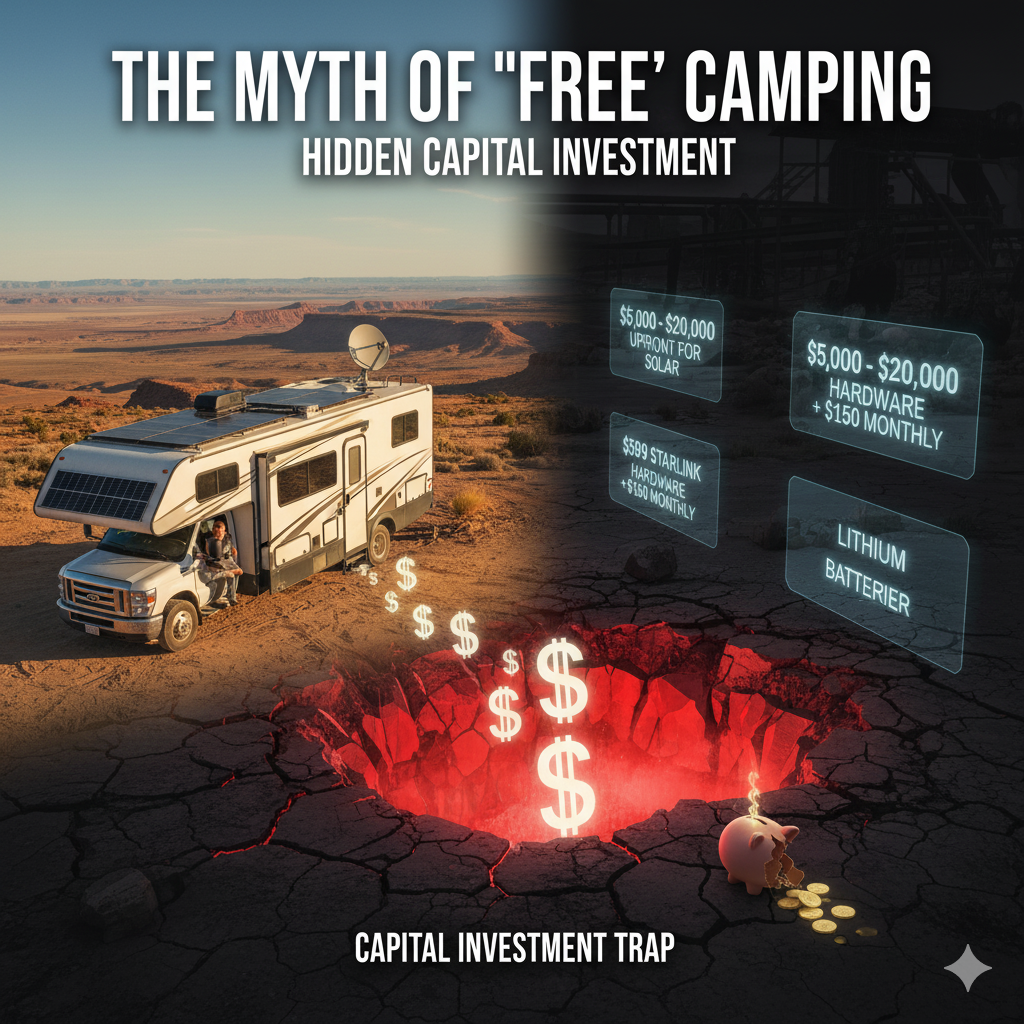
Harvest Hosts grew from 600 locations in 2018 to 5,844 in 2026 (Classic plan), while Boondockers Welcome added 3,543 private properties to the network—creating legitimate free camping infrastructure.[13][14] But accessing this network requires $5,000-20,000 in upfront capital for solar panels, lithium batteries, inverters, and connectivity equipment that generic cost calculators don’t include in “getting started” budgets.
The capital requirement creates a bifurcation in who can actually benefit from the boondocking revolution. Solar power systems capable of running air conditioning, refrigerators, and laptops cost $2,000-15,000 depending on power needs and installation complexity. A basic 400-watt solar array with a single lithium battery and inverter starts around $3,000 for DIY installation. Comprehensive off-grid setups with 800+ watts of solar, multiple lithium batteries, and sufficient inverter capacity to run all systems exceed $10,000 before labor costs.
The connectivity gatekeeper has become more expensive than the power itself. Monitoring discussions in r/vandwellers and iRV2.com reveals that Starlink represents the primary financial blindside for working-age RVers. The $150 monthly subscription plus $599 hardware cost wasn’t in most people’s pre-launch budgets, yet it’s become essential for remote workers. One thread on iRV2 documented 47 full-timers who abandoned boondocking plans entirely because they couldn’t afford both the solar setup and the Starlink subscription—choosing instead to stay in RV parks with included Wi-Fi despite the $800-1,200 monthly cost.
Cell signal boosters add another $500+ to the connectivity budget. While they don’t replace Starlink for bandwidth-intensive work, they’re essential for maintaining phone service in remote areas where emergency calls or basic communication requires amplification. Water management systems—larger tanks, water bladders for refills, and potentially composting toilets—extend off-grid capability but add $1,000-3,000 to initial costs.
Membership programs themselves carry minimal expense compared to equipment. Harvest Hosts charges $99-179 annually for access to wineries, farms, breweries, and museums offering overnight stays. Boondockers Welcome costs $79 annually for 3,500+ private property hosts, with over 75% offering electric and water hookups. In Canada, Terego lists approximately 1,600 farms, vineyards, and attractions where RVers can overnight with membership.[15] Combined, these networks cost under $300 annually—trivial compared to equipment but only accessible after making the capital investment.
Public land opportunities remain substantial for those equipped to use them. The Bureau of Land Management manages approximately 245 million acres where dispersed camping is generally permitted for up to 14 days within a 28-day period.[16] Long-Term Visitor Areas in Arizona and California currently charge $420 for seven-month stays as of the 2025-2026 season—representing just $60 monthly—providing legal camping with minimal amenities and a built-in community of fellow full-timers. In Canada, 89% of land is Crown Land where Canadian residents can camp free for up to 21 days per site annually, though non-residents require permits costing $10.57 per person per night in Ontario.[17]
The savings calculation depends entirely on capital access. Comparing monthly costs reveals why boondockers can maintain this lifestyle despite rising prices. A budget RV park scenario costs $800 monthly rent plus $150 electricity, totaling $950. Boondocking reduces this to $500-600 monthly for a frugal approach, yielding savings of $350-450 monthly or $4,200-5,400 annually. An average RV park at $1,200 monthly versus boondocking at $500-600 creates savings of $600-700 monthly or $7,200-8,400 annually. The membership network approach—combined Harvest Hosts and Boondockers Welcome at $248 annually versus minimum campground rates of $35 nightly—delivers savings exceeding $12,000 annually.
But these savings only materialize after spending $5,000-20,000 upfront plus $150+ monthly for connectivity. This creates a troubling dynamic: boondocking works brilliantly for lifestyle choosers with capital to invest, but remains inaccessible to economic-necessity RVers who lack upfront resources. The boondocking revolution didn’t make RV living cheaper for everyone—it made it cheaper for those who could afford the admission price.
Practical pathways to free camping—and what the resources don’t tell you
The boondocking narrative often conflates two distinct camping styles—true off-grid living with solar and lithium batteries versus basic overnight parking that requires minimal infrastructure. Understanding this distinction reveals accessible entry points that don’t require five-figure investments.
Federal public lands managed by the Bureau of Land Management and U.S. Forest Service permit dispersed camping across approximately 245 million acres, typically allowing 14-day stays within 28-day periods.[16] This represents the largest free camping resource in North America, yet it remains underutilized by budget-constrained RVers who assume all boondocking requires expensive solar setups. Many dispersed sites along maintained Forest Service roads work for stock RVs with standard generators, provided you can handle the noise restrictions and propane consumption.
The store parking landscape has fundamentally shifted
The retail parking that sustained budget RVers for decades contracted sharply between 2020 and 2026. Approximately half of Walmart locations now prohibit overnight stays based on community reports, up from around 40% in 2023, with restrictions concentrated near tourist destinations and major highways. The iconic big-box overnight stop hasn’t disappeared, but it requires more advance research and fallback planning than it did five years ago.
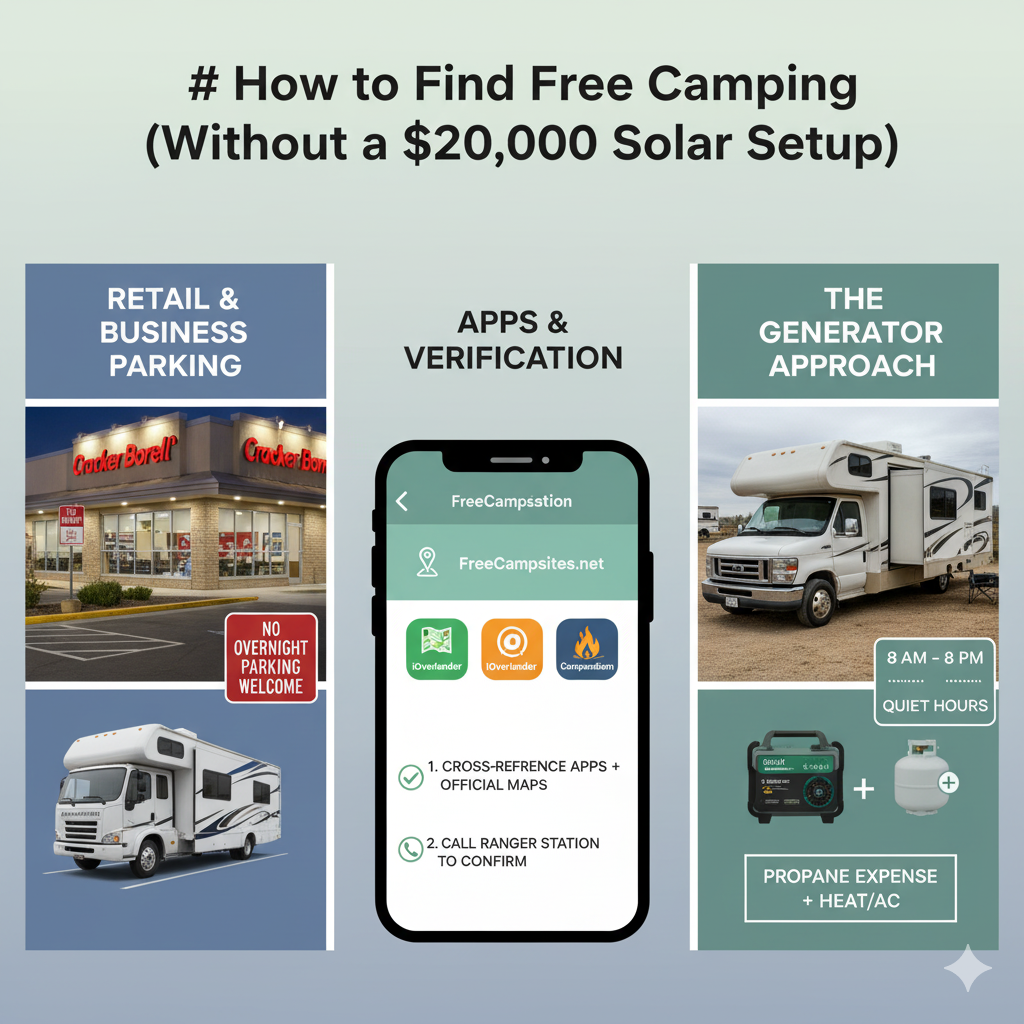
Cracker Barrel emerges from community reports as the most consistently RV-friendly major retail chain in 2026, with many locations maintaining designated RV spaces and quieter evening environments. However, an unspoken expectation has solidified: patronizing the business isn’t legally required, but managers increasingly view dining as the implicit exchange for parking space. One Tennessee manager framed it directly in a forum post: “We’re happy to have you stay, but we’re not a campground—we’re a restaurant.” Budget travelers report average costs of $20-30 for two meals when using Cracker Barrel overnight, still cheaper than campgrounds but not truly free.
Truck stops evolved differently, with major chains like Love’s, Pilot Flying J, and TA expanding RV-specific services rather than restricting access. Some Love’s locations now offer dedicated RV lanes with hookups for $15-25 nightly—not free, but providing amenities that justify the cost for travelers who need them. The critical distinction: these paid spots sit alongside traditional free parking areas, giving RVers choices based on their power and water needs rather than forcing an all-or-nothing decision.
Home Depot and Lowe’s parking lots represent an underutilized resource in urban areas where other options disappeared. These locations typically open early for contractors, suggesting a strategy: arrive after 8pm, depart before 6am, and park away from loading zones. Success rates vary significantly by location and local ordinances, requiring the same verification calls that Walmart stays demand.
Free camping apps—which ones actually deliver current information
The explosion of camping apps created a paradox: more information sources but less clarity about which data remains current. Apps aggregate user-submitted content, but update frequency varies wildly. A five-star boondocking spot from 2023 may have closed road access, changed regulations, or become overcrowded without the app reflecting these changes.
FreeCampsites.net maintains the most comprehensive database of no-cost camping locations without requiring membership fees. The trade-off is complete dependence on user contributions—information quality fluctuates based on whether recent visitors submitted updates. Cross-referencing with official Forest Service or BLM websites provides the most reliable verification for free camping locations.
iOverlander excels at GPS coordinates for dispersed sites, with particularly strong coverage in the western states where BLM land dominates. The platform receives 5,000+ place corrections monthly from active users, indicating robust community engagement.[18] However, coordinates for dispersed camping can be off by anywhere from a few feet to a mile depending on how contributors marked locations—treat them as general area guides rather than exact destinations.
Campendium combines free and paid camping information with detailed user reviews that often reveal critical details generic listings miss. Recent reviews matter more than star ratings—a five-star review from three years ago doesn’t account for the road washout last spring or seasonal gate closures. Filtering for reviews posted within 60 days, particularly for dispersed sites on Forest Service roads, provides the most actionable intelligence.
The Dyrt boasts 500,000+ campsites listed with millions of active users, including 16,000+ free dispersed and overnight parking locations. The platform’s strength lies in its extensive database and active community, though like other crowdsourced resources, information currency depends on recent user updates.
Official government resources deserve equal attention as crowdsourced apps. Recreation.gov handles reservations for federal campgrounds, many of which charge fees, but it also shows which National Forest campgrounds operate on first-come, first-served basis without reservation requirements.[19] The USFS Interactive Visitor Map displays dispersed camping areas, forest roads, and current closures with official authority that community apps can’t match.
| Resource |
Best Use Case |
Key Limitation |
Cost |
| FreeCampsites.net |
User-submitted database of free and low-cost campsites on public land. |
Coverage and update frequency vary widely by region. |
Free. |
| iOverlander |
GPS-based map of dispersed camping, overnight parking, and services worldwide. |
Pin locations and access details can be approximate or outdated. |
Free (no premium tier). |
| Campendium |
Detailed reviews, photos, cell coverage reports, and conditions for free and paid campsites. |
Mixes boondocking, public, and private parks; some advanced features require a subscription via Roadpass/Roadtrippers. |
Free basic access; optional paid membership for premium features. |
| AllStays |
Comprehensive POI database (campgrounds, Walmarts, rest areas, low bridges, services) for route and overnight planning. |
Full campground details, reviews, and advanced filters require a paid subscription (app or AllStays Pro). |
App: free download with in-app subscription; AllStays Pro web app about $34.95/year. |
| Recreation.gov |
Official reservations and information for federal campgrounds and recreation facilities. |
Focuses mainly on reservable, fee-based sites; limited coverage of free dispersed camping. |
Free to search and browse; camping fees and reservation charges apply when booking. |
Regional strategies for finding free camping without solar investment
Free camping accessibility varies dramatically by region, with western states offering substantially more options than eastern locations due to federal land management patterns. Understanding regional characteristics helps target searches toward realistic options rather than chasing theoretical opportunities that don’t exist in your area.
Desert Southwest (Arizona, California, New Mexico): Quartzsite, Arizona represents perhaps the most accessible entry point to free camping culture, with thousands of RVers congregating on BLM land from October through March. The Long Term Visitor Areas currently charge $420 for seven-month stays as of the 2025-2026 season—just $60 monthly—providing legal camping with minimal amenities and a built-in community of fellow full-timers.[16] Anza-Borrego Desert State Park in California allows permit-free primitive camping year-round, one of the only California state parks with this distinction.
Mountain West (Colorado, Utah, Idaho): National forests blanket these states with dispersed camping along countless forest service roads. San Juan National Forest near Durango, Coconino National Forest outside Flagstaff, and Caribou-Targhee on the Idaho-Wyoming border all provide extensive free camping during summer months. The critical limitation: seasonal accessibility. Snow closes most high-elevation forest roads from October through May, concentrating free camping into a compressed 5-6 month window that creates competition for desirable spots.
Great Plains (South Dakota, Montana, Wyoming): Buffalo Gap National Grassland in South Dakota offers sweeping prairie camping with dramatic badlands overlooks. These areas see less traffic than mountain forests because they lack the Instagram-worthy scenery, but they provide reliable free camping with easier road access suitable for larger RVs. Wind represents the primary challenge rather than terrain.
Northeast (Vermont, New Hampshire, Maine): Free camping options contract significantly east of the Mississippi. State forests in Vermont, New Hampshire, and Maine permit primitive camping, but typically require advance permission from forest headquarters rather than allowing spontaneous dispersed camping. Crown Land camping in Canada provides free options for Canadian residents (21 days per site annually), but non-residents face per-night fees that eliminate the cost advantage.[17]
The verification process that prevents wasted trips
Successful free camping depends less on which app you use than on your verification habits before departing. Cross-referencing multiple sources and confirming current conditions through direct contact separates productive trips from frustrating wild goose chases.
The three-source rule provides reliable verification: if a site appears on a crowdsourced app with recent positive reviews, shows up on official Forest Service or BLM maps, and a ranger station confirms access when called, you can reasonably trust it exists and remains accessible. When only one source mentions a site—especially for dispersed camping—treat it as unverified until you find corroborating information. Twenty minutes of verification prevents two-hour drives to locked gates or non-existent turnoffs.
Seasonal considerations affect northeastern and mountain camping significantly. Apps rarely update for mud season closures, hunting season restrictions, or winter gate closures that make previously accessible sites unavailable. A five-minute phone call to the relevant ranger district confirms whether gates are open and sites are accessible before you drive hours into the mountains. USFS Ranger District contact information remains available online for all national forests.
Recent reviews trump aggregate ratings. Filter specifically for reviews posted within 60 days when evaluating dispersed sites. Spring flooding washes out roads, summer fires trigger closures, and fall hunting seasons create temporary restrictions that older reviews can’t reflect. One Escapees RV Club member documented spending four hours driving forest roads to three different “highly rated” sites, only to find all three inaccessible due to recent damage. Better advance verification would have saved the entire day.
Starting without solar—the generator-based approach
The solar-or-nothing framing misrepresents how many RVers actually approach free camping. Generator-based camping at dispersed sites provides a viable entry point that requires no capital investment beyond what most RVs already carry. The trade-offs involve noise, propane consumption, and generator hours limits at some locations, but these constraints don’t prevent access to free camping entirely.
Most dispersed camping areas on federal land permit generator use during daytime hours (typically 8am-8pm), with quiet hours enforced overnight. A standard 3,000-watt generator running 4-6 hours daily provides sufficient power to charge batteries, run refrigerators, and operate basic systems without solar panels. Propane consumption increases significantly—budget an additional 10-15 gallons weekly compared to hookup camping—but this remains substantially cheaper than nightly campground fees.
The progressive investment approach allows building off-grid capability gradually. Start with generator-based free camping to prove the concept works for your travel style and identify which systems matter most. Many RVers discover they need less power than anticipated, or that their usage patterns don’t justify comprehensive solar installations. Others confirm that off-grid camping suits them and invest in solar systematically—400 watts this year, additional batteries next year—rather than attempting to build the complete system upfront.
This staged approach also reveals whether boondocking actually saves money in your specific situation. If you’re traveling extensively and burning fuel to reach remote free sites, the savings over staying stationary at a monthly RV park diminish. If you find you can’t tolerate generator noise or prefer campground amenities, the solar investment becomes a poor use of limited capital. Better to discover these preferences with minimal investment than after spending $15,000 on equipment you ultimately don’t use.
Campground scarcity creates booking strategies the data doesn’t capture

The 56.1% booking difficulty statistic[4] doesn’t reveal the actual mechanism frustrating full-timers: reservation sniping by bots and insiders at national parks. Successful bookers in the Escapees forum no longer prioritize early reservations—they book “shoulder days” (Monday-Wednesday slots) to stay in the system for weekend cancellations that open predictably.
This tactical shift emerged from community problem-solving rather than official guidance. Recreation.gov opens reservation windows six months in advance at 10am Eastern Time for most federal campgrounds.[19] Prime weekend spots at popular destinations like Yosemite, Yellowstone, or Acadia disappear within seconds. Early attempts to simply “book faster” failed because automated bots and reservation services working for unofficial resellers grabbed spots before human users could complete checkout.
The shoulder-day strategy exploits how the cancellation system actually works. RVers discovered that weekend cancellations open most frequently within 48-hour windows as weather forecasts finalize or work schedules change. But you can only see and claim cancellations if you already have a reservation at that campground. By booking less-desirable Monday-Wednesday slots that others avoid, you gain system access to monitor for Thursday-Sunday cancellations. One Escapees forum member documented booking 23 national park stays in a single season using this method, paying weekday rates for half her nights while accessing prime weekend slots through cancellation monitoring.
Dynamic pricing models at private campgrounds added another layer of complexity. Weekday rates run $35-50, weekend rates jump to $70-100+, and holiday weekends can hit $150-200 at premium locations. This pricing spread incentivizes the shoulder-day approach even at private parks—book cheap weekdays, enjoy the facilities, then extend through weekends when spots open.
The booking difficulty statistics also mask regional variation. Western parks face more intense competition than Midwest or Southern locations. Coastal areas see summer pressure while desert parks struggle with winter demand. A full-timer traveling year-round learns to “follow the empty campgrounds”—visiting popular destinations during shoulder seasons when both availability and pricing improve dramatically.
Despite these workarounds, the scarcity persists. While the percentage of campgrounds raising rates fell from 45.3% in 2023 to 38.9% in 2024, over one-third of properties planned additional increases through 2026.[4] Inflation remains the primary driver operators cite, but the continued rate growth despite falling demand from recreational RVers—ownership dropped from around 11 million to 8.1 million households—suggests pricing power from full-timer demand rather than temporary pandemic enthusiasm.
New campground construction hasn’t kept pace with demand. While glamping facilities and upscale RV resorts proliferated, basic campgrounds with standard hookups saw limited expansion. The capital cost of land acquisition, utility installation, environmental compliance, and local zoning approvals creates barriers that prevent rapid supply response even when demand signals are clear.
Competition intensified even in the face of declining recreational ownership. The full-timer segment appears to have grown through 2026 based on community forum activity and campground operator reports, creating sustained pressure on long-term monthly sites that recreational weekenders don’t use. Some parks responded by limiting monthly stays or requiring seasonal commitments paid upfront. Others raised monthly rates faster than nightly rates, recognizing that full-timers lack alternatives while recreational campers can choose hotels.
The Dyrt’s data showed 45.5% of campers experienced sold-out conditions in 2023, rising to 56.1% reporting booking difficulty in 2024.[4] This represents the lived experience behind the statistics—refreshing websites at 10am Eastern, maintaining backup reservation lists, joining waitlist services, and developing the shoulder-day tactics that experienced RVers share in forums but that newcomers discover only through frustration.
Tracking full-time RVers reveals measurement gaps and conflicting estimates
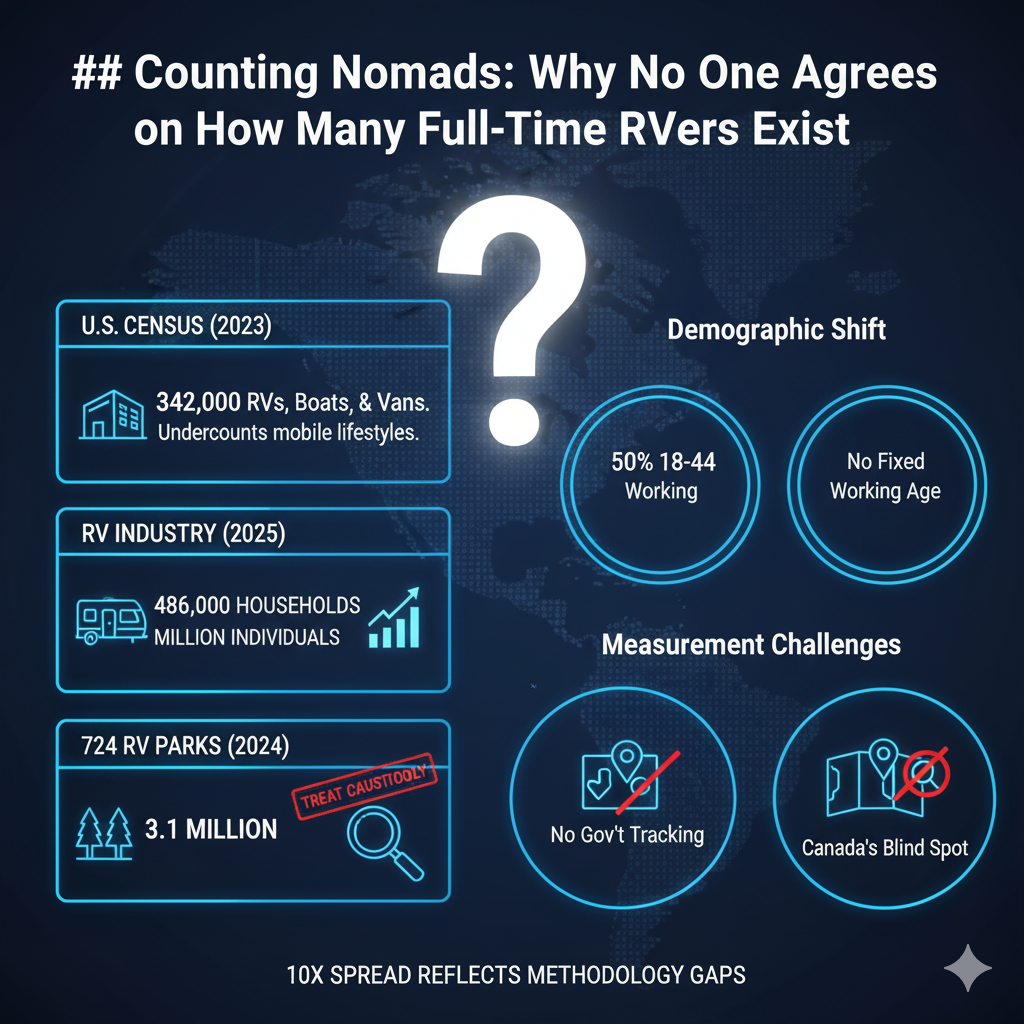
No government agency directly tracks full-time RVers. The question “how many people live in RVs year-round?” produces wildly different answers depending on methodology and definitions. Commonly cited estimates range from 342,000 to 3.1 million—a 10x spread that reflects genuine measurement challenges rather than bad data. Mobile populations defy traditional enumeration methods because they don’t fit the “primary residence at fixed address” model that census instruments assume.
The RV Industry Association’s frequently cited “1 million full-timers” figure appears throughout media coverage but lacks current methodological documentation. The number functions as industry commentary rather than an evidence-based count. Some estimates explicitly include van-dwellers and mobile home residents beyond traditional RVs, explaining their higher magnitude. Without detailed methodology, these figures should be treated as directional rather than definitive.
A conservative estimate built from census data
Methodology Note: The following estimate applies author-derived adjustments to census categories to approximate full-time RV populations. These calculations are not official census outputs and should be treated as approximate scenarios rather than definitive counts.
Using U.S. Census ACS Table B25032 for “boat/RV/van” primary residences (2024) and Statistics Canada’s “movable dwelling” category (2021)—then applying author-estimated adjustments to isolate RVs—produces an estimate of approximately 164,000 to 409,000 people living full-time in RVs across the U.S. and Canada in 2024-2025 (mid-case ≈ 280,000).
Calculation approach:
- U.S. baseline: 2024 ACS reports 138,281 occupied households (±6,716) listing “boat, RV, van, etc.” as primary residence. Applying an author-estimated 60-85% RV-only share (to remove boats/vans), then multiplying by an estimated 1.6-2.2 persons per household (based on typical nomadic household patterns), produces approximately 133,000-259,000 people (mid-case ≈ 197,000).
- Canada estimate: 2021 Census shows “movable dwellings” (which include mobile homes, RVs, houseboats, and rail cars) represent 1.3% of occupied dwellings = ~194,726 units. Applying an author-estimated 10-35% RV-only share (to discount mobile homes), then 1.6-2.2 persons per household, produces approximately 31,000-150,000 people (mid-case ≈ 83,000).
Why this estimate is likely conservative:
- Definition gap: “Primary residence” doesn’t equal “sold the house”—seasonal RVers who maintain conventional homes won’t appear in these counts
- Mixed categories: Census instruments blend boats/vans with RVs (U.S.) and mobile homes with RVs (Canada)
- Domicile masking: Many full-timers use mail-forwarding services and report standard street addresses, making them invisible to RV-specific categories
The domicile masking problem particularly affects census accuracy. Full-timers maintain traditional addresses through services like Americas Mailbox and Dakota Post for legal, insurance, and healthcare purposes. The Census tracks people by primary residence address—a concept that doesn’t fit mobile lifestyles where your legal domicile (South Dakota mail-forwarding address) differs from where you physically park (Arizona desert, Colorado mountains, wherever you choose). This structural mismatch means official counts likely understate the full-timer population substantially.
Canada faces even more severe measurement gaps. The Canadian Recreational Vehicle Association reports 2.1-2.2 million RV-owning households, representing roughly 14% of Canadian households.[22] But Statistics Canada doesn’t track full-time versus recreational use, and the “movable dwelling” category was designed to count housing stock types, not identify nomadic populations. A statistical blind spot exists for a population that anecdotal evidence suggests is growing rapidly.
The paradox in ownership data reveals two distinct markets operating in opposite directions. Total RV ownership declined from around 11 million households in 2021-2022 to 8.1 million in 2025, yet community forum activity and campground operator reports suggest full-time RV living grew during this same period.[9] This suggests recreational users exiting while necessity-driven and lifestyle full-timers entered, driven by fundamentally different economic pressures.
Demographic shifts further complicate tracking. Industry research and community surveys suggest the full-time RV population skews younger than traditional retirement demographics, with substantial representation in the 18-44 age range and median first-time buyer ages dropping into the early 30s. Working-age full-timers and remote workers represent a growing segment compared to historical retiree dominance. These younger, working full-timers behave differently than retired populations—different park preferences, different travel patterns, different connectivity needs—but may not appear in studies focused on traditional RV demographics or in census categories designed around retirement-age nomads.
Community-based tracking provides partial insight where official statistics fail. The Escapees RV Club has over 50,000 member families, most identifying as full-timers.[23] Mail forwarding services serve tens of thousands of clients who use their addresses for domicile purposes. These proxy measures suggest the full-timer population exceeds Census figures substantially but likely falls well below the frequently cited “1 million” talking point when you isolate actual year-round RV dwellers from the broader universe of van-lifers, seasonal travelers, and mobile home residents.
The measurement gap also reveals which populations remain invisible. Lower-income RVers living in older rigs at budget parks or on the margins of legality don’t appear in industry surveys targeting RV owners. Seasonal workers following harvest or tourism cycles may identify as migrant workers rather than RVers despite living in campers year-round. The statistical apparatus simply wasn’t designed to capture mobile populations who actively obscure their living situations for legal, financial, or privacy reasons.
Canadian RV living faces unique regional cost pressures
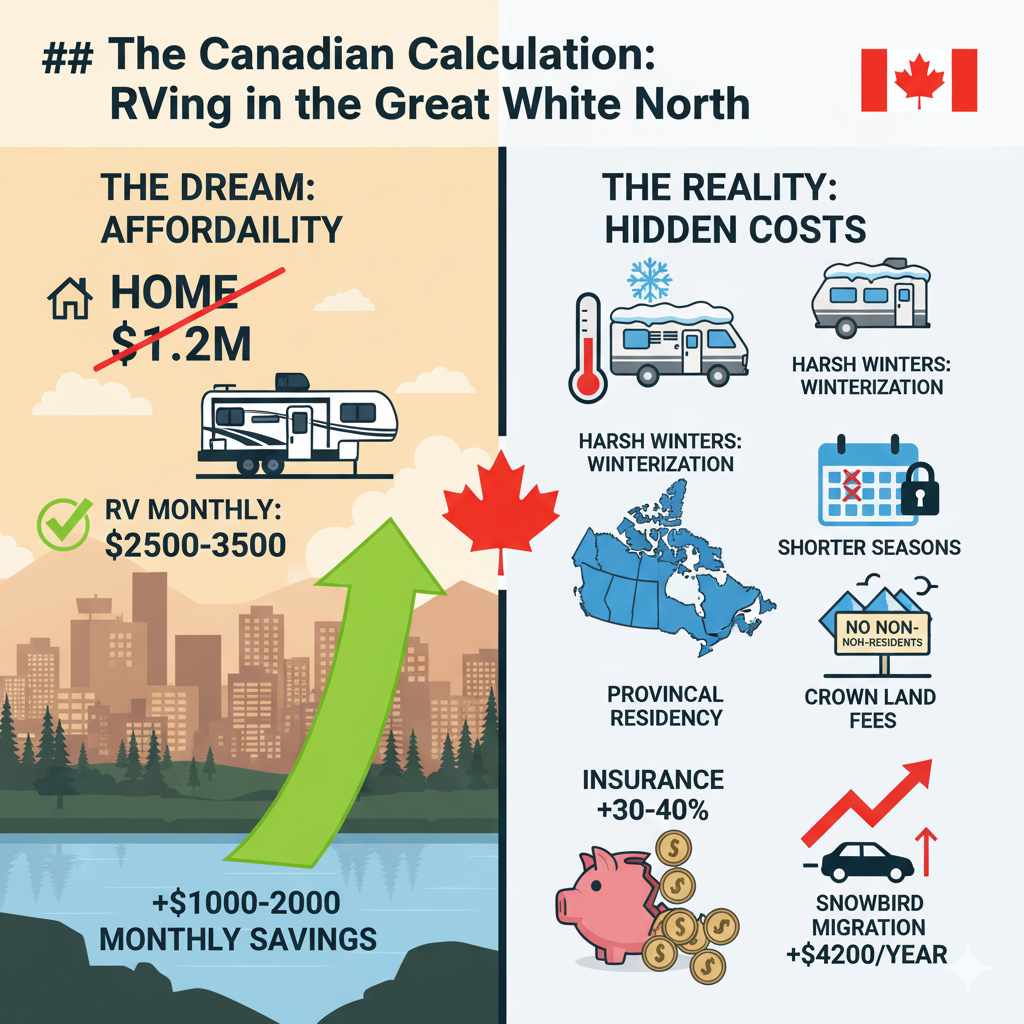
Canadian housing affordability makes RV living more compelling on paper—Vancouver’s $1.2 million average home versus $2,500-3,500 monthly RV costs suggests $1,000-2,000 monthly savings.[25] But Canadian-specific factors create hidden costs: harsher winters requiring winterization ($500-1,500), shorter viable travel seasons, provincial residency requirements, and Crown Land restrictions for non-residents.
Housing comparison data reveals dramatic regional variation. Vancouver averaged $1,226,351 for homes in 2024, while Toronto hit $1,022,143.[25][26] In these markets, monthly ownership costs easily exceed $3,000-4,000 when including mortgage payments, property taxes, insurance, and utilities. Against this baseline, RV living’s $2,500-3,500 monthly costs deliver genuine savings of $1,000-2,000. But Prairie cities like Edmonton averaged just $470,477 for homes, where mortgage payments run $1,800-2,200 monthly.[27] RV living advantages disappear in affordable housing markets.
Crown Land access creates both opportunity and complexity. Approximately 89% of Canada is Crown Land where residents can camp free for up to 21 days per site annually. This seems comparable to U.S. Bureau of Land Management access. But non-residents face restrictions and fees. Ontario charges $10.57 per person per night for non-resident Crown Land camping.[17] A couple spending 100 nights boondocking on Ontario Crown Land pays $2,114 in fees—eliminating the cost advantage over campgrounds while sacrificing hookups and amenities.
Provincial residency requirements create administrative pressure. Unlike U.S. states like South Dakota or Florida that actively court RV domiciles with streamlined processes, Canadian provinces generally require stronger residency connections. Healthcare coverage varies by province and often requires physical presence or property ownership. Maintaining provincial health insurance while traveling extensively across Canada or into the U.S. creates bureaucratic complications that American full-timers avoid through domicile-friendly states.
Winter survival represents the most significant Canadian-specific cost. Heating propane consumption doubles or triples when temperatures drop below freezing. Arctic-rated RVs with enhanced insulation, upgraded furnaces, and heated holding tanks command 30-40% price premiums over standard models. Many Canadian full-timers become snowbirds by necessity, migrating to Arizona, California, or Texas for winter months. This creates cross-border insurance complexity, vehicle registration questions, and the practical expense of driving 2,000-3,000 miles each direction for seasonal migrations.
From monitoring r/GoRVing and Canadian RV forums, insurance difficulties emerge as a consistent theme. Fewer carriers write full-timer policies in Canada compared to the U.S. market. Those that do often exclude winter coverage or charge substantial premiums for year-round protection. Community reports document Canadian full-timers comparing quotes with average annual premiums of $1,800-2,400 CAD versus $1,200-1,800 USD for comparable U.S. policies. The premium difference reflects both exchange rates and Canada’s smaller, less competitive RV insurance market.
Parks Canada fee increases mirror U.S. trends. A 4.1% increase took effect in January 2024, with typical campgrounds ranging $40-75 CAD nightly.[3] Provincial parks vary by region but generally cost $35-60 nightly for sites with electrical hookups. British Columbia and Ontario parks face particularly high demand and corresponding price pressure. Reservations at premium locations like Banff or Jasper require the same bot-fighting tactics Canadian RVers learn from U.S. forums.
The snowbird migration adds quantifiable costs beyond fuel based on community-reported experiences. U.S. RV insurance for Canadian-registered vehicles runs $800-1,200 for six-month seasonal coverage. Some Canadians maintain dual registrations to simplify border crossings. Vehicle inspections, temporary import documentation, and potential customs complications all add friction and expense. One Escapees forum member calculated her annual snowbird costs at $4,200 beyond normal RV expenses—$2,800 in extra fuel for migrations, $900 for U.S. insurance, and $500 in border-related fees and paperwork.
Canadian RV ownership reached 2.1-2.2 million households in 2024, with 6.3 million people going RV camping in 2023.[28] But no government agency tracks full-time versus recreational use, creating the same statistical blind spot seen in U.S. data. Anecdotal evidence from Canadian RV clubs and forums suggests the full-timer population grew substantially since 2020, driven by the same housing affordability pressures affecting the U.S. but with uniquely Canadian complications.
The Alberta and Saskatchewan insurance situation connects to broader Canadian market dynamics. Prairie provinces face catastrophic weather risks—hail, high winds, extreme cold—that coastal regions avoid. This creates regional premium variations that national averages obscure. Community reports suggest full-timers planning to spend summers in southern Alberta should budget 30-40% above national insurance estimates based on quote experiences shared in forums.
Language requirements add minor but real complexity in Quebec. While English-speaking RVers encounter no practical barriers, official documentation and campground signage defaults to French. Some Quebec provincial parks prioritize French-language reservations or communications. This doesn’t prevent RV travel but creates friction that unilingual English speakers navigate with varying success.
Cost comparisons depend critically on housing markets and upfront capital access
Monthly RV living costs of $2,500-3,500 appear cheaper than the $2,329 average U.S. mortgage plus $200-400 utilities and 1-3% maintenance.[29] But this comparison ignores the capital access problem: “free” boondocking requires $5,000-20,000 upfront that economic-necessity RVers often lack, while traditional housing builds equity that RVs destroy through 30-50% five-year depreciation.
Mortgage rates are forecast to average around 6.3% in 2026, down slightly from 6.6% in 2025 but still well above the pandemic-era rates that created the lock-in effect. This marginal improvement brings minimal relief—monthly payments remain elevated compared to historical norms. Home prices are projected to continue rising modestly in most markets, with forecasters predicting 0.5-4% growth in 2026 depending on region. The Northeast and Midwest see stronger price growth supported by tight inventory and strong labor markets, while Southern and Western markets show more softening as pandemic-era migration slows.
Break-even analysis reveals when each option makes financial sense. RV living proves cheaper in expensive housing markets like Vancouver ($1.2 million average homes) or San Francisco, where monthly ownership costs exceed $3,000-4,000. Against this baseline, RV costs of $2,500-3,500 deliver genuine savings of $1,000-2,000 monthly. But in affordable Midwest markets like Green Bay, Wisconsin ($798 average rent) or Dayton, Ohio ($824), RV living often costs MORE than traditional housing.[30]
Capital access creates a bifurcation that statistics obscure. Lifestyle choosers with $20,000 for comprehensive off-grid setups can access cheap boondocking on public lands, reducing recurring costs to $1,000-1,600 monthly. They save $7,200-12,000 annually compared to park-based RV living. Economic-necessity movers without upfront capital remain stuck paying $800-1,200 monthly for RV parks that include utilities and Wi-Fi—costs comparable to or exceeding apartment rent in many markets.
Financing traps compound this dynamic. Paying 5-8% interest on a depreciating asset means many RVers end “underwater” within three years, owing more than the RV’s worth. One iRV2 discussion thread documented what members call the “5-year trap”—people who financed discover they cannot sell for loan payoff, stuck making payments while watching friends build home equity. The thread included 31 responses, with 19 reporting they were currently underwater on RV loans ranging from $8,000 to $47,000.
A specific cost breakdown shows the range. Thrifty stationary RVers living in one location and boondocking frequently spend $1,000-1,600 monthly: $400 RV payment, $100 insurance, $100 maintenance reserve, $150 phone/internet, $200 occasional campground fees, $300 fuel for minimal travel, $50 propane, $500 food for two people. Luxury travelers in Class A motorhomes moving frequently hit $5,000+ monthly: $800 RV payment, $200 insurance, $300 maintenance, $200 connectivity, $1,200 campground fees at premium locations, $700 fuel for constant movement, $100 propane, $1,000 food and dining out.
Hidden costs over five years total $25,000-85,000 with zero equity gained. Depreciation loss alone runs $15,000-50,000 on typical RVs. Unexpected repairs add $5,000-20,000—the major engine failure, roof leak with water damage, or slide-out mechanism replacement that warranties don’t cover. Financing interest costs $5,000-15,000 on typical loans. Meanwhile, homeownership over the same period involves $10,000-30,000 in repairs and maintenance but typically generates 15-40% appreciation plus $50,000-100,000+ in equity, creating net positive wealth of $20,000-70,000.
Recent housing market dynamics shifted the comparison. CBRE Research found in March 2024 that average monthly mortgage payments for newly purchased homes now surpass apartment rents by 38%, with the gap projected to persist through 2029.[31] This represents a reversal from historical patterns driven by high interest rates colliding with rising rents. Zillow’s 2024 report showed that in 22 of the 50 largest U.S. metros, mortgage payments fell lower than rent.[32] This changes the RV living calculation—if mortgage payments exceed rent in most markets, RV living compares favorably to renting but still lags homeownership’s equity-building advantage.
The comparison must account for lifestyle factors beyond pure finances. RVers sacrifice space, stability, consistent healthcare access, and community roots. They gain mobility, minimal possessions, proximity to nature, and freedom from property maintenance. For retirees with home equity already established, these tradeoffs work differently than for working-age people trying to build wealth while supporting families.
Demographics reveal who benefits most. Industry research and community surveys suggest approximately 40-45% of full-timers are retired, while 55-60% are working-age or actively employed. Retirees who cashed out home equity can fund comprehensive RV setups and travel comfortably. Working-age people choosing RVs for affordability often discover they’re paying comparable costs without building equity, trapped by the same capital constraints they hoped to escape. With median first-time buyer ages dropping into the early 30s based on industry data, younger buyers are making this choice during their peak wealth-building years—time they cannot recover.
Hidden costs create a depreciation trap that homeownership avoids
The RV Industry Association itself states RVs are “recreational vehicles built for temporary recreational use,” not permanent homes.[9] Full-timers discover this through $17,000 engine failures, $2,000-4,000 tire replacement sets, and $1,000-5,000 roof leak repairs that traditional homeowners’ insurance wouldn’t allow to accumulate. Meanwhile, homeowners build $50,000-100,000 equity in five years that RV dwellers forfeit entirely.
Major repair reality hits unexpectedly. One documented case involved a $17,000 engine failure on a motorhome with 78,000 miles. Another owner’s extended warranty offset $17,981 in repairs over three years—without warranty coverage, these costs would have depleted savings entirely.[7] First-year maintenance on a 2017 model RV averaged $4,000+ according to owner tracking, well above the $1,500-2,000 most budgets anticipated. Common major repairs include roof replacements at $7,000-10,000, slide-out mechanisms at $2,500-9,000, AC systems at $1,000-3,000, and complete tire sets at $2,000-4,000.[6]
Quality-of-life costs extend beyond financial calculations. Difficulty holding steady employment with constant movement affects career trajectories and income potential. Limited healthcare access in rural areas creates medical risks and forces expensive urgent care or ER visits for routine issues. Mail forwarding complications delay important documents or medication refills. Mental health impacts from confined spaces affect relationships and individual wellbeing. These factors don’t appear on cost comparison spreadsheets but accumulate real consequences.
Weather vulnerability creates both expense and risk. Poor insulation drives extreme heating and cooling costs—propane consumption triples in winter, electrical usage doubles in summer when running air conditioning at full capacity. Flash flooding, hurricanes, and severe storms that houses withstand can total an RV. Insurance deductibles of $1,000-2,500 mean weather damage creates immediate financial stress beyond monthly budgets.
The “stuck underwater” phenomenon threads through community discussions on iRV2 and Escapees forums. Multiple members describe feeling trapped—they cannot sell without bringing cash to closing, yet continuing to pay compounds wealth destruction as depreciation continues. One thread participant calculated that after four years of $650 monthly payments, she still owed $28,000 on an RV worth $22,000. Selling meant finding $6,000 cash she didn’t have. Continuing meant paying another $7,800 annually in payments plus operational costs while losing $3,000-5,000 annually to depreciation.
The demographic shift amplifies this trap’s impact. With substantial representation from ages 18-44 based on industry research, the population skews toward people who should be building wealth during peak earning years. Median first-time buyer ages have dropped into the early 30s. These younger RVers face opportunity costs that retirees don’t—every year not building home equity or retirement savings compounds into six-figure differences over 30-40 year horizons.
Industry research and community surveys suggest the majority of full-timers are working-age or actively employed rather than retired. Among RVers generally, remote work is common, particularly among younger age groups. This working population chose RV living during peak wealth-building years. If they’re paying comparable costs to apartment rent without equity accumulation, they’re falling behind peers who own homes—not because they’re spending more monthly, but because they’re receiving no return on housing expenditure beyond immediate shelter.
About one-third of full-time RVers travel with children based on community surveys, with families in the 35-44 age range particularly likely to have kids with them.[9] Education complications add stress—some homeschool, others use virtual classes, and many stay near home bases so children can attend physical schools. Constant movement disrupts friendships and educational continuity. Stationary RV living to maintain school enrollment defeats the mobility advantage that supposedly justifies the lifestyle sacrifice.
The RV Industry Association’s own warning that these vehicles aren’t built for full-time use manifests in accelerated wear. Systems designed for weekend camping fail under daily use. Water heaters, furnaces, refrigerators, and slide-out mechanisms all have duty cycles based on recreational assumptions. Full-time use exceeds design parameters, leading to premature failures that manufacturers won’t warranty as defects. Service center managers estimate full-time use reduces typical component lifespan by 40-60%, turning a 10-year refrigerator into a 4-6 year unit requiring $800-1,500 replacement.
Resale market realities compound depreciation. RVs with visible full-time wear—faded decals, worn flooring, permanent site setup modifications—sell for 20-30% less than comparable units showing recreational-only use. Buyers discount heavily for perceived accelerated aging. This means full-timers face both faster depreciation rates and lower resale multiples, compounding wealth destruction at both ends of the ownership cycle.
Frequently asked questions
How much does it actually cost to live in an RV full-time in 2026?
Full-time RV living costs $2,500-3,500 monthly for most people in 2026, covering RV payments, insurance, maintenance, campgrounds, fuel, and food. Budget minimalists living stationary and boondocking can reduce this to $1,000-1,600, while frequent travelers in luxury rigs spend $5,000+. The single biggest variable is whether you have $5,000-20,000 upfront for solar and connectivity equipment that enables free camping. This capital requirement creates a bifurcation—lifestyle choosers with resources access cheap boondocking, while economic-necessity movers without capital pay $800-1,200 monthly for RV parks comparable to apartment rent.
Is living in an RV cheaper than renting an apartment in 2026?
It depends entirely on your housing market and capital access. In expensive cities like Vancouver ($1,226,351 average home) or San Francisco, RV living saves $1,000-2,000 monthly. In affordable markets like Green Bay, Wisconsin ($798 average rent) or Dayton, Ohio ($824), you’ll likely spend MORE living in an RV. The comparison also ignores the $25,000-85,000 in depreciation and hidden costs over five years that renters and homeowners avoid. RVs lose 30-50% of their value in five years while homes typically appreciate, creating fundamental wealth-building differences that monthly cost comparisons miss.
Can you legally live in an RV full-time in Canada?
Yes, but Canadian full-timers face unique challenges. Crown Land offers 21-day free camping for residents across 89% of Canada, but non-residents pay fees ($10.57/person/night in Ontario). Harsh winters require expensive winterization or snowbird migration to the U.S., adding border and insurance complexity that costs $4,000+ annually. Fewer insurance carriers write full-timer policies with winter coverage, and provincial residency requirements complicate mail forwarding more than U.S. domicile states like South Dakota or Florida. Community reports document Canadian RVers paying insurance premiums of $1,800-2,400 CAD versus $1,200-1,800 USD for comparable U.S. policies.
How many people actually live in RVs full-time?
Estimates range from 342,000 (U.S. Census “boat/RV/van” category) to 1 million Americans (commonly cited in industry commentary), with Canada having 2.1 million RV-owning households but no tracking of full-time versus recreational use. The 10x spread in estimates reflects genuine measurement challenges—mobile populations use mail forwarding addresses and defy traditional census methods. What’s clear is the demographic shift indicated by industry research: substantial representation from ages 18-44 rather than retirement-dominated demographics, with median first-time buyer ages dropping into the early 30s. The majority appear to be working-age rather than retired. This represents a fundamental change from the traditional RV lifestyle, driven by housing affordability crises and remote work opportunities rather than retirement leisure.
Sources
- IBISWorld. (2025). Campgrounds & RV Parks in the US – Market Research Report.
- The Happy Camper. (2025). The Rising Cost of RV Insurance in 2025: What Every Owner Should Know.
- Parks Canada. (2024). Fees and Passes.
- GearJunkie. (2025). The Dyrt’s 2025 Camping Report: Trends and Insights.
- Nomads in Nature. (2025). Cost of Living in an RV Full Time [2025 Update].
- Overland RV Services. (2024). 7 Most Common RV Repair & Replacement Costs You Should Know.
- RV Living. (2024). RV Emergency on the Road: How We Survived a $17k Breakdown.
- Bureau of Transportation Statistics. (2025). Motor Fuel Prices – May 2025.
- RV Industry Association. (2025). Media Resources and Industry Data.
- Industry analysis and manufacturer reporting on RV pricing factors (2024-2025).
- RV Industry Association. (2021). RV Industry Produces 600,000 RVs in 2021, Surpassing Previous Record by 19%.
- Morton, T. & Morton, C. (2025). RV Buying Guide 2025: What You Need to Know.
- Price, C. (2026). RV Overnights vs Harvest Hosts (2026): Which Is Worth It? Boondock or Bust. Harvest Hosts network growth data: 600 locations (2018) to 5,844 (2026).
- Harvest Hosts. (2026). Official Website.
- Boondockers Welcome. (2026). Official Website.
- Terego. (2026). Canadian RV Hosting Network.
- Bureau of Land Management. (2026). Camping on Public Lands.
- Ontario Parks. (2026). Recreational Activities on Crown Land.
- iOverlander. (2026). Community-Driven Camping Database.
- Recreation.gov. (2026). Federal Recreation Reservations.
- U.S. Census Bureau. (2024). American Community Survey.
- Community-reported full-time RVer population estimates (2024).
- Canadian Recreational Vehicle Association. (2024). Industry Statistics.
- Escapees RV Club. (2026). Official Website and Forums.
- Industry research on RV demographics and buyer profiles (2024-2025).
- WOWA. (2024). Vancouver Housing Market Report.
- WOWA. (2024). Canadian Housing Market Report.
- Spring Financial. (2025). The Average Home Prices in Canada 2025.
- Camper Champ. (2024). Canada RV Camping: Statistics 2024.
- Experian. (2024). Average US Mortgage Debt Increases to $252,505 in 2024.
- SmartAsset. (2024). Rent vs. Buy: A Comparison of Housing Costs in U.S. Cities – 2024 Study.
- CBRE Research. (2024). New Mortgage Payments Expected to be Higher than Rent for Next Five Years.
- Zillow. (2024). Mortgage payments fall lower than rent in 22 of the 50 largest US metros.
Additional Community Sources Referenced:

by Chuck Price | Nov 13, 2025 | Resources
5 Retiree Regrets to Avoid (2026)
Dreaming of trading your house keys for an RV key and cruising down scenic highways on endless adventures? You’re not alone. A Progressive survey found that 46% of retirees living the RV lifestyle see no end in sight (Progressive, 2024).
The allure is undeniable: freedom of the open road, exploring new places at your own pace, and the chance to simplify your life. However, the romanticized vision often clashes with reality. Many aspiring retirees underestimate the financial impact of RV depreciation, the relentless maintenance demands, and the challenge of building community while constantly moving.
We’re experienced full-time RVers who specialize in boondocking and have navigated these exact challenges over multiple years on the road. We’ve seen countless retirees make costly mistakes that could have been avoided with better planning. In this guide, we’ll walk you through the five biggest regrets new RV retirees face, backed by real cost data, comparison tables, and actionable insights from our firsthand experience.
By the end of this article, you’ll have access to three comprehensive comparison tables showing RV living costs versus traditional retirement, a breakdown of different RV types for retirees, and a downloadable budget worksheet to help you make an informed decision. Whether you’re ready to sell your home or just exploring the possibility, this reality check will prepare you for what full-time RV retirement truly entails.
Regret #1: The Financial Burden of RV Depreciation

Unlike traditional homes that typically appreciate over time, RVs are depreciating assets that lose 20-30% of their value in the first year alone. According to J.D. Power research, most RVs experience their steepest depreciation immediately after purchase, similar to driving a new car off the lot (J.D. Power, 2024). This rapid value loss can significantly impact your retirement nest egg if you’re not prepared for the financial reality.
Our Class A motorhome depreciated approximately $35,000 in the first year—money that vanished from our retirement savings with nothing to show for it except the privilege of ownership. This came as a shock because we’d planned our budget around the assumption that our RV would hold value similarly to our previous home. That assumption cost us dearly.
Rick Broyer, a 40-year camping veteran, shares this perspective: “Selling your house to fund an RV lifestyle offers the allure of adventure and freedom. However, the financial implications are crucial to consider. Unlike a house, which typically appreciates, an RV depreciates rapidly. This means you’ll get less money when you eventually decide to sell it” (Broyer, 2024).
To illustrate this gap, consider that homes appreciated an average of 3-5% annually in recent years according to Rocket Homes (Rocket Homes, 2024), while RVs consistently lose value. Here’s what typical RV depreciation looks like over five years:
| Year |
Depreciation Rate |
Example: $150,000 RV Value |
Cumulative Loss |
| Year 1 |
20-30% |
$105,000-$120,000 |
$30,000-$45,000 |
| Year 2 |
10-15% |
$89,250-$108,000 |
$42,000-$60,750 |
| Year 3 |
8-10% |
$80,325-$97,200 |
$52,800-$69,675 |
| Year 4 |
6-8% |
$73,899-$89,424 |
$60,576-$76,101 |
| Year 5 |
5-7% |
$70,204-$83,164 |
$66,836-$79,796 |
Source: J.D. Power RV depreciation data (2024) and industry analysis from RVIA market reports (2024-2025)
Compare this to a home purchased for $250,000 that appreciates 4% annually—it would be worth approximately $304,000 after five years, a gain of $54,000. Meanwhile, that $150,000 RV lost nearly $70,000 in the same period. The financial gap between these two assets represents a swing of over $120,000 in your retirement portfolio.
This doesn’t mean RV retirement is financially irresponsible, but it requires a fundamentally different cost-benefit analysis than traditional homeownership. You’re paying for mobility, freedom, and experiences rather than building equity. The key is entering this lifestyle with your eyes wide open to the depreciation reality, not expecting your RV to serve as a financial asset the way a home might. Budget for the RV as an expense that enables your retirement adventure, not as an investment that will protect your wealth.
Regret #2: Underestimating the Ongoing Costs and Maintenance

Full-time RVing demands constant attention and maintenance that far exceeds what most first-timers budget for. Between routine service like oil changes costing $170-$330 and unexpected repairs, RV owners spend an average of $3,500-$7,000 annually on maintenance, according to industry data (RV Repair Club, 2024). Unlike a traditional home where you might schedule one major service call per year, your RV requires weekly checks and monthly maintenance tasks to keep it roadworthy.
Mike Thomas, a veteran RV mechanic with over 20 years of experience, explains the reality: “The biggest surprise for many new RVers is the sheer amount of upkeep involved. From routine maintenance like oil changes and tire rotations to unexpected repairs like plumbing leaks or appliance breakdowns, there’s always something that needs attention” (Thomas, 2024).
Our first-year unexpected maintenance bill totaled $4,200—nearly double our budget. This included a refrigerator compressor failure ($850), a roof leak repair ($1,100), new house batteries ($650), and multiple smaller issues that added up quickly. We learned the hard way that RVs experience constant stress from road vibration, temperature extremes, and the simple fact that your entire home is bouncing down the highway at 60 miles per hour.
Here’s a realistic breakdown of what you should budget for annual RV maintenance:
| Maintenance Category |
Routine Cost (Annual) |
Unexpected Reserve |
Total Range |
| Oil changes and filters (2-3x/year) |
$340-$990 |
— |
$340-$990 |
| Tire rotation and replacement |
$300-$600 |
$1,200-$2,400 |
$300-$3,000 |
| Generator maintenance |
$200-$400 |
$500-$2,000 |
$200-$2,400 |
| Roof inspection and resealing |
$150-$300 |
$800-$3,000 |
$150-$3,300 |
| Plumbing system service |
$100-$250 |
$400-$1,500 |
$100-$1,750 |
| Appliance maintenance/replacement |
$200-$400 |
$500-$2,500 |
$200-$2,900 |
| Brake system inspection/service |
$300-$500 |
$800-$2,000 |
$300-$2,500 |
| Awning, slide-out maintenance |
$150-$300 |
$600-$1,800 |
$150-$2,100 |
| TOTAL ANNUAL BUDGET |
$1,740-$3,740 |
$4,800-$15,200 |
$3,500-$7,000 |
Sources: Camping World Service Center pricing (2024), Luxury Coach Lifestyle forum data (2024), RV Repair Club cost analysis (2024), and our personal maintenance logs.
Beyond the financial costs, there are the time and logistical challenges. Finding qualified RV technicians can be difficult, especially in remote areas. According to industry forum discussions, wait times for service appointments can stretch to 3-4 months during peak season (Luxury Coach Lifestyle, 2024). When major repairs are needed, you may have to find temporary housing for weeks or even months while your home is in the shop.
The good news is that many routine tasks can be handled yourself with basic tools and knowledge, potentially saving $1,000-$2,000 annually. The RV Repair Club offers excellent video tutorials for DIY maintenance, from changing air filters to troubleshooting electrical systems (RV Repair Club, 2024). We’ve learned to handle most routine checks ourselves, reserving professional service for major engine work and specialized repairs.
Our recommendation: Budget an additional 15-20% beyond the averages shown in the table above for your first two years. This cushion accounts for the learning curve and the inevitable surprises that come with RV ownership. Once you understand your specific RV’s quirks and maintenance patterns, you can adjust your budget accordingly. The key is never being caught financially unprepared when something breaks—because something always will.
Regret #3: Health and Accessibility Challenges on the Road

Accessing specialized healthcare while RVing full-time requires careful planning that many retirees overlook until they face a medical crisis far from home. Original Medicare covers care in any state, but Medicare Advantage plans often restrict out-of-network coverage to emergencies only, leaving you with limited options when you need routine care or specialist appointments hundreds of miles from your plan’s network (Medicare.gov, 2024).
Dr. William Lee, a geriatric care specialist, shares his perspective on the challenges: “While RV living can be an exciting adventure for some retirees, it’s crucial to consider potential health challenges. Limited access to specific medical professionals and the potential for chronic health flare-ups due to stress or unfamiliar environments require careful planning” (Lee, 2024).
We experienced this firsthand when we needed a cardiology specialist while staying in rural Montana. Our Medicare Advantage plan required us to travel 240 miles to the nearest in-network provider, turning what should have been a routine follow-up into a multi-day ordeal. That experience taught us the critical importance of understanding your healthcare coverage before hitting the road.
Here’s how different Medicare options stack up for full-time RV travelers:
| Plan Type |
Coverage Area |
Out-of-Network Care |
Avg. Monthly Cost |
Best For |
| Original Medicare (Parts A & B) |
Nationwide |
Covered anywhere |
$174.70 (Part B only) |
Full-time travelers |
| Medicare Advantage (Part C) |
Regional network |
Emergency only |
$0-$200+ |
Home-base RVers |
| Medigap + Original Medicare |
Nationwide |
Covered anywhere |
$150-$400 supplement |
Frequent travelers |
| Pre-65 Private Insurance |
Often state-specific |
Very limited |
$500-$1,500+ |
Not ideal for RVers |
Sources: Medicare.gov coverage guidelines (2024), eHealth Medicare Advantage cost data (2024), and KFF Medicare cost analysis (2024).
For retirees under 65, the healthcare challenge becomes even more complex. Most private insurance plans are state-specific, creating significant coverage gaps when you cross state lines (Medicare.gov, 2024). Your options include expensive nationwide plans, ACA marketplace coverage with limited networks, or health-sharing ministries that may not cover pre-existing conditions.
Mobility and accessibility present another layer of challenges. Navigating the smaller living quarters and potentially uneven terrain around campsites can be difficult for those with mobility limitations. Check out this comprehensive guide created by two camping experts who use wheelchairs, offering practical tips for accessible RV travel (REI, 2024).
Our advice: Before committing to RV retirement, verify your current healthcare coverage’s travel provisions, identify accessible RV parks along your planned routes, and establish relationships with telehealth providers who can manage routine care remotely. The freedom of the road shouldn’t come at the cost of your health and well-being.
Regret #5: Not Everyone Is Cut Out for Full-Time RVing

Full-time RV living requires significant lifestyle adjustments that don’t suit everyone, regardless of how appealing the concept seems. Downsizing to 200-400 square feet, managing constant travel logistics, and handling unpredictable challenges demand flexibility and resilience that many retirees underestimate until they’re living the reality. The romanticized vision of endless adventure often collides with the day-to-day stress of finding campgrounds, dealing with mechanical issues, and missing familiar comforts.
David and Lisa Miller gave up full-time RVing after just one year. “We envisioned ourselves exploring national parks and soaking up new cultures,” they shared. “The reality was a lot of time spent driving, dealing with RV breakdowns, and struggling to find decent internet for remote work.” Their experience represents a common pattern—approximately 30% of new full-timers return to traditional housing within the first two years, according to RVIA research (RVIA, 2025).
Here’s how we knew we were ready: We’d taken multiple extended trips (3-6 months each) before selling our home, tested our tolerance for small spaces during those trials, built a realistic maintenance budget based on experience rather than optimistic assumptions, and most importantly, we both genuinely enjoyed the lifestyle rather than one person compromising for the other’s dream.
Consider exploring part-time RV travel as a middle ground. This approach allows you to experience the joys of RVing without the full-time commitment. According to Go RVing data, part-time RVers report higher satisfaction rates than full-timers because they maintain a home base while still enjoying adventure (Go RVing, 2024). You can take shorter trips closer to home, return to familiar surroundings when needed, and test your appetite for the lifestyle without burning your bridges to traditional retirement.
Here’s a comprehensive comparison to help you assess which retirement path aligns with your needs:
| Factor |
Full-Time RVing |
Part-Time RVing |
Traditional Retirement |
| Avg. Monthly Cost |
$1,500-$2,800 |
$2,000-$3,500 |
$1,200-$2,000 (paid-off home) |
| Freedom/Flexibility |
Maximum (go anywhere) |
High (seasonal travel) |
Low (location fixed) |
| Community Stability |
Low (constantly changing) |
High (home base + travel) |
Very High (established) |
| Maintenance Burden |
High (RV only) |
Very High (RV + home) |
Moderate (home only) |
| Healthcare Complexity |
High (multi-state) |
Low (home network) |
Very Low (local providers) |
| Family Proximity |
Variable (must plan) |
Good (seasonal visits) |
Excellent (always nearby) |
| Space/Storage |
Minimal (200-400 sq ft) |
Full home + RV |
Full home space |
| Best For |
Adventurous, minimalist, healthy, flexible |
Best of both worlds seekers |
Community-focused, health concerns, homebodies |
Sources: RVIA full-timer cost surveys (2024-2025), Go RVing lifestyle research (2024), and comparative analysis from RV Life magazine (2024).
If full-time RVing doesn’t resonate after honest self-assessment, consider alternative retirement adventures. The Peace Corps actively recruits volunteers age 50+, offering meaningful service opportunities with housing and healthcare provided (Peace Corps, 2024). House sitting through platforms like TrustedHousesitters allows extended travel without RV ownership costs. Extended cruises designed for retirees provide adventure with less logistical burden than RV life.
Before making any irreversible decisions, ask yourself these five critical questions: Can I comfortably live in 300 square feet with my partner for months at a time? Am I willing to handle unexpected mechanical and plumbing issues myself or pay premium rates for emergency repairs? Does my health condition allow for limited access to specialized medical care? Can I build new friendships quickly and accept their temporary nature? Do I genuinely enjoy driving and navigating large vehicles, or does it stress me out?
The perfect retirement is the one you’ve planned for and that aligns with your authentic values and needs—not the one that looks appealing in glossy RV magazines or social media feeds. There’s no shame in choosing traditional retirement after exploring RV living. The shame would be committing to a lifestyle that makes you miserable simply because you felt you “should” want the adventure.
The Real Cost: RV Living vs. Traditional Retirement
One of the most critical decisions you’ll make is understanding the true financial picture of RV retirement versus staying in a traditional home. Many retirees assume RV living is automatically cheaper, but the reality depends heavily on your specific situation, travel frequency, and the type of home you’re comparing against. Here’s a comprehensive breakdown based on 2024-2025 cost data:
| Expense Category |
RV Full-Time |
Traditional Home (Paid Off) |
Rental Apartment |
| Housing/Site Fees |
$600-$1,200/month |
$0 |
$1,200-$1,800/month |
| Utilities |
$50-$150/month |
$200-$400/month |
$150-$250/month |
| Insurance |
$125-$210/month ($1,500-$2,500/year) |
$100-$165/month ($1,200-$2,000/year) |
$17/month ($200/year renter’s) |
| Maintenance |
$290-$585/month ($3,500-$7,000/year) |
$165-$415/month ($2,000-$5,000/year) |
$0 (landlord responsibility) |
| Property Tax |
$0 |
$165-$415/month ($2,000-$5,000/year) |
$0 |
| Fuel/Transport |
$300-$800/month |
$150-$300/month |
$150-$300/month |
| Internet/Communication |
$100-$200/month |
$60-$100/month |
$60-$100/month |
| MONTHLY TOTAL |
$1,465-$3,145 |
$840-$1,795 |
$1,577-$2,467 |
| ANNUAL TOTAL |
$17,580-$37,740 |
$10,080-$21,540 |
$18,924-$29,604 |
Sources: RVIA 2024-2025 full-timer cost surveys, Progressive RV insurance average costs (2024), KOA and Good Sam campground fee averages (2024-2025), HomeGuide.com home maintenance costs (2024), and Rent.com national rental averages (2024).
The comparison reveals that RV living can be more expensive than staying in a paid-off home but potentially comparable to or slightly cheaper than renting. However, these numbers don’t tell the complete story. If you’re selling an appreciating home to fund RV life, you’re also forfeiting potential equity gains of 3-5% annually. Conversely, if you’re downsizing from a high-cost area or eliminating a mortgage payment, RV living could provide substantial savings.
The wildcard in RV budgets is fuel costs. If you’re aggressive travelers covering 15,000-20,000 miles annually, fuel expenses can reach $10,000-$15,000 per year depending on your RV’s fuel economy. Staying in one location for extended periods (snowbirding) dramatically reduces this expense. Our personal sweet spot has been moving every 2-4 weeks rather than every few days, which keeps fuel costs manageable while still providing variety.
Choosing the Right RV for Retirement
The type of RV you choose dramatically impacts your retirement experience, from initial investment to daily livability. Here’s what you need to know about the three most popular options for retirees:
| Factor |
Class A Motorhome |
Class C Motorhome |
Fifth Wheel Trailer |
| Initial Cost Range |
$100,000-$600,000 |
$30,000-$100,000 |
$25,000-$100,000 + $60,000-$90,000 truck |
| Ease of Driving |
Moderate (bus-like handling) |
Easier (drives like pickup truck) |
Requires towing experience |
| Accessibility Features |
Best (flat entry, wide aisles) |
Good (cab-over bed may require ladder) |
Challenging (stairs to enter) |
| Annual Maintenance |
$5,000-$10,000 |
$3,000-$6,000 |
$2,000-$4,000 (no engine maintenance) |
| Fuel Economy |
6-10 MPG |
8-14 MPG |
8-12 MPG (truck pulling) |
| Living Space |
Largest (300-450 sq ft) |
Moderate (200-300 sq ft) |
Very spacious (300-400 sq ft) |
| Tow Vehicle Needed |
Optional (“toad” car) |
Optional (“toad” car) |
Required (heavy-duty truck) |
| Setup/Breakdown Time |
15-30 minutes |
15-30 minutes |
20-40 minutes (unhitching) |
| Best For |
Luxury seekers, frequent movers, and those needing accessibility |
First-time RVers, balanced budget, and easier driving |
Long-term stay folks, maximum space, budget-conscious |
Sources: RV Owner HQ pricing data (2024-2025), Bullyan RV Sales cost estimates (2024), AARP RV retirement guide featuring Jeremy Puglisi (2025), and HomeGuide.com RV cost analysis (2024).
Our recommendation for most retirees is to start with a Class C motorhome if you’re new to RVing. The lower entry price, easier driving characteristics, and moderate maintenance costs provide a gentler introduction to the lifestyle. If you discover you love full-time RV living after a year or two, you can upgrade to a Class A or fifth wheel. If you find it’s not for you, you’ll have less capital tied up in depreciation.
For couples with mobility concerns or those planning to age in place in their RV, Class A motorhomes offer the best accessibility with flat entries, wider doorways, and more maneuvering space for walkers or wheelchairs. The higher cost is worthwhile if physical limitations are a primary concern.
Frequently Asked Questions About RV Retirement
Can you live in an RV full-time after retirement?
Yes, approximately 1.3 million Americans live full-time in RVs, with 43% being retirees according to RVIA research (RVIA, 2025). However, success requires careful financial planning, healthcare logistics coordination, and honest assessment of lifestyle compatibility. Many retirees thrive in RV life, but it’s not suitable for everyone.
Is RV living cheaper than traditional retirement?
It depends on your specific situation. Monthly costs range from $1,500-$2,800 for full-time RV living compared to $840-$1,795 for a paid-off home or $1,577-$2,467 for renting. RVs eliminate property taxes but add fuel costs, campground fees, and typically higher maintenance expenses. The financial advantage depends on whether you’re selling an appreciating home and your travel frequency.
How do I get healthcare while RVing across state lines?
Original Medicare provides nationwide coverage, making it ideal for full-time RVers. Medicare Advantage plans often restrict out-of-network care to emergency situations only, severely limiting options when traveling. According to Medicare.gov, you should verify your plan’s coverage area before committing to RV retirement (Medicare.gov, 2024). Consider Medigap supplemental insurance for additional nationwide coverage.
Should I try part-time RV living before going full-time?
Absolutely. Renting an RV for extended periods (3-6 months) or taking multiple long trips in your own RV helps assess lifestyle fit without the commitment of selling your home. Research from Go RVing shows that part-time RVers report higher satisfaction rates because they maintain a home base while enjoying adventure (Go RVing, 2024). Many retirees find part-time RVing offers the ideal balance of freedom and stability.
Making the Right Decision for Your Retirement

RV retirement offers unparalleled adventure and freedom, but it demands careful planning across financial, healthcare, social, and lifestyle dimensions. The five regrets we’ve explored—depreciation blindness, maintenance shock, healthcare hurdles, social isolation, and lifestyle mismatch—are entirely avoidable with proper preparation and honest self-assessment before you sell your home and hit the road.
Before making your decision, consider these critical factors: Can you comfortably afford $1,500-$2,800 monthly plus a $70,000 depreciation hit over five years? Have you verified your healthcare coverage works nationwide, or are you willing to switch to Original Medicare? Are you prepared to actively build community rather than passively receiving it? Does downsizing to 300 square feet genuinely excite you, or does it trigger anxiety?
Remember that part-time RV travel offers a middle ground that many retirees find ideal. You can explore 3-6 months annually while maintaining a home base for community, healthcare continuity, and family proximity. This approach eliminates the pressure of full-time commitment while still providing substantial adventure and freedom.
📊 Ready to Plan Your RV Retirement?
Review the monthly budget comparison in this guide, then adjust the estimates for your RV, travel plans, and household expenses.
Compare monthly RV living costs
For additional planning resources, explore our guides on RV maintenance fundamentals, getting started with boondocking, and comparing RV insurance options. If you’re still deciding whether RV life is right for you, consider renting an RV for an extended trial period before making any permanent commitments.
The perfect retirement is the one that brings you genuine fulfillment and aligns with your authentic needs—not the one that looks appealing in marketing materials. Whether you choose full-time RVing, part-time adventure, or traditional retirement, make the decision based on thorough research, honest self-assessment, and realistic financial planning. Your retirement should enhance your life, not complicate it.

by Chuck Price | Nov 11, 2025 | Resources
Comprehensive Support, Discounts, and Resources for Over 40 Years
Ever dream of hitting the open road in your RV, the sun kissing your face, the wind whispering tales of freedom? But then the practicalities rear their head – mail, maintenance, the gnawing loneliness of a solitary journey. Or perhaps you’re a seasoned RVer, a veteran of countless campgrounds, but feel a yearning for something more, an edge, a deeper connection?
Enter Escapees RV Club, a name synonymous with worry-free, affordable, and – dare I say – fun RV adventures. More than just a club, it’s a meticulously crafted ecosystem designed to smooth out the bumps and amplify the joys of the nomadic life.
What’s truly in it for you, the intrepid traveler? Imagine a community forged in shared experiences, savings that stretch your travel budget further, and a treasure trove of resources that transform you from a wanderer into a confident explorer. Let’s unpack this intriguing organization and see if it holds the key to unlocking your ultimate RV dreams.
A Trip Down Memory Lane: How Escapees Paved the Way
The story of Escapees is, at its heart, a deeply human one. In 1978, Joe and Kay Peterson, kindred spirits united by their love for the open road, recognized a void in the RV community. Their “Sharing and Caring” vision was born from necessity – solving real-world problems like reliable mail services and fostering a sense of belonging amidst the transient lifestyle. They sought to build a supportive network, a family on wheels, for those who chose to embrace the unconventional.
From this humble beginning, a vibrant network blossomed. The first Escapade rally in 1979 marked the beginning of in-person connections, solidifying the community. The SKP Co-Op parks, established in 1982, offered affordable and welcoming havens for members. Birds of a Feather groups, emerging in 1984, allowed RVers to connect based on shared interests, hobbies, and life stages. And in 1985, the legendary mail forwarding service was launched, providing a stable lifeline for full-time travelers.
The narrative took an exciting turn in 2015 with the birth of Xscapers. This signaled a crucial evolution, shattering the misconception that Escapees was solely for retirees. Xscapers embraced the burgeoning community of working nomads, proving that the RV lifestyle could be a viable option for those still climbing the career ladder, thus injecting fresh energy and perspectives into the established framework.
Today’s Roadmap: What Escapees Offers Now
Escapees proudly boasts a “Total Support Network,” a holistic approach to addressing the multifaceted needs of RVers. Let’s delve into some key components:
- Mail Call, Anywhere: The mail forwarding service remains a cornerstone, a reliable home base address that transcends geographical limitations. It’s more than just convenience; it’s a vital link to the stationary world, often accepted by banks and other institutions, allowing full-timers to maintain essential services.
- Roadside Heroes: We all know that things break. That’s where 24/7 roadside assistance comes in, offering peace of mind knowing that help is just a phone call away when those inevitable hiccups occur on the road.
- Brains & RVs: Education is empowerment. Escapees provides a plethora of educational programs, ranging from immersive Boot Camps to the accessible Online University. SmartWeigh ensures your rig is safe and compliant, while the classic Escapees Magazine keeps you informed and entertained.
- Your Tribe Awaits: Community is the lifeblood of Escapees. Dive into a rich tapestry of gatherings – Escapades (the large rallies), Xscapers Convergences (aimed at the working nomad), Hangouts, HOPs (Hosted Overnight Parking), and the ever-popular Birds of a Feather groups. These connections foster friendships, mentorship, and a sense of belonging that combats the isolation often associated with long-term travel.
Beyond these core offerings, Escapees sweetens the deal with a treasure trove of discounts. Imagine saving 15-50% on campground fees, plus deals on RV products, insurance, tires, and even memberships to other valuable services like Harvest Hosts!
But Escapees goes beyond personal benefit. They actively engage in RVer advocacy, protecting the rights of RVers and fighting for access to public lands.
Bumps in the Road? Unpacking the Controversies
No organization is without its critics. It’s crucial to acknowledge and examine the occasional controversies that arise within the Escapees community.
- Park Potholes & Perfection: Some members voice concerns about the maintenance levels in certain SKP Co-Op parks, a stark contrast to the rising costs of private campgrounds. Balancing affordability with upkeep is a perennial challenge.
- The “Mistreatment” Myth? Reports of negative experiences at parks do surface from time to time, highlighting the importance of managing expectations and fostering respectful interactions within the community.
- Speaking Your Mind (or Not): The Code of Conduct, designed to promote harmony, prohibits discussions about religion and politics at Escapees events. While intended to create a safe space for all, this policy has drawn criticism from those who believe it stifles free expression.
- The Mail Forwarding Conundrum: While widely praised, the mail forwarding service isn’t without its complexities. The Patriot Act implications raise concerns about privacy, and the ongoing debate regarding financial institutions accepting forwarding addresses as physical residences continues to simmer.
The Future’s Horizon: What’s Next for Your RV Journey
The landscape shifted dramatically in July 2024 with the acquisition of Escapees RV Club by Harvest Hosts. This is not merely a merger, but a strategic alignment of forces, promising to reshape the future of RVing. Harvest Hosts is now at the helm of membership, events, and education, while the Carr family maintains control over mail forwarding and SKP parks.
So, what does this mean for the average RVer?
- What Stays the Same: The beloved events, the distinct focus of Xscapers, and the pledge of no immediate fee hikes should reassure existing members. The two entities retain their separate identities, at least for now.
- What Might Change: The acquisition opens doors to potentially enhanced educational offerings and expanded event experiences, leveraging the strengths of both organizations.
Furthermore, several broader industry trends are driving the RV wave and influencing the future of Escapees:
- Community is King: The intrinsic human desire for connection is amplified on the road, making Escapees’ community-building efforts more vital than ever.
- Digital Nomads Roam: Remote work fuels longer stays and a demand for specific amenities, prompting Escapees to adapt to the needs of this growing demographic.
- Younger Wheels on the Road: Gen Z and Millennials are embracing the RV lifestyle in droves, bringing fresh perspectives and technological savvy to the community.
- Green Machines: The shift towards sustainable and electric RVs necessitates education and infrastructure development, areas where Escapees can play a crucial role.
- Tech-Enabled Travels: Smart RVs and advanced safety systems are transforming the RV experience, requiring RVers to stay abreast of the latest technological advancements.
Looking ahead, exciting adventures await! Keep an eye out for future events like the DND Odyssey and the Xscapers Annual Bash, offering opportunities to connect, learn, and explore.
FAQs
Q1: What is the Escapees RV Club, and how long has it been in operation?
A1: The Escapees RV Club is one of the oldest, largest, and most popular RV membership organizations in the world, and it has been serving RVers for over 40 years.
Q2: What benefits does the Escapees RV Club offer to its members?
A2: The Escapees RV Club offers a variety of benefits to its members, including a mail forwarding service, 24/7 roadside assistance, educational resources, and a tight-knit community of like-minded RVers.
Q3: What is the mail forwarding service offered by the Escapees RV Club?
A3: The mail forwarding service offered by the Escapees RV Club allows members to have their mail and packages securely delivered to a permanent address, even while they’re on the move.
Q4: What kind of educational resources does the Escapees RV Club offer?
A4: The Escapees RV Club offers a range of educational resources, including RVers Boot Camp, RVers Online University, SmartWeigh, and Escapees magazine, to help members enhance their RVing knowledge and skills.
Q5: Why should I join the Escapees RV Club?
A5: Joining the Escapees RV Club offers a comprehensive support network for all RVers, making your travels worry-free, affordable, safe, and enjoyable. With over 40 years of experience and a mission to provide valuable resources and services, it’s a valuable resource for anyone looking to make the most of their RVing journey.
Overall, whether you’re a seasoned RVer or just starting, the Escapees RV Club can help you make the most of your RVing adventures. With a range of benefits, including support services, educational resources, and a tight-knit community, you can ensure that your RV travels are worry-free, affordable, safe, and enjoyable.
Conclusion:
Escapees RV Club, now interwoven with the expansive network of Harvest Hosts, stands as a testament to the enduring power of community, education, and support in the world of RVing. It’s not just about finding a place to park your rig; it’s about finding your place within a vibrant and welcoming community.
The mission that began with Joe and Kay Peterson’s simple act of “Sharing and Caring” continues to resonate today. As the RV lifestyle evolves, Escapees remains a constant, adapting to the changing needs of its members while staying true to its core values.
So, I ask you, are you ready to embark on an extraordinary RV adventure? Explore how Escapees can transform your RV dreams from mere possibilities into breathtaking realities. The open road awaits, and with Escapees as your guide, the journey promises to be richer, more rewarding, and undeniably unforgettable.
Resources
- Escapees RV Club Official Website (https://www.escapees.com/): The official website of the Escapees RV Club, where you can find comprehensive information about the club, its benefits, resources, and events, as well as instructions on how to become a member.
- RVers Online University (https://www.rversonlineuniversity.com/): An online educational platform provided by the Escapees RV Club, offering various courses and resources designed to enhance your RVing knowledge and skills, ranging from RV maintenance to trip planning.
- Escapees Magazine (https://www.escapees.com/escapees-magazine/): The official magazine of the Escapees RV Club, featuring articles on RV lifestyle, travel destinations, technical advice, and personal stories from fellow RVers. Access to the digital edition of the magazine is included in the club membership.
- RVers Boot Camp (https://www.escapees.com/education/rvers-boot-camp): An in-person training event offered by the Escapees RV Club, focusing on essential RV knowledge and safety practices, with experienced instructors sharing their expertise in a classroom setting.
- SmartWeigh Program (https://www.escapees.com/education/smartweigh/): A service provided by the Escapees RV Club that offers an accurate and thorough weighing of your RV, helping to ensure safe and optimal tire inflation, weight distribution, and overall vehicle handling while on the road.