
Plan Your Best RV Trip: A Comprehensive Free Planner & Checklists
By: Chuck Price | Boondock or Bust
Last Updated: September 6, 2025
The dream of RV and van life is one of ultimate freedom: open roads, breathtaking landscapes, and the ability to go wherever adventure calls. Yet between the dream and reality lies a canyon of overwhelming planning decisions.
Here’s the truth most planning guides won’t tell you: meticulous planning and spontaneous adventure aren’t enemies—they’re partners. The most memorable trips happen when you’ve planned well enough to say “yes” to unexpected opportunities without worrying about your budget, your next campsite, or whether your RV is road-ready.
This planner bridges that gap. Unlike expensive digital planners that treat you like a customer to convert, this system treats you like a traveler to empower. No upsells, no “premium” features, no processing fees—just a comprehensive planning framework designed by travelers who understand that the best adventures require both preparation and flexibility.
Choose Your Planning Style (Not One-Size-Fits-All)
Travelers have different planning preferences. The three approaches below are a practical framework for choosing tools that fit your trip.
The Structured Planner
You thrive on detailed itineraries, confirmed reservations, and scheduled activities. Uncertainty creates anxiety, while a well-planned day brings peace of mind. You research restaurants before visiting new cities and prefer knowing exactly where you’ll sleep each night.
Your planning strengths: Detailed research, comprehensive preparation, excellent at avoiding common pitfalls.
Your planning challenges: Difficulty adapting when plans change, potential for over-scheduling, may miss spontaneous opportunities.
The Flexible Explorer
You prefer loose frameworks with room for spontaneous discoveries. Detailed itineraries feel restrictive, and you’d rather research options on the road than commit to specific plans. You enjoy the thrill of finding hidden gems and making last-minute decisions.
Your planning strengths: Adaptable, excellent at discovering unexpected experiences, comfortable with uncertainty.
Your planning challenges: May encounter fully booked campgrounds, higher costs from last-minute decisions, potential for decision fatigue.
The Hybrid Adventurer
You want the security of a planned foundation with windows for spontaneous exploration. You book accommodations for busy periods but leave gaps for unexpected discoveries. You research multiple options for each location but decide in the moment which to pursue.
Your planning strengths: Balanced approach, good crisis management, combines security with flexibility.
Your planning challenges: More complex planning process, requires discipline to maintain boundaries between planned and spontaneous time.
Planning Style Assessment
When planning a vacation, you typically:
Mostly A’s: Structured Planner | Mostly B’s: Flexible Explorer | Mostly C’s: Hybrid Adventurer
Essential Considerations Most Planners Miss
Mainstream RV planners focus on routes and campgrounds while ignoring the practical realities that make or break real trips. These overlooked factors don’t just cause inconvenience—they can derail entire adventures and exclude whole communities from the RV lifestyle.
Seasonal & Weather Strategy
Weather doesn’t just affect your comfort—it determines campground availability, road accessibility, and activity feasibility. Yet most planners treat weather as an afterthought rather than a primary planning factor.
Regional Climate Patterns: The difference between a magical trip and a miserable experience often comes down to timing. Visiting the Southwest in July or the Pacific Northwest in February isn’t just uncomfortable—it can be dangerous and expensive.
Seasonal Campground Economics: Operating seasons vary by campground. Check the specific campground’s current dates before you travel.
Accessibility & Universal Design
The RV industry has made significant strides in accessible vehicle design, but accessible travel planning resources remain scarce. This gap excludes travelers with disabilities from resources that could enable incredible adventures.
Accessible Campground Reality: ADA compliance varies dramatically between campground types. Federal campgrounds generally offer better accessibility than private parks, but even “accessible” sites may have limitations like steep approaches or inaccessible bathhouses.
| Accessibility Factor | Federal Campgrounds | Private Parks | Planning Requirement |
|---|---|---|---|
| Site Accessibility | Generally compliant | Varies widely | Verify actual measurements, not just designations |
| Bathhouse Access | ADA compliant | Often inaccessible | Research proximity and accessibility features |
| Trail Access | Some accessible options | Rarely considered | Identify accessible alternatives and equipment needs |
Pet Travel Integration
Over 60% of RV travelers bring pets, yet most planners treat animals as an afterthought. Pet-friendly travel requires fundamentally different planning approaches that consider animal safety, comfort, and legal requirements.
Pet-Friendly Route Planning: Temperature extremes kill pets in RVs faster than most people realize. Desert crossings require early morning departures and midday breaks in air-conditioned spaces. Mountain passes may trigger altitude sickness in some animals.
Climate Control Strategy: Pet safety in RVs requires redundant cooling and heating systems. Plan for generator runtime limits, electrical hookup availability, and emergency cooling options. Never rely on a single system to maintain safe temperatures for animals.
Connectivity & Remote Work Planning
The rise of remote work has created a new category of traveler that traditional planners ignore: digital nomads who need reliable internet to maintain income while traveling. Poor connectivity planning can cost thousands in lost work opportunities.
Internet Reality Check: Campground WiFi ratings are notoriously unreliable, with “good WiFi” often meaning one bar of cell service. Professional remote workers need backup plans for their backup plans.
Connectivity Planning Strategy:
- Research actual cell tower locations using carrier coverage maps, not marketing materials
- Plan routes through areas with multiple carrier options
- Identify coworking spaces and libraries along your route for emergency connectivity
- Budget for multiple data plans and hotspot devices
- Schedule critical calls and deadlines around guaranteed connectivity windows
Alternative Planning Frameworks
Traditional route planning assumes constant movement equals maximum experience. This flawed logic produces exhausting itineraries that prioritize miles covered over memories made. Three alternative frameworks offer superior approaches for different travel goals and lifestyles.
Hub-and-Spoke Method
Instead of constantly moving, establish a base camp for 1-4 weeks and explore the surrounding region through day trips and short excursions. This approach reduces setup fatigue, builds local connections, and enables deeper regional exploration.
Hub Selection Criteria: Choose locations with campground availability, diverse nearby attractions, good connectivity, and essential services (grocery, medical, laundry). Popular hub examples include Moab, Utah (national parks), Asheville, North Carolina (mountains and culture), and Quartzsite, Arizona (desert and community).
| Planning Method | Best For | Advantages | Considerations |
|---|---|---|---|
| Linear Route | First-time RVers, limited time | Covers many destinations | High fuel costs, setup fatigue |
| Hub-and-Spoke | Remote workers, community seekers | Lower costs, deeper exploration | Requires regional research |
| Theme-Based | Hobby enthusiasts, repeat travelers | Focused experiences, expert connections | May miss unexpected discoveries |
| Slow Travel | Long-term travelers, budget-conscious | Cultural immersion, relationships | Requires patience, advance planning |
Theme-Based Adventures
Organize entire trips around specific interests rather than geographic regions. This approach creates coherent experiences with deeper engagement and often reveals destinations you’d never discover through traditional planning.
Popular Theme Categories: National Parks tours, culinary journeys through regional specialties, craft brewery trails, historical routes tracing specific events, outdoor activity focus (hiking, fishing, rock climbing), or cultural movements across regions.
Slow Travel Philosophy
Prioritize depth over breadth by spending extended periods (weeks to months) in fewer locations. This approach contradicts the “see everything” mentality but produces richer experiences and stronger connections.
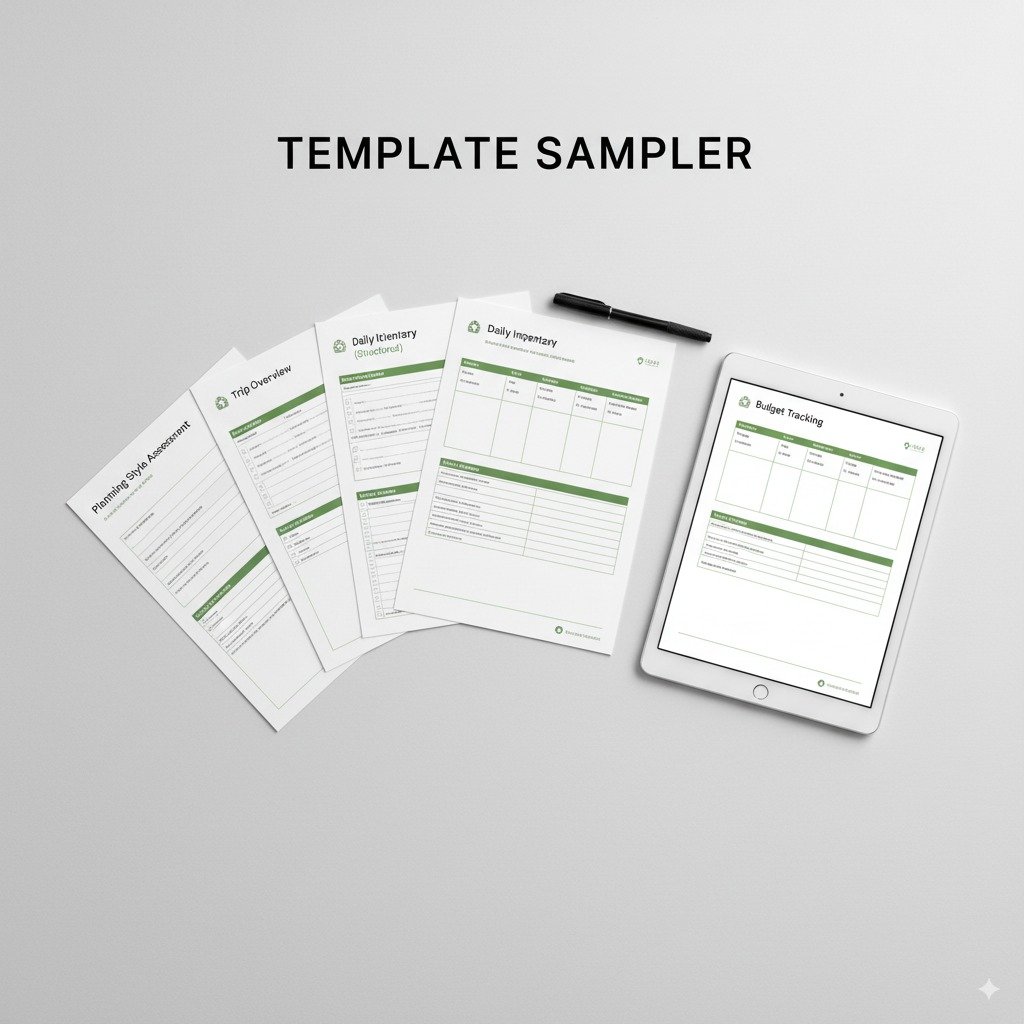
Free PDF Template Library
Download the six templates below. These are printable pages that you can also annotate in a PDF app; they do not contain interactive form fields or automatic calculations.
- Planning Style Assessment: Compare your preferences for structured, flexible or hybrid planning.
- Trip Overview: Record dates, travel party, vehicle, goals, budget and special considerations.
- Structured Daily Itinerary: Organize routes, activities, departure checks and end-of-day notes.
- Pre-Trip Vehicle Inspection Checklist: Record inspection status and needed work; follow your vehicle and equipment manuals.
- Budget Tracking Sheet: Record planned and actual expenses, daily spending and budget lessons.
- Post-Trip Analysis & Learning: Capture highlights, problems, costs, equipment notes and improvements.
Frequently Asked Questions (FAQs)
Is this planner really 100% free?
Yes. There are no hidden costs, required sign-ups for core features, or “pro” versions. It is a completely free resource for the travel community.
What is the best way to print the planner pages?
For durability, we recommend using a slightly heavier paper (24 lb. or 90 gsm). You can print double-sided to save paper. Organize the pages in a 3-ring binder with dividers for each module.
Can I customize this planner?
You can print the PDFs and write on them, or add notes using a compatible PDF annotation app. The downloads are static PDFs, so calculations must be done separately.
How is this different from an app like Roadtrippers?
This planner provides six printable templates for planning preferences, a trip overview, a structured daily itinerary, vehicle checks, budget records, and a post-trip review. Apps can help with navigation and finding places to stop.
What does this planner cover?
The six PDFs cover planning preferences, a trip overview, a structured daily itinerary, vehicle checks, budget records, and a post-trip review.
Conclusion: Your Adventure Awaits
Your adventure deserves planning that matches your dreams. This system transforms overwhelming preparation into manageable steps, creates space for spontaneity through systematic organization, and builds travel expertise that improves with every journey.
The goal isn’t to restrict you but to liberate you. Thoughtful preparation is the key that unlocks true freedom and confident spontaneity on the open road. By organizing the essentials before you go, you free up valuable mental energy for soaking in views, embracing experiences, and making memories.
Download the Planning Style Assessment and Trip Overview Template to begin.
Safe travels, fellow adventurers. The open road awaits.
References
National Highway Traffic Safety Administration. (2024). Motor Home Safety Guidelines. U.S. Department of Transportation. https://www.nhtsa.gov/vehicle-safety/motor-homesRecreation.gov. (2024). Campground Reservation Data and Seasonal Availability. U.S. Department of the Interior. https://www.recreation.gov/
RV Industry Association. (2024). RV Ownership Hits Record High. https://www.rvia.org/news-insights/rv-ownership-hits-record-high
Download the Core Templates (100% Free)
Print them or use in your favorite notes app.


