

Last updated: September 25, 2026
Full-time RV living in 2026 has no single price. Your monthly RV living expenses depend on fuel, camping style, insurance, mail, health coverage and internet. Fuel moved most this year. U.S. diesel averaged $6.529 a gallon in the EIA week of September 21, 2026.
Chuck and Cindy Price run Boondock or Bust and travel in a 2018 Hymer Aktiv Class B. Chuck has 35+ years of RV camping experience.
At a glance
- Must-know: Fuel is the most volatile line. Diesel averaged $6.529 a gallon in the EIA week of September 21, 2026.
- Trip killers: Unbudgeted health premiums and tires that age out before the tread wears down.
- Best for: Readers building a line-item RV living budget before they commit.
- Confirm before you go: Recheck EIA fuel prices, park fees and plan prices before you sign or sell the house.
Every price below is a list or published price checked on September 25, 2026, unless another date is shown. Prices change. Treat each figure as a starting point for your own budget.
Fuel: the line item that moved most in 2026
U.S. diesel averaged $6.529 a gallon in the EIA week of September 21, 2026. That is up $2.780 from $3.749 a year earlier, per the U.S. Energy Information Administration (EIA). Regular gasoline averaged $4.478 a gallon the same week, up $1.305 from $3.173. These are national retail averages across all U.S. stations. Regional prices differ, and the weekly average can shift from one week to the next.
Fuel math is simple once you know your rig’s real miles per gallon (mpg). The example below assumes 10 mpg. Use your own rig’s mpg.
| Fuel | Price per gallon | Gallons for 1,000 miles | Cost per 1,000 miles | Use it for |
|---|---|---|---|---|
| Diesel | $6.529 | 100 | $652.90 | Diesel motorhomes and tow vehicles |
| Regular gasoline | $4.478 | 100 | $447.80 | Gas Class A, B and C rigs |
Many online RV budgets still quote diesel well below the current EIA figure. Check the EIA weekly page before you set your fuel line.
Campgrounds, memberships, dump and propane fees
BLM dispersed camping is free in most areas but generally capped at 14 days in 28. The Bureau of Land Management (BLM) says dispersed camping is “generally limited to 14 days within any 28-day period, though specific stay limits vary by state and field office” on its camping page. Most areas need no permit or reservation. After the limit, BLM says you must move to a new location, often at least 25 to 30 miles away. Our guide to boondocking on a budget covers how to stretch free nights.
Paid sites vary by state. Here are two official state examples as of September 2026.
- Washington State Parks full-utility sites cost $46 to $56 a night in peak season (May 15 to September 15), per Washington State Parks fees. Shoulder season runs $41 to $51. Winter is $41. Standard sites run $31 to $43 in peak season.
- Thirty peak nights at a Washington full-utility site cost $1,380 to $1,680.
- Washington lists a trailer dump fee of $5 per use with a Discover Pass, per the same fee page. Ask at check-in whether your site fee covers the dump station.
- Pennsylvania state park sites start at $16 a night for residents and $21 for nonresidents, per the Pennsylvania DCNR price list. Electric adds $7 and water and sewer add $14 per night.
- A Pennsylvania nonresident full-hookup site costs $42 a weeknight. Friday, Saturday and holiday nights add $4.
Private parks cost more, and their rates rose in 2025. RoverPass reported 2025 average daily rates of $64.85 at small parks, $83.00 at medium parks and $95.00 at large parks in its 2026 industry report. Those rates rose 8.7%, 20.1% and 18.7% over 2024. The data covers RoverPass-booked parks for calendar 2025 and includes all site types, not only RV sites.
Memberships can cut nightly costs. Harvest Hosts list prices are $99 a year for Classic, $169 for Harvest Hosts plus Boondockers Welcome, and $179 for All Access, which includes an Escapees membership. We compare the clubs in Good Sam vs Harvest Hosts vs RVO. The America the Beautiful pass costs $80 for U.S. residents and $250 for nonresidents. Seniors pay $20 a year or $80 for a lifetime pass. Our America the Beautiful pass guide explains what it covers.
Propane is harder to price. The EIA residential propane average was $2.674 a gallon on March 30, 2026, per EIA heating fuel data. That is a home delivery price, not an RV cylinder refill price. EIA paused this series until October 2026.
Stay limits and fees change. Verify them with the land agency or park before you go.
RV insurance for full-timers
Progressive’s average motorhome policy cost $1,052 a year in its 2024 data. The average travel trailer policy cost $594 a year, per Progressive’s RV insurance cost page. Liability-only motorhome coverage starts at $125 a year. These averages cover Progressive customers only, and Progressive does not publish the sample size.
Full-timers may need more coverage. Progressive says that if “your RV is your permanent residence (you live in it six or more months out of the year), you may need to purchase additional coverages” such as personal liability, medical payments and loss assessment. Get quotes that match how many months you live aboard. Our guide to what RV insurance you really need walks through each layer. Zoning decides how long someone can live in a camper on your land, and the limits vary by county.
Mail forwarding and domicile
A full-timer needs a legal address. Entry personal mail plans for South Dakota, Texas and Florida domiciles cost about $160 to $250 a year before postage. Business plans cost more. Prices below are as of September 2026.
| Service | Domicile state | Entry price | Extra costs | Best fit |
|---|---|---|---|---|
| Escapees Mail Service | Texas, Florida or South Dakota | From $110 a year (Category A). $130 for B, $150 for C. | Escapees membership $49.95 a year. $50 postage deposit. $50 enrollment fee currently waived. | Escapees members |
| Americas Mailbox | South Dakota | Three personal plans at $169.99, $189.99 and $209.99 a year, plus tax. | $25 lifetime setup. Suggested postage fund $100 to $150. | South Dakota domicile |
| St. Brendan’s Isle | Florida | Travelers Special $13.99 a month | Mail Scan Pro add-on $7.99 a month | Florida domicile |
| Good Sam Mail Service | Florida | Premium $249 a year, or $24.90 a month | $224.10 a year with Good Sam membership | Good Sam members |
The Escapees first-year minimum is $159.95, which is $49.95 membership plus $110 mail service. Add the $50 postage deposit. Escapees offers domicile in Texas, Florida or South Dakota, per its mail forwarding benefits page.
Your domicile state also sets vehicle costs. South Dakota charges a 4% motor vehicle excise tax on the purchase price and a $10 title fee, per the South Dakota Department of Revenue. Motorhome registration is priced by weight and year on its fee schedule.
Maintenance, tires and the repair reserve
Tires age out before they wear out on many RVs. The National Highway Traffic Safety Administration (NHTSA) states on its tire safety page: “Some vehicle and tire manufacturers recommend replacing tires that are six to 10 years old, regardless of treadwear.” Consumer Reports advises replacing RV tires at 10 years from manufacture, or sooner if your owner’s manual says so. Check the date code on every tire, including the spare.
For a general repair reserve, one dealer offers a rule of thumb. Sun Camper RVs suggests budgeting “1% to 3% of the vehicle’s total purchase price each year” in its maintenance budget post. The dealer cites no source for that range. As an example only, an $80,000 rig at 1% to 3% works out to $800 to $2,400 a year. That is about $67 to $200 a month. Our breakdown of Class B RV maintenance costs goes deeper for van-sized rigs.
The cost of an RV to live in also includes depreciation. Buying used shifts the steepest depreciation to the prior owner. Check J.D. Power RV values for the model you want before you buy.
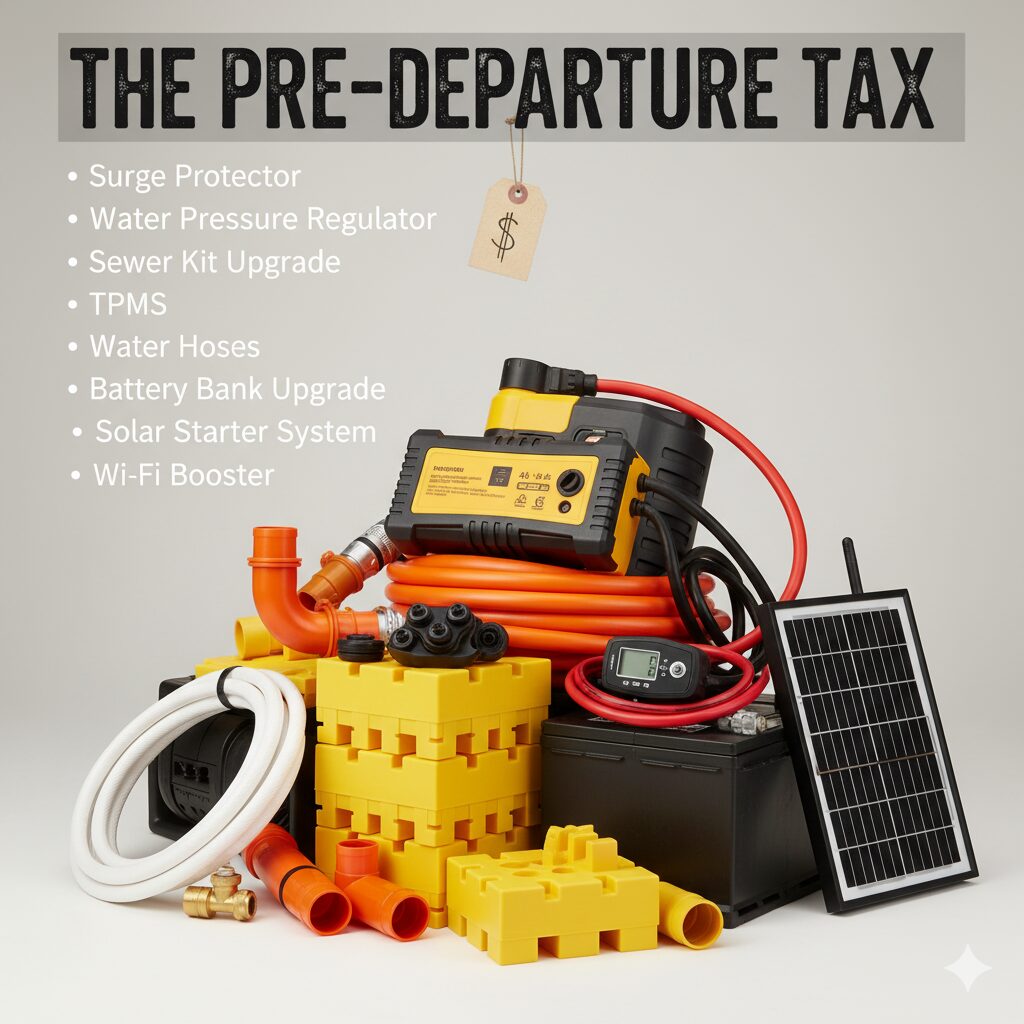
Setup gear is a separate first-year cost. Common items include:
- Surge protector
- Water pressure regulator and fresh water hoses
- Sewer kit
- Tire pressure monitoring system (TPMS)
- Leveling blocks
- Battery bank or solar upgrade for boondocking
Internet: cellular hotspot vs Starlink cost line
Entry plans for a hotspot line and Starlink Roam sit in the same monthly range. Verizon’s prepaid 100 GB hotspot plan costs $80 a month, per Verizon’s data-only plans page. Starlink Roam 100GB starts at $55 a month, per the Starlink Roam page. Coverage and data caps decide which fits. Prices are as of September 2026.
| Plan | Monthly price | After the cap | Fits when |
|---|---|---|---|
| Verizon prepaid hotspot 100 GB | $80 | 3 Mbps on 5G Ultra Wideband, 600 Kbps on 5G/4G LTE | Your routes have Verizon coverage |
| Verizon prepaid hotspot 150 GB | $100 | Same reduced speeds | You need more data with good coverage |
| Starlink Roam 100GB | From $55 | Unlimited low-speed data, no rollover | Light use, about one week of typical use per Starlink |
| Starlink Roam 300GB | $80 | Unlimited low-speed data, no rollover | Remote camping with moderate data use |
| Starlink Roam Unlimited | $175 | No cap | Heavy use in remote areas |
Both options carry limits. Weigh these before you pick one.
- A hotspot line can cost less when your routes have coverage and your data fits under the cap.
- Starlink needs clear sky. The Starlink Mini has a 110-degree field of view, per its specification sheet. Trees and canyon walls cause dropouts.
- The Mini draws 25 to 40 watts on average, per the same sheet. That load matters when you run on batteries and solar.
- Hardware is an upfront cost. Check the current kit price at checkout.
- Roam 100GB and 300GB drop to low-speed data after the cap, with no rollover. Starlink’s Service Plan Descriptions say low-speed data does not suit streaming, video calls or gaming.
- Starlink says speeds are not guaranteed and slow during congestion.
- Roam is for personal use. Starlink’s terms do not permit business or enterprise use on Roam.
- In-motion use is supported on Roam only in select areas. A Standby Mode is available for a small monthly fee.
Skip Starlink if campground Wi-Fi or cellular covers your routes, or if you rarely camp remote. We use a Starlink Mini on the Roam plan in our 2018 Hymer Aktiv. Our RV internet guide compares Starlink and 5G setups in detail. If Starlink fits your travel pattern, check current Starlink Roam availability.
Referral disclosure: If you sign up for Starlink through our referral link, you may receive Starlink’s current referral benefit, and Boondock or Bust may receive a referral reward from Starlink. We are not affiliated with Starlink. Eligibility and terms are set by Starlink and can change.
Health coverage before Medicare
Marketplace benchmark premiums averaged $625 a month for a 40-year-old in 2026, before subsidies. That is up from $497 in 2025, per KFF benchmark premium data. The benchmark is the second-lowest-cost silver plan, weighted by county. In the three common domicile states, 2026 benchmarks were $683 in Florida, $661 in Texas and $655 in South Dakota.
Subsidies change the net cost. The Association of State and Territorial Health Officials (ASTHO) reported that the enhanced Affordable Care Act (ACA) tax credits expired at the end of 2025, with no extension enacted as of January 20, 2026, in its legislative update. Check HealthCare.gov for current subsidy rules. Your plan network depends on your domicile state. Check whether a plan covers care outside your home area before you enroll.
Build your 2026 RV living budget
A realistic RV living budget is built line by line, not copied from someone else’s total. Use the reference figures below, then fill in your own number for each line. The table skips a grand total because your fuel, camping and health lines drive the result.
| Cost line | 2026 reference figure | Source | Your number |
|---|---|---|---|
| Fuel | Diesel $6.529/gal, regular $4.478/gal. Divide your monthly miles by your mpg. | EIA, week of Sept 21, 2026 | |
| Camping | BLM dispersed free in most areas. WA full-utility $46 to $56 peak. PA nonresident full hookup $42 weeknight. Private park 2025 averages $64.85 to $95.00. | BLM, WA State Parks, PA DCNR, RoverPass (2025 data) | |
| Memberships | Harvest Hosts $99 to $179 a year. America the Beautiful pass $80 resident. | Harvest Hosts, NPS | |
| Insurance | Motorhome average $1,052 a year. Travel trailer $594. | Progressive (2024 data) | |
| Mail and domicile | About $160 to $250 a year plus postage. SD 4% excise tax on vehicle purchase. | Mail providers, SD Department of Revenue | |
| Maintenance reserve | 1% to 3% of purchase price a year (one dealer’s guideline). Tires at 6 to 10 years. | Sun Camper RVs, NHTSA | |
| Internet | Verizon prepaid 100 GB $80. Starlink Roam from $55. Roam Unlimited $175. Hardware extra. | Verizon, Starlink | |
| Health | Benchmark $625 a month at age 40 before subsidies. | KFF (2026) | |
| Propane | Residential $2.674/gal on March 30, 2026. Seasonal, not a cylinder price. | EIA |
These are not your only motorhome living expenses. Add food, phone, entertainment and any RV loan payment from your own records.
One worked example, not an average
Here is one month built only from the table rows above, with the assumptions shown. A diesel rig that drives 1,000 miles at 10 mpg spends $652.90 on fuel. Thirty peak nights at a Washington full-utility site cost $1,380 to $1,680. Insurance at the Progressive 2024 motorhome average is $88 a month. Mail service runs $13 to $21 a month across the four providers. A 1% to 3% reserve on an $80,000 rig is $67 to $200. Internet is $55 to $175 on Starlink Roam. The KFF benchmark for one 40-year-old is $625. That example totals about $2,880 to $3,440 a month before food, propane, phone, campground taxes and any loan payment. Change any row and the total moves with it.
RV living tends to make financial sense when
- You would otherwise pay high rent in a high-cost area.
- You buy used and the rig is mechanically sound.
- You plan to boondock most nights.
- You hold emergency reserves for major repairs.
- You price every cost line before you commit.
RV living tends to be financially risky when
- You finance a new rig with a small down payment.
- You expect resort-style parks at budget prices.
- You lack mechanical skills or an emergency fund.
- You expect the move to fix an existing budget shortfall.
Frequently asked questions
How much does full-time RV living cost per month in 2026?
No single number fits every RVer. Build your budget from line items. As of September 2026, diesel averaged $6.529 a gallon in the EIA week of September 21. The KFF 2026 marketplace benchmark was $625 a month for a 40-year-old. A Washington State Parks full-utility site ran $46 to $56 a night in peak season. Use the worksheet above.
How long can you camp for free on BLM land?
Most Bureau of Land Management dispersed camping is limited to 14 days in any 28-day period, per the BLM camping page checked in September 2026. Specific limits vary by state and field office. After the limit, you move to a new area. Verify current stay limits with the local BLM field office before you go.
How much does RV mail forwarding cost?
Entry personal plans run about $160 to $250 a year as of September 2026. Escapees charges $110 plus a $49.95 membership. Americas Mailbox starts at $169.99 plus a $25 setup fee. St. Brendan’s Isle charges $13.99 a month. Good Sam Mail Service costs $249 a year. Postage is extra with every service.
How often should RV tires be replaced?
NHTSA says some vehicle and tire manufacturers recommend replacing tires that are six to 10 years old, regardless of treadwear. Consumer Reports advises replacing RV tires at 10 years from manufacture, or sooner if the owner’s manual says so. Check the date code on each tire, including the spare, before every season.
Is Starlink cheaper than a cellular hotspot for RVers?
On monthly price alone, Starlink Roam 100GB starts at $55 and a Verizon prepaid 100 GB hotspot costs $80, as of September 2026. Starlink hardware is extra and needs clear sky. Both plans slow down after the cap. Our RV internet guide compares Starlink and 5G setups for different routes.
What does RV insurance cost for full-timers?
Progressive’s 2024 data shows an average motorhome policy of $1,052 a year and a travel trailer policy of $594. Progressive notes that full-timers who live in an RV six or more months a year may need additional coverages. Get quotes from several insurers that reflect how you actually live aboard.
Is it cheaper to live in an RV than to rent?
It depends on your camping style, travel pace and fuel costs. Frequent boondocking and slow travel keep costs down. Private parks and long drives push them up. Health coverage, insurance and repairs apply either way. Fill in the budget worksheet with your own numbers and compare the total with your current rent.
Your next step
Open the EIA weekly fuel page and your target state park fee page today. Enter those two numbers in the worksheet first, since fuel and camping swing the most. Then price health coverage on HealthCare.gov for your chosen domicile state.
Land access, permits, road conditions, and site availability change. Verify all information with the relevant land management agency before your trip.


