Must-Know: Jackery partnered with Pebble on October 5, 2026, to supply a 2 kW deployable solar add-on for the 2027 Pebble Flow travel trailer.
Trip Killers: A $4,000 add-on price in the October 5 announcement, an expected December 2026 hardware-shipping start, and solar-performance claims not independently tested for this article.
Best For: Off-grid RV campers seeking a propane-free travel trailer with 45 kWh battery storage and high-input solar generation.
Confirm Before You Go: Verify production lead times, total trailer weight ratings, and daily solar yield estimates on pebblelife.com before placing a deposit.
Jackery announced a partnership with Pebble on October 5, 2026, to produce custom solar panels for the 2027 Pebble Flow travel trailer. The $4,000 Self-Powered Package pairs 2 kW of deployable solar input with a 45 kWh lithium iron phosphate battery system.
Hardware Specs and Power Architecture
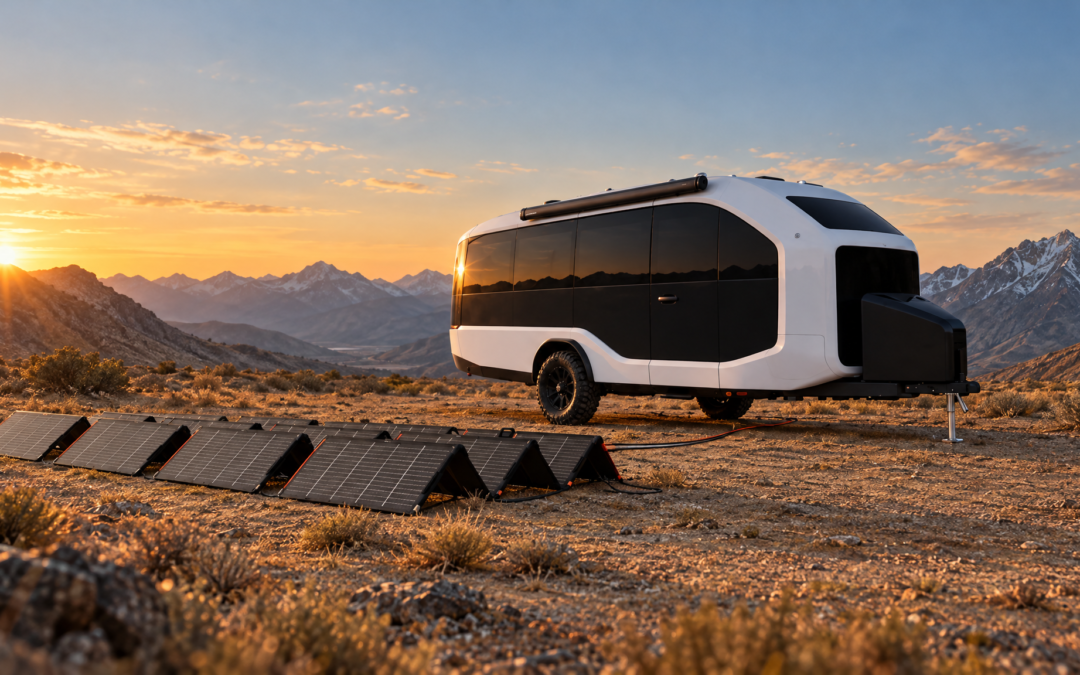
The Jackery Self-Powered Package adds 2 kW of external solar capacity directly to the Pebble Flow travel trailer electrical system. Four 500W rigid solar panels connect through four 3-meter extension cables into a four-in-one junction box feeding the trailer’s main power distribution hub. Operating this array requires flat terrain around the campsite, sunny weather without tree canopy shading, and physical space to deploy external ground panels. According to Jackery’s announcement on GlobeNewswire, the panels charge a 45 kWh lithium iron phosphate battery bank capable of exporting 12 kW of AC power.
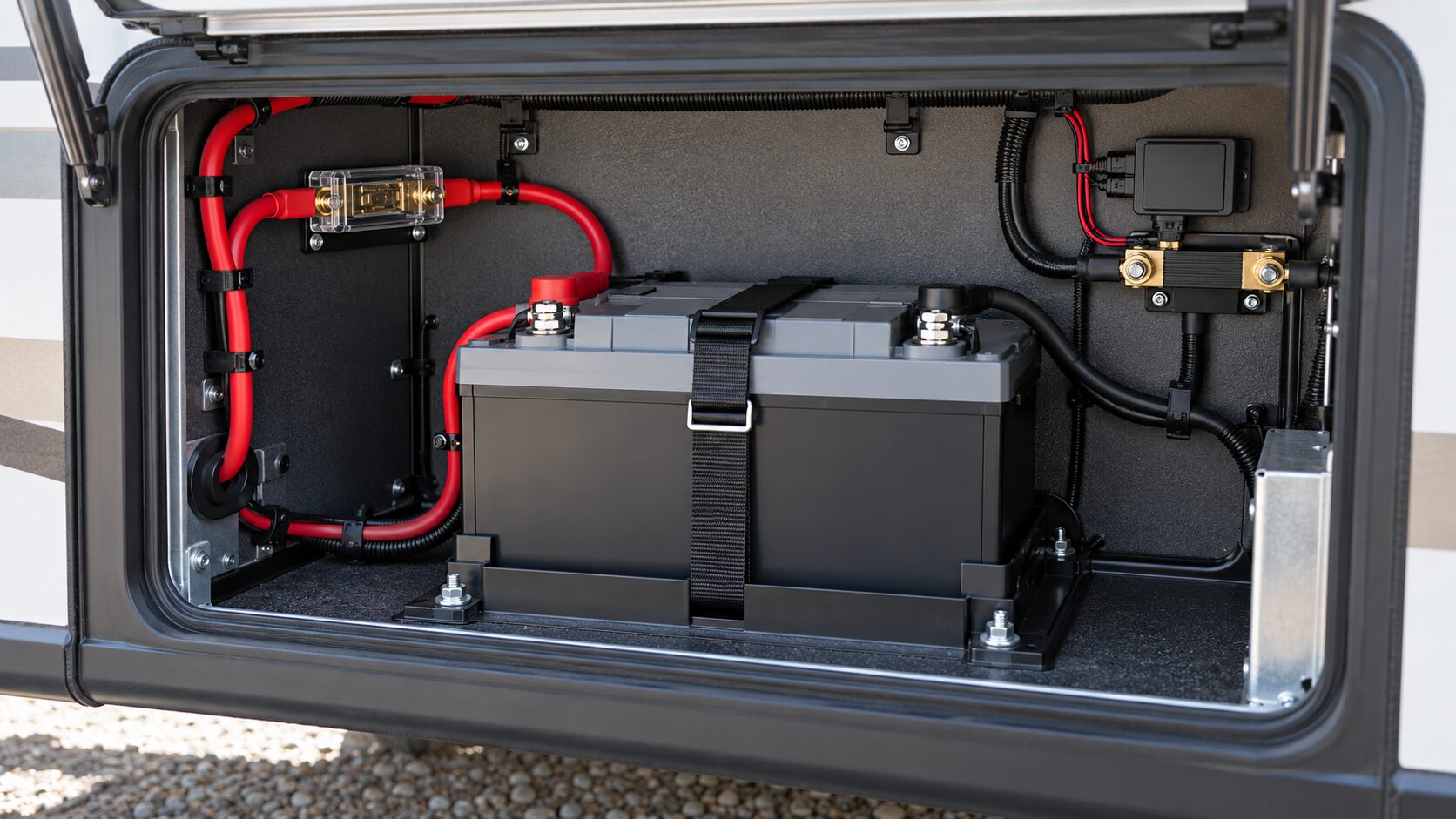
The 45 kWh LFP battery bank operates as the central energy repository for the all-electric trailer. Power export capabilities reach up to 12 kW via AC outlets, allowing the system to charge an electric tow vehicle, supply backup power to a residential home, or power another RV.
Four 500W panels add 2 kW of rated solar input. Pebble’s 2027 specifications list 1.1 kW of rooftop solar, standard on the Founders Edition and optional on the Magic Pack trim. Together those ratings total 3.1 kW; this is not a measured daily energy yield. Jackery says deployed panels can support daily use including air conditioning. Actual generation and runtime depend on weather, shading, orientation and electrical loads.
Pricing and Package Tier Breakdown
Jackery’s October 5, 2026 announcement lists the Self-Powered Package as a $4,000 upgrade on the Founders Edition and quotes $5,000 for Integrated Solar plus $4,000 for the Self-Powered Package, totaling $9,000 in solar options. It says package hardware was expected to begin shipping in December 2026. Confirm the trim, included equipment, current total and delivery estimate directly with Pebble. This article does not report independent field testing.
Attribute
Details
Considerations
Source
Last Verified
Solar Input
2.0 kW external (3.1 kW combined peak)
Requires ground space and manual setup; system supports up to 4 kW total
GlobeNewswire / Pebble
October 5, 2026
Cabling System
4 x 3m extension cables + 4-in-1 junction box
Proprietary connection to Pebble external input port
GlobeNewswire / Jackery
October 5, 2026
Battery Storage
45 kWh Lithium Iron Phosphate (LFP)
Integrated into Pebble Flow trailer chassis
Pebble Life
October 5, 2026
Power Output
12 kW maximum AC export
Capable of vehicle-to-vehicle (V2V) and vehicle-to-home (V2H) export
Pebble Life
October 5, 2026
Option Pricing
$4,000 Self-Powered / $9,000 total solar bundle
Included equipment and required options vary by trim; confirm the order configuration
Pebble Life
October 5, 2026
Delivery Date
December 2026 target shipment
Manufacturer estimate; confirm current hardware availability
Pebble Life
October 5, 2026
Boondocking Capability and Industry Impact
In its October 5 announcement, Jackery describes the partnership as its first entry into the automotive sector. Solar output falls with shading and other site conditions. Size expected appliance loads against available battery storage and charging rather than assuming energy independence.
Eliminating propane appliances requires substantial electrical reserves. The Pebble Flow relies entirely on induction cooktops, electric water heaters, and electric HVAC equipment. Runtime depends on appliance use, power draw and available charging. Confirm the configuration and expected loads before planning an extended off-grid stay.
For boondockers sizing systems on existing rigs, building a custom 45 kWh LFP system with 3 kW solar input using aftermarket components typically requires significant interior storage space and custom wiring. Readers planning off-grid setups can explore our general RV power options guide or review current power station deals to size portable storage for their specific equipment needs.
Frequently Asked Questions
What is the Jackery Self-Powered Package for the Pebble Flow?
The Jackery Self-Powered Package is a $4,000 solar add-on for the 2027 Pebble Flow travel trailer announced October 5, 2026. It includes four 500W rigid solar panels, four 3-meter extension cables, and a four-in-one junction box designed to plug directly into the trailer’s 45 kWh LFP battery system.
How much rated solar input does the combined rooftop and Jackery setup provide?
The 1.1 kW rooftop array listed in Pebble’s 2027 specifications plus the 2 kW Jackery panel set totals 3.1 kW of rated input. Output varies with conditions. Magic Pack is a vehicle trim; verify its included and optional equipment separately from the solar-package prices.
Can the Pebble Flow travel trailer power a home or EV?
The Pebble Flow travel trailer features a 45 kWh lithium iron phosphate battery capable of exporting up to 12 kW of AC power as of October 5, 2026. This bidirectional export capability allows the trailer to supply emergency backup power to a house, charge another electric vehicle, or power another RV.
When will the Jackery Pebble Flow solar package be available?
Jackery and Pebble announced pre-orders for the Self-Powered Package on October 5, 2026, via pebblelife.com. The October 5 announcement said package hardware was expected to begin shipping in December 2026. Verify current delivery timelines directly with the manufacturer before placing a vehicle deposit.
Does the Pebble Flow require propane or gas generators?
The Pebble Flow travel trailer uses an all-electric architecture featuring no internal propane systems or gasoline generators. All onboard systems, including heating, air conditioning, and cooking, run off the 45 kWh LFP battery system recharged via solar input or AC shore power connections.
Before you buy Specifications, prices and delivery estimates reflect manufacturer announcements dated October 5, 2026. Confirm the current configuration, installation requirements and shipping schedule directly with Pebble before ordering.
Last updated: September 30, 2026. Information current as of September 30, 2026.
Choice Hotels International has agreed to acquire Harvest Hosts in an all-cash transaction with an enterprise value of approximately $130 million, according to the Choice Hotels announcement distributed by PR Newswire. The announcement is significant for RV travelers because the deal covers not only Harvest Hosts, but also the wider family that includes Boondockers Welcome, Escapees RV Club, CampScanner, and Brit Stops.
The acquisition had not closed when it was announced on September 30. Choice said it expected the transaction to close on October 1, 2026, subject to customary closing conditions. For now, the most accurate description is that Choice Hotels agreed to acquire Harvest Hosts—not that every operational change has already happened.
Quick answer
Choice agreed to buy 100% of Harvest Hosts from Stripes and other shareholders for an enterprise value of about $130 million.
Choice says Harvest Hosts will remain a standalone business under its existing brand.
Joel Holland is expected to remain Harvest Hosts CEO with the existing leadership team.
No price increase, host fee, membership restructuring or Choice Privileges integration was announced.
Early Facebook comments show caution, pricing concerns and interest in alternatives, but the thread is anecdotal and not a representative survey.
Editorial and affiliate disclosure: Boondock or Bust is a Harvest Hosts affiliate. We may earn a commission if a reader joins through a link on this page, at no additional cost to the reader. The acquisition coverage and conclusions below are based on the announcement and are not supplied or approved by Harvest Hosts.
What did Choice Hotels announce?
Choice Hotels said it entered into an agreement to acquire 100% of Harvest Hosts from growth-equity firm Stripes and other shareholders. The approximately $130 million enterprise-value transaction is all cash and is expected to be funded with cash on hand and borrowing under Choice’s existing revolving credit facility.
The announcement says Harvest Hosts connects RV travelers with more than 11,200 host locations across its network. Choice described the business as an asset-light subscription platform that complements its hotel portfolio.
The release also says the transaction is not expected to have a material effect on Choice Hotels’ 2026 financial results and does not change the company’s previously communicated 2026 share-repurchase expectations. Those financial expectations do not establish future member prices or host terms.
What is confirmed—and what is still unknown?
The September 30 announcement contains several concrete commitments about structure and leadership. It does not contain the operational detail most members and hosts want to know.
Question
Confirmed on September 30
Still unknown
Ownership
Choice agreed to acquire 100% of Harvest Hosts.
Whether closing conditions could delay completion beyond October 1.
Brand
Harvest Hosts is expected to operate as a standalone business under its existing brand.
How much product, marketing or account integration will happen later.
Leadership
Joel Holland is expected to remain CEO alongside the existing leadership team.
Whether roles, staffing or reporting structures will change after closing.
Membership pricing
No change was announced.
Future list prices, renewal rates, promotions and plan bundles.
Hosts
Choice says it intends to preserve the member and host experience and relationships.
Future host eligibility, fees, incentives, standards or tiering.
Choice Privileges
Choice says its loyalty members over-index among RV travelers.
Whether members will earn or redeem Choice Privileges points through Harvest Hosts.
Boondockers Welcome and Escapees
They are part of the Harvest Hosts family included in the acquired business.
Whether their brands, prices or benefits will be reorganized.
Why does a hotel company want an RV membership network?
Choice is not buying thousands of campgrounds. It is buying a subscription platform, a network of host relationships and access to travelers who may use both hotels and RVs. That matches Choice’s stated asset-light strategy: grow travel inventory and loyalty engagement without owning the underlying farms, wineries, museums, private homes or campgrounds.
The strategic fit is not as strange as the headline sounds. RV trips can include hotel nights before a rental pickup, during repairs, when weather turns or when travelers want a break from the rig. Choice says its loyalty members are unusually active in RV travel, although the announcement does not publish the underlying study or the size of that overlap.
For Choice, the opportunity is a new subscription category and more ways to keep travelers inside its ecosystem. For Harvest Hosts, the stated upside is access to Choice’s scale, marketing capabilities and loyalty reach. Whether those advantages improve the day-to-day experience will depend on execution after the deal closes.
What are Harvest Hosts members and hosts saying?
Early comments in a Harvest Hosts enthusiasts Facebook thread were cautious rather than uniformly negative. This was a convenience sample from one developing discussion, not a poll. Comments can be added, removed or reordered, and people who post in an enthusiast group may not reflect the full member or host base.
In the excerpt reviewed September 30, commenters raised four themes. Because this was an informal sample from one discussion, it cannot show how common these views are among Harvest Hosts members or hosts:
Wait and see: Many commenters wanted to see what actually changes before deciding whether to renew.
Pricing anxiety: Several said a future increase could push them not to renew. No increase was announced.
Corporate-ownership concern: Some worried that a public company would prioritize shareholder returns or introduce paid tiers. Those are predictions, not announced plans.
Alternatives: RV Overnights was mentioned repeatedly, while other commenters noted that its network is smaller or that host responses can be inconsistent.
A Harvest Hosts account replied in the discussion that the company was focused on operational improvement while maintaining its core identity. That is consistent with the formal announcement’s standalone-brand language, but it is not a promise that every price, term or feature will remain unchanged.
What could improve after the acquisition?
The following are plausible opportunities, not announced features:
Technology and support: Choice could invest in search, mapping, reservations, fraud prevention and customer service.
Broader distribution: Harvest Hosts could reach travelers through Choice’s loyalty and marketing channels.
More host recruitment: A larger sales and partnership operation could expand the network or improve coverage gaps.
Mixed-trip benefits: A future connection between RV stays and Choice Privileges could help travelers who combine hotels with RV travel.
None of those possibilities was promised with a launch date. Treat them as a watch list, not a reason to buy a membership today.
What should members and hosts watch for?
Watch official renewal notices, host agreements, and benefit announcements for changes that affect your trips.
Renewal notices: Compare your current rate, renewal date and plan benefits with any new notice before accepting a change.
Terms and privacy updates: Read notices about data sharing, account linking, automatic renewal and cancellation.
Host agreements: Hosts should watch for changes to eligibility, guest expectations, support spending, insurance language or fees.
Choice Privileges: Look for a formal announcement before assuming points can be earned or redeemed.
Network quality: Track usable hosts on your real routes, not only a headline location count.
Take screenshots of your current account page, renewal rate and benefits. That gives you a clean before-and-after record if the company changes terms later.
Should you renew or join Harvest Hosts now?
The acquisition announcement alone is not a reason to cancel, renew early or buy a higher tier. The practical decision still depends on your renewal date, your routes and how often you use the network.
Renew now if the current plan already pays for itself on trips you have scheduled and your renewal terms remain acceptable.
Wait if your renewal is months away, your travel is paused or you would be buying mainly because of hoped-for Choice benefits.
Compare alternatives if price is the deciding factor. Our RV Overnights vs Harvest Hosts analysis compares price, network size, route fit and host expectations.
Compare club economics in our RV club membership guide, which explains how trip frequency and route fit affect value.
If you are new to host-based overnight stays, our Harvest Hosts cost and expectations guide explains what the membership includes, what travelers typically buy from hosts and why “free camping” can be misleading shorthand.
If you have already decided to join: Harvest Hosts confirmed to Boondock or Bust by email that our affiliate link applies code BOONDOCK20, providing 20% off the first year of any plan for new members. The offer was verified September 29, 2026. Promotions and checkout terms can change, so confirm the code and final price before paying.
These answers reflect the September 30 announcement; future program changes require separate confirmation.
Did Choice Hotels buy Harvest Hosts?
Choice Hotels announced on September 30, 2026, that it had agreed to acquire 100% of Harvest Hosts. The transaction was expected to close October 1, subject to customary closing conditions. Until closing is confirmed, “agreed to acquire” is the precise wording.
How much is Choice Hotels paying for Harvest Hosts?
The announced all-cash transaction has an enterprise value of approximately $130 million. Choice said it would use cash on hand and borrowings under its existing revolving credit facility.
Will Harvest Hosts remain a separate brand?
Choice says Harvest Hosts will continue as a standalone business under its existing brand. Joel Holland is expected to remain CEO with the existing leadership team.
Will Harvest Hosts membership prices increase?
No price change was announced. The release does not promise that future list prices, promotions or renewal rates will remain unchanged. Members should rely on their account and renewal notice rather than predictions in social media comments.
Will Choice Hotels charge Harvest Hosts locations a fee?
No new host fee was announced. Online comments predicting host fees or paid host tiers are speculation unless Choice or Harvest Hosts publishes new host terms.
Will Harvest Hosts work with Choice Privileges?
No points earning, redemption or account-linking benefit was announced. Choice highlighted overlap between its loyalty members and RV travelers, but that is a strategic rationale, not a published Choice Privileges benefit.
What happens to Boondockers Welcome and Escapees RV Club?
Both are part of the Harvest Hosts family covered by the transaction. The announcement does not describe specific price, brand, or benefit changes for either program. Our Boondockers Welcome review explains its current membership model and host expectations.
Is RV Overnights a replacement for Harvest Hosts?
It can be an alternative for some routes and budgets, but it is not identical. Our RV Overnights vs Harvest Hosts analysis reports a lower standard annual fee and a smaller published network for RV Overnights. That comparison reflects the dated provider figures cited there; verify current prices and actual hosts on your planned routes before switching.
Bottom line
Choice Hotels has agreed to buy access to an RV travel ecosystem, not turn Harvest Hosts locations into hotels. The announcement promises a standalone brand and continuity in leadership, but leaves pricing, host terms, loyalty integration and future plan structure unanswered.
The rational response is neither panic nor blind optimism. Keep using the membership if it works for your routes, save your current terms, and judge the acquisition by the first concrete post-closing changes.
Sources
The company announcement supports the transaction facts; provider pages supply membership context.
This is a developing story. Boondock or Bust will update this page when the transaction closes or when Choice Hotels or Harvest Hosts publishes material changes to member pricing, host terms, program benefits or loyalty integration.
Pricing and availability updated November 18, 2026. Specifications originally checked October 11, 2026.
Disclosure: some EcoFlow links on this page are affiliate links. If you buy through them, we may earn a commission at no extra cost to you. It does not change what we compare or how we rank it. See our affiliate disclosure.
Pick the power option by your daily amp-hour need, not by brand. Under about 50 Ah a day, one power station is the simplest fix. At the prices checked November 18, 2026, the BLUETTI Elite 200 V2 costs less than a Battle Born lithium bank on storage alone at the 100, 200, and 300 Ah tiers below. Availability matters: EcoFlow lists the DELTA 3 Plus as out of stock, and BLUETTI expects Elite 200 V2 orders placed on or after November 18 to ship in early January. The choice turns on install effort, expandability, and weight. A generator refills either one, and it comes with fuel, noise, and carbon monoxide rules.
This is a spec comparison, not a test. Every spec, price, and warranty below comes from the linked manufacturer page. Pricing and availability checked November 18, 2026. If you plan to charge from the sun, read our RV solar power guide next. For what this costs across a whole trip, see the boondocking cost breakdown.
Which option fits how you camp
If this describes you
Start with
Why
Weekend trips, phones, laptop, fan, a few plug-in lights
Power station
No install. One unit covers a 50 Ah day with margin.
Daily off-grid use with solar or alternator charging
Lithium battery bank
Sits in your 12 volt system and grows by adding batteries.
Long cloudy stretches or heavy AC loads
Generator plus storage
A generator refills storage fast. It adds fuel, noise, and CO risk.
You want the lowest install effort now
Power station
It includes the inverter and charger. A battery bank does not.
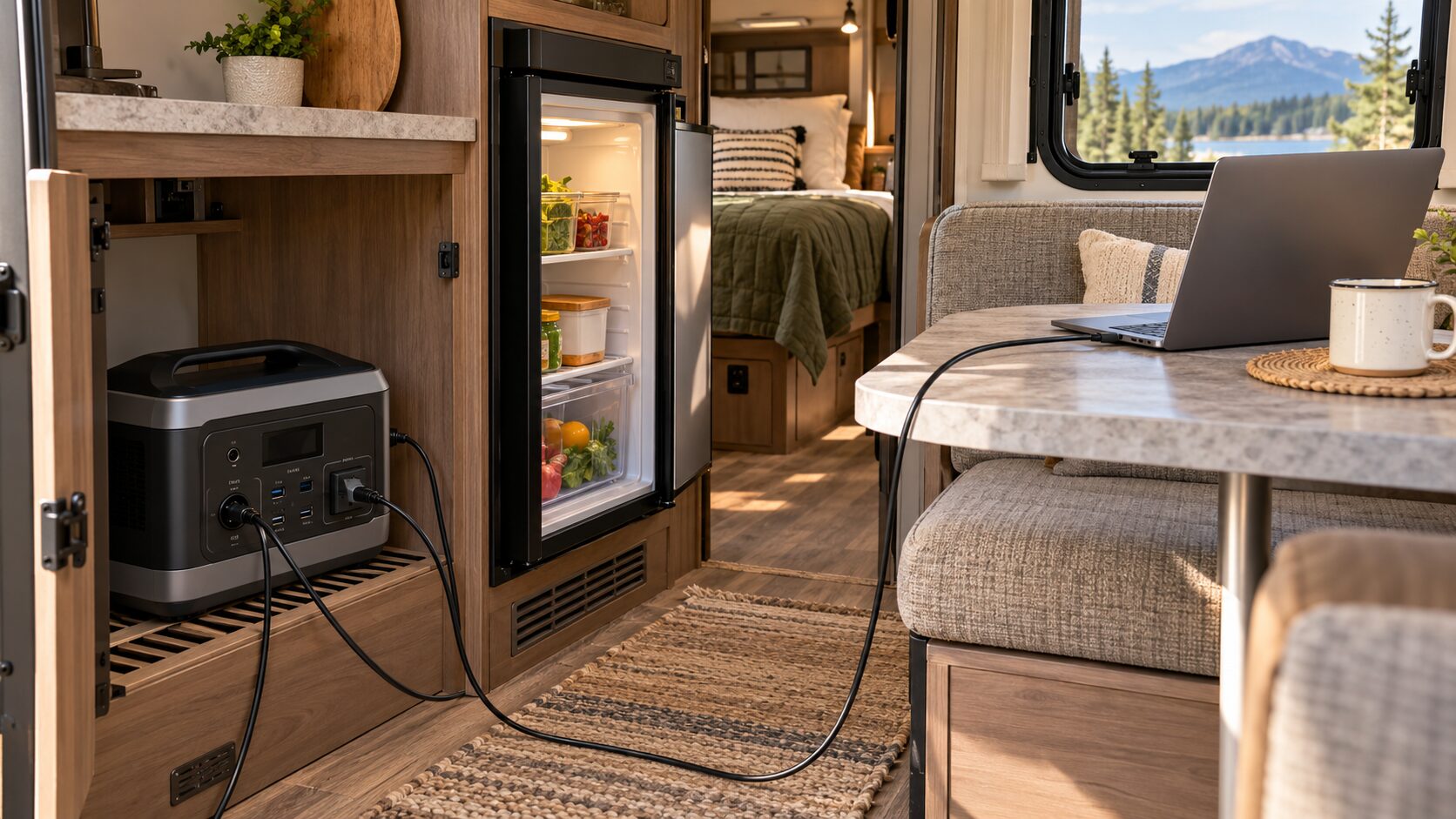
A power station runs what you plug into it. Your RV’s built-in 12 volt lights, water pump, and furnace fan need a connection to the RV’s electrical system. The Elite 200 V2 has a 30 amp RV outlet (TT-30), but BLUETTI says it isn’t designed to power the entire RV system.
Size it by daily amp-hour need
Start with your daily energy use. Multiply amps by hours for each device, add them up, and you have Ah per day at 12 volts. Our solar guide shows how to total your daily use.
The table assumes 12 volts, one day of use with no recharge, and a planning margin of 80% of rated capacity for every product. The 80% figure is our planning assumption, not a manufacturer spec. Prices come from the specs table below.
Daily need
Energy at 12 V
Battle Born 100 Ah batteries (cost)
EcoFlow DELTA 3 Plus setup (cost)
BLUETTI Elite 200 V2 units (cost)
50 Ah
600 Wh
1 ($799)
1 unit (out of stock; no current total)
1 ($899)
100 Ah
1,200 Wh
2 ($1,598)
1 unit + DELTA 3 extra battery (availability unconfirmed; no current total)
1 ($899)
200 Ah
2,400 Wh
3 ($2,397)
1 unit + DELTA Pro 3 extra battery (unavailable; no current total)
2 ($1,798)
300 Ah
3,600 Wh
4 ($3,196)
1 unit + DELTA Pro 3 extra battery (unavailable; no current total)
3 ($2,697)
The table prices storage only. A battery bank also needs a charger, fusing, wiring, and an inverter for AC loads. A power station includes its inverter and charger. EcoFlow rows assume one DELTA 3 Plus plus one extra battery, the maximum EcoFlow lists for this model. EcoFlow rows show capacity-sizing examples, not currently available purchase packages: the DELTA 3 Plus is out of stock, its linked DELTA 3 extra-battery page was unavailable, and the DELTA Pro 3 extra battery is sold out with no restock planned. BLUETTI rows use the $899 standalone-unit price; orders placed on or after November 18 are expected to ship in early January. Check the final price and delivery date before buying.
Lithium battery bank
A lithium bank suits daily off-grid use. Battle Born lists its 100Ah 12V battery at $799 (list $949) with 3,000 to 5,000 cycles and a 10-year warranty. It weighs 31 lb. Battle Born says the battery charges from solar, shore power, or alternator charging, and that you can wire batteries in parallel to add capacity as its installation guidelines permit.
Cold matters. Battle Born sells a heated version designed to enable safe charging when temperatures approach freezing. If you camp in winter, price that version instead.
Cycle claims use different test conditions, so do not compare cycle counts one to one across brands.
A built-in lithium bank needs correct fusing, cable sizing, monitoring, and secure mounting.
Power station
A power station is a battery, inverter, and charger in one box. You plug in and go. Brands also sell power stations as “solar generators.” The name means a power station paired with solar input, not a fuel-burning generator.
Some models take add-on batteries. EcoFlow lists the DELTA 3 Plus as expandable from 1 kWh to 5 kWh with one compatible extra battery. The Elite 200 V2 does not use a direct plug-in expansion battery like the EcoFlow setup. However, BLUETTI now sells an Elite 200 V2 + B500K + Charger 2 + DC Hub bundle. This is a separate charging and DC-power system, not a direct battery connection to the Elite. The Charger 2 manual distinguishes its power-station charging output from its bidirectional battery port. The sizing table above compares standalone Elite units and does not price or size this accessory system.
EcoFlow DELTA 3 Plus.EcoFlow lists 1,024 Wh, 1,800 W AC output with a 3,600 W surge, and 1,000 W of solar input. It lists 4,000 cycles to 80% or more, a 5-year warranty, and 30 dB under 600 W. It weighs 27.6 lb. On November 18, 2026, EcoFlow listed this model as out of stock, so the expired $719 offer is not used as a current buying price. The linked page for the 1,024 Wh DELTA 3 Series Smart Extra Battery was unavailable when checked. The 4,096 Wh DELTA Pro 3 Smart Extra Battery was listed as sold out with no restock planned. Confirm a compatible, in-stock setup before buying; the old combined prices have been removed.
BLUETTI Elite 200 V2.BLUETTI lists 2,073.6 Wh, 2,600 W AC output, and up to 1,000 W of solar input. It lists 6,000+ cycles and a 5-year warranty. It weighs 53.4 lb. Its AC outlets include one 120 V/30 A TT-30 RV outlet. The standalone-unit price was $899 on November 18, 2026. BLUETTI says orders placed on or after November 18 are expected to ship in early January. The October promotion has ended; confirm the checkout price and delivery estimate.
The BLUETTI has roughly twice the built-in storage; the EcoFlow weighs about half as much and supports a compatible extra battery. With the EcoFlow unavailable, a current price-per-watt-hour buying comparison would be misleading. Weigh capacity, portability, and delivery timing for your rig.
A portable power station combines storage, charging, and an inverter in one movable unit.
Generator
A generator makes power from fuel, so it works when the sun does not. The Honda EU2200i is rated 1,800 W with a 2,200 W maximum. Honda lists a 47.4 lb dry weight, 48 to 57 dBA, and a 3-year warranty. The base EU2200i has a 20 A duplex outlet. Honda’s EU2200i Companion adds a 30 A outlet for RV hookup.
Honda lists a run time per tank of 3.2 hours at rated load and 8.1 hours at one quarter load. That works out to about 5.8 kWh per tank at rated load and about 3.6 kWh per tank at quarter load. That is our math from Honda’s numbers. A tank is under a gallon.
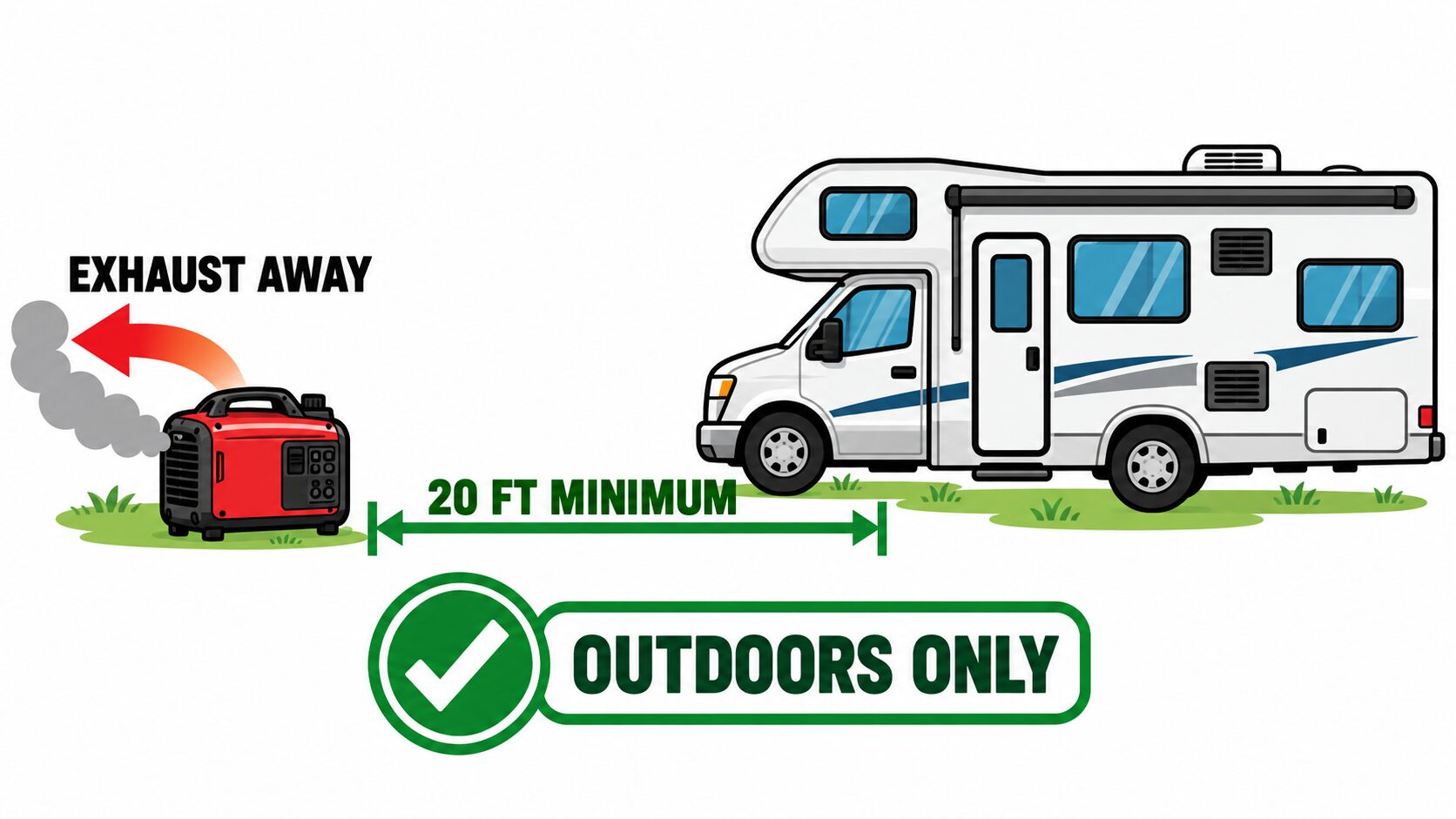
Safety comes first.CPSC says to run portable generators outside only, at least 20 feet from homes and buildings, with exhaust directed away from windows, doors, and vents. It says carbon monoxide is colorless and odorless and can kill within minutes. It also says to look for a model with a CO shut-off feature. We treat an RV as a building and keep the same 20 feet. Run a working CO alarm inside.
Operate a portable generator outdoors, at least 20 feet away, with exhaust pointed away from the RV.
Check the land manager’s generator and quiet-hour rules before you run one. For more upgrades owners choose, see our RV comfort upgrades guide.
Side-by-side specs
Spec
Battle Born 100Ah 12V
EcoFlow DELTA 3 Plus
BLUETTI Elite 200 V2
Honda EU2200i
Type
LiFePO4 battery
Power station, LiFePO4
Power station, LiFePO4
Gasoline inverter generator
Capacity or output
100 Ah, 12 V
1,024 Wh, 1,800 W AC (3,600 W surge)
2,073.6 Wh, 2,600 W AC
1,800 W rated, 2,200 W max
Expandable
Yes, in parallel
Yes, one extra battery, up to 5 kWh
No direct plug-in expansion; separate B500K + Charger 2 + DC Hub system available
Not applicable
RV 30 amp outlet
Not applicable
Not listed by EcoFlow
Yes, TT-30
No on base model. Yes on EU2200i Companion
Cycle life claim
3,000 to 5,000
4,000 cycles to 80% or more
6,000+
Not applicable
Solar input
Needs a charge controller
1,000 W (two 500 W ports)
1,000 W max
Not applicable
Weight
31 lb
27.6 lb
53.4 lb
47.4 lb dry
Noise
Not applicable (no fan or engine)
30 dB under 600 W
See BLUETTI page
48 to 57 dBA
Warranty
10 years
5 years
5 years
3 years
Price
$799 (list $949)
Out of stock. DELTA 3 extra-battery availability unconfirmed; DELTA Pro 3 extra battery sold out with no restock planned. No current package price.
$899 standalone unit; orders from November 18 expected to ship in early January
Pricing and availability checked November 18, 2026. Honda lists a $1,199 MSRP. Dealer prices may differ.
RV power FAQ
What is the best power option for boondocking?
For a 50 Ah day (about 600 Wh at 12 volts), one 1,024 Wh power station covers it with margin. From 100 Ah a day, both a large power station and a lithium bank work. At November 18, 2026 prices, the BLUETTI Elite 200 V2 costs less than a Battle Born bank for storage at the higher tiers shown above, but its stated shipping window is early January for orders from November 18. The DELTA 3 Plus is out of stock. A generator refills either one.
Is a lithium battery or a power station better for an RV?
A lithium battery bank is built into your 12 volt system and scales by adding batteries. It needs a charger, wiring, and usually an inverter. A power station includes the inverter and charger and needs no install. Some, like the EcoFlow DELTA 3 Plus, take one add-on battery. The BLUETTI Elite 200 V2 has no equivalent direct plug-in expansion, but BLUETTI offers a separate B500K + Charger 2 + DC Hub system. That accessory setup requires additional equipment and wiring; it is not included in our standalone-unit costs.
Can I charge a power station with a generator?
Some models can. EcoFlow lists generator charging for the DELTA 3 Plus, with 1,500 W AC input and a full charge in 56 minutes. The Honda EU2200i is rated 1,800 W, so it covers that input on paper. Check your own model’s input limits before you rely on it.
How loud are RV generators and power stations?
Honda lists the EU2200i at 48 to 57 dBA. EcoFlow lists the DELTA 3 Plus at 30 dB under 600 W. The makers use different units (dBA and dB) and different tests, so treat the figures as a rough guide, not a direct comparison. Noise rises with load, so compare at the load you will run.
How far from my RV should a generator run?
CPSC says to run portable generators outside only, at least 20 feet from homes and buildings, with exhaust pointed away from windows, doors, and vents. It says never to run one in an enclosed space, even with doors or windows open. Treat your RV as a building and add a working carbon monoxide alarm.
EcoFlow. (2026). Prime Day Fall Extended Sale [Historical October promotion; expired, not used for current prices]. https://us.ecoflow.com/pages/prime-day
Buy a filter for the job it has to do. For taste and chlorine at a campground spigot, an inline filter in the $27 to $38 range is usually enough. For sandy or muddy sources, add a sediment pre-filter first. For water that is not marked potable, no filter on this page makes it safe on its own.
This is a spec comparison, not a lab test. Every price, micron rating, and certification claim below comes from the linked manufacturer or retailer page. Prices checked September 30, 2026. If you boondock, read this next to our guides on RV boondocking water management and freshwater management for RV boondocking.
Quick picks by job
Job
Model
Published spec
Price
Source
Everyday spigot filter
Clear2O CRV1005
5 micron solid carbon block. The page lists no NSF certification.
Camco lists a 20 micron sediment filter and says the product is certified to NSF/ANSI 42 and 53. Its lead-free construction is certified to NSF/ANSI 372.
Prices checked September 30, 2026. Clear2O prices come from the manufacturer. The Camco price and specifications come from the manufacturer.
Inline hose filter or whole-rig canister?
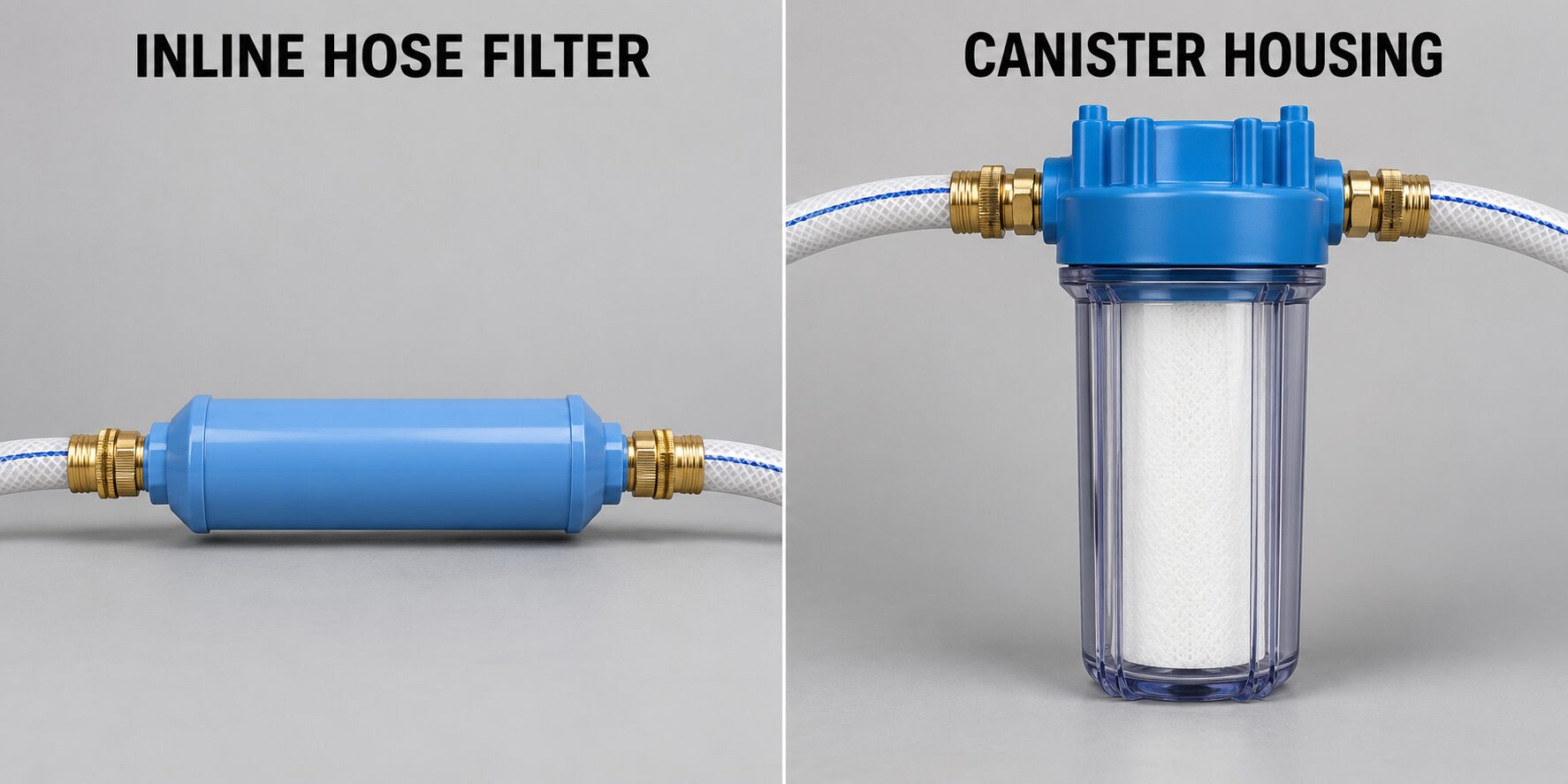
An inline hose filter threads onto the spigot hose. It is one sealed unit, so you replace the whole filter. Clear2O lists the CRV1005 as outdoor use only and not for use under the faucet cabinet. On this list they cost $26.99 to $37.99.
A canister system uses a housing that holds replaceable cartridges. That lets you put a sediment cartridge ahead of a carbon cartridge. Clear2O sells single, dual, and triple canister systems from $129.99 to $349.99.
Pick an inline filter if you fill at campground spigots and want a low cost and a fast swap. Pick a canister system if you want staged filtration and you will keep the setup for years. That is a judgment call, not a manufacturer claim.
Inline filters are quick to replace, while canister housings support staged filtration.
Micron ratings: what the number tells you
A micron is one millionth of a meter. The rating tells you the particle size a filter is built to trap. A lower number traps finer particles and clogs faster. That is why high-sediment areas need a pre-filter. Clear2O says some areas with high sediment may need a pre-filter to prevent low flow and clogging.
The micron number does not tell you what the filter removes chemically or biologically. The CDC puts it plainly: “Most portable water filters will remove parasites, but not viruses or bacteria.” The National Park Service filter-and-disinfect steps call for a 1 micron filter, followed by disinfection. The spigot filters on this page are sold for taste, odor, chlorine, and sediment.
Camco lists the TastePURE 40043 at 20 micron and says it is certified to NSF/ANSI 42 and 53, with lead-free construction certified to NSF/ANSI 372. Certification still applies only to the specific reduction claims in the listing, so check the exact model before buying.
NSF/ANSI 42 vs 53: read the claim, not the logo
NSF/ANSI 42 covers aesthetic effects such as chlorine, taste, and odor. NSF/ANSI 53 covers health effects. NSF warns that certification “does not mean that a filter, purifier or treatment system will reduce all possible contaminants.” Each certification applies to the specific contaminants named on the listing.
That means “NSF 42” is a taste claim. It is not a lead claim and it is not a germ claim. NSF/ANSI 55 covers ultraviolet treatment systems that inactivate bacteria, viruses, and cysts. Standard 42 and 53 filters are a different category.
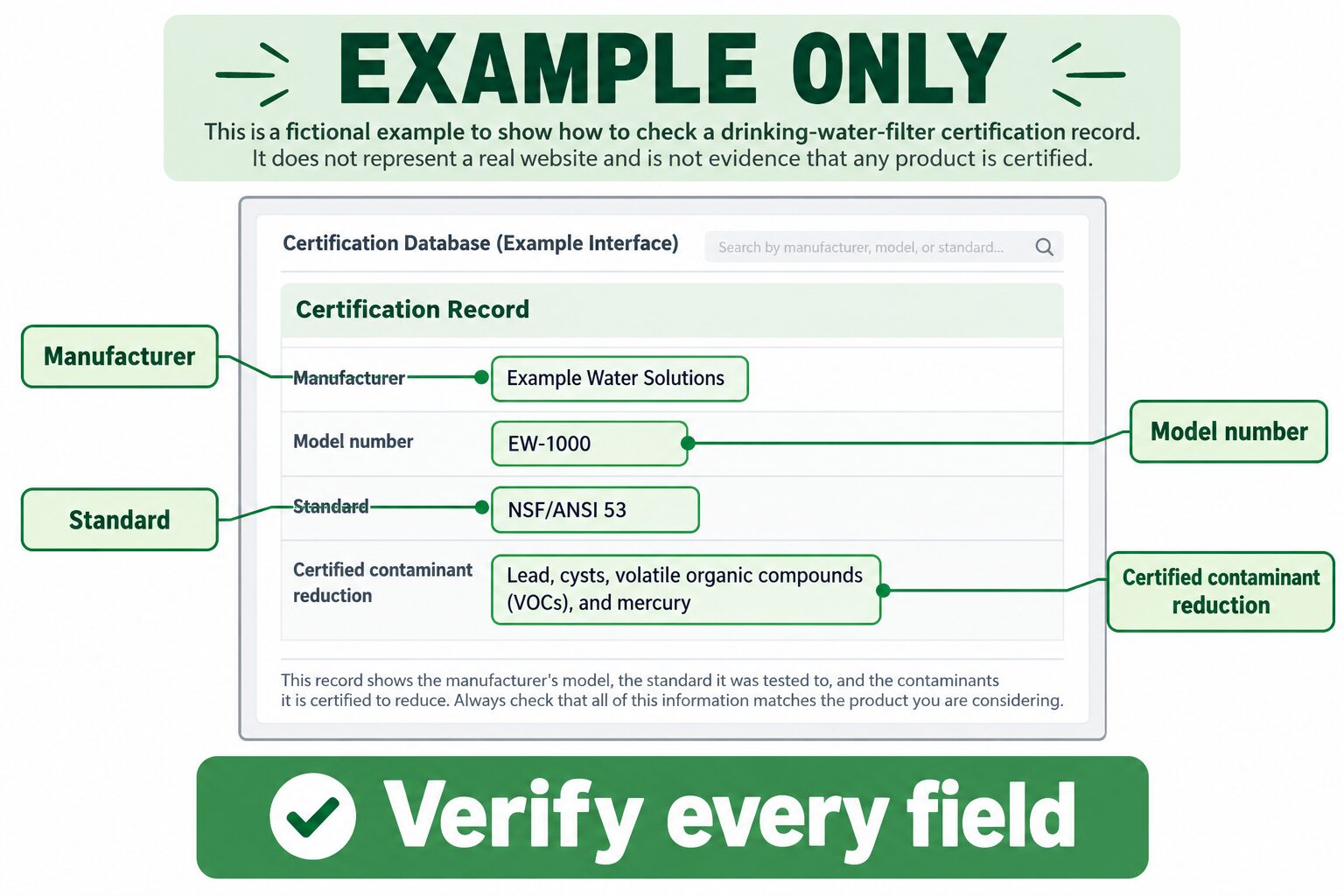
To verify a model, search the NSF certified drinking water treatment unit listings by manufacturer and model. Treat any filter you cannot find there as uncertified, whatever the packaging says. The CRV1005 page lists no NSF certification, so this page does not call it certified.
Educational example only: verify the exact model and reduction claims in the certifier’s live database.
Set up your RV water filter in this order
RV water hookup order
1. Spigot
Flush first
→
2. Regulator
Controls pressure
→
3. Filter
Spigot side of hose
→
4. Potable hose
To RV inlet
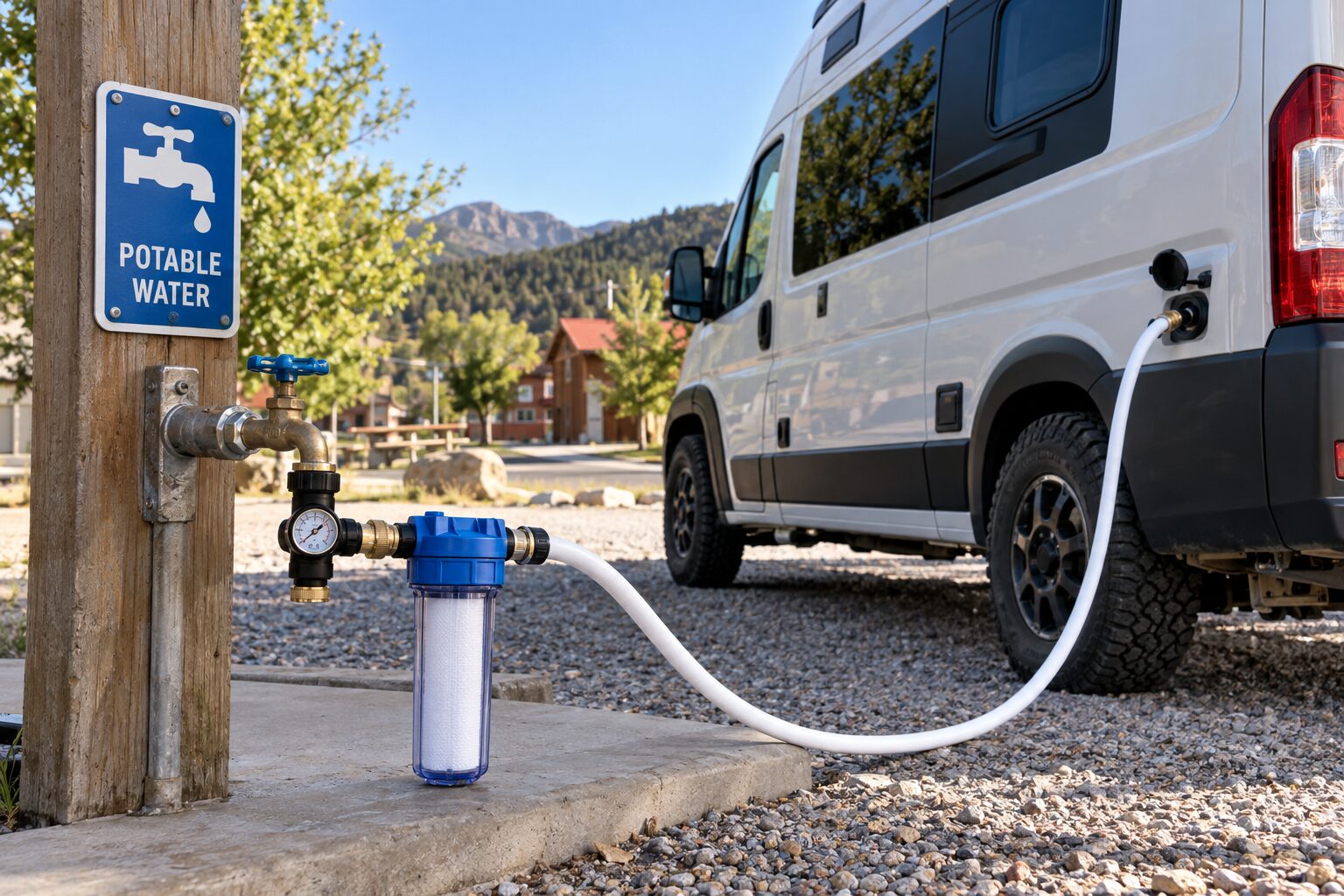
Spigot. Confirm it is meant for drinking water. Flush it before you attach anything. Clear2O says flushing helps avoid clogging the filter.
Pressure regulator. Clear2O says to use a water pressure regulator with its inline filter.
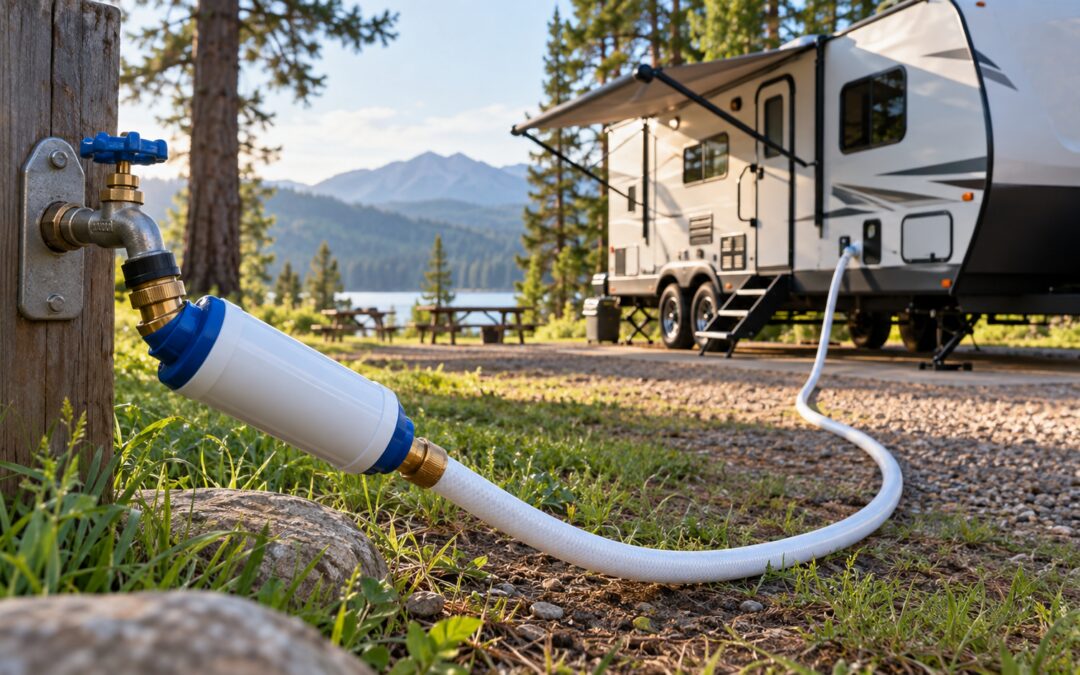
Filter. Clear2O recommends installing its inline filter on the spigot side of the hose, not at the RV water inlet. Add a sediment pre-filter ahead of it when the source is sandy or muddy.
Drinking-water-safe hose. Use a hose sold for drinking water, then connect to your RV inlet.
This order is our own setup recommendation. Clear2O says only to use a regulator and to put its filter on the spigot side of the hose.
None of the manufacturer pages checked list a gallon rating for these models. Clear2O says filter life varies with local water and volume used. So this table shows cost per year for one, two, and four filter changes. Camco says its basic inline filters can last up to 3 months, so four changes per year is a reasonable upper-end replacement schedule.
Filter
Price per change
1 change per year
2 changes per year
4 changes per year
Clear2O CRV1005 (5 micron carbon block)
$37.99
$37.99
$75.98
$151.96
Clear2O 2IN1 (10 micron carbon plus 15 micron pre-filter)
Prices checked September 30, 2026. Sources: Clear2O CRV1005, Clear2O collection page, and Camco. Math is price times number of changes. Canister housings cost $129.99 to $349.99 up front, and the table does not include them.
Change a filter sooner when flow drops. Clear2O links low flow and clogging to high-sediment water.
When a filter is not enough for boondocking tank water
A filter is a fill-hose tool for taste and sediment. Clear2O says not to use its filters on water that is microbiologically unsafe. The CDC says the next best option after boiling is to filter and then disinfect. It says to filter before using UV light.
Water source
What to do
Filter alone enough?
Marked potable campground or municipal spigot
Flush the spigot, then use an inline filter for taste and sediment if you want one.
For taste and sediment, yes
Unmarked, rural, or unknown spigot
Treat it as untrusted. Boil it, or filter and then disinfect, before drinking.
No
Stream, lake, or pond
Do not run it through a spigot filter into your tank. Boil it, or filter and then disinfect. Skip water with a posted algal bloom.
No
For boiling, the CDC says bring clear water to a rolling boil for 1 minute, or 3 minutes above 6,500 feet. The Minnesota Department of Health adds that backcountry treatment devices cannot remove algal bloom toxins, and that boiling “will not remove toxins and can increase toxin levels.”
A marked potable-water station is the right place to fill an RV fresh-water tank.
Winter and freezing
Clear2O says to shake the water out of its inline filter before freezing starts and not to let it freeze. Freezing water can damage the filter. Remove your filter and drain it before a freeze. These steps cover inline filters only. They do not cover canister housings. For the rest of your system, follow our RV winterizing guide.
RV water filter FAQ
Do I need an RV water filter?
A filter helps with taste, chlorine, and sediment at a campground spigot. It does not make unknown or untreated water safe to drink. If the source is not marked potable, treat the water first.
What micron RV water filter should I buy?
No single rating fits every source. Lower micron numbers trap finer particles and clog faster. Clear2O lists its CRV1005 at 5 micron, and its DirtGUARD pre-filter at 10 micron for sediment-heavy sources. Match the rating to your water, then confirm any NSF claim in the NSF listing.
Does an RV water filter remove bacteria and viruses?
Usually not. The CDC says most portable water filters remove parasites but not viruses or bacteria. For untreated water, boil it for 1 minute (3 minutes above 6,500 feet) or filter first and then disinfect.
What order do RV water filter parts go in?
Spigot, pressure regulator, filter, then a drinking-water-safe hose to your RV. Flush the spigot before you attach anything. Clear2O recommends a regulator and installing its inline filter on the spigot side of the hose.
How often should I change an RV water filter?
Manufacturers say filter life depends on your water and how much you use. Clear2O gives no fixed interval for its inline filters. Camco says its basic inline filters can last up to 3 months. Change sooner if flow drops or bad taste returns.
Featured image: an illustrative towing scene. It does not establish vehicle compatibility or an approved towing setup.
Flat towing means towing a vehicle behind an RV with all four wheels on the ground, which Chevrolet calls dinghy towing. For the 2026 model year, Ford’s towing guide and the Chevrolet and Jeep owner’s manuals say which models qualify. The 2026 Chevrolet Equinox is not flat-towable, as the Chevrolet section below explains. For 2027 models, see our 2027 flat towing guide.
Last updated: November 26, 2026
Chuck Price has 35+ years of RV camping experience and travels in a 2018 Hymer Aktiv Class B.
Always follow the owner’s manual for your specific vehicle and model year before you tow it. GM tells owners to review the Dinghy Towing section of the Owner’s Manual before flat-towing, in its 2026 Trailering Guide. Ford says individual vehicles have different restrictions and towing procedures, and it sends owners to the owner’s manual or a Ford dealer for complete details (Ford 2026 RV and Trailer Towing Guide). The 2026 sections come from maker documents opened September 27, 2026.
Must know: GM’s 2026 chart lists the Equinox and Equinox EV as No in every drivetrain (GM).
Trip killers: Ford says AWD/4WD vehicles cannot be towed with 2 wheels lifted, and Jeep says not to dolly tow any 4WD vehicle.
Best for: Owners of 2026 Ford, Chevrolet, Jeep Wrangler or Jeep Gladiator models who want the maker’s own answer.
Confirm before you go: Read your owner’s manual and check the brake statute in each state on your route.
What flat towing means and who decides
Check the vehicle maker’s own documents to learn whether a model can be flat towed. Chevrolet says some vehicles can be towed behind an RV with all four wheels on the ground, and it tells owners to check the Owner’s Manual for vehicle-specific capability (Chevrolet towing support). The answer can change by drivetrain, and the setup can change by transmission. Ford notes that four-wheel-down towing is sometimes referred to as “Flat Tow” or “Flat Towing” in its 2026 towing guide.
Your motorhome’s ratings still apply. GM warns owners not to exceed the towing vehicle’s ratings, such as the Gross Combination Weight Rating (GCWR), by adding the weight of the dinghy-towed vehicle (GM 2026 Trailering Guide). For more on towing from the motorhome side, see our guide to safe trailer towing.
Aftermarket kits are a warranty question. Ford says some aftermarket camper centers offer kits which may allow vehicles with automatic transmissions to be flat-towed (Ford). Ford also tells owners to check the new vehicle Warranty Guide, “as this could void the warranty of your vehicle.”
2026 Chevrolet flat towing chart
GM’s 2026 Trailering Guide lists which Chevrolets can be dinghy-towed with four wheels down. The chart shows vehicles that can be towed “without a dolly or trailer and with all four wheels on the ground,” per GM’s 2026 guide, page 47. The same model can be Yes in one drivetrain and No in another. The chart covers the 2026 model year only. For example, the 2026 Colorado 4×4 is Yes only with the available 2-speed transfer case.
2026 Chevrolet dinghy (flat) towing capability, cells as GM prints them, GM 2026 Trailering Guide p.47, checked September 27, 2026
Model year and model
2WD
4×4/4WD/e4WD
AWD/eAWD
2026 Blazer
Yes
N/A
Yes
2026 Blazer EV
No
N/A
No
2026 Camaro
No
N/A
N/A
2026 Colorado
No
Yes, requires available 2-speed transfer case
N/A
2026 Corvette
No
N/A
N/A
2026 Equinox
No
N/A
No
2026 Equinox EV
No
N/A
No
2026 Express
No
N/A
N/A
2026 Malibu
No
N/A
N/A
2026 Silverado 1500
No
Yes, requires available 2-speed transfer case
N/A
2026 Silverado EV
No
No
N/A
2026 Silverado HD
No
Yes, requires available 2-speed transfer case
N/A
2026 Suburban
No
Yes, requires available 2-speed transfer case
N/A
2026 Tahoe
No
Yes, requires available 2-speed transfer case
N/A
2026 Trailblazer
No
N/A
Yes
2026 Traverse
No
N/A
No
2026 Trax
Yes
N/A
N/A
GM says, “Towed vehicles (or dollies or trailers carrying them) should have a separate functional braking system.” GM gives no model-specific towing steps in the chart and sends owners to the Owner’s Manual.
2026 Chevy Equinox: not flat-towable
GM’s 2026 chart lists the Equinox as No for both 2WD and AWD/eAWD (GM 2026 Trailering Guide). The 2026 Equinox EV is also No in both drivetrains.
Chevrolet trucks: 4×4 with the 2-speed transfer case only
GM’s 2026 guide states, “Rear-wheel-drive and all-wheel-drive trucks should not be dinghy-towed” (GM). That sentence and the chart agree. For the 2026 Colorado, Silverado 1500 and Silverado HD, the chart lists every 2WD row as No and prints N/A in the AWD/eAWD row. Their only Yes rows are 4×4/4WD/e4WD, each marked “Requires available 2-speed transfer case.” The 2026 Silverado EV is No in its 2WD and 4×4/4WD/e4WD rows. The same footnote applies to the 2026 Suburban and Tahoe 4×4 rows. Check which transfer case your vehicle has before you tow.
2026 Ford four-wheel-down chart
Ford’s 2026 RV and Trailer Towing Guide shows which cars, trucks and SUVs can be towed with all four wheels down. The chart splits each 2026 model by transmission, automatic or manual (Ford 2026 guide, page 48, revised 03-10-26). It covers the 2026 model year only. For example, the 2026 Maverick is No, while the 2026 Maverick Hybrid is Yes.
Notes 1, 2, 3: 70 mph maximum, Neutral Tow mode, engine run schedule
2026 Escape Plug-in Hybrid
Yes
N/A
Notes 1, 2, 3: 70 mph maximum, Neutral Tow mode, engine run schedule
2026 Bronco
Yes
Yes
Automatic: notes 3 and 4, engine run schedule and transfer case neutral tow position. Manual: note 4, transfer case neutral tow position
2026 Explorer
No
N/A
None
2026 Expedition/Expedition MAX 4×2
No
N/A
None
2026 Expedition/Expedition MAX 4×4
Yes
N/A
Notes 4 and 5: transfer case neutral tow position, 2-speed transfer case required
2026 Maverick
No
N/A
None
2026 Maverick Hybrid
Yes
N/A
Notes 1, 2, 3: 70 mph maximum, Neutral Tow mode, engine run schedule
2026 Maverick Hybrid 4×4
Yes
N/A
Notes 1, 2, 3: 70 mph maximum, Neutral Tow mode, engine run schedule
2026 Ranger 4×2
No
N/A
None
2026 Ranger 4×4
Yes
N/A
Notes 4 and 5: transfer case neutral tow position, 2-speed transfer case required
2026 F-150 Pickup 4×2
No
N/A
None
2026 F-150 Pickup 4×4
Yes
N/A
Notes 4 and 5: transfer case neutral tow position, 2-speed transfer case required
2026 F-150 Raptor Pickup 4×4
Yes
N/A
Notes 4 and 5: transfer case neutral tow position, 2-speed transfer case required
2026 F-250/350/450/550/600 Super Duty 4×2
No
N/A
None
2026 F-250/350/450/550/600 Super Duty 4×4
Yes
N/A
Notes 4 and 5: transfer case neutral tow position, 2-speed transfer case required
2026 Transit
No
N/A
None
2026 E-Series Cutaway/Stripped Chassis
No
N/A
None
Ford states that individual vehicles have different restrictions and towing procedures (Ford). Ford tells owners to refer to the vehicle owner’s manual or contact a Ford dealer for complete details.
Ford hybrids: Neutral Tow mode, 70 mph and the engine run
Ford’s 2026 flat-towable hybrids are the Escape Hybrid, Escape Plug-in Hybrid, Maverick Hybrid and Maverick Hybrid 4×4. Ford caps flat-towed 2026 hybrids at 70 mph, per its 2026 guide. Ford lists three notes for these four models:
Note 1: “Maximum speed with hybrid transmission is 70 mph.”
Note 2: Select “Neutral Tow” mode, and refer to the Owner’s Manual transmission and towing sections for the procedure.
Note 3: “Start the engine and allow it to run for a few minutes at the beginning of each day and every six (6) hours or fewer, thereafter.” Then, “With the engine running and your foot on the brake, shift into drive (D) and then into reverse (R) before shifting back into neutral (N).”
Ford 4×4 trucks and SUVs: transfer case in neutral tow
Ford’s note 4 says to place the transfer case in the neutral tow position to engage the four-wheel-down towing feature (Ford 2026 guide). The same note says to refer to the Owner’s Manual for additional steps. Note 5 reads, “Requires 2-speed transfer case.” Both notes apply to the 2026 Expedition/Expedition MAX 4×4, Ranger 4×4, F-150 Pickup 4×4, F-150 Raptor Pickup 4×4 and Super Duty 4×4. The 2026 Bronco carries note 4 on both transmissions, and the automatic also carries note 3, the engine run schedule.
Ford’s tow-dolly chart
Ford lists tow-dolly eligibility in a separate 2026 chart (Ford 2026 guide, page 49, revised 12-19-25). In that chart, every 2026 Ford AWD/4WD cell reads No or N/A. The FWD cells that read Yes are the Escape, Escape Hybrid, Escape Plug-in Hybrid, Maverick and Maverick Hybrid. Ford’s footnote says, “AWD/4WD vehicles cannot be towed with 2 wheels lifted off the ground.” Ford also says to read the manufacturer’s instructions that came with the tow-dolly before towing, loading or unloading it.
2026 Jeep Wrangler and Gladiator: four-down setup
Four-wheel-drive 2026 Jeep Wrangler and Gladiator models can be flat towed with the transfer case in N (Neutral). FCA’s recreational towing table in the 2026 Wrangler owner’s manual and 2026 Gladiator owner’s manual covers four-wheel-drive models. The 2026 Wrangler manual also covers hybrid (4xe) models, and its recreational towing section gives no separate 4xe steps. Follow the owner’s manual for your own Jeep before every tow.
The 2026 manuals set these flat tow conditions for four-wheel-drive models:
Automatic transmission in PARK.
Manual transmission in gear, NOT in NEUTRAL.
Transfer case in N (Neutral).
Tow in the forward direction only.
FCA says, “Towing this vehicle backwards can cause severe damage to the transfer case” (2026 Wrangler manual). The same table marks front and rear dolly towing NOT ALLOWED and towing on a trailer ALL OK. FCA’s 2026 manuals state, “DO NOT dolly tow any 4WD vehicle.” FCA adds that towing with only one set of wheels on the ground will cause severe transmission or transfer case damage.
The tow bar mount matters. The 2026 Wrangler manual says not to use a fascia/bumper-mounted clamp-on tow bar, because “The bumper face bar will be damaged.” The 2026 Gladiator manual says, “Do not use a bumper-mounted clamp-on tow bar” (2026 Gladiator manual). FCA also states, “Damage from improper towing is not covered under the New Vehicle Limited Warranty.”
2026 Wrangler and Gladiator: shifting the transfer case into N (Neutral)
FCA’s warning comes first: “You or others could be injured or killed if you leave the vehicle unattended with the transfer case in the N (Neutral) position without first fully engaging the parking brake” (2026 Gladiator manual). FCA adds, “The parking brake should always be applied when the driver is not in the vehicle.” FCA says to complete these steps before recreational towing so the transfer case is fully in N (Neutral), or “internal damage will result.”
FCA’s 2026 Wrangler and Gladiator manuals give these steps in this order (2026 Wrangler manual):
Stop the vehicle on level ground.
Press and hold the brake pedal.
Shift an automatic transmission into NEUTRAL, or press the clutch pedal on a manual.
Turn the engine off.
Shift the transfer case lever into N (Neutral).
Start the engine.
2026 Wrangler: shift the transmission into REVERSE. 2026 Gladiator: shift into DRIVE or REVERSE.
Release the brake pedal (and clutch) for five seconds and confirm the vehicle does not move.
Repeat steps 7 and 8 with an automatic in DRIVE or a manual in first gear.
Turn the engine off.
Apply the parking brake firmly.
Shift an automatic into PARK, or put a manual in gear (NOT in NEUTRAL).
Attach the Jeep to the tow vehicle “using a suitable tow bar.”
Release the parking brake.
FCA’s caution reads, “Damage to the transmission may occur if the transmission is shifted into PARK with the transfer case in (N) Neutral and the engine running.” FCA also warns that N (Neutral) “disengages both the front and rear driveshafts from the powertrain, and will allow the vehicle to roll, even if the automatic transmission is in PARK (or manual transmission is in gear)” (2026 Gladiator manual).
2026 Wrangler and Gladiator: shifting out of N (Neutral)
FCA’s 2026 manuals give this order for shifting out of N (Neutral) (2026 Wrangler manual):
Stop the vehicle and leave it connected to the tow vehicle.
Apply the parking brake.
Start the engine.
Press and hold the brake pedal.
Shift the transmission into NEUTRAL.
Turn the engine off.
Shift the transfer case to the desired position. FCA says “the engine should remain off to avoid gear clash.”
Shift an automatic into PARK, or put a manual in NEUTRAL.
Release the brake pedal.
Disconnect the Jeep from the tow vehicle.
Start the engine.
Press and hold the brake pedal.
Release the parking brake.
Shift into gear and “check that the vehicle operates normally.”
Flat towing speed and engine-run limits by maker
The 2026 Wrangler and Gladiator manuals list no speed or distance limit for recreational towing (2026 Wrangler manual). They also give no engine-run interval. Makers differ on these limits, so use the row for your own vehicle. “None given” and “None listed” mean only that the document states no figure. Ford and GM both send owners to the owner’s manual for complete details.
Flat towing speed and engine-run guidance in 2026 maker documents, checked September 27, 2026
Do not carry Ford’s 70 mph figure over to other makers or to non-hybrid Fords.
Supplemental brakes: maker advice and state law
Ford and GM both say a flat-towed vehicle should have its own braking system. Ford’s 2026 and 2027 guides say towed vehicles “should be equipped with a separate functional brake system” (Ford). Those are maker recommendations, not law. This page checked one state’s brake statute. Jeep’s 2026 manuals say to “always follow applicable state and provincial laws” and to contact state and provincial Highway Safety offices for details (FCA).
Minnesota’s brake statute, Minn. Stat. 169.67 (2026 Minnesota Statutes, opened at the Minnesota Revisor of Statutes site on November 26, 2026), addresses a towed motor vehicle directly. Subd. 3(a) says a trailer or semitrailer with a gross vehicle weight of 3,000 or more pounds, “or a gross weight that exceeds the empty weight of the towing vehicle,” needs brakes adequate “to control the movement of and to stop and hold” it. Subd. 3(b) says one over 3,000 pounds needs brakes that stop and hold it “whenever it becomes detached from the towing vehicle.” Subd. 3(c)(2) says paragraph (a) does not apply to “a motor vehicle drawn by another motor vehicle that is equipped with brakes that meet the standards of subdivision 5.” Subd. 3(d) allows that exception only up to “3,000 pounds while being drawn by a vehicle registered as a passenger automobile, other than a pickup truck” and “12,000 pounds while being drawn by any other motor vehicle.” Subd. 3(c) names paragraph (a) only.
For every other state on your route, read the brake statute on that state’s own legislature or code site before you tow.
The makers name two equipment categories. The first is a separate functional braking system for the towed vehicle, per GM. The second is a suitable tow bar, and Jeep’s 2026 manuals rule out bumper-mounted clamp-on tow bars for the Wrangler and Gladiator.
Your next step is the towing section of the owner’s manual for your own vehicle and model year. Ford’s guide sends owners there, or to a Ford dealer, for complete details (Ford). If you are new to RV travel off the grid, start with our boondocking basics for beginners, and plan the trip budget with our boondocking cost breakdown.
Frequently asked questions
Can you flat tow a 2026 Chevy Equinox?
No. GM’s 2026 Trailering Guide lists the 2026 Equinox as No for both 2WD and AWD/eAWD. The 2026 Equinox EV is also No in both drivetrains. For any other 2026 Chevrolet, GM says to review the Dinghy Towing section of the Owner’s Manual before flat-towing.
Which 2026 Chevrolets can be flat towed?
GM’s 2026 chart lists the Trax 2WD, Blazer 2WD and AWD/eAWD, and Trailblazer AWD as Yes. It also lists the 4×4 Colorado, Silverado 1500, Silverado HD, Tahoe and Suburban as Yes. Each of those 4×4 models requires the available 2-speed transfer case. Review your Owner’s Manual before you tow.
Which 2026 Fords can be flat towed?
Ford’s 2026 towing guide lists the Escape Hybrid, Escape Plug-in Hybrid, Bronco, Maverick Hybrid and Maverick Hybrid 4×4 as Yes. It also lists the 4×4 Expedition, Ranger, F-150, F-150 Raptor and Super Duty as Yes. Those five 4×4 models require a 2-speed transfer case. Check your owner’s manual for the full steps.
Can you flat tow a 2026 Ford Maverick?
Only the hybrid versions. Ford’s 2026 guide lists the Maverick as No and the Maverick Hybrid and Maverick Hybrid 4×4 as Yes. Ford sets a 70 mph maximum for hybrid transmissions and requires Neutral Tow mode. Ford also says to run the engine for a few minutes at the start of each day and every six hours or fewer, then shift to drive (D), reverse (R) and back to neutral (N) with your foot on the brake.
Can you flat tow a 2026 Jeep Wrangler?
Yes. The 2026 Wrangler owner’s manual gives flat tow instructions for four-wheel-drive models. Put the transfer case in N (Neutral), an automatic in PARK or a manual in gear, and tow only forward. Follow the manual’s shifting steps first, and apply the parking brake whenever the driver is not in the vehicle.
Is there a speed limit for flat towing?
It depends on the maker. Ford’s 2026 guide sets a 70 mph maximum for its hybrid transmissions and gives no speed for its other rows. GM’s 2026 chart gives none. The 2026 Wrangler and Gladiator manuals list no speed or distance limit for recreational towing. Jeep also says to follow applicable state and provincial laws. Where a maker document gives no figure, check your owner’s manual.
Can you tow a 4WD vehicle on a dolly?
Not a 2026 Ford AWD/4WD, a 2026 Wrangler or a 2026 Gladiator. Ford’s 2026 guide says, “AWD/4WD vehicles cannot be towed with 2 wheels lifted off the ground.” FCA’s 2026 Wrangler manual says, “DO NOT dolly tow any 4WD vehicle.” FCA warns that towing with one set of wheels down will cause severe transmission or transfer case damage.
Do I need brakes on the car I flat tow?
Ford and GM both say towed vehicles should have a separate functional braking system. That is maker advice, not law. State law varies. Minnesota Statutes 169.67 (2026 edition) directly addresses a motor vehicle drawn by another motor vehicle. Check the statute text in each state on your route before you tow.
Last updated: November 28, 2026. Checked November 25 and 26, 2026.
Chuck Price has 35+ years of RV camping experience and travels in a 2018 Hymer Aktiv Class B.
Whether you can sleep at a rest area depends on the state. Six of 50 states ban overnight parking or sleeping in a vehicle in the source we checked: Hawaii, Maryland, Nebraska, South Carolina at welcome centers, Tennessee and Virginia. Georgia, Kansas, Missouri, Montana and Wyoming allow an overnight stay or sleeping in their sources. Twenty set a stated time limit. For 12 we found no published rule.
Rules change, and individual rest areas post their own limits. Check the posted signs before you settle in for the night. This page covers state rules for public highway rest areas only.
Must-know: The federal rest area rule, 23 CFR 752, sets no stay limit or overnight rule.
Trip killers: Maryland, Tennessee and Virginia ban overnight parking at rest areas. Hawaii bars sleeping in a vehicle on public property from 6 p.m. to 6 a.m. Tennessee and PennDOT rest areas set 2-hour limits.
Best for: Drivers and RVers planning a rest stop or overnight stop in any of the 50 states.
Confirm before you go: Read the posted signs at the rest area and check the state DOT website.
Rest area overnight parking laws by state
The table lists all 50 states, A to Z. Each row gives the time limit, the overnight or sleeping rule and the camping rule as the source states them, plus the source and the date we read it. “Not stated” means the opened source is silent on that point. It does not mean the practice is allowed. “No published policy found” is a research result, not permission.
Rest area rules in all 50 states, A to Z, each read at the linked state source on November 25 or 26, 2026
24 hours in any three-day period, unless otherwise provided by law
Not stated
Not stated
NMSA 1978, 67-8-22 (read at a published copy, the state host did not load)
Nov 26, 2026
New York
Thruway service areas: unattended vehicles can be towed after 4 hours. NYSDOT roadside parking areas and scenic overlooks: 3 hours at night, with exceptions for commercial drivers
The Thruway Authority says service areas are not designed for long-term parking or multiple-day stays
For 12 states we found no state statute, rule or DOT page that sets a rest area time limit, overnight rule or camping rule: Alabama, Arkansas, Colorado, Connecticut, Delaware, Indiana, Iowa, Louisiana, Mississippi, North Dakota, Oklahoma and Rhode Island. The source column shows what we checked. Michigan’s proposed rules would cap parking at 48 hours and ban camping, but they are not in effect. In states with no published policy, read the posted signs at the rest area and check the state DOT before you stop.
Five rows cover specific facilities, not every rest area in the state. They are Maine (Turnpike service plazas), New Jersey (the Jugtown Mountain rest area on Route NJ 173), New York (Thruway service areas and NYSDOT parking areas), South Carolina (welcome centers) and West Virginia (the Turnpike).
Counts from the 50 rows:
6 states ban overnight parking or sleeping in a vehicle. Maryland, Tennessee and Virginia ban overnight parking. The standard South Carolina welcome center sign says no overnight parking. Hawaii bars sleeping in a vehicle on public property from 6 p.m. to 6 a.m. Nebraska counts lodging in a vehicle as camping and bans camping outside designated campsites.
5 states’ sources allow an overnight stay or sleeping: Georgia, Kansas (one night), Missouri, Montana (up to 12 hours) and Wyoming. Utah permits extended stays with no stated maximum.
20 states set a stated stay limit. Ten of those limits are 4 hours or less. Ten are 8 hours or more. New Jersey’s single-facility order is not counted. Alaska uses the posted limit at each stop and is not counted. Ohio and Massachusetts use an unattended-vehicle rule instead of a stay limit.
25 states ban camping or camping devices in the opened source.
12 states have no published policy we could find.
KampTrail beta · Free · No account required
Find rest areas along your next drive
Open the rest-area map near you. Official source coverage varies. A map listing or a stated stay limit does not establish overnight permission. Check posted signs and state DOT rules.
Each interstate guide lists the rest area rule in every state on the route and every stop the state agency lists, by direction. Interstate guides: I-5, I-10, I-15, I-35, I-40, I-70, I-75, I-80, I-81, I-87, I-90, I-95.
Get the printable cheat sheet
Rest area rules in all 50 states and the Walmart state-by-state reference in one PDF. Print it or save it for when you have no signal.
Free. We email the link after you confirm your address. You will also get our occasional newsletter. Unsubscribe anytime.
Car or RV: does the rule change?
Most rows do not split the rule by vehicle type. No source in the table sets a different stay limit for cars and RVs by vehicle length. Where a source does name a vehicle or a use, it says this:
Nebraska’s camping definition names a station wagon, trailer, pickup camper, camper-bus or other vehicle, so it reaches cars, vans and RVs alike, per Neb. Rev. Stat. 39-312.
Hawaii’s 6 p.m. to 6 a.m. rule covers sleeping in any vehicle on public property, per HRS 291C-112.
Wyoming lets drivers who need rest sleep in their vehicles, but bars tents and extended slideouts, per the WYDOT rest area brochure.
Idaho bars plugging camping devices into outlets or hooking hoses to faucets, per ITD.
West Virginia’s Turnpike does not permit overnight parking for oversized loads, per the WV Parkways Authority.
Washington allows 48 hours for disabled vehicles, per RCW 47.38.020.
Commercial drivers get a longer stay in six states. The truck section below lists them.
What happened when I rested at rest areas
On past trips I have rested at a Pennsylvania Turnpike service plaza and an I-65 rest area in Indiana. At the Turnpike plaza, a state trooper told me resting inside the vehicle was fine as long as I did not set up camp outside. I took a three-hour nap and got back on the road, well inside the Turnpike System’s 24-hour limit under 67 Pa. Code 601.6. At the Indiana rest area, a maintenance worker knocked around 5 a.m. to wake me and clear the area. Rest areas and plazas are for rest, not camping, so expect to be woken for cleaning.
Time limit, overnight ban and camping ban are three different rules
A time limit, an overnight parking ban and a camping ban are separate rules. Maryland is the only state in the table whose rules set all three: a 3-hour limit, an overnight parking ban and a camping ban.
Time limit: caps how long you stay. California caps stays at 8 hours in any 24-hour period, per Caltrans.
Overnight ban: bars parking overnight. Maryland’s COMAR 11.04.07.11 states, “Camping and overnight parking are prohibited.”
Camping ban: turns on how the state defines camping. Nebraska’s definition names vehicles as camping shelters, as the next section explains.
Montana shows how two sources can set different figures. Montana Department of Transportation (MDT) allows overnight parking for up to 12 hours and prohibits camping at rest areas. The state statute, MCA 60-6-202, bans overnight camping on state highway right-of-way. That statute exempts “a designated rest area, parking area, or pullout specifically authorized for temporary parking and rest in compliance with department rule, not to exceed 24 hours.” The 12-hour cap comes from MDT’s own rest area page, not the statute.
Where the rules speak to sleeping at a rest area
Ten sources in the table speak to sleeping directly. Georgia’s law protects resting and sleeping as a normal, customary and temporary use of rest areas. Hawaii bars sleeping in a vehicle on public property between 6 p.m. and 6 a.m. Pennsylvania allows sleeping only in a legally parked vehicle, within the time limit. Wyoming says drivers who need rest may sleep in their vehicles. Illinois bans sleeping overnight on the grounds, on benches or in the building (92 Ill. Adm. Code 533.40). New Hampshire bars sleeping on the ground on public right-of-way or property without permission. Washington bars a tent or other sleeping accommodation. Nebraska, South Dakota and Virginia follow.
Neb. Rev. Stat. 39-312 states, “It shall be unlawful to camp on any state or county public highway, roadside area, park, or other property acquired for highway or roadside park purposes except at such places as are designated campsites”. The statute then defines camping. “Camping means temporary lodging out of doors and presupposes the occupancy of a shelter designed or used for such purposes, such as a sleeping bag, tent, trailer, station wagon, pickup camper, camper-bus, or other vehicle”. Under that wording, spending the night in a car, van or RV at a Nebraska roadside area outside a designated campsite fits the statute’s definition of camping. A violation is a Class V misdemeanor.
South Dakota’s SDCL 31-7-15 bans camping at interstate rest areas. SDCL 31-7-17 adds, “No person temporarily resting in any vehicle is in violation of the provisions of § 31-7-15.” Temporary resting means up to 3 consecutive hours, or 10 hours for commercial motor vehicle operators under federal rules.
Virginia rule 24VAC30-51-30, effective March 11, 2026, states, “No overnight parking is permitted in rest areas.” The same rule bars sleeping in any section of the rest area building at any time.
States with the shortest limits
Ten of the 20 states with a stated limit set 4 hours or less. Tennessee and Pennsylvania have the shortest statewide limits in the table at 2 hours, and TDOT also bans overnight parking. PennDOT rest areas allow 2 hours in a 24-hour period or the posted limit, per 67 Pa. Code 443.2. The Pennsylvania Turnpike System allows 24 hours, per 67 Pa. Code 601.6. Florida, Illinois and Maryland allow 3 hours, per Fla. Admin. Code R. 14-28.002, 92 Ill. Adm. Code 533.20 and COMAR 11.04.07.07. South Dakota allows resting in a vehicle for up to 3 consecutive hours, per SDCL 31-7-17. New York’s NYSDOT roadside parking areas and scenic overlooks allow 3 hours at night, with exceptions for commercial drivers, per the NYSDOT Highway Design Manual. Kentucky allows 4 hours in any 24-hour period at limited-access rest areas, per 603 KAR 5:040. Minnesota allows 4 hours where posted, per MnDOT. Maine Turnpike service plazas allow 4 hours for passenger vehicles, per the Maine Turnpike Authority. Posted signs can set a lower limit in Illinois. New Jersey’s 2-hour limit applies only at the Jugtown Mountain rest area on Route NJ 173, under an NJDOT traffic order.
Florida and Illinois set short limits, but neither opened rule text states an overnight parking ban. Illinois does bar sleeping overnight on the grounds, on benches or in the building, per 92 Ill. Adm. Code 533.40. Massachusetts sets no rest-area hour count. Under 700 CMR 9.00, no one may park on a state highway longer than official signs allow. Where signs are posted, a vehicle left unattended over 30 consecutive minutes at a safety rest area falls under the no-parking and tow rules. The same rules allow towing of a vehicle parked on a state highway over 24 consecutive hours without the Department’s written permission.
States that allow a longer stop
Ten of the 20 states with a stated limit allow stays of 8 hours or more. Six of those ten still ban camping. California and Washington allow 8 hours in any 24-hour period, per Caltrans and RCW 47.38.020. Idaho allows 10 consecutive hours at interstate rest areas and 16 hours at US and state highway rest areas, per ITD. Oregon allows 12 hours in any 24-hour period, per ODOT, citing OAR 734-030-0010. Nevada allows 18 hours in any 2-week period for parking, camping or occupancy combined, per NDOT quoting NAC 408.595. New Mexico allows 24 hours in any three-day period, unless otherwise provided by law, per NMSA 1978, 67-8-22. Kansas allows 24 hours and permits overnight camping for one night only, per K.A.R. 36-32-2. Texas allows up to 24 hours under Texas Transportation Code 545.411, per TxDOT. Wisconsin allows 24 hours or the posted limit, whichever is shorter, whether or not the vehicle is occupied, and WisDOT reports long-term parking to the State Patrol.
Five sources allow an overnight stay or sleeping. MDT states, “Overnight parking is allowed but limited to one parking space per vehicle and for a maximum of 12 hours.” Georgia protects resting and sleeping. Kansas permits overnight camping for one night only. The Missouri State Highway Patrol guide says no restrictions prohibit units from staying overnight. Wyoming says drivers who need rest may sleep in their vehicles. Utah sets no maximum. UDOT states that “extended stays are permitted and are monitored by the on-site staff and the Highway Patrol,” and it posts all rest areas for no overnight camping.
Traveling in an RV and want a stop where you are invited? Harvest Hosts members stay overnight at farms, wineries, breweries and attractions. Membership requires a self-contained RV, and Harvest Hosts suggests spending at least $30 with each host. It does not guarantee hookups.
Holiday sale through Jan. 12: code BOONDOCK30 takes 30% off the first year. Compare Harvest Hosts plans, pick a plan, and enter the code at checkout. Please enter the code even though the sale price already shows on the Harvest Hosts site. It helps Harvest Hosts credit Boondock or Bust for your signup.
Disclosure: Boondock or Bust is a Harvest Hosts affiliate. If you join through these links, we may earn a commission at no extra cost to you.
Truck drivers and hours-of-service exceptions
Six states in the table give commercial drivers a longer stay. Florida, Minnesota and South Dakota allow up to 10 hours for commercial motor vehicle operators subject to hours-of-service rules, per Fla. Admin. Code R. 14-28.002, MnDOT and SDCL 31-7-17. Other motorists get 3 hours in Florida and South Dakota and 4 hours where posted in Minnesota. Maine Turnpike service plazas allow 12 hours for commercial vehicles and 4 hours for passenger vehicles, per the Maine Turnpike Authority. New York’s 3-hour night limit at NYSDOT parking areas has exceptions for commercial drivers, per the NYSDOT Highway Design Manual. In Washington, RCW 47.38.020 states, “Commercial vehicles may park up to an hour beyond federally mandated rest periods.” Other vehicles there are limited to 8 hours in any 24-hour period.
The federal rest area regulation, 23 CFR 752, defines a safety rest area but sets no time limit or overnight rule. 23 CFR 752.3 defines a safety rest area as “A roadside facility safely removed from the traveled way with parking and such facilities for the motorist deemed necessary for his rest, relaxation, comfort and information needs.” Section 752.5 states, “No charge to the public may be made for goods and services at safety rest areas except for telephone and articles dispensed by vending machines.” The eCFR text checked for this update was current as of November 23, 2026.
Before you pull in: how to check a state with no published rule
If your state’s row says No published policy found, check three places before you plan a night at a rest area.
Read the signs at the rest area entrance and in the parking area.
Find the rest area rules page on the state DOT website.
Search the state’s statutes and administrative code for rest area or roadside park rules.
Before you count on any free spot, read the hidden costs of free RV parking. Then confirm the rule for your exact stop on the posted signs and the state DOT page.
Frequently asked questions
Can you sleep at a rest area?
It depends on the state. Of 50 states checked on November 25 and 26, 2026, six ban overnight parking or sleeping in a vehicle: Hawaii, Maryland, Nebraska, South Carolina at welcome centers, Tennessee and Virginia. The sources for Georgia, Kansas, Missouri, Montana and Wyoming allow an overnight stay or sleeping. Check posted signs before you sleep.
How long can you stay at a rest area?
Twenty of the 50 states set a stated stay limit. Limits run from 2 hours in Tennessee and at PennDOT rest areas to 24 hours in Kansas, Texas and Wisconsin. Nevada allows 18 hours in any 2-week period. California and Washington allow 8 hours in any 24. These rules were checked on November 25 and 26, 2026. Check posted signs.
Is sleeping in your car at a rest area the same as camping?
In Nebraska it can be. Neb. Rev. Stat. 39-312 lists a station wagon, trailer, pickup camper or other vehicle as camping shelters. Among the 50 state sources, only Nebraska’s counts a vehicle as a camping shelter. South Dakota lets you rest in a vehicle for up to 3 consecutive hours. Check posted signs.
Which states ban camping at rest areas?
Twenty-five of the 50 states ban camping or camping devices in the source checked on November 25 and 26, 2026. They are Arizona, California, Florida, Georgia, Idaho, Illinois, Maine, Maryland, Missouri, Montana, Nebraska, New Hampshire, New York, North Carolina, Ohio, Oregon, Pennsylvania, South Carolina, South Dakota, Utah, Vermont, Virginia, Washington, Wisconsin and Wyoming. Some bans are narrower, such as Vermont’s ban on overnight camping and New York’s ban at NYSDOT parking areas. Check posted signs.
Do truck drivers get longer at rest areas?
Yes, in 6 of the 50 states. Florida, Minnesota and South Dakota allow commercial drivers under federal hours-of-service rules up to 10 hours. Maine Turnpike service plazas allow commercial vehicles 12 hours. New York makes exceptions for commercial drivers at NYSDOT parking areas. Washington lets commercial vehicles park up to an hour beyond federally mandated rest periods. Check posted signs.
Is there a federal rest area time limit?
No. The federal rule, 23 CFR 752, defines safety rest areas and bars charges for most goods and services, but it sets no stay limit or overnight rule. The limits in this guide come from state statutes, rules and DOT pages checked on November 25 and 26, 2026. Check posted signs at each stop.
What if my state has no published rule?
This guide lists all 50 states. For 12 we found no state statute, rule or DOT page that sets a rest area overnight rule: Alabama, Arkansas, Colorado, Connecticut, Delaware, Indiana, Iowa, Louisiana, Mississippi, North Dakota, Oklahoma and Rhode Island. Check posted signs and the state DOT website before you stop. Michigan has proposed rules that are not in effect.
To provide the best experiences, we use technologies like cookies to store and/or access device information. Consenting to these technologies will allow us to process data such as browsing behavior or unique IDs on this site. Not consenting or withdrawing consent, may adversely affect certain features and functions.
Functional
Always active
The technical storage or access is strictly necessary for the legitimate purpose of enabling the use of a specific service explicitly requested by the subscriber or user, or for the sole purpose of carrying out the transmission of a communication over an electronic communications network.
Preferences
The technical storage or access is necessary for the legitimate purpose of storing preferences that are not requested by the subscriber or user.
Statistics
The technical storage or access that is used exclusively for statistical purposes.The technical storage or access that is used exclusively for anonymous statistical purposes. Without a subpoena, voluntary compliance on the part of your Internet Service Provider, or additional records from a third party, information stored or retrieved for this purpose alone cannot usually be used to identify you.
Marketing
The technical storage or access is required to create user profiles to send advertising, or to track the user on a website or across several websites for similar marketing purposes.