Last updated November 26, 2026. Every rule below was read at its source on that date. Labels follow our How We Check method.
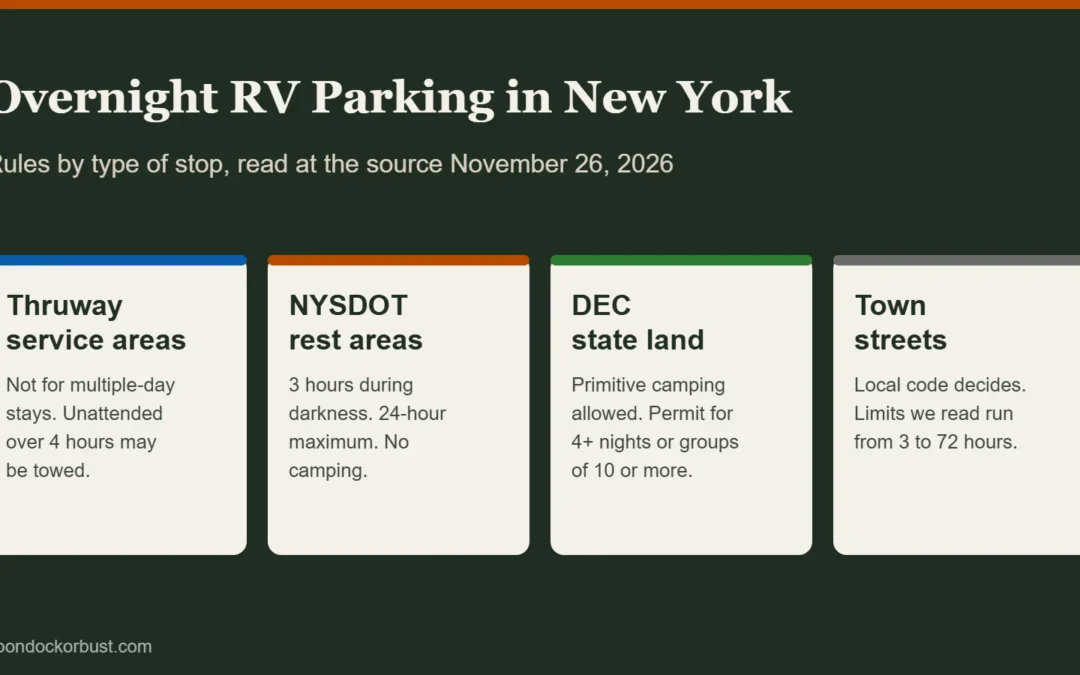
Quick answer: New York has no statewide rule that permits overnight RV parking. NYSDOT rest areas cap parking at 3 hours during darkness and ban camping. Thruway service areas say they are not for long-term or multiple-day stays and may tow unattended vehicles after 4 hours. For a planned night, use a state campground or primitive camping on DEC land under DEC rules.
New York overnight RV parking rules at a glance
The rule depends on who runs the place you stop. A Thruway service area, a NYSDOT rest area, DEC land and a city street each follow a different source.
| Where | What the source says | Label | Source |
|---|---|---|---|
| Thruway service areas (I-87 south of Albany, I-90) | Not designed for long-term parking or multiple-day stays. Unattended vehicles over 4 hours may be towed. No sleeping or camping rule on the page. | Official policy page | Thruway Authority |
| Thruway parking areas and welcome centers | Do not leave a vehicle unattended. Unattended vehicles will be towed. No hour limit stated. | Official policy page | Thruway Authority |
| NYSDOT rest areas, parking areas and scenic overlooks | 3 hours during darkness. 24 hours maximum at any time. No camping, tents or shelters. No dumping sanitary waste. | Official policy page | 17 NYCRR 156.3 and 156.4 |
| DEC State Forests and Forest Preserve | Primitive camping allowed. Permit needed for more than three nights in one place or groups of 10 or more. No camping within 150 feet of a road or water except at designated sites. | Official policy page | NYS DEC |
| State Parks and DEC campgrounds | Paid sites, reserved through ReserveAmerica up to nine months ahead. | Official policy page | NY State Parks |
| City, town and village streets | Set by local code. Limits we read range from 3 hours to 72 hours for RVs on streets. | Official policy page, by town | Local rules below |
| Walmart and other store lots | Walmart leaves RV parking to each store manager and local law. We found no New York rule that addresses store lots statewide. | Official policy page (Walmart). No published policy found (state) | Our Walmart guide |
Thruway service areas: four hours, then towing
Thruway service areas are not set up for overnight RV stays. The Thruway Authority says, “Thruway Authority Service Areas are not designed for long term parking or multiple day stays” (Thruway Authority, Service Areas). The same page says unattended vehicles left more than 4 hours are subject to towing at the owner’s expense.
- The 4-hour line is about unattended vehicles. The page sets no sleeping rule and no camping rule.
- All service areas are open 24 hours, with fuel and restrooms.
- Thruway parking areas and welcome centers are a separate facility type. Their page says not to leave a vehicle unattended and gives no hour count (Thruway Authority, Parking Areas and Welcome Centers).
Our I-87 overnight RV parking guide lists each Thruway service area and parking area on I-87 by milepost and direction.
NYSDOT rest areas: 3 hours after dark, no camping
NYSDOT rest areas limit parking to 3 hours during darkness. New York’s rule for state rest areas, parking areas and scenic overlooks sits in 17 NYCRR Part 156. It covers areas NYSDOT provides along state highways, including the Adirondack Northway (I-87 north of Albany) and I-81. Our I-81 guide lists each New York rest area on that route.
- Time limit: 3 hours during the hours of darkness (17 NYCRR 156.3(c)).
- Hard cap: no vehicle may stay more than 24 hours at any time (156.3(e)).
- Camping: the rule reads, “Camping is prohibited in rest or parking areas or at scenic overlooks” (17 NYCRR 156.4).
- Unattended: a vehicle may not be left unattended unless someone from it is within the area (156.3(d)).
- Tanks: no dumping of sanitary waste at any rest or parking area (156.5(e)).
Commercial truck drivers may stay up to 10 hours for required off-duty time under 156.3(c). That exception does not cover RVs. NYSDOT’s Highway Design Manual, Chapter 27 cites the same Part 156 limits.
New York’s row in our rest area overnight parking laws by state table carries the same rule, so you can compare it with neighboring states.
Public land: DEC primitive camping rules
Primitive camping is allowed on many DEC lands, including the Adirondack and Catskill Forest Preserve and State Forests (NYS DEC, Primitive Camping). These rules come from 6 NYCRR Part 190.
- Permit: camping in one place for four nights or more needs a permit from a Forest Ranger (6 NYCRR 190.4(a)). So does any group of 10 or more (190.4(e)).
- Distance: no camping within 150 feet of a road, trail, spring, stream or pond, except at sites DEC designates (6 NYCRR 190.3(b)).
- Vehicles: on State Forests, motor vehicles are allowed only on access roads posted as open to them (NYS DEC, State Forest Rules).
- Elevation: no camping above 4,000 feet in the Adirondacks, with seasonal exceptions (190.3(d)).
Designated roadside sites are where a camper can usually fit. The Moose River Plains Complex in the Adirondacks has 116 primitive roadside campsites, and DEC says tents or small campers can use them (NYS DEC, Moose River Plains). DEC lists campsites 1 to 20 as closed after a bridge failure at Payne Brook, as of November 26, 2026. DEC publishes no size limit for “small campers,” so call the local DEC office before you take a large rig in.
Paid backup: State Parks and DEC campgrounds
When you need a sure spot, book a state campground. Both NY State Parks and DEC campgrounds reserve through ReserveAmerica, up to nine months ahead (NY State Parks, Things to Know, and DEC Reservations).
- Fees as of November 26, 2026: a standard State Parks site is $17 a night. Electric adds $7 to $9, and full hookup adds $13 to $15. Non-residents add $5 a night, and each reservation carries a $7.25 fee (NY State Parks, Fees and Policies).
- Stay limit: 14 continuous nights at a State Park, then 48 hours away from that park.
- Season: most DEC campgrounds open May 14 for 2027 and close between September 6 and October 11 (DEC 2027 schedule). State Parks says many campgrounds stay open into the fall and several are open year-round.
- Generators: State Parks allows them 9:00 to 11:00 a.m. and 5:00 to 9:00 p.m. only.
Same-day reservations run until 3:00 p.m. on the arrival date, per State Parks. Use the ReserveAmerica filters to find sites with electric or full hookups.
City, town and village rules
Street parking for RVs is set by each municipality. These are two rules we read in the code itself. They show how far limits can differ.
| Place | Rule | Code |
|---|---|---|
| Village of Croton-on-Hudson | No motor home, camper or RV on any street or public right-of-way for longer than 3 hours. | § 197-30 |
| City of Plattsburgh | No self-contained motor home on a public street or alley for longer than 72 continuous hours. Unhitched trailers may not park on city streets. | § 340-8 |
Both rules cover streets. Neither addresses store or private lots. Before you park on a street, look up the town’s code on its website or eCode360, and follow posted signs.
Stores, truck stops and memberships
Store lots follow company policy, the manager on duty and local law. Walmart’s corporate FAQ leaves the decision to each store manager. Our Walmart overnight RV parking guide covers that policy, and our truck stop guide covers fuel-stop etiquette.
For a planned stop on private land, membership programs such as Harvest Hosts are a paid option. Our RV Overnights vs Harvest Hosts comparison walks through the costs.
Before you stop for the night
- Match the stop to its operator: Thruway, NYSDOT, DEC, a town or a store.
- Call the location the same day if it is a store or private lot.
- Read the posted signs. They override anything online.
- Keep one backup within 30 minutes.
Our overnight parking hub has the full checklist and a call script. KampTrail, our free map, shows candidate stops. A pin is a place to ask about, not permission to stay.
Found a rule that changed? Report a change with the source link. Overnight parking rules change by town and by agency. This page reports what agencies and companies publish. It is not legal advice.


