Last updated November 26, 2026. Every rule below was read at its source on that date. Labels follow our How We Check method.
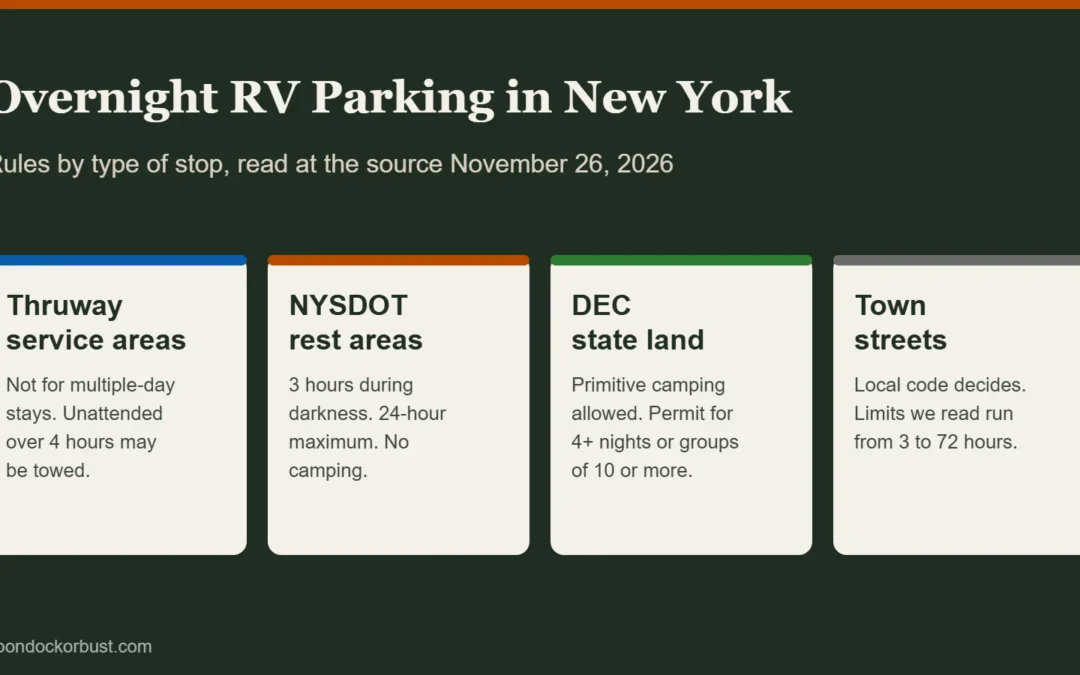
Quick answer: New York has no statewide rule that permits overnight RV parking. NYSDOT rest areas cap parking at 3 hours during darkness and ban camping. Thruway service areas say they are not for long-term or multiple-day stays and may tow unattended vehicles after 4 hours. For a planned night, use a state campground or primitive camping on DEC land under DEC rules.
New York overnight RV parking rules at a glance
The rule depends on who runs the place you stop. A Thruway service area, a NYSDOT rest area, DEC land and a city street each follow a different source.
Where
What the source says
Label
Source
Thruway service areas (I-87 south of Albany, I-90)
Not designed for long-term parking or multiple-day stays. Unattended vehicles over 4 hours may be towed. No sleeping or camping rule on the page.
Primitive camping allowed. Permit needed for more than three nights in one place or groups of 10 or more. No camping within 150 feet of a road or water except at designated sites.
Thruway service areas are not set up for overnight RV stays. The Thruway Authority says, “Thruway Authority Service Areas are not designed for long term parking or multiple day stays” (Thruway Authority, Service Areas). The same page says unattended vehicles left more than 4 hours are subject to towing at the owner’s expense.
The 4-hour line is about unattended vehicles. The page sets no sleeping rule and no camping rule.
All service areas are open 24 hours, with fuel and restrooms.
NYSDOT rest areas limit parking to 3 hours during darkness. New York’s rule for state rest areas, parking areas and scenic overlooks sits in 17 NYCRR Part 156. It covers areas NYSDOT provides along state highways, including the Adirondack Northway (I-87 north of Albany) and I-81. Our I-81 guide lists each New York rest area on that route.
Time limit: 3 hours during the hours of darkness (17 NYCRR 156.3(c)).
Hard cap: no vehicle may stay more than 24 hours at any time (156.3(e)).
Camping: the rule reads, “Camping is prohibited in rest or parking areas or at scenic overlooks” (17 NYCRR 156.4).
Unattended: a vehicle may not be left unattended unless someone from it is within the area (156.3(d)).
Tanks: no dumping of sanitary waste at any rest or parking area (156.5(e)).
Commercial truck drivers may stay up to 10 hours for required off-duty time under 156.3(c). That exception does not cover RVs. NYSDOT’s Highway Design Manual, Chapter 27 cites the same Part 156 limits.
Primitive camping is allowed on many DEC lands, including the Adirondack and Catskill Forest Preserve and State Forests (NYS DEC, Primitive Camping). These rules come from 6 NYCRR Part 190.
Permit: camping in one place for four nights or more needs a permit from a Forest Ranger (6 NYCRR 190.4(a)). So does any group of 10 or more (190.4(e)).
Distance: no camping within 150 feet of a road, trail, spring, stream or pond, except at sites DEC designates (6 NYCRR 190.3(b)).
Vehicles: on State Forests, motor vehicles are allowed only on access roads posted as open to them (NYS DEC, State Forest Rules).
Elevation: no camping above 4,000 feet in the Adirondacks, with seasonal exceptions (190.3(d)).
Designated roadside sites are where a camper can usually fit. The Moose River Plains Complex in the Adirondacks has 116 primitive roadside campsites, and DEC says tents or small campers can use them (NYS DEC, Moose River Plains). DEC lists campsites 1 to 20 as closed after a bridge failure at Payne Brook, as of November 26, 2026. DEC publishes no size limit for “small campers,” so call the local DEC office before you take a large rig in.
Paid backup: State Parks and DEC campgrounds
When you need a sure spot, book a state campground. Both NY State Parks and DEC campgrounds reserve through ReserveAmerica, up to nine months ahead (NY State Parks, Things to Know, and DEC Reservations).
Fees as of November 26, 2026: a standard State Parks site is $17 a night. Electric adds $7 to $9, and full hookup adds $13 to $15. Non-residents add $5 a night, and each reservation carries a $7.25 fee (NY State Parks, Fees and Policies).
Stay limit: 14 continuous nights at a State Park, then 48 hours away from that park.
Season: most DEC campgrounds open May 14 for 2027 and close between September 6 and October 11 (DEC 2027 schedule). State Parks says many campgrounds stay open into the fall and several are open year-round.
Generators: State Parks allows them 9:00 to 11:00 a.m. and 5:00 to 9:00 p.m. only.
Same-day reservations run until 3:00 p.m. on the arrival date, per State Parks. Use the ReserveAmerica filters to find sites with electric or full hookups.
City, town and village rules
Street parking for RVs is set by each municipality. These are two rules we read in the code itself. They show how far limits can differ.
Place
Rule
Code
Village of Croton-on-Hudson
No motor home, camper or RV on any street or public right-of-way for longer than 3 hours.
Both rules cover streets. Neither addresses store or private lots. Before you park on a street, look up the town’s code on its website or eCode360, and follow posted signs.
Stores, truck stops and memberships
Store lots follow company policy, the manager on duty and local law. Walmart’s corporate FAQ leaves the decision to each store manager. Our Walmart overnight RV parking guide covers that policy, and our truck stop guide covers fuel-stop etiquette.
For a planned stop on private land, membership programs such as Harvest Hosts are a paid option. Our RV Overnights vs Harvest Hosts comparison walks through the costs.
Before you stop for the night
Match the stop to its operator: Thruway, NYSDOT, DEC, a town or a store.
Call the location the same day if it is a store or private lot.
Read the posted signs. They override anything online.
Keep one backup within 30 minutes.
Our overnight parking hub has the full checklist and a call script. KampTrail, our free map, shows candidate stops. A pin is a place to ask about, not permission to stay.
Found a rule that changed? Report a change with the source link. Overnight parking rules change by town and by agency. This page reports what agencies and companies publish. It is not legal advice.
Last updated November 26, 2026. This page explains the method behind every overnight RV parking guide on Boondock or Bust.
Quick answer: Every rule on our overnight parking pages carries one of four labels and the date we read its source. The label tells you what the row rests on. It does not mean a store, rest area or city will say yes tonight. Posted signs and the person in charge on site override anything we publish.
The four labels
Each row on our overnight parking pages carries exactly one of these labels.
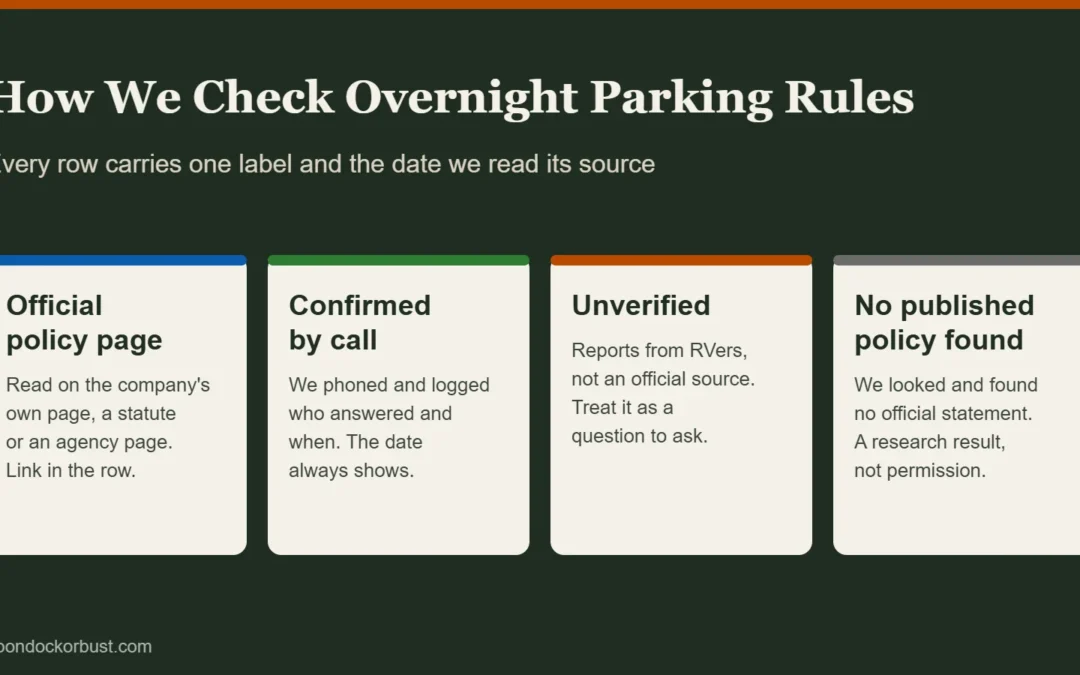
Official policy page. We read the rule on the company’s own page, or on a statute, regulation or agency page. The link sits in the row.
Confirmed by call. We phoned the location or agency, and we log who answered and the date. Calls go stale, so the date always shows. No row carries this label yet.
Unverified. The row rests on reports from RVers, not an official source. We show it as a question to ask, not a recommendation.
No published policy found. We looked for an official statement and found none. That is a research result, not permission.
Here is how a label plays out. Walmart’s corporate FAQ says, “Please contact management in each store to ensure accommodations before parking your RV” (Walmart FAQ). That row is labeled Official policy page. The policy itself still sends you to the store manager.
What counts as a source
We use primary sources for rules. That means state statutes and administrative codes, state transportation and turnpike agency pages, land agency pages, municipal codes and a company’s own published policy.
We open every source we cite and confirm the wording is there.
We do not use crowd listing sites, forums or other RV blogs as the source of a rule. We may use them to find a lead, then check the lead at the primary source.
When a company’s only statement is old, we show its date. Camping World’s statement that select stores allow overnight parking comes from a company blog post dated November 12, 2021, and our pages say so.
Three rules we keep separate
A time limit, an overnight or sleeping rule and a camping rule are three different rules. We give each its own field, because a state can set one and say nothing about the others.
Time limit: how long you may park, such as 2 hours in any 24-hour period.
Overnight or sleeping rule: whether you may stay overnight or sleep in the vehicle.
Camping rule: whether you may set up camp, such as tents, awnings, chairs or grills.
When a source is silent on one of the three, the field says “Not stated.” We never fill the gap by assuming a stay is allowed.
How we date a row
The date on a row is the day we last opened its source and compared it with what we published. We do not change a date without reopening the source. If a source disappears or changes, we recheck the row before we edit or remove it.
Some company pages block automated access or go offline for a time. When that happens, the row keeps its last read date until we can read the source again.
What a map pin means
KampTrail is our free map. Adirondack Manufacturing Corporation owns both Boondock or Bust and KampTrail. A pin on the map is a place to ask about, not permission to stay. Rules and labels live on the guides, and the map helps you find candidates near you.
Corrections
Found a rule that changed? Report a change and include the source link. We check the report against the source, or by phone, before we update anything. When we correct a row, we change its date and note the correction on the guide.
Who checks
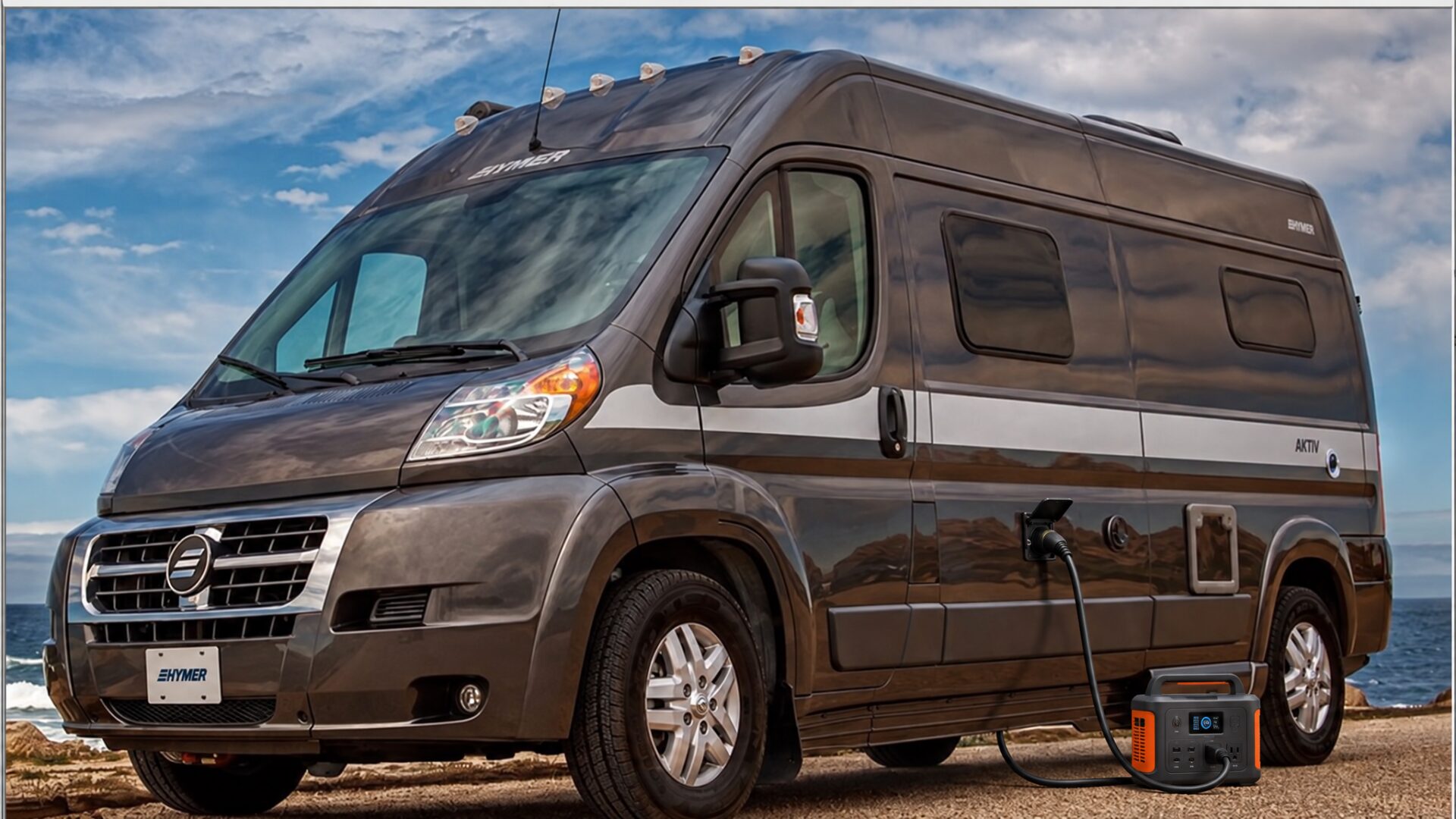
Chuck Price has 35+ years of RV camping experience and travels in a 2018 Hymer Aktiv Class B. Cindy and I have overnighted at Walmart lots, rest areas, truck stops and on public land, and we have made 24 Harvest Hosts stays across 7 states. Our travel is mostly in the Northeast, Mid-Atlantic and Midwest. We have not stayed at every place in our tables, so the label on each row tells you what it rests on.
How we make money
Some links on our parking guides are affiliate links, including Harvest Hosts and RV Overnights. If you join through one, we may earn a commission at no extra cost to you. A commission never changes a label or a rule on our pages. Read our affiliate disclosure for details.
Overnight parking rules change by store, by city and by state. Our pages report what companies and agencies publish. They are not legal advice. Confirm with the location before you stay.
Disclosure: Starware sent me this case free to review, with no return required. The sample is the only compensation, and Starware did not see this post before it went live. The FTC’s Endorsement Guides say a connection like this “must be disclosed clearly and conspicuously” (16 CFR 255.5). The Starware link below is tagged as sponsored. I earn nothing if you buy one. See the Boondock or Bust affiliate disclosure.
Quick answer: The Starware M101S is a hard case that stores a Starlink Mini kit and powers the dish through an outside DC port. This is a first look from a November 19, 2026 driveway setup in my Hymer Aktiv, so it covers fit, contents and setup, and it does not cover connection speeds, heat or rain. Starware lists the case at $119.90 and 2.1 kg (4.6 lb). My Mini fit the lid straps, and my kickstand, cable and power supply fit the foam.
Last updated: November 23, 2026
I use a Starlink Mini when we travel in our 2018 Hymer Aktiv Class B. A 19-foot van has no spare shelf for a loose dish, a kickstand and a 15 m (49.2 ft) power cable. Starware offered a sample of its M101S case, and I unboxed it on November 19, 2026. The Hymer is winterized until spring 2027, so everything below comes from that driveway session plus published specs. If you are still choosing a connection, start with my comparison of Starlink Roam and 5G hotspots for RV internet. More gear write-ups live in the Boondock or Bust resources library.
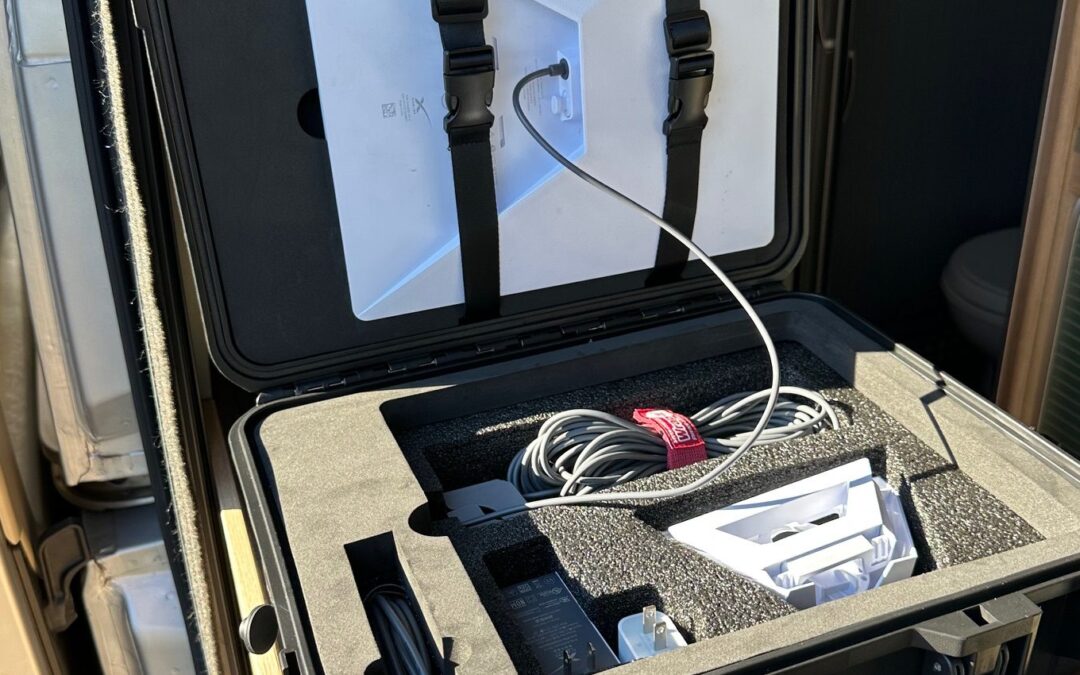
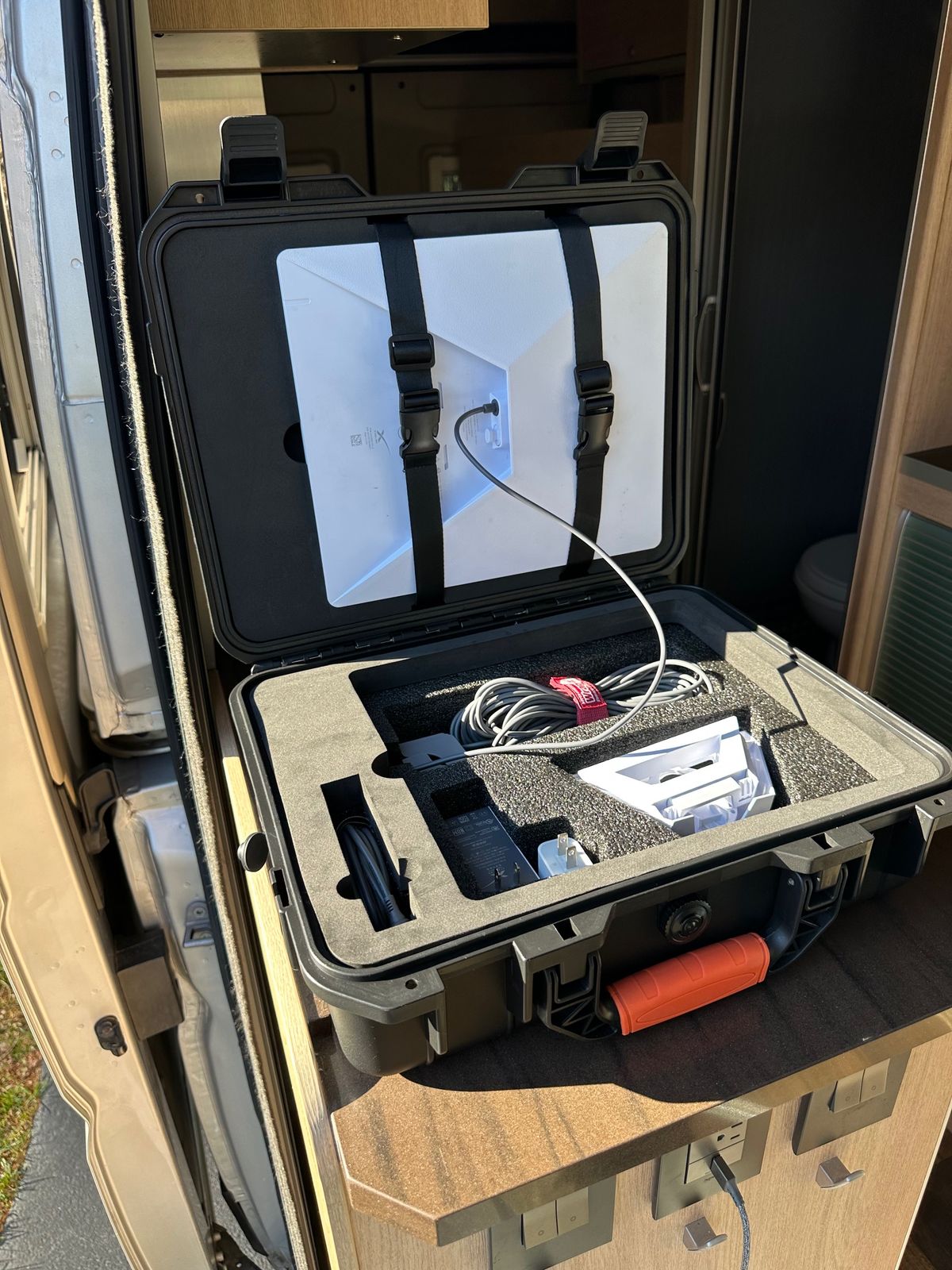
My Starlink Mini strapped into the lid of the Starware M101S, with the kit in the foam below. Photo: Chuck Price, November 19, 2026.
What is the Starware M101S case for Starlink Mini?
The Starware M101S is a polypropylene hard case with cut foam, lid straps for the dish and a waterproof DC port on the outside. Starware sells it as the Field Protective Case for Starlink Mini. The carton and the quick-start card call it the Hard Case for Starlink Mini. Both carry model number M101S.
Spec
Starware M101S
Where it comes from
Model
M101S
Carton label and Starware product page
Price
$119.90 on starwaresat.com, checked November 23, 2026
Starware product page
Case weight
2.1 kg (4.6 lb)
Starware product page
Shell
High-density polypropylene
Starware product page
Interior
Dual-layer EVA and EPE foam
Starware product page
Weather rating claimed
IP67 with a rubber gasket
Starware product page
Power input
Waterproof DC port on an aluminum panel
Starware product page
Fits
Starlink Mini only
Starware product page
Outside dimensions
Not published
Starware product page, checked November 23, 2026
The case fits the Starlink Mini only. It does not fit the Starlink Standard dish. This first look does not include my own weights or measurements.
Starlink lists the Mini at 298.5 x 259 x 38.5 mm (11.75 x 10.2 x 1.45 in) and 1.10 kg (2.43 lb), per the Starlink Mini specification sheet. Case plus dish comes to 3.2 kg (about 7.1 lb) before the kickstand, cables and power supply. That total is my addition of the two published weights, not a scale reading.
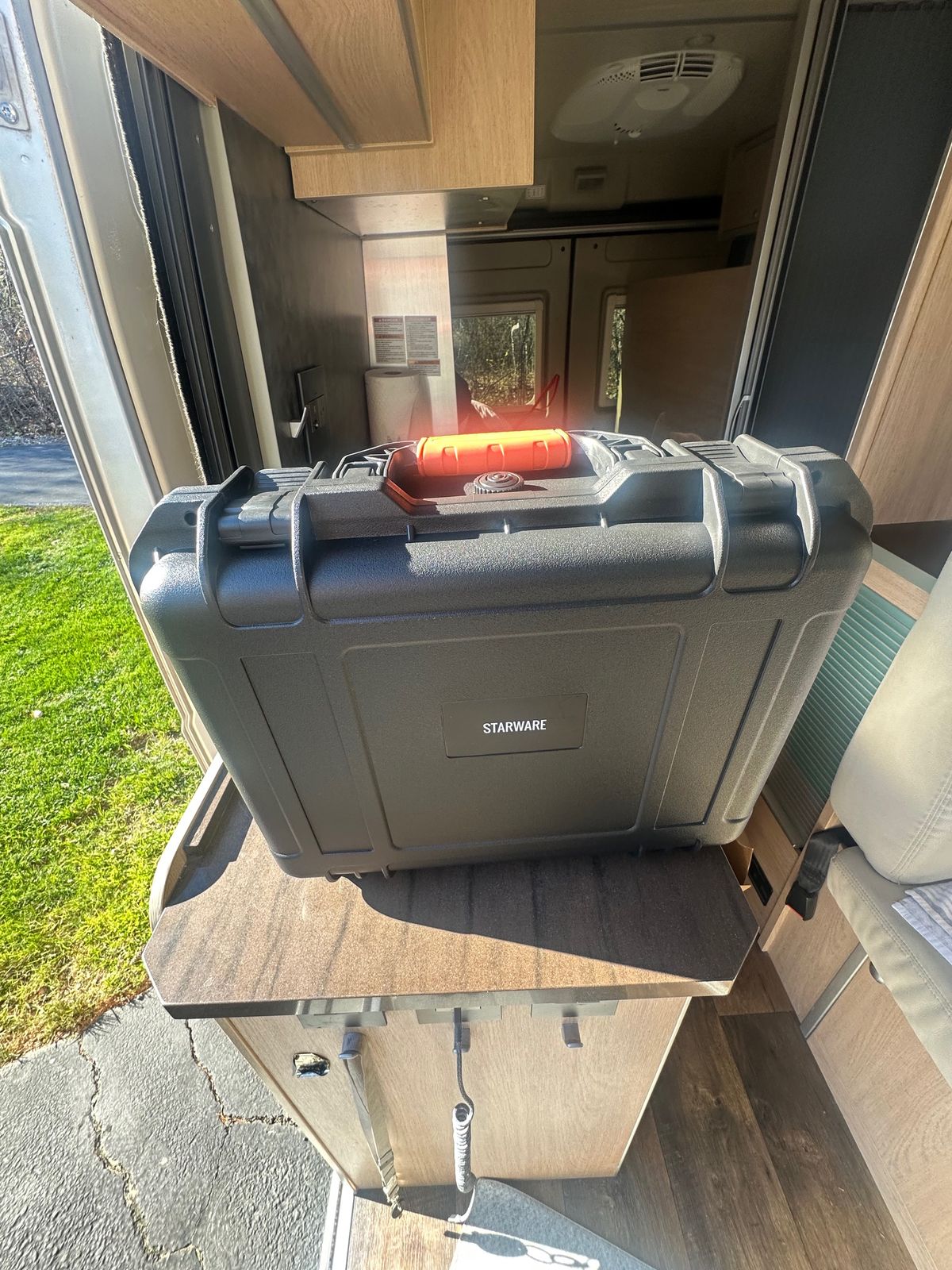
The M101S closed, on the Hymer’s fold-out counter. Two latches, one orange handle. Photo: Chuck Price.
What comes in the box?
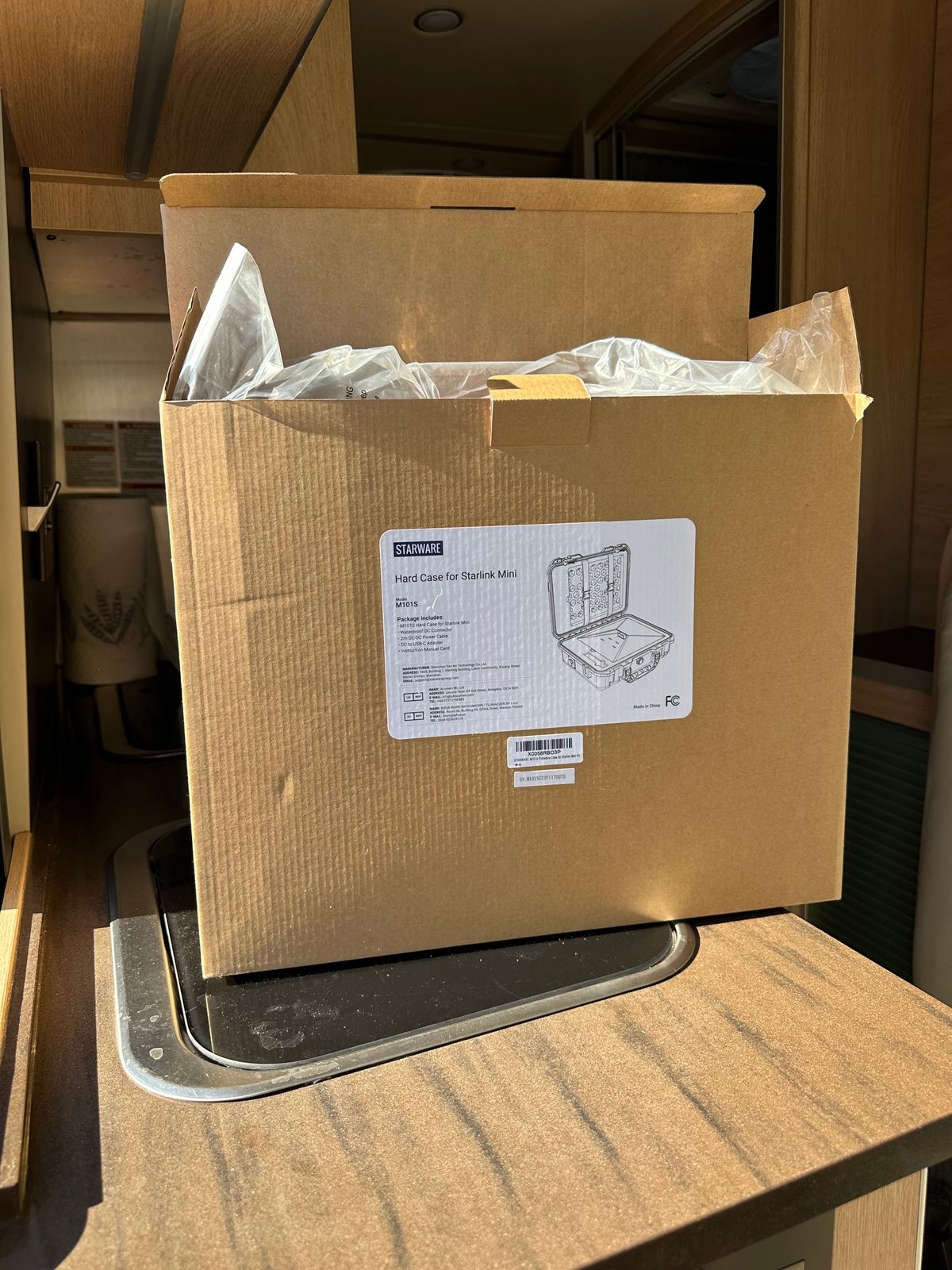
The carton label lists five items: the case, a waterproof DC connector, a 2 m DC cable, a USB-C adapter and an instruction card.
M101S hard case for Starlink Mini
Waterproof DC connector, installed in the side of the case
2 m (6.6 ft) DC to DC power cable
DC to USB-C adapter
Instruction card with four setup steps
A short cable on the inside of the DC connector plugs into the dish. No Starlink hardware is included. You supply the Mini, its kickstand, its cables and its power supply. The label lists no shoulder strap.
The USB-C adapter only works with a strong enough source. Starlink’s spec sheet sets the USB PD (Power Delivery) requirement for its own USB-C cable at “100W, 20V/5A Minimum” (Starlink Mini specification sheet). Starware’s product page names Type-C power banks of 100 W and up.
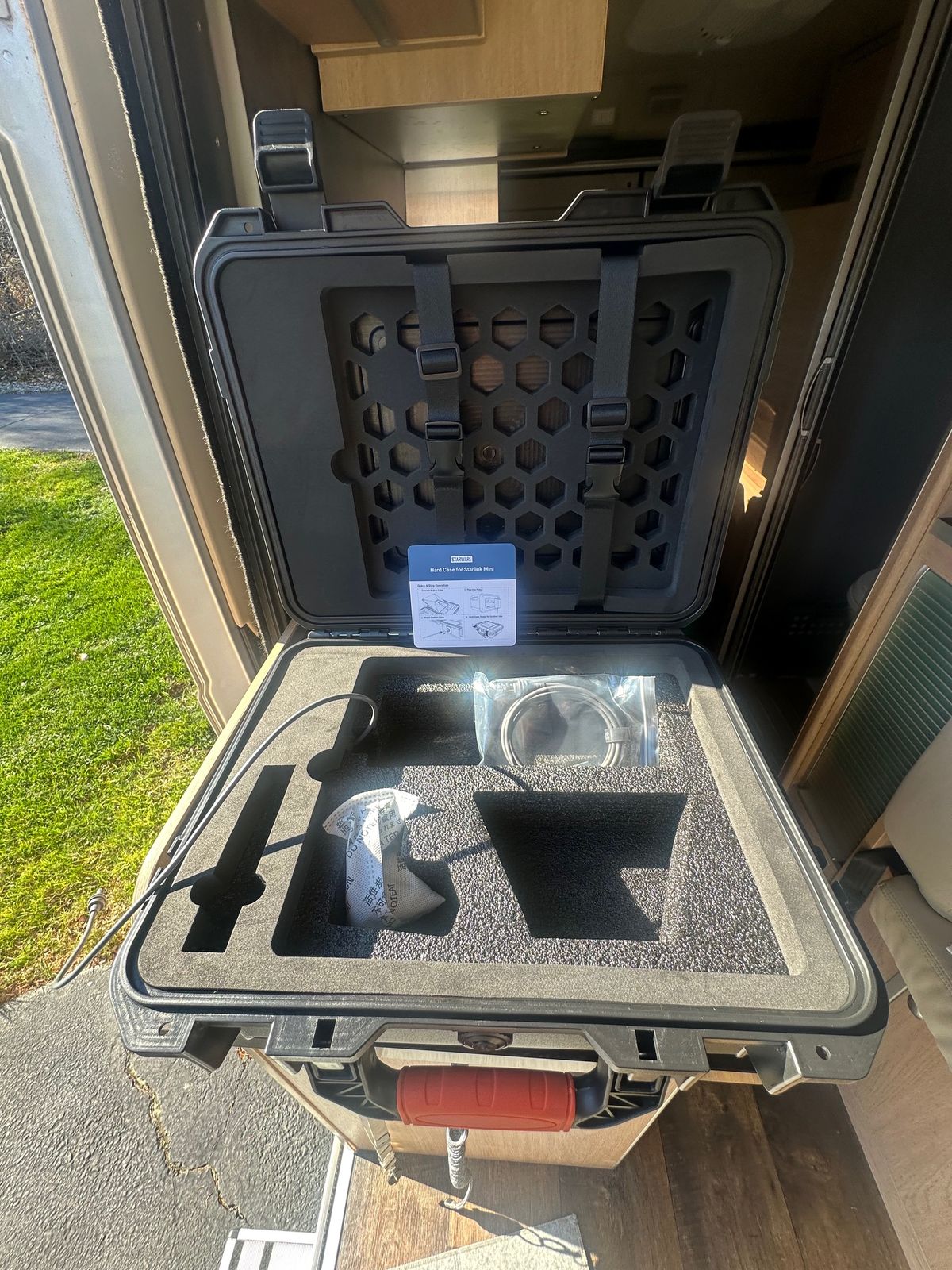
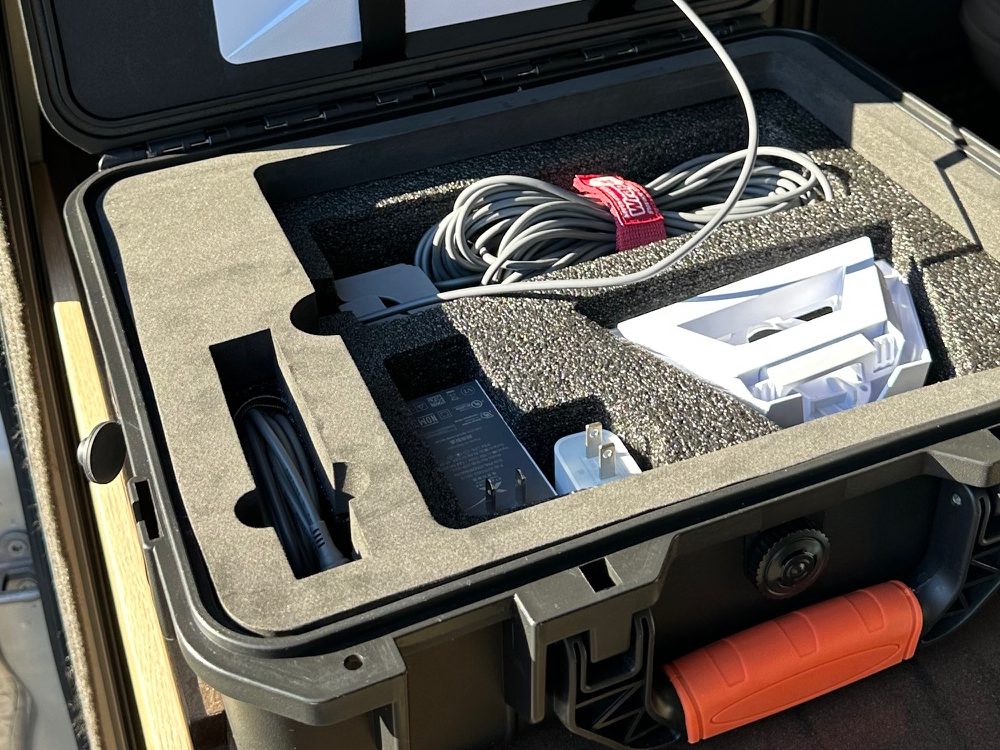
The carton label names the model and the package contents. Photo: Chuck Price.Fresh out of the bag: cut foam in the base, a honeycomb panel and two buckle straps in the lid. Photo: Chuck Price.
How does the Starlink Mini fit in the case?
The dish straps into the lid under two buckle straps, and the foam base holds the kickstand, cables and power supply. Here is where my kit went on November 19, 2026:
Lid: the Mini, back side facing in, under both buckle straps
Top foam pocket: my coiled Starlink power cable
Right foam pocket: the kickstand, which I took off the dish
Lower left pocket: the Starlink power supply and wall plug
Left slot: a spare cable
The lid panel behind the dish is a honeycomb grid. With the case shut and lying flat, the face of the dish points up through the lid. The straps hold the dish parallel to the lid, so the dish points wherever the lid points.
Cable, kickstand, power supply and plug each get a foam pocket. Photo: Chuck Price.
How do you power the Starlink Mini with the lid closed?
You plug the case’s inside cable into the dish, close the lid and feed power to the DC port on the outside. The instruction card shows four steps:
Plug the built-in cable into the dish.
Connect the Starware cable to your power source.
Attach the cable to the port on the outside of the case.
Latch the case.
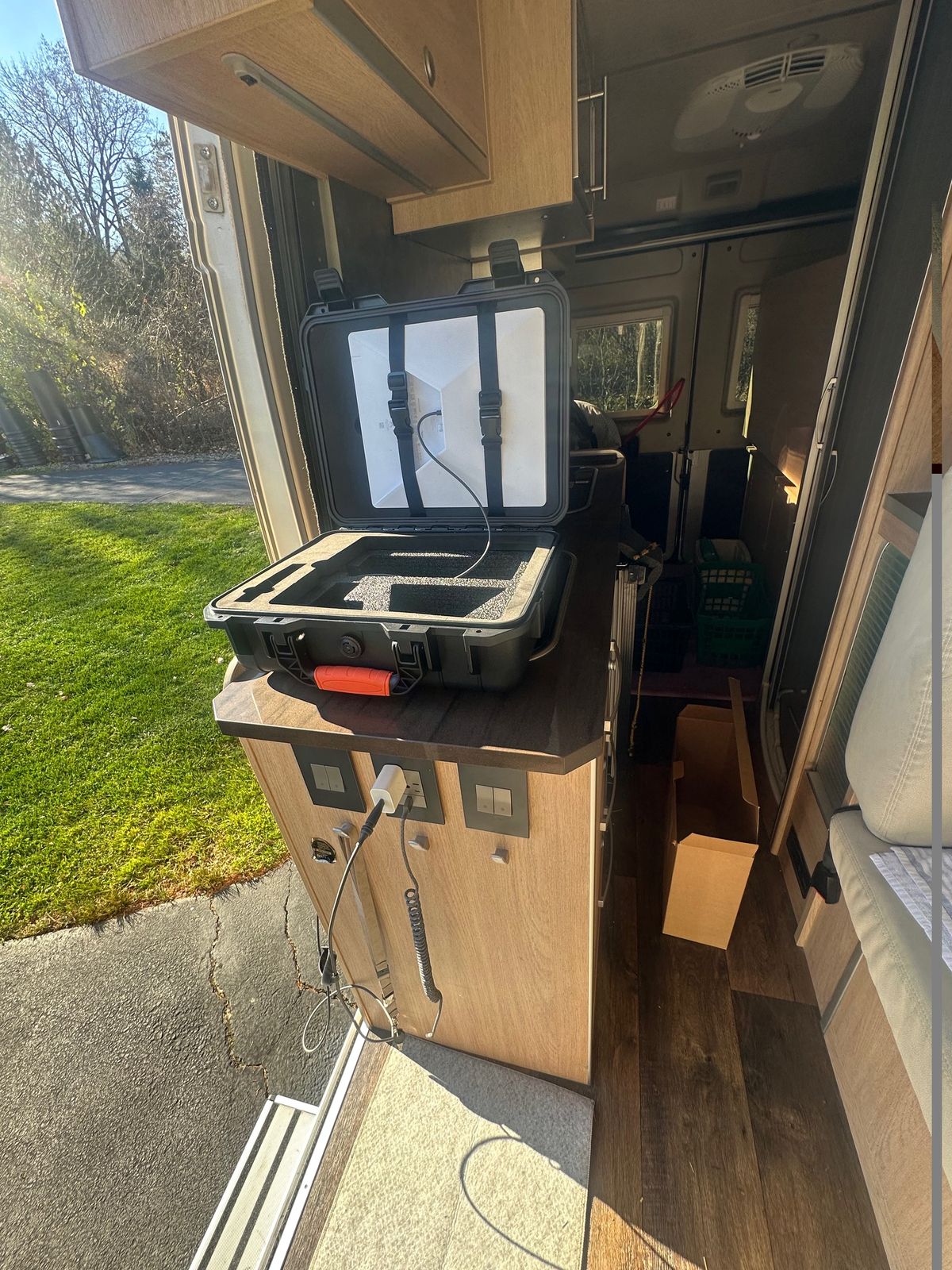
In my driveway setup, I ran the 2 m Starware cable from the side port to the USB-C adapter and a wall charger in the Hymer’s galley outlet. The case has no battery. It passes power through to the dish.
Starlink rates the Mini’s input at 12 to 48 V and 60 W, with an average draw of 25 to 40 W, per the Starlink Mini specification sheet. Worked example: 40 W for 8 hours is 320 Wh. At 25 W, the same 8 hours is 200 Wh. Those figures use Starlink’s published average, not a reading from my battery monitor.
Common mistake: any USB-C charger will run the dish.
Why it persists: phone and tablet chargers use the same plug.
The correction: Starlink’s own USB-C cable needs a USB PD source rated at least 100 W at 20 V and 5 A, per the Starlink Mini specification sheet checked November 23, 2026.
What to do: read the wattage printed on your charger or power bank before you count on it.
The Starware cable runs from the port on the side of the case to the outlet below the counter. Photo: Chuck Price.
To recap the decision so far: the Starware M101S case does two jobs for a Starlink Mini, storage and closed-lid power. My fit check covers the storage job. The closed-lid job depends on heat, sky view and your power source, which the next sections cover.
Will a Starlink Mini overheat inside a closed case?
I have no heat data yet, and Starware publishes no temperature limit for running the dish inside the case.
Starlink rates the Mini for -30°C to 50°C (-22°F to 122°F), per the specification sheet. A dish that hits its high temperature threshold first throttles performance, then stops service until it cools, according to Starlink’s alert definitions. The Mini draws 25 to 40 W on average, and a closed, gasketed case gives that heat less room to escape. That last point is my reasoning, not a measurement.
Starware says the honeycomb panel under the dish “creates airflow channels that minimize heat buildup during summer camping” on its M101S product page. The page gives no test temperatures. I found no published temperature test for this case.
My plan until numbers exist:
Keep the closed case out of direct summer sun when you can.
Watch the Starlink app for thermal alerts.
Open the lid if an alert appears.
A closed case still needs open sky above the lid. Starlink lists a 110 degree field of view for the Mini on the same specification sheet. If your income depends on the connection, keep a backup. My guide to working remotely while boondocking covers that.
What does the IP67 rating cover?
IP67 means dust-tight and protected against temporary immersion, and here it is Starware’s claim for the closed case.
The IP code comes from IEC 60529, a standard of the International Electrotechnical Commission. The 6 means dust-tight. The 7 covers temporary immersion at 1 m for 30 minutes. Starware credits a rubber gasket for the rating. Its product page names no test lab and no certificate number.
The dish carries its own rating. Starlink rates the Mini IP67 Type 4 only with the DC power cable and Starlink plug or cable installed, per the Starlink Mini specification sheet. An open lid protects nothing, so the case rating applies only when the case is latched. This first look includes no rain or immersion test.
Who should buy the Starware case, and who should skip it?
At $119.90, the M101S makes sense if you want one box that stores the Mini kit and runs it from outside power.
Consider it if:
You move the Mini in and out of a small rig and want every part in one place.
You want to try running the dish with the lid shut.
You already own a 12 to 48 V DC source or a 100 W USB-C PD source.
Skip it if:
Your Mini lives on a roof mount.
You only need storage. Plenty of hard cases store a Mini kit without a power port.
You camp in desert heat and need proven closed-lid performance today.
Four things are still open: closed-lid speeds, heat in summer sun, rain, and a season of road vibration.
The Hymer is winterized and off the road until spring 2027. When it rolls, I plan to run the dish lid-open and lid-closed at the same campsite and log speeds, obstructions and any thermal alerts from the Starlink app. I will update this page with the results and the date.
Starware Starlink Mini case FAQ
Does the Starware M101S case include a Starlink Mini?
No. The carton holds the case, a waterproof DC connector, a 2 m DC cable, a DC to USB-C adapter and an instruction card. You supply the Starlink Mini and its accessories.
Can the Starlink Mini run with the Starware case closed?
Starware says yes on its product page. The dish straps into the lid and takes power through the outside DC port. This first look does not confirm speeds or heat behavior with the lid closed.
What power source does the Starware case need?
The case passes power to the dish and has no battery. Starlink rates the Mini’s input at 12 to 48 V and 60 W. For USB-C, Starlink requires a USB PD source of at least 100 W at 20 V and 5 A with its own cable.
Does the Starware M101S fit the Starlink Standard dish?
No. Starware lists the M101S for the Starlink Mini only.
Is the Starware Starlink Mini case waterproof?
Starware claims IP67 for the closed case and credits a rubber gasket. Its product page names no test lab. This first look includes no rain or immersion test.
Last updated: October 13, 2026 | By Chuck Price | 14 min read
Quick answer
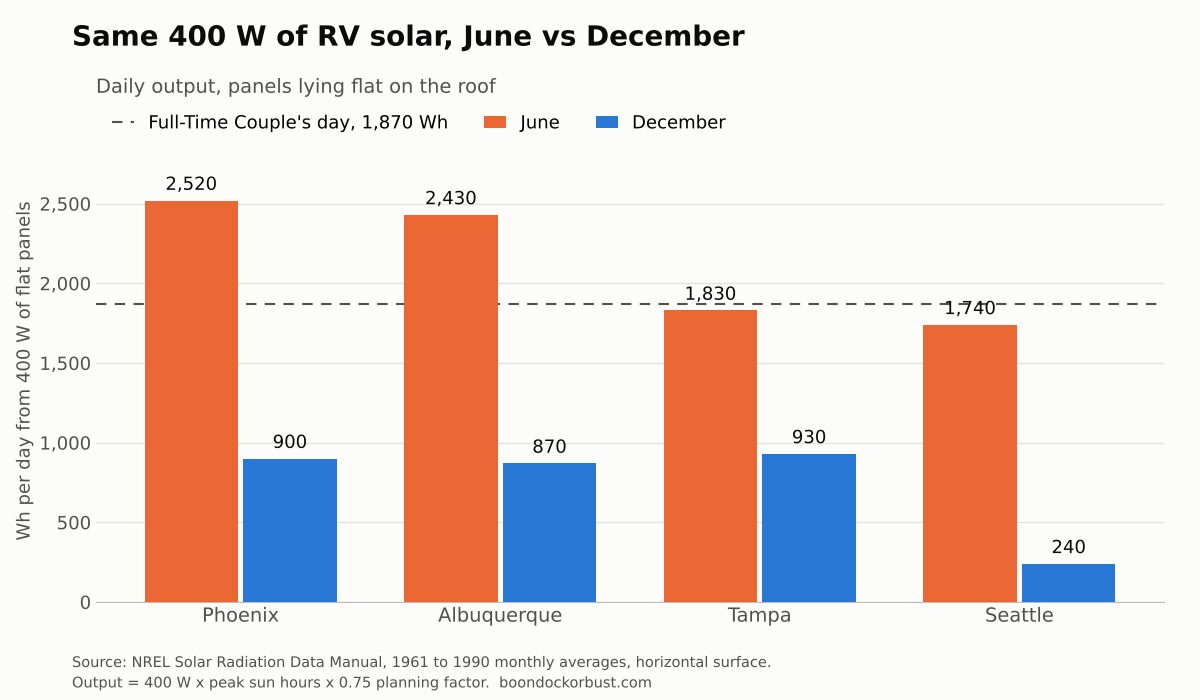
Must-know: Size RV solar for your lowest-sun month. A 400-watt flat array makes about 2,520 Wh a day in a Phoenix June but about 900 Wh in December.
Trip killers: Flat panels in a Pacific Northwest winter, an inverter left on all day, and a battery bank sized for one night.
Best for: Full-timers who measure their daily watt-hours first, then pick panels, battery and a second charging source.
Confirm before you go: Your real daily use on a battery monitor, your panels’ cold-weather voltage, and your charger’s limits.
Safety note: This guide is general information, not electrical advice. Solar, battery and inverter wiring can cause fire or shock if done wrong. Have a licensed electrician or qualified RV technician review your design and installation, and follow the equipment maker’s manuals.
A full-time couple using 1,870 Wh a day needs about 510 to 830 watts of solar in a Phoenix December, plus about 365 amp-hours of lithium for two days of storage. The same load needs only 297 watts in June. Size for your worst month and add alternator charging.
Some links on this page are affiliate links, including EcoFlow. We may earn a commission at no cost to you. See our affiliate disclosure.
Chuck Price has RVed for more than 35 years and CBC Radio’s “Cost of Living” has featured him. He and his wife Cindy travel in a 2018 Hymer Aktiv Class B with two 300 Ah lithium batteries, 250 watts of roof solar and a 280-amp underhood alternator.
How much power does your RV use each day?
Your daily watt-hours are the one number every other choice depends on. Panels, battery and inverter are all sized from it, and guessing it wrong breaks the whole design. The figures below apply to 12-volt house systems in vans, Class Bs and small trailers, not to rigs running roof air conditioning on battery. For one example, Dometic rates its CFX3 45 compressor fridge at 490 Wh per 24 hours on its spec sheet.
Daily Wh = watts x hours of use, added up for every device. Then add the loads people forget:
Fridge: the CFX3 45 rating is 490 Wh a day at Dometic’s “DC@5/25°C” test point. Dometic does not define that condition on the page, so measure your own fridge in the heat you camp in.
Ten watts of idle draw for 24 hours costs 240 Wh a day before you run a single appliance.
That idle draw is about 13% of the 1,870 Wh full-time couple profile below.
Parasitic loads: propane detectors, stereo memory and USB chargers left plugged in.
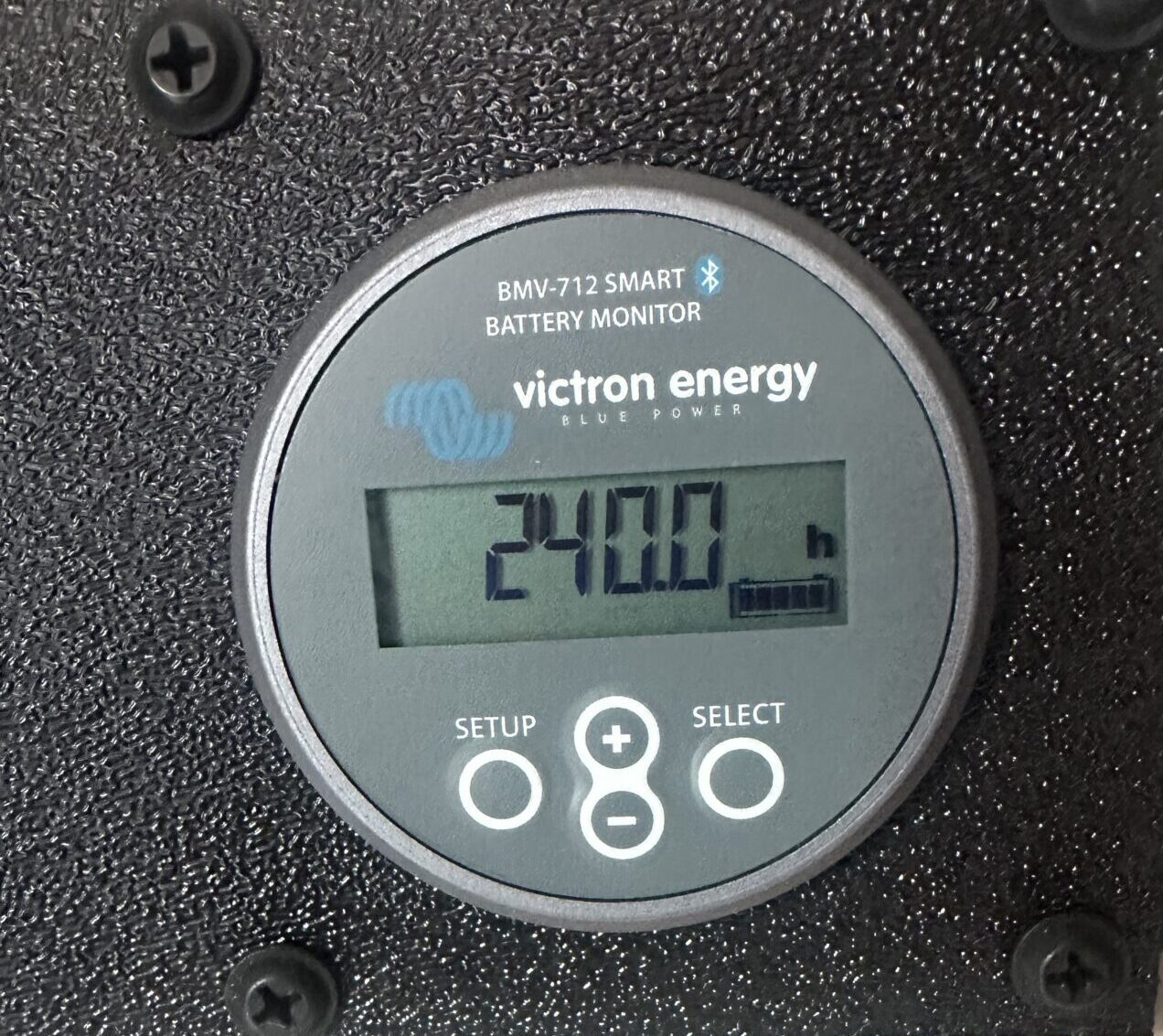
Guess less and measure more. A shunt-type battery monitor records every amp-hour in and out of the bank. Run your normal routine for a week and read the daily total. That week of data replaces every estimate in this article.
The Victron BMV-712 in our Hymer counts what goes in and out of the bank. Voltage alone does not tell you that.
How much solar do you need, and in which month?
Size your RV solar array for the month with the least sun, not the most. Panel output follows the season, and a summer-sized array runs short when the days get short. This applies most to snowbirds and full-timers who stay out from November through February. The U.S. Department of Energy notes that “Denver, Colorado, (near 40° latitude) receives nearly three times more solar energy in June than they do in December” in its Solar Radiation Basics explainer.
Array watts = daily Wh / (peak sun hours x 0.75). One peak sun hour equals 1 kWh of sunlight per square meter. The 0.75 is our planning allowance for heat, dust, wiring and charge losses. It is an assumption, not a published constant.
NREL’s station data shows how much the month matters. These are monthly averages from the NREL Solar Radiation Data Manual, averaged over 1961 to 1990.
Phoenix flat panels average 8.4 peak sun hours in June and 3.0 in December, per NREL station 23183.
Albuquerque flat panels average 8.1 peak sun hours in June and 2.9 in December, per NREL station 23050.
Tampa flat panels average 6.1 peak sun hours in June and 3.1 in December, per NREL station 12842.
Seattle flat panels average 5.8 peak sun hours in June and 0.8 in December, per NREL station 24233.
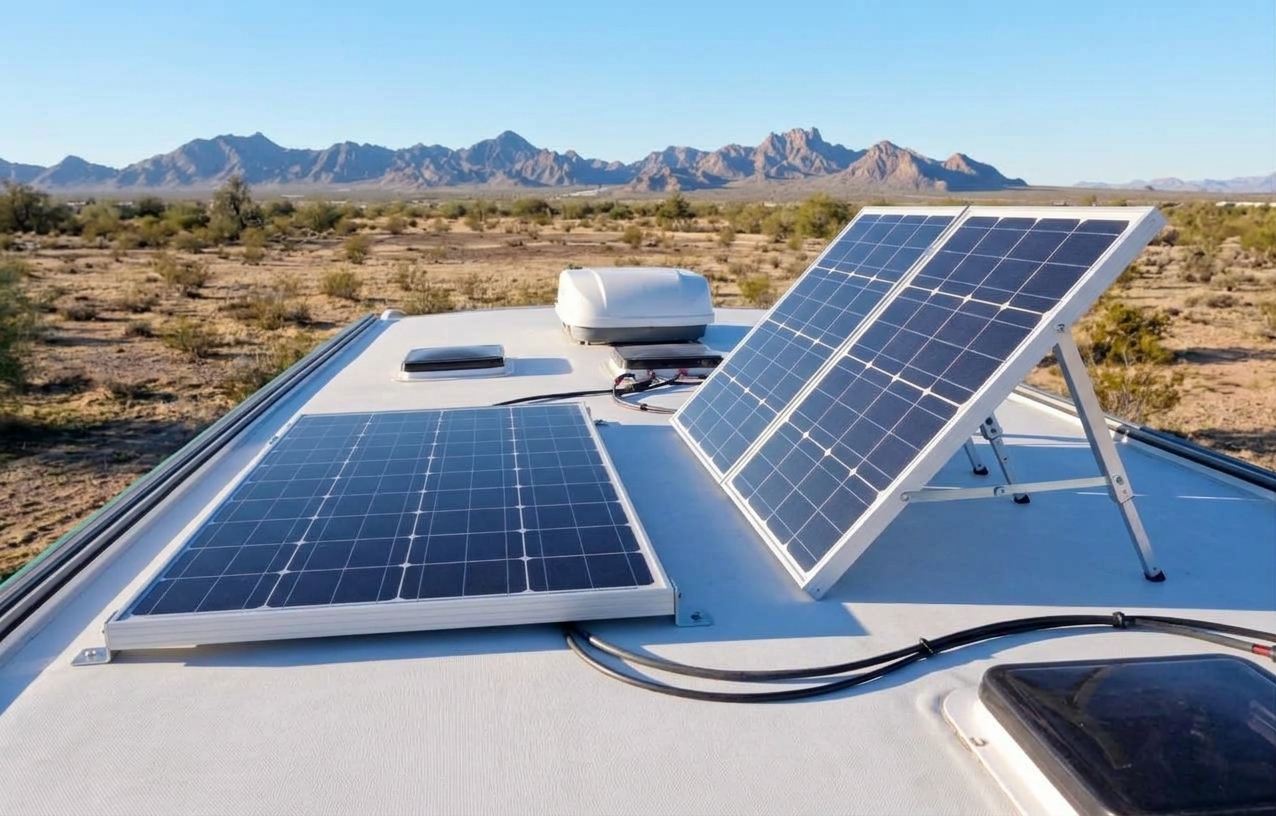
Tilting Phoenix panels south at latitude angle, about 33 degrees, raises December from 3.0 to 4.9 peak sun hours, about 63% more, per the same station file.
Daily output of a 400-watt array, flat unless noted. Source: NREL Redbook 1961 to 1990 averages x 0.75 planning factor.
Location and month
Peak sun hours
400W makes about
Use case
Phoenix, June
8.4
2,520 Wh
Covers a 2,440 Wh remote worker’s day with about 80 Wh to spare
Phoenix, December
3.0
900 Wh
Weekend loads only
Phoenix, December, tilted at latitude
4.9
1,470 Wh
Portable panels aimed at the low sun
Tampa, December
3.1
930 Wh
Gulf Coast snowbirds
Seattle, December
0.8
240 Wh
Solar is a supplement, not a source
Wintering on Arizona public land? Our guide to long-term visitor areas covers where full-timers park for months at a time. For your exact spot and panel angle, model it in NREL’s free PVWatts calculator.
The same 400 watts of panels, two months apart. Built from NREL station averages.
Illustration: a flat roof panel beside a tilted portable panel. Tilt gains about 63% in a Phoenix December.
Three real setups, sized for summer and winter
These three profiles show how far one load moves between a June and a December array. Each fixes a math error from the earlier version of this page, where every array was smaller than its own load. The loads are examples for 12-volt rigs that cook on propane. Replace them with your monitor readings. All arrays use flat panels and the 0.75 planning factor from the section above.
Weekend Warrior: 830 Wh a day
Two people, two or three nights out. Loads: compressor fridge 490 Wh, water pump 40 Wh, LED lights at 10 watts for 8 hours (80 Wh), two phones 100 Wh, vent fan at 20 watts for 6 hours (120 Wh). No inverter running.
Solar: 132 watts covers a Phoenix June day. A Phoenix December day needs 369 watts flat or 226 watts tilted.
Battery: one day of storage is 830 Wh usable, about 81 Ah of lithium or 138 Ah of AGM at a 50% average discharge.
Full-Time Couple: 1,870 Wh a day
Two people living aboard. Loads: fridge 490 Wh, two laptops at 60 watts for 6 hours (720 Wh), lights 120 Wh, vent fan 160 Wh, water pump 40 Wh, phones and tablets 100 Wh, inverter idle 240 Wh.
Solar: 297 watts covers a Phoenix June day. A Phoenix December day needs 831 watts flat or 509 watts tilted.
Battery: two days of storage is 3,740 Wh usable, about 365 Ah of lithium at 12.8 volts.
Full-Time Remote Worker: 2,440 Wh a day
One person working online. Loads: fridge 490 Wh, laptop and monitor at 100 watts for 9 hours (900 Wh), internet terminal at 40 watts for 12 hours (480 Wh), lights 80 Wh, fan 160 Wh, pump 40 Wh, phone 50 Wh, inverter idle 240 Wh.
Solar: 387 watts covers a Phoenix June day. A Phoenix December day needs 1,084 watts flat or 664 watts tilted.
Battery: two days of storage is 4,880 Wh usable, about 477 Ah of lithium.
Solar needed by profile and season. Flat panels, NREL peak sun hours, 0.75 planning factor.
Profile
Daily load
Phoenix June
Phoenix December
Seattle December
Use case
Weekend Warrior
830 Wh
132 W
369 W
1,383 W
Short trips, battery carries most of the load
Full-Time Couple
1,870 Wh
297 W
831 W
3,117 W
Snowbirds, needs a second charge source in winter
Full-Time Remote Worker
2,440 Wh
387 W
1,084 W
4,067 W
Year-round off-grid work, plan alternator charging
A 3,117-watt array is far more panel than a van roof holds. In a Pacific Northwest winter, solar alone cannot carry a full-time couple. Driving, shore power or a generator fills that gap.
Our rig: a 2018 Hymer Aktiv
Our Hymer came with EcoTrek lithium power modules. We replaced them with two Epoch 300 Ah lithium batteries, for 600 Ah and 7,680 Wh total at 12.8 volts nominal. Epoch lists 12.8 volts, 300 Ah and 3,840 Wh per battery on its product page. The shop also added a 300-amp fuse between the batteries and the underhood alternator, a 70-amp fuse between the disconnect and the batteries and a 30-amp breaker to isolate the solar. We kept the original 2,000-watt inverter.
On basic loads (lights, the microwave, phone charging) we go several days between charges. Our rig has 250 watts of roof solar on its own 30-amp breaker. Flat on the roof, it makes about 1,575 Wh on a Phoenix June day and about 560 Wh in December. That is roughly 20 amps at best. Family RVing Magazine’s 2017 Aktiv review lists a 280-amp underhood alternator and a 2,000-watt inverter for the Aktiv. The alternator’s rating is more than ten times what our panels can deliver.
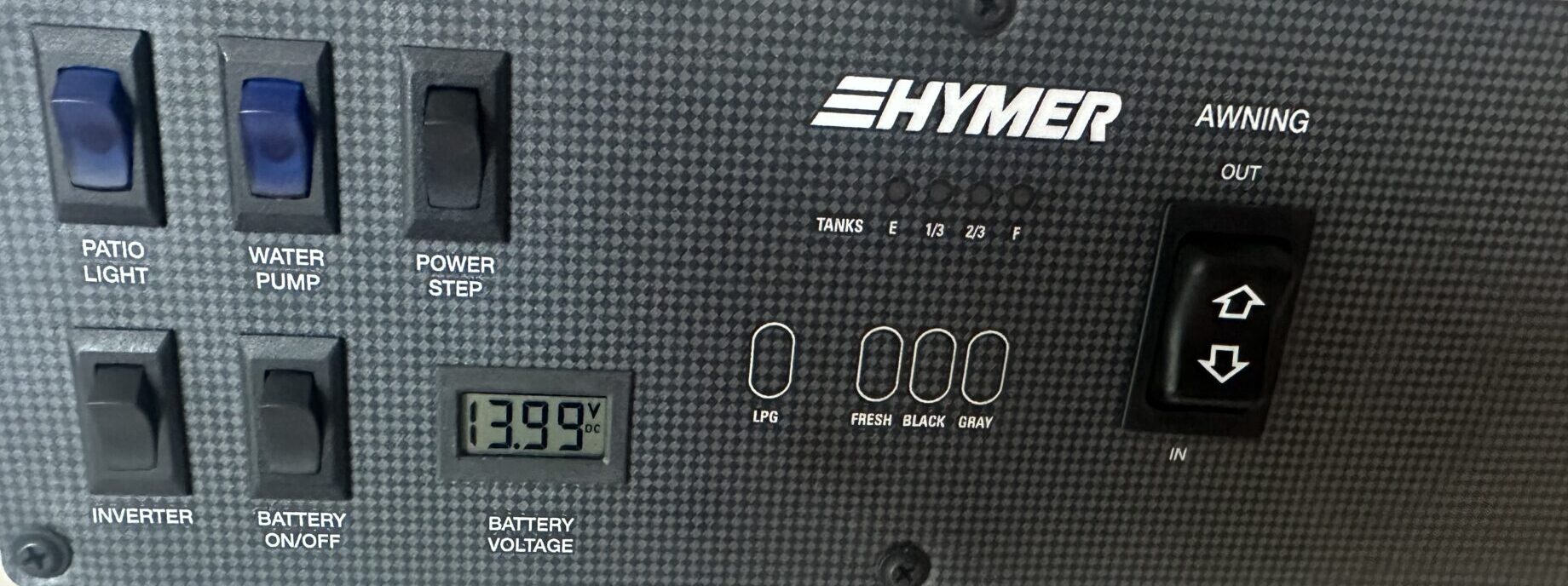
The Hymer’s control panel shows battery voltage and the inverter switch. Turn the inverter off when you are not using AC power.
Where you are so far: measure your daily watt-hours, size the array for December instead of June, and plan on driving or shore power to cover the gap. The next step is storage.
How much battery do you need?
Store at least one full day of use, and two days if you live aboard. The battery carries you through nights, clouds and the days you park in shade. The usable share differs by chemistry, so the same daily load needs a much bigger lead-acid bank than a lithium one. These rules cover 12-volt house banks. For lead-acid, Lifeline advises owners to “design your battery bank to maintain average depth of discharge below 50%” on its AGM battery page.
Usable Wh needed = daily Wh x days of storage.
Lithium iron phosphate (LiFePO4): we plan on 80% of rated capacity. Battle Born rates its 100 Ah battery for 100% depth of discharge on its data sheet. Its 3,000 to 5,000 cycle rating does not state the depth of discharge used.
Renogy rates its Core Mini 100 Ah battery at 5,000 cycles at 80% depth of discharge, tested at 25°C, per its product page.
AGM: plan on 50% for cycle life. Lifeline’s same page allows deeper discharges up to 80%, at a cost in battery life.
Worked example for the Full-Time Couple: 1,870 Wh x 2 days = 3,740 Wh usable. In lithium that is 3,740 / 0.8 = 4,675 Wh rated, or about 365 Ah at 12.8 volts. In AGM it is 7,480 Wh rated, or about 623 Ah at 12 volts. As of October 13, 2026, Battle Born lists its 100 Ah battery at $799 and Renogy lists the Core Mini 100 Ah at $307.99.
Component build, power station, or hybrid?
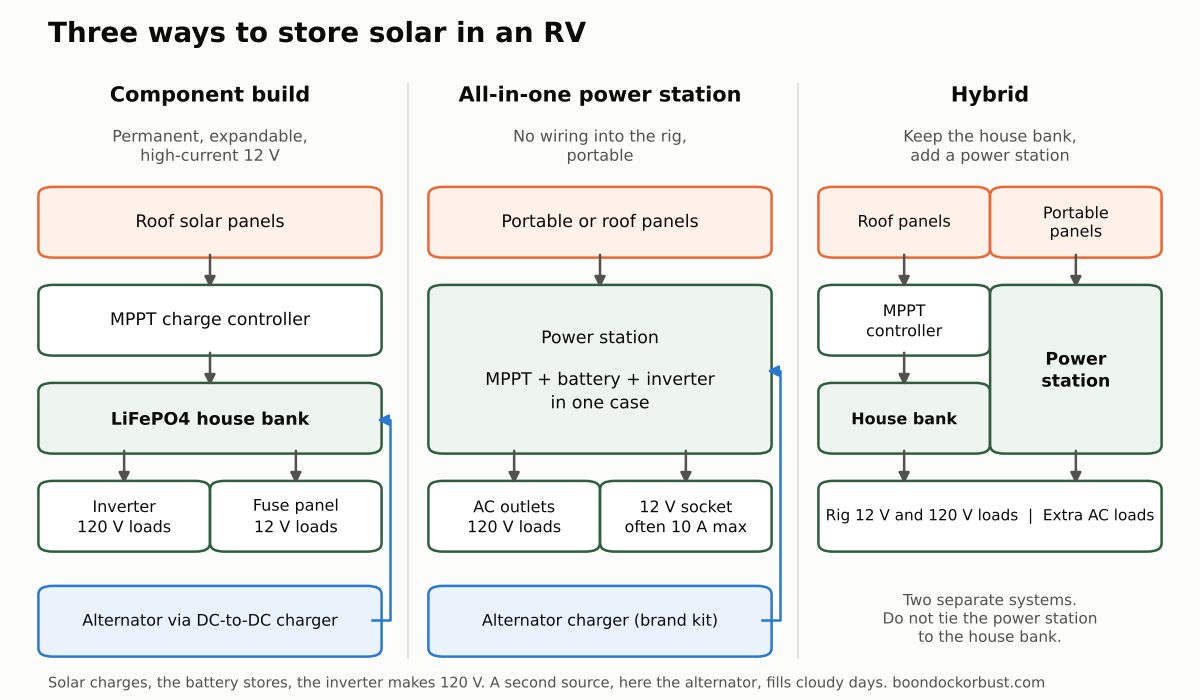
A component build fits permanent full-time use. A power station fits renters, weekenders and anyone who cannot cut into the rig. Both store the same energy. The difference is how they install, expand and run 12-volt loads. This comparison covers 12-volt rigs without battery-powered air conditioning. For a side-by-side of lithium banks, power stations and generators with prices, see our RV power options comparison.
Before you choose, check three limits:
12-volt output current. Most car sockets on the units we checked cap at 10 amps.
Solar input voltage. Four of the seven units in the table below top out at 60 volts per input.
Expansion. Some units cannot add batteries at all.
Not ideal for: a power station is a poor fit if you run several 12-volt loads at once, or if you need more than two days of storage without an expansion battery.
The 10-amp socket limit matters because Dometic rates the CFX3 45 fridge at 8.2 amps of DC input on its spec sheet. A fridge, a fan and a water pump together can pass 10 amps. Some units add a higher-current Anderson port. The table lists list prices as of October 13, 2026. Sale prices and stock change weekly.
Power stations against the Full-Time Couple’s 1,870 Wh day. Days = rated Wh x 0.8 / 1,870. Specs from manufacturer pages, accessed October 13, 2026.
Vans with an 800 W alternator charger. Backordered as of October 13, 2026
Choose a component build when
You need more usable storage than one base unit holds. The largest we checked, the 4,096 Wh DELTA Pro 3, gives about 3,280 Wh at an 80% margin.
Your 12-volt loads run past 10 amps at once.
You want the alternator wired straight to the house bank, the way our Hymer is.
Common parts: LiFePO4 batteries (Battle Born, Renogy, Epoch), an MPPT charge controller such as the Victron SmartSolar 100/50, rated for 50 amps and 700 watts of panels at 12 volts, and an inverter sized to your largest AC load.
Choose a power station when
You rent, lease or cannot drill the roof.
Your loads fit under 10 amps of 12-volt output, or the unit has an Anderson port.
You want to move the battery between the RV, the tow vehicle and the house.
Choose a hybrid when
You already own a small factory bank and need more storage without rewiring.
You want portable panels feeding a power station while roof panels charge the house bank.
Three ways to store solar in an RV. Each ends at the same 12-volt and 120-volt loads.
Illustration: a power station charging beside a Class B. Run 12-volt loads from its DC ports, not the inverter.
How do you charge when the sun quits?
Plan a second charging source, because a full-time couple needs about 831 flat watts in a Phoenix December and about 3,117 in Seattle. Solar covers the sunny days, and the alternator, shore power or a generator covers the rest. This matters most from November through February and north of the Sun Belt. Our Hymer’s 250 watts of roof solar make roughly 20 amps. Family RVing Magazine lists a 280-amp underhood alternator for the Aktiv.
DC-to-DC alternator charger: charges the house bank from the vehicle at a set current. Victron rates the Orion XS 12/12-50A at 700 watts continuous up to 40°C.
One hour of driving at 700 watts adds up to about 700 Wh. That is close to the 900 Wh that 400 flat watts make on a Phoenix December day.
Car socket charging: slow. A 10-amp, 12.6-volt socket delivers 126 watts, about 378 Wh in a three-hour drive.
Shore power and generators: the fastest refill. Use them to reset the bank after a cloudy stretch.
Cold adds a second problem. Check your lithium battery’s low-temperature charging limit before winter. Our winter boondocking guide covers cold-weather battery care.
Wiring and safety basics
Safety note: This guide is general information, not electrical advice. Solar, battery and inverter wiring can cause fire or shock if done wrong. Have a licensed electrician or qualified RV technician review your design and installation, and follow the equipment maker’s manuals.
Lithium banks and solar arrays carry enough current to start a fire. Have a qualified RV technician inspect any permanent install, and follow each manufacturer’s wiring instructions.
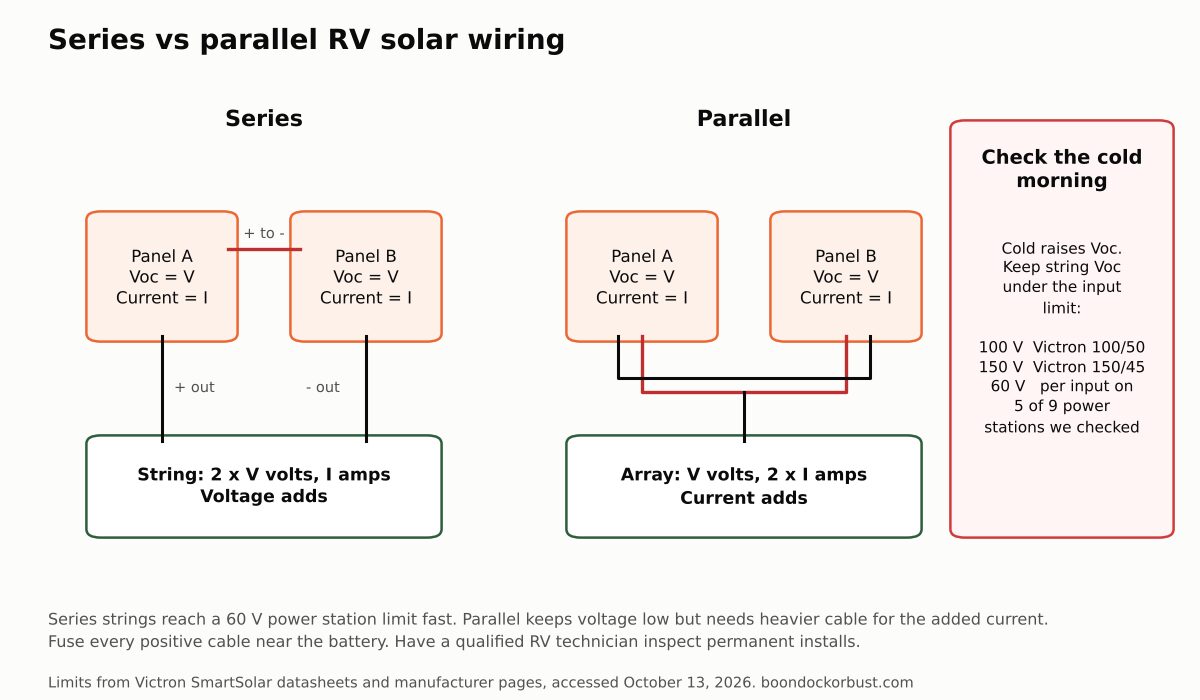
Keep panel voltage under your controller’s limit on the coldest morning you will see. Cold raises panel voltage, and every controller lists a maximum input voltage. This applies to panels wired in series on any controller or power station. Victron’s MPPT manual warns, “At ambient temperatures below 25°C, the Voc will be higher,” in its installation guide. Voc is a panel’s open-circuit voltage.
Series vs parallel: series adds voltage, parallel adds current. Series strings hit 60-volt power station limits fast.
Input limits: the Victron SmartSolar 100/50 takes 100 volts. Victron’s 150/45 lists 150 volts as the absolute maximum in the coldest conditions, per its datasheet.
Cable size: Victron’s Wiring Unlimited guide says, “You should aim for a voltage drop below 2.5%,” on its DC wiring page.
Fuses and disconnects: fuse every positive cable near the battery, and add a breaker to isolate the solar, as our shop did.
Check your air conditioner’s daily draw against your array’s daily output before counting on solar. A 400-watt array makes about 2,520 Wh on a Phoenix June day, and the AC competes with every other load for it. This applies to 120-volt rooftop units on inverter power. Read the running amps on the AC’s data plate, multiply by 120 volts and by hours of use. If that number beats your array’s output, run the AC on shore power or a generator.
RV solar power FAQ
How much solar do I need for full-time RV living?
Divide your daily watt-hours by your winter peak sun hours times 0.75. A full-time couple using 1,870 Wh a day needs about 831 watts of flat panels in a Phoenix December, or 509 watts tilted. In summer, 297 watts covers the same load. Pair any array with a second charge source.
Is 400W of solar enough for an RV?
It depends on the month. Using NREL averages and our 0.75 planning factor, 400 flat watts make about 2,520 Wh a day in a Phoenix June and about 900 Wh in December. That covers a weekend load year-round in the Southwest, but not a full-time couple in winter without alternator or shore charging.
How many batteries do I need to run an RV fridge?
Dometic rates its CFX3 45 compressor fridge at 490 Wh per 24 hours at its own test point. One 100 Ah lithium battery at 12.8 volts holds 1,280 Wh, or about 1,024 Wh at an 80% planning margin. That runs the fridge alone for about two days with no charging.
Can you run an RV on solar power alone?
In the Southwest from spring through fall, many small rigs can. In winter, flat panels in Seattle average 0.8 peak sun hours in December, per NREL data from 1961 to 1990. At that level a 400-watt array makes about 240 Wh a day, so full-timers should plan on alternator, shore or generator charging.
Are portable power stations good for full-time RV living?
They work when the daily load fits the unit’s storage and its 12-volt port. A 4,096 Wh EcoFlow DELTA Pro 3 covers about 1.8 days of a 1,870 Wh couple’s load at an 80% margin. Most car sockets on the units we checked cap at 10 amps, which limits several 12-volt loads at once.
How do I charge RV batteries while driving?
Install a DC-to-DC charger between the vehicle and house batteries, or use a power station brand’s alternator charger. Victron rates its Orion XS 12/12-50A at 700 watts continuous. A plain 10-amp car socket delivers about 126 watts. Have a technician check that your alternator can handle the added load.
How much does an RV solar system cost?
Storage drives the price. As of October 13, 2026, Battle Born lists a 100 Ah lithium battery at $799 and Renogy lists its Core Mini 100 Ah at $307.99. Power stations sized for full-time use list from $1,499 to $3,299. Panels, controller, wiring and installation add to any component build.
Your next step
Put a battery monitor on your bank and log one normal week. Divide the average day by your winter peak sun hours from NREL PVWatts times 0.75. That gives your array size. Then match storage and a second charging source using the tables above, and price the hardware in our lithium vs power station comparison. Budgeting a full year on the road? Our boondocking cost breakdown covers the rest. Browse more RV resources for water, dump stations and campsite finders.
About the author: Chuck Price has RVed for more than 35 years and boondocks with his wife Cindy in a 2018 Hymer Aktiv. He is affiliated with the Family RVing Association. More about Chuck.
Product specs, prices and stock change often. Confirm current details with each manufacturer before you buy. Electrical work carries fire and shock risk. Have a qualified RV technician inspect any permanent solar or battery install.
Last updated November 27, 2026. Checked November 27, 2026: all 50 state rows checked against primary sources. Utah permit pages rechecked October 19, 2026. Laws taking effect through January 1, 2027 were screened November 25, 2026.
You can drive a side-by-side (also called a utility terrain vehicle, or UTV) on a public road only where state law, and often a local ordinance, opens that road to it. Road legality comes from state law and registration, not from the make or model. Your machine must meet that state’s vehicle definition, carry its equipment, and hold the registration it requires. Six of 50 states offer statewide road registration, 15 allow limited road use, 22 require local approval first, and 7 allow no general road use. Each state was checked against statutes and agency pages on November 27, 2026. The state-by-state tables below link the statute or agency page behind every state.
Land access, road rules and registration requirements change. Verify all information with your state motor vehicle agency and local government before you register or ride. This guide summarizes statutes and agency pages. It is not legal advice.
State-by-State Road Access for Side-by-Sides (Checked November 27, 2026)
Every row was checked at the linked statute or agency page on November 27, 2026. Verify with state and local officials before you ride. The grouping test is explained below the tables.
Group 1: Statewide registration path (6 states)
State
Road path
Key limits
Fits if
Source
Arizona
Street-legal registration goes through the Motor Vehicle Division. A qualifying Arizona resident OHV also needs a $25 annual decal, plus a processing fee.
Title-only registration allows off-highway use only. Highways include pavement and graveled maintained roads.
Controlled-access highways need on-highway registration and a driver’s license. Inside a city or town, travel needs permission from the responsible authority or a municipal ordinance.
You want on-highway registration and will hold a license
Street-legal ATV registration under Utah Code 41-6a-1509, current version effective July 1, 2026.
No interstates, and no first-class-county highways next to grade-separated segments posted over 50 mph. Top speed is the posted limit or 50 mph, whichever is lower.
More Utah rules
Motor vehicle insurance applies. Visiting with an out-of-state machine? Read the Utah permit note.
You want a registration path with a fixed equipment list
Street-legal special purpose vehicle registration under W.Va. Code 17A-13-1.
Motorcycle-size plate. Title required. Counties, cities, and the Division of Natural Resources may prohibit. No controlled-access highways. No more than 20 continuous miles on a highway with centerline markings.
Title and register an all-purpose vehicle (APV), which includes UTVs, with the Alaska Division of Motor Vehicles. Road use allowed since January 1, 2022.
Roads posted 45 mph or less. Class D license and liability insurance. Lights, reflectors, brakes, and muffler. Passengers wear helmets. Local law can prohibit.
More Alaska rules
Alaska DMV listed Anchorage, Fairbanks, Homer, Juneau, Kenai, Palmer, Soldotna, and Wasilla as prohibiting road use as of January 1, 2022. Check current city rules before you ride.
You ride roads posted 45 mph or less outside prohibiting cities
Restricted vehicle plate from the Idaho Transportation Department (ITD) plus a certificate of number from Idaho Parks and Recreation (IDPR).
Roads that are not state or interstate highways. State highways inside city limits and one mile out where posted 60 mph or less.
More Idaho rules
Up to 5 continuous miles of rural state highway posted 65 mph or less to reach trails or services. Top speed is the posted limit or 45 mph, whichever is less.
Iowa Department of Natural Resources (DNR) registration as an ATV or off-road utility vehicle.
Unpaved secondary roads statewide. Paved, undivided two-lane secondary roads may be used as the most direct route between destinations the statute lists.
More Iowa rules
Other paved secondary roads need county approval, and city streets need city designation. Short direct trips on undivided two-lane primary highways. 35 mph or less. Valid driver’s license. Operator 18 or older, with financial liability coverage and proof carried.
No road plate. Kansas does not register ATVs or work-site utility vehicles. You get a $10 nonhighway title.
County and township roads are not on the banned list. State law bans ATVs and work-site utility vehicles on interstate, federal, and state highways, except crossings and farm use on highways posted 65 mph or less.
More Kansas rules
City streets are closed unless the city allows them. Motorcycle-style lights are required after sunset. State insurance law does not apply to nonhighway-titled vehicles.
You ride rural county or township roads in daylight
Right shoulder or extreme right side of county and county state-aid highways. Applies only to side-by-sides 65 inches wide or less and 2,000 pounds or less dry weight.
More Minnesota rules
Class 1 machines need a steering wheel, seat belts, and rollover protection. No interstates or freeways.
Cities and counties may issue a $15 special permit.
Within 3 miles of your own primary residence, and inside a town only where the town allows it.
More Missouri rules
Cities and counties can also open roads by special permit, and the statute lists other exceptions. The allowance does not help riders visiting Missouri. License, headlamp, tail lamp, roll bar or cage, and a seat belt worn.
Register a large all-terrain vehicle (ATV) with seating for two abreast under NRS 490.0825 with insurance.
General or minor county roads, unless the county or city prohibits it. A main county road, or a street in a city under 25,000 people, needs an authorizing ordinance or resolution.
Register as a modified utility vehicle (MUV) with the Division of Motor Vehicles.
Roads posted 55 mph or less. Machine must be 110 by 58 by 60 inches or larger, capable of 40 mph, and built or upfitted by a licensed manufacturer, dealer or modifier. See the full section below.
Off-highway vehicle (OHV) registration with the North Dakota Department of Transportation, not a motor vehicle plate.
Gravel, dirt, and loose-surface roads, and paved highways posted 55 mph or less.
More North Dakota rules
A licensed driver over 16 may run a registered class III OHV on paved highways posted 65 mph or less. Paved use requires 30 mph capability. No controlled-access highways.
Registration, plate, and yearly decal from Service Oklahoma for a machine that meets the street-legal utility vehicle spec. Current spec and road rules in effect since November 1, 2025.
The statute opens “the streets and highways of this state and U.S. highways” in counties under 75,000 population. In counties over 75,000, U.S. highway stretches posted 50 mph or less are open.
More Oklahoma rules
Check city rules. Never interstates. Operator 16 or older with a valid Oklahoma driver license.
Title, register, insure, and plate the UTV through the South Carolina Department of Motor Vehicles.
More South Carolina rules
Registration costs $10 every 2 years. Act 164 took effect November 18, 2026.
Unless a local ordinance sets other terms, secondary highways posted 55 mph or less, within 10 miles of the registration address or of the gated-community entrance when the address is inside one. No interstates.
More South Carolina rules
Operator 17 or older with a valid driver’s license. Permits and provisional, route-restricted, and motorcycle-only licenses do not qualify. Riders under 21 wear a helmet with a face shield or goggles. No passengers under 8. Cities and counties can set hours, methods, and locations by ordinance.
Title, register, and insure. Public Chapter 255 took effect April 24, 2025.
More Tennessee rules
The legislature’s fiscal memorandum lists the off-highway plate fee as $15 for Class I and $16 for Class II.
Any county road, plus state highways posted 45 mph or less. No interstates or controlled-access highways. Top speed 35 mph. Daylight only, including 30 minutes before dawn and after dusk.
More Tennessee rules
Operator 16 or older with a full license, not a permit. Helmets required, except in Class I and II off-highway vehicles on county roads. Counties, cities, and the Tennessee Department of Transportation can close roads for safety. Public Chapter 663 (2026) exempts qualifying agricultural operation from the 45-mph road restriction.
No highway registration. The Department of Motor Vehicles may not register an off-highway vehicle for highway use.
More Texas rules
Chapter 551A sets road paths that do not need an affirmative road ordinance. An off-highway plate exists for limited local exceptions.
Section 551A.055 covers qualifying master-planned communities and narrow daytime golf-course trips. Cities may allow off-highway vehicles on roads posted 35 mph or less inside city limits.
More Texas rules
Chapter 551A says “An unregistered off-highway vehicle may cross a highway at an intersection”. Counties may do so only in limited cases the statute names. Local governments can prohibit use for safety.
You ride in a qualifying master-planned community or a city that allows it
On-road registration of a wheeled all-terrain vehicle (WATV) with the Department of Licensing (DOL).
Roads posted 35 mph or less. Counties of 15,000 or more people and every city and town approve roads by ordinance. Smaller counties are open unless closed by ordinance.
More Washington rules
Check your county or city website. Dealer safety inspection and driver license.
South Carolina is now in Group 2. Its UTV road law took effect on November 18, 2026. Texas moved to Group 2 after the November 27, 2026 recheck, because Chapter 551A sets road paths that need no local ordinance. The same recheck moved seven states into Group 4.
Group 3: No statewide road access without local approval (22 states)
Three Group 3 states issue a plate or permit that works only on roads a local government has opened: Kentucky, New Mexico, and Ohio.
State
What state law says
Fits if
Source
Arkansas
Act 922 of 2025, approved April 21, 2025, lets a city ordinance or county judge order open a street to UTVs. On a designated street the UTV must be registered, insured, and equipped.
More Arkansas rules
Never on roads over 55 mph, divided four-lane highways, or state park roads.
An off-highway vehicle with an OHV plate or sticker may use a highway only to cross it, on an unplowed road closed to registered vehicles, or while towed (Vehicle Code 38025).
More California rules
Local, federal, or state park authorities may designate combined-use road segments of up to 3 miles to link trails and services (38026). Needles and Red Rock Canyon State Park may run 10-mile pilot routes. Combined-use segments take effect only once signs are posted (Cal. Veh. Code 38026). The Needles pilot ends January 1, 2028 and the Red Rock Canyon pilot ends January 1, 2030 unless extended (38026.2, 38026.3).
You trailer to the trailhead or ride posted combined-use segments
Colorado restricts off-highway vehicles on public roads, with listed exceptions. An out-of-state plate does not create an exemption (HB21-1138). Check the exceptions and the fine with Colorado Parks and Wildlife.
Non-highway vehicles, including recreational off-highway vehicles, are barred from streets and highways unless a local government or the Illinois Department of Transportation (IDOT) authorizes roads it controls.
More Illinois rules
Authorized use is limited to streets posted 35 mph or less. License and insurance required. The statute says “it is unlawful for any person to drive or operate a non-highway vehicle upon any street, highway, or roadway in this State” unless a local government or IDOT has authorized that road (625 ILCS 5/11-1426.1(b)).
Kentucky issues a motorcycle plate for street-legal special purpose vehicles. You may ride only where your city or county has passed an ordinance allowing them.
More Kentucky rules
A certified inspector designated by the sheriff inspects the vehicle. Motorcycle-level liability insurance is required. No more than 20 miles on a highway with centerline markings. No interstates, parkways, or other controlled-access highways. Current text effective July 15, 2026.
UTVs may use only parish roads or municipal streets that the parish or municipality designates, and may cross roads posted over 35 mph at intersections. Operator 21 or older, license, and liability insurance.
ATVs may not use maintained public ways except on locally designated ATV-access routes and to make a direct crossing.
More Maine rules
The 500-yard allowance on the extreme right of the way covers only the distance needed for that crossing. It is not a general road allowance. The Secretary of State farm permit covers farm use only. LD 557 (2025) was not enacted.
No statewide road path. Maryland law counts steering-wheel, bench-seat side-by-sides as all-terrain vehicles. Allegany and Garrett Counties may allow riding on up to 5 miles of county highway at 25 mph or less, plus crossings and routes to trails and fields.
More Maryland rules
A driver’s license is required on any allowed road. The same section gives Charles County separate regulatory authority.
You ride in Allegany or Garrett County on approved routes
Recreation vehicles, including recreation utility vehicles, are barred from state, county, city, and town ways except marked crossings, travel beside the road to reach a riding area, and designated segments up to 4 miles.
Off-road vehicles (ORVs) may use county roads only where a county, township, or municipality has adopted an ordinance. Then ride on the far right at 25 mph or less.
We found no state source that opens public roads to side-by-sides statewide. Five bills to open roads died in committee in 2025 and 2026.
More Mississippi rules
A 2023 local act lets Guntown authorize side-by-sides on its streets by ordinance (SB 2149). That act does not confirm that any Guntown road is open. Check with the Mississippi Department of Public Safety before you ride. State law says nothing in its off-road vehicle chapter authorizes operation “on a public road or highway” (Miss. Code Ann. 63-31-3). The five bills that died in committee were HB 529, HB 151 and SB 2258 in 2025, and SB 2265 and SB 2628 in 2026. Check with your county and city before riding.
Outside town limits, UTVs may use highways only when the trip is incidental to farm use. Inside a city or village, use needs a local ordinance, or a county resolution for an unincorporated village.
More Nebraska rules
Off-highway recreational vehicles (OHRVs) are barred from public ways except as the chapter allows. Towns may open sidewalks and class IV, V, and VI highways after a public hearing.
More New Hampshire rules
No interstate, toll, or limited-access class I highways.
OHVs may not use limited-access highways or paved streets except crossings, or where a local authority or the state transportation commission authorizes paved-road use.
More New Mexico rules
There, a titled and registered machine with the Motor Vehicle Division (MVD) paved-road-use plate may use those roads. New Mexico law addresses paved roads, so ask your county about unpaved roads.
Utility vehicles may use streets posted 35 mph or less only where a local authority grants permission, after local inspection, registration, and title.
More Ohio rules
All-purpose vehicles may use county or township roads only where the local authority permits. Statute as amended June 30, 2025.
Riding an off-road vehicle on a highway is a Class B violation except crossings, highways posted open, designated routes, and farm transport. Oregon Parks and Recreation Department (OPRD) says Class IV side-by-sides cannot be made street legal.
More Oregon rules
OPRD also says “Paved roads and two-lane gravel roads are generally closed to non-street legal OHVs unless posted open.” Narrow gravel roads are generally open, but a Forest Service road must be designated open on its motor vehicle use map.
ATVs may not use a public highway unless the town has opened it to ATV travel.
More Vermont rules
On state highways, the Secretary of Transportation can open and post routes. Crossings and farm, forestry, and utility use are the other exceptions. Side-by-sides wider than 72 inches, or 2,500 pounds or more dry weight, may fall outside Vermont’s ATV definition.
Section 46.2-915.1 bars ATVs from public highways except as authorized, crossing, and emergency use. A separate section says a locality “may by ordinance authorize the operation of golf carts and utility vehicles on designated public highways within its boundaries” (Va. Code 46.2-916.2).
More Virginia rules
Whether a side-by-side counts as an ATV depends on its design.
ATVs and UTVs are barred from roadways except crossings, seasonally unmaintained roads, designated routes, farm use, and certain hunting travel. Towns, villages, cities, and counties designate routes by ordinance.
More Wisconsin rules
Group 4: No general road use, crossings or narrow exceptions only (7 states)
Seven states give side-by-sides no general road use. Only crossings, special events, or narrow farm and public-work exceptions apply, and our November 27, 2026 check found no local power to open roads for recreational riding. The Alabama and Florida rows record what that check could not find. They are not a ruling that every road is closed.
State
What state law says
Fits if
Source
Alabama
No verified road path. Alabama Law Enforcement Agency (ALEA) registration covers off-road vehicles “used on designated areas for off-road public use.”
More Alabama rules
Our check found no enacted city or county power to open roads to recreational side-by-sides. A bill that has not become law does not create that power.
Crossings only. ATVs may not run on public highways.
More Connecticut rules
Chapter 255 says an ATV, “if operated by a licensed motor vehicle operator, may cross a public highway” after a stop and yielding, at about 90 degrees. Limited-access highways are excluded. Municipal consent to ride on local land is a separate permission, not road access.
Special events only. OHVs may not use public highways, streets, sidewalks, or rights-of-way.
More Delaware rules
Section 6814 says “An OHV may be pushed across or along such public way” with the drivetrain disengaged. Powered operation on a public road needs a limited, prearranged special event permit. The section sets no ordinary recreational route.
You trailer to the trailhead or ride a permitted event
No verified road path. Florida defines an off-highway vehicle as one “that is not registered and licensed for highway use under chapter 320.”
More Florida rules
Our check found no general city or county power to open roads to recreational side-by-sides. SB 356 (2026) died in committee on March 13, 2026, and created no authority. Senator Tom Wright, the SB 356 sponsor, told WUSF that UTVs are not permitted for street use in Florida (WUSF). A similar bill passed the Senate in 2025 and died in the House.
Farm or public work only. HRS 286-12 allows street use only when the machine is “Used as farm equipment, or used by a city, county, or state worker while acting within the scope of that person’s official duties”.
More Hawaii rules
The county must have a population under 500,000. Use is limited to daylight and two-lane streets posted 35 mph or less. Hawaii lawmakers considered changes in 2026 (SB 2172). It passed second reading in the Senate on February 10, 2026, and was referred to the Judiciary Committee. The bill history shows no enactment.
You use the machine for farm work outside counties of 500,000 or more
Narrow statutory exceptions only. New Jersey’s Attorney General guidance (2023) says “State law also prohibits operation of ATVs, snowmobiles, and dirt bikes on public roads.”
More New Jersey rules
The guidance names limited exceptions and separate rules for authorized areas. Local designation of public lands is not ordinary highway use. Check whether your side-by-side meets New Jersey’s ATV definition before you apply these rules.
Crossings and statutory exceptions only. Recreational vehicles, including all ATV classes, are barred from highway rights-of-way and interstates.
More Rhode Island rules
Section 31-3.2-7 says “A snowmobile or recreational vehicle may make a direct crossing of a street or highway” at about 90 degrees. Other exceptions cover specified snow emergencies and international contests with official consent. The statute gives no general power to open ordinary streets for recreational riding.
Group 2 limits come from road class, posted speed, county population, or distance. The grouping test is one question. Without a local opt-in, does state law let a qualifying side-by-side use some class of public road for general travel? Farm, work, hunting, emergency, and crossing exceptions do not count. Group 3 states let a local government or agency open roads. Group 4 states give no general road use, and our check found no local power to open roads for recreational riding. Laws not yet in effect appear as dated notes and are not counted.
If you haul a side-by-side to reach dispersed sites, these rules apply on the roads between camp and the trailhead. Start with our boondocking guide for finding sites, then read our guide to off-road RV boondocking. If you camp on BLM land, read our guide to BLM camping rules for stay limits before you unload.
How State Law Classifies Your Side-by-Side
The legal class in your state’s statute decides which road rules apply to your machine. A side-by-side can be an ATV in one state, a utility vehicle in another, and outside every road class in a third. The size and weight limits below come from state sources read on September 30, 2026, and apply only in the state named. Minnesota, North Carolina and Georgia size limits sit in their table rows.
Size and weight definitions in Ohio, Louisiana, Arkansas, Alabama and Kansas
Ohio separates utility vehicles, which carry a cargo bed, from all-purpose vehicles. Check which class your machine falls in (R.C. 4511.214, 4511.215).
Louisiana’s UTV rule covers machines 50 to 74 inches wide and 700 to 3,500 pounds (La. R.S. 32:299.3).
Arkansas defines a UTV as 80 inches wide or less with rollover protection (Act 922 of 2025). Alabama’s recreational off-highway vehicle class is 80 inches or less and 3,500 pounds dry weight or less (Ala. Code 32-12A-1).
Kansas defines a work-site utility vehicle as 48 inches or wider, over 800 pounds, with a steering wheel and side-by-side seating (K.S.A. 8-126).
If your state uses a term not listed here, read its definition section before you buy parts.
Which side-by-sides can be street legal?
No make or model is street legal in every state. A machine qualifies one state at a time, when it fits that state’s definition and passes its equipment and registration steps. North Carolina and Oklahoma set their tests in the table rows and the equipment table. Ask the seller which state’s definition a machine meets before you buy it for road use.
Low-Speed Vehicles (LSVs) Are a Separate Category
Federal rules define a low-speed vehicle by three tests. It has four wheels. Its top speed in one mile is more than 20 mph and not more than 25 mph on a paved level surface. Its gross vehicle weight rating is less than 3,000 pounds (49 CFR 571.3). Most side-by-sides can go faster than 25 mph, so they fail the speed test. NHTSA has said a vehicle with “a speed capability above 25 mph” is not an LSV under federal law.
LSV equipment under FMVSS No. 500, and why bolt-on parts do not create an LSV
An LSV must also meet FMVSS No. 500. That standard requires headlamps, front and rear turn signals, taillamps, stop lamps, red reflex reflectors, mirrors, a parking brake, a windshield that meets FMVSS No. 205, a VIN, and a seat belt at each designated seat.
Bolting on parts does not make a vehicle an LSV. NHTSA says modifying a golf cart for public roads creates a motor vehicle and treats the modifier as the manufacturer. The modifier must then certify that the vehicle meets every applicable safety standard, and a certified vehicle carries a permanent certification label. States set the road rules. Florida, North Carolina, and Georgia limit LSVs to roads posted 35 mph or less.
Riding in Another State: The State Where You Ride Sets the Rules
The state where you ride decides whether your side-by-side can use its roads. Your plate does not carry road rights across state lines. Each state applies its own vehicle definition, equipment list, and registration test, and a trail permit is a separate requirement from road access. These rules were read on September 30, 2026, and Utah was rechecked on October 19, 2026. Colorado, for example, gives out-of-state plates no exemption from its road ban (C.R.S. 33-14.5-108).
Utah: Permit Guidance Conflicts as of October 19, 2026
The Utah Division of Outdoor Recreation publishes two different answers. Its non-resident permit page says that from September 8, 2026, out-of-state OHVs need a non-resident permit even when registered as street legal in another state, subject to limited exceptions. The same division’s street-legal FAQ still says a machine that is plated, registered as street legal, meets Utah’s equipment list, and comes from a state that reciprocates with Utah needs no permit. The division says it keeps no list of reciprocating states.
Until Utah resolves this, buy a non-resident permit for each machine before you ride, and ask the OHV Program at ohveducation@utah.gov whether your machine qualifies for an exception. Every operator also needs a Utah OHV education certificate. For road use, ask the division how it treats your state’s plate, and meet Utah’s equipment list (Utah Division of Outdoor Recreation).
Other States That Tie Road Use to Their Own Registration
Oregon: out-of-state ATV plates are not valid on Oregon streets, according to the Oregon Parks and Recreation Department (OPRD).
Arizona: the Game and Fish Department says residents and non-residents who drive on Arizona highways must register as street legal through the Motor Vehicle Division when their home state or province offers no street-legal registration (Arizona Game and Fish). That rule covers Arizona roads, not roads in your home state.
Private filing services are not motor vehicle agencies. Confirm the agency that issues your plate matches the agency named in the table.
How to Register a Side-by-Side for Road Use in Five Steps
Road registration requires a state that offers it and a machine that meets that state’s definition. Start with the tables, because no equipment purchase changes a state with no road path. Oklahoma shows what a registration step looks like. Under 47 O.S. 1115.3(E), a street-legal utility vehicle “shall be required to receive a certificate of registration, license plate and yearly decal before operation on the streets, county roads and state highways” (OSCN). As of November 27, 2026, the steps below apply to the 18 Group 1 and Group 2 states with a registration step. Kansas, Missouri, and Texas have none.
Find your state in the tables. If it sits in Group 3, a state registration alone will not open roads. Ask your city or county whether it has opened any. If it sits in Group 4, plan to trailer the machine, because only crossings or narrow exceptions apply.
Check that your machine meets your state’s definition. The table rows list the size, speed and seating tests, such as North Carolina’s 110 by 58 by 60 inches and 40 mph. Oklahoma’s 400 cc engine test is in the equipment table.
Add the equipment your state lists. Lists differ, so use the equipment table below.
Buy insurance where required. The insurance note under the fees table lists the states whose sources require it.
Register with the agency in the table. North Carolina asks for the title or the manufacturer’s certificate of origin. Wyoming registers through the county treasurer. Arizona registers through the Motor Vehicle Division. Washington requires a dealer safety inspection first. Idaho needs both an ITD plate and an IDPR certificate of number.
These steps do not cover machines that fail a state’s definition. Verify each step with the named agency before you pay a fee.
Equipment Lists Differ by State
No single side-by-side equipment list applies across states. Utah, North Carolina, and Tennessee each name different items, and five more states add their own lists. The table compares the items named in each state source as of September 30, 2026. Meeting a list does not register your machine or open a road. Check the current text before you buy parts.
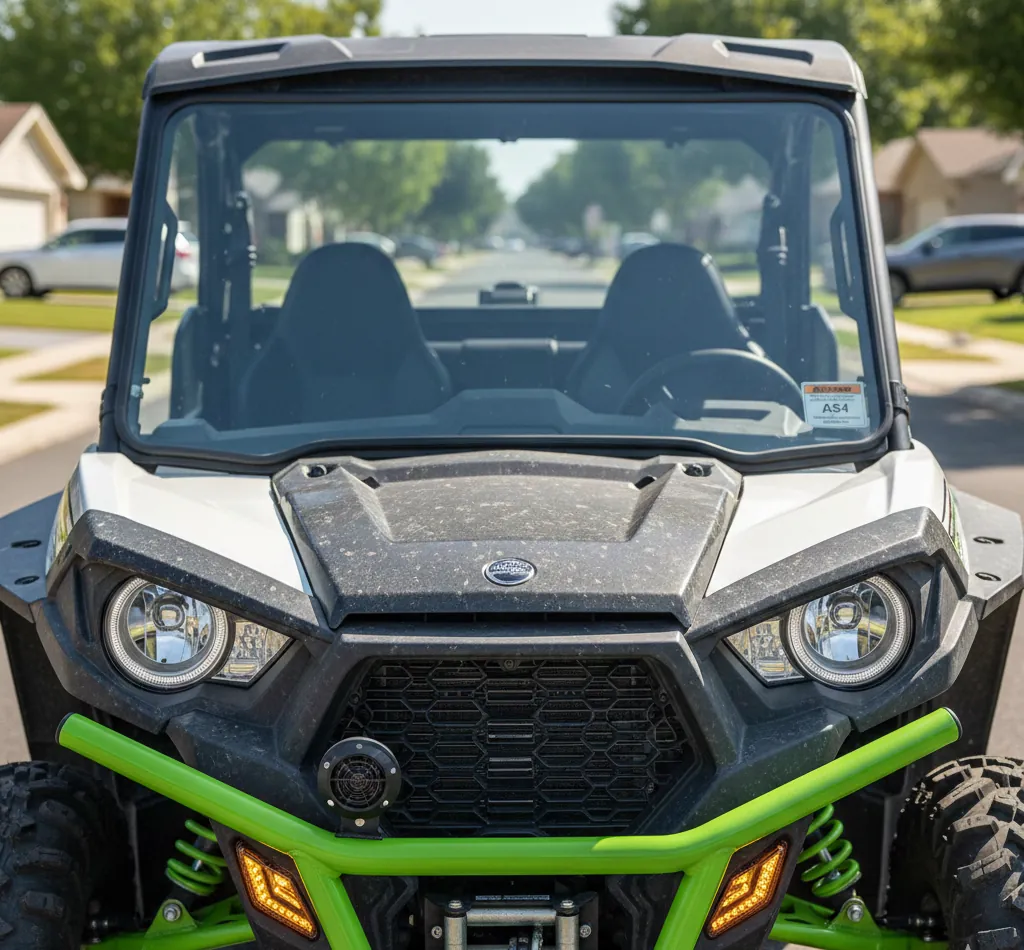
Illustration of a side-by-side front end with headlights, amber turn signals, and a windshield.Show the equipment lists for Utah, North Carolina, Tennessee, Alaska, Kentucky, North Dakota, Oklahoma and Washington
State
Items named in the source
Fits if
Source
Utah (text effective July 1, 2026)
Headlamps, tail lamps, plate lamp, red rear reflectors, stop lamps, turn signals, brakes, horn, muffler, left and right mirrors, windshield or eye protection, speedometer. Side-by-side seating requires seat belts. For type II and III vehicles: tires 44 inches high or less with at least 2/32 inch of tread, a seat height of 20 to 40 inches, and an illuminated speedometer.
Headlamps, tail lamps, stop lamps, turn signal lamps, reflex reflectors, parking brake, rearview mirrors, speedometer, seat belts, vehicle identification number. Without a windshield and wipers, everyone aboard wears a helmet meeting Federal Motor Vehicle Safety Standard 218.
If the machine has any of these from the maker, or they are added later, they must work and be used: brakes, two taillights, stoplights and headlights, turn signals, horn, roll bar, seat belts, spark arrester, muffler, and windshield. Without a windshield, occupants wear eye protection. Operator and passengers wear helmets, except in Class I and II off-highway vehicles on county roads.
Headlight, taillight, brake light, plate light, red rear reflector, front and rear turn signals, brakes other than a parking brake, horn, muffler, left and right mirrors, windshield or eye protection, a speedometer lit for night riding, roll bar or cage, seat belts at each seat on multi-passenger models, and tires with at least 2/32 inch of tread.
Bench or side-by-side seating, four wheels, a 400 cc or larger engine able to hold 50 mph, federal-standard seat belts for each occupant, and all equipment under 47 O.S. 12-201 to 12-232.
Fees, Fines, and Insurance Named in Official Sources
State sources name these fees and fines. Some are road plates and some are off-road registrations, and the table says which is which. Figures reflect pages read on September 30, 2026 and may change. Parts and installation costs vary by machine and retailer, so no total cost appears here. Confirm the current fee with the agency before you pay.
Show fees and fines for 25 states
State
Fee or fine
What it covers
Source
Alabama
$45 plus $2.50 issuance for 3 years (public use). $15 plus $2.50 (private use).
$53.25 one time for street-legal only, or $114.50 for street-legal and off-highway use. Add a $16 safety fee, a $10 Highway Patrol fee, and a $12 plate fee.
Insurance: the sources read for this guide require liability insurance in Alaska, Georgia, Louisiana, Nebraska, Nevada, and Tennessee, and on designated Arkansas roads. Illinois and New Mexico require insurance, and Kentucky requires motorcycle-level liability insurance. Iowa requires financial liability coverage. North Carolina requires a registered MUV to be insured. South Carolina requires liability insurance for road use. Utah applies its motor vehicle insurance law to street-legal ATVs. Insurance rules in other states were not read as of September 30, 2026.
North Carolina UTV Street Legal Rules: Modified Utility Vehicle (MUV) Requirements
Some side-by-sides can be street legal in North Carolina. The machine must qualify as a modified utility vehicle (MUV) and be titled, registered and insured through the North Carolina Division of Motor Vehicles (DMV). The DMV must refuse to register a standard ATV or utility vehicle (G.S. 20-54(8)). A registered MUV may run on roads posted 55 mph or less.
North Carolina MUV definition, road limits, exceptions, local rules and equipment
Does your side-by-side qualify as an MUV?
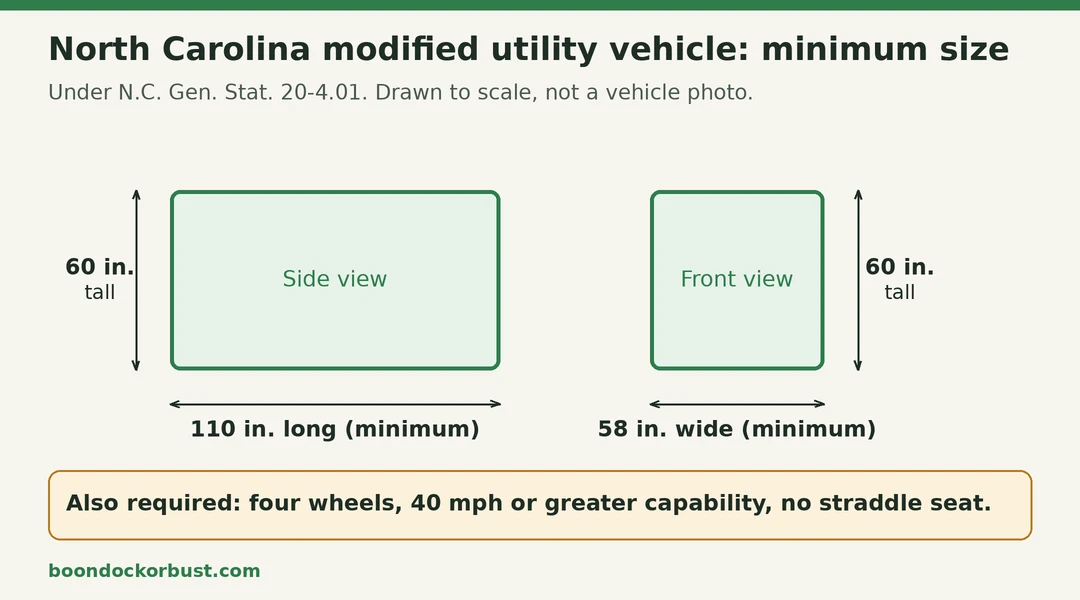
To register as an MUV in North Carolina, your machine must meet all of these criteria under N.C. Gen. Stat. 20-4.01:
Manufactured or upfitted for off-road use by a licensed manufacturer, dealer, or person or business engaged in vehicle manufacturing or modification, with the equipment required by G.S. 20-121.1(2a)
Four wheels
Overall length of 110 inches or greater
Overall width of 58 inches or greater
Overall height of 60 inches or greater
Maximum speed capability of 40 mph or greater
No requirement for the operator or a passenger to straddle a seat
The statute excludes ATVs, golf carts, utility vehicles and riding lawn mowers from the MUV definition. A side-by-side below the size thresholds or under 40 mph does not meet the definition.
Where you can drive an MUV
A registered MUV may operate on streets and highways posted 55 mph or less, and may cross a higher-speed road at an intersection (N.C. Gen. Stat. 20-121.1). The North Carolina Department of Transportation can prohibit MUV use on a specific road for safety. Check city and county rules before you ride local roads.
An ATV is different. Unless other law permits it, no one may operate an ATV on a public street, road or highway except to cross it, and no one may operate an ATV on an interstate or limited-access highway (G.S. 20-171.19(e) and (f)).
Exceptions that do not make a machine street legal
Any person may operate an ATV or utility vehicle on a public street while engaged in farming operations (G.S. 20-171.22(a1)). County and municipal employees may operate agency-owned ATVs, including utility vehicles, on public highways posted 35 mph or less under the conditions in G.S. 20-171.24. These are narrow uses. They are not general road access for a recreational rider.
Local rules
Session Law 2021-97 lets Banner Elk, Beech Mountain, Cramerton, North Topsail Beach, Seven Devils, Spencer, Conover and Lowell regulate utility vehicles on their streets by ordinance, including registration and equipment (S.L. 2021-97). This guide did not check for later local acts. Ask your town or county before you ride.
Required equipment
State law requires an MUV to carry the following, all in working order: headlamps and tail lamps, stop lamps, turn signal lamps, reflex reflectors, parking brakes, rearview mirrors, a speedometer, seat belts, and a vehicle identification number. The Division of Motor Vehicles assigns a VIN if your machine has none. If the MUV has no windshield and windshield wipers, the operator and every passenger must wear a helmet that meets Federal Motor Vehicle Safety Standard 218 (N.C. Gen. Stat. 20-121.1).
How to get a UTV street legal in North Carolina
North Carolina requires an MUV to be titled, registered, and insured through the Division of Motor Vehicles (G.S. 20-121.1(3)). The DMV’s documents and forms page lists what to bring.
Confirm the machine meets the MUV minimums: 110 inches long, 58 inches wide, 60 inches tall, 40 mph capability, and no straddle seat.
Have a licensed manufacturer, dealer, or modifier upfit the required equipment and sign the Modified Utility Vehicle Affidavit (MVR-59). The form has a notary block.
Bring the manufacturer’s certificate of origin or a properly assigned title, plus the title application (MVR-1).
Buy insurance for the vehicle.
Title and register it with the DMV. Registration costs $46.25 a year, the private passenger vehicle rate (G.S. 20-87).
North Carolina titles, out-of-state plates and law history
Since October 1, 2024, an owner of an ATV, MUV or utility vehicle may apply for a title (G.S. 20-53.6). A title alone does not make an ATV or utility vehicle street legal, because the DMV must refuse to register them. North Carolina requires a vehicle intended for its highways to be registered with the DMV (G.S. 20-50). Do not assume that a plate from another state, or an out-of-state LLC, covers North Carolina roads. Ask the DMV in writing before you ride.
The MUV definition was rewritten effective October 1, 2021 (S.L. 2021-33). The 55 mph road limit and the titling rule took effect October 1, 2024 (S.L. 2024-46).
North Carolina minimum modified utility vehicle dimensions under N.C. Gen. Stat. 20-4.01.
Frequently Asked Questions
Are UTVs street legal?
It depends on the state. Six states offer statewide street-legal registration, 15 allow limited road use, 22 need local approval, and 7 allow no general road use. All 50 states were checked on November 27, 2026. The state where you ride sets the rules. Confirm with your state motor vehicle agency and local government before you ride.
What states are UTVs street legal?
Arizona, Montana, South Dakota, Utah, West Virginia, and Wyoming offer statewide registration paths as of November 27, 2026. Alaska, Georgia, Idaho, Iowa, Kansas, Minnesota, Missouri, Nevada, North Carolina, North Dakota, Oklahoma, South Carolina, Tennessee, Texas, and Washington allow limited road use. Local governments can prohibit use in several of them, so check your city or county.
Can you drive a side-by-side on the road in Florida or Texas?
Florida has no verified side-by-side road path as of November 27, 2026, and SB 356 died on March 13, 2026. Texas allows limited road use under Chapter 551A, such as in qualifying master-planned communities, but does not register off-highway vehicles for highway use. Texas cities may allow unregistered machines on roads posted 35 mph or less. Verify before you ride.
Are side-by-sides street legal in North Carolina?
Yes, if you register it as a modified utility vehicle with the North Carolina DMV. It must be at least 110 inches long, 58 inches wide, and 60 inches tall, reach 40 mph, and have no straddle seat. A registered MUV can use roads posted 55 mph or less. Confirm with the DMV and your local government before you ride.
When can you drive a UTV on the road in South Carolina?
South Carolina’s UTV road law took effect on November 18, 2026. Unless a local ordinance sets other terms, a titled, registered, insured, and plated UTV may use secondary highways posted 55 mph or less within 10 miles of its registration address. Interstates are off limits. Cities and counties can set their own rules, so verify before you ride.
Does registering in another state make my UTV street legal?
No. The state where you ride decides where you can drive. North Carolina requires registration in North Carolina for road use, and a Montana LLC does not change that. Colorado gives out-of-state plates no exemption from its road ban. Utah’s own pages disagree on whether a plated out-of-state machine needs a non-resident permit, so buy one unless Utah confirms an exception in writing.
What do I need to make a UTV street legal?
You need a state with a road registration path, a machine that meets that state’s definition, the equipment on that state’s list, insurance where required, and registration with the named agency. As of November 27, 2026, 18 states have a road registration step. Equipment lists differ by state, so use your state’s own list.
Does my auto insurance cover a street-legal UTV?
Alaska, Georgia, Nevada, South Carolina, and Tennessee require liability insurance on road-registered machines, and North Carolina requires a registered MUV to be insured, per sources read through November 18, 2026. Ask your insurer in writing whether your policy covers a registered side-by-side used on public roads. Coverage terms differ by insurer and state, so get the answer before you ride.
Can you drive a side-by-side on the highway?
Not on interstates in most states with a road path. South Dakota, Utah, Kansas, Minnesota, North Dakota, Oklahoma, South Carolina, and Tennessee bar interstates or controlled-access highways by name. Montana requires on-highway registration and a driver’s license for controlled-access highways. Elsewhere, posted speed sets the limit, such as 45 mph in Alaska and 55 mph in North Carolina. Verify before you ride.
Do side-by-sides need license plates?
Not in every state with road access. Iowa, Kansas, Minnesota, and North Dakota allow limited road use without a road plate, under their own registration or title rules. Arizona, North Carolina, Oklahoma, South Carolina, Tennessee, and West Virginia issue plates for road use. Utah treats an out-of-state machine as street legal only when its home state issued a plate.
Are ATVs and quads street legal?
Rules for straddle-seat ATVs often differ from side-by-side rules. North Carolina’s MUV path excludes any machine that requires straddling a seat. Utah lets both Type I and Type II ATVs be modified for street-legal use, according to the Utah Division of Outdoor Recreation. Read your state’s ATV definition before you buy parts.
About the Author
Chuck Price has 35+ years of RV camping experience and travels in a 2018 Hymer Aktiv Class B. He runs Boondock or Bust.
How this guide was researched: every state row was read at the statute, agency page or legislative record linked in the table. Statutes, agency pages and legislative records were first read on September 30, 2026. Utah permit pages were rechecked on October 19, 2026. Laws taking effect through January 1, 2027 were screened on November 25, 2026. All 50 state road rules were rechecked on November 27, 2026. This guide summarizes those sources. It is not legal advice.
Sources and References
State road-access sources accessed November 27, 2026. Other sources accessed September 30, 2026. Utah Division of Outdoor Recreation pages accessed October 19, 2026.
Ditch the Spreadsheet: Introducing Our Free RV Maintenance Tracker
Last updated: October 9, 2026 · 4 minute read
Engine miles, generator hours, and calendar months each run their own service clock. The Boondock or Bust RV Maintenance Tracker follows all three in one place. It is a free web app, as of October 2026, and works in your phone’s browser.
We tried the usual fixes first. Paper logs get lost, stained, or soaked in a leak. Spreadsheets are hard to read and update on a phone while you stand at the engine bay with greasy hands. The RV maintenance apps we tried came with ads, monthly fees, or limits on getting your data back out. So we built our own.
What the Tracker Does
The tracker sorts every maintenance task into Overdue, Due Soon, OK, or Unknown. Due Soon means a task is within 30 days, 500 miles, or 25 generator hours of coming due. Unknown shows until a task has a service history, so expect to see it on day one. This lets you see the next job before it turns into a repair. Example: an oil change 400 miles out shows as Due Soon, and one 900 miles out shows as OK.
The dashboard groups tasks into Overdue, Due Soon, OK, and Unknown.
Each task can run on miles, generator hours, months, or a mix.
Whichever limit you reach first marks the task due.
Every odometer or generator hour update is saved to a usage history.
You can export all records to a CSV file at any time.
The CSV gives you a dated service history to show a dealer or a buyer. Check your warranty terms to see which records the manufacturer asks for.
How Multi-Threshold Due Dates Work
A multi-threshold task has two or more limits, and the first one reached makes it due. Maintenance schedules use this pattern because miles and time wear parts differently. The example below applies to the oil rule shown and to the two starting defaults, and your own rig may differ. Example: engine oil set to 5,000 miles or 6 months comes due at month 6 if you drove only 2,000 miles.
Sample tasks in the tracker. Oil is a worked example. Roof seal and winterizing are the tracker’s starting defaults. Confirm all intervals in your owner’s manual.
Task
Tracked by
Interval
Use case
Engine oil
Miles and months
5,000 miles or 6 months, whichever comes first
Full-timers and weekend travelers who drive very different distances
Roof seals
Months
Every 3 months
Any rig, including one parked for long stretches
Winterizing
Months
Every 12 months
Owners in freezing climates
You can change any interval to match your manual.
Who It Fits and Where It Falls Short
The tracker fits one owner logging one or more RVs from a phone. It is built for people who want a due-soon list without setup work. The limits below describe the product as of October 2026. Example: you log an oil change in a campground with a data connection, but you cannot log it in a dead zone until offline mode ships.
It is a good fit if:
You own a motorhome, van, fifth wheel, or travel trailer.
You track engine miles, generator hours, or both.
You want a free tool with no AI features and no social feed.
It is not ideal if:
You need to log service with no data connection today.
You want email reminders today. They are planned.
Two drivers need to share one dashboard today. Household sharing is planned.
Login, Privacy, and Your Data
You sign in with a magic link, so there is no password to create or reset. The tracker emails a one-time link, and you tap the link and confirm to start your session. This keeps the sign-in simple on a phone. The description applies to the current version and to accounts created with an email address. Example: type your email, open the message, tap the link, and your dashboard loads.
We do not sell your data.
We run no ads and no third-party tracking cookies. The sign-in page loads Cloudflare Web Analytics, which counts page loads without cookies, and Cloudflare Turnstile, which checks sign-ins for bots.
We store what you enter: your email, your rigs, and your service records. We also keep sign-in timestamps and IP addresses for security. Details are in our privacy policy.
A Delete My Account button removes your account.
You can export your records to CSV before you leave.
Set Up Your First Rig in Five Steps
Setup takes five steps, and the dashboard is ready after the last one. Each step feeds the next, so the order matters, and the last step calibrates what the dashboard shows. The steps apply to the web version at the address below and assume you are adding your first rig. Example: have your odometer and generator hour meter readings ready before step 3, if your rig has them.
Enter your email and click the magic link sent to your inbox.
Add your rig. Choose a type (motorhome, van, fifth wheel, or travel trailer), give it a nickname, and enter your odometer and generator hours, if applicable.
Review the schedule. The tracker preloads defaults such as roof seal checks every 3 months and winterizing every 12 months. Edit each interval to match your owner’s manual.
Log your last service. Enter the date and mileage of your last oil change or battery check to calibrate the dashboard.
What Is Planned Next
Three features are planned and not yet released. They are offline mode, optional email reminders, and household sharing. We list them so you know what the tracker cannot do yet and can decide whether to wait. The list covers the roadmap as of October 2026 and may change. Example: with offline mode, you would log service with no signal and sync when you reconnect.
Offline mode: log maintenance with no signal and sync later.
Email reminders: optional alerts before big services come due.
Household sharing: two drivers see the same dashboard.
Want a feature? Tell us in the comments. Reader requests decide what we build next.
Frequently Asked Questions
How much does the RV Maintenance Tracker cost?
The tracker is free as of October 2026. There is no paid tier, and there are no ads. You sign in with an email address and a magic link. Pricing can change, so confirm the current terms at tracker.boondockorbust.com before you set up a rig.
Do I need a password to use the tracker?
No. You enter your email address and the tracker sends a one-time magic link to your inbox. You tap the link and confirm to start your session. You never create, remember, or reset a password. The tracker does not ask for a password at any step.
Does the RV maintenance tracker work offline?
Not yet. Today you need a data connection to log service. Offline mode is on the roadmap. It would let you log maintenance with no signal and sync when you are back in range. The roadmap can change, so check the tracker for current status.
Can I export my RV maintenance records?
Yes. You can export your full maintenance history to a CSV file at any time. The file works as a dated service record. Check your warranty terms to learn which records your manufacturer requires, since a CSV export does not guarantee a claim will be accepted.
Can I change the default service intervals?
Yes. The tracker preloads starting defaults, such as roof seal checks every 3 months and winterizing every 12 months. You can edit each interval to match your owner’s manual. Always follow the manufacturer’s schedule for your make, model, and year over any default.
Set Up Your Rig Today
Open tracker.boondockorbust.com, add your rig, and log your last oil change. Then compare each default interval to your owner’s manual and edit any that differ. Tell us in the comments which feature you want most.
Maintenance intervals vary by make, model, and year. The tracker’s defaults are starting points. Follow your owner’s manual and consult a qualified technician for service decisions. Features and pricing are accurate as of October 7, 2026 and are subject to change.
To provide the best experiences, we use technologies like cookies to store and/or access device information. Consenting to these technologies will allow us to process data such as browsing behavior or unique IDs on this site. Not consenting or withdrawing consent, may adversely affect certain features and functions.
Functional
Always active
The technical storage or access is strictly necessary for the legitimate purpose of enabling the use of a specific service explicitly requested by the subscriber or user, or for the sole purpose of carrying out the transmission of a communication over an electronic communications network.
Preferences
The technical storage or access is necessary for the legitimate purpose of storing preferences that are not requested by the subscriber or user.
Statistics
The technical storage or access that is used exclusively for statistical purposes.The technical storage or access that is used exclusively for anonymous statistical purposes. Without a subpoena, voluntary compliance on the part of your Internet Service Provider, or additional records from a third party, information stored or retrieved for this purpose alone cannot usually be used to identify you.
Marketing
The technical storage or access is required to create user profiles to send advertising, or to track the user on a website or across several websites for similar marketing purposes.