
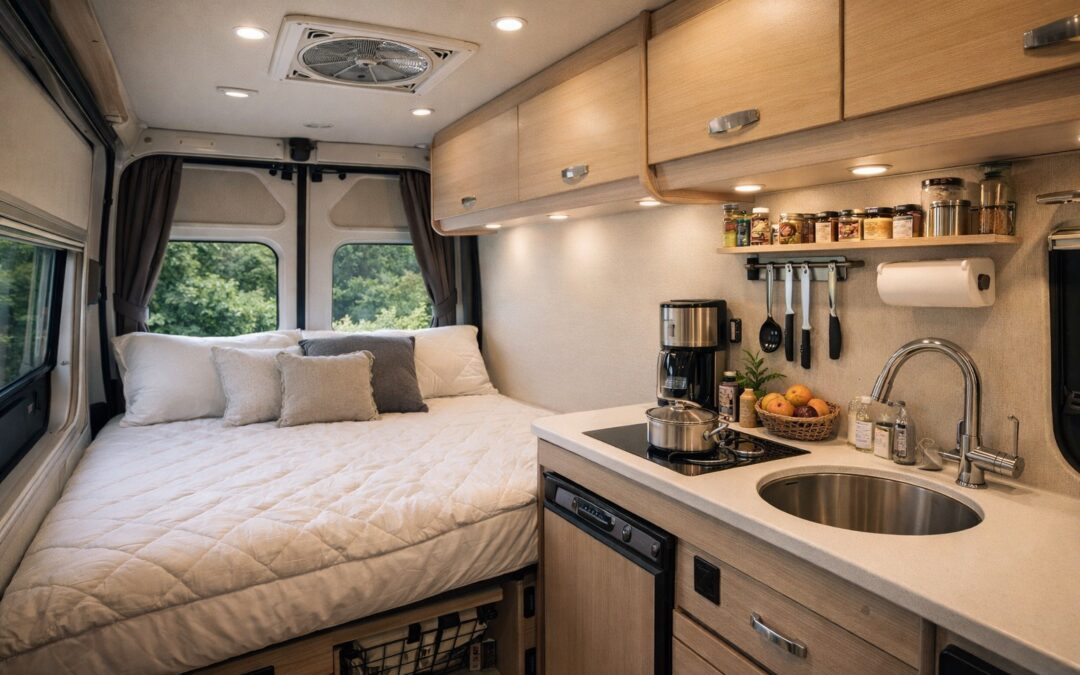
Owners in public RV forum threads from 2019 to 2025 most often name four comfort upgrades. They are a better mattress or topper, a 12V roof fan, lithium batteries with solar, and A/C soft starts. This guide links each thread and checks the claims against maker specs.
Last updated: September 25, 2026
Quick answer
- Must-know: Owners in public forums most often name a mattress or topper, a 12V roof fan, lithium power and A/C soft starts.
- Trip killers: Charging lithium batteries below about 25°F without internal heating. A residential queen mattress in a 60 by 75 inch short-queen frame. A cell booster where there is zero signal.
- Best for: Boondockers should start with a 12V fan and lithium power. Remote workers should set up cellular first, then add Starlink where coverage runs out.
- Confirm before you go: Measure your bed platform, check your battery and amp capacity, and read the current internet plan terms.
What RV owners name when asked what improved comfort
Public RV forum threads from 2019 to 2025 most often name sleep, airflow, battery power and water fixes. These are forum posts from travel trailer, fifth wheel and Class B owners, not a survey. We found no published owner survey on RV comfort upgrades, so this page gives no counts. Posters in a Forest River Forums thread on upgrades that improved camping comfort, started November 30, 2025, named lithium batteries, solar, soft starts, blackout shades, mattresses and shower heads.
In a November 30, 2025 post in that thread, user kevinB24 listed “Lithium batteries (200 AH lifepo batteries)” as one upgrade. Other posters in the same thread added a keypad lock, ceramic window tint, stabilizers, a tire pressure monitor and a composting toilet.
| Upgrade | Where owners mention it | Who it fits |
|---|---|---|
| Mattress or foam topper | Forest River Forums (2025), Class B Forums (2019) | Every rig. Measure the bed first. |
| 12V roof vent fan | Airstream Forums (2023) | Warm-weather campers and boondockers |
| A/C soft start | Forest River Forums (2025) | Owners running A/C on a generator or inverter |
| Lithium batteries and solar | Forest River Forums (2025) | Boondockers and long off-grid stays |
| Shower head and blackout shades | Forest River Forums (2025) | Anyone who showers or sleeps late on board |
If you camp off-grid, our boondocking guide covers the basics before you spend on gear.
Sleep first: topper or new mattress
An RV short queen measures 60 by 75 inches, five inches shorter than a residential queen. Size matters because a mattress that is too long will not fit the platform. Sizes vary by maker, and some RV beds have cut corners, so measure the platform before you buy. The Sleep Foundation lists the short queen at 60 by 74 to 75 inches, and Lippert lists it at 60 by 75.
The Sleep Foundation also notes that “RVs generally come with a firm, thin mattress already in the bed area that can be uncomfortable,” so many owners upgrade. In a December 9, 2025 Forest River Forums post, user idaho2some wrote, “Of course we added a 3″ foam pad to the concrete 100 year RV mattress.” In the same thread, user RubenZ wrote on December 1, 2025, “Replaced mattress with residential queen mattress,” so some rigs do take a full-length queen. A Class B owner, rvsprinterguy, wrote in a June 14, 2019 Class B Forums post, “I use a 4″ memory-foam topper and a padded mattress cover over that.”

Topper or replacement
Choose a topper when the base mattress is flat and undamaged. Choose a new mattress when the base sags or shows damage. A topper on a sagging base still leaves you on an unsupportive surface.
Foam type matters in cold rigs. Beloit Mattress warns, “When most memory foam is exposed to temperatures under 60 degrees, it gets really hard.” Beloit recommends innerspring with foam or latex padding for better breathability and less condensation mold.
Check foam certification before you buy. CertiPUR-US certified foams test below 0.5 parts per million for volatile organic compound (VOC) emissions. Formaldehyde must test below 0.1 parts per million. Certified foams are made without mercury, lead and other heavy metals, and without prohibited phthalates. Independent accredited labs test them, and certification renews annually.
RV mattress sizes
| Size name | Sleep Foundation | Lippert | Buying note |
|---|---|---|---|
| Bunk | 28 to 35 x 75 to 80 | Not listed | Measure both width and length |
| RV Full | 53 to 55 x 75 | Not listed | Width varies by maker |
| Short Queen | 60 x 74 to 75 | 60 x 75 | Five inches shorter than a residential queen |
| RV Queen | 60 x 80 | 60 x 80 | Residential queen length |
| RV Short King | 72 x 75 | Not listed | Check length before ordering |
| RV King or Narrow King | 72 x 80 | 72 x 80 (Narrow King) | “RV king” can mean 72 or 76 inches wide |
| Eastern King or King | 76 x 80 | 76 x 80 (King) | Confirm your platform width |
| RV California King | 72 x 84 | Not listed | Longest listed size |
Airflow and cooling: 12V roof fan, soft start, and when you need A/C
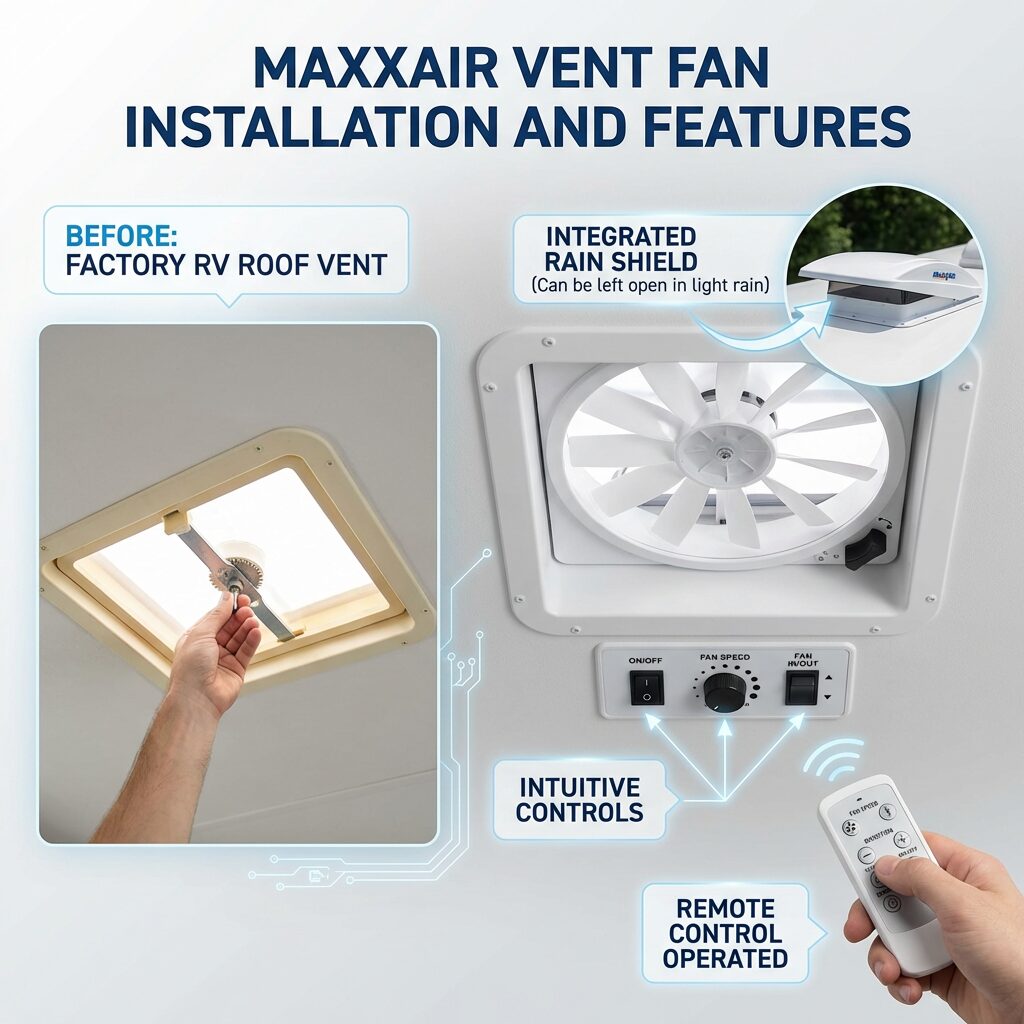
A MaxxFan Deluxe has a built-in rain cover, so it can run while it rains. A roof fan helps because it pulls hot, moist air out of the rig. A fan cools by moving air, not by dropping the air below the outside temperature. Extreme heat still calls for A/C on shore power or a generator. MaxxAir tells owners to “Use the fan while it’s raining or when driving.”
The MaxxFan Deluxe 00-07500K has 10 speeds, runs in reverse, and fits a 14 by 14 inch roof opening. It runs on 12V, with a thermostat and remote. The MaxxFan installation manual calls for a 12V circuit that can supply at least 5 amps. The Dometic Fan-Tastic Vent 3350 is a 12V, 3-speed fan with a thermostat, a rain sensor and an automatic dome lift. The 7350 adds variable speed and a remote.
Choose a MaxxFan Deluxe when you want the vent open and running in rain or while driving. Choose a Dometic Fan-Tastic 3350 or 7350 when you want a rain sensor that works the dome for you. In an August 1, 2023 Airstream Forums post, user GlassNomad called MaxxFans “One of the best upgrades thus far. I wanted to be able to have them open in rain, and have yet to encounter a storm where I had to close them.”
A/C soft start and 12V A/C
A soft start lowers the power surge when an A/C compressor starts. In a December 9, 2025 Forest River Forums post, user dave961 listed “Soft Starts on both AC units.” Micro-Air says its EasyStart Breeze gives a “reduction of up to 75% in starting current for ac units” and calls it “inverter generator friendly.” Micro-Air listed it at $345.00 as of September 25, 2026.
Van owners have a 12V roof A/C option. The Dometic CoolAir RTX 2000 12V is rated at up to 1,700 W of cooling power under ISO 5151. ISO is the International Organization for Standardization. Dometic builds it for panel vans and light trucks. Dometic’s page does not list current draw, so plan battery runtime with the maker before you buy.
Dehumidifier for humid regions
In humid regions, a dehumidifier is a separate upgrade from a fan. Lower indoor humidity helps protect upholstery and bedding from moisture. A roof fan running at night also helps move damp air out of the rig in most conditions.
Power: lithium batteries, solar and an inverter
Battle Born says LiFePO4 batteries should not charge below about 25°F without internal heating. LiFePO4 means lithium iron phosphate. Cold-climate campers need batteries with internal heating or a charging plan that respects the limit. Battle Born’s temperature guide says the batteries “should not be charged below approximately 25°F unless they are equipped with internal heating.” The same guide says they can discharge down to about -4°F, and the battery management system (BMS) “automatically blocks charging” in the cold.
Victron sets a different window. Its Smart LiFePO4 manual says charging is “only allowed in a temperature range of +5°C to +50°C.” That is 41°F to 122°F.
Cycle life depends on how deeply you drain the battery. Battle Born rates its 100Ah 12V battery at 3,000 to 5,000 cycles with a 10-year warranty. That product page does not state the depth of discharge behind the rating. Battle Born also claims up to 75% less weight than lead-acid. It listed the battery at $799.00 on sale, $949.00 regular, as of September 25, 2026.
The Victron Smart LiFePO4 manual gives 2,500 cycles at 80% depth of discharge (DoD). It gives 3,000 cycles at 70% DoD and 5,000 cycles at 50% DoD, each to at least 80% of rated capacity. Victron lists 92% round-trip efficiency and says the batteries “accept a much higher charging current” than lead-acid.
Owners in the Forest River Forums comfort thread describe systems of this kind. One poster lists 200Ah of LiFePO4 with 300W of solar. Another lists a 400W panel and a 2KW inverter.

Solar and MPPT charge controllers
A maximum power point tracking (MPPT) controller harvests more from a panel than a pulse width modulation (PWM) controller in many conditions. Victron puts the MPPT advantage at “substantial (10% to 40%)” when cells run below 45°C or above 75°C, or when light is very low. Panel count, wiring and controller size belong in a full design, so use our RV solar planning guide before you buy panels.
Inverter and charger
An inverter turns battery power into 120V AC for outlets and appliances. We recommend a pure sine wave inverter for sensitive electronics. Size it to the loads you plan to run. Have a qualified installer wire lithium batteries and inverters. Your charger, solar controller and alternator charging settings must match lithium.
Internet: cellular first, Starlink when coverage runs out
A cell booster needs some existing signal and cannot create signal in dead zones. Coverage is the first question for any RV internet setup. This section covers US plans at September 2026 pricing. weBoost says its boosters “cannot create signal in complete dead zones” and work best with a “weak but detectable signal (1-2 bars or SOS mode).” For the full comparison, read our RV internet guide comparing Starlink and 5G.
Before you add Starlink, check three things:
- Open sky. The Starlink Mini has a 110° field of view, and trees or canyon walls block it.
- Power budget. The Mini averages 25 to 40 W. The Standard kit averages 75 to 100 W.
- Monthly budget. Roam plans start at $55 a month as of September 25, 2026.
Starlink is not ideal for:
- Heavily wooded or deep canyon campsites.
- Business or enterprise use, which Roam plan terms do not permit.
Cellular options
If your phone shows usable LTE (4G) or 5G where you camp, start with cellular. A phone hotspot or a 5G router is the simplest starting point. weBoost’s Drive Reach RV kit lists up to 50 dB of gain, works with all US carriers, and runs parked or driving. weBoost listed it at $549.99 as of September 25, 2026. Devices work best within 1 to 2 feet of the inside antenna.
What Starlink Roam costs and limits
These US figures come from Starlink’s Roam page and its Service Plan Descriptions, checked September 25, 2026.
- Roam 100GB is “starting at $55/mo.” Roam 300GB is $80/mo. Roam Unlimited is $175/mo.
- Starlink describes Roam 100GB as “approximately 1 week of typical use.”
- After the 100GB or 300GB cap, you get “unlimited low speed data.” Starlink says it is “not suitable for bandwidth-intensive applications like streaming, video calls, gaming.”
- Unused data on the 100GB and 300GB plans does not roll over.
- Speeds are “not guaranteed, and will be slower during times of congestion.” Heavy rain or snow can also affect service.
- “In-motion use is supported with Roam service plans in select areas.” Check the in-motion rules for your plan before you drive with the dish on.
- Roam 100GB and 300GB work in your home country. Starlink’s Roam page lists the US and Canada for US customers.
- Roam plans are “not permitted for business or enterprise uses.” Remote workers should read the plan terms.
- Starlink offers a 30-day trial with a full refund.
Hardware sets your power draw. The Starlink Mini spec sheet lists “Average: 25-40W,” a built-in WiFi 5 router, an IP67 rating, and an operating range of -22°F to 122°F. The Standard kit spec sheet lists “Average: 75 – 100 W.” Starlink does not show the kit price before checkout, so check the current kit price at checkout. Chuck and Cindy use a Starlink Mini on the Roam plan in their 2018 Hymer Aktiv. To see what eats a 100GB Starlink plan, read our data guide before you pick a tier.
When Starlink is unnecessary
Skip Starlink if campground Wi-Fi or cellular already covers your stops. That fits travelers who stay mostly in or near towns. It also fits light users who only need email, maps and messages, and campers who rarely stream. Heavily tree-covered sites block the dish, so a cellular setup may serve those campers better.
Is Starlink worth adding?
Choose cellular first when your phone shows usable LTE or 5G where you camp. Choose Starlink when you camp beyond cell coverage, have open sky, and can budget $55 a month or more. If Starlink fits your travel pattern, check availability for your setup.
Check current Starlink Roam availability and referral offer
New Starlink customers who sign up for a Roam plan on starlink.com through a referral link get one month of free service, credited to the second month’s bill, if they stay subscribed for at least two months. Starlink sets the eligibility rules and can change them.
Referral disclosure: If you sign up for Starlink through our referral link, you may receive Starlink’s current referral benefit, and Boondock or Bust may receive a referral reward from Starlink. We are not affiliated with Starlink. Eligibility and terms are set by Starlink and can change.
Setup and plumbing: leveling, water pressure and shower head
Lippert says automatic leveling often finishes in under two minutes versus 10 to 20 manually. The time saving matters most if you move often. Most automatic kits are built for towables or large motorhomes, and Class B vans generally use blocks or ramps. Lippert’s leveling guide covers electric and hydraulic systems, says larger fifth wheels and motorhomes need higher lift capacity, and its rule is “Level Before You Stabilize.”
Before you buy automatic leveling, check three things:
- A kit made for your rig type. The Lippert Ground Control 5th-wheel system is electric, comes in 4-point or 6-point, and lists 15,500 lb total lift capacity.
- Budget. Lippert listed the 4-point kit at $5,748.95 and the 6-point kit at $6,098.95 as of September 25, 2026.
- Setup frequency. The time saved adds up only if you set up often.
Automatic leveling is not ideal for:
- Class B vans, which generally level with blocks or ramps.
- Owners who set up rarely and are comfortable with a bubble level.
Owners split on value. In a May 2, 2016 Forest River Forums thread on auto-leveling, user BamaBob wrote, “I do not know of one single person that regrets getting a camper with a auto-leveling system.” In the same thread that day, user ScottBrownstein replied, “It certainly ain’t worth 5 grand! If you can figure out how a bubble level works…don’t even sweat it.”
Choose automatic leveling when you move often, set up alone, and own a towable or large motorhome with a compatible kit. Choose blocks and a bubble level when you set up rarely or drive a Class B van.
Water pressure regulator
A regulator protects your plumbing from high campground water pressure. Winnebago’s 2016 guidance recommends “regulators that control water pressure to 50 psi. max.” Winnebago says this helps “prevent damage to any components, connections, and seals in your fresh water system.”
Shower head
Two posters in the Forest River Forums comfort thread named an Oxygenics shower head as an upgrade. The thread gives no flow or water-use figures, so compare specs with the maker before you buy.
Daily convenience: ice, coffee and small appliances
GE rates the Opal nugget ice maker at 24 pounds a day and 2.5 amps at 120 volts. A 120V appliance needs shore power, a generator, or an inverter sized for it, plus the battery capacity to run it. Off-grid campers should size power before buying one. GE Appliances lists “24 pounds per day,” “120V AC / 60 Hz / 2.5 A,” and a 3 lb ice bin.
A coffee maker is another common 120V convenience item. The same power check applies. On shore power, these appliances are easy to run. Off-grid, every amp comes from your batteries.
Match upgrades to your travel style, and what to skip
Boondockers gain most from a 12V fan and lithium power, not 120V appliances. Power source drives the choice, because off-grid every watt comes from batteries or solar. This matching is editorial, based on power source and stay length. For example, the GE Opal’s 2.5 amp draw at 120 volts is simple on shore power but needs an inverter and battery capacity off-grid.
| Travel type | Start with | Skip or wait | Why |
|---|---|---|---|
| Boondocker | 12V roof fan, lithium batteries with solar | Nugget ice maker, washer-dryer | Every load runs on batteries or solar |
| Remote worker | Cellular setup, then Starlink where coverage runs out | Starlink if cellular covers your stops | Coverage decides the setup |
| Weekend camper | Mattress topper, roof fan | Automatic leveling, large solar builds | Short trips favor low-cost, high-use fixes |
| Snowbird or full-timer | New mattress, A/C soft start, water pressure regulator | Half-bath retrofit | Long stays justify bigger spending |
| Class B owner | Topper cut to size, 12V roof fan | Washer-dryer, automatic leveling | Space, weight and power limits |
| Pet owner | Roof vent fan, climate monitor | Nothing specific | Pet safety in temperature extremes |
What the upgrades cost
| Upgrade | Listed price | Source | Best for |
|---|---|---|---|
| Mattress topper or new mattress | Varies | Retailers | Every rig |
| 12V roof fan | Varies | MaxxAir, Dometic | Warm-weather campers, boondockers |
| Micro-Air EasyStart Breeze soft start | $345.00 | Micro-Air | A/C on a generator or inverter |
| Battle Born 100Ah 12V LiFePO4 battery | $799.00 sale ($949.00 regular) | Battle Born | Boondockers |
| weBoost Drive Reach RV kit | $549.99 | weBoost | Weak but detectable cell signal |
| Starlink Roam service | From $55/mo (kit price at checkout) | Starlink | Camping beyond cell coverage |
| Lippert Ground Control 5th-wheel leveling | $5,748.95 (4-point), $6,098.95 (6-point) | Lippert | Fifth wheels that set up often |
| GE Profile Opal nugget ice maker | Varies | GE Appliances | Shore power stays |
Upgrades add to the running costs RVers underestimate, so budget for them alongside fuel and campsites.
For Class B owners: Space, weight and power limits change the math. A washer-dryer is rarely practical in a van. Start with a topper cut to the van’s bed, a 12V roof fan and careful power sizing. Chuck and Cindy travel in a 2018 Hymer Aktiv, and our Class B RV section covers more van-specific topics.
Upgrades that are not universal
- Washer-dryer combo: Needs a steady water hookup, dedicated power and floor space. It suits long stays in full-hookup parks, not boondocking or most Class B vans.
- Countertop dishwasher: Needs hookup access and counter space. It suits full-hookup campers and fits poorly with boondocking.
- Residential refrigerator: Usually found in large Class A rigs with residential power. Weight, space and electrical load rule it out for most rigs.
- Half-bath addition: A wish-list item, not a practical retrofit in most rigs. Floor plans that include one from the factory are the realistic path.
Where to start
- Measure your bed platform and check the base mattress for sag or damage.
- Fix airflow with a 12V roof fan, and add a soft start if you run A/C on a generator or inverter.
- Size your battery, solar and inverter for the loads you plan to run.
- Set up cellular, then decide whether your campsites need Starlink.
Your next step: measure your bed platform, then confirm current specs, prices and plan terms on the maker’s or provider’s site before you buy.
RV comfort upgrade FAQ
What RV upgrade makes the biggest difference in comfort?
Sleep and airflow come up first in public owner threads on Forest River Forums, Class B Forums and Airstream Forums. Owners name a mattress topper or new mattress, then a 12V roof fan. Measure the bed before you buy, since Lippert lists an RV short queen at 60 by 75 inches.
Should I get a mattress topper or a new RV mattress?
Choose a topper if the base mattress is flat and undamaged. Replace the mattress if it sags or is damaged. In cold rigs, Beloit Mattress warns that most memory foam gets really hard below 60 degrees. CertiPUR-US certified foam tests below 0.5 parts per million for volatile organic compound emissions.
Can you run an RV roof fan in the rain?
Yes, with a MaxxFan Deluxe. MaxxAir says its built-in rain cover lets you use the fan while it is raining or when driving. The Dometic Fan-Tastic Vent 3350 and 7350 work differently. They use a rain sensor with an automatic dome lift, so decide which behavior you want before you buy.
Are lithium RV batteries worth it?
They cost more up front. Battle Born rates its 100Ah battery at 3,000 to 5,000 cycles with a 10-year warranty, and listed it at $799.00 on sale on September 25, 2026. Victron lists 2,500 cycles at 80% depth of discharge. Battle Born says not to charge below about 25°F without internal heating.
Do I need Starlink in my RV?
Not if LTE, 5G or campground Wi-Fi works where you stay. As of September 25, 2026, Starlink Roam starts at $55 a month for 100GB, which Starlink calls approximately 1 week of typical use. weBoost says a cell booster needs some existing signal. Verify current plan terms before you buy.
Is automatic leveling worth it?
It depends on how often you set up. Lippert says automatic systems often level in under two minutes, versus 10 to 20 minutes manually. Lippert listed its 4-point Ground Control 5th-wheel kit at $5,748.95 on September 25, 2026. Owners on Forest River Forums disagree on whether the time saved justifies the cost.
What water pressure is safe for an RV?
Use a water pressure regulator when you connect to campground water. Winnebago recommends regulators that limit water pressure to 50 psi maximum. Winnebago says this helps prevent damage to components, connections and seals in the fresh water system. Check your own RV maker’s manual for its limit.
Do RV upgrades increase resale value?
We found no source that measures resale value gains from RV comfort upgrades. Treat upgrades as comfort spending, not an investment. In a December 2025 Forest River Forums post, one owner doubted any of the time and material cost would come back at sale. Buy upgrades for how you camp now.
Sources
- Airstream Forums. MaxxFan: Are They Worth It. Forum thread, started August 1, 2023.
- Battle Born Batteries. 100Ah 12V LiFePO4 Deep Cycle Battery. Product page, checked September 25, 2026.
- Battle Born Batteries. Understanding Temperature Limits of LiFePO4 Batteries. May 4, 2026.
- Beloit Mattress. RV Mattress Sizes. Modified January 22, 2026.
- CertiPUR-US. About the Certification. Checked September 25, 2026.
- Class B Forums. Class B Beds. Forum thread, started June 12, 2019.
- Dometic. CoolAir RTX 2000 12V. Product page, checked September 25, 2026.
- Dometic. Fan-Tastic Vent 3350. Product page, checked September 25, 2026.
- Forest River Forums. Auto Leveling Is It Worth It? Forum thread, started May 2, 2016.
- Forest River Forums. RV Upgrades That Improved Camping Comfort. Forum thread, started November 30, 2025.
- GE Appliances. Opal Nugget Ice Maker specifications. Checked September 25, 2026.
- Lippert. Ground Control Automatic 5th Wheel Leveling System. Product page, checked September 25, 2026.
- Lippert. Manual vs Automatic RV Leveling. October 22, 2025.
- Lippert. RV Mattress Sizes. May 21, 2026.
- MaxxAir. MaxxFan Deluxe 00-07500K. Product page, checked September 25, 2026.
- MaxxAir. MaxxFan and MaxxFan Plus Installation Instructions. PDF manual.
- Micro-Air. EasyStart Breeze Soft Starter. Product page, checked September 25, 2026.
- Sleep Foundation. RV Mattress Sizes. Updated July 16, 2025.
- Starlink. Roam. Checked September 25, 2026.
- Starlink. Service Plan Descriptions. Checked September 25, 2026.
- Starlink. Starlink Mini Specifications. PDF spec sheet.
- Starlink. Starlink Standard Specifications. PDF spec sheet.
- Victron Energy. Lithium Battery Smart: Operation. Online manual.
- Victron Energy. Lithium Smart Battery Manual. PDF, revised January 2026.
- Victron Energy. Which Solar Charge Controller: PWM or MPPT? July 21, 2014.
- weBoost. Drive Reach RV. Product page, checked September 25, 2026.
- Winnebago. Water Pressure Regulator Round-Up. May 2016.

Chuck Price
Founder, Boondock or Bust
Chuck Price has 35+ years of RV camping experience. He travels in a 2018 Hymer Aktiv Class B with Cindy Price, and they use a Starlink Mini on the Starlink Roam plan.
Product specs, prices and plan terms change. Verify current details with the maker or provider before you buy. Have a qualified installer handle battery, inverter and other electrical work. This guide does not cover propane or carbon monoxide systems.


