by Chuck Price | Jul 24, 2026 | Blog
RV Overnights Rewards: How the Loyalty Program Works
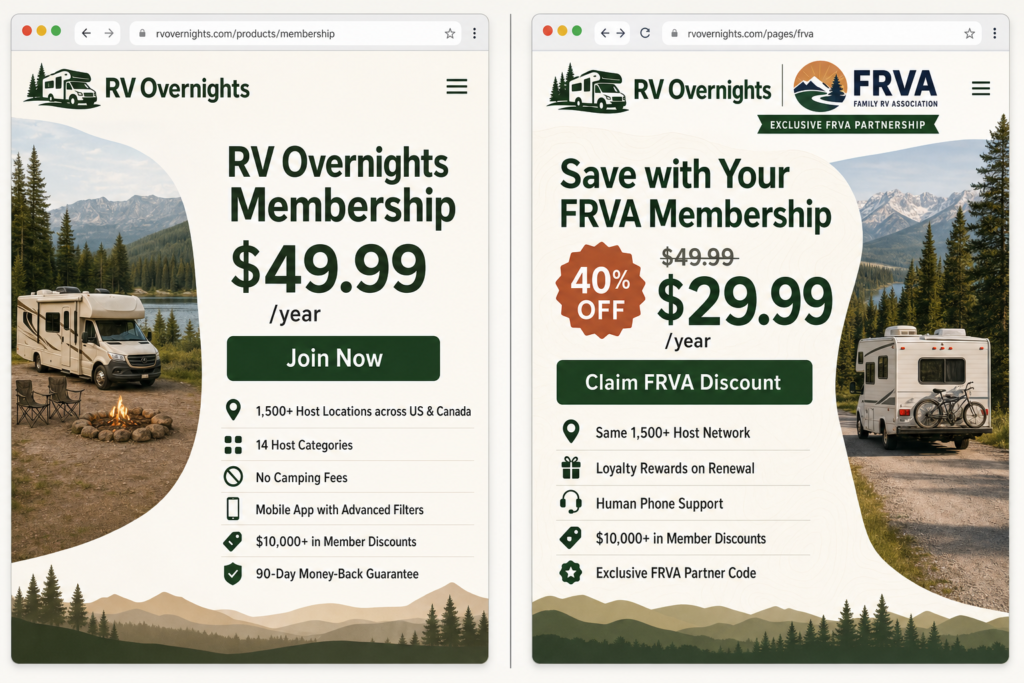
The RV Overnights membership now includes a points program that rolls discounts back into your annual renewal. Membership runs $49.99 a year, or $29.99 for eligible Family RV Association members. Here is the full breakdown.
By Chuck Price | Last updated: July 24, 2026 | Pricing and program terms verified: July 24, 2026 | Read time: ~8 minutes
Verified July 24, 2026
Every price and program rule on this page was checked against a live source on July 24, 2026:
TL;DR
- What It Costs: $49.99 a year at the public rate. $29.99 a year for eligible Family RV Association (FRVA) members, a 40% discount. Same 40% for verified military, veterans, and first responders.
- Must-Know: Rewards points come from stays, reviews, photos, referrals, and renewals. Points convert automatically to renewal discounts. No coupon codes, no extra steps.
- The Code: FRVA26. RV Overnights publishes it on its own FRVA partner page. You still need an active FRVA membership.
- Read This Before You Pay: RV Overnights publishes two different renewal prices for the FRVA rate. Its FRVA page says $29.99 every year. Its FRVA checkout page says the locked rate after year one is $49.99. Get the recurring amount in writing before you buy.
- Not Confirmed: RV Overnights has not published whether the Rewards renewal discount applies on top of the $29.99 FRVA rate or only to the standard rate. Do not assume the two stack.
- Trip Killers: Points reset every year at renewal and are forfeited entirely if your membership lapses. A lapse also kills your locked-in rate. In-app balance tracking is still listed as coming soon.
- Best For: Active RV Overnights members who camp at host locations multiple times per year, and existing FRVA members who already pay those dues for other reasons.
- Confirm Before You Buy: Verify current point values, pricing, and program terms at rvovernights.com/pages/loyalty and rvovernights.com/pages/rv-membership. Program rules are subject to change.
RV Overnights runs a points-based loyalty program that rolls discounts directly into your annual membership renewal. The membership itself costs $49.99 a year, or $29.99 for eligible FRVA members. A single weekend stay earns 100 points. A stay plus a photo review earns 200. Max out at 2,000 points and you take 20% off your next renewal automatically.
Chuck Price has traveled 47 states in a Class B van and has evaluated RV membership programs for over a decade as part of the Boondock or Bust site.
What Is RV Overnights Rewards?
RV Overnights Rewards is the loyalty points program built into active annual RV Overnights memberships. RV Overnights has not published a launch date for the program. Its terms carry a document date of April 1, 2026. Every qualifying action, meaning stays, reviews, photos, referrals, and renewals, earns points that convert to a percentage discount on your next annual renewal. The program applies only to annual memberships. It requires no separate signup. Enrollment is automatic with your active subscription.
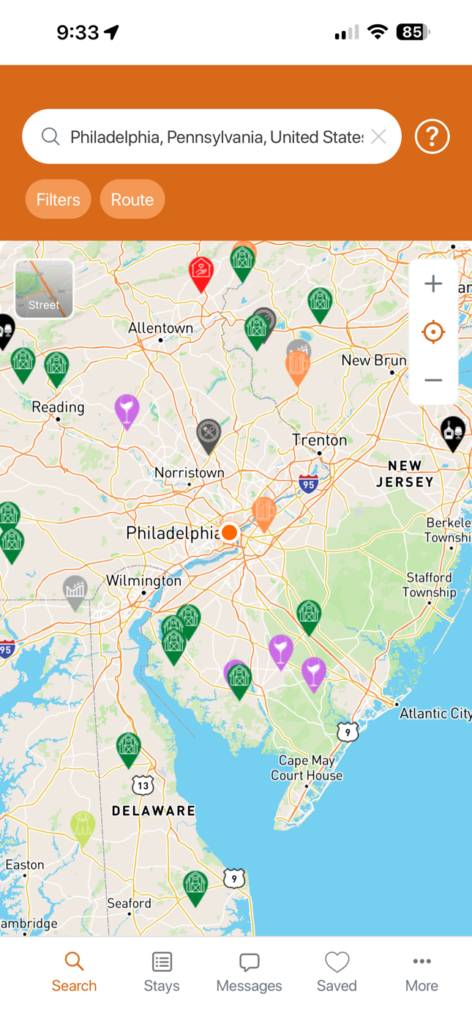
RV Overnights is a host-based RV overnight network where property owners open their land to members for short-term stays. The Rewards program sits on top of that core membership, creating a loop: use the membership to stay, earn points, lower the cost of keeping the membership. For members who use the network regularly, that loop has real dollar value. If you are weighing RV Overnights against other membership options, see our Good Sam vs Harvest Hosts vs RV Overnights comparison.
For context on how this stacks up against other apps that help you find free or low-cost overnight spots, see our guide to free camping apps for RV travelers.
What RV Overnights Costs, and Where the $29.99 FRVA Rate Fits
An RV Overnights annual membership costs $49.99 at the public rate. Family RV Association members pay $29.99, a 40% discount. (RV Overnights, RV Membership page) (FRVA, RV Overnights partner page)
This matters for the Rewards math because every renewal discount is a percentage of whatever rate you are on. A 20% Rewards discount is worth $10.00 against the $49.99 rate and $6.00 against the $29.99 rate, assuming the discount applies to the discounted rate at all. See the stacking section below before you count on that.
There are three published ways to pay for RV Overnights right now.
RV Overnights annual membership pricing paths (verified July 24, 2026)
| Pricing path |
Annual cost |
What it requires |
| Standard public rate |
$49.99 |
Nothing. Open to anyone at rvovernights.com. |
| Family RV Association (FRVA) member rate |
$29.99 (40% off) |
Active FRVA membership plus code FRVA26 at checkout. Published at rvovernights.com/pages/frva. Also surfaced behind the FRVA member login at frva.com/rvovernights. |
| Military, veteran, and first responder rate |
40% off, which computes to $29.99 at the current list price |
Eligibility verified through VerifyPass. A one-time code is issued after verification. Applies to new memberships and renewals. (RV Overnights, Hero Discount page) |
Assumption labeled: RV Overnights publishes the military and first responder offer as “40% off” without a dollar figure. The $29.99 figure in that row is calculated from the current $49.99 list price. RV Overnights does not publish that number. Verify at checkout.
The FRVA rate is only cheap if you already pay FRVA dues
Here is the part the press coverage leaves out. FRVA membership is not free. Annual dues are $99 for one year, $188 for two years, and $267 for three years, with the $10 new-member initiation fee currently waived. (FRVA, Membership Types)
The RV Overnights savings is $20.00 a year. FRVA dues are $99.00 a year. Joining FRVA purely to unlock the $29.99 RV Overnights rate costs you $79.00 more in year one than simply paying $49.99 direct.
Year-one total cost by path (calculated July 24, 2026 from published rates)
| Path |
RV Overnights cost |
Other required spend |
Year-one total |
| Pay RV Overnights directly |
$49.99 |
$0 |
$49.99 |
| Join FRVA solely to get the $29.99 rate |
$29.99 |
$99.00 FRVA dues |
$128.99 |
| Already an FRVA member for other reasons |
$29.99 |
$0 incremental |
$29.99 |
| Verified military, veteran, or first responder |
$29.99 (calculated) |
$0 |
$29.99 |
Table assumption: The $128.99 total assumes FRVA’s $10 new-member initiation fee stays waived. If that waiver ends, the same path costs $138.99 in year one. Verify at
frva.com/why-join-frva-club.
If you are already an FRVA member for the magazine, the roadside program, the tire program, or the chapters, the $29.99 rate is free money. Take it. If you are not an FRVA member, the RV Overnights discount alone does not justify $99 in dues.
RV Overnights publishes two different renewal prices for the FRVA rate
RV Overnights states two conflicting renewal prices for the same FRVA membership on two of its own pages. This is the single most important thing to check before you pay.
The RV Overnights FRVA partner page says FRVA members get 40% off every year, lists the annual price as $29.99 every year, and tells you that clicking through means you automatically pay only $29.99 every year.
The FRVA checkout page that button sends you to headlines $29.99, then states directly underneath, in the Lifetime Price Lock item, that after your first year the $49.99 per year rate never goes up.
Both cannot be true. Either $29.99 is your locked annual rate for as long as you stay active, or $29.99 is a first-year price that renews at $49.99. The difference is $20.00 every year for the life of the membership.
Do this before you pay: Ask RV Overnights support for the recurring renewal amount on the FRVA plan in writing. The most likely explanation is boilerplate copied from the standard membership page, and FRVA’s own materials describe a rate locked for life, which supports the $29.99 reading. Likely is not verified. Check the subscription amount on your first renewal notice.
Note: The public rate and the FRVA member rate are published on two different sites, by two different organizations.
FRVA pricing and RV Overnights Rewards are two separate systems
The $29.99 FRVA rate is a membership price set by a partnership agreement between the Family RV Association and RV Overnights. RV Overnights Rewards is a points program governed by the RV Overnights Loyalty Program Terms and Conditions. They are not the same benefit and they are not documented in the same place.
The differences that actually matter:
- Different documents. The Rewards program lives in the Loyalty Program Terms and Conditions. The FRVA rate lives in the FRVA partnership offer at frva.com/rvovernights. Neither document references the other.
- Different eligibility. Rewards is automatic for every active annual RV Overnights member. The $29.99 rate requires a separate, paid FRVA membership.
- Different mechanics. The FRVA rate is a fixed price applied at signup and held by the lifetime price lock. Rewards is a variable percentage recalculated every year from points you earned that year.
- Different failure modes. Letting your FRVA membership lapse affects your FRVA benefits. Letting your RV Overnights membership lapse wipes your points, resets your loyalty anniversary credit, and voids your locked rate. (T&C §4)
Do not assume the Rewards discount stacks with the FRVA rate
Unconfirmed as of July 24, 2026: RV Overnights has not published whether the Rewards renewal discount applies on top of the $29.99 FRVA member rate, or whether it applies only to the standard $49.99 rate. The Loyalty Program Terms and Conditions state that points apply toward “the next annual renewal” and that the discount is “based on your membership plan and point total,” without defining how partner or association pricing interacts with that calculation. RV Overnights does market both benefits to the same buyer: its FRVA checkout page lists “Save Up To 20% on Renewal” as an included benefit directly beneath the $29.99 price. That is an implied pairing, not a stated rule. RV Overnights never says which base price the 20% applies to, and it publishes two different renewal prices for that base. This site does not claim the two discounts stack.
If a stacked discount is part of your decision, ask RV Overnights support directly before you buy. The specific question to ask: “If I am on the FRVA member rate, is my Rewards renewal discount calculated against the $29.99 rate I pay, or against the $49.99 standard rate, or does the FRVA rate exclude me from the Rewards discount?” Get the answer in writing.
Absent that confirmation, the safe planning assumption is the conservative one. Budget the $29.99 rate as your renewal cost and treat any Rewards discount on top of it as a possible bonus rather than a certainty.
The current FRVA promo code is FRVA26
The FRVA promotional code is FRVA26, verified July 24, 2026 on the RV Overnights FRVA partner page. That page states FRVA members get 40% off with code FRVA26. RV Overnights also embeds the same code in the discount parameter of the checkout link it uses from that page.
The code is public, but eligibility is not. You need an active Family RV Association membership. FRVA also surfaces the same offer behind its member login at frva.com/rvovernights.
Two things to confirm at checkout before you submit payment: that the first charge shows $29.99, and that the recurring renewal amount matches what support told you. See the renewal price section above.
The military and first responder discount uses a different, personal code. RV Overnights issues it one time after you verify eligibility through VerifyPass. (RV Overnights, Hero Discount page)
Coupon aggregator sites list other codes for RV Overnights. None are published or confirmed by RV Overnights, and this site does not republish unverified codes.
How You Earn Points, The Full Breakdown
RV Overnights members earn 100 points per stay, 50 per review, 50 per photo upload, 100 at renewal, and 200 per referral. (RV Overnights Loyalty Program Terms and Conditions, §2)
Points are earned on activity verified through the RV Overnights platform. You cannot self-report stays or submit photos unconnected to a platform-confirmed review. Bonus points are available during seasonal promotions and member events, though specific campaigns are not announced in advance. Promotional point values are not published ahead of time and are not guaranteed to run each year. Do not factor promotional points into your renewal discount planning.
RV Overnights Rewards earning actions and point values (verified July 24, 2026, T&C §2)
| Action |
Points Earned |
Who It Applies To |
| Completed stay at a host location |
100 |
All active annual members |
| Written review of a stay |
50 |
All active annual members |
| Photos uploaded with a review |
50 |
All active annual members |
| Membership renewal |
100 |
All active annual members |
| Referral of a new paying member |
200 |
Active annual members. Referred person must maintain active paid subscription |
| Seasonal or promotional campaigns |
Varies |
All active annual members. Announced per campaign |
The referral points are worth flagging. The main loyalty page does not list them prominently, but the official Terms and Conditions confirm 200 points per referral where the referred person holds an active paid subscription. (T&C §2) A single referral is worth more than a stay-plus-review combined.
A complete stay with a photo review earns 200 points in one trip. Add the renewal action and a single referral and you have 500 points before your second stay of the year. For a members-focused look at the RV Overnights host network itself, see our RV Overnights review covering cost, hosts, and complaints.
What Points Are Worth, How the Discount Math Works
Every 100 RV Overnights Rewards points equals 1% off your annual renewal, capped at 2,000 points, or 20% maximum, per year. (T&C §3) The discount applies automatically. No coupon, no redemption step required.
The 2,000-point cap is not prominently surfaced on the main loyalty page, which references “up to 20% off” without the ceiling. Points earned above 2,000 in a single year do not increase your discount and do not roll over to the next year. They do count toward your leaderboard ranking.
The discount is applied at renewal. It is based on your membership plan and point total at that time. Points reset to zero once the renewal processes.
Point totals and corresponding renewal discounts (cap: 2,000 points = 20% max, T&C §3)
| Points Earned |
Renewal Discount |
Dollar value at $49.99 |
Who Reaches This |
| 100 |
1% |
$0.50 |
Member who renews only, takes no stays |
| 400 |
4% |
$2.00 |
2 stays + 2 reviews + 2 photo uploads |
| 1,000 |
10% |
$5.00 |
5 stays + 5 reviews + 5 photo uploads (no renewal action) |
| 1,700 |
17% |
$8.50 |
8 stays + 8 reviews + 8 photo sets + renewal |
| 2,000+ |
20% (max) |
$10.00 |
Active campers: about 9 stays with full reviews + 1 referral, or fewer stays with multiple referrals |
Table assumption: Dollar values are calculated against the $49.99 standard rate. On the $29.99 FRVA rate the maximum 20% discount would be worth $6.00, and RV Overnights has not confirmed that Rewards applies to the FRVA rate at all.
The dollar column above is calculated against the $49.99 standard rate. If you are on the $29.99 FRVA rate, the maximum 20% discount would be worth $6.00 instead of $10.00, assuming the Rewards discount applies to the FRVA rate at all. RV Overnights has not confirmed that it does.
The math is straightforward for frequent campers. Eight stays with a photo review each plus the renewal action nets 1,700 points, a 17% discount. Add one referral and you hit the 2,000-point ceiling at 20%.
The Leaderboard and Free Membership
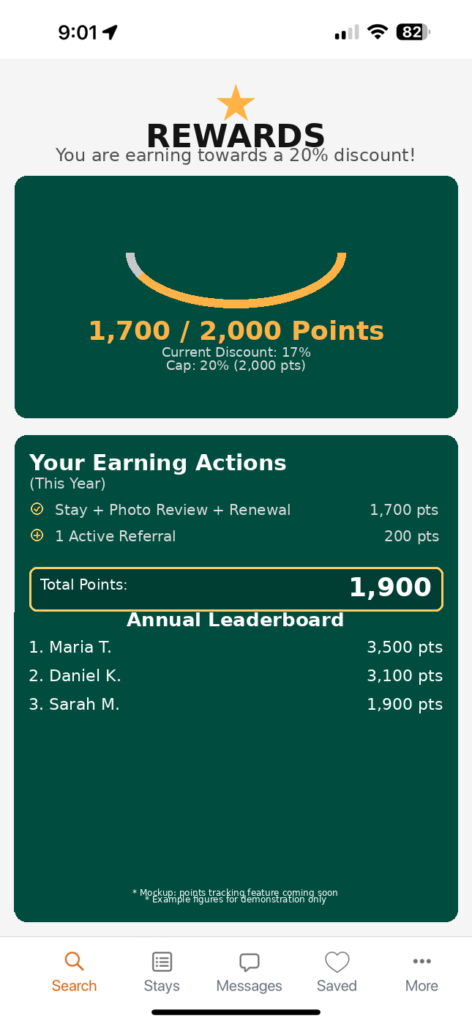
The top 100 point earners in the RV Overnights Rewards program each year receive a free membership for the following year. The leaderboard is a public ranking by username (first name, last initial). It refreshes monthly and is finalized once per year. Per the official Terms and Conditions, winners are announced annually on April 1. Verify the current announcement schedule at rvovernights.com/pages/loyalty before planning around that date. (T&C §5)
This matters for how you think about points above the 2,000 cap. You get no additional renewal discount past 2,000 points, but every point beyond that still builds your leaderboard position. Members who camp frequently, review consistently, and refer new members can stack hundreds of additional points that push them toward a free year.
The leaderboard is currently visible in the RV Overnights app. Your personal point balance, progress tracking, and notifications are still listed as coming soon in the Terms and Conditions as of July 24, 2026. (T&C §7) Check rvovernights.com/pages/loyalty for current availability status.
The Rules You Need to Know Before You Count on This Discount
Points reset to zero at your annual renewal date, and all points are forfeited if your membership lapses or is canceled. This is the most consequential constraint in the program. (T&C §4)
A lapse does more than wipe your points. The Terms and Conditions note that legacy pricing is also lost. Members who let their subscription expire and rejoin later pay current standard pricing, not the rate they had locked in. If you joined at the $29.99 FRVA rate, a missed renewal could cost you that rate entirely, on top of the lost points. Note that RV Overnights publishes conflicting language about what your locked FRVA renewal rate actually is.
Additional constraints:
- Points have no cash value and are not transferable between accounts.
- Fraudulent activity, including duplicate reviews, irrelevant photos, and fake referrals, can result in point forfeiture and program disqualification. (T&C §6)
- RV Overnights can adjust point values, earning methods, or program rules at any time. The program terms are not locked.
- In-app tracking is still listed as coming soon as of July 24, 2026. There is currently no dashboard to monitor your balance in real time. (T&C §7)
- RV Overnights offers a 90-day money-back guarantee on membership fees. (RV Overnights, RV Membership page)
The bottom line: the discount is real, but it depends entirely on keeping your membership active. If you are already a consistent RV Overnights user, none of this changes your behavior. It just adds a perk. If you are thinking about letting it lapse and rejoining later, factor in both the pricing loss and the point reset before you let it go.
For more on keeping overnight camping costs in check, see our guide to BLM camping rules and free overnight options.
Is It Worth Joining (or Staying) for the Rewards?
If you are already an active RV Overnights member who camps at host locations several times a year, the Rewards program is a straightforward add. It costs nothing, requires no changes to your behavior, and the discount applies automatically. The math works for consistent users.
Here is an illustrative scenario for a moderate user: 8 stays in a year, with both a written review and a photo upload after each one, plus the annual renewal action. That is 8 x 200 (stay + review + photos) + 100 (renewal) = 1,700 points = 17% off your next renewal. Against the $49.99 rate, that is $8.50. Add one successful referral and you reach 1,900 points, just 100 points short of the 2,000-point maximum. One more stay closes that gap exactly at 2,000. A second referral also gets you there, but it adds 200 points, and anything above 2,000 counts only toward leaderboard rank. Keep in mind that referral points only apply once the referred person holds an active paid subscription. Actual point totals depend on your usage pattern and current verified point values.
For light users who complete reviews and photos, meaning one or two stays per year, the discount will typically be in the 3 to 7 percent range. That is $1.50 to $3.50 against the standard rate. A single stay with no review or renewal earns 1%. Not transformative, but it is money back on a membership you are already paying for.
Put the two savings mechanisms in perspective. The FRVA member rate saves $20.00 in year one with no effort, and potentially every year after, depending on which renewal price RV Overnights actually applies. Maxing out Rewards saves $10.00 once, and requires nine documented stays plus a referral to get there. If you are already an FRVA member, the pricing channel is worth more than the points channel even under the less favorable renewal reading.
If you are considering a new membership specifically because of the Rewards program, the honest answer is that the Rewards benefit alone is not the reason to join. The reason to join is whether the host network has locations where you camp. The Rewards program is a retention mechanism, and a well-designed one, but the underlying membership has to make sense on its own terms first.
RV Overnights has been steadily building out their host network, and this loyalty program is a meaningful step in their member retention strategy. For how this compares to other low-cost overnight options, see our guide to public lands for boondocking.
Frequently Asked Questions
How much does an RV Overnights membership cost in 2026?
An RV Overnights annual membership costs $49.99 at the standard public rate as of July 24, 2026. Eligible Family RV Association members pay $29.99 with promo code FRVA26. Verified military, veterans, and first responders receive the same 40% discount through VerifyPass. RV Overnights publishes conflicting language about whether the FRVA rate renews at $29.99 or $49.99, so confirm the recurring amount before you pay. Verify current pricing at rvovernights.com/pages/rv-membership.
Does the RV Overnights Rewards discount stack with the $29.99 FRVA member rate?
RV Overnights has not published an answer to this. The Loyalty Program Terms and Conditions state that the renewal discount is based on your membership plan and point total, but do not address partner or association pricing. The FRVA offer page does not mention the Rewards program. Do not assume the two discounts stack. Contact RV Overnights support for written confirmation before making a purchase decision based on a combined discount.
What is the RV Overnights promo code for the FRVA discount?
The code is FRVA26, verified July 24, 2026 on the RV Overnights FRVA partner page. It applies a 40% discount, bringing the $49.99 annual membership to $29.99. You need an active Family RV Association membership to be eligible. The separate military and first responder discount issues a one-time personal code after eligibility verification through VerifyPass. Codes listed on coupon aggregator sites are not published or confirmed by RV Overnights.
Does the $29.99 FRVA rate renew at $29.99 or $49.99?
RV Overnights publishes both answers. Its FRVA partner page says FRVA members get 40% off every year and pay $29.99 every year. Its FRVA checkout page says that after your first year the $49.99 per year rate never goes up. The two statements contradict each other. FRVA materials and the original partnership announcement describe a rate locked for life, which supports the $29.99 reading, but RV Overnights has not corrected the checkout page. Ask support for the recurring renewal amount in writing before you pay.
Does RV Overnights Rewards cost extra to join?
No. RV Overnights Rewards is included with any active annual RV Overnights membership at no added cost. Enrollment is automatic. There is no sign-up step. Confirm current membership tiers at rvovernights.com/pages/rv-membership.
How many points do I need for the maximum discount?
You need 2,000 points to earn the maximum 20% renewal discount in a given year. Every 100 points equals 1% off. Points beyond 2,000 count toward the leaderboard but do not increase your discount or carry over to the next year. Source: RV Overnights Loyalty Program Terms and Conditions, §3.
What happens to my points if I cancel my RV Overnights membership?
All points are forfeited if your membership lapses or is canceled. You also lose any locked-in rate you had, including the $29.99 FRVA rate, and would have to rejoin at current standard pricing. Points reset to zero at the start of each renewal year even if you stay active. Source: RV Overnights Loyalty Program Terms and Conditions, §4.
Can I track my points in the RV Overnights app?
In-app point tracking and notifications are still listed as coming soon in the Loyalty Program Terms and Conditions as of July 24, 2026. RV Overnights says the points balance, progress toward renewal discount, and leaderboard status will be visible in the member portal and app once available. Verify current status at rvovernights.com/pages/loyalty.
Do past stays count toward my points balance?
Yes, at program launch. This credit is stated in the FAQ on the RV Overnights loyalty page, not in the Loyalty Program Terms and Conditions, which contain no retroactive provision. The loyalty page says RV Overnights would credit members with eligible Rewards points from the past six months of activity at launch. If you completed stays, left reviews, or uploaded photos before then, those actions may already have points attached to your account. Confirm whether it is still active at rvovernights.com/pages/loyalty.
How does the free membership for top earners work?
The top 100 point earners in the RV Overnights Rewards leaderboard each year receive a free membership for the following year. The leaderboard refreshes monthly and is finalized once annually. Per the official Terms and Conditions, winners are announced annually on April 1. Verify the current announcement schedule at rvovernights.com/pages/loyalty. Points above the 2,000-point renewal cap still count toward leaderboard ranking. Source: RV Overnights Loyalty Program Terms and Conditions, §5.
Next Step
If you are an existing RV Overnights member, your points are already accumulating. Check your account for the retroactive credit from the past six months.
If you are already an FRVA member, use code FRVA26 at the RV Overnights FRVA partner page, or sign in at frva.com/rvovernights. Before you submit payment, ask RV Overnights support in writing whether your renewal charge will be $29.99 or $49.99. Their own pages say both.
If you are not an FRVA member, do not join FRVA just for this discount. The dues cost more than the savings. Go to the RV Overnights membership page and verify that host locations exist where you actually plan to camp. The Rewards discount adds value once the core network fits your travel pattern.
All prices and program terms on this page were verified on July 24, 2026. Verify current terms before your membership decision at rvovernights.com/pages/loyalty and rvovernights.com/pages/rv-membership.
Sources
- RV Overnights. (2026). Loyalty points program. Retrieved July 24, 2026, from https://rvovernights.com/pages/loyalty
- RV Overnights. (2026). RV Overnights loyalty program terms and conditions. Retrieved July 24, 2026, from https://www.rvohelp.com/en/articles/14412146-rv-overnights-loyalty-program-terms-and-conditions
- RV Overnights. (2026). RV membership. Retrieved July 24, 2026, from https://rvovernights.com/pages/rv-membership
- RV Overnights. (2026). Military & first responder discount. Retrieved July 24, 2026, from https://rvovernights.com/pages/military-first-responder-discount
- RV Overnights. (2026). Exclusive FRVA partnership. Retrieved July 24, 2026, from https://rvovernights.com/pages/frva
- RV Overnights. (2026). Start your RV Overnights membership: FRVA partner. Retrieved July 24, 2026, from https://rvovernights.com/pages/start-your-rv-overnights-membership-frva-partner
- Family RV Association. (2026). RV Overnights member offer. Retrieved July 24, 2026, from https://www.frva.com/rvovernights
- Family RV Association. (2026). Membership types and dues. Retrieved July 24, 2026, from https://www.frva.com/why-join-frva-club
- Family RV Association. (2025, May 29). Family RV Association enters exclusive partnership with RV Overnights [Press release]. PR Newswire. https://www.prnewswire.com/news-releases/family-rv-association-enters-exclusive-partnership-with-rv-overnights-302467543.html
- Family RVing Magazine. (2026, January 1). Association update: January-February 2026. https://magazine.frva.com/2026/01/01/association-update-january-february-2026/
About the Author
Chuck Price is the founder of Boondock or Bust and has traveled 47 states in a Class B van over 35-plus years of RV camping. He evaluates RV apps, memberships, and gear based on real-world use, not spec sheets.

by Chuck Price | Jul 21, 2026 | Blog
RV Overnights vs Harvest Hosts: Which Membership Fits Your RV Travel Style in 2026?
By Chuck Price | Last updated: July 21, 2026 | Data verified: July 21, 2026
This page helps RVers compare RV Overnights and Harvest Hosts based on budget, route fit, rig size, amenities, host network, and travel style. It also covers the Family RV Association (FRVA) member rate, which changes the RV Overnights (RVO) math for some readers and changes nothing for most.
Quick answer: Choose RV Overnights when cost, electric-hookup filtering, and big-rig practicality matter most. Choose Harvest Hosts when you want a larger experience-driven network, based on the published host counts below. If you already hold a Family RV Association membership, RV Overnights gets cheaper still at $29.99 per year. Choose neither until you check your actual routes.
Plan terms change. Before you buy either membership, verify current pricing, refund terms, host counts, discount eligibility, and route coverage on the provider’s own website.
Current Snapshot: Verified Pricing and Terms
RV Overnights now has two rates that matter, and the public one is not the only one.
| Item |
RV Overnights |
Harvest Hosts |
Decision Impact |
| Public annual price |
$49.99/year. RVO states the rate you sign up at is the rate you keep while the subscription stays active |
$99 Classic, $169 with Boondockers Welcome, $179 All Access |
Use standard renewal pricing for long-term math, not sale pricing. |
| FRVA member price |
$29.99/year. Eligible Family RV Association members receive 40% off, locked for as long as the membership stays active |
No FRVA-specific rate was identified on the provider and FRVA pages reviewed on July 21, 2026 |
Only relevant if you already hold or already want FRVA membership. |
| First-year promotions |
Compare page showed a $39.99 first year renewing at $49.99, plus a switch code for buyers coming from a competing platform |
Sale pricing shown at $84.15, $143.65, and $152.15 for the first year |
First-year math and renewal math are different questions. Run both. |
| Network size |
Over 1,500 host locations across the US and Canada |
5,858+ Classic, 9,399+ with Boondockers Welcome, 9,753+ All Access |
Harvest Hosts wins on raw network size by a wide margin. |
| Host support spending |
Suggests a minimum $30 purchase per host location |
Suggests a minimum $30 spend. Optional hookup fees count toward it |
Same expectation on both platforms. Budget for it either way. |
| Electric hookups |
Comparison page lists electric hookups at 36% of locations. RVO publishes 32% elsewhere on its own site |
Support documentation states the majority of locations do not offer hookups |
RVO is the better starting point if electric access is a frequent need. |
| Refund terms |
90-day money-back guarantee |
Happy Camper Guarantee, refund within the first three months |
Test quickly. Do not let the refund window pass unused. |
Verification note: Pricing, host counts, and plan terms were checked against provider pages on July 21, 2026. Both companies change promotions and location counts often, so recheck before purchase.
Conflicting vendor data: RV Overnights publishes different host statistics on different pages of its own site. Its comparison page and FRVA partnership page both list electric hookups at 36% of locations, while its main membership page lists 32%. Additional-night availability is listed as 79% in one place and 73% in two others. Neither figure is used in the analysis below. This page uses the 36% figure and flags the discrepancy rather than presenting a single number as settled.

Public pricing, member pricing, and promotional pricing are three different numbers. Compare renewal rates, not headline offers.
Start With the Job, Not the Brand
Each membership solves a different travel problem.
That sounds basic, but it is where a lot of RVers waste money. They buy the membership with the bigger name, the lower sale price, or the strongest Facebook recommendations. Then they discover the hosts do not line up with their routes, the rig is too large, the arrival window does not work, or the overnight stay itself does not remove the host-support expectation. Before you pay for either network, it is worth reading the rest of the boondocking guide to see how paid host stays compare with free public-land options.
Use this filter first
- Need the lowest annual fee? Start with RV Overnights.
- Already an FRVA member? Start with RV Overnights at the $29.99 member rate.
- Need the largest host network? Start with Harvest Hosts.
- Need electric more than occasionally? Start with RV Overnights, then verify each host.
- Want memorable farms, wineries, breweries, attractions, and private-property stays? Start with Harvest Hosts.
- Already have cheap public camping dialed in? You may not need either one.
The FRVA Member Rate: Who It Actually Helps
Eligible FRVA members can receive 40% off RV Overnights, reducing the current annual price from $49.99 to $29.99. Verify your membership tier qualifies at the RV Overnights FRVA offer page before checkout.
Family RV Association is the organization formerly known as the Family Motor Coach Association. RV Overnights publishes the offer on its own FRVA partnership page, lists the member price as $29.99 per year, and gives the member code as FRVA26. It states the 40% applies every year rather than the first year only, and its lifetime price lock holds your signup rate for as long as the subscription stays active. FRVA also hosts a member-facing version of the offer behind account login.
Verify current eligibility, promotional codes, and checkout pricing before joining. Codes and partner pages change without notice.
Do not join FRVA just to get this discount. FRVA dues were listed at $99 for one year, $188 for two years, and $267 for three years as of July 21, 2026. The RV Overnights discount is worth $20 per year.
Spending $99 to save $20 puts you $79 behind in year one, and the gap grows every year after, because FRVA dues recur while the $20 saving stays fixed. Five years in that is $495 in dues against $100 saved. Multi-year FRVA dues work out to roughly $94 and $89 per year, which does not change the answer. The member rate is worth taking when you already value FRVA for its magazine, medical and travel assistance, roadside coverage, tire program, insurance rates, and chapters. It is not a reason to join.
Other RV Overnights rates you may qualify for
The $49.99 public price is a list price, not the only rate available.
- Military and first responder discount (as of July 21, 2026). RVO lists 40% off annual memberships for active duty, retired military, veterans, and their families, verified through a third-party service. See RVO’s military and first responder page for current verification requirements. This is the same 40% as the FRVA offer, with no association dues attached.
- First-year promotional pricing (as of July 21, 2026). The RVO comparison page showed a $39.99 first year that renews at $49.99. Verify before purchase.
- Switch promotion (as of July 21, 2026). RVO promotes a code giving 30% off the first year for buyers moving from a competing platform. Verify before purchase.
- Loyalty program (as of July 21, 2026). RVO advertises up to 20% off membership renewals earned by staying at host locations.
Stacking is not documented. RV Overnights has not published terms confirming that the FRVA rate combines with the loyalty program, the switch code, or the military discount. Assume one discount applies at checkout and confirm with RVO support before you count on a combined rate. Do not build your budget around a stack that has not been verified.
The Real Cost: Use Two Break-Even Models
Break-even math is useful only when the assumptions are visible.
Membership-fee-only break-even and total cash outlay answer different questions. Mixing them produces a number that flatters whichever membership you already wanted. Run both models separately. Both tables below round up to whole nights, because a partial night does not recover a fee.
Model 1: Membership-Fee-Only Break-Even
This model asks one narrow question: how many avoided campground nights does it take to recover the membership fee?
Formula: annual membership fee divided by estimated nightly campground savings equals break-even stays. You cannot take a fraction of a stay, so round up to the next whole stay. Quotients are shown to two decimal places.
| Membership |
Illustrative Fee |
If You Avoid a $55 Campground Night |
What It Means |
| RV Overnights, FRVA member rate |
$29.99 |
$29.99 ÷ $55 = 0.55, rounded up to 1 stay |
Lowest annual outlay on this page. Requires active FRVA membership. |
| RV Overnights, public rate |
$49.99 |
$49.99 ÷ $55 = 0.91, rounded up to 1 stay |
Fast fee recovery, but only if host locations fit your route. |
| Harvest Hosts Classic |
$99 |
$99 ÷ $55 = 1.80, rounded up to 2 stays |
Reasonable for travelers who want the experience, not just parking. |
| Harvest Hosts + Boondockers Welcome |
$169 |
$169 ÷ $55 = 3.07, rounded up to 4 stays |
Adds private-property hosts to the small-business network. |
| Harvest Hosts All Access |
$179 |
$179 ÷ $55 = 3.25, rounded up to 4 stays |
Best for heavier users who want the widest network. |
Model 2: Conservative Cash-Outlay Break-Even
This model includes expected host-support spending. It is more conservative, and more honest for budget planning.
Assumption: If your alternative campground is $55 and you expect to spend about $30 supporting the host, your estimated cash savings is about $25 per stay. Divide the fee by $25 and round up to the next whole stay. Your real savings may be higher or lower depending on what you would have bought anyway.
| Membership |
Illustrative Fee |
Using $25 Estimated Savings Per Stay |
Reality Check |
| RV Overnights, FRVA member rate |
$29.99 |
$29.99 ÷ $25 = 1.20, rounded up to 2 stays |
Lowest risk entry point if you already hold FRVA membership. |
| RV Overnights, public rate |
$49.99 |
$49.99 ÷ $25 = 2.00, rounded up to 2 stays |
Good math if route fit is strong. |
| Harvest Hosts Classic |
$99 |
$99 ÷ $25 = 3.96, rounded up to 4 stays |
Fair if you value the destination experience. |
| Harvest Hosts + Boondockers Welcome |
$169 |
$169 ÷ $25 = 6.76, rounded up to 7 stays |
Needs steady use across a full travel season. |
| Harvest Hosts All Access |
$179 |
$179 ÷ $25 = 7.16, rounded up to 8 stays |
Works best for frequent travelers, not occasional weekend use. |
What the FRVA rate does not do: at these illustrative assumptions only, the member rate does not change the break-even stay count. At a lower campground alternative it can. Against a $35 night, the public rate needs 2 stays under Model 1 while the member rate needs 1. Public and member pricing both recover in one stay under Model 1 and two stays under Model 2. The discount saves $20 a year in cash. It does not make the membership work on routes where the hosts are not there. Route fit is still the deciding variable.
Do not treat these examples as guaranteed savings. They are decision math. Your numbers change if your campground alternative is $35, if you spend $60 at wineries, if you buy on a first-year promotion, or if the host is twenty miles off your route.
Route Fit Matters More Than Total Host Count
A bigger network is worthless if it is not on your route.
Harvest Hosts has the larger network, about 3.9x at Classic and about 6.5x at All Access against the RVO count cited above. That gives it an obvious advantage for national coverage, last-minute reroutes, and travelers who cross different regions often. RV Overnights is smaller, so it requires more pre-checking. Its lower price only matters if you can actually use the hosts.
The route test
- Open both provider maps. Cross-check against your usual free campsite finder apps so you can see paid and free options on the same routes.
- Plot your next three planned travel days, not dream trips.
- Count usable hosts within roughly 30 to 50 miles of your actual route.
- Remove any host that cannot fit your rig, pets, arrival timing, or power needs.
- Buy only if the remaining usable hosts justify the annual fee.
That final count matters more than marketing totals. One perfectly placed host beats fifty beautiful locations you would never drive near.
Rig Size, Hookups, and Arrival Rules Can Decide It Fast
Hard requirements beat brand preference.
Choose RV Overnights first if:
- You want the lowest standard annual fee, at either the public or FRVA rate.
- You need better odds of finding electric hookups.
- You drive a large rig and want to filter on rig length before you commit, subject to host-specific limits.
- You are willing to check the map before every trip.
- You prefer functional transit stops over destination-style experiences.
Choose Harvest Hosts first if:
- You want the larger host ecosystem.
- You value farms, wineries, breweries, attractions, and private-property stays.
- You travel across regions and want more fallback options on unfamiliar routes.
- You are comfortable dry camping most of the time.
- You want a longer-established platform with a larger body of member reviews.

Run the route test in both apps before you pay. Filter counts matter less than usable hosts on your next three travel days.
The $30 Host-Support Question
The stay is not the same as a free parking lot.
Both platforms now use the same framing. Harvest Hosts support documentation asks members to spend a minimum of $30 in support of the host, and notes that products, experiences, and optional hookup fees all count toward that amount. RV Overnights membership guidelines suggest a minimum $30 purchase per host location and encourage members to spend more. Neither company bills it as a camping fee, and neither treats it as a hard charge, but the expectation is explicit on both sides.
That support may be wine, produce, dinner, a museum admission, an electric hookup fee, or a donation where the host has nothing to sell. You are not paying a campground fee. You are participating in the exchange that keeps small-business hosts in the network.
Common Mistakes That Waste Money
Most bad memberships come from bad assumptions.
Mistake 1: Buying before checking the map
Do not buy based on total host count. Buy based on the hosts that fit your next real trips.
Mistake 2: Buying a club membership to chase a discount
A $99 association membership that unlocks $20 in savings is a $79 loss unless you wanted the association anyway. Price the parent membership on its own merits first, then treat the partner discount as a bonus.
Mistake 3: Treating host support as optional in the budget
You might not spend exactly $30 every time, but you should plan for it. That keeps your cost math honest.
Mistake 4: Ignoring your rig size
Host access roads, turnarounds, slopes, and parking surfaces matter. Check the host profile, then confirm directly when the fit looks tight.
Mistake 5: Assuming hookups are available
Both programs are built around self-contained RVs. Hookups are a bonus, not a guarantee. If power is critical, carry a backup plan.
Mistake 6: Arriving like it is a campground
These are businesses and private properties. Follow arrival windows, ask about generator rules, and do not treat the host as a 24-hour check-in desk.
My Practical Recommendation
Start with the cheapest rate you already qualify for, but only when it fits your routes.
If you already hold an FRVA membership, RV Overnights at $29.99 is the lowest-risk test on this page. Log in to the FRVA member offer page, pull your code, and run the route test before you check out. If you qualify for the military or first responder discount instead, you reach the same 40% without association dues.
If you are cost-sensitive and hold neither, RV Overnights at the public rate is still the cheaper entry, provided the map shows usable hosts on your next several trips. The 90-day guarantee reduces the risk. Do not join FRVA to close a $20 gap.
If you want a larger experience-driven network, start with Harvest Hosts Classic. If you also want Boondockers Welcome, golf courses, and the widest combined network, price All Access against your real expected use. At eight break-even stays under the conservative model, All Access needs a genuine travel season behind it. Do not buy it because the location count looks impressive.
If you travel a lot, both memberships can make sense. Buy both only after your route test proves they solve different problems for you.

Decision order: confirm which rate you qualify for, run the route test, then buy inside a refund window you can still use.
Frequently Asked Questions
These are the questions that usually decide the purchase.
Which is cheaper, RV Overnights or Harvest Hosts?
RV Overnights is cheaper on annual fee at either rate. As of July 21, 2026, RV Overnights listed a public price of $49.99 per year, and eligible Family RV Association members can receive 40% off, which brings the annual price to $29.99. Harvest Hosts listed standard plans at $99, $169, and $179 per year. Both companies also run first-year promotions, so verify current checkout pricing before buying.
How much is the RV Overnights FRVA member discount?
Eligible Family RV Association members can receive 40% off RV Overnights, reducing the current annual price from $49.99 to $29.99. RV Overnights publishes the member code FRVA26 on its own FRVA partnership page, states the 40% applies every year, and locks your signup rate for as long as the subscription stays active. Verify current eligibility, promotional codes, and checkout pricing before joining.
Is it worth joining FRVA just to get the RV Overnights discount?
No. Family RV Association dues were listed at $99 for one year as of July 21, 2026, and the RV Overnights discount saves $20 per year. Paying $99 to save $20 leaves you $79 behind. The discounted rate makes sense only when you already want FRVA membership for its other benefits, such as the magazine, medical and travel assistance, roadside coverage, and the tire program.
Does either membership replace campgrounds?
No. Both are best treated as one-night or short-stay tools, not campground replacements. You still need commercial parks or public campgrounds for guaranteed hookups, laundry, dump stations, or longer destination stays.
Do I have to spend $30 at every host?
Treat $30 as expected host-support money, not a campground fee. Both platforms use suggested-minimum language. Harvest Hosts suggests spending a minimum of $30 in support of your host, and RV Overnights suggests a minimum $30 purchase. Harvest Hosts also counts the cost of optional hookups toward that $30.
Which membership is better for electric hookups?
RV Overnights is the better starting point if electric access matters because its comparison page lists electric hookups at 36% of locations. RV Overnights publishes a conflicting 32% figure on its own membership page, so treat 36% as the comparison-page figure as of July 21, 2026. Harvest Hosts support documentation states that the majority of its locations do not offer hookups and that availability is host-specific.
Should frequent RV travelers use both memberships?
Some frequent travelers may benefit from using both, but only after checking route fit. Do not buy both because they overlap. Buy both only when your actual routes show enough usable hosts on each platform.
What should I check before buying either membership?
Check current pricing and which discount you actually qualify for, refund terms, host density along your next three routes, rig length limits, hookup needs, pet rules, arrival windows, and whether you can comfortably support hosts during each stay.
Related RV Overnights Guides
Use these active cluster pages for deeper review and three-way membership comparison.
Sources and Verification
Every price, host count, and program term on this page was checked against the provider’s own published pages on July 21, 2026.
- Family RV Association. “RV Overnights.” Member offer page. Accessed July 21, 2026. https://frva.com/rvovernights
- Family RV Association. “Family RV Association Enters Exclusive Partnership With RV Overnights.” Accessed July 21, 2026. https://www.frva.com/family-rv-association-enters-exclusive-partnership-with-rv-overnights
- Family RV Association. “Membership Types.” Accessed July 21, 2026. https://frva.com/why-join-frva-club
- RV Overnights. “Exclusive FRVA Partnership.” Accessed July 21, 2026. https://rvovernights.com/pages/frva
- RV Overnights. “RV Membership.” Accessed July 21, 2026. https://rvovernights.com/pages/rv-membership
- RV Overnights. “Compare Us.” Accessed July 21, 2026. https://rvovernights.com/pages/compare-us
- RV Overnights. “Membership Resources.” Accessed July 21, 2026. https://rvovernights.com/pages/membership-resources
- RV Overnights. “Military and First Responder Discount.” Accessed July 21, 2026. https://rvovernights.com/pages/military-first-responder-discount
- Harvest Hosts. “Membership Plans.” Accessed July 21, 2026. https://www.harvesthosts.com/plans
- Harvest Hosts Support. “Completing – How much should I spend at a Host location?” Updated April 1, 2026. Accessed July 21, 2026. https://support.harvesthosts.com/en/articles/6110801-completing-how-much-should-i-spend-at-a-host-location
- Harvest Hosts Support. “Do Hosts offer Hookups in Harvest Hosts?” Updated January 7, 2026. Accessed July 21, 2026. https://support.harvesthosts.com/en/articles/6111730-do-hosts-offer-hookups-in-harvest-hosts
Methodology: Pricing and program terms come from provider-published plan pages, member offer pages, and public policy documentation. The $29.99 FRVA member price and the FRVA26 member code are published publicly by RV Overnights on its own FRVA partnership page, and the $29.99 figure is separately confirmed in the Family RV Association partnership announcement. Final checkout pricing depends on eligibility verification. Claims that could not be verified cleanly were removed, softened, or labeled as unverified.
Discount stacking: No published terms confirm that the FRVA rate combines with the RV Overnights loyalty program, switch code, or military discount. This page does not claim they stack.
Affiliate disclosure: Some links may be affiliate or sponsored links. The comparison remains based on practical fit, public pricing, route usability, and stated program terms.
Data last verified: July 21, 2026

by Chuck Price | Jun 4, 2026 | Blog
The Endless Rally: 20 Adult-Only Motorcycle Rally Stops in One 2026 Road Trip
By Chuck Price | Published: March 5, 2026 | Last Reviewed: June 4, 2026
The Endless Rally is a long-distance 2026 road trip plan that connects 20 adult-only or age-restricted motorcycle rally stops across one riding season.
The route runs from March 12 through November 7, 2026. It starts in Oklahoma, loops through Texas, Iowa, Illinois, Tennessee, New York, Kentucky, Indiana, Ohio, Maryland, Maine, and Florida, then closes the season in Lakeland. Starting and ending near Albany, New York, expect roughly 14,000 to 15,000 total driving miles depending on exact roads, detours, weather, and home-base routing.
This is not a simple weekend rally trip. It is a season-long biker route built for riders with schedule flexibility, a reliable bike or tow rig, a realistic fuel budget, and the discipline to skip a stop if the route gets too tight.
Important planning note: Adult motorcycle rallies can change dates, venues, ticket rules, age policies, camping rules, and entry restrictions with little notice.
Use this as a route-planning framework, not a booking contract. Confirm every event directly with the organizer before buying tickets, reserving campsites, or committing long-distance travel. For a broader event list, see our Comprehensive 2026 Adult Rally Calendar.
2026 Endless Rally Route at a Glance
This route connects 20 adult-only or age-restricted motorcycle rally stops from March through November 2026.

- Season window: March 12 through November 7, 2026.
- Total core stops: 20 adult-only or age-restricted rallies.
- Estimated route distance: Roughly 14,000 to 15,000 miles when starting and ending near Albany, NY.
- Primary rally states: Oklahoma, Texas, Iowa, Illinois, Tennessee, New York, Kentucky, Indiana, Ohio, Maryland, Maine, and Florida.
- Best home-base reset: Harley Rendezvous in Pattersonville, New York, especially for Northeast-based riders.
- Hardest logistics window: New Portland, Maine to Bloomville, Ohio to Conesville, Iowa between August 23 and September 3.
Key Planning Notes Before You Use This Route
This route works best as a flexible rally framework, not a rigid itinerary.
- The route runs into November. Roscoe’s Chili Challenge in Lakeland, Florida closes the 20-stop route on November 5-7, 2026.
- Route 66 remains the Oklahoma hub. Depew appears three times in the core route because Route 66 Rally Grounds hosts several age-restricted biker rallies during the season.
- JuneBug Boogie has two 2026 stops. The spring rally is listed for June 18-21 and the fall rally for September 24-27.
- Some rows need final organizer confirmation. Third-party listings are useful for planning, but they should not replace direct confirmation before buying tickets or reserving campsites.
- This is a route framework, not a promise that every rider can make every stop. Weather, fatigue, work schedules, bike issues, and sold-out camping can all change the plan.
The 20-Stop Route
The table below is the current route order for the 2026 Endless Rally.
“Official organizer” means the date was found on an event or organizer site. “Official ticket page” means the date was found on the event’s ticket or application page. “Official social” means the date was found on the organizer’s public social page. “Third-party listing” means the date should be treated as useful but still verified before travel.
| Stop |
Rally |
Location |
2026 Dates |
Age |
Source Basis |
| 1 |
Route 66 Cabin Fever Rally |
Depew, OK |
March 12-15 |
21+ |
Official organizer and event listings |
| 2 |
Thunder in the Hill Country |
Bandera, TX |
March 26-29 |
21+ |
Official organizer |
| 3 |
Route 66 BikeStock Oklahoma |
Depew, OK |
April 30-May 3 |
21+ |
Official organizer and event listings |
| 4 |
Crater Rally Spring |
Somerville, TX |
May 14-17 |
21+ |
Official organizer |
| 5 |
Redneck Revival Memorial Day |
Conesville, IA |
May 21-24 |
21+ |
Third-party listing, verify |
| 6 |
Hogrock River Rally |
Cave-In-Rock, IL |
June 11-14, early bird June 10 |
18+ |
Official organizer and listings |
| 7 |
JuneBug Boogie Spring |
Cookeville, TN |
June 18-21 |
21+ |
Official organizer |
| 8 |
Harley Rendezvous Classic |
Pattersonville, NY |
June 25-28 |
21+ |
Official organizer |
| 9 |
ABATE of Iowa Freedom Rally |
Algona, IA |
July 2-4 |
18+ |
Official organizer |
| 10 |
Sturgis Kentucky Bike Rally |
Sturgis, KY |
July 15-19 |
21+ |
Official organizer and ticket page |
| 11 |
ABATE of Indiana The Boogie |
Springville, IN |
July 16-19 |
18+ |
Official organizer |
| 12 |
Wetzelland |
Grover Hill, OH |
July 23-26 |
21+ |
Official organizer |
| 13 |
East Coast Sturgis |
Oldtown, MD |
August 3-9, official start August 5 |
21+ |
Official ticket page |
| 14 |
United Bikers of Maine Statewide |
New Portland, ME |
August 19-23 |
21+, members only |
Official social and UBM site |
| 15 |
Easyriders Rodeo Bloomville |
Bloomville, OH |
August 28-September 1 |
Verify gate policy |
Official event application page |
| 16 |
Redneck Revival Labor Day |
Conesville, IA |
September 3-6 |
21+ |
Third-party listing, verify |
| 17 |
JuneBug Boogie Fall |
Cookeville, TN |
September 24-27 |
21+ |
Official organizer |
| 18 |
Hogrocktoberfest |
Cave-In-Rock, IL |
October 1-4, early bird September 30 |
18+ |
Official organizer |
| 19 |
Route 66 Fall Biker Rally |
Depew, OK |
October 15-18 |
21+ |
Official organizer and event listings |
| 20 |
Roscoe’s Chili Challenge |
Lakeland, FL |
November 5-7 |
21+ |
Official organizer |
Leg 1: Oklahoma to Texas Spring Kickoff
This leg starts the route with a long southern push.
If you are leaving from the Albany, New York area, plan on several travel days before the first rally. This is the hardest mental part of the trip because the season starts before northern riding weather fully settles in.
Stop 1: Route 66 Cabin Fever Rally, Depew, OK, March 12-15. Route 66 Rally Grounds works as the launch point because the same venue hosts several age-restricted biker rallies during the season. The route uses Depew more than once, which makes it a practical mid-continent anchor.
Stop 2: Thunder in the Hill Country, Bandera, TX, March 26-29. Bandera gives the route its Texas Hill Country leg. Riders have enough time between Depew and Bandera to avoid rushing, explore the Hill Country, and use Bandera as a warm-weather reset before returning north later in spring.
What this leg does not cover: This is not a ride-by-ride Texas Hill Country guide. Confirm local road conditions, event gate rules, and lodging options before leaving Oklahoma.
Leg 2: Back Through Oklahoma, Texas, and Iowa
This leg contains the tightest early-season transfer.
Stop 3: Route 66 BikeStock Oklahoma, Depew, OK, April 30-May 3. This second Depew stop is where the hub strategy starts to make sense. Riders with local storage, a friend nearby, or a long-term site arrangement can avoid hauling everything for the full route.
Stop 4: Crater Rally Spring, Somerville, TX, May 14-17. The Crater Rally runs at Welch Park on Lake Somerville. This is another Texas stop before the route makes the big move north toward Iowa.
Stop 5: Redneck Revival Memorial Day, Conesville, IA, May 21-24. This remains the tightest early-season transition. The Somerville-to-Conesville move is roughly 900-plus miles depending on the route. Build in a margin for weather, mechanical issues, and recovery time.
Routing caution: If you fall behind after Crater Rally, the Memorial Day Conesville stop is the first one to consider dropping. Forcing this leg while tired creates the highest risk window in the first half of the route.
What overrides this plan: Weather, mechanical trouble, or late departure from Texas should override the rally count. This route only works if you are willing to skip a stop when the schedule gets tight.
Leg 3: Midwest to Tennessee to New York
This leg is the first efficient eastbound stretch.
Stop 6: Hogrock River Rally, Cave-In-Rock, IL, June 11-14. June 10 is treated as early-bird arrival. Plan June 10 only if you want to arrive early and the organizer still offers early entry when you book.
Stop 7: JuneBug Boogie Spring, Cookeville, TN, June 18-21. The official event page lists June 18-21 for the spring rally and September 24-27 for the fall rally. This route uses both 2026 JuneBug stops.
Stop 8: Harley Rendezvous Classic, Pattersonville, NY, June 25-28. This is the first major Northeast home-base opportunity for riders from New York, New England, or the Mid-Atlantic. For an Albany-area rider, Pattersonville is close enough for laundry, mail, mechanical checks, and resupply.
For RVers shadowing this route, build in your own overnight strategy. Our free campsite apps guide can help with route gaps between rally grounds.
Leg 4: July Split Attendance
July is the densest part of the route.
The Sturgis Kentucky Bike Rally and ABATE of Indiana’s The Boogie overlap, but they are close enough to split if the goal is to touch both events instead of fully attending one.
Stop 9: ABATE of Iowa Freedom Rally, Algona, IA, July 2-4. This is the Fourth of July anchor. The official ABATE of Iowa listing shows July 2-4 at ABATE Freedom Park in Algona.
Stop 10: Sturgis Kentucky Bike Rally, Sturgis, KY, July 15-19. The full rally dates are July 15-19. For this route, attend the opening stretch and use it as the first half of the July split.
Stop 11: ABATE of Indiana The Boogie, Springville, IN, July 16-19. The full Boogie dates are July 16-19. The practical split is to spend July 15-16 in Sturgis, then make the roughly 110-mile, 2.5-to-3-hour transfer to Springville for July 17-19. You miss part of both events, but you gain two rally stops without a major geography penalty.
Stop 12: Wetzelland, Grover Hill, OH, July 23-26. Wetzelland follows cleanly from Indiana and keeps the route moving north and east before the August East Coast stretch.

What split attendance costs: You miss the back half of Sturgis Kentucky and the opening part of The Boogie. This tactic only makes sense if touching both rallies matters more than staying put for one full event.
Leg 5: Maryland, Maine, and the Hardest Northeast Transfer
This leg is where the route gets harder.
Stop 13: East Coast Sturgis, Oldtown, MD, August 3-9. Some listings show the official rally running August 5-9, with early entry beginning August 3. For route planning, treat August 3-9 as the available event window and confirm ticket details before travel.
Stop 14: United Bikers of Maine Statewide, New Portland, ME, August 19-23. UBM lists the 2026 Statewide dates as August 19-23. UBM also describes Statewide as a members-only event for those 21 or older, with membership available at the gate or online. Confirm membership and entry rules directly with UBM before relying on gate access.
Planning note: New Portland, Maine to Bloomville, Ohio is roughly 800-plus miles depending on route. Bloomville to Conesville, Iowa is another roughly 500-plus miles. Recheck both legs in your routing app before committing.
What overrides this plan: If Maine weather, fatigue, or bike trouble slows you down, skip Bloomville or Conesville. The August-to-September chain is workable, but it has little slack.
Leg 6: Ohio and Iowa Labor Day Routing
This leg links the Ohio rally window to the Iowa Labor Day weekend stop.
Stop 15: Easyriders Rodeo Bloomville, Bloomville, OH, August 28-September 1. Current Easyriders event materials list Bloomville, Ohio at Smokin’ Cole Farms for August 28-September 1. This gives riders a workable route from Maine to Ohio before heading west to Iowa.
Stop 16: Redneck Revival Labor Day, Conesville, IA, September 3-6. This listing places the event on the weekend immediately before Labor Day 2026, which falls on Monday, September 7. Confirm the promoter’s current dates before treating this as a locked stop.
Labor Day routing note: The Ohio-to-Iowa transfer is not a casual hop. Build in fuel, sleep, and weather margin before committing to both stops.
Leg 7: Tennessee, Illinois, Oklahoma, and Florida
The final leg turns this into a November route.
Stop 17: JuneBug Boogie Fall, Cookeville, TN, September 24-27. This is the second Cookeville stop of the season. The fall version gives the route a cleaner move out of Iowa before the October stretch.
Stop 18: Hogrocktoberfest, Cave-In-Rock, IL, October 1-4. September 30 is listed as early-bird arrival. Use October 1-4 as the main event window unless the organizer confirms an early-entry plan that fits your travel schedule.
Stop 19: Route 66 Fall Biker Rally, Depew, OK, October 15-18. This is the third Depew stop on the core route. It completes the Route 66 hub concept while giving riders a mid-October Oklahoma anchor.
Stop 20: Roscoe’s Chili Challenge, Lakeland, FL, November 5-7. This is the season closer. Adding Lakeland extends the Endless Rally into November, but it keeps the 20-stop adult-only route intact.
For RVers continuing into Florida, plan water and waste stops before the long southbound push. Our fresh water management guide and RV dump station guide cover the two systems most likely to force an unplanned stop.
Route Stats and Logistics
The route is a framework, not turn-by-turn navigation.
- Total rally stops: 20 core stops
- Season window: March 12-November 7, 2026
- Age-restricted mix: Mostly 21+, with several 18+ events
- Rally states: Oklahoma, Texas, Iowa, Illinois, Tennessee, New York, Kentucky, Indiana, Ohio, Maryland, Maine, and Florida
- Estimated driving distance: Roughly 14,000 to 15,000 miles when starting and ending near Albany, NY. This is a broad waypoint estimate, not a live GPS calculation.
- Hardest travel window: Somerville, TX to Conesville, IA after Crater Rally
- Hardest Northeast-to-Midwest transfer: New Portland, ME to Bloomville, OH to Conesville, IA between August 23 and September 3
- Best home-base resupply window: Harley Rendezvous in Pattersonville, NY, especially for Northeast-based riders
- Navigation warning: For larger RVs, do not rely only on consumer map apps. Use the route as a planning concept and cross-check low bridges, restricted roads, and clearance risks with a safer routing stack. See our free truck GPS apps for RVers guide.
What to Verify Before You Commit
Every time-sensitive entry needs one final organizer check.
- Gate age policy: Confirm 18+ or 21+ entry rules directly with every organizer. Do not rely on older flyers or third-party summaries.
- Camping rules: Verify RV hookups, generator rules, tent camping, early arrival, and re-entry before showing up.
- Ticket status: Several events sell wristbands, camping, and parking separately.
- Overlap plans: If you split Sturgis Kentucky and The Boogie, accept that you will miss part of each rally.
- Labor Day sequencing: Confirm Easyriders Bloomville and Redneck Revival Labor Day before booking. This is a tight Ohio-to-Iowa move.
- Florida finish: Roscoe’s Chili Challenge is the adult-only November closer, but it adds a major southbound leg after Oklahoma.
- Route apps: Use RV-safe or motorcycle-aware routing where appropriate. This article is a sequencing guide, not a turn-by-turn navigation plan.
Who Should Attempt the Full Endless Rally?
The full route is for riders who want a season-long project.
This is not a simple vacation. You need schedule flexibility, a reliable rig, a realistic fuel budget, and the discipline to skip a stop if the calendar gets too tight.
The better version for most people is not all 20 stops. It is a regional slice. Start with the June and July Midwest loop, or build a Northeast version around Harley Rendezvous, East Coast Sturgis, and UBM Maine.
Best practical version: Use this article as a menu, then build a 5-stop or 8-stop route that fits your calendar.
The full 20-stop route is possible. It is not the smartest choice for every rider.
Sources Checked for This 2026 Route
Sources were checked on June 4, 2026. Organizer pages, official ticket pages, and official social pages were preferred. Third-party event calendars were used only when organizer confirmation was not publicly available or when they added useful cross-check detail.
- Route 66 Biker Rallies. (2026). Upcoming events. Retrieved June 4, 2026.
- Biker Rallies of Texas. (2026). Thunder in the Hill Country. Retrieved June 4, 2026.
- The Crater Rally. (2026). Spring Crater Rally. Retrieved June 4, 2026.
- CycleFish. (2026). Redneck Revival Memorial Day Motorcycle Rally 2026. Retrieved June 4, 2026.
- Hogrock. (2026). Hogrock River Rally and Hogrocktoberfest. Retrieved June 4, 2026.
- JuneBug Boogie. (2026). 2026 JuneBug Boogie rallies. Retrieved June 4, 2026.
- Harley Rendezvous Classic. (2026). Harley Rendezvous Classic. Retrieved June 4, 2026.
- ABATE of Iowa. (2026). A.B.A.T.E. of Iowa Freedom Rally. Retrieved June 4, 2026.
- Kentucky Bike Rally. (2026). Sturgis Kentucky Bike Rally 2026. Retrieved June 4, 2026.
- ABATE of Indiana. (2026). The Boogie. Retrieved June 4, 2026.
- Wetzel Motorcycle Club. (2026). Wetzelland. Retrieved June 4, 2026.
- Eventbrite. (2026). East Coast Sturgis. Retrieved June 4, 2026.
- United Bikers of Maine. (2026). UBM Statewide official Facebook page. Retrieved June 4, 2026.
- United Bikers of Maine. (2026). UBM events. Retrieved June 4, 2026.
- Easyriders Events. (2026). Bloomville, Ohio exhibitor application. Retrieved June 4, 2026.
- CycleFish. (2026). Redneck Revival Labor Day Motorcycle Rally 2026. Retrieved June 4, 2026.
- Roscoe’s Chili Challenge. (2026). RCC 2026. Retrieved June 4, 2026.
Looking for a full state-by-state directory of every event? Check out our Comprehensive 2026 Adult Rally Calendar.
Chuck Price is the founder of Boondock or Bust, a camping and RV website. He has 35+ years of RV travel experience across 47 U.S. states.