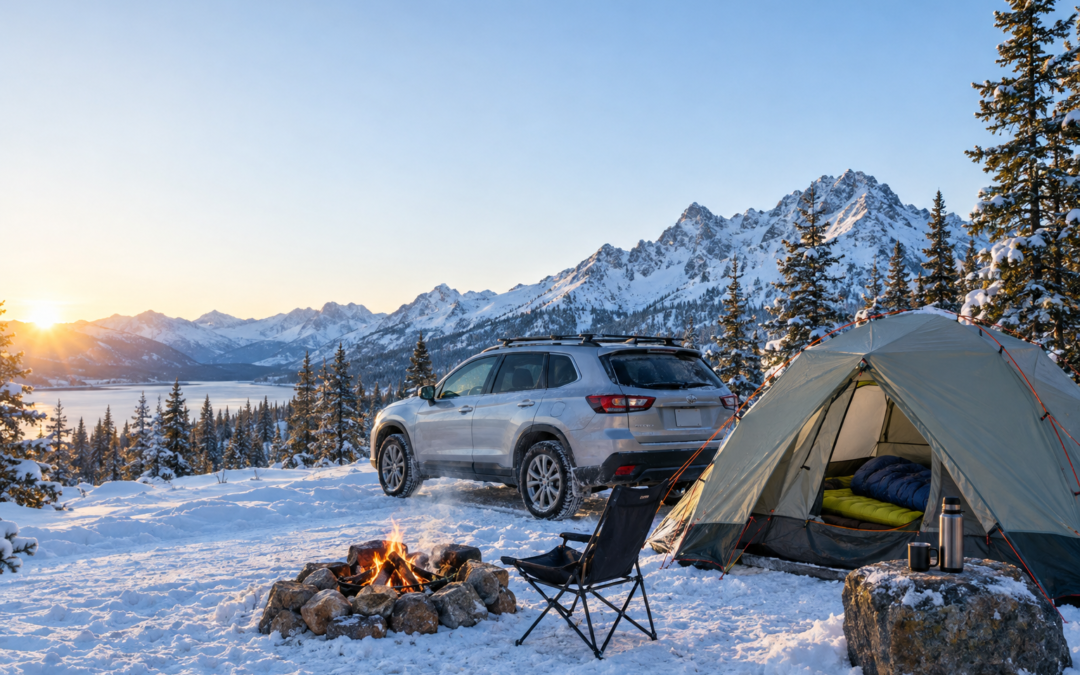
If you want to embrace the cold and experience the outdoors in a totally new way, we’ve compiled a few winter camping tips to help you get started.
Editor’s Note: This is a guide for car camping in the front country, in an established campsite. Winter camping is extreme enough, without adding things like backcountry orienteering and avalanche safety to the list. Plus, it’s comforting to know that if it all goes bad, you can always pull the ripcord and drive to a Motel 6.
Check The Forecast
There’s a big difference between camping with snow on the ground and camping during an active blizzard. On a calm clear day, you can really enjoy yourself. But when the wind is howling and it’s dumping snow, everything is miserable. Don’t get caught unprepared, know the weather before you go.
Check Your Gear
Make sure your gear can handle the conditions. If the nighttime low is 5° Fahrenheit and your sleeping bag is only rated to 15 degrees, either this isn’t your weekend, or you need a different bag. Also, double, and triple check you have everything you need before you leave. Again, the stakes are high, and forgetting even a single item (e.g., gloves) can ruin your trip.
Check Your Expectations
Cold-weather camping is nothing like summer camping. In fact, it’s better to think about the whole thing like you’re going into outer space. While the environment is breathtakingly beautiful, it is also completely inhospitable. The car is your spaceship, and the sleeping bag is your space capsule. You can exist in warmth and safety inside these two places. Everything else is a spacewalk that requires proper attire.
Layer Up
We’ve all been told to dress in layers since elementary school, but that doesn’t mean you should throw on every piece of clothing in your closet. There’s a specific way to layer to maximize your warmth and comfort in a variety of conditions.
The base layer should consist of a long-sleeved shirt and a pair of long johns made from wool or synthetic material. This layer is responsible for keeping your body dry and should wick away any internal perspiration.
The mid-layer should be a jacket with either down or synthetic insulation. This layer is responsible for trapping your body heat and is the chief thing keeping you warm.
The outer layer should be a waterproof and windproof shell made from a three-layer synthetic fabric. This layer is responsible for repelling external water and precipitation while wicking internal moisture and perspiration out.
Cotton Kills
Avoid wearing anything made from cotton – including underwear. When wet, cotton loses all its thermal properties and takes an extremely long time to dry. Instead, opt for wool and synthetic materials, which perform much better when cold and wet.
Socks, Hats, and Gloves
These are critical items that complete the overall clothing “system”. Extremities are the first part of the body to get cold, so make sure you have them properly covered. Again, look for wool and synthetic material that will not degrade if they accidentally get wet. You can double layer gloves and socks but be careful they are not so tight as to restrict blood flow.
One Pot Meals
There’s absolutely no shame in taking a few shortcuts when it’s freezing cold outside. The fewer number of steps between you and a warm meal, the better.
Keep Hydrated
It is very easy to get dehydrated in cold, dry conditions. Make sure you’re drinking water throughout the day. We recommend drinking warm water or a light tea, which both hydrates and warms the body.
Whiskey Weather
Forget beer. If the temperature is below freezing, they’ll just explode anyways. Warm whiskey drinks are the way to go.
Extra Fuel
Everything takes longer to cook when it’s cold outside, especially when you’re trying to bring near-frozen water to a rolling boil, so make sure to pack extra fuel canisters.
Hot Water Bottle
At night, fill your water bottle with boiling water and put it inside your sleeping bag. Not only will this warm up your bag, but it will ensure you have some non-frozen water to use in the morning. (Make sure the cap is on securely!)
Tent
A specifically designed 4-season tent is ideal for severe winter conditions, but for more mild winter weather a quality 3-season tent can work just as well. A strong, self-supporting structure is a must, though. Deep snow and frozen ground make it difficult for tents that need to be staked in to stay up.
Be Selective
You’ll probably have your pick of the campground, so look for an ideal location. Someplace with good sunlight and buffered from the wind. Don’t set up under a tree, especially if you are making a fire. If there is snow in the branches, this virtually guarantees it all comes crashing down on your tent.
Build A Foundation
Pack down the snow with your feet before setting up your tent. If your tent is set up on soft snow, you can accidentally punch a hole through the bottom when you step inside.
Sleeping Bag
Your sleeping bag should be your happy place. So, whether it’s down, synthetic, or a mix, make sure your sleeping bag is rated 10 degrees lower than the lowest expected temperature. Don’t cut it too close to the rating, or you’ll have all night to lie awake and regret your decision.
Insulation From the Ground
It is critical that you insulate yourself from the snow-covered ground. An insulated sleeping pad with an R-rating of at least R4 is a good start but adding in a few yoga mats or blankets is a good idea as well. (Do not use a regular air mattress. The air inside never warms up and it will drain your body heat all night long.)
Snack Early, Snack Often
With less effort than cooking a full meal, continually snacking throughout the day is a great way to keep warm. Eating a little bit here and there keeps your metabolism fired up.
Take A Hike
Winter camping is for active individuals. The best way to enjoy yourself is to keep moving throughout the day. Take a hike, go snowshoeing, have a snowball fight, go sledding. But whatever you do, keep the blood moving.
Conserve The Heat
After hiking for a while, you may start to get warm. Remove layers as needed to prevent yourself from sweating. But when you stop, immediately layer back up.
Skincare
While getting a tan might be the last thing on your mind, it’s important to wear sunscreen. Sun glare off the snow can very quickly result in a sunburn. Bring ChapStick and hand lotion. Apply regularly to keep skin from cracking.
Ten Digit Warning Sign
Don’t ignore cold fingers and toes. These are the early warning signs that your body is losing heat faster than it is generating it. Address the issue immediately. Get another layer on, get moving, or throw another log on the fire.
To Build a Fire
A well-fed campfire can be a blessing on a cold winter’s night. Even if it isn’t putting off that much heat, the flickering light still offers a psychological feeling of warmth. Bring plenty of wood. The last log always comes sooner than you think.
Tent Time
After the sun goes down, dinner is over, and the last log has been thrown on the fire, you may look at your watch and discover it’s only 7:45 PM. At this point crawling into your sleeping bag is the only way to stay warm, but tent time doesn’t necessarily mean bedtime. Pack a deck of cards or a board game and move the party inside.
Don’t Hold It
Getting up to pee might be the absolute last thing you want to do when you’re wrapped up inside your sleeping bag, but it’s going to make you warmer. Your body prioritizes heating your torso, which is full of critical organs but also includes your very full bladder. It takes a lot of energy to keep all that liquid at a constant 98.6 F degree, so help your body out and break the seal.
Battery Life
Lithium-ion batteries will drain much faster in cold weather and will eventually stop working altogether if it gets cold enough. To extend your cell phone battery life, keep your device close to your person during the day, and at night bring it with you inside your sleeping bag.
Above all else, the most important thing required for winter camping is a positive attitude. Nothing warms the spirit like a bit of humor, nothing breaks the ice like some levity. Yes, it will be cold. Yes, it will be somewhat of a struggle. But for those sanguine individuals willing to brave the elements and put up with a little discomfort, there are spectacular rewards. Like being able to see Yosemite covered in snow, with hardly another person in the entire park.
State-by-State Guide to RV Living Laws on Private Property
Last updated: September 12, 2026
Disclaimer: Local zoning laws dictate RV and camper regulations. The information below is for educational purposes and does not constitute legal advice. Always consult your local county zoning office before allowing someone to live in an RV on your property.
In my 35+ years of RV camping across federal lands and private properties, I’ve learned one critical thing about hosting someone in an RV on your property: it’s heavily restricted or regulated in many US jurisdictions, because HUD and state codes treat RVs as temporary-use vehicles rather than permanent dwellings. But “illegal” doesn’t tell the whole story.
The real answer depends on three overlapping factors: state statutes establish the baseline, county ordinances add specifics, and zoning classifications determine actual enforcement. What is permitted in some rural Texas counties may be prohibited in suburban Delaware. Verify state and local law before relying on any general statement. This guide, part of our RV resources library, cuts through the confusion with a comprehensive 50-state analysis, permit cost breakdowns, and the landlord-tenant law implications that most property owners completely miss.
I’m Chuck Price, and my wife Cindy and I have spent decades testing these rules firsthand, from BLM camping on federal lands to navigating municipal codes for private property hosting. Unlike the solar generator companies and generic legal sites dominating this topic, we focus on evidence-based analysis backed by actual state statutes, not marketing claims.
Key Takeaways
Living in an RV on private property is heavily restricted in many US jurisdictions due to HUD classification as recreational vehicles, not permanent dwellings
At least 10 US states are generally permissive toward RV dwelling on private property at the state level (though county regulations still apply), while 4 states effectively prohibit it through consistent state-level restrictions or uniform local enforcement
Urban areas typically limit RV stays to 7-14 days without permits, while rural jurisdictions may permit 90-180 days or indefinite agricultural use (based on typical patterns in sample municipal codes)
In many states, continuous occupancy for around 30-60 days with the owner’s permission is enough for courts to treat someone as a tenant, triggering eviction requirements even without rent or written lease
Based on sample market quotes, temporary use permits typically cost $50-$200 for 30-90 days, conditional use permits cost $200-$500 for 6-12 months across sampled jurisdictions. Fee ranges are as of February 2026. Confirm current fees with your county planning department before applying
HOA restrictions through CC&Rs are legally enforceable through civil action and often stricter than government zoning laws
Standard homeowner’s insurance may not cover liability for RV dwellers, requiring additional coverage verification with your carrier
Scenario 1: Can a family member live in a camper in my backyard?
Generally no for permanent residence, but temporary visitor permits of 14-30 days are usually allowed depending on the municipality. Even rent-free family arrangements can trigger landlord-tenant protections after 30-60 days of continuous occupancy in many states, meaning you’d need a formal court eviction process to remove them even if no money ever changed hands.
Scenario 2: Can I rent my land to a stranger with an RV?
Rarely legal without commercial zoning or establishing an official RV park or campground. Collecting rent from an RV dweller on residentially zoned land typically violates municipal codes, may void your homeowner’s insurance coverage, and creates landlord obligations, including full tenant eviction rights, from day one of occupancy.
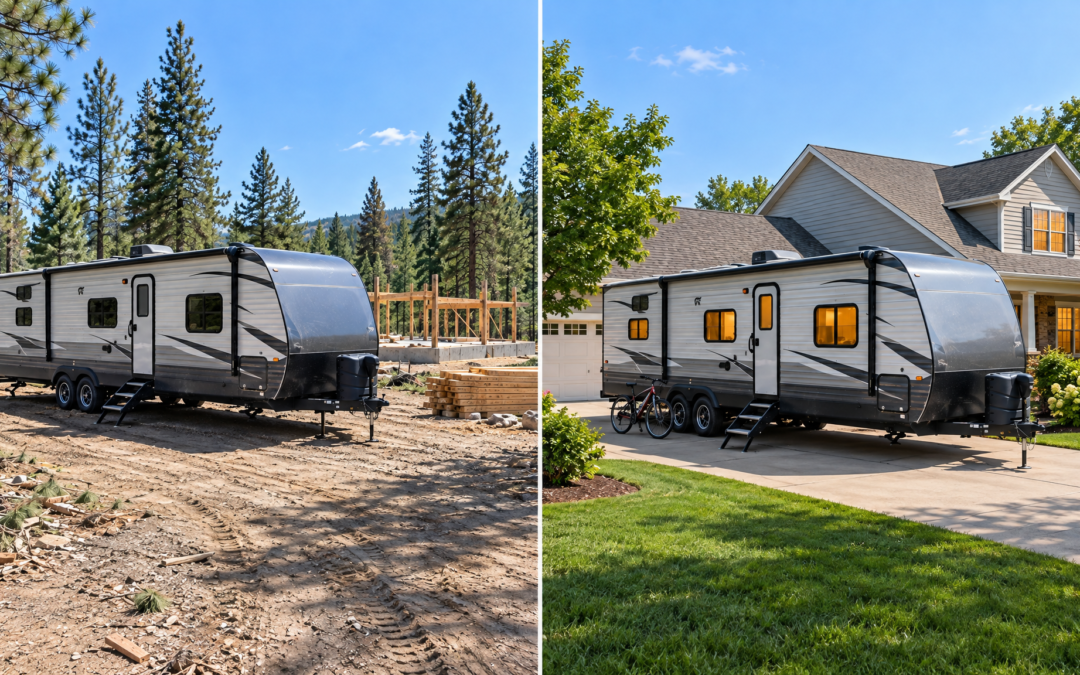
Scenario 3: Can I live in an RV while building my house?
Often yes, provided you have an active building permit and a temporary use permit from your local jurisdiction. Most counties grant construction exception permits for 6-12 months with periodic progress inspections required, and one extension is typically available if construction delays are documented. See Section 5 for permit costs and application steps.
Is It Legal to Live in a Camper on Your Property?
RV living on private property is restricted in many US jurisdictions because HUD classifies RVs as temporary-use vehicles, not dwellings. However, legality depends on three factors: state statutes, county ordinances, and zoning classification.
IMPORTANT: RV dwelling legality depends on three overlapping factors: (1) state statutes, (2) county ordinances, (3) zoning classification. What’s legal in Texas may be prohibited in Delaware. Always verify with your local zoning department before hosting an RV dweller on your property.
The federal baseline comes from the U.S. Department of Housing and Urban Development. Federal regulations define a recreational vehicle as one “designed only for recreational use and not as a primary residence or for permanent occupancy” (24 CFR 3282.15). This classification creates the foundation for most local restrictions, but HUD doesn’t prohibit RV dwelling directly. Instead, state and local governments interpret this classification through their own zoning codes and building regulations.
State laws divide into three categories:
Generally Permissive: States like Texas, Arizona, and South Dakota are generally permissive toward RV dwelling on private property at the state level, leaving most regulation to local governments without imposing state-level prohibitions. County and city regulations still apply and can impose significant restrictions.
Effectively Prohibited: Hawaii, Delaware, Indiana, and Michigan effectively prohibit using RVs as permanent residences on private property through state-level restrictions or consistent enforcement across counties, though narrow exceptions (such as short-term stays or construction periods) may exist.
Conditional: Most states (30) fall into this category, where legality depends entirely on county ordinances and municipal codes. Florida, for example, shows extreme county variation with some inland counties being more permissive while many coastal counties prohibit or severely restrict private-property RV dwellings.
This three-tier system creates confusion because property owners often assume state law determines legality. In reality, your county zoning code carries more weight. Even in generally permissive states like Texas, individual cities can prohibit RV dwelling in residential zones through local ordinances.
The distinction between private property RV dwelling and public lands like BLM areas is critical. Federal lands operate under entirely separate regulations managed by agencies like the Bureau of Land Management and National Park Service. While BLM land generally limits dispersed camping to 14 days within a 28-day period, with limits varying by state and field office (see BLM camping guidance), private property dwelling faces far more complex legal requirements.
The next section breaks down all 50 states with specific legal status, key restrictions, and permit requirements to help you determine your property’s RV dwelling eligibility.
At least 10 states are permissive at the state level and 4 effectively prohibit RV dwelling, though county rules still control. Most states (30) fall into a conditional category where county ordinances and zoning classifications determine actual legality.
This table compiles state-level patterns from state statutes, state agency guidance, and municipal code databases as of February 2026. Classifications reflect the general statutory posture at the state level only. County and city ordinances control in every case, so confirm your specific location with the local planning or zoning office.
State
Legal Status
Key Restrictions
Permit Required?
Use-Case Notes
Alabama
Allowed
No broad state-level prohibition; local zoning and health codes govern where and how RVs may be used as dwellings
Varies by county and municipality
Rural areas may be more flexible, but owners must confirm rules with the local planning and zoning office
Alaska
Conditional
Borough-dependent, remote areas lenient
Yes (populated areas)
Unincorporated areas more flexible
Arizona
Allowed
No statewide ban on RV dwelling; counties and cities set specific standards for placement, hookups, and duration
County- and city-dependent
Popular RV destination with generally permissive attitudes in many rural jurisdictions, but urban areas can impose tight limits
Arkansas
Conditional
County ordinances vary significantly
Yes (most counties)
Rural areas more lenient than cities
California
Conditional
Strict local regulations, short-term only in most areas
Yes, often denied
Very restrictive in coastal/urban counties
Colorado
Allowed
State law does not categorically forbid RVs as dwellings; each county or city uses its own zoning and land-use rules
County- and city-dependent
Mountain and rural counties may offer more options than Front Range metro areas; always check local zoning maps and codes
Connecticut
Restricted
Many municipalities limit RV use as a dwelling to licensed campgrounds or RV parks; private-property occupancy is often short-term or prohibited by local zoning
Yes, in the few areas that allow longer stays
Expect strict regulation in most towns and cities; any private-property dwelling plans require careful review of local code and health regulations
Delaware
Prohibited
RVs treated as vehicles, not dwellings; long-term living on private property is not allowed outside licensed campgrounds and RV parks
N/A for permanent dwelling; local codes may allow short stays or campground permits
Violations can lead to code enforcement and fines; property owners must use licensed parks for long-term RV occupancy
Florida
Conditional
Extreme county variation; some inland counties are more permissive while many coastal counties prohibit or severely restrict
Yes (where allowed)
County-by-county variation is significant; research specific county ordinances before planning RV dwelling
Georgia
Conditional
County ordinances determine legality
Yes (most areas)
Rural counties more permissive
Hawaii
Prohibited
Full-time RV dwelling on private property generally not allowed; limited temporary use may be permitted during permitted home construction in some counties
N/A for permanent dwelling; check county rules for temporary construction use
Vehicle-dwelling is heavily restricted; county codes focus on protecting residential housing stock and health/sanitation standards
Idaho
Conditional
Some counties impose seasonal occupancy restrictions and duration limits; wastewater hookups typically required
Yes
Check specific county code for seasonal restrictions and duration limits
Illinois
Conditional
County and municipal regulations vary
Yes (where allowed)
Chicago area very restrictive
Indiana
Prohibited
Many counties prohibit using RVs as dwellings on private property outside approved parks or limited temporary/construction exceptions
Rarely granted for private property; some counties allow short-term or construction-related occupancy with permits
In practice, full-time RV living on your own land is effectively barred in much of the state; always confirm with county planning/zoning
Iowa
Conditional
County-dependent, agricultural zones more lenient
Yes (most counties)
Rural areas generally permit with restrictions
Kansas
Conditional
County ordinances vary, check local zoning
County-dependent
Western rural counties more permissive
Kentucky
Restricted
Many jurisdictions allow RVs only in designated parks or as short-term, accessory, or construction-related housing; using an RV as a primary residence on standard residential lots is often barred
Yes, where local ordinances provide temporary or special-use permits
Rural counties may offer limited flexibility, but overall the state leans restrictive for long-term RV dwelling on private property
Louisiana
Conditional
Parish-dependent regulations
Yes (most parishes)
Rural parishes more lenient
Maine
Conditional
Town-by-town variation, seasonal considerations
Yes (most towns)
Winterization requirements in cold months
Maryland
Restricted
Zoning in many counties treats RVs as temporary or recreational units and generally bars their use as primary residences on standard residential lots
Yes, where local codes provide a narrow path (e.g., temporary or special use)
Long-term RV dwelling is difficult to legalize on private property; most owners must rely on RV parks or specially zoned areas
Massachusetts
Conditional
Town-by-town rules; some communities allow RV dwelling on residential-zoned private land with permits and code compliance, while others confine long-term RV use to licensed parks
Yes (where allowed)
Expect stricter rules in dense or coastal municipalities and more flexibility in some rural towns; always verify zoning, health, and septic requirements in advance
Michigan
Prohibited
Zoning and health codes generally prevent using RVs as permanent residences on private property outside licensed parks
N/A for permanent dwelling; limited short-term or construction-related use may be allowed where codes provide for it
Commonly cited as a state where full-time RV living on your own land is not allowed; local deed restrictions can further limit RV use
Minnesota
Conditional
County-dependent, winterization concerns
Yes (most counties)
Cold climate creates practical limitations
Mississippi
Allowed
No overarching state prohibition; local governments regulate RV dwelling through zoning, septic, and building codes
Varies by county
Often considered RV-friendly in many rural counties, but specific conditions and limits still depend on local ordinances
Missouri
Allowed
State law leaves most decisions about RV dwelling to counties and municipalities, which regulate via zoning and health codes
County-dependent
Rural areas may allow longer stays or more informal setups than cities and suburbs; local verification is essential
Montana
Allowed
No broad state ban; counties and cities set their own standards for RVs used as dwellings, including hookup and duration requirements
Rural areas: often minimal; urban areas: more likely to require permits
Popular among full-time RVers, but rules still vary widely between rural counties and growth corridors
Nebraska
Conditional
County regulations vary
Yes (most counties)
Agricultural zones more lenient
Nevada
Allowed
State is generally RV-friendly, but each county and city regulates whether RVs can be used as dwellings on private property and for how long
County-dependent
Rural desert counties may allow more flexibility than metro areas like Las Vegas or Reno; check local code before establishing domicile
New Hampshire
Conditional
Town-dependent, seasonal considerations
Yes (most towns)
Northern rural areas more lenient
New Jersey
Conditional
Municipality-dependent; some towns allow RV dwelling on private property with permits and compliance with zoning and health codes
Yes (where allowed)
Urban/suburban areas often limit or prohibit long-term occupancy; research local ordinances carefully before planning full-time RV living
New Mexico
Allowed
No statewide prohibition on RVs as dwellings; local zoning, septic, and building standards control what is permitted on each property
County- and city-dependent
Rural counties are often quite flexible, while some cities restrict or time-limit private-property RV occupancy
New York
Conditional
City and town zoning varies; large cities commonly prohibit RVs as primary residences outside licensed campgrounds, while some rural areas may allow them on private land with approvals
Yes (where allowed)
Full-time RV living may be possible on residential property in cooperative rural jurisdictions, but you must confirm with the local building and zoning office
North Carolina
Conditional
County-by-county variation
Yes (most counties)
Western rural counties more permissive
North Dakota
Conditional
County ordinances determine legality
Yes (most counties)
Rural areas generally permit
Ohio
Conditional
County and city regulations vary significantly
Yes (where allowed)
Rural counties more lenient
Oklahoma
Conditional
County-dependent, generally moderate restrictions
Yes (most counties)
Rural areas more permissive
Oregon
Allowed
Senate Bill 1013 (2023, effective January 1, 2024) lets a county allow one RV used as a residence on rural residential land, but only where an owner-occupied primary home already sits on the property and a residential rental agreement is in place. County option, not a statewide right
County-dependent
Recent law expanded options for using RVs as housing, but owners must follow county-specific rules and any local limits on hookups and duration
Pennsylvania
Conditional
Municipality-dependent, urban areas restrictive
Yes (where allowed)
Rural counties more lenient
Rhode Island
Restricted
Small, densely regulated state where many municipalities confine long-term RV occupancy to licensed campgrounds and prohibit use as a primary dwelling on typical residential lots
Yes, but often limited to campground or special zoning contexts
Owners should assume tight limits on private-property RV dwelling and verify any potential exceptions directly with local zoning officials
South Carolina
Conditional
County-by-county variation
Yes (most counties)
Coastal areas more restrictive
South Dakota
Allowed
Generally regarded as RV-friendly at the state level; some cities still require temporary camping permits or limit private-property stays
Minimal in some areas; local permits in others
Popular domicile state for full-time RVers, but city ordinances (for example, temporary camping overlays) can restrict where and how long you can stay
Tennessee
Conditional
County ordinances vary
Yes (most counties)
Eastern rural counties more lenient
Texas
Allowed
No broad state prohibition; counties and cities decide where RVs can be used as dwellings and what standards apply (septic, electric, duration)
County- and city-dependent
Often viewed as one of the more RV-friendly states, but major cities like Austin or Dallas can have strict limits on RVs in residential zones
Utah
Conditional
County-by-county, rural areas more lenient
Yes (most areas)
Salt Lake area more restrictive
Vermont
Conditional
Town-by-town variation, seasonal considerations
Yes (most towns)
Rural towns more flexible
Virginia
Conditional
County regulations vary, urban areas restrictive
Yes (where allowed)
Southwest rural counties more lenient
Washington
Conditional
County-dependent, conditional use permits common
Yes (most counties)
Eastern rural counties more permissive
West Virginia
Conditional
County ordinances vary, generally moderate
Yes (most counties)
Rural areas more lenient
Wisconsin
Conditional
County-by-county, seasonal considerations
Yes (most counties)
Northern rural counties more permissive
Wyoming
Allowed
State imposes few specific restrictions on RV dwelling; local governments regulate siting, hookups, and duration on private property
County-dependent
Rural counties can be very accommodating, but resort and gateway communities may enforce stricter rules
Key Legal Status Definitions:
Allowed: State is generally permissive at the state level with minimal state-imposed restrictions; actual legality and conditions determined by county and city zoning, septic, and building codes
Conditional: County-by-county variation, requires local verification
Restricted: Many jurisdictions within the state prohibit or severely limit dwelling through local codes
Prohibited: State effectively prohibits RV dwelling on private property through state-level restrictions or consistent enforcement across counties, though narrow exceptions (short-term stays, construction) may exist
Important Notes (as of February 2026): This table reflects general state patterns based on publicly available statutes and local code guidance. Even in “Allowed” states, specific cities or counties may prohibit RV dwelling through local ordinances. Even in “Prohibited” states, short-term stays (7-14 days) may be permitted. Always verify with your local zoning department before hosting an RV dweller.
County-level research is essential. For example, Florida’s legal status as “Conditional” means significant variation exists across counties. Even in generally permissive states like Texas, individual cities can impose specific zoning restrictions in residential districts.
State Zoning Quick-Reference: 5 High-Population States
The 50-state table above covers general legal status. This table goes one level deeper for five high-population states, summarizing the typical local enforcement stance, how long you can realistically stay without triggering a permit requirement, and what exceptions actually get used. County and municipal ordinances still control enforcement; always verify with your local planning department.
State / Region
General Stance on Full-Time RV Living
Typical Temporary Limit
Common Exceptions
Texas
Generally permissive at state level; no statewide ban. Counties and cities set their own standards for placement, hookups, and duration. Major cities (Austin, Dallas) impose strict residential-zone limits despite the state’s overall RV-friendly reputation.
Urban: 7-14 days without permit. Rural/unincorporated: often unrestricted
Agricultural zoning (A-1) and rural unincorporated areas often allow indefinite stays; construction exception permits available statewide; farm worker housing exemption in many counties
California
Conditional with strict local enforcement in most jurisdictions, especially coastal and urban counties. Long-term permits frequently denied. Inland rural counties (e.g., Siskiyou, Modoc, Trinity) apply lighter enforcement than the Bay Area or SoCal coast.
Coastal/urban: 7-14 days. Some counties limit to 3 consecutive days on one parcel per week
Active construction on same parcel (most counties); agricultural worker housing in A-1 zones; documented hardship temporary permits in select inland counties
Florida
Conditional with extreme county variation. Inland counties (Highlands, Okeechobee, Glades) more permissive; most coastal counties prohibit or severely restrict private-property RV dwelling. The same state law (§720.3045, 2023) restricts HOAs from banning RV storage but does not address dwelling use.
Coastal counties: 7-14 days or effectively prohibited outside licensed parks. Inland: 30-90 days with permit
Construction permits; agricultural worker housing; temporary hardship permits; §720.3045 limits HOA storage bans (not dwelling bans)
New York
Conditional. NYC metro area and Long Island prohibit RVs as primary residences outside licensed campgrounds. Upstate and North Country rural jurisdictions (e.g., St. Lawrence, Franklin, Hamilton counties) allow private-property stays with local approvals and are notably more flexible.
NYC/suburbs: effectively prohibited outside campgrounds. Rural upstate: 30-90 days with permit
Rural cooperative jurisdictions; construction exceptions in most upstate counties; agricultural zones in Hudson Valley and Western NY; caregiver accommodation permits in some counties
Washington
Conditional with conditional use permits common statewide. Western counties (King, Pierce, Snohomish) are restrictive in line with urban density pressures. Eastern rural counties (Okanogan, Ferry, Stevens, Lincoln) are significantly more permissive and complaint-driven in enforcement.
Western WA: 14-30 days without permit. Eastern WA: 90-180 days or longer in agricultural zones
Construction exception permits statewide; agricultural worker housing exemption; caregiver accommodation permits in many counties; rural unincorporated areas with minimal enforcement
Sources: State statutes, county municipal code databases, and state agency guidance as of February 2026. Verify current requirements with your local zoning department before making any decisions.
How Long Can Someone Live in an RV on Your Property?
Duration limits for RV dwelling on private property vary by jurisdiction type. Based on typical patterns observed in sample municipal codes, urban residential zones typically limit stays to 7-14 days without permits, suburban areas permit 30-60 days with temporary use permits, and rural jurisdictions may allow 90-180 days or indefinite stays in agricultural zones.
These timelines come from municipal ordinances, which create a patchwork of regulations across jurisdictions. The distinction between “parking” and “dwelling” becomes legally significant when enforcement actions begin. Most ordinances define “dwelling” as connecting to utilities (water, sewer, electric) or occupying the RV for sleeping purposes beyond the specified limit.
Duration by Jurisdiction Type
Urban Residential Zones (R-1, R-2): Cities enforce the strictest limitations, typically 7-14 days per calendar year without permits in many jurisdictions. Some major cities prohibit RV dwelling in residential zones entirely. Urban enforcement is usually proactive, with code enforcement officers conducting regular patrols rather than relying solely on neighbor complaints.
Suburban Residential Areas: Suburban jurisdictions typically allow 30-60 days with temporary use permits costing $50-$200 based on sample fee schedules. These permits often include requirements for screened parking locations (not visible from street) and utility hookup restrictions. Permit renewals are typically limited to one or two consecutive periods before a mandatory break.
Rural Residential and Agricultural Zones: Rural counties offer the most flexibility, with duration limits ranging from 90-180 days to indefinite occupancy in agricultural zones. Some counties classify RV dwelling as agricultural worker housing, which bypasses residential zoning restrictions entirely. Enforcement in rural areas is almost exclusively complaint-driven rather than proactive.
Unincorporated Areas: Properties outside city limits but within county jurisdiction often face fewer restrictions. Duration limits extend to 180 days or may be entirely unrestricted depending on county code. However, utility requirements (septic systems, well water) still apply.
Construction Exception (6-12 Months)
Many jurisdictions offer extended duration allowances for property owners actively constructing a permanent residence. Conditional use permits for construction typically allow 6-12 months of RV occupancy with these requirements:
Active building permit for permanent residence on same property
Demonstrable construction progress (regular inspections)
Written construction timeline with milestones
Temporary utility hookups meeting health code requirements
One-time extension possible if construction delays documented
This exception significantly extends how long someone can live in an RV on your property when paired with legitimate construction activity. Jurisdictions monitor these permits closely to prevent indefinite occupancy disguised as construction projects.
Enforcement Probability Matrix by Jurisdiction Type (Based on Sample Jurisdictions)
Jurisdiction Type
Typical Duration Limit
Enforcement Frequency
Penalty Range (Sample)
Urban Residential
7-14 days/year
Proactive patrols, high enforcement
$250-$1,000/day fines in sample jurisdictions
Suburban Residential
30-60 days with permit
Complaint-driven, moderate enforcement
$150-$500/violation in sample jurisdictions
Rural/Agricultural
90-180 days or indefinite
Complaint-driven only, low enforcement
$100-$300/violation in sample jurisdictions
Unincorporated County
180 days or unrestricted
Rarely enforced, complaint-driven
Varies by county
Enforcement Reality vs Written Code
Written ordinances don’t always reflect enforcement reality. Rural counties may have 90-day written limits but rarely enforce them without neighbor complaints. Urban areas enforce 14-day limits aggressively through regular patrols. Understanding enforcement patterns matters as much as knowing the written code.
Enforcement triggers typically include: visible utility connections from street, multiple vehicles on property suggesting permanent occupancy, neighbor complaints about noise or parking, expired vehicle registration visible on RV, or code enforcement spot checks in residential neighborhoods.
The concept of “temporary” vs “permanent” occupancy creates legal gray areas. Many jurisdictions consider utility connections as evidence of permanent occupancy regardless of duration. Disconnecting utilities during daytime hours doesn’t eliminate dwelling classification if the occupant sleeps in the RV overnight.
The next sections detail zoning classifications, permit types and costs, and landlord-tenant law implications that apply when hosting reaches 30-60 day thresholds in many states.
Zoning Laws and RV Property Dwelling Regulations
Zoning classifications determine RV dwelling permissibility more than state laws in most jurisdictions. Residential zones (R-1, R-2) typically prohibit permanent RV occupancy, agricultural zones (A-1) often permit it for farm workers, and rural residential zones (RR-5, RR-10) vary by county ordinances.
Municipal zoning codes divide land into categories with specific permitted uses. These codes establish what activities and structures are allowed on each parcel. RV dwelling falls into a gray area because RVs are classified as vehicles rather than structures, creating inconsistent treatment across zoning categories.
Primary Zoning Classifications
R-1 (Single-Family Residential): The most restrictive zone for RV dwelling. Most R-1 ordinances explicitly prohibit using RVs as dwellings beyond short-term guest stays (typically 7-14 days). Enforcement focuses on preventing permanent occupancy that circumvents minimum square footage requirements for residential structures. Utility connections to RVs in R-1 zones are often prohibited entirely.
R-2 (Multi-Family Residential): Slightly more flexible than R-1, but still restrictive. Some R-2 zones allow temporary RV occupancy with permits, particularly in areas zoned for duplex or triplex properties. Duration limits typically range from 30-60 days with permit requirements. The rationale: multi-family zoning already accommodates higher density, making RV dwelling less disruptive.
A-1 (Agricultural): Most permissive for RV dwelling. Agricultural zoning often includes provisions for farm worker housing, which can include RVs used by seasonal or permanent agricultural employees. Some counties classify property owner RV dwelling as incidental to agricultural operations, bypassing residential zoning restrictions. Requirements may include active farming operations or minimum acreage (often 5-10 acres).
RR-5 / RR-10 (Rural Residential): These hybrid zones blend residential and agricultural characteristics. The number indicates minimum lot size (RR-5 = 5 acres, RR-10 = 10 acres). RV dwelling regulations vary significantly by county. Some treat RR zones like agricultural (permissive), others like residential (restrictive). Generally more lenient than urban R-1 zones but stricter than pure agricultural.
Commercial / Industrial: Generally prohibit dwelling of any kind, including RVs, due to zoning intended for business operations. Exceptions exist for watchman or caretaker arrangements where RV occupancy is incidental to property security.
Zoning Classification Comparison for RV Dwelling
Zone Code
Description
RV Dwelling Allowed?
Typical Duration Limit
Common Requirements
R-1
Single-family residential
Rarely (short-term guest only)
7-14 days/year
No utility connections, guest status
R-2
Multi-family residential
Sometimes (with permit)
30-60 days
Temporary use permit, screening
A-1
Agricultural
Yes (farm worker housing)
Indefinite (agricultural use)
Active farming, minimum acreage
RR-5/RR-10
Rural residential (5 or 10 acre minimum)
County-dependent
90-180 days or indefinite
Minimum lot size, setbacks
C-1/I-1
Commercial/Industrial
No (except caretaker)
N/A
Business operations only
How to Check Your Property’s Zoning Designation
Determining your property’s zoning classification requires accessing county or municipal records. Follow these steps:
Visit County Assessor Website: Most counties maintain online property search tools. Search by address or parcel number (found on property tax statements).
Locate Zoning Code: Property records typically display zoning designation as 2-4 character codes (R-1, A-1, RR-5, etc.).
Review Zoning Ordinance: Search “[county name] zoning ordinance [code]” to find specific permitted uses for your zone classification.
Contact Planning Department: For ambiguous codes or RV-specific questions, call your county planning or zoning department directly. Request clarification on RV dwelling duration limits and permit requirements.
Check for Overlays: Some properties have overlay zones (floodplain, historic district, environmental protection) that add restrictions beyond base zoning.
Zoning verification is essential before hosting an RV dweller. Assuming your zone permits RV dwelling without verification creates legal risk. Even rural properties may have restrictive zoning if located within city planning jurisdictions or special districts.
Permit Requirements by Jurisdiction Type
Most jurisdictions require permits for RV dwelling on private property beyond short-term visits. Based on sample market research across 15 jurisdictions, temporary use permits typically cost $50-$200 for 30-90 day periods, conditional use permits cost $200-$500 for 6-12 months, and zoning variances cost $500-$2,000+ for permanent approval but are rarely granted for RV dwelling. Fee ranges are as of February 2026. Confirm current fees with your county planning department before applying.
Permit requirements create a revenue stream for municipalities while providing oversight of non-traditional housing. Understanding permit types and their limitations determines realistic hosting timelines.
Temporary Use Permit (30-90 Days)
Duration: Typically 30-90 days depending on jurisdiction. Some municipalities offer 30, 60, and 90-day options at different price points.
Cost Range: $50-$200 based on municipal fee schedules reviewed across 15 sample jurisdictions. Urban areas typically charge higher fees ($150-$200) while rural counties charge less ($50-$100).
Renewal Limitations: Most jurisdictions allow 1-2 renewals maximum before requiring a mandatory break (often 30 days). This prevents indefinite occupancy through consecutive temporary permits. Some jurisdictions prohibit consecutive temporary permits entirely, requiring gaps between each permit period.
Application Requirements:
Site plan showing RV location on property
Proof of property ownership (deed or tax statement)
Written waste management plan (portable tanks or septic connection)
Neighbor notification (within 300-500 feet in some jurisdictions)
RV registration and insurance documentation
Conditional Use Permit (6-12 Months)
Duration: Typically 6-12 months with specific conditions attached to approval. Extensions possible but require re-application and fee.
Cost Range: $200-$500 for initial permit in sample jurisdictions, plus potential inspection fees. Higher than temporary permits due to extended duration and additional oversight requirements.
Common Purposes:
Construction Exception: Property owner living in RV while building permanent residence. Requires active building permit and demonstrable construction progress with regular inspections.
Caregiver Accommodation: Family member providing care to elderly or disabled resident in main dwelling. May require medical documentation or affidavit explaining need.
Temporary Hardship: Natural disaster recovery, home damage repairs, or other documented temporary housing needs.
Requirements Beyond Temporary Permits:
Planning commission or board hearing (public comment period)
Detailed justification explaining why conditional use is warranted
Conditions documented in permit (timelines, progress benchmarks, inspection schedules)
Higher scrutiny for renewals or extensions
Zoning Variance (Permanent, Rarely Granted)
Duration: Permanent if approved, runs with property (transfers to future owners).
Cost Range: $500-$2,000+ for application alone in sample jurisdictions, not including potential attorney fees or multiple hearing appearances. Cost reflects extensive review process.
Approval Rate: Less than 10% for RV dwelling variances based on municipal data from sample jurisdictions. Variances require demonstrating “undue hardship” created by strict zoning application, which is difficult to prove for RV dwelling preference.
No self-created hardship (can’t buy property knowing zoning prohibits RV dwelling, then request variance)
Neighbor notification and public hearing(s)
Planning commission and potentially city council approval
Findings of fact documenting why variance serves public interest
Zoning variances are rarely appropriate for RV dwelling because preference for RV living doesn’t constitute hardship under variance criteria. Most applications are denied.
Special Exception Permits
Some jurisdictions offer special exception permits for specific scenarios:
Caregiver RVs: Permits for family members providing full-time care to elderly or disabled residents
Agricultural Worker Housing: RVs for seasonal or permanent farm employees on agricultural property
Construction Temporary Housing: Separate from conditional use permits, specifically for property owners during construction
Permit Type Comparison for RV Dwelling
Permit Type
Duration
Cost Range (Sample)
Typical Requirements
Renewal Allowed?
Temporary Use
30-90 days
$50-$200
Site plan, ownership proof, waste plan
Yes, 1-2 times max
Conditional Use
6-12 months
$200-$500
Public hearing, justification, conditions
Possible with re-application
Zoning Variance
Permanent (if approved)
$500-$2,000+
Hardship proof, public hearing, approvals
N/A (permanent)
Construction Exception
6-12 months
$150-$400
Active building permit, progress inspections
One-time extension if justified
Application Process Overview
The standard permit application process follows these general steps (specific procedures vary by jurisdiction):
Pre-Application Research: Verify zoning allows RV dwelling with permit. Contact planning department to confirm permit type needed and application requirements.
Application Submission: Submit complete application with all required documents and fees to planning or zoning department.
Review Period: Staff reviews application for completeness and compliance. May request additional information or clarifications.
Public Hearing (if required): Conditional use permits and variances typically require public hearings. Property owners present justification, neighbors can comment.
Decision: Planning department or commission issues approval, approval with conditions, or denial.
Inspection (if approved): Some permits require initial or periodic inspections to verify compliance with conditions.
Timeline: Temporary use permits typically process within 2-4 weeks. Conditional use permits requiring public hearings may take 6-12 weeks from application to decision. Zoning variances can extend 3-6 months due to multiple hearings and appeals periods.
Application denials can be appealed, but appeal processes add significant time and cost. Consulting with a local real estate attorney before applying for conditional use permits or variances is advisable given complexity and low approval rates.
Landlord-Tenant Law Implications for RV Dwellers
Property owners hosting RV dwellers face landlord-tenant law implications even without rent or written leases. In many states, continuous occupancy for around 30-60 days with the owner’s permission is enough for courts to treat someone as a tenant, triggering eviction requirements including 30-day notice periods and court orders to remove occupants. Exact thresholds vary by state and circumstance.
DISTINCTION: Landlord-tenant relationship forms based on duration and permission, NOT based on rent paid. Even family members living rent-free can become tenants after sufficient occupancy duration in most jurisdictions, triggering mandatory eviction procedures and tenant protections regardless of informal arrangements.
This legal reality surprises many property owners who assume informal arrangements avoid landlord-tenant law. The rationale: tenancy laws protect occupants from arbitrary removal regardless of how the relationship began. Payment of rent is irrelevant to tenancy formation under most state statutes.
When Landlord-Tenant Relationship Forms
State landlord-tenant statutes use different thresholds for tenancy formation, but many follow this pattern:
Duration Threshold: In many states, continuous occupancy for around 30-60 days with the owner’s permission is enough for courts to treat someone as a tenant. California presumes tenancy after 30 days. Michigan recognizes tenancy creation “when a person occupies premises with owner’s permission,” which courts interpret as 30-60 days for RV scenarios. Exact thresholds vary by state and circumstance.
Permission: Property owner explicitly or implicitly permits occupancy. Explicit permission includes verbal or written agreements. Implicit permission includes allowing utility connections, providing keys/access codes, or not objecting to ongoing occupancy.
Rent Payment NOT Required: Tenancy forms without any rent exchange. Family members, friends, or acquaintances living rent-free for sufficient duration become tenants with full protections.
Written Lease NOT Required: Oral agreements or no agreement at all can create tenancies. Written leases establish terms but aren’t necessary for tenancy formation.
Once tenancy forms, property owners become landlords with specific legal obligations and restrictions on removal rights. The informal nature of RV hosting doesn’t exempt property owners from these requirements.
Tenant Rights (Even Without Lease or Rent)
RV dwellers who cross the tenancy threshold gain substantial legal protections:
Right to Notice Before Eviction: Most states require 30-60 day written notice to terminate month-to-month tenancies. The notice must follow specific statutory format and delivery requirements. Verbal notices are typically insufficient.
Court Order Required for Removal: Property owners cannot forcibly remove tenants or their belongings. Physical removal requires filing eviction lawsuits (unlawful detainer actions) and obtaining court orders. Sheriff enforcement follows court orders.
Protection from “Self-Help” Evictions: Landlords cannot change locks, shut off utilities, remove belongings, or otherwise force tenant departure without court process. Self-help evictions can result in tenant lawsuits for damages, attorney fees, and penalties.
Right to Retrieve Belongings: Even after lawful eviction, tenants retain rights to retrieve personal property within specified timeframes (typically 15-30 days). Landlords must store belongings and provide access.
Habitable Conditions (if Utilities Provided): If property owner provides utility connections (water, electric, septic), habitability standards may apply requiring functional systems meeting health and safety codes.
Landlord Obligations and Liability
Property owners hosting RV dwellers who become tenants face several obligations:
Notice Requirements for Entry: Many states require 24-48 hour notice before entering tenant’s dwelling (the RV) except in emergencies.
Formal Eviction Process: Removal requires proper notice, waiting periods, court filings, hearings, and sheriff enforcement. Total timeline typically 60-120 days from initial notice to physical removal.
Habitability Standards (Conditional): If providing utilities, landlords may be responsible for maintaining functional systems (water, electric, septic). Failure can result in repair obligations or rent withholding rights.
Injury Liability: Property owners may face premises liability for injuries occurring on property or related to utility connections. Standard homeowner’s insurance may not cover tenant-related injuries.
Eviction Process for RV Tenants
When property owners need to remove RV dwellers who have become tenants, the formal eviction process applies:
Written Notice to Vacate: Deliver proper statutory notice (30-60 days for month-to-month tenancies without cause). Notice must follow state-specific format requirements and be delivered via certified mail or personal service.
Wait for Notice Period: Allow full notice period to expire. Tenant departure during notice period resolves matter without court involvement.
File Eviction Lawsuit: If tenant doesn’t vacate after notice expires, file unlawful detainer action in county court. Filing fees typically $150-$400 depending on jurisdiction.
Court Hearing: Attend hearing where both parties present evidence. Property owner must prove proper notice was given and tenancy should terminate. Tenant can raise defenses (improper notice, habitability issues, retaliation).
Court Order for Possession: If property owner prevails, court issues order for possession (writ of restitution). Order authorizes sheriff to physically remove tenant if necessary.
Sheriff Enforcement: Sheriff posts notice of pending enforcement (typically 24-72 hours). If tenant doesn’t vacate voluntarily, sheriff physically removes tenant and belongings.
Total Timeline: 60-120 days typical from initial notice to physical removal. Delays occur if tenant contests hearing, requests continuances, or files appeals. Attorney representation ($1,500-$3,000) is common for contested evictions.
ILLUSTRATIVE EXAMPLE: Michigan property owner allowed adult daughter and son-in-law to live in RV on property for one year rent-free. When the relationship deteriorated, removing them required a formal court eviction rather than self-help, even without rent or a written lease. Michigan’s anti-lockout statute, MCL 600.2918, prohibits forcibly removing an occupant or otherwise interfering with their possession outside the court process. Verbal removal requests were insufficient.
Landlord-Tenant Status by Scenario
Scenario
Duration
Rent Paid?
Tenant Rights?
Eviction Required?
Family member, no rent
3 months+
No
Yes (tenancy likely formed)
Yes (formal process)
Paying tenant
6 months+
Yes ($350/month)
Yes (clear tenancy)
Yes (formal process)
Short-term guest
2 weeks
No
No (guest status)
No (trespass removal)
Construction temp housing
1 year (self-occupied)
No (owner living in own RV)
N/A (owner-occupied)
N/A (not applicable)
Family Member vs Tenant Distinction
Property owners often assume family relationships exempt them from landlord-tenant law. This assumption is incorrect. Family members become tenants like any other occupant when duration and permission elements combine. Courts explicitly reject “family member” defenses to eviction procedures.
The Michigan example above demonstrates this principle. Adult children living on parents’ property in RVs can become tenants requiring formal eviction despite family relationship. Written family agreements can clarify expectations but don’t override statutory tenancy protections once formed.
To minimize landlord-tenant law complications when hosting family members or friends:
Set Clear Duration Limits: Put time limits in writing (60 days maximum, for example) and enforce them strictly.
Require Periodic Departures: Built-in breaks (leave property for 7-14 days every 60-90 days) may interrupt continuous occupancy, though legal effectiveness varies by state.
Document “Guest” Status: Written agreements stating occupant is temporary guest, not tenant, may help but won’t override statutory tenancy if duration threshold passes.
Avoid Utility Connections When Possible: Limiting utility access may reduce tenancy implication, though occupancy duration remains primary factor.
Consult Attorney Before Extended Hosting: For anticipated stays exceeding 60 days, consult real estate attorney about structuring arrangement to minimize landlord-tenant law exposure.
The next section addresses how HOA restrictions operate independently from government zoning, creating an additional layer of legal complexity for property owners considering RV dwelling on their land.
HOA Restrictions vs Government Zoning Laws
HOA restrictions through covenants, conditions, and restrictions (CC&Rs) can prohibit RV dwelling even where government zoning allows it. CC&Rs are private agreements recorded with property deeds, enforceable through civil lawsuits rather than code enforcement, and often more restrictive than municipal regulations.
DISTINCTION: HOA restrictions (CC&Rs) vs government zoning laws:
CC&Rs = Private agreements between property owners, enforced through civil lawsuits by HOA
Zoning laws = Government regulations, enforced through municipal code enforcement and criminal penalties
Both can prohibit RV dwelling, but enforcement mechanisms and legal remedies differ significantly.
Property owners in HOA-governed communities face dual compliance requirements: government zoning codes AND HOA CC&Rs. Even if municipal zoning permits RV dwelling, HOA CC&Rs can prohibit it entirely. This creates situations where legal compliance with government regulations doesn’t protect against HOA enforcement action.
HOA vs Government: Key Differences
HOA Restrictions vs Government Zoning Comparison
Factor
HOA Restrictions (CC&Rs)
Government Zoning
Key Difference
Authority Source
Private contract between property owners
Municipal or county government
CC&Rs arise from a private agreement recorded on the deed, zoning is imposed by government
Enforcement Method
HOA board sues violator in civil court
Code enforcement issues citations, criminal penalties possible
Civil vs criminal proceedings
Penalties
Fines ($50-$200/day), injunctions, attorney fees, liens on property
Planning commission, city council, administrative appeals
HOA appeals less formal than government
Bindingness
Binds current AND future property owners (runs with deed)
Applies to all property in zoning district
CC&Rs transfer with property sales
Common HOA RV Restrictions
HOA CC&Rs typically include several types of RV-related restrictions:
Complete Dwelling Prohibitions: “No recreational vehicles shall be used for dwelling purposes on any lot.” This language prohibits RV occupancy regardless of duration or circumstances.
Duration Limits Stricter Than Government: HOAs may impose 7-day limits where municipal code allows 30 days, or prohibit RV dwelling entirely where county permits it with permits.
Visibility Requirements: RVs must be screened from street view, stored in enclosed garages, or parked behind fences. Florida’s 2023 statute (§720.3045) bars HOAs from banning RV storage, but only protects RVs not visible from the parcel’s frontage or an adjacent parcel.
Guest Vehicle Restrictions: Limitations on how long guest RVs can be parked (typically 24-72 hours), even if no dwelling occurs.
Size and Type Restrictions: Prohibitions on specific RV types (Class A motorhomes, fifth-wheels over certain length) or requirements for particular parking pad specifications.
Florida Exception: §720.3045 (2023)
Florida enacted legislation in 2023 limiting HOA authority over RV storage. The statute prohibits HOAs from banning RV storage on property but allows restrictions on visibility. Key provisions:
HOAs cannot prohibit property owners from storing RVs on their property
HOAs can still restrict RVs that are visible from the parcel’s frontage or an adjacent parcel
Law addresses storage only, not dwelling use (HOAs may still prohibit occupancy)
Applies to properties with HOAs, does not affect non-HOA properties
This Florida statute represents growing legislative pushback against restrictive HOA rules, but most states have not enacted similar protections. The statute’s limitation to storage (not dwelling) means Florida HOAs can still prohibit living in RVs on property through CC&R dwelling restrictions.
HOA Enforcement Mechanisms
HOAs enforce CC&Rs through escalating actions:
Violation Notice: Written notice citing specific CC&R provision violated, typically 10-30 days to cure violation
Hearing Before HOA Board: Property owner can present defense or request accommodation
Fines: Daily fines ($50-$200/day typical) accumulating until violation resolved
Civil Lawsuit: HOA files injunction lawsuit seeking court order for compliance plus attorney fees
Lien on Property: Unpaid HOA fines can result in liens on property title, affecting refinancing or sale
HOA enforcement is often more aggressive than government code enforcement because HOA boards answer to dues-paying members who expect rule compliance. Neighbor complaints within HOAs trigger quicker enforcement than similar complaints to municipal code enforcement.
Workaround Strategies (Limited Effectiveness)
Property owners seeking to circumvent HOA RV restrictions have limited options:
Request Variance from HOA Board: Submit written request explaining circumstances (caregiver need, construction timeline). Success rate low unless CC&Rs explicitly allow board variances.
Propose CC&R Amendment: Amendments typically require 67-75% property owner approval. Extremely difficult to achieve unless community sentiment supports RV dwelling.
Hardship Accommodation: Some states’ fair housing laws may require HOA reasonable accommodation for disabilities (caregiver RV for disabled family member). Requires medical documentation.
Deed Restriction Removal: Requires legal action, rarely successful. CC&Rs run with property deeds and bind future owners, making removal legally complex.
Pre-Purchase Due Diligence
Property buyers planning RV dwelling must review HOA documents before purchase:
Review Complete CC&Rs: Request full CC&Rs, amendments, and architectural guidelines from seller or HOA management company
Search “Recreational Vehicle” Provisions: Search documents for RV, camper, trailer, mobile home references
Check HOA Meeting Minutes: Review 12-24 months of board meeting minutes for RV-related enforcement actions or policy discussions
Ask Seller About Enforcement: Question seller about HOA’s enforcement history on RV violations
Consider Non-HOA Properties: If RV dwelling is priority, focus property search on non-HOA areas (typically rural or older subdivisions)
CC&Rs are legally binding contracts that survive property transfer. Buying property subject to restrictive CC&Rs then requesting variances rarely succeeds. Prevention through informed property selection is far more effective than attempting post-purchase workarounds.
Insurance and Liability Considerations
Standard homeowner’s insurance may not cover liability for RV dwellers on property. Property owners should verify coverage with insurance carriers and consider additional umbrella liability policies, especially when hosting paying tenants or providing utility hookups that could cause property damage or personal injury.
Insurance gaps create substantial financial risk for property owners hosting RV dwellers. Injuries on property, utility-related accidents, or property damage caused by RV occupants may fall outside standard homeowner’s policy coverage, leaving property owners personally liable for damages and legal defense costs.
Homeowner’s Insurance Coverage Gaps
Standard homeowner’s policies typically cover:
Short-term guests injured on property (slips, falls, etc.)
Property damage from covered perils (fire, wind, hail)
Liability for negligence by property owner or household members
Standard policies typically exclude or limit:
Long-term tenant injuries: Once landlord-tenant relationship forms (30-60 days), tenant injuries may require landlord liability policy
Business activities: Collecting rent (even minimal) may be considered business activity requiring commercial policy
Utility-related damages: Electrical fires, water damage, or septic system failures related to RV hookups may be excluded
Intentional RV dwelling: Insurer may deny claims if property owner intentionally violates zoning by allowing prohibited RV dwelling
Liability Scenarios
Electrical Hookup Injuries: Property owner provides electrical hookup to RV. Faulty wiring causes fire damaging RV and injuring occupant. Property owner may be liable for injury and property damage if hookup installation was negligent or code-noncompliant.
Water System Contamination: RV occupant connects to property’s well water system. Backflow contamination occurs, making water unsafe. Property owner may be liable for health impacts if backflow prevention devices weren’t installed.
Slip-and-Fall on Property: RV occupant slips on property walkway and suffers serious injury. If occupant has become tenant (30+ days), homeowner’s policy may deny claim requiring landlord policy. Medical bills and injury settlement could reach $50,000-$500,000+ depending on injury severity.
Septic System Failure: RV sewage hookup overloads property septic system, causing system failure and environmental contamination. Repair costs ($10,000-$30,000) plus environmental remediation may not be covered by standard homeowner’s policy.
Insurance Coverage by Hosting Scenario (Estimated Costs)
Scenario
Standard Coverage?
Additional Coverage Needed?
Estimated Additional Cost
Risk Level
Family member, no rent, 2 weeks
Usually yes
Generally no
$0
Low
Family member, no rent, 3+ months
Maybe (tenant status unclear)
Landlord liability recommended
$300-$600/year (estimated)
Medium
Paying tenant ($350/month)
No (business activity)
Landlord policy required
$500-$1,200/year (estimated)
High
Utility hookups provided
Partial (injury yes, utility damage maybe not)
Umbrella policy + professional installation
$200-$400/year umbrella (estimated)
Medium-High
Recommended Actions
Contact Insurance Carrier Before Hosting: Call homeowner’s insurance agent and explain RV dwelling scenario (duration, relationship to occupant, rent/no rent, utilities provided). Ask specifically if coverage applies.
Document Agreements in Writing: Even family arrangements should be documented. Written agreements establish expectations and may support insurance claims demonstrating reasonable care.
Require Renter’s Insurance from Tenant: If collecting rent, require tenant maintain renter’s insurance covering their belongings and liability. Request proof of insurance and name property owner as additional insured.
Consider Umbrella Liability Policy: $1-2 million umbrella policies typically cost $200-$400/year and provide additional liability coverage beyond homeowner’s policy limits. Essential for paying tenant scenarios.
Use Licensed Contractors for Utility Hookups: Professional installation of electrical, water, and septic hookups demonstrates reasonable care. Retain invoices and permits to document code-compliant installation if claims arise.
Document Property Condition: Photograph property and utility hookup areas before RV occupancy begins. Documentation helps establish pre-existing conditions vs damages caused by occupant.
Landlord Liability Insurance
If hosting paying tenants or long-term occupants (90+ days), landlord liability insurance is strongly recommended:
Cost: $500-$1,200/year typical for single dwelling unit coverage (estimated based on sample quotes)
Coverage: Tenant injuries on property, property damage caused by tenants, legal defense costs for tenant lawsuits, loss of rental income during repairs
Requirements: Most policies require written lease agreements, security deposits, and property inspections
Umbrella policies provide additional liability coverage (typically $1-2 million) above primary homeowner’s or landlord policy limits. Cost is relatively low ($200-$400/year estimated) compared to potential liability exposure.
Frequently Asked Questions
Is it legal to live in a camper in your backyard?
It depends on state statutes, county ordinances, and zoning classification. In many US jurisdictions, living in an RV on private property is restricted or regulated due to HUD classification of RVs as recreational vehicles designed for temporary use. At least 10 states are generally permissive at the state level with minimal state-imposed restrictions (though county regulations still apply), while 4 states effectively prohibit it through consistent state-level restrictions or uniform local enforcement. Check your local zoning department for specific regulations.
What states allow you to live in an RV on your property?
At least 10 states are generally permissive toward RV dwelling at the state level with minimal state-imposed restrictions: Texas, Arizona, South Dakota, Oregon, Colorado, Montana, Missouri, Mississippi, Alabama, and Nevada. However, actual legality and conditions are determined by county and city zoning, septic, and building codes even in these states. Florida shows extreme county variation with some inland counties being more permissive while many coastal counties prohibit or severely restrict private-property RV dwellings. Most states fall into a “conditional” category where county-level regulations determine actual legality.
How long can someone stay in an RV on your property?
Duration varies by jurisdiction type based on typical patterns in sample municipal codes. Urban residential areas typically limit stays to 7-14 days without permits. Suburban areas permit 30-60 days with temporary use permits costing $50-$200. Rural jurisdictions may allow 90-180 days or longer depending on zoning classification. Construction exceptions permit 6-12 months while building a permanent residence with active building permits. Agricultural zones sometimes allow indefinite occupancy for farm workers.
Do I need a permit to live in an RV on my land?
Most jurisdictions require permits for RV dwelling beyond short-term visits. Based on sample jurisdictions, temporary use permits typically cost $50-$200 for 30-90 day periods and typically allow 1-2 renewals maximum. Conditional use permits cost $200-$500 for 6-12 months and require public hearings with specific justification (construction, caregiver, hardship). Zoning variances cost $500-$2,000+ for permanent approval but are rarely granted (less than 10% approval rate) because RV dwelling preference doesn’t constitute legal hardship under variance criteria.
Can HOAs restrict RV living on property?
Yes, HOAs can prohibit RV dwelling through covenants, conditions, and restrictions (CC&Rs) recorded with property deeds. HOA restrictions are private agreements enforceable through civil lawsuits rather than code enforcement, and often more restrictive than government zoning laws. Even where municipal zoning allows RV dwelling, HOA CC&Rs can prohibit it entirely. Florida enacted legislation in 2023 limiting HOA authority over RV storage (not dwelling), but most states have not enacted similar protections. Review CC&Rs before purchasing property if RV dwelling is planned.
What are landlord-tenant laws for RV on property?
Landlord-tenant relationships form based on duration and permission, not rent payment. In many states, continuous occupancy for around 30-60 days with the owner’s permission is enough for courts to treat someone as a tenant, though exact thresholds vary by state and circumstance. Once tenancy forms, RV dwellers become tenants with eviction protections requiring 30-60 day written notice and court orders for removal. This applies even to family members living rent-free without written leases. Property owners cannot forcibly remove occupants through self-help evictions (changing locks, shutting off utilities). Formal eviction process through courts is required, typically taking 60-120 days from initial notice to physical removal.
Which states prohibit living in RV on property?
Four states effectively prohibit RV dwelling on private property through state-level restrictions or consistent enforcement across counties: Hawaii, Delaware, Indiana, and Michigan, though narrow exceptions (such as short-term stays or construction periods) may exist. Additional states with highly restrictive policies include Maryland, Connecticut, New Jersey, Massachusetts, New York, and Kentucky, where many jurisdictions within these states prohibit or severely limit RV dwelling through local codes. Even in prohibitive states, short-term stays (7-14 days) may be permitted as guest accommodations. These restrictions stem from state interpretations of HUD’s recreational vehicle classification and local concerns about permanent occupancy circumventing residential building codes.
Can you live in a camper year-round?
Year-round RV dwelling depends on both legal status (state and local laws) and practical considerations (winterization, utilities, climate). While some states and rural areas permit year-round occupancy where legally allowed, most urban jurisdictions prohibit it through duration limits or seasonal restrictions. Cold-climate RV living requires proper insulation, heating systems, and freeze protection for plumbing systems. Some jurisdictions impose seasonal occupancy restrictions due to habitability concerns. Legal year-round dwelling typically requires agricultural zoning, construction exceptions, or rural areas with minimal restrictions.
What happens if I get caught living in an RV illegally on my land?
Code enforcement typically issues a notice of violation giving you 10-30 days to cure the violation, either vacate the RV, obtain a permit, or bring the situation into compliance. If you fail to comply within that window, daily fines ranging from $100-$1,000 per day (based on sample jurisdictions) accumulate until the violation is resolved, and repeated or willful violations can escalate to misdemeanor charges, mandatory court appearances, and property liens that affect your ability to refinance or sell.
How do I get my property zoned for an RV?
The most direct path is to apply for a temporary use permit ($50-$200) or conditional use permit ($200-$500) through your county planning department. These are administrative approvals that don’t require rezoning the parcel. A formal zoning variance ($500-$2,000+ in filing fees) is technically an option but approval rates for RV dwelling requests are below 10% in sample jurisdictions, because you must prove “undue hardship” created by the existing zoning, and RV living preference does not meet that legal standard in most jurisdictions.
Does an RV count as an Accessory Dwelling Unit (ADU)?
In most jurisdictions, no. HUD classifies RVs as recreational vehicles designed for temporary use, which disqualifies them from ADU status under most state and local building codes that require ADUs to meet permanent construction and habitability standards. Oregon comes closest. Senate Bill 1013 (2023) lets a county allow one RV used as a residence on rural residential land where an owner-occupied home already exists, under a residential rental agreement. That is an RV rental-tenancy pathway, not a true ADU, and it is a county option rather than a statewide right. Oregon regulates actual ADUs under a separate statute.
Conclusion
RV dwelling legality depends on four layers: state statutes, county ordinances, zoning classification, and HOA CC&Rs. This complexity creates situations where informal arrangements with family members or friends can trigger unexpected landlord-tenant obligations, insurance coverage gaps, and enforcement actions.
Property owners considering hosting RV dwellers should take these steps:
Check State Laws: Review the state-by-state table in Section 2 to determine if your state is generally permissive, conditional, restricted, or effectively prohibits RV dwelling on private property at the state level
Verify County Ordinances: Contact your county or municipal planning/zoning department to confirm RV dwelling regulations for your specific property location and zoning classification
Review CC&Rs if Applicable: If your property is in an HOA-governed community, review covenants, conditions, and restrictions for RV dwelling or storage prohibitions
Understand Duration Thresholds: Recognize that in many states, continuous occupancy for around 30-60 days with owner’s permission can form landlord-tenant relationships requiring formal eviction procedures for removal
Verify Insurance Coverage: Contact your homeowner’s insurance carrier to confirm coverage applies to your hosting scenario and consider additional umbrella liability policies
Obtain Necessary Permits: Apply for temporary use permits, conditional use permits, or construction exceptions as required by your jurisdiction
Consult Real Estate Attorney for Complex Situations: Long-term hosting (90+ days), paying tenants, or anticipated enforcement challenges warrant legal consultation
In my 35+ years of RV experience across federal and private lands, I’ve learned that legal compliance requires multiple-level research rather than assumptions based on property ownership alone. While federal lands like BLM areas generally cap dispersed camping at 14 days within a 28-day period, with the exact limit set by each field office, private property RV dwelling faces far more complex regulatory frameworks varying dramatically by location.
Property owners who navigate this regulatory complexity successfully typically combine thorough upfront research, formal written agreements, proper insurance coverage, and realistic duration expectations. The alternative, informal arrangements without legal verification, creates substantial financial and legal risk through code enforcement penalties, HOA lawsuits, insurance coverage denials, and landlord-tenant complications requiring costly eviction proceedings.
Legal References and Sources
This guide relies on the following authoritative sources:
U.S. Department of Housing and Urban Development – Manufactured home standards (24 CFR Part 3280) and the recreational vehicle exemption (24 CFR 3282.15) classifying RVs as temporary-use vehicles, not primary residences
Federal Register – 2018 HUD clarification on recreational vehicle exemption from manufactured home regulations
State Legislative Statutes (all 50 states) – Individual state RV dwelling and zoning regulations compiled from state legislature websites and municipal code databases
National Association of Insurance Commissioners – Property insurance guidelines for landlord liability and homeowner coverage exclusions
Municipal Ordinances (sample 15 jurisdictions reviewed) – Permit requirements, duration limits, and enforcement procedures from county and city zoning codes
Uniform Residential Landlord and Tenant Act – Model statute framework for landlord-tenant relationship formation and eviction procedures
State Bar Associations – Landlord-tenant law guidance and eviction procedure requirements by state
Florida Statute §720.3045 (enacted via House Bill 437, effective July 1, 2023) – limits HOA restrictions on storing recreational vehicles not visible from the parcel frontage or an adjacent parcel
Note: This article provides general legal information for educational purposes. It does not constitute legal advice. Property owners should consult qualified real estate attorneys in their jurisdiction for advice specific to their situation. Laws and regulations change frequently; verify current requirements with local authorities before making decisions.
Tap a group to jump to its table. South Carolina moves to limited road use when its new law takes effect November 18, 2026.
Quick Reference
Must know: Six of 50 states offer a statewide street-legal registration path for side-by-sides, as of September 30, 2026. Thirteen allow limited road use. The other 31 allow no statewide road access without local approval.
Main limits: Local governments can prohibit road use in West Virginia, Alaska, Nevada, and Tennessee. Georgia limits registered machines to county roads. Tennessee caps speed at 35 mph. South Carolina road use stays illegal until November 18, 2026.
Best for: Riders in Arizona, Montana, South Dakota, Utah, West Virginia, or Wyoming who want a plate. Riders in the 13 limited-use states who stay on the road types listed in the Group 2 table.
Confirm before you go: Read your state’s agency page, then your county or city ordinance. Statutes listed here were checked on September 30, 2026.
Land access, road rules and registration requirements change. Verify all information with your state motor vehicle agency and local government before you register or ride. This guide summarizes statutes and agency pages. It is not legal advice.
Six of 50 states let you register a side-by-side (also called a utility terrain vehicle, or UTV) for road use statewide. Thirteen more allow limited road use. The other 31 allow no statewide road access without local approval. Each was checked against statutes and agency pages on September 30, 2026.
If you carry a side-by-side to reach dispersed sites, these rules apply on the roads between camp and trailhead. Start with our boondocking guide for finding sites, then read our guide to off-road RV boondocking. If you camp on BLM land, read our guide to BLM camping rules for stay limits before you unload.
State-by-State Road Access for Side-by-Sides (September 2026)
Group 2 limits come from road class, posted speed, county population, or distance. The grouping test is one question. Without a local opt-in, does state law let a qualifying side-by-side use some class of public road for general travel? Farm, work, hunting, emergency, and crossing exceptions do not count. Laws not yet in effect appear as dated notes and are not counted.
Group 1: Statewide registration path (6 states)
State
Road path
Key limits
Fits if
Source
Arizona
Street-legal registration through the Motor Vehicle Division. A $25 yearly off-highway decal applies separately.
Title-only registration allows off-highway use only. Highways include pavement and graveled maintained roads.
Controlled-access highways need on-highway registration and a driver’s license.
You want on-highway registration and will hold a license
Montana FWP, MCA 23-2-824. Checked Sept. 30, 2026. Verify with state and local officials before you ride.
South Dakota
License as a motorcycle under SDCL 32-20-13.
Four or more wheels and 200 cc or more, or battery-electric. Motorcycle lights and brakes required. No interstates.
Your machine meets the engine or electric test
SDCL 32-20-13. Checked Sept. 30, 2026. Verify with state and local officials before you ride.
Utah
Street-legal ATV registration under Utah Code 41-6a-1509, current version effective July 1, 2026.
No interstates, and no first-class-county highways next to grade-separated segments posted over 50 mph. Top speed is the posted limit or 50 mph, whichever is lower. Motor vehicle insurance applies.
You want a registration path with a fixed equipment list
Utah Code 41-6a-1509. Checked Sept. 30, 2026. Verify with state and local officials before you ride.
West Virginia
Street-legal special purpose vehicle registration under W.Va. Code 17A-13-1.
Motorcycle-size plate. Title required. Counties, cities, and the Division of Natural Resources may prohibit.
Your county or city has not opted out
W.Va. Code 17A-13-1. Checked Sept. 30, 2026. Verify with state and local officials before you ride.
Wyoming
Register with the county treasurer under W.S. 31-2-232.
Fee matches the motorcycle rate. Confirm road and equipment rules with the Wyoming Department of Transportation.
You register in person at the county
WY HB 18 (2022). Checked Sept. 30, 2026. Verify with state and local officials before you ride.
Group 2: Limited road use (13 states)
State
Road path
Key limits
Fits if
Source
Alaska
Title and register an all-purpose vehicle (APV), which includes UTVs, with the Alaska Division of Motor Vehicles. Road use allowed since January 1, 2022.
Roads posted 45 mph or less. Class D license and liability insurance. Lights, reflectors, brakes, and muffler. Passengers wear helmets. Local law can prohibit. Anchorage, Fairbanks, Homer, Juneau, Kenai, Palmer, Soldotna, and Wasilla prohibit, as listed by Alaska DMV. Check your city.
You ride roads posted 45 mph or less outside prohibiting cities
Alaska DMV, 13 AAC 02.325. Checked Sept. 30, 2026. Verify with state and local officials before you ride.
Georgia
Voluntary registration as a multipurpose off-highway vehicle since December 1, 2023.
County road system roads, or as O.C.G.A. 40-6-362 otherwise allows. Driver’s license and liability insurance. Capable of 25 to 65 mph, 80 inches wide or less, under 4,000 pounds gross weight, four or more wheels, built after January 1, 2000.
Restricted vehicle plate from the Idaho Transportation Department (ITD) plus a certificate of number from Idaho Parks and Recreation (IDPR).
Roads that are not state or interstate highways. State highways inside city limits and one mile out where posted 60 mph or less. Up to 5 continuous miles of rural state highway posted 65 mph or less to reach trails or services. Top speed is the posted limit or 45 mph, whichever is less.
You ride local roads and short connectors
Idaho Code 49-426. Checked Sept. 30, 2026. Verify with state and local officials before you ride.
Iowa
Iowa Department of Natural Resources (DNR) registration as an ATV or off-road utility vehicle. Iowa issues no road plate.
Unpaved secondary roads statewide. Paved secondary roads need county approval, and city streets need city designation. Short direct trips on undivided two-lane primary highways. 35 mph or less. Valid driver’s license. Operator 18 or older, with financial liability coverage and proof carried.
You ride unpaved county roads
Iowa Code 321I.10, 321.234A. Checked Sept. 30, 2026. Verify with state and local officials before you ride.
Kansas
No road plate. Kansas does not register ATVs or work-site utility vehicles. You get a $10 nonhighway title.
State law bans ATVs and work-site utility vehicles on interstate, federal, and state highways, except crossings and farm use on highways posted 65 mph or less. City streets are closed unless the city allows them. County and township roads are not on the banned list. Motorcycle-style lights are required after sunset. State insurance law does not apply to nonhighway-titled vehicles.
You ride rural county or township roads in daylight
Right shoulder or extreme right side of county and county state-aid highways. Applies only to side-by-sides 65 inches wide or less and 2,000 pounds or less dry weight. Class 1 machines need a steering wheel, seat belts, and rollover protection. No interstates or freeways.
Your machine fits Minnesota’s ATV size limits
Minn. Stat. 84.928, 84.92. Checked Sept. 30, 2026. Verify with state and local officials before you ride.
Missouri
No state road plate. Cities and counties may issue a $15 special permit.
Only within 3 miles of your own primary residence and outside towns that have not allowed it. The allowance does not help riders visiting Missouri. License, headlamp, tail lamp, roll bar or cage, and a seat belt worn.
You ride near home
RSMo 304.033. Checked Sept. 30, 2026. Verify with state and local officials before you ride.
Nevada
Register a large all-terrain vehicle (ATV) with seating for two abreast under NRS 490.0825 with insurance.
General or minor county roads only. Cities and counties may prohibit. Main county roads and small-city streets need local authorization.
You ride on designated county roads
NRS 490, Nevada OHV Program. Checked Sept. 30, 2026. Verify with state and local officials before you ride.
North Carolina
Register as a modified utility vehicle (MUV) with the Division of Motor Vehicles.
Roads posted 55 mph or less. Machine must be 110 by 58 by 60 inches or larger and capable of 40 mph. See the full section below.
Off-highway vehicle (OHV) registration with the North Dakota Department of Transportation, not a motor vehicle plate.
Gravel, dirt, and loose-surface roads, and paved highways posted 55 mph or less. A licensed driver over 16 may run a registered class III OHV on paved highways posted 65 mph or less. Paved use requires 30 mph capability. No controlled-access highways.
You ride rural gravel roads
N.D.C.C. ch. 39-29. Checked Sept. 30, 2026. Verify with state and local officials before you ride.
Oklahoma
Registration, plate, and yearly decal from Service Oklahoma for a machine that meets the street-legal utility vehicle spec. Current spec and road rules in effect since November 1, 2025.
Streets and highways, including U.S. highways, in counties under 75,000 population. In larger counties, only U.S. highway stretches posted 50 mph or less, and check city rules. Never interstates. Operator 16 or older with a valid Oklahoma driver license.
You live in a county under 75,000 people
47 O.S. 1115.3, 1-171.1, 11-1116. Checked Sept. 30, 2026. Verify with state and local officials before you ride.
Tennessee
Title, register, and insure. Public Chapter 255 took effect April 24, 2025. The off-highway plate fee is $15 for Class I and $16 for Class II.
Any county road, plus state highways posted 45 mph or less. No interstates or controlled-access highways. Top speed 35 mph. Daylight only, including 30 minutes before dawn and after dusk. Operator 16 or older with a full license, not a permit. Helmets required, except in Class I and II off-highway vehicles on county roads. Counties, cities, and the Tennessee Department of Transportation can close roads for safety. A 2026 law exempts farm use from the road limits.
On-road registration of a wheeled all-terrain vehicle (WATV) with the Department of Licensing (DOL).
Roads posted 35 mph or less. Most Washington residents live where a local ordinance must approve roads first. Counties of 15,000 or more people and every city and town approve roads by ordinance. Smaller counties are open unless closed by ordinance. Check your county or city website. Dealer safety inspection and driver license.
Your county or city lists approved roads
RCW 46.09.455, Washington DOL. Checked Sept. 30, 2026. Verify with state and local officials before you ride.
Some of these states issue a plate or permit that works only on roads a local government has opened (Kentucky, New Mexico, Ohio, Texas). South Carolina is scheduled to move to Group 2 when its new law takes effect on November 18, 2026.
Group 3: No statewide road access without local approval (31 states)
State
What state law says
Fits if
Source
Alabama
No statewide road registration path. Alabama Law Enforcement Agency (ALEA) registration covers off-road public areas and private use, not roads. SB 303 (2026) failed in the House on April 7, 2026, on a 43 to 44 vote, as reported by the Alabama Reflector.
You trailer to designated off-road areas
ALEA, Ala. Code 32-12A-1. Checked Sept. 30, 2026. Verify with state and local officials before you ride.
Arkansas
Act 922 of 2025, approved April 21, 2025, lets a city ordinance or county judge order open a street to UTVs. On a designated street the UTV must be registered, insured, and equipped. Never on roads over 55 mph, divided four-lane highways, or state park roads.
Your city or county has designated streets
Act 922 of 2025. Checked Sept. 30, 2026. Verify with state and local officials before you ride.
California
An off-highway vehicle with an OHV plate or sticker may use a highway only to cross it, on an unplowed road closed to registered vehicles, or while towed (Vehicle Code 38025). Local, federal, or state park authorities may designate combined-use road segments of up to 3 miles to link trails and services (38026). Needles and Red Rock Canyon State Park may run 10-mile pilot routes.
You trailer to the trailhead or ride posted combined-use segments
Cal. Veh. Code 38025, 38026. Checked Sept. 30, 2026. Verify with state and local officials before you ride.
Colorado
Off-highway vehicles may not use public roads except crossings, designated routes that are not state highways, and farm, emergency, event, and utility use. An out-of-state plate does not create an exemption. A violation carries a $50 fine.
You ride designated routes only
HB21-1138, C.R.S. 33-14.5-108. Checked Sept. 30, 2026. Verify with state and local officials before you ride.
Connecticut
ATVs may not run on public highways. A licensed operator may cross at about 90 degrees after a stop, never on limited-access highways.
You trailer to the trailhead
Conn. Gen. Stat. ch. 255. Checked Sept. 30, 2026. Verify with state and local officials before you ride.
Delaware
OHVs may not use public highways, streets, sidewalks, or rights-of-way except when pushed across with the drivetrain disengaged, or at permitted events. No powered-crossing exception was found in 6814.
You trailer to the trailhead
21 Del. C. 6814. Checked Sept. 30, 2026. Verify with state and local officials before you ride.
Florida
No statewide street-legal path. SB 356 (2026) died in committee on March 13, 2026.
You trailer to the trailhead
Florida Senate. Checked Sept. 30, 2026. Verify with state and local officials before you ride.
Hawaii
Street use only as farm equipment between agriculture-zoned properties or by on-duty government workers, on two-lane streets posted 35 mph or less, in daylight. Hawaii lawmakers considered changes in 2026 (SB 2172). Its final status was not confirmed, so check the Hawaii Legislature before relying on this row.
You use the machine for farm work
HRS 286-12. Checked Sept. 30, 2026. Verify with state and local officials before you ride.
Illinois
Non-highway vehicles, including recreational off-highway vehicles, are barred from streets and highways unless a local government or the Illinois Department of Transportation (IDOT) authorizes roads it controls. Authorized use is limited to streets posted 35 mph or less. License and insurance required.
Your town or county has passed an ordinance
625 ILCS 5/11-1426.1. Checked Sept. 30, 2026. Verify with state and local officials before you ride.
Indiana
Off-road vehicles are barred from public highways except listed cases, including county-designated highways outside city or town limits. The Bureau of Motor Vehicles (BMV) will not issue a plate regardless of modifications.
Kentucky issues a motorcycle plate for street-legal special purpose vehicles. You may ride only where your city or county has passed an ordinance allowing them. A certified inspector designated by the sheriff inspects the vehicle. Motorcycle-level liability insurance is required. No more than 20 miles on a highway with centerline markings. No interstates, parkways, or other controlled-access highways. Current text effective July 15, 2026.
Your city or county has passed an ordinance
KRS 186.077, 186.050, 186A.115. Checked Sept. 30, 2026. Verify with state and local officials before you ride.
Louisiana
UTVs may use only parish roads or municipal streets that the parish or municipality designates, and may cross roads posted over 35 mph at intersections. Operator 21 or older, license, and liability insurance.
Your parish or town has designated roads
La. R.S. 32:299.3. Checked Sept. 30, 2026. Verify with state and local officials before you ride.
Maine
ATVs may not use maintained public ways except crossings up to 500 yards and locally designated ATV-access routes. The Secretary of State farm permit covers farm use only. LD 557 (2025) was not enacted.
No statewide road path. Maryland law counts steering-wheel, bench-seat side-by-sides as all-terrain vehicles. Allegany and Garrett Counties may allow riding on up to 5 miles of county highway at 25 mph or less, plus crossings and routes to trails and fields. A driver’s license is required on any allowed road. The machine must be titled and registered with the Motor Vehicle Administration.
You ride in Allegany or Garrett County on approved routes
Recreation vehicles, including recreation utility vehicles, are barred from state, county, city, and town ways except marked crossings, travel beside the road to reach a riding area, and designated segments up to 4 miles.
You ride posted designated segments
M.G.L. c. 90B, 25. Checked Sept. 30, 2026. Verify with state and local officials before you ride.
Michigan
Off-road vehicles (ORVs) may use county roads only where a county, township, or municipality has adopted an ordinance. Then ride on the far right at 25 mph or less.
Your county or township has an ordinance
MCL 324.81131. Checked Sept. 30, 2026. Verify with state and local officials before you ride.
Mississippi
No statewide road use. State law says its off-road vehicle chapter does not authorize ATVs or side-by-sides on a public road or highway. Cities may allow golf carts and low-speed vehicles only. Bills to open roads died in 2025 and 2026.
Outside town limits, UTVs may use highways only when the trip is incidental to farm use. Inside a city or village, use needs a local ordinance, or a county resolution for an unincorporated village. Modified UTVs cannot be registered as motor vehicles. Statute as amended through July 18, 2026.
Off-highway recreational vehicles (OHRVs) are barred from public ways except as the chapter allows. Towns may open sidewalks and class IV, V, and VI highways after a public hearing. No interstate, toll, or limited-access class I highways.
Your town has opened local roads
RSA 215-A:6. Checked Sept. 30, 2026. Verify with state and local officials before you ride.
New Jersey
ATVs are barred from limited-access highways and from public streets and their rights-of-way, except crossings after a full stop and parallel travel when reaching a riding area is otherwise impracticable. Whether a given side-by-side meets New Jersey’s ATV definition was not checked.
OHVs may not use limited-access highways or paved streets except crossings, or where a local authority or the state transportation commission authorizes paved-road use. There, a titled and registered machine with the Motor Vehicle Division (MVD) paved-road-use plate may use those roads. New Mexico law addresses paved roads, so ask your county about unpaved roads.
ATVs may cross highways directly and may use highways designated and posted as open by the agency in charge. Confirm your machine meets New York’s ATV definition.
You ride posted connector routes
N.Y. VTL 2403, 2405. Checked Sept. 30, 2026. Verify with state and local officials before you ride.
Ohio
Utility vehicles may use streets posted 35 mph or less only where a local authority grants permission, after local inspection, registration, and title. All-purpose vehicles, which include most recreational side-by-sides, may use county or township roads only where the local authority permits. Statute as amended June 30, 2025.
Your local authority has granted permission
R.C. 4511.214, 4511.215, 4519.41. Checked Sept. 30, 2026. Verify with state and local officials before you ride.
Oregon
Riding an off-road vehicle on a highway is a Class B violation except crossings, highways posted open, designated routes, and farm transport. Oregon Parks and Recreation Department (OPRD) says side-by-sides cannot be made street legal.
You trailer to the trailhead
ORS 821, OPRD. Checked Sept. 30, 2026. Verify with state and local officials before you ride.
Pennsylvania
ATVs are barred from streets and highways not designated and posted as ATV roads, except emergencies, bridge crossings, and direct crossings.
You ride posted ATV roads
75 Pa.C.S. 7721. Checked Sept. 30, 2026. Verify with state and local officials before you ride.
Rhode Island
Recreational vehicles, including all ATV classes, are barred from highway rights-of-way and interstates. Only 90-degree crossings and snow emergencies are allowed.
You trailer to the trailhead
R.I. Gen. Laws 31-3.2-7. Checked Sept. 30, 2026. Verify with state and local officials before you ride.
South Carolina
South Carolina’s new UTV road law takes effect November 18, 2026. Until then, the South Carolina Department of Public Safety (SCDPS) says operating a UTV on the road is illegal. From that date, a titled, registered, insured, and plated UTV may use secondary highways posted 55 mph or less within 10 miles of its registration address.
The Department of Motor Vehicles may not register an off-highway vehicle for highway use. An off-highway plate exists for limited local exceptions.
You ride within a permitting city or a master planned community
Tex. Transp. Code ch. 551A. Checked Sept. 30, 2026. Verify with state and local officials before you ride.
Vermont
ATVs may not use a public highway unless the town has opened it to ATV travel. Crossings and farm, forestry, and utility use are the other exceptions. Side-by-sides wider than 72 inches, or 2,500 pounds or more dry weight, may fall outside Vermont’s ATV definition.
Your town has opened roads to ATVs
23 V.S.A. 3506, 3501. Checked Sept. 30, 2026. Verify with state and local officials before you ride.
Virginia
Section 46.2-915.1 bars ATVs from public highways except as authorized, crossing, and emergency use. Whether a side-by-side counts as an ATV depends on its design.
You trailer or ride where authorities allow
Va. Code 46.2-915.1. Checked Sept. 30, 2026. Verify with state and local officials before you ride.
Wisconsin
ATVs and UTVs are barred from roadways except crossings, seasonally unmaintained roads, designated routes, farm use, and certain hunting travel. Towns, villages, cities, and counties designate routes by ordinance. Wisconsin passed ATV/UTV legislation in 2025 that this guide did not review. Check DNR for current route rules.
The legal class in your state’s statute decides which road rules apply to your machine. A side-by-side can be an ATV in one state, a utility vehicle in another, and outside every road class in a third. The size and weight limits below come from state sources read on September 30, 2026, and apply only in the state named. For example, Minnesota’s county-road rule covers only side-by-sides 65 inches wide or less and 2,000 pounds or less dry weight (Minn. Stat. 84.92).
North Carolina registers road-legal side-by-sides as modified utility vehicles, not ATVs. The machine must be at least 110 by 58 by 60 inches and capable of 40 mph (N.C. Gen. Stat. 20-4.01).
Georgia’s multipurpose off-highway vehicle must be 80 inches wide or less, under 4,000 pounds gross weight, and capable of 25 to 65 mph (Georgia DOR).
Ohio separates utility vehicles, which carry a cargo bed, from all-purpose vehicles, which include most recreational side-by-sides. Check which class your machine falls in (R.C. 4511.214, 4511.215).
Louisiana’s UTV rule covers machines 50 to 74 inches wide and 700 to 3,500 pounds (La. R.S. 32:299.3).
Arkansas defines a UTV as 80 inches wide or less with rollover protection (Act 922 of 2025). Alabama’s recreational off-highway vehicle class is 80 inches or less and 3,500 pounds dry weight or less (Ala. Code 32-12A-1).
Kansas defines a work-site utility vehicle as 48 inches or wider, over 800 pounds, with a steering wheel and side-by-side seating (K.S.A. 8-126).
If your state uses a term not listed here, read its definition section before you buy parts.
Low-Speed Vehicles (LSVs) Are a Separate Category
Federal rules define a low-speed vehicle by three tests. It has four wheels. Its top speed in one mile is more than 20 mph and not more than 25 mph on a paved level surface. Its gross vehicle weight rating is less than 3,000 pounds (49 CFR 571.3). Most side-by-sides can go faster than 25 mph, so they fail the speed test. NHTSA has said a vehicle with “a speed capability above 25 mph” is not an LSV under federal law.
An LSV must also meet FMVSS No. 500. That standard requires headlamps, front and rear turn signals, taillamps, stop lamps, red reflex reflectors, mirrors, a parking brake, a windshield that meets FMVSS No. 205, a VIN, and a seat belt at each designated seat.
Bolting on parts does not make a vehicle an LSV. NHTSA says modifying a golf cart for public roads creates a motor vehicle and treats the modifier as the manufacturer. The modifier must then certify that the vehicle meets every applicable safety standard, and a certified vehicle carries a permanent certification label. States set the road rules. Florida, North Carolina, and Georgia limit LSVs to roads posted 35 mph or less.
A Plate From Another State Does Not Change Your Home State’s Road Rules
The state where you ride decides where a registered side-by-side can go. Colorado law gives out-of-state plates no exemption from its road ban (C.R.S. 33-14.5-108). These rules were read on September 30, 2026. Nevada and Tennessee each tie road use to registration under their own laws.
North Carolina: a machine used on North Carolina roads must be registered in North Carolina. A Montana LLC does not change that.
Nevada: a large ATV must be registered by the Department of Motor Vehicles under NRS 490.0825 to use designated county roads (NRS 490.105).
Tennessee: the machine must be titled and registered under chapters 3 and 4 of Title 55 of the Tennessee Code (Tenn. Code Ann. 55-8-185).
Oregon: out-of-state ATV plates are not valid on Oregon streets, according to the Oregon Parks and Recreation Department (OPRD).
Missouri: the 3-mile allowance applies only around your own primary residence, so it does not help visitors (RSMo 304.033).
Arizona: the Game and Fish Department says residents and non-residents who drive on Arizona highways must register as street legal through the Motor Vehicle Division when their home state or province offers no street-legal registration (Arizona Game and Fish). That rule covers Arizona roads, not roads in your home state.
Private filing services are not motor vehicle agencies. Confirm the agency that issues your plate matches the agency named in the table.
How to Register a Side-by-Side for Road Use in Five Steps
Road registration requires a state that offers it and a machine that meets that state’s definition. Start with the tables, because no equipment purchase changes a state with no road path. Texas law bars its Department of Motor Vehicles from registering an off-highway vehicle for highway use (Tex. Transp. Code 551A.052). Oklahoma shows what a registration step looks like. Under 47 O.S. 1115.3(E), a street-legal utility vehicle “shall be required to receive a certificate of registration, license plate and yearly decal before operation on the streets, county roads and state highways” (OSCN). As of September 30, 2026, the steps below apply to the 17 Group 1 and Group 2 states with a registration step. Kansas and Missouri have none.
Find your state in the tables. If it sits in Group 3, a state registration alone will not open roads. Ask your city or county whether it has opened any.
Check that your machine qualifies. North Carolina requires 110 by 58 by 60 inches and 40 mph. Georgia requires 25 to 65 mph capability and under 4,000 pounds gross weight. Nevada requires seating for two abreast. Oklahoma requires a 400 cc or larger engine able to hold 50 mph.
Add the equipment your state lists. Lists differ, so use the equipment table below.
Buy insurance where required. Alaska, Georgia, Nevada, and Tennessee require liability insurance. Iowa requires financial liability coverage. Utah applies its motor vehicle insurance law.
Register with the agency in the table. North Carolina asks for the title or the manufacturer’s certificate of origin. Wyoming registers through the county treasurer. Arizona registers through the Motor Vehicle Division. Washington requires a dealer safety inspection first. Idaho needs both an ITD plate and an IDPR certificate of number.
These steps do not cover machines that fail a state’s definition. Verify each step with the named agency before you pay a fee.
Group 3 Details: Local Plates, Failed Bills, and Pilot Routes
Thirty-one of 50 states allow no statewide road access for side-by-sides without a local or agency approval first. Many still allow crossings, locally designated routes, or narrow farm and work exceptions. Illinois shows the default rule. Its statute says “it is unlawful for any person to drive or operate a non-highway vehicle upon any street, highway, or roadway in this State” unless a local government or IDOT has authorized that road (625 ILCS 5/11-1426.1(b)). These rows reflect statute or legislative records checked on September 30, 2026.
Texas: cities may allow unregistered off-highway vehicles on roads posted 35 mph or less inside city limits. Counties may do the same only in limited cases the statute names. The plate costs up to $10 and does not expire (Tex. Transp. Code 551A.052, 551A.053).
Texas master planned communities: an unregistered off-highway vehicle may operate in a master planned community with restrictive covenants and an approved plat (551A.055).
Florida: Senator Tom Wright, the SB 356 sponsor, told WUSF that UTVs are not permitted for street use in Florida (WUSF). A similar bill passed the Senate in 2025 and died in the House. The 2026 bill died on March 13, 2026.
Mississippi: state law says nothing in its off-road vehicle chapter authorizes operation “on a public road or highway” (Miss. Code Ann. 63-31-3). Five bills to create a road path died in committee in 2025 and 2026 (HB 529, HB 151, and SB 2258 in 2025, and SB 2265 and SB 2628 in 2026). Check with your county and city before riding.
California: combined-use segments take effect only once signs are posted (Cal. Veh. Code 38026). The Needles pilot ends January 1, 2028 and the Red Rock Canyon pilot ends January 1, 2030 unless extended (38026.2, 38026.3).
New York: ATVs may cross a highway at about 90 degrees after a complete stop. Posted designated highways are also open (N.Y. VTL 2403 and 2405).
Equipment Lists Differ by State
No single side-by-side equipment list applies across states. Utah, North Carolina, and Tennessee each name different items, and five more states add their own lists. The table compares the items named in each state source as of September 30, 2026. Meeting a list does not register your machine or open a road. Check the current text before you buy parts.
Illustration of a side-by-side front end with headlights, amber turn signals, and a windshield.
State
Items named in the source
Fits if
Source
Utah (text effective July 1, 2026)
Headlamps, tail lamps, plate lamp, red rear reflectors, stop lamps, turn signals, brakes, horn, muffler, left and right mirrors, windshield or eye protection, speedometer. Side-by-side seating requires seat belts. Tire height 44 inches or less for type II and III vehicles.
Headlamps, tail lamps, stop lamps, turn signal lamps, reflex reflectors, parking brake, rearview mirrors, speedometer, seat belts, vehicle identification number. Without a windshield and wipers, everyone aboard wears a helmet meeting Federal Motor Vehicle Safety Standard 218.
If the machine has any of these from the maker, or they are added later, they must work and be used: brakes, two taillights, stoplights and headlights, turn signals, horn, roll bar, seat belts, spark arrester, muffler, and windshield. Without a windshield, occupants wear eye protection. Operator and passengers wear helmets, except in Class I and II off-highway vehicles on county roads.
Headlight, taillight, brake light, plate light, red rear reflector, front and rear turn signals, brakes other than a parking brake, horn, muffler, left and right mirrors, windshield or eye protection, a speedometer lit for night riding, roll bar or cage, seat belts at each seat on multi-passenger models, and tires with at least 2/32 inch of tread.
Bench or side-by-side seating, four wheels, a 400 cc or larger engine able to hold 50 mph, federal-standard seat belts for each occupant, and all equipment under 47 O.S. 12-201 to 12-232.
Fees, Fines, and Insurance Named in Official Sources
State sources name these fees and fines. Some are road plates and some are off-road registrations, and the table says which is which. Figures reflect pages read on September 30, 2026 and may change. Parts and installation costs vary by machine and retailer, so no total cost appears here. Confirm the current fee with the agency before you pay.
State
Fee or fine
What it covers
Source
Alabama
$45 plus $2.50 issuance for 3 years (public use). $15 plus $2.50 (private use).
Insurance: the sources read for this guide require liability insurance in Alaska, Georgia, Louisiana, Nebraska, Nevada, and Tennessee, and on designated Arkansas roads. Illinois and New Mexico require insurance, and Kentucky requires motorcycle-level liability insurance. Iowa requires financial liability coverage. South Carolina requires insurance from November 18, 2026. Utah applies its motor vehicle insurance law to street-legal ATVs. Insurance rules in other states were not read as of September 30, 2026.
North Carolina UTV Street Legal Rules: Modified Utility Vehicle (MUV) Requirements
North Carolina does not register a street-legal side-by-side as an ATV. It registers it as a modified utility vehicle (MUV) through the North Carolina Division of Motor Vehicles. Under the current statute, a registered MUV may run on roads posted 55 mph or less.
Does your side-by-side qualify as an MUV?
To register as an MUV in North Carolina, your machine must meet all of these criteria under N.C. Gen. Stat. 20-4.01:
Four wheels
Overall length of 110 inches or greater
Overall width of 58 inches or greater
Overall height of 60 inches or greater
Maximum speed capability of 40 mph or greater
No straddle seat, and built or upfitted for off-road use
ATVs, golf carts, and standard utility vehicles do not qualify. A side-by-side below the size thresholds or under 40 mph cannot be registered for road use in North Carolina.
Where you can drive an MUV
A registered MUV may operate on streets and highways posted 55 mph or less, and may cross a higher-speed road at an intersection (N.C. Gen. Stat. 20-121.1). The North Carolina Department of Transportation can prohibit MUV use on a specific road for safety. Check city and county rules before you ride local roads.
Required equipment
State law requires an MUV to carry the following, all in working order: headlamps and tail lamps, stop lamps, turn signal lamps, reflex reflectors, parking brakes, rearview mirrors, a speedometer, seat belts, and a vehicle identification number. The Division of Motor Vehicles assigns a VIN if your machine has none. If the MUV has no windshield and windshield wipers, the operator and every passenger must wear a helmet that meets Federal Motor Vehicle Safety Standard 218.
Registration and insurance
Title, register, and insure the vehicle through the North Carolina Division of Motor Vehicles. Bring proof of ownership, either the title or the manufacturer’s certificate of origin. Registering out of state, including a Montana LLC, does not make a side-by-side legal to operate on North Carolina roads. A machine used on North Carolina roads must be registered in North Carolina. The current MUV framework took effect October 1, 2021, and the statute has been amended since, most recently in 2024.
North Carolina minimum modified utility vehicle dimensions under N.C. Gen. Stat. 20-4.01.
Frequently Asked Questions
Are UTVs street legal?
It depends on the state. Of 50 states checked on September 30, 2026, six offer statewide street-legal registration, 13 allow limited road use, and 31 allow no statewide road access without local approval. The state where you ride sets the rules. Confirm with your state motor vehicle agency and local government before you ride.
What states are UTVs street legal?
Arizona, Montana, South Dakota, Utah, West Virginia, and Wyoming offer statewide registration paths as of September 30, 2026. Alaska, Georgia, Idaho, Iowa, Kansas, Minnesota, Missouri, Nevada, North Carolina, North Dakota, Oklahoma, Tennessee, and Washington allow limited road use. Local governments can prohibit use in several of them, so check your city or county.
Can you drive a side-by-side on the road in Florida or Texas?
Florida has no statewide street-legal path, and SB 356 died on March 13, 2026. Texas does not register off-highway vehicles for highway use. Texas cities may allow unregistered machines on roads posted 35 mph or less. Verify with your city before you ride.
Are side-by-sides street legal in North Carolina?
Yes, if you register it as a modified utility vehicle with the North Carolina DMV. It must be at least 110 inches long, 58 inches wide, and 60 inches tall, reach 40 mph, and have no straddle seat. A registered MUV can use roads posted 55 mph or less. Confirm with the DMV and your local government before you ride.
When can you drive a UTV on the road in South Carolina?
South Carolina’s new UTV road law takes effect November 18, 2026. Until then, the South Carolina Department of Public Safety says operating a UTV on the road is illegal. From that date, a titled, registered, insured, and plated UTV may use secondary highways posted 55 mph or less within 10 miles of its registration address. Verify before you ride.
Does registering in another state make my UTV street legal?
No. The state where you ride decides where you can drive. North Carolina requires registration in North Carolina for road use, and a Montana LLC does not change that. Colorado law gives out-of-state plates no exemption from its road ban, and Oregon says out-of-state ATV plates are not valid on Oregon streets.
What do I need to make a UTV street legal?
You need a state with a road registration path, a machine that meets that state’s definition, the equipment on that state’s list, insurance where required, and registration with the named agency. As of September 30, 2026, 17 states have a road registration step. Equipment lists differ by state, so use your state’s own list.
Does my auto insurance cover a street-legal UTV?
Alaska, Georgia, Nevada, and Tennessee require liability insurance on road-registered machines, per sources read September 30, 2026. Ask your insurer in writing whether your policy covers a registered side-by-side used on public roads. Coverage terms differ by insurer and state, so get the answer before you ride.
About the Author
Chuck Price runs Boondock or Bust and has 35+ years of RV camping experience. He travels in a 2018 Hymer Aktiv Class B, and this 50-state guide draws on statutes, agency pages, and legislative records read on September 30, 2026.
By Chuck Price · Updated September 11, 2026 · Prices and terms checked September 11, 2026 · About 12 minutes
RV club memberships are worth buying when their usable benefits exceed the annual fee on trips you already plan to take. Compare campground discounts, host stays, and community benefits separately. This 2026 guide helps you check route fit, restrictions, and the spending needed to break even.
Must-know: Choose an RV membership whose eligible stops and benefits justify its fee on your planned trips.
Trip killers: Unavailable sites, incompatible RV requirements, and excluded travel dates can eliminate the value.
Best fit: Campground discounts suit paid camping. Host networks suit planned stopovers. Community clubs offer a different reason to join.
Confirm before you go: Check the exact plan, host or campground rules, renewal price, and total trip cost.
Pricing note: Prices are in US dollars and may change. Budget for applicable taxes, optional services, and host purchases. Promotional checkout prices may differ from the regular prices below.
Chuck Price writes Boondock or Bust with his wife, Cindy. Their RV travel background spans more than 35 years.
At a glance: Start with the kind of camping you actually book. A discount card and a farm stopover membership solve different needs.Plan details matter more than a familiar brand name. Good Sam Standard and Elite, for example, do not include identical benefits.
A host stay can be worthwhile for the experience even when it does not lower your spending. Keep that preference separate from claimed savings.
Before buying, price your next three candidate stops with and without the membership. Use the comparison and examples below to make that decision.
September 30, 2026 acquisition update: Choice Hotels agreed to acquire Harvest Hosts. Read our Choice Hotels and Harvest Hosts acquisition analysis for confirmed transaction details, member reactions, and unanswered questions about pricing and host terms.
What do RV club memberships cost in 2026?
RV membership prices apply to specific plans, not every benefit a brand offers. Good Sam and Harvest Hosts both sell different levels of access. Compare the plan you would buy and the dates you would use it. The table separates regular dues from purchase expectations and optional extras. For the broader camping context, start with our boondocking planning guides before choosing a paid network.
Published membership prices checked September 11, 2026. This date applies to all prices in this table. Confirm current dues and terms through the official links in each row before purchase.
Community, events, education, and campground discounts.
Base club membership. Price any separate service or event you want rather than assuming its cost is included.
Harvest Hosts reader offer: save 20% with BOONDOCK20
BOONDOCK20 gives new members 20% off any Harvest Hosts plan, first year only. Our affiliate link applies the code automatically. At the list prices verified September 29, 2026, Classic is $79.20 for the first year, Harvest Hosts + Boondockers Welcome is $135.20, and All Access is $143.20. Host purchases and optional fees are extra. Use the then-current regular renewal rate for later-year budgeting, and do not assume promotions stack.
Affiliate disclosure: Boondock or Bust may earn a commission at no extra cost to you. Confirm the final price and renewal terms at checkout.
Compare renewal costs and sign-up costs. A first-year promotion can change the initial calculation without establishing the price of later years. Check whether another membership already includes the benefit you want.
What do host stays actually include?
Harvest Hosts and RV Overnights connect members with overnight hosts, subject to program rules. A host listing does not promise a campground’s facilities or an available site. Your RV, arrival time, and facility needs must fit the host. Harvest Hosts states, “All RVs must be self-contained.” RV Overnights requires host approval: “You must have an approved stay request.” Check those requirements before paying for access.
Fit check: Verify three things: an eligible self-contained RV, at least one suitable host for your next stop, and an approved request before arrival. Neither network fits an ineligible rig or a traveler who needs guaranteed hookups at every stop. The host count is an editorial screening minimum, not a membership rule.
Extra nights, electricity, generator use, and arrival windows depend on the host listing. Confirm facilities and any charges before requesting a stay. Our RV Overnights review covers practical fit questions.
Choose RV Overnights when its eligible hosts cover your planned stops and its total cost works for you. Harvest Hosts is a fit when its available hosts or expanded-plan benefits justify the added dues. Use our RV Overnights and Harvest Hosts comparison for a closer look.
How do you calculate your break-even point?
Calculate membership value against the alternative you would actually book for the same trip. A discount off an expensive campsite can still cost more than another suitable park. Use eligible nights and incremental spending, not every night away from home. Good Sam, Passport America, and host networks require different calculations. The examples below use clearly stated assumptions so you can replace the sample nightly costs with actual quotes.
Net savings per stay = avoided alternative cost − membership-stay costs − extra travel or service costs.
Break-even stays = total membership cost ÷ positive net savings per stay. Round up to a whole stay. This shortcut assumes similar savings on each stay. For different nightly costs, total each stay’s savings until the membership fee is recovered.
Example: a campground discount
Using Good Sam Standard’s $39 dues and 10% discount, camping savings alone cover the fee at $390 in eligible annual campground spending, before membership tax. Dues checked September 11, 2026; confirm the current Standard price with Good Sam before purchase. This assumes the discounted rate is the rate you would otherwise pay and excludes other benefits.
At a hypothetical $60 eligible nightly rate, the discount saves $6. You would need seven eligible nights to recover $39. A competing park, public rate, or weekly offer may change that calculation.
Example: a business-host stopover
Assume you would otherwise pay $60 for the night. Subtract a hypothetical $30 incremental host purchase and $5 in extra travel or services. Net savings would be $25 per stay. At the $49.99 RV Overnights public fee, that means two stays. At Harvest Hosts Classic’s $99 regular fee, it means four. Both regular fees were checked September 11, 2026; confirm current dues with each program before purchase. With BOONDOCK20, a new member pays $79.20 for the first year of Harvest Hosts Classic at its current $99 list price. At $25 net savings per stay, $79.20 ÷ $25 = 3.17, still four whole stays.
These are illustrations, not average campground rates or promised savings. If the host purchase replaces food you already budgeted for, count only the extra spending. If the alternative is a suitable no-fee stop, a host visit may add cost. Do not count negative savings toward break-even.
Screen out incompatible membership rules before estimating savings. Thousand Trails imposes plan-specific stay limits, while Passport America directs members to individual campground conditions. Test your intended dates, consecutive nights, and required facilities. A discount that works on a different itinerary does not help the trip you are buying it for. Check the Camping Pass rules and Passport America guidelines, then confirm the actual property before committing.
Thousand Trails: distinguish the base pass from upgrades
The base Camping Pass allows up to 14 consecutive days per stay. A stay longer than four nights triggers seven nights out before returning to the system. Its monthly-payment option requires a two-year agreement. These are base-pass terms, checked September 11, 2026, not a description of every upgraded or resale contract.
The Trails Collection is optional. Add its cost only if the included properties serve your itinerary. Include any nights outside the network in your trip budget.
For Good Sam Elite, evaluate the $110 annual premium over Standard separately, based on dues checked September 11, 2026. Confirm current plan prices before purchase. Do not credit Elite-only features to the Standard plan.
When is a community membership worth considering?
Community benefits deserve a separate decision from campground savings. Escapees RV Club offers events, education, and a member community, while Family RV Association offers chapters, education, and member discounts. Join for benefits you intend to use, and price any separate services. If meeting other RVers is the goal, compare the actual events or chapters available to you rather than forcing the decision into a nightly camping discount calculation.
Check bundle overlap before paying twice. Harvest Hosts All Access includes Escapees membership at a regular $179 annual price, checked September 11, 2026. Confirm the current price and included benefits before purchase. If you want both, compare that bundle with separate memberships and your renewal offers. New members can use BOONDOCK20 for a $143.20 first year at the current $179 All Access list price; that is a first-year offer, not a renewal discount.
An existing FRVA membership may qualify you for the RV Overnights offer. If you would join FRVA solely to obtain it, include FRVA dues in the total and resolve the renewal conflict first.
Can a federal park pass replace an RV membership?
An America the Beautiful pass serves a different purpose from a private camping membership. The National Park Service explains that these passes cover entrance and standard day-use fees at participating federal sites. Do not treat the regular annual pass as prepaid camping. As checked September 11, 2026, the resident annual pass costs $80 and the nonresident annual pass costs $250. Verify eligibility and current terms with the National Park Service before departure.
As checked September 11, 2026, eligible US citizens and permanent residents age 62 or older can buy a Senior Pass for $20 annually or $80 for life. NPS says the Senior Pass may provide a 50% discount on some camping and other amenity fees. Confirm the specific campground’s treatment of utilities, reservations, and concession-operated facilities.
You can also compare individual campsite bookings without buying a private membership. Use actual agency or campground prices for your trip. Land access, permits, road conditions, and site availability change. Verify current information with the relevant land management agency before traveling.
RV club membership FAQs
Use these answers to narrow your shortlist, then verify the specific offer before purchasing. Good Sam, Harvest Hosts, and Passport America sell different combinations of access and discounts. A program name alone does not establish eligibility, available dates, or total savings. For example, compare Good Sam’s plan table with Harvest Hosts’ plan table before assuming their entry-level memberships cover the same kind of overnight stop.
Are RV club memberships worth it?
RV club memberships are worth considering when usable benefits outweigh dues and added trip costs. Count eligible stays on routes you already plan, then compare actual alternatives. A Good Sam campground discount and a Harvest Hosts stopover require different budgets. No membership is automatically worthwhile at a fixed number of annual travel nights.
Which RV membership gives 50% off camping?
Passport America advertises 50% off regular nightly camping rates at participating parks. The discount is subject to individual campground rules and space availability. Read the current listing notes and confirm your dates, site type, and added charges with the park. Membership does not guarantee a campsite.
Does Good Sam membership include free overnight stays?
Good Sam lists Overnight Stays as an Elite benefit, not a Standard benefit. Standard includes campground discounts, which still leave a campsite bill. Before buying Elite for overnight access, inspect its participating locations and stay requirements. Availability and permitted use must fit your actual route and travel dates.
Do Harvest Hosts and RV Overnights require self-contained RVs?
You can hold multiple memberships, but that does not make their discounts stackable. Passport America prohibits combining its discount with another discount. Evaluate each booking under its own terms. For RV Overnights, do not assume earned Rewards savings combine with the FRVA rate without confirmation for your membership plan.
Does Harvest Hosts include Escapees membership?
Harvest Hosts All Access includes Escapees RV Club membership. The published plan comparison does not list that benefit for Classic or the Harvest Hosts plus Boondockers Welcome plan. Check the exact tier and renewal offer before buying a separate Escapees membership or upgrading an existing Harvest Hosts subscription.
Choose a membership using your next three stops
Make the purchase decision using three real candidate stops, not a hypothetical year of travel. This is a screening exercise, not a minimum-use rule imposed by any club. Compare Good Sam or KOA rates for paid campgrounds, Harvest Hosts or RV Overnights for business stays, and Thousand Trails for regional use. Save the current quotes and conditions so the final choice rests on the trip you intend to take.
List your stops: Record dates, rig length, required facilities, and arrival window.
Price both options: Compare the membership option with the suitable alternative you would otherwise book.
Check billing: Add dues, purchases, detours, optional services, and the confirmed renewal price.
Choose the membership that passes those checks and serves the reason you travel. If no option justifies its cost, book the trip without a membership.
Sources and update record
Official sources checked September 11, 2026. Publication dates are not supplied on all operator pages. Passport America’s FAQ was available as official indexed text, while direct page retrieval returned an application shell. The RV Overnights FRVA renewal conflict remains unresolved.
Escapees RV Club. Membership. Accessed September 11, 2026.
September 2026 update: Replaced the 2025 comparison, refreshed plan pricing and restrictions, removed unsupported research and testimonials, and added explicit assumptions to the break-even examples.
Only the Senior Pass and the Access Pass take 50% off federal camping fees. The Military and Veterans passes do not.
All America the Beautiful passes cover the same entrance and day-use fees, which is why the confusion spreads. The camping discount is the exception. If you are 62 or older, get the Senior Pass. If you have a permanent disability, get the free Access Pass. Both carry the discount. Verified against National Park Service, Recreation.gov, and U.S. Army Corps of Engineers sources, September 2026.
I have carried most of these passes at one point or another across more than 35 years of RV travel. The one question I still see argued in every campground and Facebook group is simple. Does the free Military or Veterans pass get you the same 50% off camping that the Senior Pass does?
It does not, and the reason is worth understanding before you drive to a Corps of Engineers gatehouse expecting half off. Here is exactly which pass does what, straight from the agencies that issue them. If you are new to camping on public lands, our boondocking guide covers the wider picture.
Which America the Beautiful passes get the camping discount?
Two passes carry the camping discount. The Senior Pass and the Access Pass each take 50% off camping fees at most federal campgrounds. Recreation.gov states plainly that “Senior and Access Passes may offer a discount on some expanded amenity fees” such as camping. Every other America the Beautiful pass covers entrance and standard day-use fees only.
Pass
Cost
Who qualifies
50% camping discount
Senior Pass
$20 annual or $80 lifetime
U.S. citizens and residents age 62 or older
Yes
Access Pass
Free ($10 processing fee by mail or online)
People with a permanent disability
Yes
Military Annual Pass
Free
Current service members and dependents
No
Military and Veterans Lifetime Pass
Free
Veterans and Gold Star Families
No
Resident Annual Pass
$80 per year
U.S. citizens and residents
No
Non-Resident Annual Pass
$250 per year
Non-U.S. residents
No
Every Kid Outdoors and Volunteer
Free
Fourth graders, and volunteers with 250+ hours
No
Prices and eligibility confirmed at NPS and Recreation.gov, September 2026. Verify current pricing and eligibility before you buy.
For 2026, NPS also lists a $100 per-person nonresident surcharge at 11 high-traffic parks unless the visitor is admitted with an eligible annual pass. Check the current NPS pass rules before travel.
The discount does not apply to the $80 Resident Annual Pass or the $250 Non-Resident Annual Pass, and it does not travel with any of the free passes. If saving on camping is the goal, the pass you hold has to be the Senior Pass or the Access Pass.
Does the Military or Veterans pass include a camping discount?
The myth. Plenty of people say the free Military or Veterans lifetime pass gets you the same 50% off camping as the Senior Pass.
Why it spreads. Every America the Beautiful pass covers the same entrance and day-use fees, so people assume the camping discount rides along with all of them. It does not. And plenty of secondhand advice online, including some pages that should know better, repeats the error.
The correction. Per the National Park Service and Recreation.gov, the 50% camping discount belongs only to the Senior Pass and the Access Pass. The Military and Veterans passes waive entrance and standard day-use fees and stop there. Verified September 2026.
What to do. If you want the camping discount and you qualify by age or disability, get the Senior Pass or the Access Pass. Do not rely on a Military or Veterans pass for half off a campsite.
This matters most at the gatehouse. A ranger checking your pass will honor a Senior or Access pass for the camping discount and will not apply one to a Military or Veterans pass.
Read that last part closely. The discount applies to one site, the one you occupy, not to a second site for friends or family. The Military, Annual, and Volunteer passes get you free day-use access at Corps lakes, but full price on camping.
Worked example
Say a Corps campsite runs $24 a night. With a Senior or Access pass you pay $12. Over a week that is $84 saved on a single site. That is more than a lifetime Senior Pass costs, so it pays for itself on one trip.
One boundary condition worth checking locally. At some Corps parks the 50% comes off the base site fee only, and you pay the full electric or full-hookup surcharge on top. At others it comes off the whole fee. This varies by lake, so confirm at the campground before you count on a number. The discount also does not apply at campgrounds run by private concessionaires, who set their own rates.
The Corps operates recreation areas at hundreds of lakes nationwide, which is why these sites show up so often on a public-lands route. The same 50% discount applies at many national forest campgrounds too, though fees vary by forest, so the pass earns its keep well beyond Corps water. See our guide to camping in America’s national forests for where else it applies.
Disabled veterans: the Access Pass is your route to the discount
Veterans with a permanent disability qualify for the Access Pass and its 50% camping discount. That is the veteran path to half off a campsite, not the Military and Veterans Lifetime Pass.
The Access Pass is free and lasts for the life of the holder. A service-connected disability is not required to be rated at 100%. You provide documentation of a permanent disability, and you can pick the pass up in person at many federal recreation sites or order it for a $10 processing fee.
The eligibility boundary. The Access Pass requires proof of a permanent disability. A veteran without a qualifying disability does not qualify for it and would rely on the Senior Pass instead once age 62. If you already hold a Military or Veterans pass, you do not have to give it up. You simply add a Senior or Access pass to get the camping discount. Access Pass eligibility, documentation, and the processing fee are set by the issuing agencies, so confirm current requirements with the National Park Service or Recreation.gov before you apply.
To keep the core straight as you read on: the America the Beautiful passes all waive entrance and day-use fees, but only the Senior Pass and the Access Pass cut camping fees in half. That rule holds at national parks, national forests, and Corps of Engineers lakes alike, though how much comes off the fee varies by site. Your decision comes down to how you qualify, by age, by disability, or by military service.
How to choose the right pass for how you camp
Match the pass to your situation and how much you actually camp on federal land.
Age 62 or older: Get the Senior Pass. The $80 lifetime version, priced as of September 2026, pays for itself fast if you camp at federal sites, and it carries the 50% discount. Verify current pricing at Recreation.gov before you buy.
Permanent disability: Get the free Access Pass. Same 50% camping discount, no cost beyond the $10 processing fee if ordered by mail or online.
Veteran or Gold Star Family, no qualifying disability, mostly day-use: The free Military and Veterans Lifetime Pass covers your entrance and day-use fees. For camping savings you still need a Senior or Access pass.
U.S. resident under 62, no disability, no military tie: The $80 Resident Annual Pass (as of September 2026) covers entrance and day-use only. There is no camping discount at your age unless a park offers its own.
Where to get them. Buy or pick up passes at Recreation.gov, the USGS Store, or in person at staffed federal recreation sites. Senior and Access passes need proof of eligibility, so a mail or online order carries a small processing fee. In person is often the fastest route. Many parks now issue digital entrance passes, as at Yosemite, but the physical Senior and Access cards are what you present at a campground gatehouse.
If you are weighing the pass against paid camping clubs, it helps to run the numbers side by side. Our breakdown of senior camping discounts and membership ROI shows where each one actually pays off across a real travel calendar.
What none of these passes cover
Even the Senior and Access passes stop at clear lines. Knowing those limits saves you an argument at the pay station.
Concessionaire campgrounds. Sites run by private concessionaires set their own rates and are not required to honor the discount.
Utility surcharges at some parks. At certain Corps and forest sites the 50% comes off the base fee only, not the electric or full-hookup add-on. This varies by location.
Reservation and special fees. Booking fees, group sites, and special recreation permits fall outside the discount.
State park campgrounds. State parks run separate systems and do not accept the federal pass. A few states offer their own senior or veteran passes instead.
Passes also do not replace a separate parking tag where one is required. At Great Smoky Mountains, for example, a parking tag is required and the pass gives no discount on it.
Frequently asked questions
Does the America the Beautiful Military pass include a camping discount?
No. The Military and Veterans passes cover entrance and day-use fees only. The 50% camping discount belongs to the Senior and Access passes.
Which America the Beautiful pass gives 50% off camping?
The Senior Pass and the Access Pass. Both take 50% off the nightly campsite fee at most federal campgrounds, including Corps of Engineers sites.
Do disabled veterans get a camping discount?
Yes, through the free Access Pass. A veteran with a permanent disability qualifies for the Access Pass, which includes the 50% camping discount.
Does the Senior Pass discount work at Corps of Engineers campgrounds?
Yes. The Corps honors the Senior and Access passes for 50% off camping fees at the campsite you occupy. It does not honor the Military or Annual passes for camping.
What does the 50% camping discount not cover?
It does not cover concessionaire-run campgrounds, and at some Corps parks it does not cover the electric or full-hookup surcharge. State park campgrounds run separate systems and do not accept the federal pass.
About the author
Chuck Price has traveled by RV for more than 35 years and full-times in a Class B motorhome. He is a member of the Family RVing Association (FRVA) and writes Boondock or Bust with his wife Cindy, focused on boondocking and camping on public lands. He tests the gear, passes, and memberships he writes about before recommending them.
Sources
National Park Service. (2026). Free entrance to national parks for current military, veterans, and Gold Star Families.nps.gov
National Park Service. (2026). Entrance passes.nps.gov