Last updated: October 22, 2026. Directory fee table checked September 29, 2026. App prices and truck stop pages checked October 4, 2026.
Chuck Price has 35+ years of RV camping and road-trip experience. Boondock or Bust focuses on practical RV planning, boondocking logistics, campground alternatives, and road-tested travel systems.
Quick Reference
Must-know: RV dump stations are the proper place to empty black tanks and gray tanks.
Trip killers: Closed facilities, unclear fees, tight access lanes, and out-of-date app listings cause the biggest detours.
Best for: RVers searching for dump stations near a route, campground, truck stop, public facility, or boondocking area.
Confirm before you go: Hours, fee, payment method, RV length access, and current operating status.
Use this guide to find RV dump stations for black and gray tank disposal only. It covers finder apps, truck stop options, public dump facilities, processing fees, timing, gear, and local disposal-rule checks. For broader off-grid trip planning, pair it with our boondocking tips guide. Read our Allstays Camp & RV review before you pay for the app.
Verify before you detour: Waste facilities, processing fees, access rules, and operating status change. Confirm current details with the facility, app listing, campground office, public works department, or land management agency before you drive out of your way.
Find an RV dump station near you
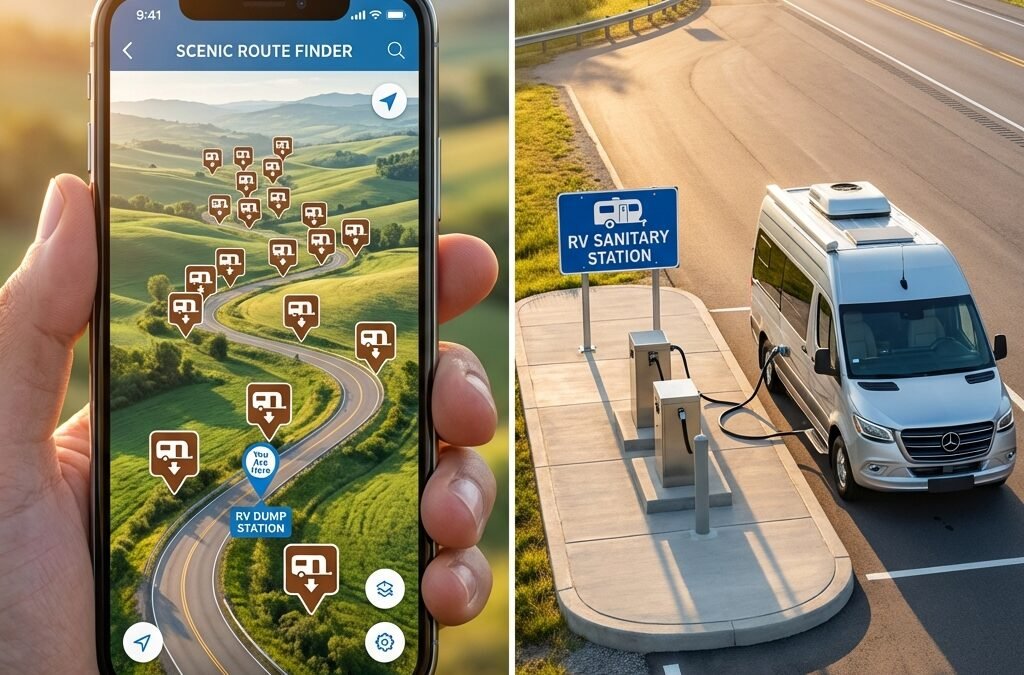
To find an RV dump station near you, search a dump station app first, then check truck stop and state rest area pages, then call the site. This page does not have a live map and it cannot see where you are. Use the steps below on your own phone or computer.
Search a dump station app. The RVing Life app says it lists more than 44,000 dump stations and searches by state, province or postal code. It is free with ads. Going ad-free costs $3.99 per month or $29.99 per year. The RV Dump Stations app costs $0.99 once, lists more than 7,100 stations and shows them offline. Its developer says the data is crowd-sourced, so one camper may call a station working while another calls it broken.
Check truck stops.Pilot lists RV dump stations among its RV services. Love’s says its RV Stops can offer an RV dump. Good Sam lists $2.50 off dumping fees for members at Pilot and Flying J. The Pilot and Love’s pages we checked do not list a dump fee, so confirm the price at the location.
Check state rest areas. Some states list dump stations at rest areas. The Louisiana DOTD rest area page lists an RV dump station at six rest areas. Look for your own state DOT page, then read our rest area rules by state.
Check campgrounds. Some campgrounds let non-guests dump for a fee. The Coloma/St. Joseph KOA in Michigan lists $25 for non-registered guests. The Newberry, South Carolina KOA lists $15 during office hours. Call the office and ask.
Call before you detour. Ask whether the dump is open today, what it costs, how to pay and whether your rig fits the lane.
Searching by zip code or on a map? Use an app that searches by postal code, such as RVing Life. Google Maps works as a last resort. A map pin does not prove a working dump station, so call first.
App prices and fees checked October 4, 2026. They change, so confirm before you go.
Compare dump station finder apps
Each finder covers a different slice of dump stations, and crowd-sourced listings go stale. Match the finder to your route, then confirm with the facility before you detour.
Availability, prices, and app features can change. Confirm current details before using any listing.
Finder
Best Use Case
What to Confirm
RV Dump Stations app
Dedicated dump station lookup with offline map access.
Recent user notes, fee, hours, and whether the station is still operating.
The Dyrt PRO
Route planning when you also need campground or overnight parking options. The Dyrt help center says dump pins are a PRO feature.
Current subscription terms, route filters, and user-reported facility status.
Pilot and Flying J app
Interstate routes where truck stop RV services are convenient. Pilot RV Services lists RV dump stations among its RV amenities.
Dump station amenity, Good Sam discount eligibility, and access hours.
Love’s app or RV Stops page
Highway stops with dedicated RV service layouts at selected locations. Love’s RV Stops promotes RV dump access at participating RV stops.
Whether that location has an RV dump, current fee, and lane access.
iOverlander
Crowd-sourced options, municipal sites, and remote-route backup planning.
Comment recency, local restrictions, and whether the listing is still public.
Google Maps
Last-minute backup when dedicated RV apps miss a nearby business.
Call the facility. Map results often mix RV parking, service centers, and true dump sites.
What Counts as an RV Dump Station?
An RV dump station is a designated waste disposal point built to receive sewage and gray tank wastewater from recreational vehicles. This page covers RV waste-disposal planning in the United States, not state-by-state legal advice, household plumbing, campground hookups, or solid trash disposal. Dump stations are commonly found at campgrounds, truck stops, RV service centers, some public facilities, and selected public recreation areas.
Black tanks hold toilet waste. Gray tanks hold sink and shower wastewater. Both need proper disposal because campground drains, roadside ditches, storm drains, and open ground are not RV dump stations. Leave No Trace disposal guidance directs travelers to dispose of waste properly and follow local rules. For non-tank trash, use our separate guide to trash disposal rules while boondocking.
How Much Do RV Dump Stations Cost?
Non-guest dump fees listed in directories run $10 to $50 at the Northeast and Mid-Atlantic sites in the table below, checked September 29, 2026. Registered campers often dump free, and truck stops and campgrounds charge others. Fees change by owner, season and membership, so confirm the price before you go. The Dyrt help center notes that dump station costs and availability can vary by season, campground status, and whether you are a paid guest. For how dump fees fit a full trip budget, see what boondocking costs per month.
Use these as planning ranges only. Confirm the exact fee before arrival.
Location Type
Common Fee Pattern
Best Verification Step
Campgrounds and RV parks
Often included for registered guests. Non-guest access may be restricted or paid.
Call the office and ask whether non-guests may use the dump station.
Truck stops
Usually paid unless a discount or loyalty program applies.
Check the chain app, then confirm at the location desk.
National or state park campgrounds
May be included for campers and paid for visitors where public access is allowed.
Check the specific park page before arrival.
Municipal facilities
May be free, resident-only, donation-based, or paid by card or cash box.
Call public works or the wastewater treatment office.
RV dealers and service centers
Sometimes offered to customers. Walk-in access varies.
Call before detouring and confirm your RV can fit.
Fee example: Some National Park Service dump stations publish location-specific prices and seasonal access rules. Confirm the exact park page before arrival because access and fees are site-specific. Use the National Park Service park finder to verify the specific location.
Listed dump fees in the Northeast and Mid-Atlantic
The table below shows fees as directories list them. We did not pay these fees ourselves, and directory entries can be out of date. Where a non-guest price is listed, it runs from $10 to $50. The three truck stop listings show $10, and the campground, forest and military listings limit free use to guests or campers. Call ahead to confirm the fee, payment method and hours.
RV dump station fees as listed in directories, checked September 29, 2026. Sources are linked in each row.
Free RV dump stations exist, but they are inconsistent and often poorly advertised. The best free-disposal searches start with public rest areas, municipal wastewater sites, campground guest amenities, and public recreation facilities. Always verify access because free sites can become resident-only, seasonal, temporarily closed, or removed from public use.
Highway rest areas: Some state rest areas list RV dump amenities. Check the state transportation department site or rest area guide before relying on one. See our rest area rules by state.
Municipal wastewater facilities: Smaller towns sometimes allow RV waste disposal at public works sites, but rules are local.
Campgrounds: Dump station use is often available to registered guests. Non-guest access is location-specific.
Public recreation areas: Some park campgrounds include sewage disposal facilities with camping reservations or a separate fee.
Truck Stop Dump Stations: Pilot, Flying J, Love’s, and TA
Truck stop dump stations are useful because they sit close to major routes, but not every location has RV waste disposal. Pilot RV Services lists RV dump stations as an RV amenity, and Good Sam lists $2.50 off dumping fees for linked Pilot and Flying J rewards accounts. Love’s RV Stops promotes RV dump access at participating sites, but location-level confirmation still matters.
Open the chain app or location page and confirm the dump station amenity.
Call the store if the app listing is old, vague, or missing fee details.
Confirm lane access, hours, and payment method before entering with a larger RV.
Red flags: The listing says RV parking but not RV dump station. User reviews mention closure, broken equipment, locked access, or cash-only payment. The app shows the facility but gives no recent operating-status signal.
How to Dump Black and Gray Tanks Without Making a Mess
RV tank dumping works best when the process is simple, controlled, and done in the right order. Dump the black tank first so the gray tank can help rinse the sewer hose afterward. This is a common RV waste-handling practice, but always follow your rig manual and the posted rules at the dump station.
Park close enough for the sewer hose to reach without pulling tight.
Put on disposable gloves before handling caps, valves, or fittings.
Connect the sewer hose securely to the RV outlet and dump station inlet.
Open the black tank valve first and let it drain fully.
Close the black tank valve, then open the gray tank valve.
Close all valves, disconnect carefully, rinse approved parts only where allowed, and store sewer gear separately.
Check the site for spills, loose caps, or dropped gear before you leave.
Gear to carry: Sewer hose, clear elbow, sewer hose support, disposable gloves, bayonet adapters, sewer cap wrench if needed, disinfecting wipes, tank treatment, and a sealed bin for sewer-only equipment.
Cassette toilets: dumping without a dump station
A cassette toilet lets you empty toilet waste without an RV dump station. Our 2018 Hymer Aktiv has a cassette toilet, so our dump fees are typically nil. We empty it at porta-potties and public restrooms. Check that the facility allows it before you do, and follow your toilet maker’s instructions.
Scope: This applies to a removable cassette only. A fixed black tank still needs an RV dump station.
Gray water: Sink and shower water still needs a proper dump point unless a land manager allows otherwise.
Plan dump stops before your tanks are full. A conservative route plan gives you one confirmed disposal option before your next overnight stop and one backup option along the same corridor. This matters most when you are boondocking, crossing rural areas, or traveling during shoulder seasons when some facilities close.
Use tank sensors as a warning, not a guarantee: Sensors can read incorrectly when waste buildup sticks to the tank wall.
Build disposal into travel days: Dumping on the way into or out of a destination avoids dedicated detours.
Keep a backup facility: Save a second location in case the first site is locked, broken, or too tight for your RV.
Do not wait for an emergency: Full tanks can create odor, backup, and route-planning stress.
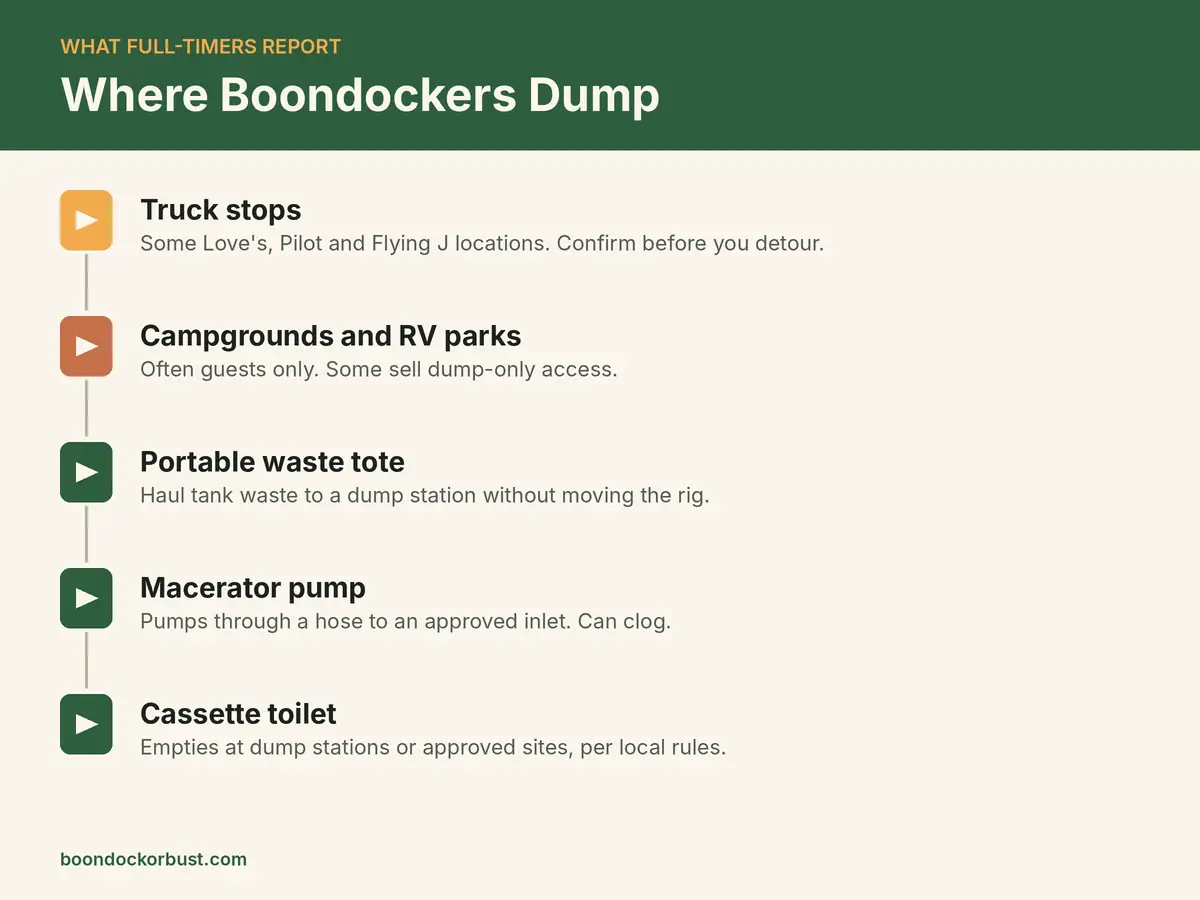
How Boondockers Handle Dumping: What Full-Timers Report
Full-timers most often described a dump and water run about once a week. Your tank sizes, how many people are aboard, and how you shower set the real interval. The reports below come from full-timers and long-term campers in three Reddit threads in r/boondocking and r/RVLiving (one, two). They are individual experiences, not published rates or rules.
How fast the tanks fill
A couple in a 35-foot motorhome said their 40-gallon gray tank fills in 3 to 4 days with daily showers, cooking and dishes. With quick showers and no dishes, it lasts about a week.
Another camper said few rigs can last 3 to 4 weeks with two people without dumping.
A fully off-grid couple in a converted trailer reported going 2 to 3 weeks between fills and dumps.
Where they dump and what they say it costs
One boondocker estimated about $25 a week to fill and dump at a campground or RV park, less at a truck stop.
One commenter said Love’s charged $10 and that many Maverik stations have a free dump, though the hoses may be in poor shape or missing. Another said many truck stops charge about $10.
Fees and access change by location. Confirm the dump station and price with the three-step check above before you detour.
Portable totes and macerator pumps
A portable waste tote lets you empty the tanks into a wheeled container and haul it to a dump station without moving the rig. One commenter recommended a tote over a macerator pump for a long stay in one spot.
A macerator pump grinds waste so you can push it through a garden-style hose. Commenters said they are not common on most RVs and can clog. One full-timer described taking “a handful of poop showers because a clogged pump.” Another said a macerator into a septic tank works pretty well for them.
What not to do
Do not leave the black tank valve open on a sewer hookup. A commenter warned it creates other problems.
Never dump on the ground or into an unapproved drain. A commenter warned a hidden dump can bring environmental enforcement. Check local rules before you empty gray water anywhere but a dump station.
The right finder depends on how you travel. Weekend campground users need office confirmation and guest rules. Highway travelers need chain apps. Boondockers need offline maps, public facility options, and a backup plan because signal, staffing, and seasonal access can fail at the same time.
Travel Pattern
Best Starting Point
Backup Move
Weekend campground trip
Ask the campground whether dumping is included for guests.
Find a nearby RV park or service center before checkout day.
Interstate travel day
Check Pilot, Flying J, Love’s, or TA locations along the route.
Search dedicated RV dump apps before leaving the highway corridor.
Boondocking route
Pre-save dump stations before you lose cell signal.
Call municipal public works offices near your exit route.
Seasonal migration
Plan dump stops every few travel days along major corridors.
Use campground guest dumps when route facilities are unavailable.
RV Dump Station FAQ
How do I find RV dump stations near me right now?
Open a dedicated RV dump app first, then confirm the listing with the facility. Search by your current location, filter for dump stations, read recent comments, and check fee notes. For urgent searches, use a chain app or Google Maps as a backup, then call before detouring.
How much does it cost to dump RV tanks?
Directory listings in the Northeast and Mid-Atlantic show non-guest dump fees of $10 to $50, checked September 29, 2026. Three truck stop listings show $10. Many campgrounds include dumping for registered guests and charge everyone else. Fees change by owner and season, so confirm the price, payment method and hours before you arrive.
Can I dump RV tanks for free?
Yes, but free dump stations are inconsistent. Start with campground guest amenities, selected public rest areas, municipal facilities, and public recreation sites. Confirm access before arrival because free sites can be seasonal, resident-only, temporarily closed, or available only to registered campers.
Do Love’s, Pilot, and Flying J have RV dump stations?
Some Love’s, Pilot, and Flying J locations have RV dump stations, but the amenity is location-specific. Use the chain app or location page to confirm the dump station, then verify fees and access hours. Do not assume every truck stop on a route has waste disposal.
Should I dump black or gray tanks first?
Dump the black tank first, then dump the gray tank. The gray tank flow helps rinse the sewer hose after toilet waste drains. Follow your RV manual, keep the hose secured at both ends, wear gloves, and obey the posted instructions at the dump station.
Can I dump gray tank wastewater on the ground?
Do not dump gray tank wastewater on the ground unless a land manager explicitly allows it, and many places do not. Leave No Trace grey water guidance says local regulations and campground staff instructions should guide disposal. Use a designated dump station and verify local rules before camping off-grid.
Can I use a campground dump station without staying there?
Sometimes. Campgrounds often include dump station use for registered guests, but non-guest access depends on the owner, staffing, local rules, and site layout. Call before arrival, ask about the fee, and confirm whether your RV can enter and exit safely.
Can I empty a cassette toilet in a public restroom?
We empty our Hymer’s cassette toilet at porta-potties and public restrooms, so our dump fees are typically nil. Check posted rules or ask first, because some facilities may not allow it. This works only for a removable cassette. A fixed black tank still needs an RV dump station.
Before You Leave the Dump Station
A good dump stop ends with a clean site and a confirmed next disposal option. Check that all valves are closed, caps are secure, sewer gear is stored separately, and the dump area is clear of spills or dropped supplies. Then save the next verified location before heading back off-grid.
Boondockers shower at Pilot/Flying J and Love’s truck stops, Planet Fitness clubs (Black Card, multi-location access), campgrounds that sell showers to non-campers, and rec centers or YMCAs in nearby towns. Love’s typically charges $17 to $20 per shower. Pilot prices vary by location, so check the store. If your rig has a built-in shower, a solar shower bag or RV onboard system extends your range between facility visits.
For full-timers, a Planet Fitness Black Card membership is often the lowest-cost long-term strategy. For a single shower on a travel day, Pilot and Flying J travel centers are a common choice. Confirm showers with the individual store.
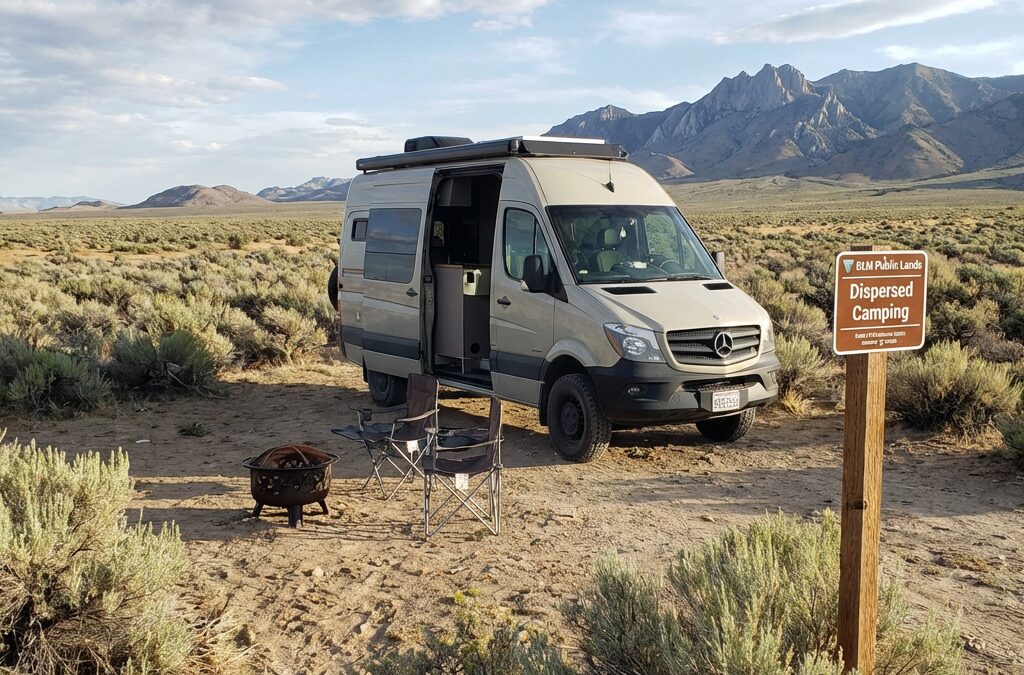
There is no shower at your dispersed campsite. There is no shower block on BLM land. If you’re 40 miles out on National Forest road, the nearest hot water is a drive away, and how far depends entirely on how well you planned before you left.
This is not a complicated problem. Boondockers have been solving it for decades with a short list of reliable options. What changes is the math: how often you actually need a full shower, what you’re willing to pay per visit, and how much water your rig carries between resupply runs. Get those three numbers right and the logistics run themselves.
Where to shower while boondocking: 7 options compared
The table covers the main options ranked by typical cost and availability. None of these requires a campsite booking or overnight stay.
Pilot and Flying J travel centers offer private shower rooms to all travelers, not just truckers. Prices vary by location, so check the store. Towels included at select sites.
Option
Cost
Availability
Notes
Pilot / Flying J truck stops
Varies by location. Check the store.
More than 900 locations in 44 states and five Canadian provinces as of January 2026 (Pilot). Confirm showers with the store.
Private rooms. Open to all travelers, not just truckers. A qualifying 50-gallon commercial diesel purchase earns one shower credit, valid for up to 10 days (Pilot). Pay at the counter.
Love’s Travel Stops
Typically $17 to $20 per shower (Love’s). Local prices vary.
681 locations in 42 states as of September 2026 (Love’s). Confirm showers with the store.
Similar setup to Pilot/Flying J. MyLove Rewards app: casual customers may redeem points for showers. Slightly less coverage but comparable quality.
Planet Fitness (Black Card)
Varies by club. As of November 27, 2026: Glenmont, NY $24.99/month + $59 annual fee (Planet Fitness). Hoboken, NJ $29.99/month + $49 annual fee (Planet Fitness).
2,962 clubs system-wide in several countries as of September 30, 2026 (Planet Fitness)
Strong value for full-timers. Multi-location access. A $5 per-visit fee may apply after more than 10 visits in a month to the same non-home club (Planet Fitness). No towels provided.
Paid campground day-use showers
Varies by park. Examples as of November 27, 2026: $5 for non-campers at Sunrise Campground, Storm Lake, IA (City of Storm Lake) and Heritage Park and Campground, Embarrass, MN (Embarrass).
Some public campgrounds sell showers to non-campers. Check each park.
Call ahead. Not all campgrounds allow non-guest shower use, and fees vary by park.
YMCA / recreation centers
Varies by Y. As of November 27, 2026: Capital District YMCA (NY) day pass $20 at pool branches or $15 at branches without pools (Capital District YMCA). Tillamook YMCA (OR) $1 shower only during posted community shower hours (Tillamook YMCA).
Small towns and cities along your route
Each YMCA sets its own guest pricing. Good for multi-purpose stops: shower, laundry and Wi-Fi in one town run. A day pass is not the same as a shower-only fee.
Natural hot springs
Developed: $15+. Glenwood Hot Springs Resort (CO) lists $42 to $60 all-day adult and teen admission as of November 27, 2026 (Glenwood Hot Springs). Undeveloped: access and fees vary by site.
Select Western states, not nationwide
Viable supplement, not a system. Keep all soap, even biodegradable soap, out of springs and side streams (BLM). Check the managing agency’s rules before use.
Onboard RV shower (water-conserving)
Limited by your water and tank capacity
Your rig
Requires water management discipline. A navy shower (wet, off, soap, rinse) can use as little as 3 gallons (U.S. Navy). Actual use depends on flow and how long the water runs. Fresh tank capacity determines your range between resupply stops.
Truck stop showers: what to expect and how to use them
In January 2026, Pilot described a network of more than 900 locations in 44 states and five Canadian provinces (Pilot). Pilot Flying J explicitly opens its shower facilities to all travelers, not just commercial drivers. (pilotflyingj.com.) That count covers the whole network, so confirm showers with the individual store. Love’s reported 681 locations in 42 states in September 2026 (Love’s). That count includes convenience stores, so check for showers at each stop. Travel Centers of America (TA/Petro) lists showers as an earnify Pro reward, but no public cash price was confirmed, so check with the store.
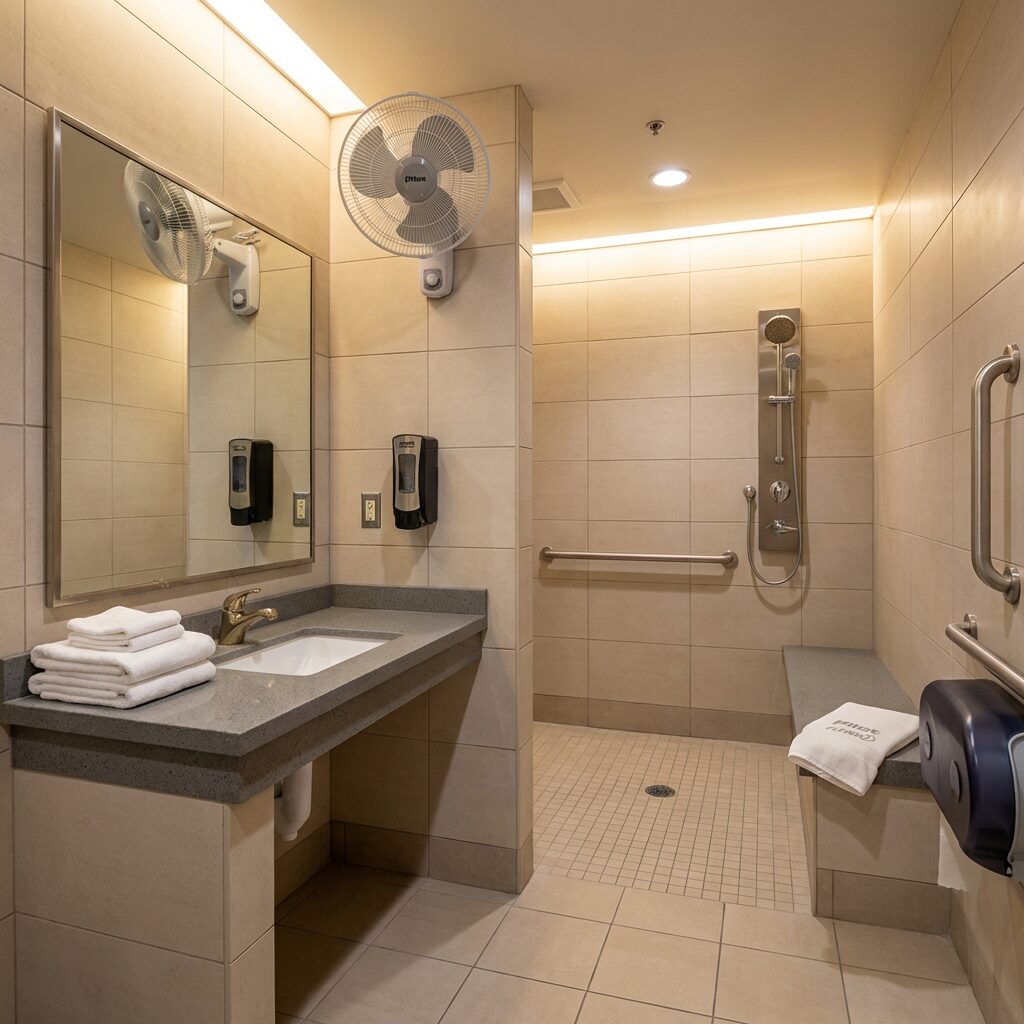
The process is straightforward. Go to the counter, ask for a shower, pay the posted price, and you receive a room code or slip. Pilot does not publish a chain-wide cash price, so prices vary by location. Check with the store. The rooms are private, with a full bathroom, lockable door, bench, hook, and controlled-temperature shower. Towels are included at some locations. Bring your own to be safe.
Loyalty programs can cut the cost. Pilot says a qualifying purchase of 50 gallons of commercial diesel earns one shower (Pilot showers). That credit is valid for up to 10 days. Pilot’s myRewards program tracks the credits. Love’s gives free showers to qualifying professional drivers, and casual customers may redeem MyLove Rewards points for a shower (Love’s showers). Both programs are built around professional drivers, so a large RV fuel fill does not guarantee a credit. Verify eligibility at the counter.
One practical note: if you and a travel partner arrive together, most truck stop locations allow both to use one shower purchase sequentially. Confirm at the counter before paying. Policies vary by location and shift.
Planet Fitness Black Card: the full-timer’s math
Planet Fitness reported 2,962 clubs system-wide as of September 30, 2026, across several countries (Planet Fitness). The Black Card membership grants access to any location nationwide, per planetfitness.com. Black Card pricing varies by club. As of November 27, 2026, the Glenmont, NY club listed $24.99 a month plus a $59 annual fee. The Hoboken, NJ club listed $29.99 a month plus a $49 annual fee. Taxes and startup fees can be extra. Showers are included with all membership tiers at no per-use charge.
The access limit matters: A $5 per-visit franchise fee may apply after more than 10 visits in a calendar month to the same non-home club (Planet Fitness customer service). Showering every 3 to 4 days while boondocking works out to 7 to 10 visits per month. That stays at or under the threshold even if every visit is at one club. Two people require two memberships.
The annual cost math: As of November 27, 2026, the recurring pre-tax cost before any startup fee was $358.88/year per person at Glenmont and $408.88/year at Hoboken. At Love’s typical $17 to $20 per shower, that equals about 18 to 24 truck stop showers to break even. Full-timers averaging one shower every 3 days hit that number in under 3 months.
No towels provided. Planet Fitness does not supply towels. Bring your own microfiber travel towel. This is consistent across all locations.
A navy shower can use as little as 3 gallons. At that rate, a 20-gallon fresh tank covers about 6 on-rig showers before a water resupply is needed.
The core decision: Boondockers need a shower system, not a shower solution. Truck stops handle the single-use need on travel days. Planet Fitness covers the recurring need for full-timers at a low per-visit cost. Your onboard shower extends the gap between facility visits when water management is tight. Build the system before your first extended trip.
Making your onboard shower work harder
If your rig has a shower, you need no facility stop. It only extends your stay if you manage water well. The two levers are technique and tank capacity.
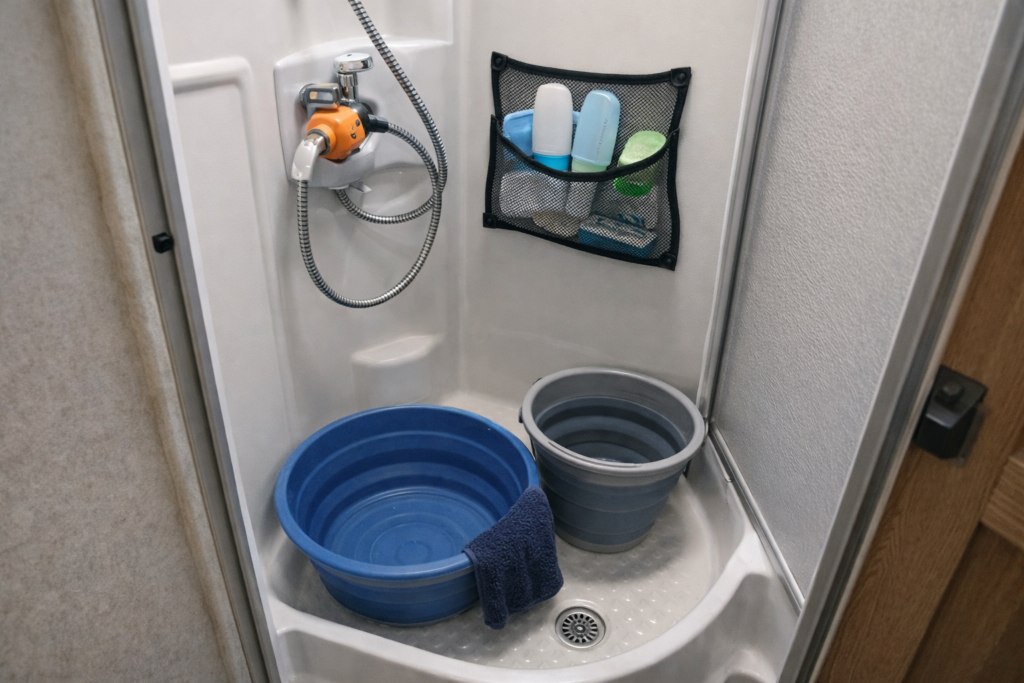
The navy shower method: Wet down, turn the water off, soap up, turn on to rinse. A Navy publication says a navy shower can use as little as 3 gallons of fresh water (U.S. Navy). Your use depends on flow rate and how long the water runs. At 3 gallons per shower, a 20-gallon fresh tank covers about 6 showers before a water fill is needed. A 40-gallon tank covers about 13. The technique is not uncomfortable once it becomes habit. The Hymer Aktiv’s 30-gallon fresh water tank pushed us to this approach quickly, and it’s been standard practice ever since.
Low-flow showerheads: Replacing a standard RV showerhead with a 1.0 to 1.5 GPM low-flow model cuts water use further. Prices vary by model. As one example, Oxygenics lists its BodySpa RV showerhead at $49.95 MSRP as of November 27, 2026.
Gray tank is the real constraint, not fresh: On a Class B or small Class C, the gray tank often fills before the fresh tank empties. A 3-gallon shower creates 3 gallons of gray water. Time your dump station stops accordingly. Don’t run out of gray capacity mid-site. For dump station planning, see our RV dump station guide.
Solar shower bags: the low-cost camp option
A solar camp shower bag costs $25 to $40 and warms water in direct sun. As one example, the Advanced Elements 5-gallon Summer Shower (model SS762) lists at $35.99 as of November 27, 2026. Field heating time depends on sun and air temperature. This is not a replacement for a full shower system. It is a supplement for warm-weather boondocking when full facilities are days away.
How it works: Fill the bag from your fresh tank or a water jug in the morning. Lay it flat in direct sun on your rig’s roof or hood. Check the water temperature before you rinse. The SS762 has a built-in temperature gauge. Hang the bag from a tree or awning arm. Use a pop-up privacy shelter if needed.
Where it fails: Cold weather, overcast days, and desert heat waves (water overheats past comfort level) all reduce reliability. Do not count on a solar bag as your primary shower system in fall or winter camping. It is a spring/summer supplement.
Water goes where your waste management rules allow. Follow the land manager’s rules for gray water, and keep it away from streams and other water sources. Leave No Trace advises washing at least 200 feet from water sources (Leave No Trace). BLM low-impact camping guidance uses the same 200-foot distance (BLM). Local rules can require more. For full waste management rules, see our boondocking waste disposal guide.
Common questions
Can you shower at a truck stop if you’re not a trucker?
Yes. Pilot Flying J explicitly states that all guests are welcome to use its shower network. Love’s lets casual customers redeem rewards points for showers. At TA/Petro, ask at the counter. Walk to the counter, ask for a shower, and pay. No commercial driver’s license or proof of occupation required.
Is Planet Fitness worth it just for showers while boondocking?
For full-timers, often yes, if you’re within reasonable driving distance of towns with Planet Fitness locations (most mid-size towns qualify). Black Card pricing varies by club. Two examples ran $358.88 and $408.88 a year before taxes and startup fees as of November 27, 2026. That equals about 18 to 24 truck stop showers at Love’s typical $17 to $20 price. If you boondock year-round and shower more than twice a week, the math favors Planet Fitness. If you’re on a short trip or primarily camping in rural areas far from any gym, truck stops are the better choice.
⚠ Planet Fitness Black Card: the 10-visit limit
A $5 per-visit fee may apply after more than 10 visits in a calendar month to the same non-home club (Planet Fitness customer service). The count is per club, so visits spread across different towns are less likely to trigger it. For a boondocker showering every 3 days at one club, that’s roughly 10 visits per month, right at the threshold. If you shower more often at one club, budget for the overage fee or consider a second membership for a travel partner.
How do you find shower facilities along a boondocking route?
Three tools cover most cases: (1) the Pilot Flying J or Love’s apps for truck stop locations along your route, (2) the Planet Fitness app for gym locations in towns near your site, and (3) Google Maps search for “recreation center” or “YMCA” in towns you’ll pass through for resupply. Map these stops during trip planning, not the morning you need a shower.
What about showering on BLM land in natural water sources?
Bathing in streams, rivers, or lakes on BLM land is generally not prohibited, but soap, including products marketed as biodegradable, should not be used in or near natural water. Leave No Trace advises washing at least 200 feet from water sources (Leave No Trace). BLM low-impact camping guidance also says to stay at least 200 feet from lakes, rivers and streams. (BLM, Camping on Public Lands.) This is guidance, not a nationwide BLM regulation. Local rules can add more. A swim or rinse works in warm weather. It is not a substitute for a functional shower system on extended trips.
Build the system, not the workaround
The mistake most new boondockers make is treating showering as a one-off problem to solve on the fly. It isn’t. It’s a recurring logistics task that runs on the same schedule as water fills and tank dumps.
Set it up before your first extended trip: decide whether you’re a truck-stop user or a Planet Fitness member, identify three or four facility locations along your planned route, and bake the stops into your departure-day checklist. After the first trip, it becomes automatic.
If water management is still the limiting factor and you’re burning through your fresh tank faster than expected, the next thing to solve is your overall water resupply system. Our real-cost breakdown of boondocking covers water resupply costs alongside fuel, dump fees, and site logistics so you can budget the full picture.
Plan your campsite setup and cleanup
Use our campsite setup and cleanup checklist to plan arrival, your stay, and departure.
Money Digest. Are Planet Fitness’ Black Card Perks Worth the Price? (Secondary coverage. Planet Fitness customer service terms say the $5 fee may apply after more than 10 visits a month to the same non-home club.) moneydigest.com
Athletech News. Planet Fitness Plans Black Card Price Hike. November 2025. (Secondary coverage of Black Card pricing. Club prices vary.) athletechnews.com
Prices last checked November 27, 2026. Truck stop shower prices and gym membership rates are subject to change by location. Verify current pricing before your trip.
Chuck Price
Chuck Price has 35+ years of RV camping experience and travels in a 2018 Hymer Aktiv Class B.
He travels with his wife, Cindy. BoondockOrBust.com is their field-tested resource for off-grid RV living, boondocking regulations, and no-cost camping strategy.
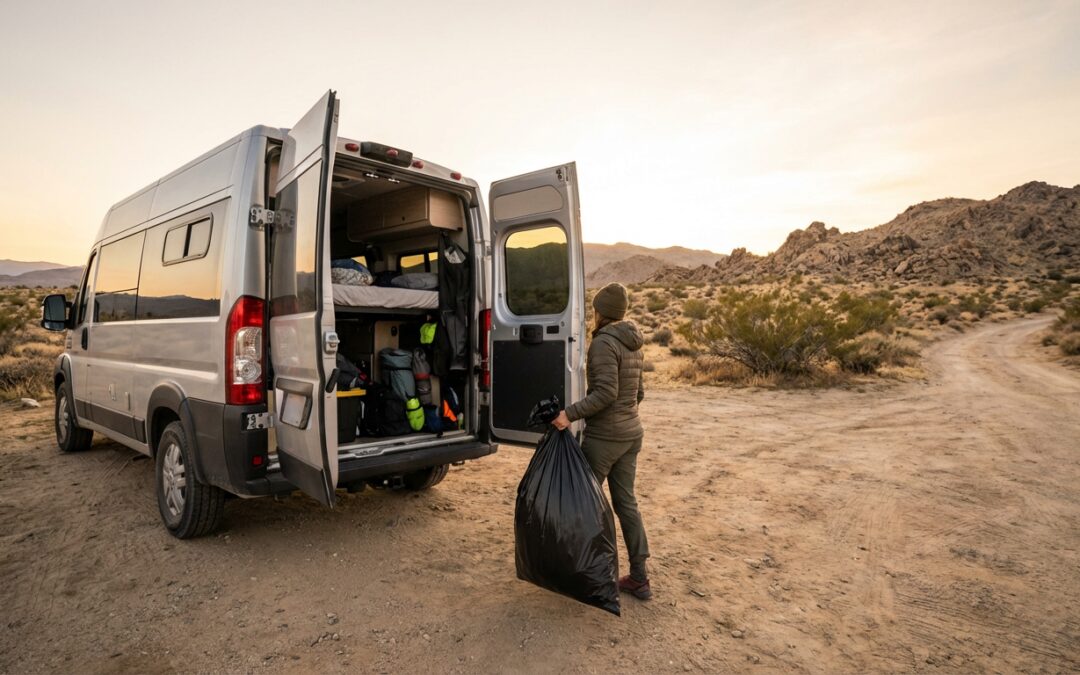
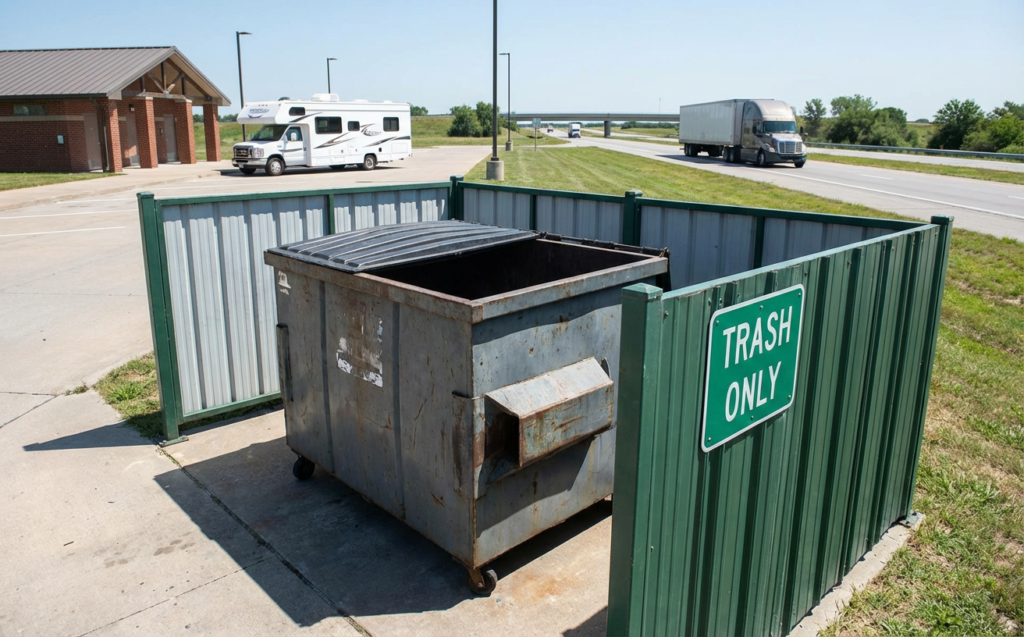
When boondocking, you are legally required to pack out all trash — no disposal on public land is permitted under BLM and U.S. Forest Service rules. Your practical options are highway rest areas, county transfer stations, campground dumpsters, Pilot/Flying J truck stops, and town trash cans when purchasing fuel or supplies.
Violating BLM waste disposal rules can result in citations carrying fines up to $1,000 and up to 12 months imprisonment under 43 CFR Part 8360. Plan your disposal route before leaving camp, not after.
There is no trash pickup on BLM land. There is no dumpster on a National Forest dispersed site. If you pack it in, you pack it out — and that rule applies to every chip bag, coffee ground, and piece of toilet paper.
Most new boondockers don’t struggle with the rule. They struggle with the logistics: where, exactly, does the trash go when you’re 40 miles from the nearest town? This guide answers that with specific, verifiable options ranked by reliability and cost.
The legal baseline: pack it in, pack it out
Both BLM and the U.S. Forest Service operate under a pack-it-in, pack-it-out rule for dispersed camping. The BLM states this directly in its dispersed camping guidelines: “Take all trash and belongings with you.” (BLM, Camping on Public Lands.) The U.S. Forest Service applies the same standard across regions, with several district pages noting that leaving trash is illegal and can result in steep penalties. (USDA Forest Service, Hoosier National Forest Dispersed Camping.)
Pack out trash from dispersed campsites, including food scraps and packaging. Burning or burying it leaves waste at the site. See the BLM’s dispersed camping guidance.
Waste violations are the highest enforcement priority on BLM land. Improper disposal of trash, sewage, and wastewater generates faster enforcement response than stay-limit violations in most districts. Federal regulation authorizes penalties up to $1,000 and/or 12 months imprisonment for violations of BLM visitor services regulations under 43 CFR § 8360.0-7.
The rule is simple. The logistics require planning.
Where to dump trash while boondocking: 7 options ranked
The table below covers the most reliable options, including typical cost and availability notes based on current field reporting. No single option works everywhere — use multiple as a rotation.
Option
Typical Cost
Availability
Notes
Highway rest areas
Free
Widespread on interstates
Most reliable free option. Large dumpsters on most. Some states (WA, AL, KS) include RV dump stations.
County transfer stations / landfills
$1–$10 per load
Rural counties — search Google Maps for “transfer station”
Best option for large volumes. Designed for exactly this use. Call ahead for hours and fees.
Campground / RV park dumpsters
Free–$5 (or as part of day-use fee)
Most Forest Service and BLM campgrounds near dispersed areas
Call ahead to confirm public use is allowed. Do not use if marked “campers only.”
Pilot / Flying J truck stops
Free with fuel purchase (varies)
Major interstates nationwide
Trash cans at fuel pumps. Also offer RV dump stations at select locations ($8–$12). Combine with fuel stop.
Gas stations / convenience stores
Free with purchase
Town re-supply stops
Pump-side cans handle small bags. Dumpsters typically locked. Don’t abuse: one or two bags, not a week’s load.
Staging area / ranger station dumpsters
Free
Select BLM and Forest Service trailheads
Use only if marked for public use. Find the responsible office through the BLM office directory.
Town public trash cans
Free
Parks, picnic areas, visitor centers
Acceptable for small amounts. One bag per can. Do not fill a single can with your entire trip’s waste.
Reduce trash volume before you leave camp
The cheapest disposal strategy is producing less waste. Experienced boondockers compress volume before departure using a few reliable methods.
Pack out paper and cardboard. Flatten clean boxes for recycling where accepted. Bag food-soiled cardboard and other trash and take it to a designated disposal site. Before lighting a campfire on BLM land, check local restrictions and follow posted rules, as described in the BLM’s fire safety guidance for campers.
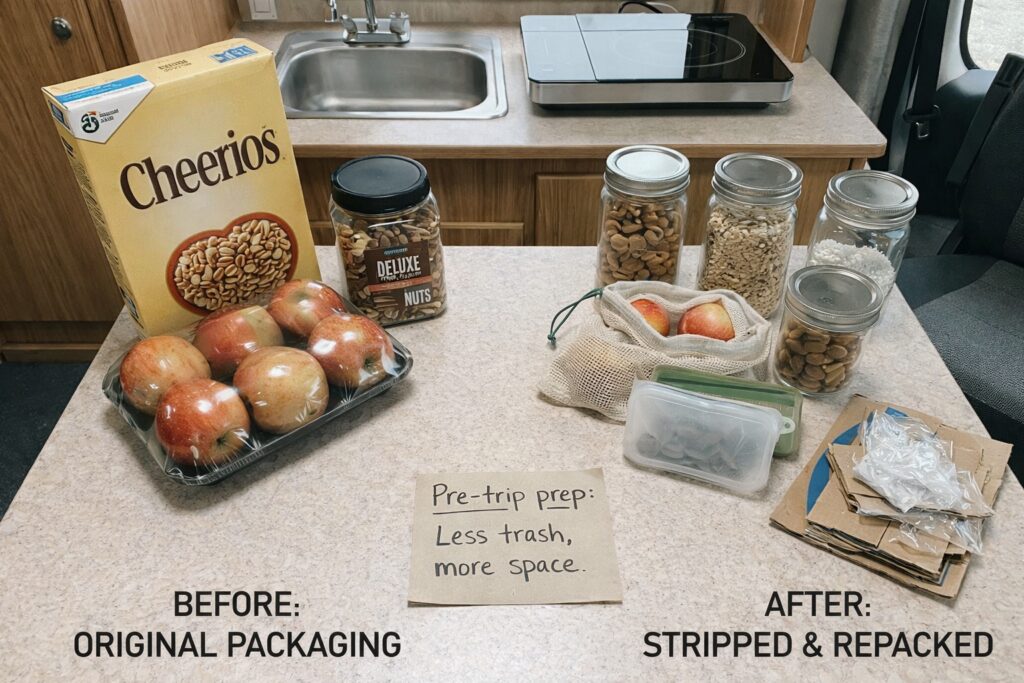
Remove packaging at home, not at camp. Strip multi-layer packaging, cardboard boxes, and plastic wrap from food, gear, and supplies before you leave. This alone can reduce trip waste by 30–40% in our experience with the Hymer Aktiv over multi-week stays.
Use sealed, hard-sided containers for external storage. If trash will be stored outside your rig — in a truck bed, exterior compartment, or trailer pass-through — it must be inside a sealed, hard-sided container. This is not optional in bear country, and it prevents wildlife-attractant problems that can generate BLM enforcement attention fast.
Compress everything. Flatten cans, flatten cardboard for recycling or disposal, and consolidate bags daily. Smaller volume = fewer disposal stops.
The core problem: Boondocking on BLM and National Forest land means zero trash service. Pack-it-out is a legal requirement, not a suggestion. Highway rest areas and county transfer stations are the two most reliable disposal points for multi-day trips. Combine disposal stops with fuel runs to eliminate extra miles.
How to find disposal locations before you go
Route your disposal stops during trip planning, not mid-trip. Four tools cover most needs:
Google Maps: Search “transfer station,” “landfill,” or “solid waste facility” along your route. Filter for hours to confirm they’ll be open during your exit window.
iOverlander / Campendium: Both include user-reported dump station and trash locations. Campendium’s dump station index at campendium.com/dump-stations covers locations beyond RV parks.
RVDumps.com: Focused specifically on non-campground disposal options — rest areas, truck stops, and public facilities. Searchable by state.
Your BLM or Forest Service district office: Call before departure. Ask specifically whether any staging areas or ranger stations near your destination have public-use dumpsters. This information is not always posted online.
What you cannot do — and why it matters beyond the fine
These are not gray areas. They are documented enforcement triggers on federal land.
Burying trash: Prohibited. Not a Leave No Trace-compliant alternative. Wildlife digs it up, and buried waste contaminates soil and water sources.
Leaving trash at a site “for someone to pick up”: Illegal. Abandoning property on BLM land carries the same penalty as littering.
Dumping trash in a campground dumpster you are not a guest of, without permission: Technically trespassing or misuse in most jurisdictions. Always ask or call first.
Burning trash: Pack out plastic, foam, paper and other packaging, even where campfires are allowed.
Dumping gray water near streams or water sources: Prohibited. BLM requires gray water disposal at approved facilities. All water sources within 200 feet are protected under the dispersed camping rules. (BLM, Camping on Public Lands.)
Beyond the fine: improper waste disposal is the fastest way to trigger use restrictions and permit requirements on dispersed camping areas. The BLM can and does close land to camping when overuse and waste problems reach a threshold. Every campsite you leave clean extends the window before restrictions land on areas the whole community uses.
For full detail on BLM compliance requirements across your trip, see our BLM camping rules compliance guide — including stay limits, fire rules, and enforcement priorities by violation type.
Common questions
Can I leave trash at a Forest Service campground dumpster if I’m not staying there?
You need to ask first. Some campgrounds explicitly allow public trash disposal; others have signs restricting dumpsters to registered campers. Call the ranger district before your trip and confirm. Using a dumpster without permission at a fee area is a federal violation.
What about compostable waste — food scraps, peels, coffee grounds?
Pack it out. “Compostable” does not mean disposable on public land. Food scraps are wildlife attractants. Scattered on the ground, they draw bears, rodents, and ravens, which creates dangerous and expensive human-wildlife conflicts. All food waste goes in your trash bag and leaves with you.
Are there any apps specifically for finding trash disposal while boondocking?
No single app is purpose-built for trash-only disposal while boondocking. The best workarounds: use iOverlander or Campendium for community-reported locations, Google Maps for county transfer stations along your route, and the AllStays Camp & RV app for staging-area dumpsters near public lands. Call the local ranger district as a backup — they often know about public-use dumpsters not listed anywhere online.
How do full-time boondockers handle this long-term?
Three habits separate experienced full-timers from novices: (1) they remove packaging before leaving home, cutting volume by 30% or more; (2) they route supply runs through towns with transfer stations or truck stops; (3) they treat the 14-day BLM stay limit as a natural reset point — leave camp, hit a dump station and rest area, resupply, then move to the next site. The logistics are simple once they’re baked into the departure routine.
The takeaway
There is no complicated system here. Pack it out, use highway rest areas and transfer stations as your primary disposal points, and combine those stops with fuel and water runs to avoid separate trips. The hard part is the planning — do it before you leave, not when you’re 50 miles from the nearest town with a full trash bag.
If you haven’t already mapped your black and gray tank disposal for the same trip, that’s the next thing to sort. Our RV dump station guide covers location tools, cost, and how to cluster tank dumps with water fills to minimize extra stops.
Use the RV campsite setup and cleanup checklist
A practical checklist for setting up, cleaning up, and leaving your campsite responsibly.
Last reviewed: April 2026. Regulations vary by BLM field office and Forest Service district. Verify current rules with your local office before departure.
Chuck and his wife Cindy travel in a 2018 Hymer Aktiv Class B. BoondockOrBust.com is their field-tested resource for off-grid RV living, boondocking regulations, and no-cost camping strategy.
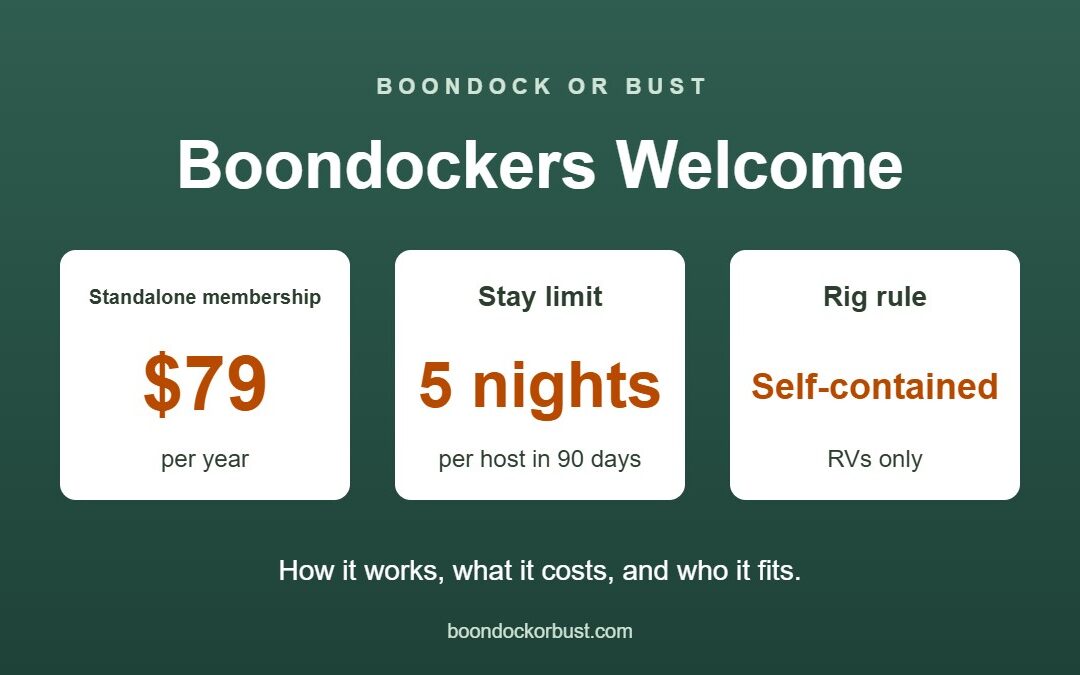
Short answer: Boondockers Welcome is a paid membership that lets you request free overnight RV parking on private property owned by other RVers and homeowners. The standalone guest plan costs $79 a year, per the Boondockers Welcome plans page (verified Nov. 12, 2026).
Stays run one to five nights, depending on the host. Your RV must be self-contained. Hosts cannot charge for parking, but you must offer to pay for any hookups you use.
Last updated: November 12, 2026
This guide is built from the published rules of Boondockers Welcome and its parent company, Harvest Hosts. It is not based on a stay. Chuck Price has 35+ years of RV camping experience and travels in a 2018 Hymer Aktiv Class B. He and his wife Cindy are Harvest Hosts members. They are not Boondockers Welcome members.
Ownership update: On Sept. 30, 2026, Choice Hotels International announced an agreement to acquire Harvest Hosts, the company that runs Boondockers Welcome, according to the Choice Hotels announcement. Read what the deal could mean for members in our Choice Hotels and Harvest Hosts analysis.
Key points
Must-know: Boondockers Welcome sells access to private-property RV parking for $79 a year (verified Nov. 12, 2026).
Trip killers: Tents, cars, SUVs and pickup trucks are not allowed. Your rig needs an indoor toilet with a holding tank.
Best for: Self-contained RVers who want one to five quiet nights near a destination and are fine asking permission first.
Confirm before you go: Each host sets its own request window, house rules, stay length and hookup costs. Read the host profile before you request.
What is Boondockers Welcome?
Boondockers Welcome is a membership network of private hosts who let RVers park overnight on their property. Hosts are individuals at private residences, not businesses, per the Harvest Hosts membership comparison (updated Feb. 5, 2026). Harvest Hosts owns it and runs both programs from one help center.
The standalone Boondockers Welcome guest plan costs $79 a year, billed annually. Two Harvest Hosts plans also include Boondockers Welcome. Prices below come from the Boondockers Welcome plans page and the Harvest Hosts plan page, both checked Nov. 12, 2026. Taxes can apply based on your billing address. Prices change, so confirm at checkout.
Plans that include Boondockers Welcome. Sources: Boondockers Welcome plans page and Harvest Hosts plan page, verified Nov. 12, 2026.
Plan
List price per year
What it adds
Use case
Boondockers Welcome
$79
Private community hosts only
You only want private-property stays
Harvest Hosts + Boondockers Welcome
$169
Wineries, farms, breweries, distilleries and attractions
You want both private homes and business hosts
All Access
$179
Adds golf course hosts and an Escapees RV Club membership
You also want golf hosts or Escapees
Membership gives you access. It does not guarantee a spot. Each host approves or declines each request.
Discount for Harvest Hosts plans: New members can enter code BOONDOCK20 at checkout for 20% off the first year of any Harvest Hosts plan, including Harvest Hosts + Boondockers Welcome. That makes the first year $135.20 instead of $169. Compare Harvest Hosts plans, pick a plan, and enter the code.
Holiday sale through Jan. 12: code BOONDOCK30 takes 30% off the first year of any Harvest Hosts plan. Harvest Hosts + Boondockers Welcome drops to $118.30 for the first year. Compare Harvest Hosts plans, pick a plan, and enter the code at checkout. Please enter the code even though the sale price already shows on the Harvest Hosts site. It helps Harvest Hosts credit Boondock or Bust for your signup.
We could not confirm that either code applies to the standalone $79 Boondockers Welcome plan. If you want only Boondockers Welcome, buy it on the Boondockers Welcome plans page.
Disclosure: Boondock or Bust is a Harvest Hosts affiliate. If you join through these links, we may earn a commission at no extra cost to you.
How does a Boondockers Welcome stay request work?
You request each stay through the site or app, and the host approves or declines it. The steps below come from the Boondockers Welcome how-it-works page. Rules vary by host, so the host profile controls what you can request.
Open a host profile on the website or the app.
Pick your stay date.
Click Request to Stay and complete the form. The host gets an email notice.
Wait for approval. Driving directions become available once the host accepts.
Show up within the host’s arrival rules and follow the house rules on the profile.
Each host sets how early and how late you can ask. Some hosts accept same-day requests, and others require up to 7 days of notice, per the Boondockers Welcome stay rules. The site maximum is two months ahead, and some hosts allow only one week. A Same Day Requests filter on the host map covers both Harvest Hosts and Boondockers Welcome hosts, per the Harvest Hosts same-day filter article.
For a multi-night stay, Boondockers Welcome hosts receive one stay request for the whole stay to approve or decline, per the Harvest Hosts extra nights article. Boondockers Welcome does not publish a deadline for host replies. Plan a backup spot until you have an approval.
What kind of RV can you use with Boondockers Welcome?
Boondockers Welcome requires a self-contained RV with an indoor toilet and a holding tank. The Boondockers Welcome guest requirements state that a toilet system with a holding tank is required. Sleeping, cooking, eating and sanitation must all happen inside the RV.
Motorhomes, travel trailers and truck campers qualify.
Pop-up and hybrid trailers can qualify once the toilet rule is met. Some hosts decline them.
A cassette or marine-style portable toilet is acceptable only if you use it inside the rig and empty it after you leave. Do not ask a host to let you dump unless the profile lists an RV dump.
Converted vans may qualify, but the guest requirements page tells you to contact Boondockers Welcome first.
Some vehicles are excluded outright. The Harvest Hosts article Is Boondockers Welcome only for RVers? (updated June 18, 2025) says tents, cars, SUVs and pickup trucks cannot join as guests. A self-contained car or truck still does not qualify.
How long can you stay with a Boondockers Welcome host?
Boondockers Welcome stays run from one to five nights, depending on the host. The Boondockers Welcome stay rules add a repeat limit of 5 nights with the same host in a 90-day window. That cap applies per host, whether you take one stay or several short ones.
Most hosts expect one to three nights, per the how-it-works page. The guest requirements describe the service as short stays while passing through, not long stays or a base for local work. If you need a week in one place, plan to move between hosts or book a campground.
Do Boondockers Welcome hosts charge fees?
Boondockers Welcome hosts cannot charge you for parking. The Harvest Hosts article Do Boondockers Welcome hosts charge a fee? (updated Aug. 15, 2024) states that Boondockers Welcome hosts may not charge for parking. Hookups are different. Hosts may ask you to cover their costs, and free parking without hookups must stay available.
Hosts list expected hookup compensation in the Suitability section of their profile.
If you use hookups, you must offer payment even if the host does not ask.
When a host lists no amount, Harvest Hosts calls about $3 to $5 per night for electricity fair in most cases, per its hookup charges article (updated Aug. 15, 2024).
The amount can rise with water, dump, Wi-Fi, firewood, rig size and air conditioner or furnace use.
The stay rules say electric, water, Wi-Fi and dump access are privileges, not rights. A host only has to provide a safe place to park for the night. Skipping the hookup payment can lead to cancellation of your membership without a refund. Unlike Harvest Hosts business locations, Boondockers Welcome hosts expect no purchase. Optional hookups are the only cost, per the Harvest Hosts article How much should I spend at a host location? (updated April 1, 2026).
A third completed stay ends refund eligibility on a new membership.
Auto-renewed memberships can be refunded within 30 days of renewal if you have completed no stays since renewal.
Each account gets one refund. If you refund and rejoin later, you cannot get a second one.
A refunded account loses any legacy pricing. Future purchases are charged at current rates.
Apple App Store purchases follow Apple’s refund policy and must be requested from Apple.
Gift cards are not refundable, and members removed for rule violations are not eligible.
To request a refund, contact Harvest Hosts at team@harvesthosts.com or through the site chat, per the refund policy page.
What are the real limits of Boondockers Welcome?
Boondockers Welcome sells permission to ask, not a reserved site. Five limits come straight from its published rules. Each one applies to every plan that includes Boondockers Welcome, and each host can add stricter house rules on top.
Approval is not guaranteed. Hosts approve or decline each request, and no reply deadline is published. Some hosts also require up to 7 days of notice.
It is private property, not open land. The stay rules say a host only has to provide a safe place to park for the night. Expect a private parking spot, not a dispersed site on public land.
House rules are binding. Hosts set rules on arrival and departure times, drinking, smoking, pets and children. Breaking them can cancel your membership without a refund, per the stay rules.
Hookups cost money. Parking is free, but you must offer payment for any hookups you use.
Many rigs are excluded. No tents, cars, SUVs or pickup trucks, and no rig without an indoor toilet and holding tank.
Boondockers Welcome fits self-contained RVers who want short, quiet stays and do not mind asking first. The fit depends on your rig, your travel pace and how far ahead you plan. These conditions come from the rules cited above, not from a test stay.
It fits you when:
Your RV has an indoor toilet and holding tank, and you cook inside.
You want one to five nights near a town, family or an event.
You can request a stay a day or more ahead and keep a backup plan.
You would rather pay a few dollars for hookups than a full campground rate.
It is a poor fit when:
You camp in a tent, car, SUV or pickup bed.
You need a guaranteed site every night with no approval step.
You want a week or more in one spot.
You want public land rather than private property.
To decide, add up the nights you expect to use it this year and compare the $79 fee with what those nights would cost elsewhere. If you also want wineries and farms, price the $169 Harvest Hosts + Boondockers Welcome plan. To weigh other memberships, see our RV Overnights vs Harvest Hosts calculator. Before you pay, open the Boondockers Welcome plans page and confirm the current price.
Boondockers Welcome FAQ
How much does Boondockers Welcome cost?
The standalone Boondockers Welcome guest plan costs $79 a year, per the Boondockers Welcome plans page on Nov. 12, 2026. Harvest Hosts + Boondockers Welcome costs $169 a year, and All Access costs $179 a year. Taxes can apply. Confirm current prices at checkout before you buy.
How long can you stay at a Boondockers Welcome host?
Stays run from one to five nights, depending on the host. Boondockers Welcome also limits you to five nights in any 90-day window with the same host. Most hosts expect one to three nights. Check each host profile for its own limit before you send a request.
Do Boondockers Welcome hosts charge a fee?
Hosts cannot charge for parking. They can ask you to cover costs for hookups such as electric, water or dump access. If you use hookups, you must offer payment before you leave. When no amount is listed, Harvest Hosts calls about $3 to $5 per night for electricity fair.
Can you get a refund on a Boondockers Welcome membership?
Yes, with limits. New memberships can be refunded within 90 days of purchase if the account has two or fewer completed stays. Renewals can be refunded within 30 days if you made no stays since renewal. Each account gets one refund, and App Store purchases go through Apple.
Does BOONDOCK20 work on Boondockers Welcome?
BOONDOCK20 gives new members 20% off the first year of any Harvest Hosts plan, including Harvest Hosts + Boondockers Welcome. Enter the code at checkout. We could not confirm that it applies to the standalone $79 Boondockers Welcome plan, so do not count on that discount.
What kind of RV do you need for Boondockers Welcome?
You need a self-contained RV with an indoor toilet and a holding tank. Motorhomes, travel trailers and truck campers qualify. Pop-ups and hybrids can qualify if they meet the toilet rule. Tents, cars, SUVs and pickup trucks are not allowed, even if they are self-contained.
Membership terms, prices and host availability change. Confirm current details on the Boondockers Welcome and Harvest Hosts websites before you buy or travel.
Last updated: March 28, 2026 | 12 min read | By Chuck Price
Non-Lethal Protection for RV Campers and Boondockers
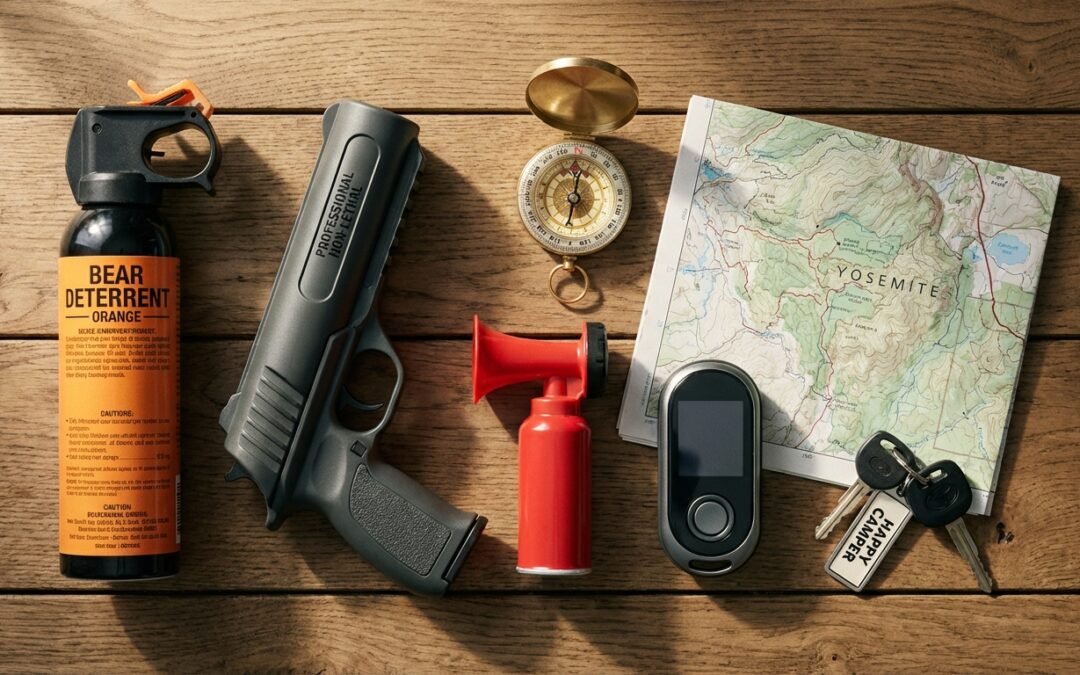
Bear spray stops an aggressive bear 92% of the time based on peer-reviewed research. Byrna says its launcher is not a firearm, but state and local weapons laws vary, so verify the law where you travel. An air horn is broadly legal across the U.S. and costs under $25. Many boondockers carry none of these. This guide covers what each option actually does, what it doesn’t, and which scenarios each is built for — without the product hype.
Quick Answer
Wildlife threats: Bear spray is the most evidence-backed deterrent. Effective range 20–40 feet. 92% success rate against brown bears in documented encounters.
Human threats: Byrna launcher (manufacturer says no permit, state and local law varies) or pepper spray. Air horn for deterrence and signaling.
Wasp spray: Prohibited under federal pesticide law for use against people. Do not use it as a substitute for pepper spray.
First rule: Carry what you will actually deploy. The best protection is the tool you reach for without thinking about it.
Chuck Price has 35+ years of RV camping experience and travels in a 2018 Hymer Aktiv Class B. He has been featured on CBC Radio’s Cost of Living.
Why Boondockers Consider Non-Lethal Options
Remote camping removes the safety nets that developed campgrounds provide — host staff, neighboring rigs within earshot, security lighting. That exposure is precisely why people boondock, and it’s also why the question of personal protection arises more frequently in dispersed camping forums than anywhere else.
Non-lethal tools fill a specific gap. Firearms are effective but introduce complexity: interstate transport laws, storage requirements in a tight rig, and — if you haven’t trained for stress shooting — a false sense of preparedness. Non-lethal options are not a compromise. For the threat scenarios most boondockers actually face — curious black bears, wildlife startled near camp, or an escalating situation with a stranger — a non-lethal tool is often the appropriate and legally cleaner response.
This is not an either/or discussion. Many full-timers carry both. What follows is a clear-eyed look at each non-lethal option: what the evidence says, what the law says, and what the practical limitations are in a boondocking context. For a broader view of remote self-sufficiency — including site selection, water security, and emergency planning — see our boondocking with wildlife safety guide.
Options at a Glance
Prices and permit requirements vary by state, park, and retailer. Verify legality for the specific areas you plan to visit before travel. Prices checked as of March 2026.
Option
Best For
Effective Range
Permit Required
Approx. Cost
Bear Spray
Wildlife encounters
20–40 ft
No
$35–$60
Pepper Spray (human)
Human threats
8–16 ft
Some states
$15–$35
Byrna Launcher
Human threats; visual deterrent
30+ ft
None required per mfr; verify state law
$300–$400
Air Horn
Wildlife deterrence; emergency signal
Audible to 1 mi
No (verify site rules)
$10–$25
Personal Alarm
Seniors; signaling; deterrence
Passive only
No
$15–$50
Sources: BearWise, Byrna Technologies, NPS, BLM. Prices checked as of March 2026 — confirm current pricing before purchase. Permit requirements vary by state and site; verify before travel.
Bear Spray: The Evidence-Backed Wildlife Deterrent
Bear spray stopped aggressive brown bear behavior in 92% of documented Alaskan encounters, based on a peer-reviewed 20-year study published in the Journal of Wildlife Management (Smith et al., 2008).
That number matters because it comes from real-world encounters, not controlled conditions. The same study found that 98% of people who deployed bear spray in close-range encounters escaped without injury. No other non-lethal wildlife deterrent has a comparable evidence base.
Bear spray is specifically formulated for wildlife — it is not interchangeable with personal defense pepper spray. The NPS recommends deploying when an aggressive charging bear is within 60 feet, directing spray at a downward angle to create a barrier cloud the bear must pass through at approximately 30 feet. This is a practiced technique, not an instinctive one. Run at least one dry-run deployment before your first backcountry trip.
What Bear Spray Does NOT Do
Bear spray is not approved for use on humans in any U.S. jurisdiction. Using it against a person is a federal violation.
It is not permitted on commercial aircraft. Ship it to your destination or rent at some popular trailheads.
It does not work as a tent or gear repellent. Applying bear spray to equipment can actually attract bears.
Performance degrades in extreme cold. Keep it inside your sleeping bag overnight in sub-freezing temperatures.
Canisters expire — typically 3 to 4 years from manufacture. Check the date before every season.
What to buy: Look for the EPA registration number on the label. The EPA requires a minimum 7.9 oz canister and 1–2% capsaicinoids for a product to be marketed as bear spray. Brands meeting this standard include Counter Assault, UDAP, Frontiersman, and Guard Alaska. A chest or hip holster is not optional — the spray is useless stored in a day pack during a charge.
Byrna Launcher Review: What RV Campers Actually Report
Byrna launchers are CO2-powered devices not classified as firearms under federal law. Byrna’s documentation says no permit, background check or registration is required, but that is the manufacturer’s reading, and state and local weapons laws vary as of early 2026. Verify current law in each state you travel through before departure.
The Byrna addresses a problem bear spray cannot: human threats where you’re not in bear country, or where deploying a chemical agent intended for wildlife creates legal exposure. It fires kinetic or pepper-compound projectiles from 30+ feet. The visual resemblance to a sidearm provides a deterrent effect before any round is fired, which is the outcome most boondockers are actually after.
The Byrna SD and Byrna LE are the two models with the most RV-community use. Tracy Michelle, who keeps one in her RV on the Oregon Coast, describes it this way: “It fits. Not just in a drawer, but into the way I live.” That’s the appeal in a rig context — compact enough to store within reach, no gunpowder, no interstate transport legal complexity.
As of March 2026, a full kit with pepper rounds typically runs $300–$400, and projectile packs are around $20–$30. Confirm current pricing at Byrna.com before purchase.
Does it work? The accidental proof.
Ryan Vader, a verified Byrna owner, accidentally broke open a pepper round while reloading, touched his face, and spent the next 30 seconds coughing violently and vomiting outside his shop. His words: “I am 100% a fan of the Byrna Launcher. I know for a fact that it works, even if by an unfortunate accident.” That’s an unintentional but hard-to-argue field test of the pepper rounds.
Shelf Life Warning — Read Before You Load
Larry Lankenau, who purchased a Byrna SE in January 2024, discovered his pepper projectiles had started leaking powder before the 18-month shelf life was up. Cause: vibration from driving over time caused the two-halve seam to separate. He found out the hard way — a dusting of pepper powder in a hotel room. His loading recommendation, confirmed by a Byrna retail outlet: load pepper rounds seam-side up, alternate with kinetic rounds, and plan to replace pepper projectiles every 8 months if stored in a vehicle.
The shelf life issue is real and specific to vehicle storage. Factor replacement costs into your total cost of ownership — this is not a buy-once setup.
Pros
Manufacturer says no permit, state and local law varies
30+ foot effective range
Fires kinetic or pepper rounds
Strong visual deterrent before firing
Compact; fits in a glove box or bedside drawer
No interstate transport restrictions of a firearm
Cons
$300–$400 entry cost plus ongoing consumables
Pepper rounds degrade faster in vehicles — replace every ~8 months
CO2 cartridges need replacing
Requires deliberate practice to deploy under stress
Not designed for large wildlife (bears, mountain lions)
Displaying it can create legal exposure in strict states — see below
Dale Brown, a Byrna dealer, frames the practice requirement plainly: “You need to know how to use the launcher, how to carry it, and how to deploy it. Practice, practice, practice.” That applies at least as much in a boondocking context as anywhere else — you may be retrieving it from a storage drawer at 2 a.m. with limited light and elevated stress.
The core decision for most boondockers: bear spray for wildlife, a Byrna or pepper spray for humans, an air horn for both at low cost. No single tool covers every scenario. The goal is a lightweight, legally clean setup you will actually deploy when stress degrades fine motor control. None of these tools are useful sitting in a storage bay when you need them at 2 a.m.
Air Horns and Fog Horns: The Underrated Option
Air horns are broadly legal across the U.S. with no permit requirement — but specific parks, campgrounds, and recreation areas may restrict their use, so check site rules before you deploy one. Marine-grade compressed-air horns meet U.S. Coast Guard sound requirements and produce 115 to 120 dB — enough to startle most wildlife and alert other campers from a significant distance.
For wildlife deterrence, the noise plus the sudden movement of a human reacting to it is often enough to redirect a bear, mountain lion, or coyote that hasn’t committed to aggression. Bear spray and an air horn together cover most wildlife-encounter scenarios on BLM or National Forest land.
What air horns don’t do: They provide no meaningful protection against a determined human threat and have a limited effect on an already-committed wildlife charge. An air horn is a deterrence and signaling tool, not a response tool.
What to buy: The Falcon Safety brand and Primus Powerhorm are widely used by backcountry campers. Get a marine-grade canister, not a sports horn — the compressed air output and sound level are meaningfully different. As of March 2026, quality marine-grade canisters run $10–$25 at most outdoor retailers — confirm current pricing before purchase.
Personal Alarms: Best for Seniors and Mobility-Limited Campers
Electronic personal alarms are generally lawful throughout the U.S., carry a low risk of self-injury, and are simple to deploy without significant practice. At 120–130 dB, a quality alarm is audible for several hundred feet in open terrain. Specific park or campground rules may restrict noise devices in some areas — verify before relying on one as your primary option.
For seniors or RVers with mobility limitations, a wearable personal alarm is a practical primary option. Some models include GPS tracking and fall detection with a connected monitoring service — relevant for solo travelers boondocking in areas with no cell coverage.
Limitations: Personal alarms are passive deterrents only. They signal distress and may startle an attacker or wildlife, but they do not stop a threat. Treat them as a complement to bear spray or pepper spray, not a replacement.
Key specs to look for: 120+ dB output, wrist or belt attachment, backup battery or rechargeable, pin-pull or button activation. Avoid models that require two hands to activate.
Wasp Spray for Self-Defense: A Bad Idea on Multiple Fronts
Correction: A Common but Risky Piece of Advice
What circulates online: “Keep wasp spray near your door — it shoots farther than pepper spray and is legal everywhere.”
Why it persists: Wasp spray does shoot 15–20 feet and is inexpensive and widely available. The legal risk is invisible until after an incident occurs.
The EPA label issue: Wasp spray is a registered pesticide. The product label expressly prohibits any use other than killing insects as directed — using it against a person violates federal pesticide law. EPA pesticide regulation guidance.
The state law issue: Separately from the EPA label violation, spraying any chemical on a person can constitute assault or aggravated assault under state criminal law, depending on jurisdiction. These are distinct legal risks — the federal label violation and whatever state law applies where the incident occurs.
Bottom line: Human-formulated pepper spray is inexpensive, more effective against human threats, and does not carry the EPA label-use problem. Use products specifically designed and labeled for personal defense.
Legal Considerations Before You Leave Home
Self-defense laws vary by state and by the specific land jurisdiction where you camp. This article is informational only — not legal advice. The following are starting points, not legal clearance.
National Park Service:NPS firearms and weapons policies vary by park. State law on possession generally applies, but specific park rules on weapon discharge — including non-lethal projectiles — may differ.
BLM land: Self-defense tools are generally permitted on BLM dispersed camping areas, but specific recreation areas may have additional restrictions. BLM.gov has land-specific visitor use rules.
Reasonable force doctrine: Courts apply a proportional force standard. A tool’s legal status does not automatically make its use legally justified. Understand the difference between a legal tool and a legally justified deployment. The Legal Information Institute’s overview of self-defense law is a useful primer.
Pepper spray state restrictions: Most states allow civilian possession of pepper spray, but some (Massachusetts, New York, California) have size or age restrictions. Verify before crossing state lines.
Byrna in strict states — a documented example: A Massachusetts buyer reported that merely displaying a holstered Byrna (never fired, never pointed) during a road confrontation resulted in a police summons, court appearance, and tens of thousands in legal fees. His account: “The law doesn’t really see a difference between this and a real gun in situations like this.” Massachusetts law on what constitutes a dangerous weapon in a threatening situation is broader than many buyers expect. This is not a reason to avoid the Byrna — it is a reason to understand your specific state’s laws before you travel with one.
Prevention Is the First Line of Defense
The tools above matter most when prevention fails. Prevention rarely fails if you apply a few consistent habits in the field.
The Nose-Out Parking Rule
Always park nose-out at boondocking sites. This single habit eliminates the most common reason people can’t leave quickly: backing out in the dark while stressed. If a situation deteriorates, nose-out means 30 seconds to driving away, not a 10-point turn with a flashlight.
Wildlife encounters: Do not maintain eye contact. Move slowly away. Keep food and scented items secured at all times — not in a cooler by the door.
Human encounters: Trust your instincts early — before a situation escalates. De-escalation and exit are always preferable to confrontation. Most experienced boondockers report never needing to deploy anything. Choosing a site with good sight lines and a clear exit route is more effective than any specific piece of gear. For emergency preparedness beyond personal protection, see our RV safety and emergency preparedness guide.
The three-rule field test from backcountry experience: Animals — do not look them in the eye; move quietly away. Intoxicated individuals — there is no productive conversation; move away. Belligerents — do not give them a scene; move away. Most situations resolve without escalation if you refuse to escalate.
How to Choose the Right Option for Your Situation
There is no universal answer. The right tool is the one that matches your specific camping profile, physical capability, and threat context.
If you camp in bear country
Bear spray is non-negotiable. Add an air horn as a secondary deterrent. Keep both in a belt holster and reachable from your driver’s seat.
If your primary concern is human threats
A Byrna launcher with pepper rounds gives you meaningful range without firearms complexity across state lines. Verify current state law before travel. Pair with a personal alarm for nighttime signaling.
If you are a solo senior or have mobility limits
A wearable personal alarm plus bear spray covers most scenarios at low cost and minimal self-injury risk. GPS-enabled models add a safety net for off-grid medical emergencies.
If you want broad coverage at a low cost
Bear spray ($35–$60) plus a marine-grade air horn ($10–$25) covers the two most common boondocking threat types for $50 to $85 total (March 2026 pricing). Both are broadly legal with no permit requirement — verify site-specific rules before travel.
Broader preparedness
If non-lethal protection is one piece of a larger self-sufficiency mindset, Ammo.com’s off-grid living guide covers the full picture — from remote location selection and water sourcing to food independence and personal security. Read: Off-Grid Living Guide
Before Your Trip
Practice with whatever you carry — at a minimum, practice the draw and safety removal. Stress degrades fine motor skills. If you haven’t removed the safety on your bear spray canister 20 times in a driveway, you will fumble it in the dark. Inert training canisters are available from most bear spray manufacturers for this purpose.
Frequently Asked Questions
Is bear spray legal on BLM land and in national parks?
Bear spray is legal in all U.S. national parks and on BLM land for deterring wildlife. Using it against a human being may be illegal in some jurisdictions. Specific park rules can add restrictions — check the NPS or relevant agency site before entering. The NPS recommends bear spray as the primary wildlife deterrent over firearms.
Is the Byrna launcher legal in all 50 states?
Byrna’s documentation states their launchers are CO2-powered devices not classified as firearms. That is the manufacturer’s position, not a legal ruling, so check your state and city law before you buy or carry one. State weapons laws change — verify current law in each state you plan to travel through before departure, particularly in states with restrictive weapons statutes.
Can you use wasp spray for self-defense while camping?
No. Wasp spray is an EPA-regulated pesticide, and its label prohibits use against people — violating that restriction is a federal pesticide law issue. Separately, spraying any chemical on a person can constitute assault under state law, depending on jurisdiction. It is also less effective than pepper spray against human threats. Use products specifically labeled for personal defense.
What is the effective range of bear spray?
Most EPA-registered bear sprays have an effective range of 20 to 40 feet, depending on brand and conditions. The NPS recommends deploying when an aggressive bear is within 60 feet, creating a barrier cloud at approximately 30 feet. Cold weather and high winds reduce the effective range. Confirm the range on your specific canister’s label.
What non-lethal protection is best for solo women boondocking?
A layered approach works best: bear spray for wildlife (range 20–40 feet), a personal alarm for emergency signaling, and pepper spray or a Byrna for human encounters. The most effective tool is the one you carry consistently and can deploy under stress without hesitation.
Should I tell other campers or rangers if I carry non-lethal protection?
No affirmative disclosure is typically required for legal non-lethal tools. If asked by a ranger, answer honestly. Some campgrounds and specific park areas may prohibit projectile-launching devices even if non-lethal — check site-specific rules before setting up camp.
Smith, T.S., Herrero, S., DeBruyn, T.D., Wilder, J.M. “Efficacy of Bear Deterrent Spray in Alaska.” Journal of Wildlife Management, 72(3), 640–645. 2008. Available via BearWise.
U.S. Environmental Protection Agency. “Pesticide Registration and Regulation.” EPA.gov. Accessed March 2026. epa.gov/pesticides
Note: Two references present in the original version of this article — Brewer (2023) Journal of Wilderness Safety and Richardson & Martinez (2024) Outdoor Recreation Law Review — could not be independently verified and were removed in the first rewrite. No replacement sources were invented.
About the Author
Chuck Price has 35+ years of RV camping experience and travels in a 2018 Hymer Aktiv Class B. He and his wife Cindy run BoondockOrBust.com. Chuck has been featured on CBC Radio’s Cost of Living.
By Chuck Price | Published March 12, 2026 | Last Updated March 12, 2026<! –>
Quick Answer: Facebook Gurus say your RV can “pay for itself.” Some even suggest you could earn $20,000 or more per year. Here’s what they leave out: platform fees take 20% to 25%, your personal insurance probably won’t cover rental use, renters have no idea how to handle your lithium batteries or composting toilet, and the accelerated depreciation often eats the income. For owners of custom boondocking rigs, renting out rarely makes financial sense. If you must try it, delivery-only is the least-bad option.
Every RV Facebook group runs the same cycle. Someone posts about renting their rig on Outdoorsy or RVshare. The comments fill with “I made $2,500 last month!” and “It pays for itself!” Then three months later, the same owner is posting about a denied insurance claim or a renter who cooked the lithium batteries.
We’ve spent 35+ years RVing. Everything we teach in our boondocking guide is built around self-reliance and protecting an RV’s systems. The idea of handing the keys to a stranger who doesn’t know the difference between a charge controller and a light switch makes most owners uncomfortable. But this isn’t about feelings. It’s about math.
So we ran the numbers. What follows is the financial reality of renting out an RV, with specific attention to why boondocking rigs carry risks that the rental platforms never mention.
The Real Math: What RV Rental Income Actually Looks Like
Peer-to-peer platforms take a cut of each booking. Outdoorsy lists host fees of 20% to 25% and starts new hosts at 25%. That means a $200/night listing puts $150 to $160 in your pocket before any other costs. RVshare sets its own host fee, so check its current rate.
Platforms like Outdoorsy and RVshare suggest owners can earn anywhere from a few thousand to $30,000 or more per year. Third-party sites push the range even higher, up to $50,000 for driveable motorhomes. Those numbers assume occupancy rates of 40 to 50%, which industry benchmarks treat as a rough target, not a guarantee. Your location, season, rig type, and pricing all affect real-world bookings.
Here’s a worked example for a Class B motorhome listed at $175/night:
That $14,000 headline number becomes $1,800 after real costs. At Outdoorsy’s 25% starting rate for new hosts, the platform fee is $3,500 and net income falls to $1,100. And we haven’t accounted for accelerated depreciation from rental mileage, your time managing bookings, or the one bad rental that puts your rig in a body shop for three weeks.
This does not mean nobody earns money renting RVs. Owners of newer Class A or Class C rigs in high-demand tourist markets can do better. But the math changes dramatically for custom, off-grid-equipped rigs where replacement costs for specialty systems are high and renter inexperience creates unique risk.
Constraint: These numbers are estimates based on published platform fee structures and reported owner experiences. Your actual results depend on location, rig type, occupancy, and operating costs. Do not treat this table as a guarantee of income or loss.
Depreciation and Maintenance: The Costs Nobody Advertises
RVs depreciate fast. According to Progressive Insurance, most lose 15 to 20% of their value in the first year alone, with an additional 5 to 10% per year over the next four years. After five years, the curve flattens, but by then a $100,000 rig may be worth $50,000 to $60,000 regardless of how carefully you’ve maintained it.
Rental use accelerates both depreciation and maintenance in ways that compound:
Mileage accumulation. A renter on a week-long trip can put 1,000+ miles on your rig. At 80 rental nights, that’s easily 5,000 to 8,000 additional miles per year. Used RV buyers shop for low mileage. Every rental mile moves you further from the “lightly used” category that holds resale value.
Wear pattern differences. Renters use your rig differently than you do. They run the generator harder, cycle the slides more frequently, stress the awning in wind, and treat the drivetrain like a rental car. Components that would last 10 years under your care may need replacement in 5.
Warranty risk. RV manufacturers have taken the position that commercial use, including peer-to-peer rental, can void the factory warranty. If your rig is still under warranty, rental use could eliminate that coverage entirely. Extended warranties carry similar exclusions.
The core problem: the income from 80 rental nights might net $1,800, but the accelerated depreciation from those 80 nights could reduce your resale value by $2,000 to $5,000. You can end up losing money on a venture that looks profitable on the surface. This is one of the hidden costs of RV living that rarely shows up in the rental pitch.
Constraint: Depreciation rates vary by RV type, brand, condition, and market. Class B motorhomes from brands like Winnebago and Airstream tend to hold value better than average. These figures represent general industry patterns, not a prediction for any specific rig.
Insurance and Liability Gaps That Could Sink You
Most personal RV insurance policies contain a commercial exclusion clause. Once you accept money for rental use, even one weekend per year, your personal policy may no longer cover your rig. Insurers have denied claims and canceled policies after discovering undisclosed rental activity.
The platforms offer their own coverage. According to Roamly’s owner insurance guide, Outdoorsy provides up to $1 million in liability and up to $300,000 in comprehensive and collision protection during the rental period. RVshare offers similar coverage through their insurance partner Crum and Forster. That sounds comprehensive until you read the details.
Here’s what falls through the gaps:
Between-rental coverage. Platform insurance only applies during active bookings. Between rentals, you need a personal policy that explicitly allows rental use. Most standard insurers don’t offer this. Specialty insurers like Roamly do, but the premiums are higher. One insurance professional quoted by Insurance.com estimated the difference between personal and commercial RV coverage at roughly 800%, meaning a $500/year personal policy could jump to $4,000 or more for commercial use. Even if the actual increase is smaller, it cuts directly into rental margins.
Claims processing reality. One RV owner documented a $1,700 body damage claim on Winnebago’s blog. He described the process as tedious at best, involving multiple phone calls and emails over weeks. The final payout came minus the $750 security deposit, which he had to claim separately. During that time, he had to send out the rig for another rental in less-than-perfect condition because he couldn’t afford the downtime.
Deductible gaps. Platform coverage often has deductibles of $500 to $1,500. For minor damage, a renter’s deposit and the deductible may not cover the full repair. You eat the difference.
Loan and financing conflicts. If you’re financing your RV, your loan agreement likely specifies personal use. Commercial rental use may breach that agreement. As one legal analysis from the law firm Hudson Cook noted, RV manufacturers and lenders may view peer-to-peer rental as a breach of the retail installment sales contract.
The core question this article answers: Should you rent out your RV if it’s equipped for boondocking? The math shows that platform fees, insurance gaps, accelerated depreciation, and off-grid system damage risk combine to make rental income far less attractive than the headline numbers suggest. For owners of custom rigs with solar, lithium, composting, or other off-grid systems, the risk-adjusted return is often negative. The decision framework comes down to three variables: your rig’s replacement cost, your personal risk tolerance, and whether you can realistically use the rig more days per year yourself.
Why Renters Destroy Off-Grid Systems
A weekend RV renter and a boondocker operate in fundamentally different contexts. The renter expects the rig to work like a hotel room on wheels. The boondocker understands it’s a self-contained power and water system that requires active management. This mismatch is where expensive damage happens.
Lithium battery mismanagement. Lithium iron phosphate (LiFePO4) batteries are the standard for serious boondocking rigs. They require charge controllers programmed to the correct battery chemistry. A renter who doesn’t understand the system might plug into shore power with incompatible settings, run the batteries below their low-voltage disconnect threshold, or leave high-draw appliances running overnight. One experienced RV solar installer documented a case where incorrect charge controller settings were actively damaging lead acid batteries, causing them to bubble hydrogen gas and corrode. Lithium systems are more forgiving but not renter-proof.
Solar panel damage. Rooftop solar panels require periodic cleaning and awareness of shade management. A renter who parks under trees for the shade won’t realize they’re cutting solar production by 40% or more and over-discharging batteries. Worse, renters who climb on the roof to “check the panels” risk cracking cells or damaging mounting hardware. Dirty panels alone lose 15 to 25% efficiency, and a renter won’t know to clean them.
Composting toilet misuse. If your rig runs a composting toilet like a Nature’s Head or Airhead, you already know the learning curve. A renter who treats it like a flush toilet will destroy the composting medium, create odor problems, and potentially damage the agitator mechanism. Most rental platforms have no process for training renters on composting toilets, and most renters have never seen one. If you want to learn more about managing waste systems effectively, see our waste disposal and management guide.
Water system overuse. Boondocking rigs are designed for water conservation. A 30-gallon fresh tank might last a boondocker 5 to 7 days. A renter will empty it in 2. They’ll leave the water pump running, take long showers if the rig has one, and overfill the gray tank. If your rig has a water management system tuned for off-grid use, rental use will stress every component.
4×4 MIMO and connectivity equipment. External antenna systems for Starlink and cellular boosters involve roof-mounted hardware, cable routing, and configuration. A renter who doesn’t understand the system won’t use it properly and may try to “fix” things by unplugging cables or adjusting mounts. The replacement cost for a damaged Starlink dish or a weBoost antenna system can easily exceed $500.
Constraint: Not every rental results in system damage. But for rigs with off-grid systems totaling $5,000 to $15,000 in upgrades, a single bad rental can wipe out a full season of income. Platform insurance typically covers collision and liability, not improper use of specialty equipment.
Why Delivery-Only Is the Least-Bad Option
If you’ve read this far and still want to try renting, delivery-only is the approach that minimizes the most destructive risks.
Delivery-only means you drive or tow the rig to a campground or event, set it up for the renter, and retrieve it when they’re done. The renter never drives your vehicle. They use it as a stationary accommodation.
This eliminates several of the worst problems:
No driving damage. The number one source of major RV rental damage is driving incidents. Renters clip awnings on gas station overhangs, sideswipe trees on narrow campground roads, and misjudge clearance heights. If the renter never drives, these risks disappear.
Reduced mileage impact. You control the miles. A delivery within 50 miles of home adds minimal depreciation compared to a renter taking your rig on a 500-mile road trip.
Lower insurance complexity. Some delivery-only platforms like RVPlusYou charge as little as 3% of rental fees to the owner, compared to 20% at the major peer-to-peer platforms. The insurance model is also simpler because the rig is stationary during the rental.
You can control setup. You set up the solar, configure the power system, demonstrate the toilet, fill the water tank, and explain the systems. This dramatically reduces the chance of renter misuse.
The trade-off: delivery-only requires more of your time per rental and limits your market to your local area. You’re earning less per booking but protecting more of your investment.
Constraint: Delivery-only is not risk-free. Renters can still damage interiors, misuse water systems, and break appliances. It simply removes the driving risk and gives you more control. Platform coverage terms still apply and should be reviewed carefully before listing.
Who Should Not Rent Out Their RV
Based on the evidence, the following owners should not rent out their rigs:
Owners of custom boondocking rigs. If you’ve invested $5,000 to $15,000 in solar, lithium batteries, composting toilets, water filtration, or connectivity equipment, the replacement risk from renter misuse exceeds the likely rental income. These systems require operator knowledge that a typical renter doesn’t have.
Owners still under warranty. RV manufacturers can void factory warranties for commercial use, including peer-to-peer rental. Extended warranties carry similar exclusions. The real cost of Class B maintenance without warranty coverage adds significant financial exposure.
Owners who finance their RV. Loan agreements typically restrict use to personal, family, or household purposes. Rental use may constitute a breach. If your lender discovers rental activity, they may have grounds to declare default, depending on the contract terms.
Owners with standard personal insurance. If your insurer doesn’t know you’re renting, you have a coverage gap that could cost you everything in a serious incident. Switching to rental-friendly insurance adds cost that erodes already thin margins.
Full-time RVers. If your RV is your home, renting it out means you have nowhere to live during the rental period. The logistics rarely work, and the insurance complexity of a full-time policy that also allows rental is significant.
Who might make it work: Owners of newer, stock Class A or Class C rigs in high-demand tourist markets who don’t use the rig more than a few weeks per year, who carry rental-friendly insurance, and who treat rental income as a partial offset to storage and depreciation costs rather than a profit center. That’s a narrow audience.
The Better Math: Using Your Rig More Strategically
The best way to improve your RV’s economic return isn’t renting it to strangers. It’s using it more yourself and reducing your cost per night of ownership.
Here’s the math that actually matters for boondocking rig owners:
If you own a rig that costs $800/month in loan, insurance, and maintenance, and you use it 30 nights per year, your cost per night is about $320. Use it 100 nights per year, and that drops to $96/night. Use it 150 nights and you’re at $64/night.
Compare that to the rental math: after all costs, you might net about $22.50 per rental night ($1,800 across 80 nights) while accepting depreciation, insurance, and damage risk. Or you can use the rig yourself, pay nothing per additional night of use, and keep your systems intact.
If your rig sits unused 300+ days per year and you’re paying for storage, the calculus shifts slightly. But the solution isn’t necessarily renting. It might be:
Selling the rig and buying when you need it. If you use your RV fewer than 30 nights per year, the depreciation alone may exceed what you’d spend on renting someone else’s rig for those trips.
Extending your boondocking season. Longer trips to free or low-cost public land reduce your per-night cost without adding any rental risk.
Reducing fixed costs. Dropping comprehensive coverage to liability-only on older rigs, eliminating storage by boondocking more often, and doing your own maintenance all lower the denominator in the cost-per-night equation.
The boondocking lifestyle is fundamentally about cost control, not income generation. The best RV financial strategy for most of our readers is the same as our core thesis: spend less by camping smarter, not by turning your home into a side hustle.
Frequently Asked Questions
Answers to the most common questions about renting out an RV, insurance risks, and alternatives for boondocking rig owners.
How much can you realistically make renting out an RV?
After platform fees (20%), cleaning, insurance, maintenance, and minor damage, most owners of custom or off-grid rigs net far less than the platforms suggest. A realistic worked example for a Class B listed at $175/night with 80 rental nights shows roughly $1,800 in net income before taxes and depreciation.
Does renting out your RV void the warranty?
It can. RV manufacturers have stated that commercial use, including peer-to-peer rental, may void factory and extended warranties. Check your specific warranty terms before listing. The legal analysis firm Hudson Cook has identified warranty voiding as a known issue in peer-to-peer RV rental.
Will my insurance cover my RV if I rent it out?
Most standard personal RV insurance policies exclude commercial use. Renting your RV without disclosing it to your insurer can result in denied claims and policy cancellation. You need either a rental-friendly personal policy from a specialty insurer or separate commercial coverage. Platform-provided insurance only covers the active rental period.
What is delivery-only RV rental?
Delivery-only means you transport the RV to a campground or event, set it up, and the renter uses it as stationary accommodation. The renter never drives the vehicle. This eliminates driving damage risk, reduces mileage impact, and gives you control over system setup. Platforms like RVPlusYou specialize in this model and charge lower commission rates than peer-to-peer driving platforms.
Is renting out a boondocking rig different from renting a standard RV?
Yes. Boondocking rigs typically have solar panels, lithium batteries, composting toilets, external antennas, and water conservation systems that require operator knowledge. A typical renter lacks this knowledge and can damage systems that cost thousands to replace. Platform insurance generally covers collision and liability, not improper use of specialty equipment.
To provide the best experiences, we use technologies like cookies to store and/or access device information. Consenting to these technologies will allow us to process data such as browsing behavior or unique IDs on this site. Not consenting or withdrawing consent, may adversely affect certain features and functions.
Functional
Always active
The technical storage or access is strictly necessary for the legitimate purpose of enabling the use of a specific service explicitly requested by the subscriber or user, or for the sole purpose of carrying out the transmission of a communication over an electronic communications network.
Preferences
The technical storage or access is necessary for the legitimate purpose of storing preferences that are not requested by the subscriber or user.
Statistics
The technical storage or access that is used exclusively for statistical purposes.The technical storage or access that is used exclusively for anonymous statistical purposes. Without a subpoena, voluntary compliance on the part of your Internet Service Provider, or additional records from a third party, information stored or retrieved for this purpose alone cannot usually be used to identify you.
Marketing
The technical storage or access is required to create user profiles to send advertising, or to track the user on a website or across several websites for similar marketing purposes.