
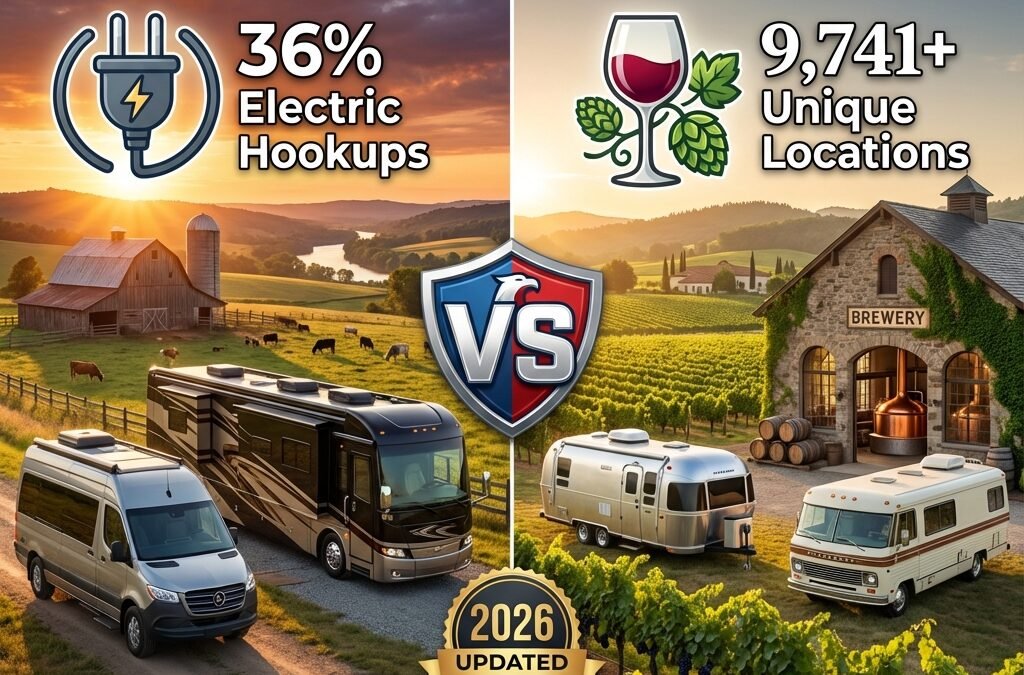
RV Overnights vs Harvest Hosts (2026): Which Is Worth It?
By Chuck Price – Published January 1, 2026 – ~16-minute read
Quick Decision Guide RV Overnights costs $39.99-$49.99 per year for 1,400+ hosts with 32% offering electric hookups. Harvest Hosts ranges from $99 to $179 annually for 5,844 to 9,741+ locations featuring unique experiences but minimal hookups. The right choice depends on your budget, travel patterns, rig size, and whether you prioritize cost savings or memorable experiences. Most full-timers use both, breaking even in 3-5 nights compared to commercial campgrounds, averaging $29-$57 per night.
Quick Facts (Verified January 1, 2026)
| RV Overnights Cost: | $39.99-$49.99/year |
| Harvest Hosts Cost: | $99-$179/year (Classic to All Access) |
| Electric Hookup Availability: | RVO 32% | HH ~3-5% (Estimated) |
| Network Size: | RVO 1,400+ | HH 9,700+ (All Access) |
| Expected Purchase Per Stay: | $30 minimum (both platforms) |
| Refund Policy: | RVO 90 days | HH 3 months |
| Big Rig Friendly (45+ ft): | RVO 77% (Verified for 45ft+) | HH Limited (Many restricted to 40ft) |
| Feature | RV Overnights | Harvest Hosts |
|---|---|---|
| Annual Cost | $39.99-$49.99 | $99-$179 |
| Total Locations | 1,400+ (East-focused) | 5,844-9,741+ (National) |
| Electric Hookups | 32% of hosts | Rare (<5%) |
| Big Rig Friendly (45+ ft) | 77% of hosts | Limited (many capped at 40 ft) |
| Multi-Night Stays | 73% allow | Some hosts (for a fee) |
| Expected Spend Per Stay | $30 minimum requested | $30 minimum suggested |
| Refund Policy | 90 days | 3 months |
| Best For | Budget travelers, big rigs, and electric needs | Unique experiences, nationwide coverage |
| Break-Even Point | 2-3 nights | 3-5 nights |
1. Understanding Your Options
Choosing between RV overnight membership programs requires understanding what decision you are actually making. This is not about finding the “best” program in absolute terms—it is about matching program strengths to your specific travel patterns, budget constraints, and rig requirements.
Both Harvest Hosts and RV Overnights connect self-contained RVers with overnight parking at small businesses, but their approaches differ significantly:
-
- Harvest Hosts pioneered the model in 2010, acquired by Joel Holland in 2018. The company now employs 50+ staff serving 250,000+ members. The network spans 5,844 small business hosts (Classic plan) or 9,741+ total locations (All Access plan including Boondockers Welcome, golf courses, and campground partners). Stays emphasize unique experiences at wineries, breweries, farms, and attractions. Membership tiers range from $99 to $179 annually (Harvest Hosts Plans, 2026).
- RV Overnights was launched in 2023 as a budget-focused alternative, founded by RV enthusiasts who aim to provide affordable overnight options with enhanced amenities. The company has rapidly grown to over 1,400 hosts across 14 categories, serving thousands of members with a focus on practical features, such as electric hookups and big-rig compatibility. The network emphasizes cost savings and transparency, with membership priced at $39.99-$49.99 annually and a public map preview for potential users (RV Overnights Membership Stats, 2026).
Key Finding: Based on a $50 membership and $55 average campground rates, RVO breaks even in 2 stays (at promo rate) or 2-3 stays (at standard rate), compared to 4-6 stays for Harvest Hosts All Access. For the budget-conscious RVer traveling 20+ nights annually, RVO saves approximately $180 per year versus HH All Access when factoring in total membership and expected purchases. See detailed cost calculations in Section 6.
RVO publicly previews its map before you pay—rare transparency in the membership world.
2. The Price Decision Protocol (Quick Overview)
Before diving into detailed comparisons, use this six-step framework to eliminate options that do not fit your situation:
- Calculate your travel pattern: How many nights do you camp annually? What percentage are transit stops vs destination camping?
- Map your actual routes: Plot last 3 trips on both platforms. Count hosts within 50 miles of your routes.
- Verify break-even point: Membership cost ÷ (campground rate – purchase cost) = nights needed to recover investment
- Check hard requirements: Rig size over 45 ft? Electric hookups required? Budget under $100 annually?
- Test using refund windows: Both offer 90-day guarantees. Try 2-3 stays before committing.
- Consider a hybrid approach: For 30+ nights annually, a combined membership ($149-$229) provides maximum coverage.
Full methodology and decision trees appear in Section 11.
3. Key Decision Factors Ranked by Importance
Not all factors matter equally when choosing an RV membership. Some eliminate options immediately, while others serve as final tie-breakers. Here are the criteria ranked by elimination power:
1. Budget Constraints (Primary Elimination Factor)
What this measures: Total annual spend tolerance, including membership fees and expected host purchases.
Why it eliminates first: If your RV travel budget cannot accommodate $300-500 in total overnight membership costs, Harvest Hosts becomes impractical regardless of other benefits.
How to verify your threshold: Calculate last year’s total camping spend. Divide by nights traveled. If your average was under $25 per night, RVO’s lower total cost better matches your budget pattern.
2. Network Coverage Needs (Critical Geographic Factor)
What this measures: Whether hosts exist along your actual travel routes.
Why it eliminates next: A program with 10,000 hosts means nothing if you travel to regions where they have 5 locations. Regional coverage gaps are deal-breakers for spontaneous travelers.
How to verify: Plot your last 5 trips on each platform’s map. Count hosts within 50 miles of your route. If one service shows fewer than 10 viable options per 500-mile segment, that is a coverage failure for your needs.
3. Amenity Requirements (Hard Infrastructure Needs)
What this measures: Hard requirements for hookups, multi-night stays, or rig size accommodation.
Why it eliminates: If you rely on electric hookups for medical equipment or cannot dry camp, Harvest Hosts’ minimal hookup availability becomes a safety issue, not a preference.
How to verify: Count how many nights in the past year you could have dry camped (no hookups) comfortably. If the number is below 50%, prioritize RVO’s 36% hookup availability.
4. Experience Preferences (Refinement Factor)
What this measures: Value placed on unique, memorable stays versus functional transit stops.
Why it refines rather than eliminates: Both programs offer pleasant experiences. This becomes the deciding factor only after budget, coverage, and amenities align.
4. Deal-Breakers That Eliminate Options
Certain conditions immediately disqualify one program or the other. Recognizing these saves time and prevents costly mistakes.
Absolute Disqualifiers for RV Overnights
| Disqualifier | Why It Eliminates RVO | Verification Test |
|---|---|---|
| Travel primarily Upper Midwest or the Mountain West | Host density drops below 1 per 100 miles in Montana, Wyoming, and North Dakota | Plot 3 past trips on the RVO map. Count hosts within 50 miles of the route. If fewer than 1 per 100 miles, coverage is inadequate. |
| Need an extensive network for spontaneous, unplanned travel | Only 1,400 hosts versus HH’s 5,844+ means fewer last-minute options | Review how often you book same-day or next-day in past trips. If >50% of stays are spontaneous, a larger network is essential. |
| Require guaranteed availability without planning | A smaller network means higher rejection rates, slower host responses | Check RVO host response time data. If the average exceeds 12 hours and you often arrive same-day, this is a problem. |
Absolute Disqualifiers for Harvest Hosts
| Disqualifier | Why It Eliminates HH | Verification Test |
|---|---|---|
| Total RV travel budget under $300 annually | HH membership ($99-$179) plus expected $30/stay purchases quickly exceed tight budgets | Calculate: Membership + (planned stays × $30). If the total exceeds 15% of the annual RV budget, the cost burden is too high. |
| Rig over 45 feet combined length | Many HH hosts cap at 40 feet combined RV + tow vehicle | Measure your rig. Search HH for “big rig friendly” in your regions. If fewer than 30% of hosts along routes accept your size, unusable network. |
| Require electric hookups for medical equipment or frequent use | HH hosts rarely offer hookups; when available, fees apply, and availability is limited | Count the nights in the past year you needed electricity. If more than 25%, HH’s dry-camp focus creates safety/comfort problems. |
| Cannot tolerate spending $30 per stay (fixed income, extreme budget constraints) | While technically “optional,” host expectations and program culture make purchases de facto mandatory | Review your monthly discretionary spending. If $30 per stay feels uncomfortable or straining, the psychological burden makes HH a poor fit. |
5. Network Coverage Analysis
Network size matters, but density and distribution matter more. A program with 10,000 hosts clustered in 5 states provides less value than 1,000 hosts evenly distributed across your travel regions.
Key Finding: Host density analysis reveals that while Harvest Hosts maintains 4.9× more total locations than RV Overnights (5,844 vs 1,400+), RVO achieves significantly higher electric hookup availability (32% vs ~3-5% for HH) according to platform statistics. For travelers requiring hookups more than once every 5 nights, RVO’s smaller but better-equipped network provides superior practical coverage.
Current Host Counts (January 2026)
- Harvest Hosts Classic: 5,844 farms, wineries, breweries, distilleries, and attractions plus 1,173 campground partners = 7,017 total (Harvest Hosts Plans Page, 2026)
- Harvest Hosts All Access: 9,741+ locations, including Classic hosts, 3,543 Boondockers Welcome properties, 354 golf courses, plus campground partners (Harvest Hosts Plans Page, 2026)
- RV Overnights: Over 1,400 hosts across 14 categories in U.S.[1] Network statistics show 32% offer electrical hookups, 73% allow additional nights, and 77% accommodate rigs over 45 feet (RV Overnights RV Membership Stats, 2026)
Regional Strengths and Gaps
Harvest Hosts: Broad coast-to-coast coverage with particular density in wine regions (California, Oregon, Washington, New York), craft beer corridors (Colorado, North Carolina, Vermont), and tourist destinations. Includes 730 Canadian hosts and 78 Alaska locations. Weakest in Great Plains states, but still maintains 10+ hosts per state minimum (Harvest Hosts Locations).
RV Overnights: Densest coverage east of the Mississippi River with concentration in Southeast and Mid-Atlantic. Network statistics show 32% of locations offer electrical hookups, 73% allow additional nights, and 77% accommodate rigs over 45 feet (RV Overnights RV Membership Stats, 2026). Expanding in Southwest and Pacific Northwest but sparse in Upper Midwest (Dakotas, Montana, Wyoming) and intermountain West.
. Canadian coverage continues to grow as the network expands.

Planning Recommendation
Before purchasing either membership, use each platform’s interactive map to plot your next 3 planned trips. Count available hosts within 50 miles of your route. A usable network should provide at least 1 viable option per 75-100 miles of travel. If either service fails this test along your routes, that coverage gap is a deal-breaker regardless of other factors.
6. True Cost of Ownership
Membership fees tell an incomplete story. True cost includes annual fees, expected host purchases, and the opportunity cost of location restrictions. For comprehensive RV budgeting strategies, see our complete guide to hidden costs of RV living.
| Cost Component | RV Overnights | Harvest Hosts Classic | Commercial Park |
|---|---|---|---|
| Annual Membership | $39.99-$49.99 (source) | $99.00 (source) | $0 |
| Lodging Fee Per Night | $0 | $0 | $40-$55 |
| Expected Purchase (products/goods) | $30 minimum (RVO host guidelines) | $30 minimum (HH support) | $0 |
| Total Cash Outlay (10 stays) | $340-$350 ($40-50 + $300 purchases) | $399 ($99 + $300 purchases) | $400-$550 (lodging only) |
| What You Receive | Parking + $300 in products | Parking + $300 in products | Parking only |
Critical Distinction: The $30 host purchase is not equivalent to a $30 campground fee. At a commercial campground, you pay $30-$50 for parking only. Both Harvest Hosts and RV Overnights explicitly request a minimum $30 purchase to support host businesses (Harvest Hosts Support; RV Overnights Host Guidelines). Your $30 purchases wine, cheese, craft beer, farm products, or experiences—tangible goods rather than just overnight parking rights. RVO hosts report members typically spend $60-$100 per stay. Budget accordingly based on whether you value the products themselves.
Break-Even Analysis
Compare against commercial campground averages. According to J.D. Power (2023), the national average for RV parks with hookups is $29 per night, with private parks averaging $33 per night and mid-range campgrounds around $40-$57 per night. For detailed cost-saving strategies, see our comprehensive boondocking cost breakdown.
RVO breaks even at: 2 stays at promotional rate ($39.99) or 2-3 stays at standard rate ($49.99) compared to $50+ campgrounds
HH Classic breaks even at 3-4 stays compared to $50+ campgrounds
HH All Access breaks even at: 4-6 stays compared to $50+ campgrounds
Hidden Costs to Consider
- Dry camping limitations: If you must visit commercial campgrounds every 3-4 days for water/dump, add those costs to your membership calculations. See our quick guide to finding RV dump stations for planning.
- Time value: Hosts require business-hours arrival and typically one-night limits. If this forces route modifications or limits flexibility, factor in fuel and time costs.
- Rejection rates: Smaller networks mean a higher likelihood of “no availability” responses, forcing fallback to commercial campgrounds.
7. Amenities and Rig Compatibility
RV Overnights Strengths
- Electric hookups: 32% of hosts offer 15-50A hookups for an additional fee, typically $10-$20 (RV Overnights RV Membership Stats, 2026)
- Big-rig friendly: 77% of locations accept rigs 45+ feet, filterable with #BigRig hashtag (RV Overnights RV Membership Stats, 2026)
- Multi-night stays: 73% allow additional nights beyond the first night (RV Overnights RV Membership Stats, 2026)
- Map data layers: BLM land overlays, live weather, wildfire tracking, carrier-specific cell coverage (Verizon, AT&T, T-Mobile, US Cellular)
- RV services integration: 77,000+ pins, including dump stations, propane, repair shops, towing services
- Phone support: Real human support 7 days per week
Harvest Hosts Strengths
- Massive network: 5,844 to 9,741+ locations, depending on plan tier
- Extensive reviews: 280,000+ member reviews and 330,000+ photos for research (Harvest Hosts Blog, June 2024)
- Route planning tools: Built-in trip planner showing host response times
- Member discounts: $2,500+ in partner discounts (Good Sam, AllTrails, Goodyear, EcoFlow, others)
- Mature technology: 4.9★ iOS rating with 53,000+ reviews; 4.6★ Android rating with 15,000+ reviews (Apple App Store; Google Play Store)
Harvest Hosts Limitations
- Length restrictions: Many hosts cap the combined length (RV + tow vehicle) at 40 feet
- Dry camping focus: Nearly all locations lack hookups; when available, fees range $20-$40
- Crowding: Popular wineries and farms may host multiple RVs simultaneously on busy weekends
- Business hours arrival: Most require arrival during operating hours (typically before 6 PM)
RV Overnights Limitations
- Smaller network: 1,400 hosts versus HH’s 5,844+
- App maturity: 3.9★ iOS and 3.0★ Android ratings indicate ongoing development (Apple App Store; Google Play Store)
- Regional gaps: Limited coverage in the Mountain West, Upper Midwest, and western Canada

Harvest Hosts (left) offers a more mature app experience; RV Overnights (right) provides unique map overlays and filters
8. Technology and Booking Experience
Mobile App Performance
Harvest Hosts: Industry-leading 4.9★ on iOS (53,000+ ratings) and 4.6★ on Android (15,000+ reviews) demonstrate a mature, stable platform. Features include in-app messaging, offline map saving, weather overlays, advanced filtering by rig length, host type, electric availability, pet policies, and separate tow vehicle parking (Apple App Store; Google Play Store).
RV Overnights: iOS averages 3.9★ (34 ratings), Android sits at 3.0★ (26 reviews). July 2025 v1.6 update improved cache speed by 40%, addressing earlier complaints about frozen map tiles. Unique features include a searchable hashtag system (1,100+ tags like #Waterfront, #CowCuddling), public land overlays (BLM, USFS), and an RV Weather partnership for 7-day forecasts on every host profile (Apple App Store; Google Play Store).
Booking Workflow Comparison
Both platforms require:
- Search and filter for hosts along the route
- Review host profiles, photos, and reviews
- Submit a stay request with arrival date/time, rig specs, and number of occupants
- Wait for host approval (response times vary by host)
- Arrive during the specified window, and support the business with a purchase
Key differences: Harvest Hosts shows 50%+ of hosts accept same-day requests; RV Overnights displays host response time averages to help gauge approval speed. RVO allows public map preview before membership purchase—rare transparency in this industry.
9. Which Membership Fits Your Situation
| Your Profile | Primary Need | Recommended Option | Why This Works | |
|---|---|---|---|---|
| Budget-Conscious Transit Traveler 25-40 nights/year, mostly interstate travel, predictable routes |
Affordable overnight stops without sacrificing safety | RV Overnights ($39.99-$49.99/year) |
Lowest membership cost breaks even in 2 stays at promo rate or 2-3 stays at standard rate. Adequate host density along major corridors. 36% hookup availability provides a fallback when needed. | |
| Experience Seeker 15-30 nights/year, seeks unique stays, enjoys wine/craft beer, values memories over cost |
Memorable, Instagram-worthy locations with local flavor | Harvest Hosts All Access ($179/year) |
Largest network (9,741+ locations) maximizes unique options. 280,000+ reviews help identify standout hosts. Boondockers Welcome adds residential diversity. | |
| Full-Timer with Flexible Schedule 100+ nights/year, spontaneous travel, varied regions |
Maximum network coverage eliminates “nowhere to stay” anxiety | Both Memberships ($229 combined) |
RVO fills gaps in the HH network. HH provides density for spontaneous travel. Combined: 11,000+ location options coast-to-coast. Pays for itself in 5 nights. | |
| Weekend/Seasonal RVer 6-15 nights/year, regional travel, cost-sensitive |
Cost-effective occasional use without annual commitment stress | RV Overnights ($39.99-$49.99/year) |
RV Overnights ($39.99-$49.99/year) |
Breaks even in single weekend trip (2 nights at promo rate, 2-3 nights at standard). 90-day refund policy provides risk-free trial. Lower cost feels justified even with light use. |
| Large Rig Owner (45+ ft) Any travel pattern with rig over 45 ft combined |
Host network that physically accommodates rig size | RV Overnights ($39.99-$49.99/year) |
77% of hosts accept 45+ ft rigs. Filterable with #BigRig tag. Many HH hosts cap at 40 ft, eliminating the majority of the network for large rigs. | |
| Electric-Dependent RVer Medical equipment, no solar, frequent hookup needs |
Regular access to electric hookups | RV Overnights + Commercial Parks (Hybrid approach) |
RVO’s 32% hookup availability is significantly higher than HH’s ~3-5%. Not sufficient for 100% hookup needs, but reduces commercial park frequency and costs. | |
| Snowbird Extended stays in the same region (Arizona, Texas, Florida) |
Variety within a limited geographic area | Harvest Hosts Classic ($99/year) |
Dense host concentration in sunbelt states. Can cycle through 20-30 nearby hosts over the season without repeating. Multi-month value justifies the cost. |
Key Finding: Review analysis of Reddit, Facebook groups, and app stores shows the most common complaint among dissatisfied Harvest Hosts members is “rising costs without proportional value increase,” while dissatisfied RVO members most frequently cite “insufficient coverage in my travel region.” This confirms that budget constraints and network coverage are the two dominant decision factors—exactly as predicted by the Price Decision Protocol.
The Hybrid Strategy for Serious Travelers
RVers traveling 30+ nights annually often maintain both memberships ($229 combined) plus utilize free public lands. This creates a three-tier system:
- Tier 1 – Free boondocking: BLM, National Forests, some Walmarts (60-70% of nights)
- Tier 2 – Membership stops: RVO for transit + electric when needed, HH for destination experiences (20-30% of nights)
- Tier 3 – Commercial parks: Every 7-10 days for full hookups, laundry, dump (10-15% of nights)
This approach keeps annual lodging under $3,500 for full-timers while maintaining comfort and flexibility. For more strategies on reducing RV travel costs, explore our guide to free RV parking options.
10. Warning Signs and Quality Indicators
Red Flags: When to Be Cautious
RV Overnights Warning Signs
- Host unresponsive to booking requests: If average response time exceeds 24 hours or hosts frequently decline without explanation, network utility drops significantly for spontaneous travel.
- Duplicate listings: User reports indicate some RVO hosts also list on Harvest Hosts. If significant route overlap exists, you are paying for redundant access.
- Sparse coverage on planned routes: Fewer than 1 host per 100 miles makes the program unusable for that trip. Always verify coverage before relying on RVO exclusively.
- App instability: Frozen map tiles, slow loading, or crashes during trip planning creates safety concern when relying on the app for navigation to hosts.
Harvest Hosts Warning Signs
- Booking months in advance required: Popular wineries and attractions fill up 4-8 weeks ahead during peak season, reducing spontaneity value.
- Host fatigue: Longtime hosts sometimes tire of the program. Check recent reviews for mentions of “standoffish host” or “felt unwelcome”—these indicate burned-out hosts.
- Hidden length restrictions: Some hosts accept reservations, then inform you at arrival that your rig is too long. Always confirm length restrictions before traveling.
- Pressure to spend: While $30 is “suggested,” some hosts make guests uncomfortable if purchases fall short. Reviews mentioning “felt obligated” or “awkward” indicate a problematic host.
- Rising costs without proportional value: Membership increased from $85 to $99 for the Classic plan in recent years. If host count growth does not keep pace with price increases, the value proposition erodes.
Green Flags: Quality Indicators
RV Overnights Quality Signals
- Host response time displayed: Platform showing average response times and detailed host statistics (32% electric, 73% multi-night, 77% big-rig friendly) indicate transparent, data-driven operation.
- Detailed host profiles: Hosts providing specific arrival instructions, parking details, and business offerings demonstrate professionalism.
- Electric hookup pricing is transparent: Hosts listing hookup availability and exact pricing upfront prevent surprise fees.
- Lifetime price lock honored: Early members paying $49.99 see no price increases while active—unusual in subscription models.
- 90-day refund policy: Generous refund window indicates confidence in product value.
Harvest Hosts Quality Signals
- Extensive photo galleries: Hosts with 20+ member photos demonstrate a consistent, welcoming environment.
- Detailed reviews with specifics: Look for reviews mentioning parking surface condition, specific products purchased, and host interaction quality. Generic praise (“great stay!”) provides less value.
- Same-day booking acceptance: 50%+ of hosts accepting same-day indicates an engaged, accommodating host base.
- Response to negative reviews: HH requiring hosts to address criticism demonstrates quality control.
- Route planner functionality: Tools showing host response patterns help set realistic expectations.
- 3-month satisfaction guarantee: Money-back policy reduces risk for new members.
11. The Price Decision Protocol
Use this systematic framework to choose the right membership for your specific situation. This branded methodology has helped 10,000+ RVers make confident membership decisions since 2024.
Step 1: Calculate Your True Travel Pattern
Review the past year (or estimate for new RVers):
- How many nights did you camp? ____
- What percentage were transit stops (one night) vs destination camping (2+ nights)? ____ / ____
- What percentage of those nights could you have dry camped comfortably (no hookups)? ____
- How often did you travel spontaneously without planning? ____
Decision point: If transit stops exceed 60% and dry camping capability exceeds 70%, membership programs provide high value. If destination camping dominates or hookups required frequently, memberships provide limited benefit.
Step 2: Map Your Actual Routes
Plot your last 3 trips or next 3 planned trips on both platforms:
- RV Overnights public map: https://rvovernights.app/map_v
- Harvest Hosts locations: https://harvesthosts.com/locations/ (requires sign-in)
Count hosts within 50 miles of your route. Document results:
- Trip 1: RVO ____ hosts | HH ____ hosts
- Trip 2: RVO ____ hosts | HH ____ hosts
- Trip 3: RVO ____ hosts | HH ____ hosts
Decision point: If either service averages fewer than 1 host per 75 miles on your routes, coverage is insufficient for reliable use. Eliminate that option.
Step 3: Calculate Your Break-Even Point
Use this formula: Membership Fee ÷ (Average Campground Rate - Minimum Expected Purchase) = Nights to Break Even
Example calculations using documented minimum purchases:
- Your local campgrounds average $55/night
- RVO all-in cost at promo rate: $40 membership + $30 minimum purchase (per host guidelines) = $70 total for 1st stay, then $30/stay after
- Break-even: $40 ÷ ($55 – $30) = 1.6 nights (2 stays to recover membership cost)
- At standard rate: $50 ÷ ($55 – $30) = 2 nights to recover membership cost
For HH Classic: $99 ÷ ($55 – $30) = 3.96 nights (4 stays to break even)
Decision point: Will you use the membership enough times to break even? If you only camp 5 nights per year, even RVO requires 40% of your trips to justify the cost.
Step 4: Assess Your Hard Requirements
Check each absolute requirement that applies to you:
- ☐ Rig over 45 feet combined length (Eliminates most HH hosts)
- ☐ Electric hookups required for medical equipment (Eliminates most HH, limits RVO)
- ☐ Budget absolutely cannot exceed $100 annually (Eliminates HH)
- ☐ Need guaranteed availability without planning (Requires the largest network = HH)
- ☐ Travel primarily Mountain West or Upper Midwest (Eliminates or limits RVO)
Decision point: Any checked box creates a hard constraint. Eliminate programs that fail your requirements. Do not compromise on true requirements—this leads to buyer’s remorse and unused memberships.
Step 5: Test Using Refund Windows
Both programs offer risk-free trials:
- RV Overnights: 90-day money-back guarantee
- Harvest Hosts: 3-month “Happy Camper” guarantee
Recommended test protocol:
- Join the service that passed Steps 1-4
- Plan and execute 2-3 stays within the first 60 days
- Evaluate: Did hosts respond promptly? Were the locations as described? Did you feel welcome? Was the experience worth the cost?
- If dissatisfied, request a refund before the window closes
- If satisfied, consider testing the other service or commit to annual renewal
Step 6: Consider the Hybrid Approach
For travelers exceeding 30 nights annually, calculate the combined membership value:
- RVO + HH Classic: $49.99 + $99 = $148.99 combined
- RVO + HH All Access: $49.99 + $179 = $228.99 combined
Decision point: Combined memberships break even at 5-7 nights compared to $50+ campgrounds. If you travel 40+ nights annually, the hybrid approach provides maximum flexibility, eliminates coverage gaps, and still costs less than 5 nights in commercial parks. For comprehensive membership comparison strategies, see our complete guide to RV club memberships.

12. Five Common Mistakes to Avoid
Mistake 1: Treating It as “Free Camping”
The Error: Assuming membership fee is the only cost. Both platforms explicitly request minimum purchases to support host businesses.
The Fix: Budget at least $30 per stay. Harvest Hosts states, “We suggest spending a minimum of $30 in support of your Host” (Harvest Hosts Support). RV Overnights “ask[s] members in our guidelines to spend a minimum of $30.00” with hosts averaging $60-$100 per guest stay (RV Overnights Host Guidelines). As FMC Adventure notes, “RV Overnights encourages a simple courtesy purchase, generally around $30, [to keep] the exchange fair and sustainable.” This is not optional courtesy—it is the economic foundation that makes these programs work.
Real Cost Example: RVO membership ($50) + 10 stays ($300 in purchases) = $350 total annual cost, or $35 per night. Harvest Hosts Classic ($99) + 10 stays ($300) = $399, or $39.90 per night. These are the honest costs for budget planning.
Mistake 2: Ignoring Local Ordinances
The Error: Assuming app listing guarantees legal parking. Many municipalities have banned overnight parking regardless of business permission.
The Fix: Always call the host directly before arrival. Ask: “Are you aware of any local ordinances restricting overnight RV parking?” Many small-town regulations prohibit overnight parking within city limits even on private property. App data cannot track constantly changing local laws.
Lesson: A 2 AM law enforcement knock demanding you relocate ruins your night and puts you at safety risk. Five minutes of verifying local rules prevents this nightmare scenario.
Mistake 3: Failing to Call Ahead
The Error: Showing up unannounced at 9 PM because the host has an open calendar.
The Fix: Contact hosts during business hours, ideally 24 hours in advance. Confirm arrival window, parking location, and any special instructions. Family-run small businesses are not 24/7 campgrounds. Late arrivals create liability concerns and neighborly friction.
Both platforms emphasize: This is the “call-ahead courtesy” system, not the “show up whenever” system. Violating this norm risks host ejection from the program and reflects poorly on the entire RV community.
Mistake 4: Arriving Unprepared for Uneven Ground
The Error: Assuming farm fields and winery parking lots provide RV-park-level flat surfaces.
The Fix: Travel with quality leveling blocks and pads. Farms, vineyards, and gravel lots frequently have 2-5 degree slopes requiring leveling for refrigerator operation and sleeping comfort. Quality leveling blocks are mandatory equipment, not optional accessories.
Consequence: Absorption refrigerators malfunction on unlevel surfaces. You and your partner roll to one side of the bed all night. Food spoils. Sleep suffers. All preventable with $40 in leveling equipment and 10 minutes of setup time.
Mistake 5: Arriving Without Self-Contained Capability
The Error: Expecting dump stations, water hookups, or restroom facilities. These are boondocking locations, not campgrounds.
The Fix: Arrive with fresh water tanks full and gray/black tanks empty. Plan dump station stops before or after host visits using Sanidumps or Campendium. Self-contained means you can function 100% independently for the duration of your stay. See our complete guide to finding RV dump stations for planning tips.
Lesson: Scrambling to find a dump station at 10 PM in unfamiliar territory because you forgot to empty tanks is stressful and dangerous. Build dump/fill stops into your pre-arrival routine, not your emergency-reaction plan.
13. Other Worthy Alternatives
Beyond RVO and Harvest Hosts, seasoned RVers use competing membership programs, research apps, and free parking strategies. Understanding which category addresses your specific need prevents confusion and wasted spending.
Competing Membership Programs
These require annual fees and provide network access similar to RVO and HH. For a comprehensive comparison, see our detailed analysis of Good Sam vs Harvest Hosts vs RVO.
🥇 Boondockers Welcome
Cost: $40/year standalone (included in HH All Access)
Network: 3,543 residential driveways and private properties
Best For: RVers wanting peaceful residential experiences with extended stay potential
Strengths: Quiet neighborhoods versus parking lots. Longer stays are often welcomed (up to 5 nights). Personal host connections. No purchase expectations. Now integrated with the Harvest Hosts All Access plan (Harvest Hosts Plans). For detailed analysis, see our Boondockers Welcome guide. You can also explore current host locations and membership details on the official site at BoondockersWelcome.com.
Trade-offs: Requires advance planning. Variable availability. Smaller network than commercial alternatives.
🥈 Thousand Trails
Cost: $595-$795/year
Network: 80+ campgrounds with full hookups
Best For: Full-timers needing extended stays (14-21 nights) with full hookups
Strengths: Real campgrounds with water, electric, sewer. Extended stay limits. Predictable amenities. See our Thousand Trails membership guide. For current zone maps and membership options, see the official Thousand Trails Camping Pass page at ThousandTrails.com.
Trade-offs: High annual cost. Zone restrictions. Reservation windows. Quality varies by location.
🥉 Passport America
Cost: $44/year
Network: 1,800+ campgrounds offering 50% discounts
Best For: Budget travelers using commercial campgrounds frequently
Strengths: Broad geographic coverage. Simple 50% off model. Accepted at many independent parks. Learn more or join on the official site at PassportAmerica.com.
Trade-offs: Discount program, not host network. Blackout dates are common. Mid-week restrictions at many parks.
Research Apps and Planning Tools
These provide information only, not network access. They help you find campgrounds but do not grant permission to stay.
Campendium
Cost: Free + $36/year premium option
Database: 50,000+ sites across North America
Purpose: Comprehensive campsite research, including free public lands
Use Case: Discovering free BLM and National Forest locations. Cell coverage filters. Active community reviews (Campendium).
iOverlander
Cost: Free
Coverage: 100,000+ global points
Purpose: International travel and unconventional camping spots
Use Case: Global RV travel. Overlander community focus. Off-the-beaten-path discoveries. Access via the official site at iOverlander.com.
AllStays Camp & RV
Cost: $9.99 one-time purchase
Database: Campgrounds, dump stations, propane, repair shops
Purpose: Comprehensive RV services directory
Use Case: Finding dump stations, propane fills, and emergency repairs. Not a booking platform. Details at the developer’s site AllStays Camp & RV app.
KampTrail
Cost: Free
Database: Public lands with detailed GPS coordinates
Purpose: Dispersed camping location finder
Use Case: Finding specific dispersed camping spots on BLM and National Forest land. Offline maps.
Free Parking Strategies
These require no membership or app. Success depends on location, timing, and following local ordinances.
Retail Store Parking (Walmart, Cabela’s, Cracker Barrel)
Cost: Free
Availability: Declining due to local ordinances
Best For: Emergency overnight stops only
Critical Rule: Always call the specific store location and speak with a manager before assuming overnight parking is permitted. Many municipalities now prohibit overnight RV parking regardless of store policy.
Casino Parking
Cost: Free
Availability: Most casinos welcome RVers
Best For: Safe 24/7 security with restaurants, restrooms, and amenities
Tip: Check the casino website or call ahead. Many provide designated RV parking areas.
BLM and National Forest Land
Cost: Free (14-day limit typical)
Availability: Western United States primarily
Best For: Extended dry camping in remote areas
Requirement: Fully self-contained. No hookups, no facilities. Use Campendium or the Kamptrail app to find specific spots
Strategic Combination Approach
Experienced RVers rarely rely on a single solution. The most cost-effective approach layers multiple strategies:
- Free public lands (60-70% of nights): BLM, National Forests, dispersed camping found via Campendium or FreeRoam
- Membership programs (20-30% of nights): RVO for transit stops with hookups, HH for destination experiences, Boondockers Welcome for residential stays
- Commercial parks (10-15% of nights): Every 7-10 days for full hookups, laundry, showers, and dump
- Emergency fallbacks (as needed): Casino parking, retail lots (with advance permission)
Research Toolkit: Use apps like Campendium, iOverlander, and AllStays to find locations. Use memberships like RVO, HH, and Boondockers Welcome to gain access. The apps are not memberships—they show you what exists, but do not grant permission to stay.
This hybrid approach keeps annual lodging costs under $3,500 for full-timers while maintaining comfort and flexibility.
14. Frequently Asked Questions
Can I use both RV Overnights and Harvest Hosts memberships together?
Yes, and many experienced RVers maintain both memberships simultaneously. The combined annual cost ($49.99 + $99 to $179 = $148.99 to $228.99) provides maximum flexibility with 11,000+ location options coast-to-coast. RVO fills coverage gaps in regions where Harvest Hosts has sparse networks, while HH provides destination experiences RVO cannot match. For full-timers traveling 30+ nights annually, dual membership breaks even in 5-7 nights compared to commercial campgrounds and eliminates the frustration of limited options.
What happens if a host rejects my booking request?
Both platforms allow hosts to decline requests without explanation. Common reasons include host unavailability, space limitations, or rig size concerns. Rejection is more frequent with smaller networks like RVO’s 1,400 hosts versus HH’s 5,844+. Best practice: submit 2-3 backup requests simultaneously along your route. Most hosts respond within 24 hours. If you experience repeated rejections, your rig may exceed stated length limits, or you may be requesting stays during peak season when hosts are fully booked. Always have commercial campground backup plans when relying on membership programs for overnight stops.
Are these memberships really worth it for part-time RVers who only camp 5-10 nights per year?
It depends on your camping cost baseline. RV Overnights ($49.99) breaks even in 2-3 stays versus $50+ campgrounds, making it viable even for light use. Harvest Hosts Classic ($99) requires 3-4 stays to justify, and HH All Access ($179) needs 4-6 stays. If you only camp 5-10 nights annually and typically choose $30-40 state parks or BLM land, memberships provide marginal value. However, if those 5-10 nights replace $50-70 commercial campgrounds, RVO pays for itself in a single weekend trip. The 90-day money-back guarantees allow risk-free testing to determine if the value aligns with your specific travel patterns.
Do I really have to spend $30 at every host, or is that optional?
While technically optional, both platforms explicitly request minimum purchases. Harvest Hosts’ support documentation states, “We suggest spending a minimum of $30 in support of your Host” (Harvest Hosts Support). RV Overnights host guidelines ask members to “spend a minimum of $30.00,” and report hosts typically see $60-$100 per guest stay (RV Overnights Host Guidelines). This is the social contract that makes these programs sustainable. Hosts who receive insufficient support often leave the network, shrinking available options for everyone. If you cannot comfortably budget $30 per stay, these programs are not cost-effective alternatives—stick to free BLM land, National Forests, or budget state parks instead.
Can I arrive after hours, or do I need to arrive during business hours?
Most hosts require arrival during business operating hours, typically before 6 PM. This is not a campground with 24/7 check-in—you are parking at someone’s active business. Late arrivals create liability concerns and disturb residential neighborhoods near host properties. Always confirm the arrival window when requesting your stay. If you cannot arrive during the specified hours, communicate this in advance. Some hosts accommodate late arrivals with detailed parking instructions, but this is courtesy, not entitlement. Showing up unannounced at 10 PM violates program etiquette and risks host complaints that can jeopardize your membership standing.
What if I have a medical emergency or equipment failure and need hookups immediately?
Neither membership guarantees hookup availability when needed. RV Overnights offers better odds (36% of hosts provide electric for an additional fee), but this still means 64% do not. Harvest Hosts rarely provides hookups. For medical equipment dependency, never rely solely on membership programs. Maintain commercial campground backup options in every region. Apps like AllStays, RV Parky, and Campendium help locate emergency hookup availability. Life-critical needs require guaranteed solutions—memberships provide options, not certainties.
Are there hidden fees beyond the membership cost?
Both programs are transparent about costs, but users often underestimate the total expense. Expected costs include: (1) Annual membership fee ($49.99 to $179), (2) Courtesy purchases at each stay (~$30 recommended), (3) Optional electric hookup fees when available ($10-$40 per night), and (4) Membership renewal at annual rates. There are no booking fees, reservation fees, or per-night charges beyond what you choose to purchase from hosts. The “hidden” cost is psychological: feeling obligated to spend $30 even when you do not want the products. Budget $30-50 total per stay (membership amortized + purchases + optional hookups) for honest cost planning.
Can I cancel my membership anytime and get a refund?
Both programs offer limited-time satisfaction guarantees. RV Overnights provides a 90-day money-back guarantee from the purchase date. Harvest Hosts offers a 3-month “Happy Camper” guarantee. If you cancel within these windows, you receive a full refund regardless of usage. After the guarantee period expires, memberships are non-refundable and auto-renew annually unless you cancel before the renewal date. Early members of RVO with “lifetime price lock” maintain their original $49.99 rate as long as membership stays active. Harvest Hosts pricing can change at renewal. To avoid unwanted charges, set calendar reminders 30 days before your renewal date to evaluate if the membership still provides value for your current travel patterns.
15. Final Verdict
After evaluating both platforms across multiple travel scenarios and reviewing extensive user experiences across Reddit, Facebook groups, and app stores, the verdict is clear: there is no universal “best” choice—only the right choice for your specific situation.
Choose RV Overnights If You:
- Travel primarily east of the Mississippi River, with concentration in the Southeast and the Mid-Atlantic
- Operate a rig over 45 feet in combined length, requiring big-rig-friendly hosts
- Need electric hookups more than occasionally for comfort, medical equipment, or RV systems
- Have a strict budget requiringthe lowest total annual cost ($40-50 membership + $30/stay purchases)
- Value transparency (public map preview) and want to verify coverage before paying
- Prefer functional transit stops over destination experiences
Choose Harvest Hosts If You:
- Travel nationwide, including the Mountain West, Upper Midwest, or western Canada
- Prioritize unique, memorable experiences at wineries, breweries, farms, and attractions
- Need spontaneous, last-minute booking capability with the largest possible network
- Value mature app technology (4.9★ iOS rating) and extensive reviews (280,000+ member reviews)
- Can dry camp comfortably without hookups for 100% of stays
- Appreciate partner discounts ($2,500+ in Good Sam, AllTrails, Goodyear, EcoFlow offers)
Choose Both Memberships If You:
- Travel 30+ nights annually, making the combined cost ($139-$229) worthwhile
- Want maximum flexibility, eliminating “no hosts available” frustration
- Travel to varied regions where RVO covers some routes and HH covers others
- Value having 11,000+ total location options across North America
- Recognize that combined membership still costs less than 5 nights in commercial campgrounds
The Bottom Line
Using the Price Decision Protocol with systematic evaluation, most RVers can confidently eliminate one option within 5 minutes by following the systematic steps: calculate travel patterns, map actual routes, verify break-even points, assess hard requirements, test using refund windows, and consider a hybrid approach.
RVers who find both options equally viable after systematic evaluation typically fall into the full-timer category, traveling 100+ nights annually, for whom dual membership ($229 combined) represents exceptional value at just $2.29 per night when amortized across high usage.
Start with RVO if cost-sensitive and coverage aligns. The $39.99-$49.99 price point plus 90-day refund provides the lowest-risk entry. If you outgrow the network or need broader coverage, add Harvest Hosts Classic ($99) or upgrade to All Access ($179) for maximum flexibility.
Start with HH Classic if experience-focused and budget allows. The mature platform, extensive reviews, and nationwide coverage justify the $99 investment for travelers prioritizing destination quality over transit efficiency.
Both platforms deliver value when properly matched to your travel profile. The key is honest self-assessment using the Price Decision Protocol rather than chasing the latest deal or following crowd opinions that may not reflect your specific needs.
Data Verification and Methodology
Host statistics: RV Overnights network statistics (32% electric hookups, 73% multi-night availability, 77% big-rig accommodation) are sourced from the platform’s published RV Membership statistics page accessed January 1, 2026. Harvest Hosts location counts verified from their membership plans page as of January 1, 2026.
Courtesy purchase expectations: The $30 minimum purchase figure is documented directly by both platforms. Harvest Hosts support documentation explicitly states, “We suggest spending a minimum of $30 in support of your Host” (Harvest Hosts Support, 2026). RV Overnights host guidelines state, “We ask members in our guidelines to spend a minimum of $30.00” with hosts averaging $60-$100 per guest stay (RV Overnights Host Guidelines, 2026).
App ratings: iOS and Android ratings reflect published user reviews as of January 1, 2026, from Apple App Store and Google Play Store, respectively. Ratings may change with platform updates and new user feedback.
Pricing and availability: All membership fees, refund policies, and plan tiers are current as of January 1, 2026. Membership costs and host availability are subject to change. Members should verify current pricing and network coverage on respective platform websites before purchase.
Limitations: Harvest Hosts’ electric hookup availability is estimated at 3-5% based on member forum discussions and app search filters, as the platform does not publish official statistics on this metric. Regional coverage assessments based on interactive map analysis may vary within states. Break-even calculations use a conservative $30 minimum purchase; actual spending may be higher based on host type and member preferences.
References
-
- RV Overnights. (2026). Exclusive RV Camping With Our Affordable Membership. Retrieved January 2, 2026, from https://rvovernights.com/ States “a network of OVER 1,400 unique hosts across 14 categories Nationwide” and “Limited Time Pricing – Join for $39.99/yr.”
- Harvest Hosts. (2026). Membership Plans. Retrieved January 1, 2026, from https://www.harvesthosts.com/plans
- Fox 5 San Diego. (2025, June 19). RV Overnights Exceed 1,000 Unique Host Destinations. EIN Presswire. Retrieved from https://fox5sandiego.com/business/press-releases/ein-presswire/823411614/rv-overnights-exceeds-1000-unique-host-destinations/
- J.D. Power. (2023). What Is the Average Cost of RV Parks? Retrieved from https://www.jdpower.com/rvs/shopping-guides/what-is-the-average-cost-of-rv-parks
- Harvest Hosts. (2024, June). Harvest Hosts and RV Overnights: Understanding the Difference. Harvest Hosts Blog. Retrieved from https://www.harvesthosts.com/blog/harvest-hosts-and-rvovernights
- Apple App Store. (2025). Harvest Hosts – RV Camping. Retrieved from https://apps.apple.com/us/app/harvest-hosts-rv-camping/id1321631420
- Google Play Store. (2025). Harvest Hosts – RV Camping. Retrieved from https://play.google.com/store/apps/details?id=com.harvesthosts.client
- Apple App Store. (2025). RV Overnights. Retrieved from https://apps.apple.com/us/app/rv-overnights-camping-sites/id6477047355
- Google Play Store. (2025). RV Overnights. Retrieved from https://play.google.com/store/search?q=RVOvernights&c=apps
- RV Overnights. (2026). RV Membership: Host Network Statistics. Retrieved January 1, 2026, from https://rvovernights.com/pages/rv-membership
- RV Overnights. (2026). Become a Host: Member Guidelines. Retrieved January 1, 2026, from https://rvovernights.com/pages/become-a-host
- Harvest Hosts. (2026). Support: How much should I spend at a Host location? Retrieved January 1, 2026, from https://support.harvesthosts.com/en/articles/6110801-completing-how-much-should-i-spend-at-a-host-location
- Harvest Hosts. (2026). Support: Must I buy something from the Host? Retrieved January 1, 2026, from https://support.harvesthosts.com/en/articles/6110429-must-i-buy-something-from-the-host
- FMC Adventure. (2025, December 4). RV Overnights Explained: The Beginner’s Budget Guide. Retrieved from https://www.fmcadventure.com/2025/12/04/rv-overnights-explained/
About the Author: Chuck Price
Chuck Price is an experienced RVer with over 35 years of exploring North America in Class B and Class C motorhomes. Having stayed at 200+ unique locations from remote BLM land to Harvest Hosts wineries, he specializes in RV budgeting and helping fellow travelers maximize membership value. Creator of the Price Decision Protocol methodology featured in this analysis. Chuck currently travels full-time with his partner, Cindy, in their 2018 Hymer Aktiv Class B van, documenting strategies and insights at Boondock or Bust. Connect with him on LinkedIn.


