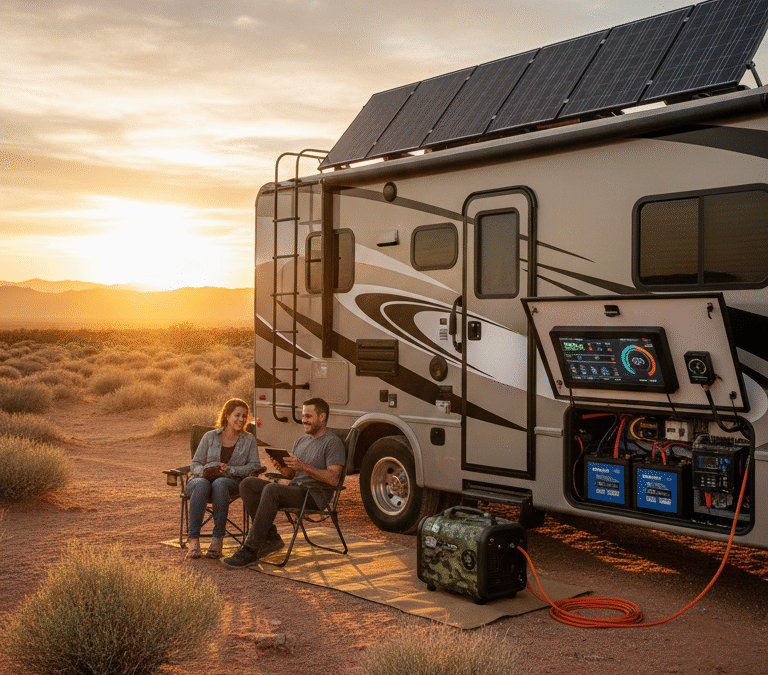
Boondocking gives you maximum freedom – and maximum responsibility for your own power. This guide walks you step-by-step through designing, building, and managing an RV electrical system that actually works off-grid: from power audits and battery banks to solar, generators, smart monitoring, and real-world setups.
Watch: A visual walkthrough of boondocking power basics before you dive into the details below.
This guide provides a comprehensive overview of RV boondocking electrical systems, essential for comfortable and safe off-grid exploration. It covers power audits, battery selection and sizing, charging sources, power conversion, management, conservation, and troubleshooting.
This guide provides a comprehensive overview of RV boondocking electrical systems, essential for comfortable and safe off-grid exploration. It covers power audits, battery selection and sizing, charging sources, power conversion, management, conservation, and troubleshooting.
RV Boondocking Electrical System Diagram
Phase 1: Conducting Your RV Power Audit – Understanding Your Needs
A power audit is crucial to understand daily energy consumption and peak load requirements, ensuring the electrical system is correctly sized.
Calculating Daily Watt-Hour Consumption: This involves listing all appliances, estimating their run time, and multiplying wattage by hours of use to get total watt-hours. A detailed spreadsheet or template is recommended.
Identifying Peak Load Requirements: This determines the maximum power needed at any given time, essential for sizing the inverter. It involves summing the wattage of appliances that might run simultaneously, noting any surge requirements (which can be 2–3 times running wattage).
Essential Appliances and Their Power Draw: Power draw varies significantly. LED lights are more efficient than incandescent. 12V refrigerators are more efficient than residential fridges run through an inverter. Water pumps have intermittent use. Propane can be used for water heaters and refrigerators to conserve electricity.
Worksheet/Template for Power Audit: A worksheet should list devices, wattage, and daily usage hours. Wattage × hours = daily watt-hours per device. Summing these gives total daily consumption. A 20% safety margin for unexpected usage and system losses is advised.
Phase 2: The Heart of Your System – Choosing and Sizing Your Battery Bank
The battery bank stores energy and is central to the RV’s electrical system.
Battery Chemistry Deep Dive: Pros and Cons:
Lead-Acid (Flooded, AGM, Gel): Affordable but have shorter lifespans and lower usable capacity (around 50%). Flooded require maintenance; AGM and Gel are sealed. They are heavier than lithium options.
Lithium Iron Phosphate (LiFePO4): Offer longer lifespans (3000+ cycles), higher usable capacity (80–100%), lighter weight (up to 60% less), and faster charging. Higher initial cost but better long-term value. More resistant to temperature extremes.
Understanding Battery Ratings:
Amp-hours (Ah): Total energy storage capacity.
Depth of Discharge (DoD): Percentage of capacity safely discharged (e.g., 50% for lead-acid, 80–100% for LiFePO4).
C-Rating: Rate of charge/discharge relative to capacity (e.g., 1C for a 100Ah battery means 100 amps).
Sizing Your Battery Bank: Calculate total amp-hours needed for daily consumption × desired days of autonomy. Divide by the usable DoD of the chosen battery type. Example: 50Ah/day × 3 days autonomy ÷ 0.80 DoD (LiFePO4) = 187.5Ah minimum capacity.
Battery Management Systems (BMS): Essential for LiFePO4 batteries, protecting against overcharging, over-discharging, and extreme temperatures by monitoring cell voltages, current, and temperature.
Series vs. Parallel Wiring:
Series: Increases voltage, maintains Ah capacity.
Parallel: Increases Ah capacity, maintains voltage. RV systems typically use 12V, so batteries are wired in parallel for capacity. Use identical batteries.
Phase 3: Charging Your Batteries – Comprehensive Energy Sources
Recharging the battery bank is achieved through various sources.
Solar Power Systems
Components: Solar panels, charge controller, wiring.
Panel Types:
Monocrystalline: Higher efficiency, sleek, more expensive.
Polycrystalline: More affordable, slightly less efficient.
Flexible: Lightweight, conform to surfaces, shorter lifespan.
Charge Controllers:
PWM (Pulse Width Modulation): Less expensive, less efficient, especially in cooler temps.
MPPT (Maximum Power Point Tracking): More efficient, maximizes power transfer, recommended for larger arrays and off-grid systems.
Sizing Solar Array and Wire Gauges: Based on daily amp-hour consumption and peak sun hours. Use online calculators. Proper wire gauge selection is crucial to minimize voltage drop and prevent overheating.
Mounting and Positioning: Fixed or adjustable mounts. Aim for south-facing (northern hemisphere) at an angle equal to latitude for optimal year-round performance. Avoid shading.
Generator Power
Generator power provides backup charging, especially when solar is limited.
Inverter Generators vs. Conventional: Inverter generators produce cleaner, more stable power (safer for electronics), are quieter, and more fuel-efficient. Conventional generators are less expensive but have higher total harmonic distortion (THD).
Sizing Generator: Calculate total wattage of simultaneous devices + 20% safety margin for surges.
Noise, Emissions, and Regulations: Consider low decibel ratings and mufflers. Ensure compliance with emissions standards and campground quiet hours.
Alternator Charging (DC-DC Chargers)
Alternator charging tops up house batteries while driving. DC-DC chargers regulate voltage/current from the vehicle’s alternator. This is crucial for hybrid systems, preventing starting battery drain and ensuring the correct charge profile for AGM or LiFePO4 batteries.
Shore Power and Converters/Chargers
Shore power connects the RV to an external power source. Converters/chargers convert 120V AC to 12V DC for battery charging and powering DC appliances.
Alternative/Hybrid Charging Sources
Wind and hydro power can be viable in specific locations but are highly dependent on environmental conditions. Hybrid systems combining multiple sources (solar, alternator, generator, shore) offer the most reliability.
Phase 4: Converting Power – Inverters and Their Role
Inverters convert 12V DC battery power to 120V AC for household appliances.
Pure Sine Wave vs. Modified Sine Wave:
Pure Sine Wave: Produces clean, stable power identical to shore power; ideal for sensitive electronics (laptops, TVs, medical devices).
Modified Sine Wave: Less expensive, higher THD; can damage some sensitive devices. Pure sine wave is recommended for most RV applications.
Sizing Your Inverter: Calculate total continuous wattage of simultaneous AC appliances + 20% safety margin. Check surge rating for appliances like air conditioners.
Installation Best Practices and Safety: Mount in a well-ventilated area, away from moisture and extreme temperatures. Use appropriately sized cables and fuses. Ensure proper grounding. Follow manufacturer instructions.
Phase 5: Management, Monitoring, and Conservation for Extended Boondocking
Effective management, monitoring, and conservation maximize battery life and extend off-grid time.
Battery Monitors and System Gauges: Provide real-time data on battery voltage, current, state of charge, and remaining capacity for informed usage decisions. Advanced monitors offer data logging and alerts.
Smart RV Technology: Offers remote monitoring and control. Smart power strips turn off unused devices; smart thermostats optimize heating/cooling. Some systems integrate with smartphone apps.
Advanced Conservation Strategies: Use LED lighting, minimize water usage (reduces pump use), cook outdoors, unplug unused chargers to eliminate phantom loads.
Building in Redundancy and Reliability: Have backup charging sources (generator, extra solar), spare fuses, cables, and connectors. Regularly inspect and maintain the system.
Real-World Case Studies: RVers’ Off-Grid Power Setups
Examining successful systems provides inspiration and practical insights.
Case Study 1: Solar-Dominant System: An RV setup primarily using solar power, including panel wattage, battery capacity, charge controller type, and powered appliances. This highlights strengths, weaknesses, and key takeaways such as quiet operation and low ongoing costs, with weather dependence as the main limitation.
Case Study 2: Hybrid Solar–Generator System: An RV setup combining solar and generator power, including panel wattage, battery capacity, generator size, and integration methods. This highlights strengths, weaknesses, and key takeaways such as resilience in poor weather and the trade-off of fuel use and noise.
Key Takeaways from Successful Systems: Proper planning, component selection, installation, and maintenance are crucial principles in every reliable off-grid electrical system.
Common Pitfalls and Troubleshooting Your RV Electrical System
Addressing common issues helps maintain system functionality.
Overcoming Under-Sizing and Compatibility Issues: Ensure all components are adequately sized with a safety margin and verify compatibility between them (voltage, charge profiles, wire gauge, and fuse ratings).
Diagnosing Charging Problems: Check for faulty panels, controllers, alternators, or corroded connections. Use a multimeter to test voltage/current, check fuses and breakers, and inspect wiring for damage or loose connections.
Safety Considerations and Best Practices: Always disconnect power before maintenance. Use appropriate fuses and breakers. Wear safety glasses and gloves. Ensure proper ventilation for generators to prevent carbon monoxide poisoning.
Comparison Table: RV Battery Types
Feature / Type
Lead-Acid (Flooded)
AGM
LiFePO4 (Lithium)
Cost
Low
Medium
High
Lifespan
2–5 years
5–7 years
10–15 years
Usable Capacity
50%
50%
80–100%
Weight
High
Medium
Low
Charging Speed
Slow
Medium
Fast
Maintenance
High
Low
None
Cold Weather Performance
Poor
Fair
Good
Safety
Fair
Good
Excellent
RV Off-Grid Power Planner
Estimate daily power use, usable battery capacity, solar production, off-grid runtime, and generator load.
Adjust the example values to match your RV and equipment.
Battery Bank
Default usable-capacity values are planning assumptions. Use your battery manufacturer’s specification when available.
Solar and Generator
Peak sun hours are not daylight hours. Generator comparison uses running watts only and does not include startup surge.
Daily Appliance Use
Edit, remove, or add loads to match your setup.
Daily Energy
0 Wh
Usable Battery
0 Wh
Solar Harvest
0 Wh/day
Off-Grid Runtime
0 days
System Sizing
Battery bank for one no-solar day 0 Ah
Solar needed to replace daily use 0 W
Daily battery draw after solar 0 Wh
AC Load Check
AC running watts if all AC loads run together 0 W
Generator running-watt margin 0 W
Planning tool only. Actual results vary with temperature, battery age, wiring losses, inverter behavior,
appliance cycling, solar conditions, and startup surge. Verify equipment limits before operating high-load appliances.
Conclusion: Powering Your Ultimate Boondocking Adventures
A well-designed and managed electrical system is key to successful boondocking.
Recap of Key Principles: Power audit, battery selection and sizing, charging sources, inverter choice, and management/conservation are fundamental. Prioritize safety and regular inspection.
Future Trends in RV Off-Grid Power: Expect continued advancements in battery technology (LiFePO4 and beyond), solar panel efficiency, and integrated smart power management systems that tie everything together in a single dashboard.
Frequently Asked Questions
How do I calculate my RV’s daily power consumption for boondocking?
List every device, find its wattage, and estimate hours of use per day. Multiply watts by hours to get daily watt-hours for each device, then total everything. Divide total watt-hours by system voltage (typically 12V) to get daily amp-hours. Add around 20% extra for system losses and unplanned usage.
What are the key differences between AGM and Lithium (LiFePO4) batteries for RVs?
AGM batteries are sealed lead-acid units with medium cost, about 50% usable capacity, and moderate lifespan. LiFePO4 batteries have higher upfront cost but offer 80–100% usable capacity, much longer cycle life, lower weight, and faster charging. For frequent boondocking, lithium typically provides better long-term value.
Can I mix different types of charging sources in my RV boondocking electrical system?
Yes. Many systems combine solar, alternator (via DC-DC charger), shore power, and a generator. The important part is that each charging source is correctly sized, properly fused, and set to the appropriate charge profile for your battery chemistry.
What is the importance of a pure sine wave inverter for an RV?
Pure sine wave inverters produce clean AC power that closely matches grid/shore power. This is safer for sensitive electronics like laptops, TVs, CPAP machines, and many battery chargers. Modified sine wave inverters are cheaper but can cause noise, overheating, or long-term damage in some devices.
How can I maximize my RV’s power conservation while boondocking?
Switch all lighting to LEDs, run water heaters and fridges on propane when possible, minimize electric resistance heating, unplug chargers and electronics when not in use, cook outside to reduce cooling loads, and monitor your battery state of charge so you can adjust habits before you run low.
Planning to pair a dispersed campsite with hunting season? Our RV hunting basecamp guide explains licenses, local closures, the Forest Service 150-yard discharge rule, firearm transport and carcass-movement planning.
Your Guide to Extended Camping Trips
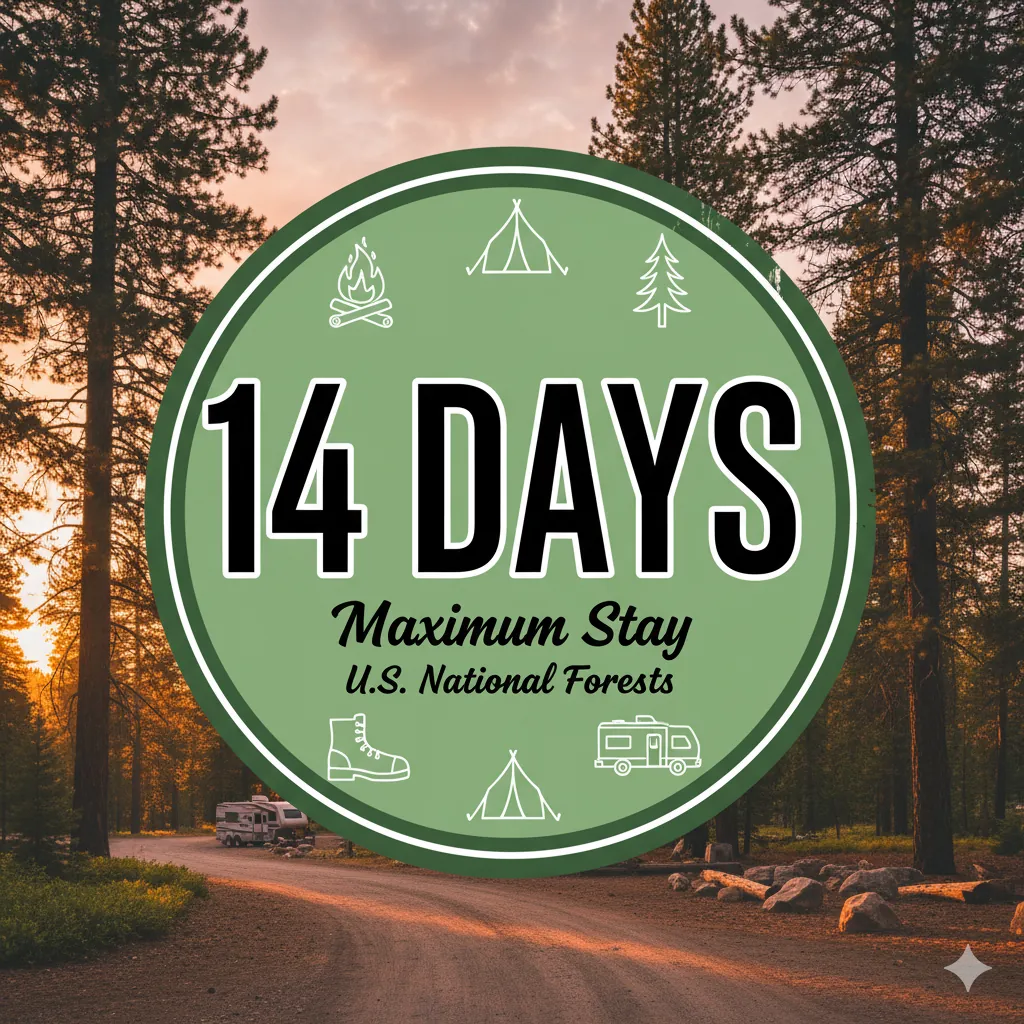
Are you dreaming of a long, adventurous journey through America’s National Forests? Many travelers and campers share the allure of exploring these vast natural landscapes. A common question that arises is: Can you travel from one National Forest campground to another, staying up to 14 days at each for free? The answer is yes, with some important details to consider.
Understanding the 14-Day Rule
The most well-known rule about camping in National Forests is the 14-day stay. However, this isn’t a one-size-fits-all regulation. The allowed duration can vary significantly from one forest to another, ranging from as few as 5 days to as long as 30 days. Each forest and grassland sets its own occupancy rules, which may include specifics on how long you can camp within their boundaries, when you can return to the same site, and the total days allowed for camping throughout the year.
Dispersed Camping
For those interested in ‘dispersed camping’ or ‘boondocking,’ these areas in National Forests usually permit camping up to 14 days. This type of camping means setting up in previously-used sites off forest service roads, though there are exceptions to this as well.
Permits and Passes:
Most National Forest dispersed camping is free and does not require a nationwide pass, but local fees, permits, and closures can apply. In Southern California National Forests, the Adventure Pass is generally $5 per day or $30 per year for designated recreation sites. An America the Beautiful Pass can cover qualifying federal entrance and standard amenity fees, but it is not blanket permission to camp anywhere. Check the specific forest and site before travel.
Dealing with Fire Restrictions
In areas with fire restrictions, like during droughts or high fire danger ratings, a Campfire Permit might be necessary. This permit allows campfires outside of designated rings and outlines other regulations, such as food storage requirements.
Planning Your Trip
Before you set off on your National Forest adventure, research is key. Knowing the specific permits and passes required for your intended camping area is crucial. These permits can often be purchased online or at ranger stations near your destination.
Adhering to Specific Rules
It’s important to note that National Forest camping rules can be more lenient than those in National Parks. Activities like hunting, having dogs on trails, and using motorized vehicles might be permissible in National Forests. However, strict rules are in place for designated wilderness areas and other sensitive regions.
Booking and Fees
Lastly, not all National Forest campgrounds are free, especially those offering more amenities. Some may require reservations or have associated fees, so it’s essential to check this information in advance.
Conclusion
Embarking on a camping journey through America’s National Forests can be an enriching and memorable experience. By understanding the specific rules, permits, and conditions of each forest and campground, you can fully enjoy the beauty and serenity of these natural treasures. Happy camping!
Resources
U.S. Forest Service (USFS) Official Site: This government website provides official information about National Forests, including rules, permits, and camping guidelines.
National Park Service (NPS) Official Site: As a federal agency that manages all national parks and many national monuments, the NPS site offers authoritative information on camping in natural reserves.
Recreation.gov: This site is an interagency collaboration that provides information on outdoor recreation opportunities and reservation services for federal lands, including National Forests.
USDA Forest Service – Dispersed Camping Guidelines: This page specifically focuses on dispersed camping guidelines in National Forests, providing detailed and reliable information.
America the Beautiful Pass Official Information: For detailed information about the pass that grants access to federal recreation sites, including National Forests.
RV Boondocking is a calling for the free-spirited, a yearning for the wild, a whisper from the ancient heart of the land. It is a lifestyle that beckons us to leave behind the comforts of civilization and embrace the raw beauty of nature.
To boondock is to live as one with the earth, to subsist on the essentials, to find solace in the silence. It is to awaken to the symphony of birdsong and drift to sleep beneath the canopy of stars. It is to feel the sun on your skin, the wind in your hair, and the rain on your face.
Boondocking is a journey of self-discovery, a test of resilience, and a celebration of the human spirit. It is a way to reconnect with our primal roots and to find our true place in the universe.
Campendium is a treasure trove of information for boondockers, offering the exact locations of free campsites and dump stations across the United States and Canada. Its search functionality is a breeze to use, allowing you to filter results by state, region, amenities, and more.
AI-generated camping illustration; not a screenshot or a verified location.
Whether you’re looking for a secluded spot in the forest or a convenient place to park overnight near a city, Campendium has you covered. With its comprehensive database and helpful reviews from other boondockers, you can be sure to find the perfect place to pitch your tent or park your RV.
In addition to finding campsites, Campendium also makes it easy to locate dump stations, so you can empty your tanks and keep your rig running smoothly. Whether you’re a seasoned boondocker or just starting out, Campendium is an essential tool for any RVer.
Freecampsites.net is a community-driven website that is another essential tool for finding free camping spots. It is a great resource for boondockers of all experience levels, from seasoned veterans to complete beginners.
AI-generated camping illustration; not a screenshot or a verified location.
Freecampsites.net has a vast database of free camping spots across the United States and Canada. You can search for campsites by state, region, or type of land (e.g., national forest, BLM land, etc.). Each campsite listing includes detailed information such as GPS coordinates, amenities, and reviews from other boondockers.
While the map function on Freecampsites.net can be a bit challenging to use on mobile devices, it is still a useful resource. You can zoom in and out of the map to find campsites in your desired area. You can also filter the results by amenities and other criteria.
If you’re looking for a free place to camp, Freecampsites.net is a great place to start your search. With its comprehensive database and helpful reviews from other boondockers, you’re sure to find the perfect place to pitch your tent or park your RV.
AI-generated camping illustration; not a screenshot or a verified location.
Boondocking.org is a great resource for finding RV-friendly businesses that allow overnight parking. This can be especially helpful in urban areas where traditional camping spots may be scarce.
Boondocking.org provides a searchable directory of RV-friendly overnight-parking listings. Because its public inventory count could not be independently verified, use the current directory rather than relying on a fixed total. Listings may include details such as address, contact information, and available amenities.
Boondocking.org also has a forum where RVers can share tips and advice. This is a great place to learn about the best places to boondock and to get advice on how to make the most of your experience.
If you’re looking for a place to park your RV overnight in an urban area, Boondocking.org is a great resource. With its comprehensive database and helpful forum, you’re sure to find the perfect place to stay.
Here are some examples of how Boondocking.org can be helpful for urban boondocking:
If you’re visiting a city for a music festival or sporting event, Boondocking.org can help you find a place to park your RV near the venue.
If you’re on a road trip and need a place to stay overnight in a city, Boondocking.org can help you find a safe and convenient place to park.
If you’re a business owner and you want to allow RVs to park overnight on your property, Boondocking.org can help you get listed on their website.
No matter what your reason for urban boondocking, Boondocking.org is a great resource to have on your side.
AI-generated camping illustration; not a screenshot or a verified location.
AllStays Camp & RV and Free Campsites are two more essential platforms for trip planning and ensuring that you have access to the resources you need while boondocking.
Both platforms offer a variety of features to help you find places to park and dispose of waste, including:
Searchable databases of campsites and dump stations
Detailed information about each campsite and dump station, such as amenities, location, and reviews from other boondockers
The ability to filter your search results by criteria such as state, region, amenities, and RV type
Offline maps so you can access your information even when you don’t have cell service
AllStays Camp & RV and Free Campsites are both great resources for boondockers of all experience levels. With their comprehensive databases and helpful features, you can be sure to find the perfect place to park your RV and dispose of your waste, no matter where you are.
Here are some additional tips for using AllStays Camp & RV and Free Campsites to ensure your safety:
Always read reviews from other boondockers before choosing a campsite. This can help you avoid any surprises and ensure that the campsite is safe and suitable for your needs.
Be aware of your surroundings when visiting a new campsite. Take note of the terrain, the types of plants and animals in the area, and any potential hazards.
Let someone know where you are going and when you expect to be back. This is especially important if you are boondocking alone.
Be prepared for anything. Pack plenty of food and water, and bring a first-aid kit and other essential supplies.
By following these tips, you can ensure a safe and enjoyable boondocking experience.
AI-generated camping illustration; not a screenshot or a verified location.
iOverlander is a popular boondocking app that allows you to find campsites, dump stations, and other points of interest for RVs and overlanders. It has a large database of user-submitted locations, and it allows you to filter your search results by criteria such as amenities, land type, and cell service.
AI-generated camping illustration; not a screenshot or a verified location.
The Dyrt is another popular boondocking app with a large database of campsites, dump stations, and other RV-friendly locations. It also allows you to filter your search results by criteria such as amenities, land type, and pet-friendliness.
AI-generated camping illustration; not a screenshot or a verified location.
US Public Lands is a great app for finding free campsites on public lands. It includes a map of all public lands in the United States, as well as a list of campsites and other points of interest.
AI-generated camping illustration; not a screenshot or a verified location.
Gaia GPS is a powerful GPS app that can be used for a variety of purposes, including boondocking. It allows you to download offline maps, create custom waypoints, and track your progress.
AI-generated camping illustration; not a screenshot or a verified location.
Avenza Maps is another powerful GPS app that can be used for boondocking. It allows you to download and purchase detailed maps of public lands, as well as maps from other sources.
These apps can save you a lot of time and energy when scouting out boondocking sites in advance. They allow you to filter your search results by specific criteria, and they provide detailed information about each site. This can help you find the perfect place to park your RV and enjoy the great outdoors.
Here are some tips for using boondocking apps:
Read the reviews of other boondockers before choosing a site. This can help you avoid any surprises and ensure that the site is safe and suitable for your needs.
Be aware of the terrain and other hazards at the campsite. Boondocking sites are often located in remote areas, so it is important to be prepared for anything.
Let someone know where you are going and when you expect to be back. This is especially important if you are boondocking alone.
Be prepared for anything. Pack plenty of food, water, and other essential supplies.
By following these tips, you can ensure a safe and enjoyable boondocking experience.
AI-generated camping illustration; not a screenshot or a verified location.AI-generated camping illustration; not a screenshot or a verified location.
Harvest Hosts and Boondockers Welcome are two membership programs that offer access to unique boondocking sites. Harvest Hosts partners with farms, wineries, breweries, and other businesses to allow RVers to stay overnight for free. Boondockers Welcome connects RVers with private landowners who are willing to allow them to stay overnight for free or a small fee.
Both programs have a large network of boondocking sites across the United States and Canada. This gives members a lot of flexibility to choose where they want to stay.
Membership in Harvest Hosts and Boondockers Welcome also offers a platform to connect with other RVers. Both programs have online forums and social media groups where members can ask questions, share tips, and plan trips together.
Benefits of Harvest Hosts and Boondockers Welcome
Access to unique boondocking sites: Harvest Hosts and Boondockers Welcome offer access to boondocking sites that you wouldn’t be able to find on your own. This includes farms, wineries, breweries, and other businesses, as well as private land owned by RVers.
Flexibility: With a large network of boondocking sites to choose from, you can stay wherever you want, whenever you want. This is ideal for RVers who like to travel spontaneously.
Community: Harvest Hosts and Boondockers Welcome offer a platform to connect with other RVers. This is a great way to make new friends and learn about new places to boondock.
Which program is right for you?
Harvest Hosts and Boondockers Welcome are both great programs, but they have different strengths and weaknesses. Here is a comparison to help you decide which program is right for you:
Feature
Harvest Hosts
Boondockers Welcome
Number of boondocking sites
6,000+ business-host locations
3,300+ Community Hosts
Types of boondocking sites
Farms, wineries, breweries, and other businesses
Private land owned by RVers
Cost
$99/year
$79/year
Amenities
Varies by site
Varies by site
Hookups
Varies by site
Varies by site
Overall, both Harvest Hosts and Boondockers Welcome are great programs for RVers who want to experience unique boondocking sites. The best program for you depends on your individual needs and preferences.
Educational Material
Online Boondocking Courses: Level Up Your Off-Grid Camping Skills
Online boondocking courses can equip you with the knowledge and skills needed to embark on your off-grid adventures with confidence. These comprehensive programs offer structured learning on a range of boondocking 101 topics, from preparation and spot finding to safety and sustainable practices. Enrolling in such a course can significantly enrich your understanding of boondocking and prepare you for a successful and enjoyable first trip.
Here are some of the key benefits of online boondocking courses:
Structured Learning: Courses typically follow a well-defined curriculum, ensuring you cover all the essential aspects of boondocking in a logical and organized manner. This structured approach helps beginners build a strong foundation of knowledge before venturing out on their own.
Expert Guidance: Many online courses are led by seasoned boondockers who share their valuable insights and practical tips based on their own experiences. This expert guidance can save you time and prevent potential challenges on your trip.
Comprehensive Coverage: Courses typically cover a wide range of topics, including:
Preparation: Choosing the right RV for boondocking, packing essentials, setting up your rig, and understanding legal considerations.
Spot Finding: Identifying boondocking locations through online resources, maps, and apps, assessing suitability of sites, and understanding Leave No Trace principles.
Safety: Emergency preparedness, managing risks associated with wildlife, fire safety, and ensuring your personal safety.
Sustainable Practices: Minimizing your impact on the environment, conserving water and resources, and leaving no trace.
Troubleshooting: Dealing with common issues like battery management, waste disposal, and technical difficulties.
Flexibility and Convenience: Online courses offer unparalleled flexibility, allowing you to learn at your own pace from the comfort of your home. You can access the course materials anytime, anywhere, and revisit modules as needed.
Community and Support: Many online courses offer access to a community of fellow boondockers, where you can ask questions, share experiences, and learn from each other. This supportive network can enhance your confidence and provide valuable advice throughout your boondocking journey.
By investing in an online boondocking course, you can gain the knowledge and confidence you need to explore the world off the beaten path. With the right preparation and understanding of boondocking principles, you can experience the freedom and adventure of off-grid camping in a safe and responsible way.
Boondocking Guides and Books
There are many online articles, guides, and books available on boondocking. These materials can provide valuable insights on diverse topics like water, power, and internet management while boondocking.
The Boondocker’s Bible: The Complete Guide to RV Boondocking and Off-Grid Living by Lonnie J. Brown and Tammy J. Brown
RV Boondocking: Your Complete Guide to Free and Legal Overnight Camping by Bob Difley
Boondocking: The Essential Guide to Living Off the Grid in Your RV by Ashley Scott
Free RV Camping: A Guide to Finding Free Campsites in the United States and Canada by Dave & Veronica Van Sickle
The Ultimate Guide to Boondocking: How to Camp Off the Grid in Your RV by Don Miller and Richard Van Sickle
These guides and books cover a wide range of topics related to boondocking, including:
How to find boondocking sites
How to prepare for a boondocking trip
How to manage water, power, and waste while boondocking
Boondocking safety and etiquette
I recommend reading one or more of these guides or books before your first boondocking trip. This will help you learn the basics of boondocking and ensure that you are prepared for a safe and enjoyable experience.
Here are some additional tips for finding and using boondocking guides and books:
Look for guides and books that are written by experienced boondockers. This will ensure that the information is accurate and up-to-date.
Read reviews of guides and books before you purchase them. This will help you get a sense of the quality of the information and the writing style.
Use guides and books as a resource, but don’t rely on them completely. Boondocking conditions can vary widely, so it’s important to be prepared for anything.
Practical Tips
Location Research
Thorough preparation is essential for any boondocking trip, and location research is one of the most important steps. Resources like RV Life’s RV Trip Wizard and the others mentioned above can be invaluable for this stage.
When choosing a boondocking site, consider the following factors:
Amenities: What amenities are important to you? Do you need access to water, electricity, or dump stations?
Terrain: Is the terrain suitable for your RV? Avoid sites with uneven ground or steep inclines.
Cell service: Do you need cell service? Many boondocking sites are located in remote areas with limited cell service.
Pet-friendliness: Are pets allowed at the site?
Regulations: Are there any regulations that you need to be aware of? For example, some public lands have restrictions on boondocking.
Once you have considered these factors, you can start narrowing down your options. Use resources like RV Life Trip Wizard to find boondocking sites that meet your needs. Be sure to read reviews from other boondockers before choosing a site.
Here are some additional tips for location research:
Use a GPS app: A GPS app like Google Maps or Gaia GPS can help you find boondocking sites and navigate to them.
Check public land websites: Many public lands, such as national forests and BLM land, allow boondocking for free. Be sure to check the website of the public land you are interested in to learn about any restrictions.
Ask other RVers: Other RVers are a great source of information about boondocking sites. Ask your friends and family for recommendations, or join a boondocking forum or group online.
Scouting Ahead
Scouting ahead is especially important for those with larger rigs, as it allows you to make sure that the site is suitable for your RV and that there are no surprises.
Here are some things to look for when scouting ahead:
Access: Is the access road to the site wide enough and well-maintained for your RV?
Turning radius: Is there enough turning radius to get your RV into and out of the site?
Leveling: Is the site level enough for your RV?
Overhead clearance: Are there any low branches or power lines that could damage your RV?
Amenities: Are the amenities that you need available at the site? For example, if you need water, make sure that there is a water source nearby.
Hazards: Are there any hazards at the site, such as steep drop-offs or loose rocks?
If you are unsure whether a site is suitable for your RV, it is always better to err on the side of caution and find another site.
Here are some additional tips for scouting ahead:
Go during the day: It is best to scout ahead during the day so that you can see the site clearly.
Take someone with you: It is a good idea to take someone with you when scouting ahead, so that you can have a second opinion.
Be prepared: Be prepared for anything when scouting ahead. Bring water, snacks, and sunscreen, and wear sturdy shoes.
By following these tips, you can scout ahead and find the perfect boondocking site for your next trip.
Proper Equipment
Having the right equipment can significantly enhance the comfort of your boondocking experience. Here are some essential pieces of equipment to consider:
Water bladders or tanks: Water is essential for boondocking, so you will need a way to store it. Water bladders are a good option for small RVs, as they are lightweight and compact. Wastewater tote tanks are used to store wastewater, such as gray water and black water, until you can dump it at a dump station.
Leveling kit: A leveling kit can help you level your RV, even if the campsite is uneven. This is important for comfort and to ensure that your appliances work properly.
Generator: A generator can provide electricity for your RV if there is no hookup available. This is especially important for RVs with large appliances, such as air conditioners.
Solar panels: Solar panels can be used to charge your RV’s batteries and power your appliances. This is a good option for boondocking for extended periods of time.
Portable toilet: A portable toilet is a good option if there is no bathroom available at the campsite.
In addition to these essential pieces of equipment, there are other items that can make your boondocking experience more enjoyable, such as:
Camp chairs and table: Camp chairs and a table can provide a comfortable place to relax and eat.
Awning: An awning can provide shade and protection from the elements.
Outdoor grill: An outdoor grill is a great way to cook meals while boondocking.
Fire extinguisher: A fire extinguisher is an essential safety item for any RV.
By having the right equipment, you can make your boondocking experience more comfortable, safe, and enjoyable.
Forums and Community Websites
RV forums and Facebook groups are great places to share experiences and learn from others. They are a great way to get real-world advice from fellow boondockers on topics such as:
Finding and choosing boondocking sites
Preparing for boondocking trips
Managing water, power, and waste while boondocking
Boondocking safety and etiquette
Troubleshooting boondocking problems
Here are some popular RV forums and Facebook groups for boondockers:
These communities are a wealth of information and advice for boondockers of all experience levels. I encourage you to join them and get involved.
Here are some tips for using RV forums and Facebook groups to learn about boondocking:
Read past forum threads and posts. This is a great way to learn about common boondocking questions and answers.
Ask your own questions. Don’t be afraid to ask questions, even if you think they are basic. Fellow boondockers are usually happy to help.
Share your own experiences. Once you have some boondocking experience, share your experiences with others. This can help other boondockers learn and avoid mistakes.
Be respectful. Remember that everyone is there to learn and help each other. Be respectful of other members and their opinions.
I hope this information is helpful. Have fun boondocking!
Etiquette and Regulations
Following the unwritten code of conduct in boondocking is essential for a pleasant experience for everyone. Here are some tips for boondocking etiquette and BLM Camping Regulations:
Leave no trace. Pack out all of your trash and leave the campsite as you found it.
Be respectful of other boondockers. Keep noise to a minimum and be aware of your surroundings.
Be aware of your impact on the environment. Avoid driving off-road or damaging vegetation.
Obey all posted regulations. Many public lands have restrictions on boondocking, such as length of stay limits and vehicle size restrictions.
Here are some additional tips:
Get permission from landowners before boondocking on private property.
Be mindful of your noise levels, especially at night.
Don’t leave any campfire unattended.
Conserve water and power.
Dispose of waste properly.
By following these tips, you can help ensure that boondocking remains a enjoyable and sustainable activity for everyone.
Here are some specific regulations that you may need to be aware of:
Length of stay limits: Many public lands have length of stay limits for boondocking. For example, the Bureau of Land Management (BLM) typically has a 14-day length of stay limit.
Vehicle size restrictions: Some public lands have vehicle size restrictions for boondocking. For example, some national parks have a maximum vehicle length of 30 feet.
Distance from roads and water sources: Some public lands have restrictions on how close you can boondock to roads and water sources. For example, the BLM typically requires you to camp at least 200 feet from water sources.
Fire restrictions: Many public lands have fire restrictions during the summer months. Be sure to check the fire restrictions for the public land you are planning to visit before you go.
You can find more information about boondocking etiquette and regulations on the websites of the public lands you are planning to visit.
Conclusion
Boondocking is a great way to experience the outdoors and to enjoy the freedom of RVing. By following the tips and advice in this article, you can ensure that your boondocking experience is safe, enjoyable, and responsible.
In Summary:
Boondocking is camping off the grid, without access to hookups for water, electricity, or sewer.
Boondocking can be done on a variety of public and private lands.
It is important to be prepared for boondocking by having the right equipment and supplies.
There are many resources available to help you find boondocking sites and learn about boondocking etiquette and regulations.
Following the unwritten code of conduct in boondocking is essential for a pleasant experience for everyone.
I hope this article has been helpful. Happy boondocking!
A Real-World Guide to Business Boondocking for RVers (2025)
TL;DR: Business boondocking requires a “respectfully invisible” mindset where success depends on verifying permission for each specific location, performing a safety assessment, and being the kind of low-impact guest businesses actually want to welcome back. With individual store managers now making parking decisions and many locations reversing previous allowances, the old “park anywhere” days are over.
The high-pitched whine of hydraulics started at exactly 2:17 AM. It was our third night ever in our new rig, parked confidently in a Florida Walmart lot because an online guide said it was allowed. That confidence evaporated as a commercial street sweeper, lights flashing, began a meticulous cleaning pattern that brought it within inches of our slide every ten minutes. We didn’t get another minute of sleep.
That night taught us our first lesson: most boondocking advice is written by people who haven’t actually done it recently. Generic blog posts and outdated apps won’t tell you how to read the subtle cues of a safe location, nor will they prepare you for the conversation with a skeptical store manager.
After 500+ nights boondocking in business parking lots across 45 states, we don’t rely on luck. We rely on a strategic mindset.
With the RV industry experiencing remarkable growth—RV shipments up nearly 14% in the first quarter of 2025 (RVIA, 2025) and approximately 11.2 million households now owning RVs (ConsumerAffairs, 2024)—mastering business boondocking becomes increasingly crucial. This guide provides the exact strategy we use: a proven three-tier business hierarchy, field-tested manager conversation scripts, and specific behavioral guidelines that keep you safe and welcome time and again.
Understanding the Current Business Boondocking Landscape
Business boondocking requires a “respectfully invisible” mindset where success depends on verifying permission for each specific location, performing safety assessments, and being the low-impact guest businesses actually want. The landscape has shifted dramatically, and what worked five years ago no longer applies in 2025.
Individual store managers now hold the only authority to grant overnight parking permission (DAT, 2024), creating a patchwork of policies that varies not just by chain, but by individual location. Community reports suggest as few as 58% of stores still allow overnight parking (Jalopnik, 2025), marking a stark downturn from previous years. This decline stems from legitimate concerns—managers have witnessed RVers deploying full camping setups, overstaying welcome periods, and leaving behind waste or damage.
The broader context makes this shift even more significant. The RV industry continues its rapid expansion, with shipments up nearly 14% in Q1 2025 compared to the previous year (RVIA, 2025). Approximately 11.2 million American households now own RVs (ConsumerAffairs, 2024), and with 72 million Americans planning RV trips in 2025 (RVIA, 2025), the pressure on free overnight parking options intensifies monthly.
Our 500+ nights across 45 states taught us that generic advice fails in this new environment. You can’t rely on apps that show a location “allowed” parking last year. You can’t assume permission based on chain reputation. The street sweeper incident in Florida happened precisely because we trusted outdated information instead of performing our own verification and assessment.
The solution isn’t complicated, but it requires abandoning the “park anywhere” mentality. Success in 2025 demands strategic location selection, explicit permission conversations, and behavior that makes businesses want to continue welcoming RVers.
The Strategic Business Hierarchy: Where to Park in 2025
Not all businesses welcome RVers equally, and based on 500+ nights across 45 states, we’ve developed a clear three-tier ranking system that prioritizes safety, official policies, and genuine RV-friendly culture. This hierarchy represents where we consistently found the safest, most welcoming environments rather than just convenience.
Tier
Business Type
Key Advantages
Our Experience
Permission Status
1
Cabela’s & Bass Pro Shops
RV-friendly culture, designated large vehicle parking, safer commercial areas
Sidney, Nebraska Cabela’s gave us one of our most memorable sunrises over the Great Plains
Explicitly designated RV spots (Cracker Barrel), 24/7 security patrols and excellent camera coverage (Casinos)
Smaller lots often feel more secure; casino security provides genuine peace of mind
Cracker Barrel designates spots; Casinos in NV, CA, AZ, WA, OR, MI offer excellent options (Roadtrippers, 2025)
3
Walmart (Last Resort)
Widespread locations across the country
Once the gold standard, now our last resort due to policy inconsistency
Individual store managers are the only authority to give permission (DAT, 2024); mandatory check every time
Data verified October 2025. Sources: Roadtrippers (2025); DAT (2024)
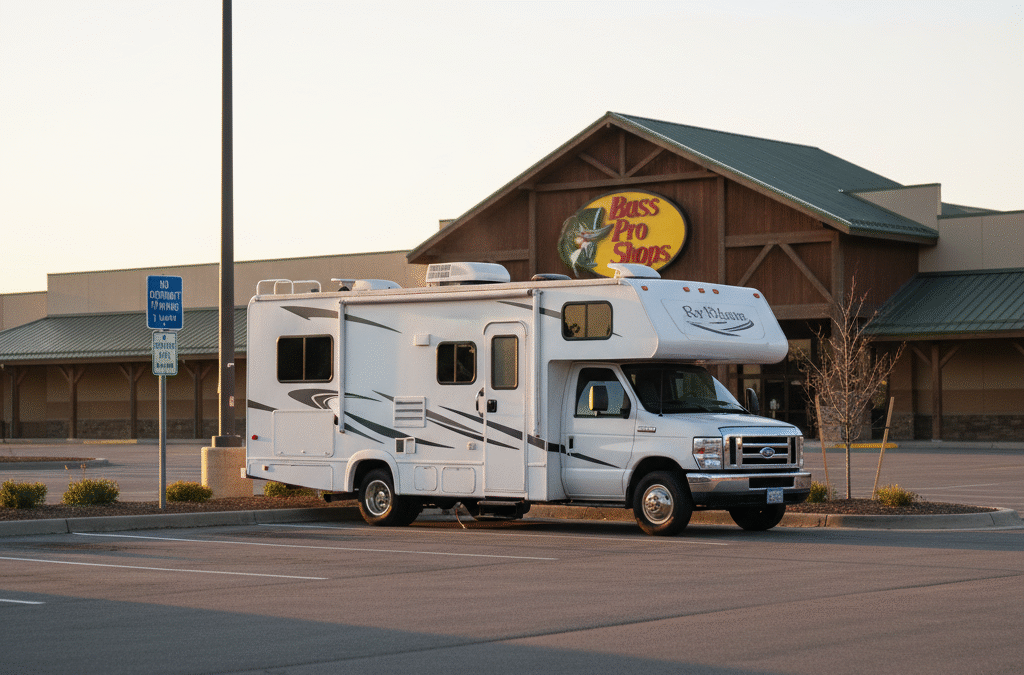
Our Tier 1 choice reflects lessons learned through hundreds of stays. Cabela’s and Bass Pro Shops understand their customer base intimately—these are businesses built around the outdoor lifestyle, and RVers represent their core demographic. Nearly all locations allow overnight parking (Roadtrippers, 2025), often with designated areas that keep you separated from regular customer traffic. The Sidney, Nebraska Cabela’s exemplifies this perfectly: we parked on the far edge facing an open field, completely undisturbed, and woke to an unobstructed sunrise over the Great Plains.
Tier 2 locations earn their ranking through deliberate infrastructure. Cracker Barrel explicitly designates RV spots, removing the ambiguity that plagues other chains. Their smaller lots typically mean fewer late-night disturbances. Casinos in Nevada, California, Arizona, Washington, Oregon, and Michigan offer excellent overnight options (Roadtrippers, 2025) with security-focused environments. The 24/7 patrols and comprehensive camera coverage at casinos create one of the safest overnight environments we’ve encountered.
Walmart drops to Tier 3 not because the company changed its heart, but because execution has become unreliable. Individual store managers hold the only authority to grant permission (DAT, 2024), creating dramatic policy variations even within the same region. What worked last month may not work today. What’s allowed at one location is prohibited three miles away. This inconsistency means Walmart stays now require mandatory verification every single time, making them our last resort when better options aren’t available.
This hierarchy isn’t arbitrary—it’s the result of hundreds of actual stays and represents where we consistently found the safest, most welcoming environments in 2025.
The Art of Getting Permission: A 60-Second Conversation Script
Getting permission isn’t about asking for a handout—it’s a quick, respectful business-to-business conversation, and over hundreds of interactions, we’ve refined a simple process that works nearly every time. The key is understanding that you’re addressing a manager’s legitimate concerns about liability, customer flow, and property management.
Timing matters more than most people realize. We’ve found the sweet spot is between 6 PM and 8 PM. Arriving during this window means the day’s main shopping rush has passed, making it easier to navigate the lot without blocking customers. More importantly, it’s early enough that the store’s manager-on-duty remains present and accessible, making the permission conversation straightforward. Rolling in near midnight feels secretive and often attracts unwanted attention from security or law enforcement.
Talk to the right person. Never ask a cashier, cart attendant, or random employee on the floor. They lack the authority to say “yes,” so their default answer becomes “no” to avoid potential trouble. You need to speak directly with the Manager on Duty. Individual store managers hold the exclusive authority to grant overnight parking permission at retail locations (Walmart Locator, 2024), and they understand both official store policy and any local ordinances. Simply walk to the customer service desk and ask, “Could I speak with the manager on duty, please?”
Use our field-tested script:
“Hi there, quick question for you. We’re traveling in a fully self-contained RV and were hoping to get your permission to park in an out-of-the-way spot overnight. We’d be happy to grab some dinner/supplies while we’re here, and we’ll be gone first thing in the morning.”
This script does several things simultaneously. The phrase “self-contained” tells the manager you won’t be leaving a mess or using their facilities—a key component of the industry-sanctioned RVers Good Neighbor Policy (Escapees, 2025). Stating you’ll park “out-of-the-way” shows you respect their customer flow and won’t block prime parking spaces. Offering to make a purchase frames the request as mutually beneficial rather than purely extractive, which aligns with the Good Neighbor Policy’s recommendation to “purchase gas, food, or supplies as a form of thank you” (Walmart Locator, 2024). Promising to be “gone first thing” assures them you aren’t planning to set up a semi-permanent camp.
Read their response carefully. If they give you an enthusiastic “Yes, absolutely! We love having RVers,” you know you’re in a genuinely welcoming spot. If they seem hesitant—”I… guess that would be okay… just be discreet”—take it as a sign to be extra low-profile and consider this a one-time location rather than a reliable future option. If the answer is “no,” the only correct response is a cheerful, “No problem at all, thanks for your time!” Never argue, never push back, and never try to negotiate. That single negative interaction can influence their decision for every future RVer who asks.
Our hundreds of permission conversations taught us that managers appreciate directness, brevity, and genuine respect. They’re evaluating whether you’ll create problems for their business. This script works because it addresses their three main concerns—liability, customer experience, and transience—in under 30 seconds.
Being Respectfully Invisible: Positioning and Behavior
Once you have permission, your goal is to become “respectfully invisible”—so low-impact that the business barely knows you’re there, which keeps these opportunities open for the entire RV community. This concept separates welcomed guests from RVers who get lots shut down permanently.
Positioning determines your entire experience. We always aim for the outer perimeter of the lot, far from the main entrance and away from any truck loading docks or cart return areas. Look for a level spot under a security light for safety, but not one that shines directly into your windows. Industry experts recommend parking near other RVers when it feels right, as being close to other travelers can add comfort and support (Roadtrippers, 2022). The Sidney, Nebraska Cabela’s stay exemplifies perfect positioning: we parked on the far edge of the lot facing an open field, completely removed from customer traffic, yet still under adequate lighting. We had an unobstructed sunrise view, and we didn’t interfere with a single customer arrival or departure.
Here’s the most important rule: you are parking, not camping. The industry-sanctioned RVers Good Neighbor Policy is explicit on this point: “No awnings, chairs, or barbecue grills outside your RV” (Walmart Locator, 2024). Your slides stay in, your awning stays retracted, and your camping chairs and grill remain in their storage bays. The moment you deploy outdoor living space, you transform from a guest into a liability. We’ve witnessed this transformation cost entire communities their parking privileges. One RVer setting up a full campsite can trigger a manager’s decision to ban all future overnight stays.
Sound travels further at night than you expect. What seems like normal conversation volume inside your RV can carry surprisingly far across an empty parking lot. We’ve learned to keep voices low, avoid slamming cabinet doors, and never run our generator after 8 PM or before 8 AM. If you must run a generator, do so only briefly during early evening hours and only when parked far from other vehicles. The Good Neighbor Policy explicitly addresses hydraulic equipment: “Don’t use hydraulic jacks on soft surfaces, including asphalt” (Walmart Locator, 2024). Many locations now prohibit generator use entirely, and violating this creates noise complaints that end parking privileges.
Your departure completes the cycle. We maintain a strict rule to be rolling out before the first wave of morning customers arrives, typically by 7 or 8 AM. The Good Neighbor Policy’s first rule is unambiguous: “Stay one night only” (Escapees, 2025). Before pulling out, do one final walk-around of your spot to ensure you haven’t left a single trace of your stay—no trash, no gray water stains, no evidence you were ever there. The goal is to leave that parking space even cleaner than you found it, following the principle to “always leave an area cleaner than you found it” (Walmart Locator, 2024). This attention to detail is what separates RVers who preserve these opportunities from those who destroy them.
You’re parking, not camping—this distinction is what separates welcomed guests from RVers who get lots shut down. Every action you take either strengthens or weakens the relationship between the RV community and business owners.
Troubleshooting Common Scenarios
Even with perfect planning, you’ll eventually encounter tricky situations, and staying calm and professional while having backup plans ready is the key to maintaining positive relationships. Here’s how we handle the most common scenarios based on real experience across hundreds of overnight stays.
1. You get “the knock”
If security or law enforcement knocks on your door, don’t panic. Be polite, open your door promptly, and explain that you received permission from the store manager. Nine times out of ten, they’re just doing their rounds and will leave you alone once they know you’re authorized. Keep your tone calm and cooperative. If they still ask you to leave despite your permission, comply immediately and without argument. The Good Neighbor Policy emphasizes safety: “Be safe! Always be aware of your surroundings and leave if you feel unsafe” (Walmart Locator, 2024). Thank them politely, pack up efficiently, and move to your backup location. Arguing accomplishes nothing except damaging the reputation of future RVers.
2. Another RVer is breaking the rules
You pull into a lot and see another camper with their slides and awning deployed, running a loud generator at 10 PM. This happened to us in Arizona, and we made a critical mistake: we tried to politely suggest to the other RVer that their loud generator might cause problems for everyone. The conversation went poorly, they became defensive, and we ended up looking like the troublemakers when security made their rounds. RV community experts warn that “not following the code has serious consequences and is detrimental to the rights of all RVers” (Walmart Locator, 2024). Now our approach is simple: do not confront them. Your best move is to park far away from them or simply choose a different location entirely. You don’t want to be associated with their behavior when a manager decides to clear the lot.
3. You’re alone and feel unsafe
There’s a distinct psychological shift when you pull into a massive parking lot and realize you’re completely alone. You received permission and parked correctly, but something just feels wrong. Maybe a suspicious car is circling the lot repeatedly, or you’re the only vehicle for acres. Trust your gut immediately—safety experts recommend that if something feels off, you should move to a different spot or choose another location (Roadtrippers, 2022). Check your cell signal strength—if you can’t get help in an emergency, reconsider staying. Position yourself closer to the main entrance and under a primary security camera if possible. Walmart parking lots typically lack on-site security patrols unlike casino locations (Roadtrippers, 2022), making your personal vigilance even more critical. It’s always better to pack up and move to your backup location, even if it’s late, than to stay in a situation that feels unsafe. We’ve done this three times, and we’ve never regretted prioritizing our safety over convenience.
These scenarios taught us that preserving your safety and the community’s reputation always takes priority over pride or convenience.
Becoming a Boondocking Ambassador
Business boondocking isn’t a secret hack to exploit—it’s a relationship built on mutual respect between the RV community and business owners, where every interaction shapes how future RVers will be received. After thousands of miles and hundreds of nights, we’ve learned that success isn’t defined by a checklist but by a mindset.
Think of yourself as an ambassador for the entire RV community. Every interaction you have shapes how that business owner views future requests from other RVers. With 72 million Americans planning RV trips in 2025 (RVIA, 2025), maintaining positive relationships with businesses becomes more crucial than ever. The Escapees RV Club has spent decades protecting overnight RV parking options by “monitoring detrimental bills, working to defeat adverse laws, and educating city, county, state and federal officials” about the RV community (Escapees, 2025). The math is simple: more RVers competing for the same spaces means we must collectively demonstrate why businesses should continue welcoming us.
See the situation from the manager’s perspective. They’re balancing corporate policies, local ordinances, customer satisfaction, and property management. The industry recognizes that “most of the complaints lodged regarding RV parking on business parking lots have to do with aesthetics and perceived abuse of the privilege” (Walmart Locator, 2024). When you approach them with genuine respect rather than entitlement, you’re not just asking for a favor—you’re offering to be a responsible, low-impact guest who strengthens their willingness to help the next traveler.
The best business boondockers we’ve met share certain characteristics: they’re genuinely curious about local communities, they understand that free doesn’t mean without obligation, and they’ve learned to read situations and adapt quickly. They carry themselves with quiet confidence because they know they’re offering something of value—they’re customers, they’re respectful, and they make good neighbors even if it’s just for one night. As one veteran RVer observed, following these simple overnight parking rules ensures “everyone can continue to enjoy the privilege” (Always On Liberty, 2024).
This approach has opened doors we never expected. Business owners have recommended their favorite local restaurants, warned us about road construction ahead, and sometimes even invited us back during future travels. These connections happen because we approach each situation with authentic respect rather than trying to game the system. Municipalities across the United States have passed ordinances prohibiting RV parking on business or private property, and “unfortunately, it’s because the lack of respect from a few that supersedes the respectful RVers” (Always On Liberty, 2024). By being a quiet, respectful, and invisible guest, you help ensure these valuable opportunities remain open for the next traveler who needs a safe place to rest.
Frequently Asked Questions
Q: Do I really need to ask permission every time at Walmart?
Yes. Individual store managers are the only authority who can grant permission (DAT, 2024), and the industry-sanctioned Good Neighbor Policy explicitly states: “Obtain permission from a qualified individual” (Walmart Locator, 2024). Policies vary dramatically by location even within the same chain. What was allowed last year may not be allowed this year, and what’s permitted at one location may be prohibited three miles away.
Q: What if the manager seems hesitant but says yes?
Take it as a sign to be extra low-profile. Park far from the entrance, keep everything buttoned up tight, and consider it a one-time stay rather than a reliable go-to spot. Their hesitation often reflects past negative experiences with other RVers who violated the Good Neighbor Policy guidelines (Escapees, 2025).
Q: Can I run my generator overnight in a business parking lot?
No. Never run generators after 8 PM or before 8 AM. If you must run one, do so only briefly during early evening hours and only when parked far from other vehicles. The Good Neighbor Policy specifically addresses equipment noise concerns to maintain positive relationships with businesses (Walmart Locator, 2024). Many locations now prohibit generator use entirely due to noise complaints.
Q: What’s the difference between boondocking and business boondocking?
Boondocking typically refers to “dry camping” on public lands like BLM land without hookups, often for extended periods. Business boondocking specifically means parking overnight in commercial parking lots with explicit permission—the Good Neighbor Policy defines it as “camping without the use of external hookups for electricity, water supply or waste disposal” (Walmart Locator, 2024)—usually for a single night only.
Unleash your wanderlust and explore hidden gems with the agility and comfort of a Class B RV! This comprehensive guide, your one-stop shop for all things Class B RVing, empowers both seasoned nomads and curious newcomers to hit the road with confidence. Imagine spontaneous detours through charming towns, cozy nights under starlit skies, and the freedom to go wherever your adventurous spirit takes you – that’s the magic of Class B RV travel. Dive in and discover essential tips, expert advice, and inspiring ideas to turn your dream trip into reality.or many adventure seekers, Class B RVs are like a magic key unlocking a world of freedom and exploration. Unlike their larger counterparts, Class B RVs boast incredible maneuverability, allowing you to navigate charming towns, wind down scenic byways, and discover hidden gems off the beaten path. Say goodbye to gas station anxiety with their impressive fuel efficiency, putting more money in your pocket for unforgettable experiences.
Whether you’re a seasoned traveler yearning for a simpler, more nimble travel companion or a newcomer seeking an accessible RV adventure, Class B RVs deliver. Don’t compromise on comfort – these meticulously designed vans offer everything you need, from a well-equipped kitchen for culinary creations to a cozy sleeping area for restful nights under the stars. As adventure photographer Sarah Jones once said, “My Class B RV has become my adventure mobile, taking me to breathtaking landscapes I never thought I could reach.
Class B RV Comparison Table
Feature
Compact Camper Vans
Mid-Size Conversion Vans
Large Adventure Vans
Size
Smallest (16-18 ft)
Medium (18-20 ft)
Largest (20-23 ft)
Maneuverability
Excellent – nimble for navigating cities and narrow roads
Good – comfortable driving experience
Moderate – requires more care on tight maneuvers
Sleeping Capacity
2
2-4
4-6
Fuel Efficiency
Best – highest MPG
Moderate
Least – lower MPG due to size and weight
Storage Space
Limited – ideal for minimalists
Moderate – suitable for gear and essentials
Ample – comfortable for extended expeditions
Features & Amenities
Basic – kitchenette, sleeping area
More options – pop-up roofs, fixed beds, additional storage
Most options – full kitchens, bathrooms, off-grid capabilities
Budget
Most affordable
Moderate
Highest price point
Ideal for:
Solo travelers, couples, short trips
Couples, families, weekend getaways
Frequent travelers, off-grid adventures, large groups
The road awaits, and your nimble Class B RV is the key to unlocking countless adventures. But before you hit the open highway, choosing the right van is crucial. Don’t worry, this guide will equip you with the essential factors to consider, ensuring your Class B perfectly complements your travel dreams and budget.
Size & Style:
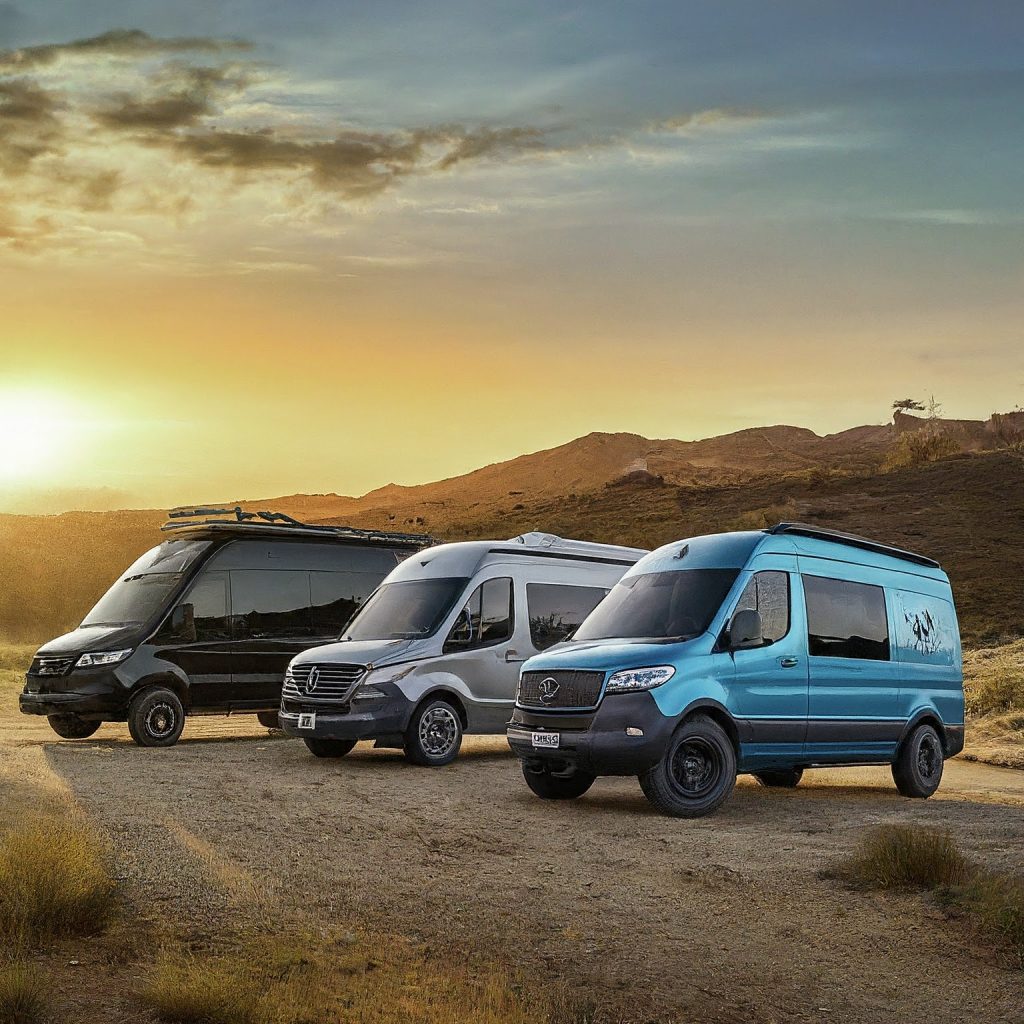
Compact Camper Vans: Ideal for solo adventurers or couples, these agile companions offer excellent fuel efficiency and navigate charming towns with ease. Think Dodge ProMaster or Mercedes-Benz Metris.
Mid-Size Conversion Vans: Perfect for families or small groups, these vans provide more space and flexibility with pop-up roofs or fixed beds. Explore options like the Winnebago Solis or Pleasure-Way Lexor TS.
Large Adventure Vans: Designed for extended explorations, these powerhouses boast off-road capabilities and ample amenities. Consider the Mercedes-Benz Sprinter 4×4 or the Leisure Travel Vans Serenity.
Think about your travel style: Will you be conquering off-the-beaten-path destinations or prioritizing cozy nights under the stars? How much space do you need for gear and comfort?
Features & Budget:
Basic Vans: Budget-friendly options with essential amenities like a kitchenette and sleeping area. Consider the Ford Transit Connect or the Ram ProMaster City.
Adventure-Ready Vans: Equipped for off-grid adventures with solar panels, roof racks, and rugged suspension. Explore the Winnebago Revel or the Sportsmobile Independence.
Luxury Vans: Pamper yourself with premium finishes, top-of-the-line appliances, and spacious living areas. Look at the Airstream Interstate or the Mercedes-Benz Sprinter Executive.
Remember, your budget plays a key role. Consider upfront costs, potential long-term savings, and how your chosen features align with your travel plans.
Rent or Buy?
Whether renting or buying depends on your individual needs. Consider factors like:
Trip Duration: Short trips or trying out the lifestyle? Renting might be ideal. Frequent or extended adventures? Buying could offer savings.
Budget: Lower upfront cost for renting, but monthly/weekly expenses add up. Buying requires a higher initial investment but offers long-term ownership.
Frequency of Use: Occasional use? Renting might be more cost-effective. Regular travelers might benefit from buying.
Ultimately, the choice is yours! Research, compare options, and don’t be afraid to ask questions.
Pack Smart, Live Large: Class B RV Essentials
Hitting the road in your Class B RV is all about freedom and adventure, but with limited space, packing efficiently is key. Fear not! This guide equips you with essential items and space-saving hacks to maximize your living space and minimize clutter.
Essentials Checklist: Adapt to your personal style.
Clothing:
Lightweight, quick-drying clothes: Opt for versatile pieces that can be layered for different weather conditions.
Comfortable shoes: Pack for your activities, whether it’s hiking boots for exploring trails or sandals for kicking back at the campsite.
Rain gear: Be prepared for unexpected downpours with a waterproof jacket and pants.
Kitchen:
Compact cookware: Choose pots and pans that nestle together or multi-function options like a pot that doubles as a frying pan.
Reusable dishes and utensils: Ditch disposables and opt for lightweight, reusable alternatives.
Spices and condiments: Add flavor to your meals with your favorite spices and sauces.
Non-perishable food staples: Stock up on items like pasta, rice, and canned goods for quick and easy meals.
Hygiene:
Biodegradable toiletries: Minimize your environmental impact with eco-friendly options.
Quick-drying towel: Save space with a microfiber towel that dries quickly.
First-aid kit: Be prepared for minor injuries with essential supplies.
Medications: Pack any medications you regularly take.
Sleeping:
Breathable bedding: Ensure comfortable sleep with lightweight sheets and blankets.
Lightweight pillows: Find compact pillows that offer good support.
Compact sleeping bags (for colder climates): Choose a sleeping bag with the appropriate temperature rating for your intended destinations.
RV Gear:
Leveling blocks and tire wedges: Ensure your van sits level for a comfortable stay.
Extension cords and hoses: Connect to campgrounds and access water sources.
Multi-tool: Be prepared for minor repairs with a versatile tool kit.
Emergency kit: Pack essential items for unexpected situations.
Space-Saving Savvy:
Multi-tasking marvels: Look for items that serve multiple purposes, like a travel mug that doubles as a water bottle.
Roll it up: Embrace the art of rolling clothes to save space and prevent wrinkles.
Compression companions: Utilize compression bags to shrink bulky items like blankets and pillows.
Downloadable Checklists: Find comprehensive, categorized checklists online to ensure you don’t miss anything.
Remember, packing light is about choosing the right gear and using clever organization techniques. This guide and the downloadable checklists will help you pack smart and live large on your Class B RV adventure!
Taking the Wheel: Adventure Awaits
Get ready to navigate the open road with confidence! While driving basics apply, Class B RVs offer unique dynamics. Their nimble size allows you to conquer winding roads and squeeze into charming town centers, but it also requires adjusting your driving approach. Master blind spots, anticipate wind sway, and hone your parking skills – practice makes perfect for a smooth journey.
Unique Destinations for Your B:
National Parks & Monuments: Embrace the grandeur of Yosemite, Yellowstone, or Zion in your compact camper, accessing scenic overlooks and hidden trails often off-limits to larger RVs.
Coastal Charm: Cruise the Pacific Coast Highway, park directly on the beach in California, or explore hidden coves along the Atlantic seaboard, enjoying ocean breezes and breathtaking sunrises.
Foodie Delights: Savor farm-to-table eats in Napa Valley, sample Louisiana’s vibrant culinary scene, or explore Oregon’s renowned wineries – your B lets you park near the action and indulge in local flavors.
Off-the-Grid Adventures: Venture deep into national forests like Montana’s Flathead or Colorado’s San Juan Mountains, find dispersed camping spots for secluded serenity, and reconnect with nature under starry skies.
Quirky Charm: Discover unique destinations like quirky roadside attractions, charming small towns with vibrant festivals, or historical landmarks – your B allows for spontaneous detours and unexpected discoveries.
Camping Options to Match Your Style:
Full-Service Campgrounds: Enjoy convenient amenities like laundry facilities, swimming pools, and organized activities, ideal for families or those seeking a resort-style experience.
National Park Campgrounds: Immerse yourself in nature with basic amenities like restrooms and picnic tables, offering a balance of convenience and access to natural wonders.
Dispersed Camping: Embrace true solitude and off-the-grid living with minimal or no amenities, often requiring self-sufficiency and responsible Leave No Trace practices.
Harvest Hosts: Park overnight at unique farms, wineries, breweries, and more in exchange for patronizing their business – a delightful way to connect with local producers and enjoy unique settings.
Boondocking: Take advantage of free overnight parking on public lands like BLM-managed areas, following regulations and respecting the environment.
Remember: Planning and research are key. Choose destinations and campgrounds that align with your desired amenities, budget, and activities. Check regulations, availability, and weather conditions before setting out.
Finding Your Perfect Oasis: Campsite Guide
Your Class B adventure needs its ideal resting place, a campsite that reflects your desires and enhances your experience. But with countless options, choosing the perfect spot can feel overwhelming. Let’s break it down to key factors:
Amenities:
Basic comfort: Consider essentials like restrooms, showers, and laundry facilities, or opt for the simplicity of dry camping and self-sufficiency.
Activities & entertainment: Do you crave swimming pools, playgrounds, and organized events, or prefer quiet contemplation by a campfire?
Connectivity: Need reliable internet access for remote work or social media updates? Choose campgrounds with Wi-Fi or cellular service reception.
Budget:
Free vs. paid camping: Dispersed camping offers free options, while full-service campgrounds have fees that vary based on amenities and location.
Membership programs: Explore programs like Harvest Hosts or Thousand Trails for special rates and unique campsite options.
Extra expenses: Factor in fuel costs, park entrance fees, and any additional charges for activities or amenities.
Location:
Proximity to your desired activities: Beachfront escapes, mountain adventures, or vibrant city access – choose a location that facilitates your travel goals.
Scenery and ambiance: Do you envision breathtaking vistas, peaceful forest settings, or vibrant community vibes? Select a campsite that matches your desired atmosphere.
Weather considerations: Research average temperatures, precipitation levels, and potential for extreme weather at your chosen destination.
Additional Resources:
RV camping apps: Explore apps like The Dyrt, Campendium, or Allstays for detailed campground information, reviews, and booking options.
RV websites: Utilize resources like Go RVing, Harvest Hosts, or Hipcamp for comprehensive listings, tips, and community recommendations.
Guidebooks and forums: Refer to regional RV guidebooks or online forums for specific campsite insights and local knowledge.
Remember: Research is key! Read reviews, compare amenities, and factor in your preferences to find the campsite that perfectly complements your Class B adventure. Don’t hesitate to adjust your plans based on availability and weather conditions.
Essential Tips for Your Class B Odyssey
Your Class B adventure should be filled with memories, not mishaps. Here are key safety pointers to keep you confident and prepared on the road:
Vehicle Readiness:
Regular maintenance: Ensure your van is in top condition with preventive maintenance and pre-trip inspections,
Tire Pressure: regularly check and adjust tire pressure according to manufacturer recommendations and weather conditions.
Emergency kit: Pack essential items for breakdowns, injuries, and unexpected situations.
Roadside assistance: Consider membership in services like AAA or Good Sam for added peace of mind.
Navigation & Planning:
Trip planning: Research routes, road conditions, weather forecasts, and campsite availability.
Share your itinerary: Inform loved ones of your travel plans and expected arrival times.
GPS & offline maps: Rely on both GPS and offline maps for reliable navigation, especially in remote areas.
On the Road:
Defensive driving: Be mindful of other vehicles, anticipate their actions, and maintain safe distances.
Rest and alertness: Avoid fatigued driving. Take breaks, plan for adequate sleep, and share driving duties if possible.
Weather awareness: Stay updated on weather warnings and adjust your plans accordingly.
Campsite Security:
Lock valuables: Secure belongings both inside and outside your van when unattended.
Be aware of surroundings: Trust your instincts and report any suspicious activity to campground staff or authorities.
Fire safety: Follow camping fire regulations and practice responsible campfire management.
Remember: Safety is a shared responsibility. Be courteous to other travelers, respect the environment, and always prioritize your well-being. For more detailed information, explore resources like the National Park Service website or RV safety guidelines by reputable organizations.
Embracing Challenges & Detours
Hitting the open road in your Class B RV promises freedom and adventure, but the journey inevitably presents challenges. From unexpected breakdowns to changing weather, detours off the planned route, and even the occasional bout of cabin fever, resilience is key. But worry not, for these challenges are interwoven with the unique joys of flexible Class B travel:
Anticipate the Bumps:
Mechanical issues: Regular maintenance minimizes risks, but be prepared for potential breakdowns with an emergency kit and roadside assistance.
Weather woes: Research weather patterns and have gear for varied conditions. Embrace cozy nights snuggled inside when storms rage outside.
Finding the perfect campsite: Not every spot will be ideal. Embrace the flexibility of your B to adjust plans and seek new havens.
Embrace the Unexpected:
Detours and spontaneity: The beauty of Class B travel lies in its agility. Embrace unplanned stops, charming towns, and scenic detours that enrich your journey.
Meeting fellow travelers: Share stories, swap tips, and build camaraderie with fellow RVers you encounter along the way.
Learning as you go: Every challenge is an opportunity to learn and grow. Embrace the problem-solving spirit and adapt to ever-changing situations.
Proactive Planning Makes Perfect:
Research alternate routes and points of interest before your trip.
Download offline maps and resources like campground directories for peace of mind.
Embrace the open road and allow new experiences to arise – sometimes the best adventures are unplanned!
Remember: The journey is as important as the destination. Embrace the challenges as part of the adventure, and find joy in the flexibility and unexpected delights that unfold on your Class B odyssey.
Troubleshooting Common Problems:
Your Class B adventure shouldn’t be derailed by minor issues. Here are some common problems and quick fixes to keep you rolling:
Flat tire: Learn how to safely change a tire or have roadside assistance on hand.
Dead battery: Jump-start your battery or consider having a portable jump starter and learning how to use it.
Overheating: Pull over safely, turn off the engine, and let it cool down. Check coolant levels and ensure proper airflow.
Plumbing issues: Identify the source of the leak and attempt basic repairs, or seek professional help at an RV dealership or campground.
Appliance malfunctions: Refer to user manuals for troubleshooting tips or seek professional assistance if needed.
Remember, prevention is key. Regular maintenance and learning basic troubleshooting skills can help you address minor issues before they become major inconveniences.
RV Etiquette: Responsible & Respectful Travel
Your Class B journey should leave a positive impact wherever you roam. Here are some key etiquette tips to remember:
Respect the environment: Leave no trace, minimize waste, and dispose of wastewater responsibly at designated dump stations.
Be mindful of noise: Respect fellow campers and the surrounding community by limiting noise levels, especially at night.
Obey campground rules: Familiarize yourself with and adhere to posted regulations for everyone’s enjoyment and safety.
Practice responsible pet ownership: Keep your furry companions leashed, clean up after them, and be mindful of noise and behavior.
Share the road: Drive defensively, yield to larger vehicles, and be courteous to other travelers.
By following these simple guidelines, you can contribute to a positive and responsible RVing community, ensuring a pleasant experience for everyone.
Conclusion: Your Class B RV Adventure Awaits!
Hitting the open road in your Class B RV is more than just a vacation; it’s a commitment to freedom, flexibility, and creating unforgettable memories. You’ve taken the first steps by exploring this guide, and now it’s time to turn your dreams into reality!
Remember the freedom you’ll savor:
No more rigid itineraries: Explore hidden gems and chase spontaneous detours.
Your home on wheels: Unpack once and wake up to stunning new views every day.
Adventure at your fingertips: Hike remote trails, explore charming towns, and embrace the unexpected.
Ready to plan your escape?
Fuel your inspiration: Research destinations, browse online communities, and connect with seasoned RVers for tips and tricks.
Start planning: Utilize recommended resources like apps, websites, and guidebooks to find campsites, map your route, and estimate costs.
Stay informed: Download offline maps, research local regulations, and subscribe to weather alerts for peace of mind.
Most importantly, embrace the journey:
Adapt and thrive: Unexpected detours and challenges are part of the adventure. See them as opportunities to grow and create lasting memories.
Connect with nature: Immerse yourself in the beauty of the outdoors, appreciate the simple moments, and leave no trace.
Share the joy: Invite friends and family along, connect with fellow RVers, and share your experiences with the world.
Remember, the open road is waiting for you. With your Class B RV as your trusty companion, a spirit of adventure, and this guide as your starting point, you’re ready to embark on an unforgettable journey. Get out there, explore, and live the Class B RV dream!