

🔹 Quick Answer
When boondocking, you are legally required to pack out all trash — no disposal on public land is permitted under BLM and U.S. Forest Service rules. Your practical options are highway rest areas, county transfer stations, campground dumpsters, Pilot/Flying J truck stops, and town trash cans when purchasing fuel or supplies.
Violating BLM waste disposal rules can result in citations carrying fines up to $1,000 and up to 12 months imprisonment under 43 CFR Part 8360. Plan your disposal route before leaving camp, not after.
There is no trash pickup on BLM land. There is no dumpster on a National Forest dispersed site. If you pack it in, you pack it out — and that rule applies to every chip bag, coffee ground, and piece of toilet paper.
Most new boondockers don’t struggle with the rule. They struggle with the logistics: where, exactly, does the trash go when you’re 40 miles from the nearest town? This guide answers that with specific, verifiable options ranked by reliability and cost.
The legal baseline: pack it in, pack it out
Both BLM and the U.S. Forest Service operate under a pack-it-in, pack-it-out rule for dispersed camping. The BLM states this directly in its dispersed camping guidelines: “Take all trash and belongings with you.” (BLM, Camping on Public Lands.) The U.S. Forest Service applies the same standard across regions, with several district pages noting that leaving trash is illegal and can result in steep penalties. (USDA Forest Service, Hoosier National Forest Dispersed Camping.)
Burning trash at your site does not satisfy this requirement. BLM guidelines explicitly prohibit burning materials that produce toxic or hazardous substances, which includes most packaging and plastics. Buried trash does not satisfy the rule either — it is still considered improper disposal.
Waste violations are the highest enforcement priority on BLM land. Improper disposal of trash, sewage, and wastewater generates faster enforcement response than stay-limit violations in most districts. Federal regulation authorizes penalties up to $1,000 and/or 12 months imprisonment for violations of BLM visitor services regulations under 43 CFR Part 8360.
The rule is simple. The logistics require planning.
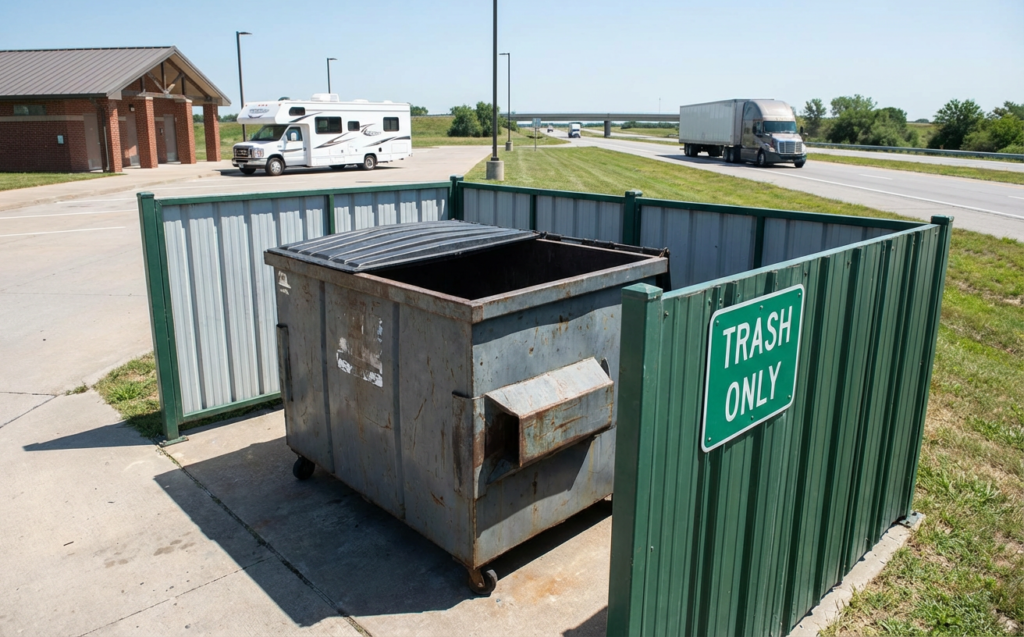
Where to dump trash while boondocking: 7 options ranked
The table below covers the most reliable options, including typical cost and availability notes based on current field reporting. No single option works everywhere — use multiple as a rotation.
| Option | Typical Cost | Availability | Notes |
|---|---|---|---|
| Highway rest areas | Free | Widespread on interstates | Most reliable free option. Large dumpsters on most. Some states (WA, AL, KS) include RV dump stations. |
| County transfer stations / landfills | $1–$10 per load | Rural counties — search Google Maps for “transfer station” | Best option for large volumes. Designed for exactly this use. Call ahead for hours and fees. |
| Campground / RV park dumpsters | Free–$5 (or as part of day-use fee) | Most Forest Service and BLM campgrounds near dispersed areas | Call ahead to confirm public use is allowed. Do not use if marked “campers only.” |
| Pilot / Flying J truck stops | Free with fuel purchase (varies) | Major interstates nationwide | Trash cans at fuel pumps. Also offer RV dump stations at select locations ($8–$12). Combine with fuel stop. |
| Gas stations / convenience stores | Free with purchase | Town re-supply stops | Pump-side cans handle small bags. Dumpsters typically locked. Don’t abuse: one or two bags, not a week’s load. |
| Staging area / ranger station dumpsters | Free | Select BLM and Forest Service trailheads | Use only if marked for public use. Check with your district office at blm.gov/office. |
| Town public trash cans | Free | Parks, picnic areas, visitor centers | Acceptable for small amounts. One bag per can. Do not fill a single can with your entire trip’s waste. |
Reduce trash volume before you leave camp
The cheapest disposal strategy is producing less waste. Experienced boondockers compress volume before departure using a few reliable methods.
Burn what the law allows. Wood, paper, and cardboard can be burned where fires are permitted and no burn restrictions are in effect. BLM rules prohibit burning materials that produce toxic fumes — that means no plastic bags, no foam packaging, no treated wood. Check USDA Fire Restrictions before any burn.
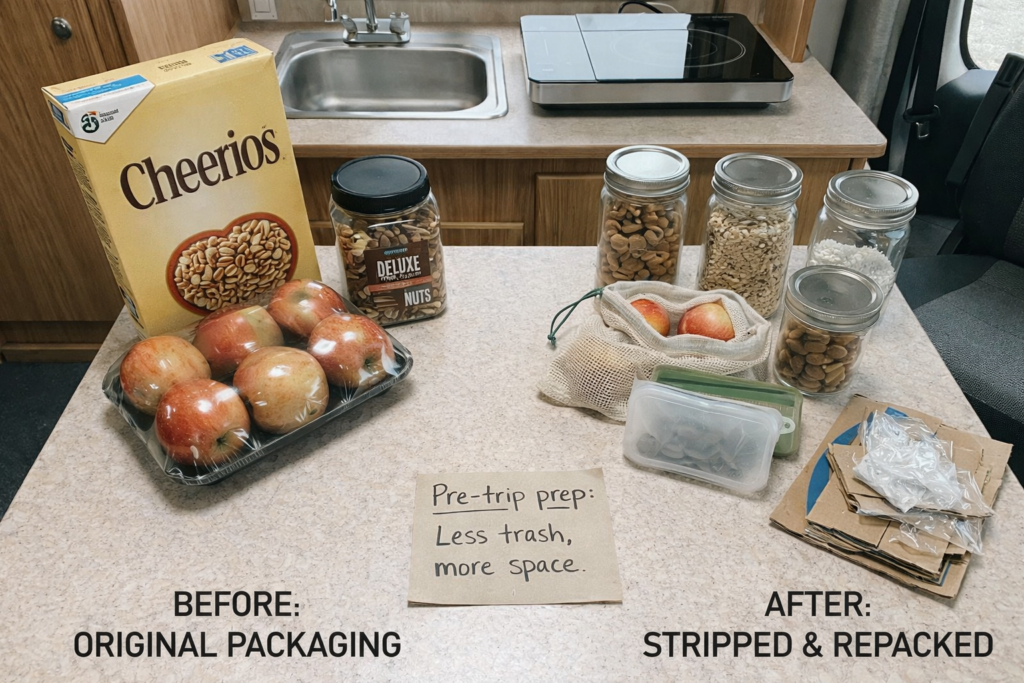
Remove packaging at home, not at camp. Strip multi-layer packaging, cardboard boxes, and plastic wrap from food, gear, and supplies before you leave. This alone can reduce trip waste by 30–40% in our experience with the Hymer Aktiv over multi-week stays.
Use sealed, hard-sided containers for external storage. If trash will be stored outside your rig — in a truck bed, exterior compartment, or trailer pass-through — it must be inside a sealed, hard-sided container. This is not optional in bear country, and it prevents wildlife-attractant problems that can generate BLM enforcement attention fast.
Compress everything. Flatten cans, collapse cardboard that can be burned on departure, and consolidate bags daily. Smaller volume = fewer disposal stops.
The core problem: Boondocking on BLM and National Forest land means zero trash service. Pack-it-out is a legal requirement, not a suggestion. Highway rest areas and county transfer stations are the two most reliable disposal points for multi-day trips. Combine disposal stops with fuel runs to eliminate extra miles.
How to find disposal locations before you go
Route your disposal stops during trip planning, not mid-trip. Four tools cover most needs:
- Google Maps: Search “transfer station,” “landfill,” or “solid waste facility” along your route. Filter for hours to confirm they’ll be open during your exit window.
- iOverlander / Campendium: Both include user-reported dump station and trash locations. Campendium’s dump station index at campendium.com/dump-stations covers locations beyond RV parks.
- RVDumps.com: Focused specifically on non-campground disposal options — rest areas, truck stops, and public facilities. Searchable by state.
- Your BLM or Forest Service district office: Call before departure. Ask specifically whether any staging areas or ranger stations near your destination have public-use dumpsters. This information is not always posted online.
For RV black and gray tank disposal specifically, see our complete guide to finding RV dump stations on the road — separate issue from trash disposal, same planning discipline.
What you cannot do — and why it matters beyond the fine
These are not gray areas. They are documented enforcement triggers on federal land.
- Burying trash: Prohibited. Not a Leave No Trace-compliant alternative. Wildlife digs it up, and buried waste contaminates soil and water sources.
- Leaving trash at a site “for someone to pick up”: Illegal. Abandoning property on BLM land carries the same penalty as littering.
- Dumping trash in a campground dumpster you are not a guest of, without permission: Technically trespassing or misuse in most jurisdictions. Always ask or call first.
- Burning plastics, foams, or packaging: Prohibited on BLM land regardless of fire restriction status. Produces toxic emissions and is a separate violation from littering.
- Dumping gray water near streams or water sources: Prohibited. BLM requires gray water disposal at approved facilities. All water sources within 200 feet are protected under the dispersed camping rules. (BLM, Camping on Public Lands.)
Beyond the fine: improper waste disposal is the fastest way to trigger use restrictions and permit requirements on dispersed camping areas. The BLM can and does close land to camping when overuse and waste problems reach a threshold. Every campsite you leave clean extends the window before restrictions land on areas the whole community uses.
For full detail on BLM compliance requirements across your trip, see our BLM camping rules compliance guide — including stay limits, fire rules, and enforcement priorities by violation type.
Common questions
The takeaway
There is no complicated system here. Pack it out, use highway rest areas and transfer stations as your primary disposal points, and combine those stops with fuel and water runs to avoid separate trips. The hard part is the planning — do it before you leave, not when you’re 50 miles from the nearest town with a full trash bag.
If you haven’t already mapped your black and gray tank disposal for the same trip, that’s the next thing to sort. Our RV dump station guide covers location tools, cost, and how to cluster tank dumps with water fills to minimize extra stops.
Get the full boondocking field checklist
Site scouting, waste management, water, power, and LNT checklist in one PDF. No fluff.
References
- Bureau of Land Management. Camping on Public Lands. U.S. Department of the Interior. https://www.blm.gov/programs/recreation/camping
- Bureau of Land Management. Dispersed Camping Guidelines [Idaho]. U.S. Department of the Interior. BLM Idaho Camping Guidelines PDF
- U.S. Forest Service. Dispersed Camping — Hoosier National Forest. USDA. https://www.fs.usda.gov/r09/hoosier/recreation/dispersed-camping
- U.S. Forest Service. Dispersed Camping — Intermountain Region. USDA. https://www.fs.usda.gov/r04/recreation/dispersed-camping
- U.S. Forest Service. Dispersed Camping — Pacific Southwest Region. USDA. https://www.fs.usda.gov/r05/recreation/dispersed-camping
- Electronic Code of Federal Regulations. 43 CFR Part 8360 — Visitor Services. https://www.ecfr.gov/current/title-43/chapter-II/part-8360
- Campendium. Dump Station Directory. https://www.campendium.com/dump-stations
- BLM Law Enforcement. Dispersed Camping Rules Enforced Through Local Action and Tooele County Partnership. BLM Blog, September 4, 2025. https://www.blm.gov/blog/2025-09-04/blm-dispersed-camping-rules-enforced-through-local-action-and-tooele-county
Last reviewed: April 2026. Regulations vary by BLM field office and Forest Service district. Verify current rules with your local office before departure.
Chuck Price
RV Travel Writer & Boondocking Specialist | 35+ years RV experience | 26,000+ campsites explored
Chuck and his wife Cindy travel in a 2018 Hymer Aktiv Class B. BoondockOrBust.com is their field-tested resource for off-grid RV living, boondocking regulations, and no-cost camping strategy.


