
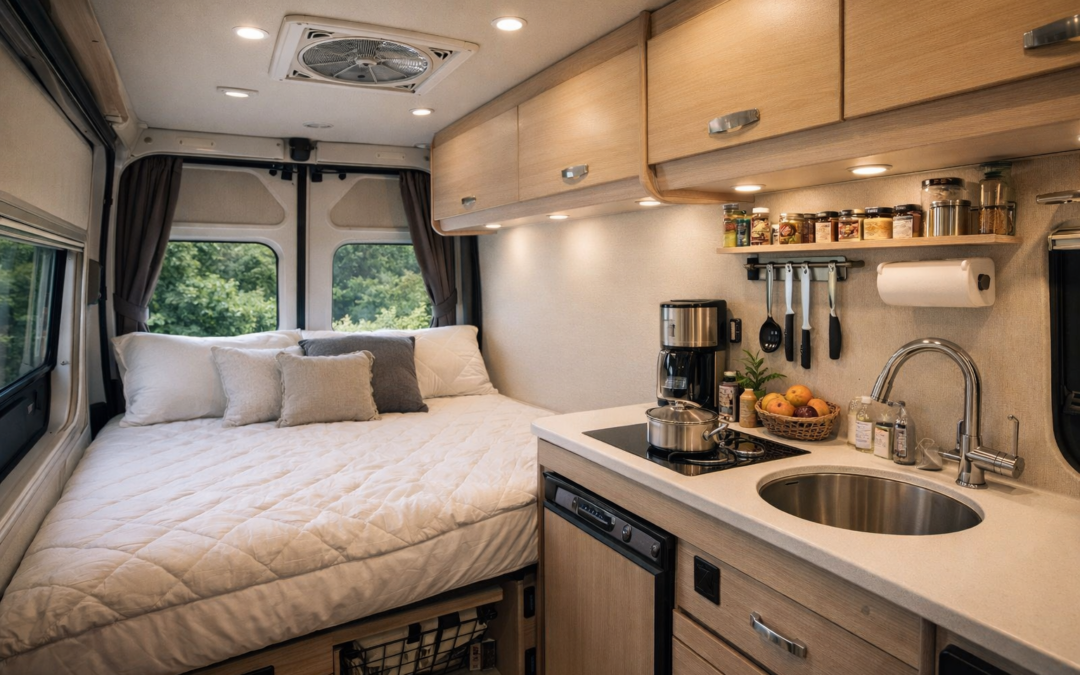
Most “best RV accessories” lists are written by people who have never camped in one. The upgrades that actually get used every day look different from the ones that get clicks.
We analyzed a thread of more than 100 RV owners responding to a simple question: what’s the one thing that made the biggest difference to your comfort? Not what they planned to buy. Not what looked good at an RV show. What they actually use and would not give up.
The same items came up again and again. None of them were complicated.
What You Need to Know First
The most commonly recommended RV comfort upgrades are a mattress or mattress topper, a 12V vent fan, a countertop ice maker, and Starlink for connected travelers. Sleep quality and daily convenience ranked above expensive gadgets and specialty features in every pattern we found.
Which upgrade matters most depends on your travel style. Boondockers and remote workers have different priorities than weekend campers or snowbirds.
One critical fact before you buy anything: stock RV mattresses are typically 5–6 inch low-density foam engineered to reduce vehicle weight, not support quality sleep. (Source: Sleep Foundation) RV mattress sizes are not the same as residential mattress sizes. The short queen — the most common RV queen size — measures 60 inches by 75 inches, not the residential standard of 60 inches by 80 inches. Buying before measuring is the most common and most expensive mistake RV owners make.
What RV Owners Said Most Often
In a community discussion of more than 100 RV owners, these upgrade categories appeared most frequently:
The pattern is clear. Sleep, temperature, and daily-use convenience dominated. Expensive electronics and specialty features were rare. This is the opposite of what affiliate-driven “best RV accessories” roundups typically lead with.

RV owner upgrade mentions by category—source: Community discussion with over 100 RV owners.
The Sleep Problem: Mattress or Topper?
Stock RV mattresses are typically 5–6 inch low-density foam. A mattress topper adds a comfort layer but will not fix a broken or unsupportive base.
This is the most important upgrade decision you will make, and the choice between a topper and a full replacement comes down to one thing: the condition of the base mattress.
“New mattress topper, 4″ thick. Changed our sleeping!”
— Cathy J., RV Life Hacks & Organization
“My mattress — sleep better in my RV than home.”
— Misty T., RV Life Hacks & Organization
✓ Topper is the right fix if…
The base mattress has structural integrity (no sag, no visible damage). A 3–4 inch memory foam topper is the most cost-effective fix. It adds pressure relief and extends the life of the base.
Look for CertiPUR-US certification — an independent, accredited laboratory has tested the foam for content, emissions, and durability. CertiPUR-US certified foams must meet VOC emissions standards under 0.5 parts per million, contain no formaldehyde, and exclude mercury, lead, and other heavy metals. (Source: certipur.us)
✗ Replace the mattress if…
The base mattress sags, has visible damage, or is the original factory foam. A topper on a broken base gives you a soft surface over an unsupportive foundation. You will still wake up with a sore back.
Q: What size mattress does my RV have?
Do not assume. Measure.
RV mattress sizes differ from residential sizes. The most common differences:
| RV Mattress Size | Dimensions | Residential Equivalent |
|---|---|---|
| Short queen (most common in RVs) | 60″ × 75″ | Standard queen is 60″ × 80″ — 5″ longer |
| RV queen | 60″ × 80″ | Same as residential queen |
| RV king | 72″ × 80″ | Standard king is 76″ × 80″ — 4″ wider |
| RV short king | 72″ × 75″ | No residential equivalent |
Sources: Sleep Foundation, Lippert
Buying a residential queen mattress for a short-queen bed frame is a costly mistake — most queen mattresses start at $500 or more, so confirm sizing before you buy. Some RV beds also have curved corners or notches for wheel wells — a custom-cut mattress may be required.
For mattress type: Memory foam provides pressure relief and handles temperature fluctuation in RVs. Latex is naturally resistant to mold and mildew, which matters in humid climates. Innerspring with foam or latex padding is breathable and may outperform pure memory foam in hot weather. (Source: Beloit Mattress)

The RV short queen is 5 inches shorter than a standard residential queen. Measure your bed platform before buying. Sources: Sleep Foundation, Lippert.
Airflow and Climate Control
A 12V vent fan (MaxxAir or Fantastic Fan) is the most cost-effective climate upgrade for RV sleeping. It pulls hot air out and runs on 12V power — compatible with solar, battery, or shore power — making it the most energy-efficient comfort upgrade for off-grid camping.
“For us, it’s a simple 12V fan. Makes a huge difference for sleeping, especially in warm nights or when airflow isn’t great. Small upgrade, but honestly a game changer.”
— RV Judge, RV Life Hacks & Organization
RV vent fans replace the factory vent covers and draw hot air and moisture out of the rig. MaxxAir and Fantastic Fan are the two most recognized brands. Both offer models with rain shields that allow the fan to stay open and running during light rain. In most conditions, a fan running at night reduces interior condensation and moisture buildup in bedding and walls. In very cold or high-exterior-humidity conditions, results may vary.
A 12V vent fan is not a substitute for A/C in extreme heat. In climates above 90–100°F, you need both. What full-timers and boondockers consistently report is that running A/C alone without addressing ventilation leaves hot pockets and high humidity inside the rig. The fan and the A/C work together.
The dehumidifier addition
In high-humidity climates (the Southeast, the Pacific Northwest, early spring/fall camping), a dehumidifier is a worthwhile separate upgrade. In owner experience, reducing interior humidity noticeably improves perceived comfort and reduces moisture damage risk to upholstery and soft goods.
For boondockers
A 12V vent fan is the preferred climate upgrade because it runs on battery or solar without the power draw of A/C. It is the single most power-efficient comfort upgrade for off-grid camping.

Aftermarket vent fans like the MaxxAir and Fantastic Fan replace factory covers and significantly improve airflow and moisture control.
The Ice Maker Question
Countertop ice makers are among the most-mentioned RV upgrades — separate appliances that require dedicated counter space and power.
Most RV refrigerators do not have built-in ice makers. The units RV owners recommend are countertop models that sit on the kitchen counter, connect to a standard outlet, and produce ice continuously. Most countertop models produce 26–38 pounds of ice per day under typical conditions. Rated output assumes ideal ambient temperature and water temperature — actual production in hot weather will be lower. Check manufacturer specs for your specific model.
Bullet-style ice makers
Produce small crescent-shaped ice, lower power draw (~100–200W), quieter.
As of April 2026: $80–$150. Prices vary by retailer and season — confirm current pricing before purchasing.
Nugget ice makers (GE Profile Opal and similar)
Produce soft, chewable nugget ice. Higher power draw (~250–500W per GE Appliances specs), louder compressor. These are the models that show up most in owner discussions.
As of April 2026: $400–$600. Prices vary — confirm current pricing before purchasing.
“GE nugget ice maker! I love ice.”
— Joni K., RV Life Hacks & Organization
“Nugget ice machine. I won’t ever not have one again. Even when we are stationary.”
— Samantha J., RV Life Hacks & Organization
⚠ Before buying a nugget ice maker for your RV
Check your shore power amperage or battery bank capacity. Owners consistently report nugget ice makers draw significantly more power than bullet-style models. They are not practical upgrades for boondockers without a robust electrical setup.
Sleep and climate upgrades improve every single night.
Ice and coffee upgrades improve every single day.
Electronics and specialty gear improve specific situations.
Start with sleep. Fix the climate. Then decide on daily convenience. That order maximizes your upgrade ROI.
Starlink for RV Travel
Starlink Roam is the plan designed for mobile RV use. It is not the same as residential Starlink in terms of pricing, mobility, or plan structure.
Starlink came up specifically among boondockers and remote workers — people camping off-grid who need reliable internet. For this group, Starlink is not a luxury upgrade. It is the enabling infrastructure that makes the lifestyle work.
The critical detail: standard residential Starlink is address-locked. To use Starlink across multiple locations or while traveling, you need the Roam plan. Pricing and plan specifics change — verify current options at starlink.com before budgeting. Plan terms verified as of April 2026; confirm before purchase.
For a full breakdown of Starlink vs. 5G options for RVers, see our RV internet guide for 2026.
Which Upgrade Matters Most by Travel Style
The right upgrade depends on how you travel. Here is the pattern from owner discussions, matched to travel type:
For Class B and van owners: Space and weight constraints change the math. A washer-dryer combo is rarely practical. A 12V fan, a quality mattress topper cut to the van’s custom dimensions, and a compact ice maker are the most common high-value upgrades in the van-life segment.
What Sounds Nice but Is Not Universal
These upgrades appeared in owner discussions but came with consistent caveats:
Washer-dryer combo: Worth it for full-timers and snowbirds on multi-week stays. Requires consistent water hookup, dedicated power, and floor space. Not practical for boondockers or Class B owners without significant electrical upgrades.
“Splendide washer/dryer. I’ve heard some negative comments on the unit, but I’ve used mine daily for 2 years now and not a single issue thus far!”
— Aaron C., RV Life Hacks & Organization
Countertop dishwasher: Mentioned by some full-timers. Requires hookup access and counter space. A practical upgrade for those who camp primarily in full-hookup parks; a poor fit for boondocking.
Full-size refrigerator: Appeared in discussions, usually in large Class A rigs with residential power. A weight, space, and electrical consideration that narrows the field significantly. Not an upgrade for most rigs.
Half-bath addition: Came up as a “wish list” item, not a practical upgrade in most cases. Factory-designed floor plans that include this feature are the intended path — retrofit additions are complex and expensive.
The honest pattern: upgrades that work in every rig, on every trip, regardless of hookup status, beat upgrades that only work in specific conditions.
Where to Start
Fix sleep first. It affects every night of every trip.
Measure your bed platform before buying anything. Confirm whether you have a short queen (60″×75″), a standard queen (60″×80″), or something else entirely. Then decide: does the base mattress have structural integrity, or does it need replacement? That answer determines whether a topper is enough or a full swap is required.
After sleep: assess your climate situation based on where and when you travel. A 12V vent fan is the highest-value, lowest-cost climate upgrade for most RVers. Add a dehumidifier if you camp in high-humidity regions.
Then address daily convenience based on how long your typical trip runs.
Additional reading:

Chuck Price
Founder, Boondock or Bust
Chuck has 35+ years of RV camping experience across 47 states. He travels in a 2018 Hymer Aktiv Class B van with his wife Cindy.
Last updated: April 4, 2026


