
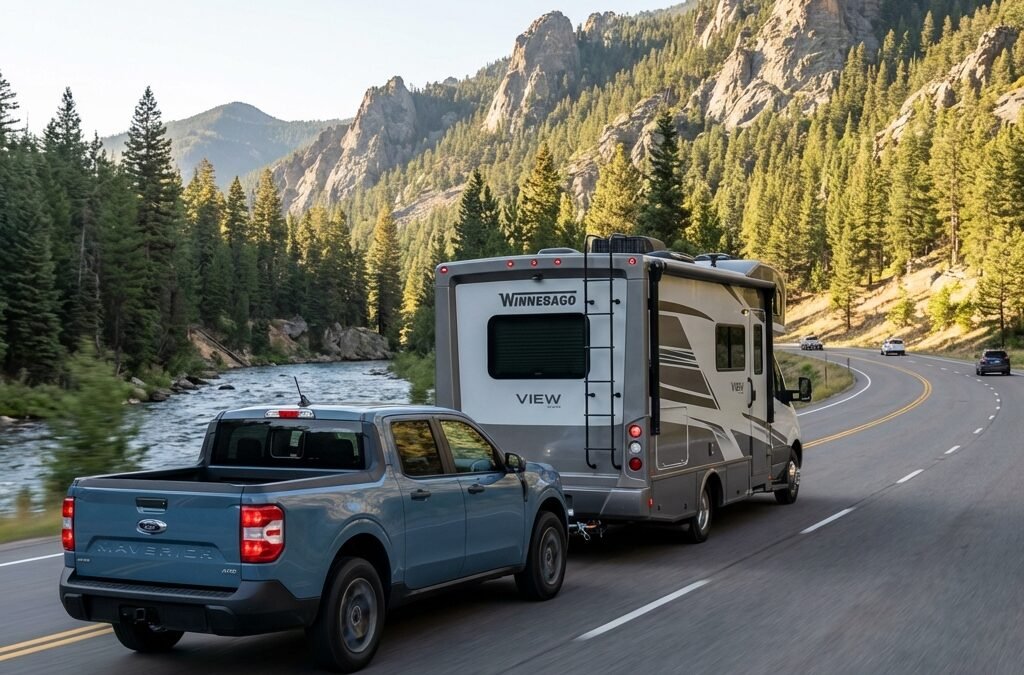
The 2025-2026 Flat Towing Compatibility Matrix & Equipment Failure Gaps
Last Updated: February 15, 2026
Important Legal Disclaimer
This article provides general information only and is not legal, mechanical, or professional advice. Federal and state towing laws vary by jurisdiction and change frequently. Vehicle specifications and manufacturer recommendations change between model years and production runs. Consult a qualified RV safety professional, licensed mechanic familiar with flat towing, and review current manufacturer documentation for your specific vehicle before attempting flat tow setup. Verify current state laws in all jurisdictions where you plan to travel. The author and publisher disclaim all liability for damages resulting from use of this information.
Key Takeaways
- 2025 Ford Maverick Hybrid AWD owner manual erroneously stated it cannot be flat towed. Ford confirmed December 2024 it can be towed and manual will be updated.
- 2025 Ford Ranger 4×4 is now flat towable after 2024 model was prohibited due to braking system incompatibility.
- 49 out of 50 US states require supplemental braking systems for towed vehicles over weight thresholds ranging from 1,500 to 15,000 lbs.
- Modern vehicles with electronic braking systems require dedicated 12V charge lines to prevent battery drain during towing.
- Blue Ox baseplate for 2025 Maverick has documented geometry failures with 41-inch spacing causing spreading and fascia damage.
The Manual Error Crisis: Ford’s Silent Updates
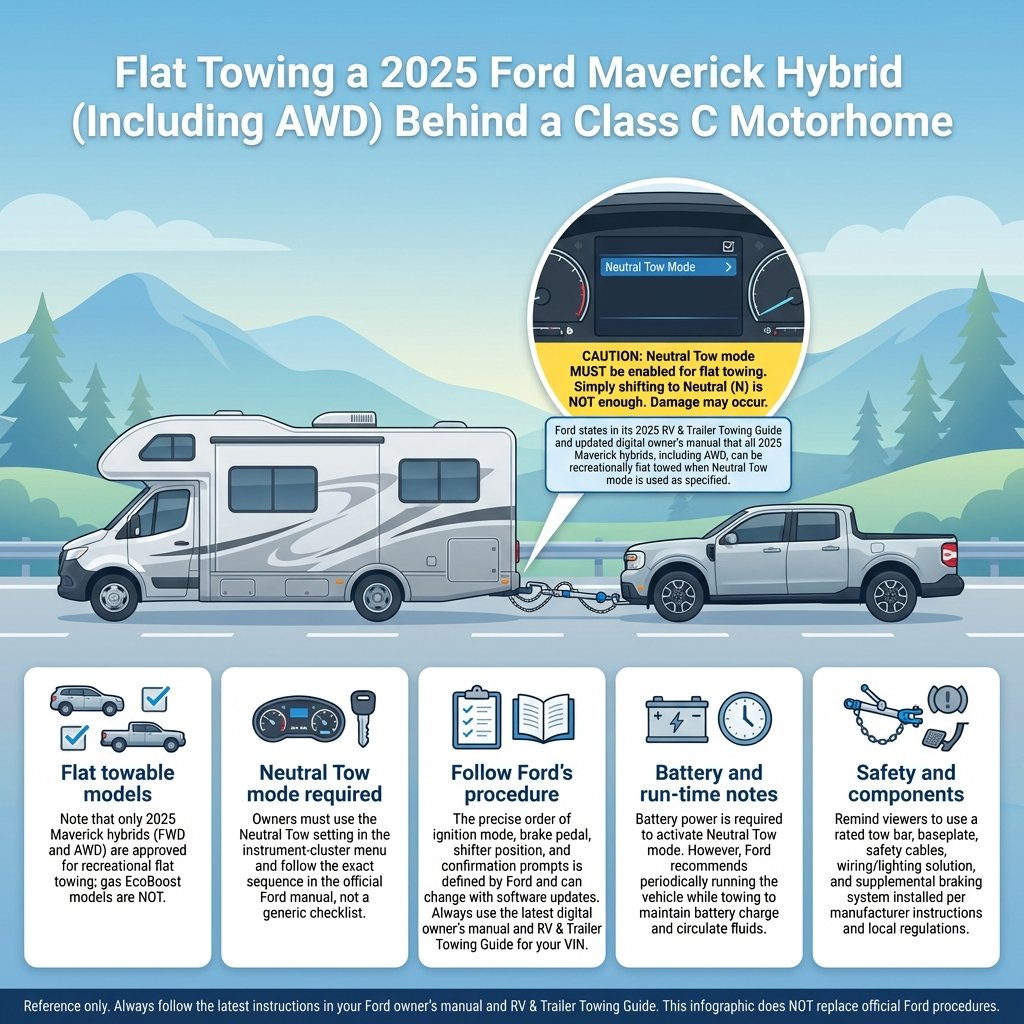
Ford released contradictory flat towing information for two 2025 U.S. domestic market vehicle models sold after July 2024. The 2025 Ford Maverick Hybrid AWD and 2025 Ford Ranger received owner manuals stating they could not be flat towed, directly contradicting earlier announcements from Ford truck communications. Ford Authority confirmed with Ford truck communications manager Dawn McKenzie in December 2024 that both vehicles can be recreationally towed, and the manuals contain errors that will be corrected. This applies specifically to USDM (United States Domestic Market) vehicles; international market specifications may differ.
The confusion stems from multiple manual versions. For the Maverick, the PDF owner manual stated AWD hybrids cannot be flat towed except in emergency situations with a 35 mph and 50-mile limit. The HTML version accessible through SYNC said hybrids can be towed using the Neutral Tow feature without distinguishing between FWD and AWD. DaVonya C. Lyons from Ford Executive Offices confirmed via email to RV forums that “the vehicle can be flat towed” and “the owner’s manual will be updated.”
For the Ranger, the 2024 model was explicitly prohibited from flat towing due to braking system incompatibility and a dangerous software feature that automatically shifts the transmission to Park if the 12V battery dies during towing. Ford redesigned the braking system for 2025, making 4×4 models flat towable using the Neutral Tow feature accessed through the transfer case. You can access the official 2025 Ford Ranger owner’s manual and 2025 Ford Maverick owner’s manual on Ford’s support website.
Critical Constraint
Ranger flat tow capability changed during the 2024-2025 model year transition due to braking system redesign. The 2024 model year used a braking system configuration incompatible with flat towing that could cause unrecoverable transmission damage. Manufacturing date and specific braking system configuration determine flat tow capability, not model year designation alone. Verify your specific vehicle’s build date, braking system type, and transfer case configuration with your Ford dealer using your VIN before attempting flat tow setup.
This manual error pattern highlights the importance of verifying flat tow capability through multiple sources before purchasing a vehicle specifically for towing purposes.
2025-2026 Flat Tow Compatibility Matrix
Flat tow capability changed significantly between 2024 and 2025 model years for Ford vehicles sold in the United States domestic market. The changes reflect engineering modifications to hybrid transmissions, electronic braking systems, and transfer case designs. This matrix reflects confirmed flat tow status for U.S. domestic market vehicles as of February 2026 based on manufacturer communications and owner manual documentation. State braking laws and manufacturer recommendations change annually. Verify current specifications with the manufacturer using your vehicle VIN and check applicable state laws before each towing season. International market vehicles may have different specifications.
This table documents confirmed flat tow status for vehicles with recent updates or common confusion:
| Vehicle | Trim/Drivetrain | 2024 Status | 2025-2026 Status | The Catch |
|---|---|---|---|---|
| Ford Maverick Hybrid | FWD | Yes | Yes | Requires Neutral Tow mode activation |
| Ford Maverick Hybrid | AWD | Not available | Yes (manual incorrect) | Ford confirmed December 2024 despite manual error |
| Ford Ranger | 4×4 (all trims) | No – braking incompatibility | Yes | Requires transfer case Neutral position |
| Ford Ranger | 4×2 (all trims) | No | No | No transfer case for Neutral mode |
| Chevy Equinox | FWD/AWD (2019+) | Yes | Yes | Must disconnect positive battery cable. Pull fuse F42 to prevent radio drain. |
| Jeep Wrangler | 4WD (all years) | Yes | Yes | EPS heater required to prevent death wobble |
The weight specifications matter for towing capacity calculations. The 2025 Maverick Hybrid AWD has a curb weight starting at approximately 3,800 lbs. The 2025 Ranger 4×4 weighs between 4,200-4,800 lbs depending on cab configuration. Most Class C motorhomes have towing capacities between 5,000-8,000 lbs, making the Maverick more suitable for lighter motorhomes. Consult Ford’s official 2025 RV and Trailer Towing Guide for complete specifications.
Towing procedures vary by manufacturer. Ford hybrids require activation of Neutral Tow mode through the vehicle settings menu before placing the transmission in neutral. GM vehicles require battery disconnect switches. Jeep Wranglers need the transfer case placed in Neutral with the transmission in Park.
Equipment Gap: Why 2025 Baseplates Are Missing
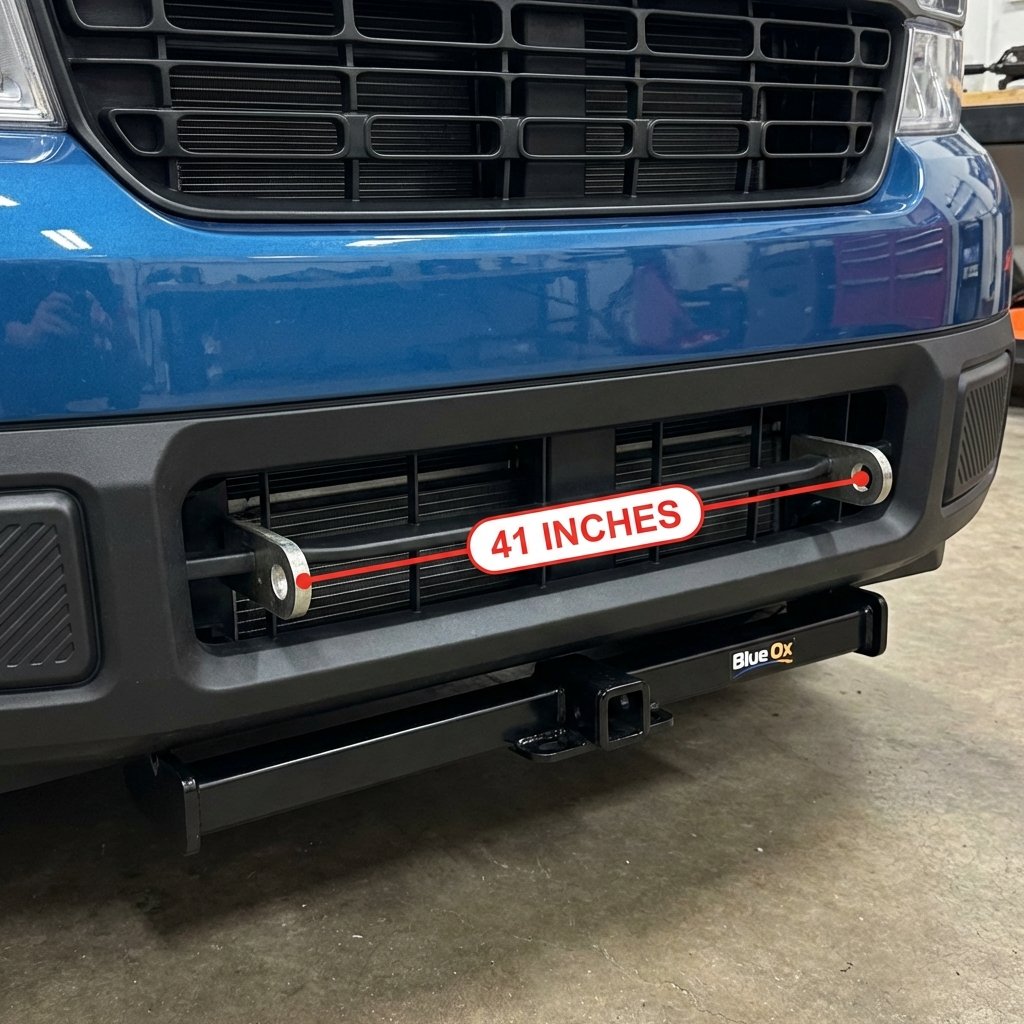
Blue Ox baseplates for the Maverick use 41-inch center-to-center spacing for tow bar attachment points. This wide spacing exceeds the typical 24-31-inch industry standard. During aggressive braking or tight turning maneuvers, the wide stance creates excessive lateral forces on the mounting points, causing documented baseplate failures.
One Maverick owner reported baseplate spreading after emergency braking at a rest area, requiring $5,539 for fascia repair and baseplate replacement. Blue Ox denied the warranty claim, citing improper use. Multiple forum users documented interference between tow bars and the vehicle yoke during full-lock turns due to the 41-inch spacing.
Equipment Constraint
Baseplate availability for 2025 Ranger and Maverick models remains uncertain and subject to manufacturer production schedules. Blue Ox, Roadmaster, and Demco have announced development timelines but actual ship dates change frequently due to engineering verification requirements. Contact manufacturers directly using your vehicle VIN to confirm current availability and estimated ship dates before taking delivery of a new vehicle purchased specifically for flat towing. Installation shops report extended backlogs once baseplates become available.
Roadmaster baseplates use 31-inch spacing and require removal of front bumper louvers for clearance. Initial engineering samples suggest this design provides superior geometry and strength, but Roadmaster requires multiple test vehicles to validate fitment across trim levels before releasing to production.
Adapters exist for mixing brands. Roadmaster part 030 adapts Blue Ox tow bars to Roadmaster baseplates. Blue Ox part BX88185 adapts in reverse. The adapters add approximately $120 to setup costs but allow RVers to keep existing tow bars when switching towed vehicles.
Supplemental Braking Requirements by State
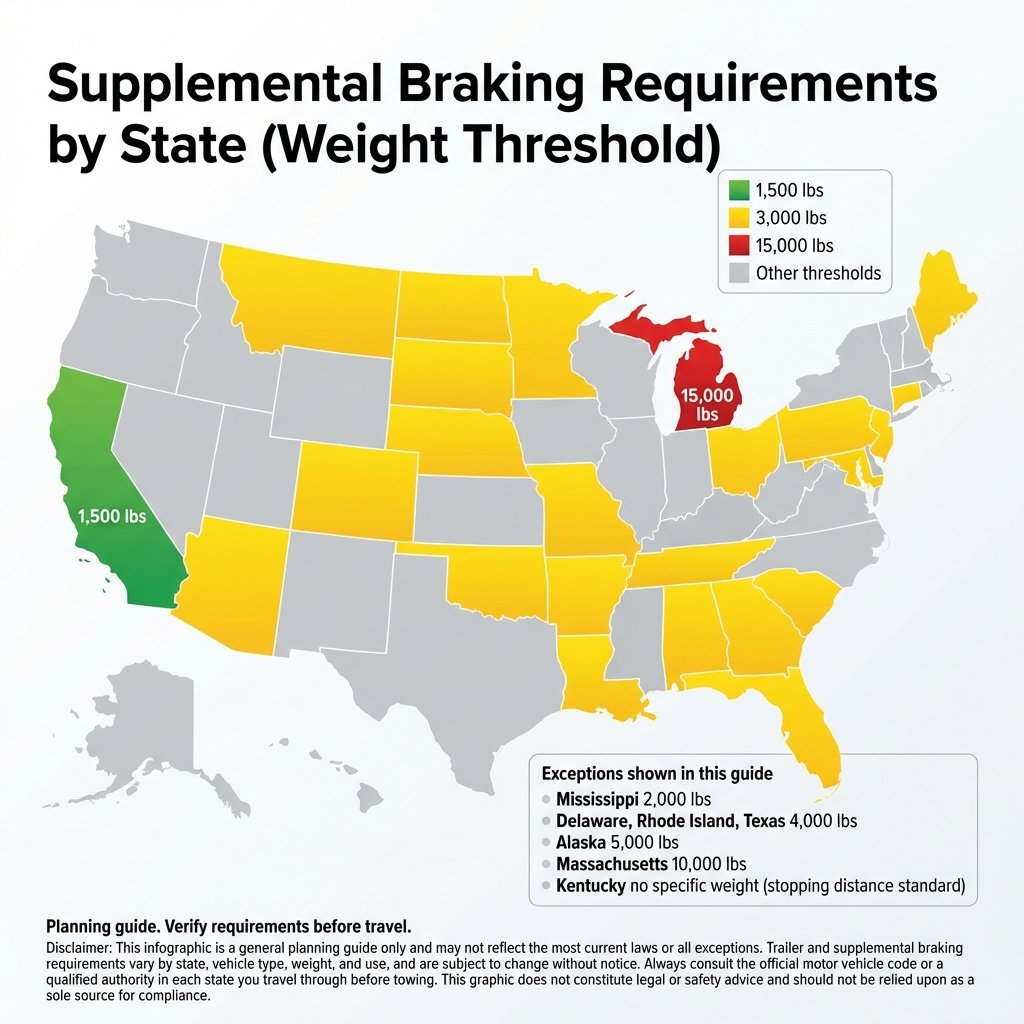
As of February 2026, the majority of U.S. states and all Canadian provinces require supplemental braking systems for flat towed vehicles exceeding specific weight thresholds, based on the American Automobile Association Digest of Motor Laws (March 2021 edition) and verified through Lippert manufacturer documentation. Weight limits range from 1,500 lbs in California to 15,000 lbs in Michigan, with 3,000 lbs being the most common threshold. State laws change frequently; verify current requirements with your state DMV and all states where you plan to travel before each towing season. Kentucky is the only U.S. state without specific trailer brake weight requirements, though combination vehicles must still meet statutory stopping distances.
Supplemental braking systems activate the towed vehicle’s brakes proportionally to the motorhome’s braking force. This reduces stopping distance and prevents premature wear on the motorhome’s brake system. Manufacturer testing data from Lippert indicates that properly configured supplemental brakes can reduce stopping distance by 5-10 feet from 30 mph in controlled test conditions, which may represent the difference between collision avoidance and impact in emergency situations.
States with the strictest requirements include New Jersey, which mandates both breakaway systems and proportional braking for any towed vehicle regardless of weight. California requires braking systems on towed vehicles exceeding 1,500 lbs. Delaware requires systems capable of controlling movement, stopping, and holding the vehicle combination with two separate means of applying brakes.
| Weight Threshold | U.S. States | Special Requirements |
|---|---|---|
| 1,500 lbs | California | Brakes on all wheels for vehicles over 6,000 lbs |
| 2,000 lbs | Mississippi | None |
| 3,000 lbs | Alabama, Arizona, Arkansas, Colorado, Connecticut, DC, Florida, Georgia, Louisiana, Maine, Maryland, Minnesota, Missouri, Montana, Nebraska, New Jersey, North Dakota, Ohio, Oklahoma, Pennsylvania, South Carolina, South Dakota, Tennessee | New Jersey requires breakaway systems for all weights |
| 4,000 lbs | Delaware, Rhode Island, Texas | Delaware requires two separate brake application methods |
| 5,000 lbs | Alaska | None |
| 10,000 lbs | Massachusetts | None |
| 15,000 lbs | Michigan | None |
| No specific weight | Kentucky | Must meet statutory stopping distances |
| Weight Threshold | Canadian Provinces | Special Requirements |
|---|---|---|
| 2,000 lbs | Alberta | None |
| 3,000 lbs | New Brunswick, Ontario, Prince Edward Island | None |
| 4,000 lbs | British Columbia, Nova Scotia | None |
Note: This compilation includes states and provinces with documented weight thresholds as of March 2021 AAA Digest publication. Additional states may have braking requirements based on stopping distance performance rather than weight thresholds. Some states not listed may have general braking adequacy requirements without specific weight limits. Verify current requirements with your state DMV before travel.
Kentucky is the only US state without specific trailer brake weight requirements, though combination vehicles must meet statutory stopping distances. Massachusetts and Michigan have the highest weight thresholds at 10,000 lbs and 15,000 lbs respectively.
Supplemental braking systems fall into two categories. Portable systems like the CURT RVibrake 4 use air cylinders or electric motors to push the brake pedal and require setup before each trip. Installed systems like the RVibrake Shadow 2 integrate permanently into the towed vehicle’s vacuum line and activate automatically without user intervention after initial installation.
Breakaway systems provide emergency braking if the towed vehicle disconnects from the motorhome while traveling. These systems use a cable that pulls a switch when separation occurs, activating the supplemental brake at maximum force to bring the towed vehicle to a stop. States requiring breakaway systems include New Jersey and several Canadian provinces. Learn more about NHTSA towing safety requirements.
The 12V Charge Line: No Longer Optional
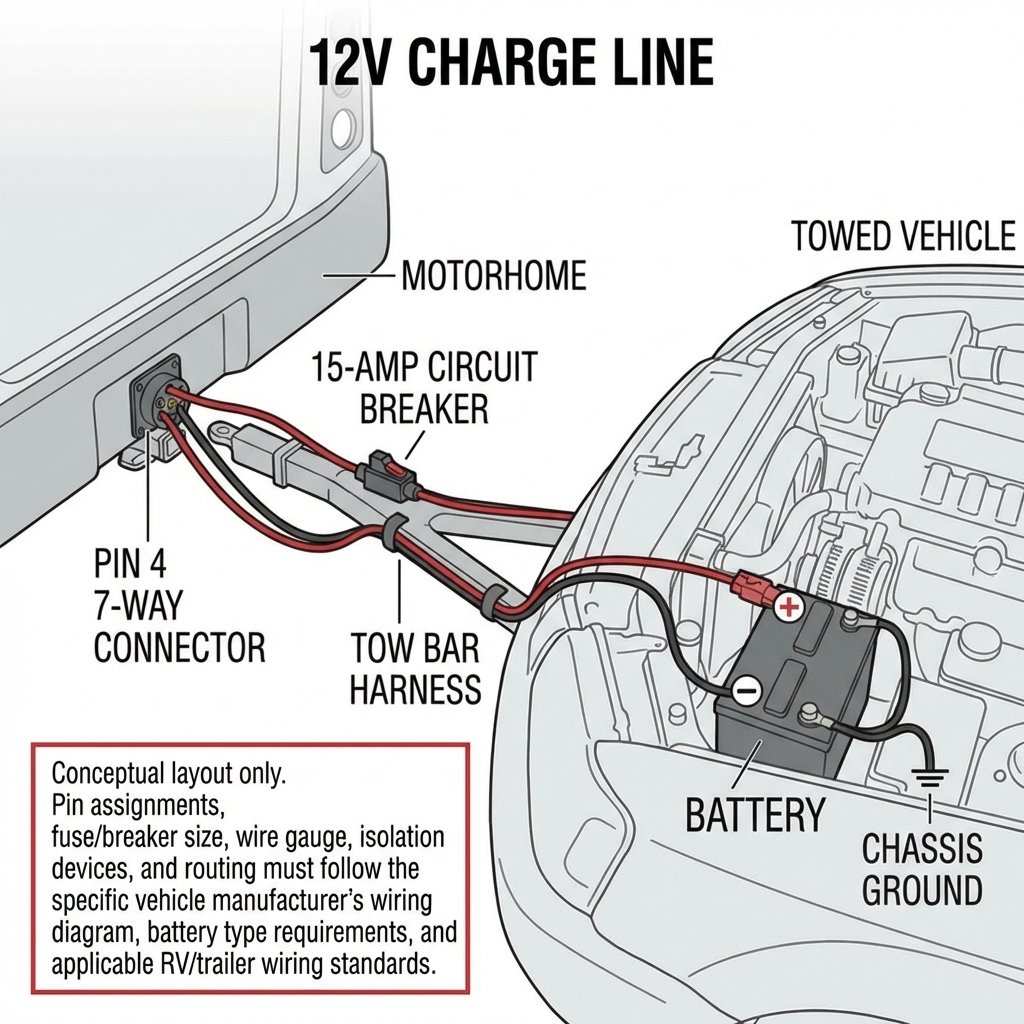
Over a six-hour drive, this draw depletes approximately 36-48 amp-hours from the typical 60-70 amp-hour battery found in compact vehicles. A fully charged battery starting at 12.8 volts drops to 11.9-12.1 volts after six hours of towing without supplemental charging, leaving insufficient reserve to reliably start the vehicle.
GM vehicles face similar challenges. A 2024 Chevy Equinox requires both positive battery cable disconnect and a charge line according to GM technical service bulletins. Even with the cable disconnected, the supplemental braking system draws power directly from the battery to maintain actuator position sensors and breakaway switch circuits.
Users on Chevy Equinox forums documented that pulling interior fuse F42 (radio/infotainment) eliminates parasitic draw that persists despite the ignition being off. After identifying the radio module as drawing 0.6 amps with all systems off, one owner drove eight hours with F42 pulled and the battery remained fully charged with only the charge line providing power.
Installation Constraint
Charge lines must use 14-gauge or larger wire with 15-amp circuit protection. The Roadmaster RM-156-25 battery charge line kit provides the correct wire gauge and inline circuit breaker. Connect the positive wire to the battery positive terminal or auxiliary jump post, not to smaller accessory circuits that may not handle sustained current draw.
Installation requires running a dedicated positive wire from the motorhome’s 12V accessory pin (typically pin 4 on a 7-way connector) to the towed vehicle’s battery positive terminal. A 15-amp circuit breaker protects the wire. The ground connection uses an existing chassis ground point near the battery rather than running a separate ground wire the full length of the motorhome.
Charge lines maintain battery voltage rather than actively charging from a depleted state. The voltage differential between the motorhome alternator output (13.8-14.4 volts) and the towed vehicle battery (12.6-12.8 volts) creates current flow of 2-4 amps to replace the parasitic draw. This maintains the towed vehicle battery at its starting charge level throughout the trip.
For vehicles requiring battery disconnect, install the disconnect switch on the positive cable between the battery and vehicle electrical system. Roadmaster part RM-766 provides an accessible switch mounted near the battery. The charge line connects on the battery side of the disconnect switch, allowing the charge line to maintain battery voltage while all vehicle systems remain isolated.
Death Wobble Prevention: Jeep EPS Requirements
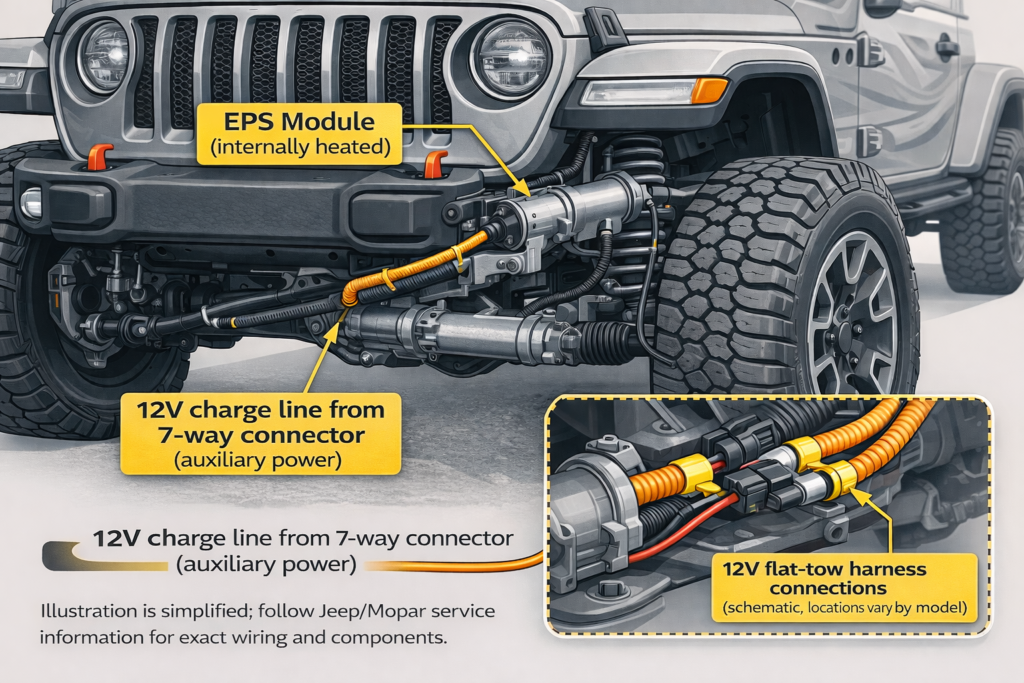
Death wobble manifests as rapid oscillation of the front wheels at frequencies of 10-15 cycles per second, typically triggered by road irregularities at speeds above 45 mph. The oscillation can reach amplitudes of 4-6 inches at the steering wheel, making the vehicle nearly impossible to control. Stopping is required to reset the system.
The EPS heater draws 12-18 amps when active, requiring the 12V charge line to provide adequate current. Without the charge line, the battery depletes within 2-3 hours of continuous EPS heater operation, shutting down the heating element and allowing fluid temperature to drop into the danger zone for death wobble.
Jeep Wrangler flat towing setup requires placing the transfer case in Neutral position while keeping the ignition in the Accessory position to power the EPS system. The transmission remains in Park. The Accessory position activates the EPS module but does not engage the drivetrain or activate the radio or climate control systems.
Critical Safety Note
EPS failure during flat towing cannot be resolved by stopping and restarting the vehicle. Once death wobble begins, the only safe response is immediate deceleration to below 30 mph and pulling off the roadway. Do not attempt to drive through the oscillation. Inspect all front-end components before resuming travel.
Verification of EPS heater operation requires monitoring the 12V charge line current draw. Normal draw during flat towing without EPS heater active measures 1-2 amps from supplemental brake and lighting systems. When the EPS heater activates, current draw increases to 14-20 amps. This spike confirms proper EPS operation.
Installation shops sometimes disable the EPS heater circuit by pulling fuse or disconnecting the heater element to reduce electrical load during towing. This practice eliminates death wobble prevention and creates unsafe towing conditions. Verify EPS heater remains connected and functional before each trip.
The 3-Inch Level Rule: Geometry Matters
Tow bar geometry requires the connection point between the motorhome receiver and the towed vehicle baseplate to remain within three inches of level to prevent premature wear on universal joints and mounting hardware. Violations of the three-inch rule create binding forces during turns and vertical articulation that exceed component design limits.
The rule applies to the loaded condition with the motorhome at typical travel weight including fresh water, propane, and cargo. Measuring with an empty motorhome produces inaccurate results because air suspension systems lower and coil springs compress when loaded, changing the receiver height by 2-4 inches from empty to loaded conditions.
Class A motorhomes on air suspension exhibit the greatest height variation. A 40-foot Class A diesel pusher typically sits 2-3 inches lower at the rear receiver when loaded compared to empty weight. Class C motorhomes on truck chassis with coil springs show 1-2 inches of variation. This height change must be factored into tow bar selection and baseplate positioning.
Tow bar manufacturers address height differences through adjustable shanks and drop/rise configurations. The Roadmaster Falcon 5250 includes a 2-inch rise/drop shank, allowing 4 inches of total vertical adjustment. The Blue Ox Aventa LX provides 6 inches of adjustment through interchangeable shanks in 2-inch increments.
Measuring procedure requires the motorhome fully loaded for travel and parked on level ground. Measure from ground to center of the receiver opening. Then measure from ground to center of the towed vehicle baseplate attachment point. The difference between these measurements must not exceed 3 inches. If the difference is 4-6 inches, use an adjustable drop/rise shank. If the difference exceeds 6 inches, the tow bar will experience binding and potential failure.
Measurement Constraint
Measure with all systems loaded: fresh water tank full, propane tanks full, typical cargo load, and all passengers aboard. Class A air suspension can drop 3-4 inches from empty to loaded. Measuring empty produces incorrect tow bar height selection, leading to binding and component failure.
Universal joints in tow bars operate through a range of ±12 degrees from center position. When the tow bar operates at an angle exceeding 8 degrees continuously, the universal joints experience uneven load distribution across the bearing surfaces. This creates accelerated wear on one side of each joint, reducing service life from the typical 50,000 miles to 10,000-15,000 miles.
Visual inspection identifies excessive tow bar angle. With the motorhome and towed vehicle connected and level, step back 10 feet and observe the tow bar angle. The center section should appear nearly horizontal. If the center section angles upward or downward more than 4-5 inches over its length, the geometry requires correction before towing.
Correction methods include: (1) adjusting tow bar shank rise/drop, (2) relocating baseplate mounting points if the vehicle design allows, or (3) installing receiver extensions on the motorhome to move the connection point forward or backward, which can improve angle in some configurations. The least expensive solution is tow bar shank adjustment, which costs $50-150 for the replacement shank versus $300-600 for baseplate relocation.
Best Lightweight Flat Tow Vehicles Under 3,000 lbs
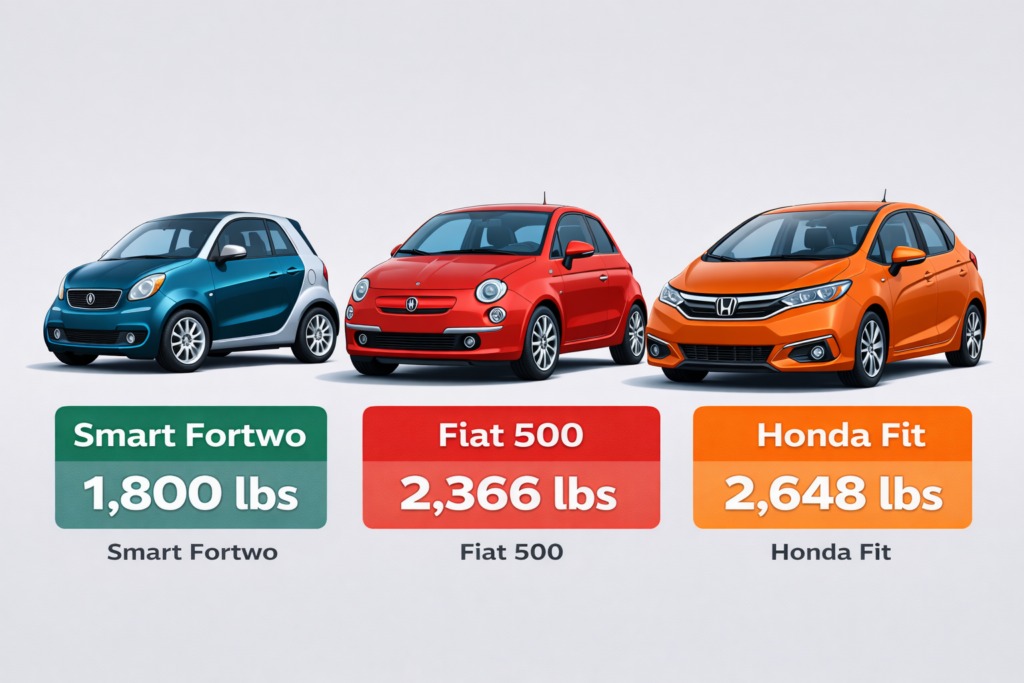
The Fiat 500 provides the best balance of weight and practicality at 2,360-2,500 lbs depending on trim level. The four-passenger capacity and 9.5 cubic feet of cargo space accommodate daily errands and grocery trips. Only manual transmission models from 2011-2019 can be flat towed. The 2020+ electric models are not flat towable. The Fiat 500 requires no battery disconnect, no fuse pulling, and the steering wheel does not lock during towing.
The discontinued Chevy Spark LS manual transmission weighs 2,226 lbs and generates 98 horsepower from the 1.4-liter four-cylinder engine. Production ended in 2022, limiting availability to used market. The five-door hatchback configuration provides 27.2 cubic feet of cargo space with rear seats folded, making it suitable for hauling camping equipment or recreational gear between destinations.
For boondocking applications, a 4×4 lightweight vehicle provides access to rugged campsites inaccessible to motorhomes. The lightest 4×4 option is the Suzuki Samurai at 2,095-2,315 lbs, though U.S. production ended in 1995. Used Samurais remain popular in the RV community for their capability and simplicity.
| Vehicle | Curb Weight | Transmission | Passengers | Special Notes |
|---|---|---|---|---|
| Smart Fortwo | 1,800 lbs | Manual only | 2 | Lightest option, 32/39 mpg, electric version not towable |
| Chevy Spark LS | 2,226 lbs | Manual only | 4 | Discontinued 2022, 98 hp, 27.2 cu ft cargo |
| Fiat 500 | 2,360-2,500 lbs | Manual only (2011-2019) | 4 | No battery drain, steering unlocked, 28/33 mpg |
| Honda Fit | 2,513-2,648 lbs | Manual (2007-2014) | 5 | Magic Seat system, 52.7 cu ft cargo, discontinued in US 2020 |
| Ford Focus 2.0L | 2,935-3,064 lbs | Manual (2016-2018) | 5 | 70 mph max speed, Focus Electric/ST/RS not towable |
Manual transmissions dominate the lightweight flat tow category. Automatic transmissions in vehicles under 3,000 lbs typically use CVT or dual-clutch designs that cannot be towed without transmission damage. The manual transmission allows the drivetrain to rotate freely in neutral without engaging clutch packs or applying hydraulic pressure.
Weight calculations must include the towed vehicle’s curb weight plus any cargo, tools, or equipment stored inside during towing. A Fiat 500 with 100 lbs of camping gear, 50 lbs of tools, and two folding chairs totals 2,510 lbs. This additional weight consumes 510 lbs of the motorhome’s available towing capacity and must be factored into gross combined weight rating compliance.
For Class C motorhomes with 5,000 lb towing capacity, a 2,500 lb towed vehicle leaves 2,500 lbs of margin. This margin accommodates the weight of the tow bar (80-120 lbs), baseplate (30-50 lbs), supplemental braking system (15-25 lbs), and allows for measurement uncertainty in the towed vehicle weight. Heavier towed vehicles approaching 3,500-4,000 lbs reduce this margin significantly, requiring precise weight verification before each trip.
Applying This Information to Your Setup
Verify flat tow capability directly from the manufacturer rather than relying solely on owner manuals, which contain documented errors for 2025 Ford models. Contact the manufacturer’s truck or RV division communications department for written confirmation if the manual contradicts other sources. You can also consult the Recreation.gov campground directory for RV-accessible dispersed camping locations.
Install 12V charge lines on all vehicles regardless of stated requirements. The minimal cost of $75-150 for the charge line kit prevents battery depletion scenarios that can strand you at campgrounds or rest areas with a dead towed vehicle battery.
Test all flat towing equipment in your driveway before the first trip. Connect the tow bar, verify all safety cables attach properly, test the supplemental brake activation, and confirm the charge line provides power to the towed vehicle battery. Drive around your neighborhood at 25-35 mph to verify no unusual vibrations or noises occur before attempting highway speeds.
For boondockers, the flat-towable 4×4 option provides access to remote dispersed camping sites that large motorhomes cannot reach. A Jeep Wrangler or similar 4×4 towed behind a Class C allows you to scout locations, access trailheads, and navigate rough forest service roads while leaving your motorhome at a stable basecamp. Find dispersed camping locations on BLM.gov and Forest Service websites.


