

2026 Hidden Cost & Detour Model
TL;DR: This page is an economic model you can reuse. It doesn’t depend on a fixed price list. Plug in today’s membership terms, your travel nights, and your real-world constraints. The output is your restriction-adjusted break-even point.
By: Chuck Price Updated: January 5, 2026
Deep Dive Resource: Before running the numbers below, you may want to review our Complete Guide to RV Club Memberships for a list of current programs and their basic terms.

Pillar 1: Illustrative economic inputs worksheet
| Input | What to enter | Why it matters |
|---|---|---|
| Annual cost | Today’s real price | Fixed yearly cost |
| Mandatory add-ons | Tiers, zones, or upgrades | Often doubles true cost |
| Availability factor | Fraction of nights usable | Restrictions reduce value |
| Hidden costs | Fuel, social spend, substitutes | Where break-even flips |
Pillar 2: The restriction-adjusted break-even formula
Break-Even Nights Formula:
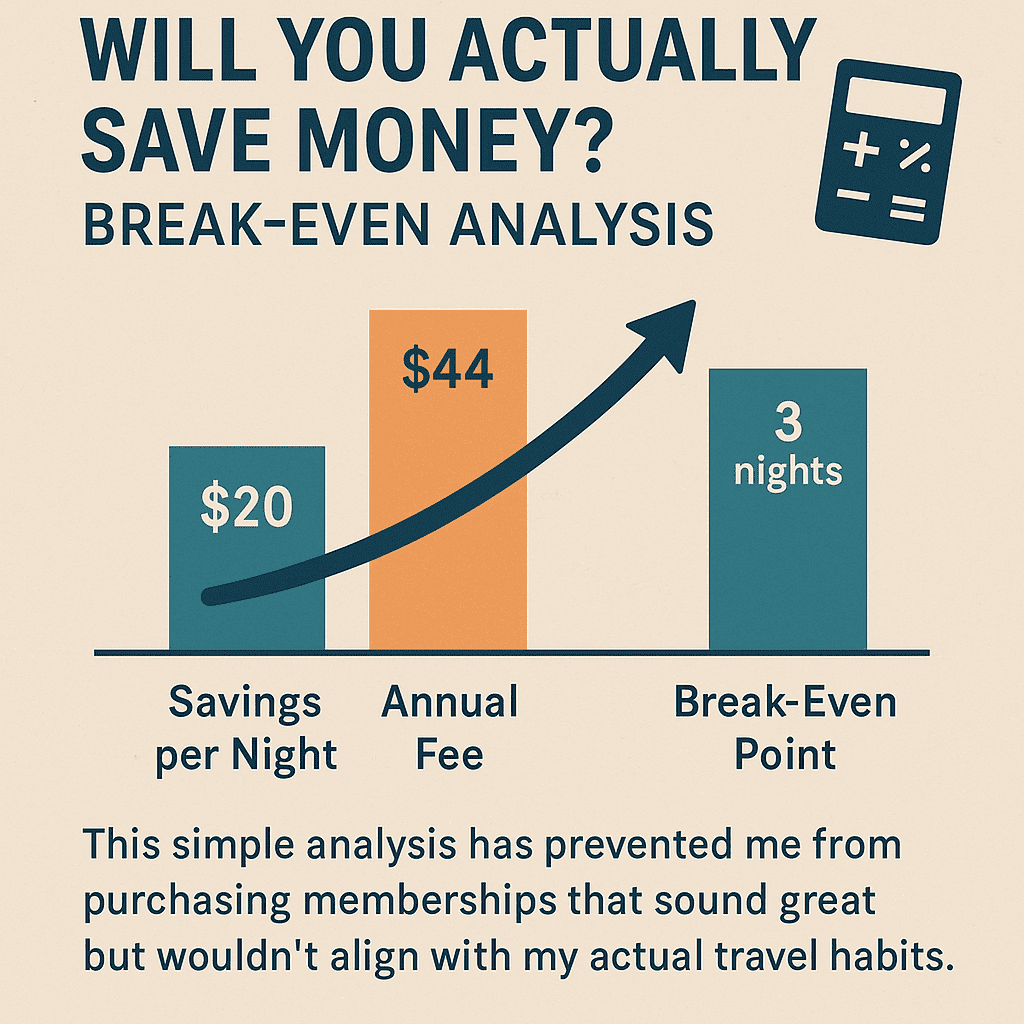
Break-Even Nights = (Annual Cost + Mandatory Fees + Hidden Costs) ÷ (Average Nightly Savings × Availability Factor)
Pillar 3: Hidden costs & fuel detour math
Fuel detours are arithmetic, not opinion. If you drive 280 miles out of your way to “save” money, did you actually save anything?
| Assumed MPG | Gas ($3.00) | Diesel ($3.53) |
|---|---|---|
| 8 MPG | $105.00 | $123.55 |
| 12 MPG | $70.00 | $82.37 |
Pillar 4: The “Friction” Checklist
Most campers fail to break even because they assume an Availability Factor of 1.0 (perfect usage). In reality, “Friction” erodes your savings.
The Two Types of Friction
- Logistical Friction: Booking friction and stay limits (e.g., “Max 3 days”). These create Rule-Induced Gaps—nights you want to use the membership but are barred from doing so.
- Behavioral Friction: The “Social Spend.” In host networks, you may feel obligated to spend money. For a detailed look at how this impacts actual users, see our analysis of Boondockers Welcome Regrets.

Pillar 5: Real-World Case Study (The “Detour Delta”)
How does “The Detour Delta” kill your savings? Let’s compare a $50 direct-route park against a $25 membership site that requires a 100-mile round-trip detour.
The Math: $25 (Site) + $35 (Fuel for 100 miles) = $60 total cost. By trying to save $25, you actually spent $10 more.
For more specific head-to-head math between programs, check our comparison of RV Overnights vs. Harvest Hosts.
Pillar 6: The 5-Question Decision Matrix

- Nights: How many nights will you travel?
- Availability: What fraction are usable after rules and blackouts?
- Substitution: What do you pay for non-usable nights?
- Detour Delta: How much extra fuel will you burn to stay “in-network”?
- Outcome: Is the math a win under conservative inputs?


