
Complete Guide
By Chuck Price, Boondock or Bust | Full-time RVer, 35+ years UTV experience, 47 states traveled
Last updated: February 2, 2026
Read time: 15 minutes | Key stat: Montana and South Dakota require zero speed restrictions for street-legal UTVs
Quick Reference (TL;DR)
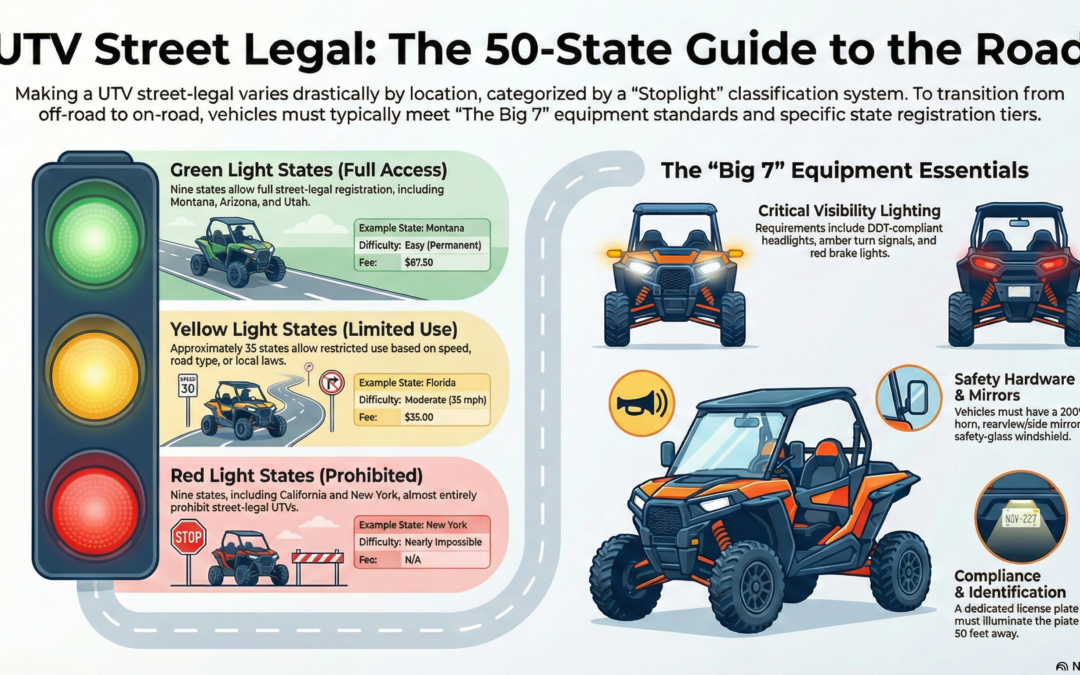
- Legal status: 20 states allow UTVs on most public roads with proper equipment and registration. Another 25 states allow limited road use. 5 to 9 states severely restrict or prohibit on-road use.
- Golden rule: Local ordinances override state permission. County commissioners can ban UTVs even in permissive states. Verify local rules before riding.
- Safety baseline: Most states require seven core components including horn, mirrors, turn signals, brake lights, headlights, license plate light, and windshield.
- Budget: $1,130 to $2,730 for basic street-legal conversion. Insurance is usually a separate powersports policy with a street-legal endorsement, not auto coverage.
A Utility Task Vehicle can legally operate on public roads in approximately 20 states with full street-legal registration (per
World Population Review), while another 25 states allow limited road use under specific conditions.
Montana and South Dakota offer the most permissive pathways with permanent plates and no speed restrictions, while California and several other states severely restrict or prohibit on-road UTV use.
Success requires understanding three layers of regulation: state registration laws, equipment rules, and local road access rules.
State-by-State UTV Street Legal Status: 2026 Quick Reference
The table below summarizes UTV road legality tiers. Treat it as a starting point. Local ordinances can override state-level permission.
| State | Tier | Registration Difficulty | Key Restrictions | Insurance Required |
|---|---|---|---|---|
| Montana | Green Light | Easy (permanent plates) | None, classified as quadricycle | Yes (motorcycle-level) |
| South Dakota | Green Light | Easy (permanent plates) | None, full road rights | Yes (motorcycle-level) |
| Arizona | Green Light | Moderate | Maintained roads only | Yes (liability minimum) |
| Utah | Green Light | Easy | Some national park access | Yes |
| Wyoming | Green Light | Easy | County roads, some highways | Yes |
| Nevada | Green Light | Moderate | State highways allowed | Yes |
| North Carolina | Yellow Light | Moderate | 35 mph roads only | Yes |
| Texas | Yellow Light | Moderate | County roads, local override | Yes (mandatory) |
| Florida | Yellow Light | Moderate | 35 mph roads, county approval | Yes |
| Georgia | Yellow Light | Moderate | Local roads, municipal override | Yes |
| Tennessee | Yellow Light | Moderate | Secondary roads only | Yes |
| Virginia | Yellow Light | Moderate | Crossing roads only, trail access | Limited |
| West Virginia | Yellow Light | Difficult | Motorcycle endorsement required | Yes |
| California | Red Light | Nearly Impossible | Agricultural or emergency use only | N/A (prohibited) |
| New York | Red Light | Nearly Impossible | Private property only | N/A (prohibited) |
| All Other States | Yellow Light | Varies | Typically 35 to 45 mph roads | Check state DMV |
Data compiled from state DMV regulations and motor vehicle codes, verified January 2026. Confirm current rules with local authorities before operation.
Download: State-by-State UTV Requirements Checklist
Get our PDF checklist with equipment requirements, registration steps, insurance minimums, and DMV contact info. Includes a printable inspection checklist and cost calculator.
Free download: UTV Street Legal State Requirements Checklist (PDF)
What Makes a UTV Street Legal? Core Requirements Explained
Before state-by-state details, focus on the basics: how your state classifies a UTV and what equipment you must add to pass inspection.
Legal Classifications: UTV vs. ATV vs. LSV
Most states distinguish UTVs (side-by-side seating, steering wheel, foot pedals) from ATVs (straddle seat, handlebars). Some states also route registrations through Low-Speed Vehicle rules, which often limits you to roads posted 35 mph or less.
The Big 7: Common Equipment Requirements

- Horn: Commonly must be audible at distance
- Mirrors: Rearview plus both side mirrors
- Turn signals: Front and rear signals, often with hazards
- Brake and tail lights: Rear lighting visible at distance
- Headlights: White forward lighting
- License plate light: Plate readable at night
- Windshield: Glass or polycarbonate depending on state
Equipment Costs: Budget $1,130 to $2,730 for Street Legal Conversion
Your cost depends on what your UTV already has and what your state requires. The biggest swings usually come from windshields and DOT tires.
| Component | Cost Range | Required In | Notes |
|---|---|---|---|
| Turn Signal Kit | $150 to $400 | Most states | Professional install often adds $100 to $200 |
| Windshield (Glass) | $250 to $700 | Many states | Some states add wiper and washer requirements |
| DOT Tires (Set of 4) | $600 to $1,200 | Some states | Recommended even when not required |
| Horn Upgrade | $30 to $80 | Most states | Audibility rules vary |
| Mirrors | $50 to $150 | Most states | Rearview plus both sides is common |
| Administrative Fees | $50 to $200 | All states | Inspection, title, registration, plates |
| Total estimated cost: $1,130 to $2,730 (average $1,800) | |||
Frequently Asked Questions
What states allow UTVs on public roads?
Montana, South Dakota, Arizona, Utah, Wyoming, and Nevada allow UTVs on most public roads with proper registration. North Carolina, Texas, Florida, and many other states allow limited road use, typically on roads posted 35 to 45 mph or less. California, New York, and others severely restrict or prohibit on-road UTV use.
What equipment is required to make a UTV street legal?
Most states require a horn, mirrors, turn signals, brake and tail lights, headlights, a license plate light, and a windshield. Some states add requirements such as DOT tires or windshield wipers.
How much does it cost to make a UTV street legal?
Budget $1,130 to $2,730 for a basic conversion. Ongoing costs include registration and insurance, commonly $200 to $600 per year for liability coverage depending on state and insurer.
Does my auto insurance cover a street-legal UTV?
Usually no. You typically need a separate powersports policy that explicitly covers street-legal use, not off-road-only coverage.
About the Author
Chuck Price has lived full-time in RVs since 2018 and operates Boondock or Bust as a testing ground for practical travel and gear guides.
Sources and References
State count data reference: https://worldpopulationreview.com/state-rankings/utv-street-legal-states
Last reviewed: February 2, 2026


