
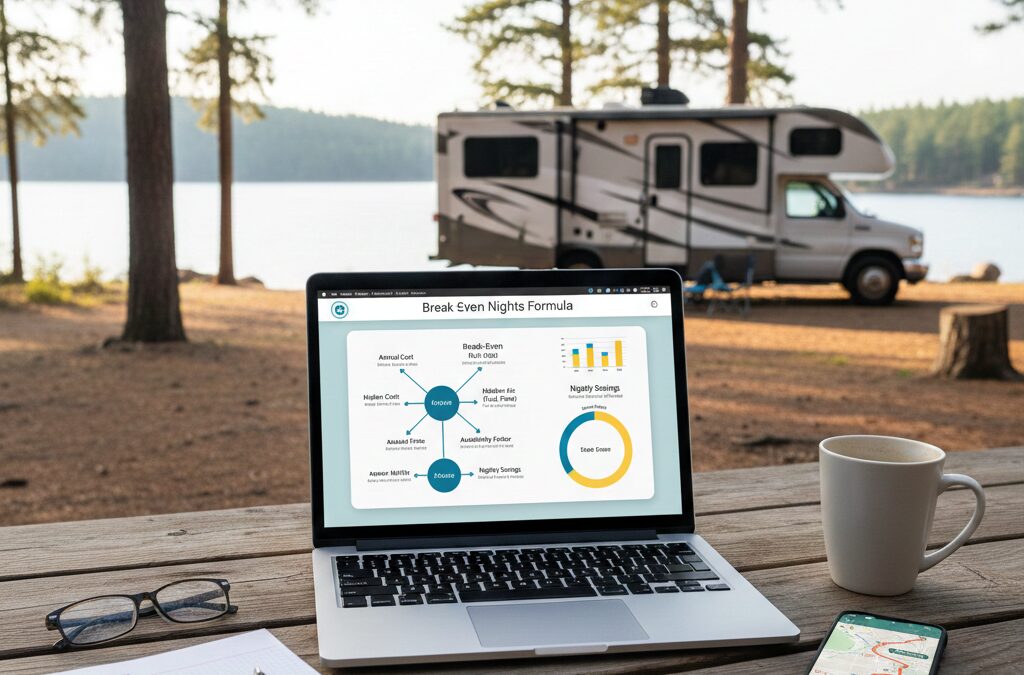
2026 Hidden Cost & Detour Model
By: Chuck Price Updated: January 5, 2026

Pillar 1: Illustrative economic inputs worksheet
| Input | What to enter | Why it matters |
|---|---|---|
| Annual cost | Today’s real price | Fixed yearly cost |
| Mandatory add-ons | Tiers, zones, or upgrades | Often doubles true cost |
| Availability factor | Fraction of nights usable | Restrictions reduce value |
| Hidden costs | Fuel, social spend, substitutes | Where break-even flips |
Pillar 2: The restriction-adjusted break-even formula
In this hypothetical example, a $44 membership divided by $20 saved per night breaks even after 2.2 nights. That means three whole nights are needed to cover the membership cost. Your result depends on your actual membership cost and savings per stay.
Pillar 3: Hidden costs & fuel detour math
Fuel detours are arithmetic, not opinion. If you drive 280 miles out of your way to “save” money, did you actually save anything?
| Assumed MPG | Gas ($3.00) | Diesel ($3.53) |
|---|---|---|
| 8 MPG | $105.00 | $123.55 |
| 12 MPG | $70.00 | $82.37 |
Pillar 4: The “Friction” Checklist
Most campers fail to break even because they assume an Availability Factor of 1.0 (perfect usage). In reality, “Friction” erodes your savings.
The Two Types of Friction
- Logistical Friction: Booking friction and stay limits (e.g., “Max 3 days”). These create Rule-Induced Gaps—nights you want to use the membership but are barred from doing so.
- Behavioral Friction: The “Social Spend.” In host networks, you may feel obligated to spend money. For a detailed look at how this impacts actual users, see our analysis of Boondockers Welcome Regrets.

Pillar 5: Real-World Case Study (The “Detour Delta”)
How does “The Detour Delta” kill your savings? Let’s compare a $50 direct-route park against a $25 membership site that requires a 100-mile round-trip detour.
The Math: $25 (Site) + $35 (Fuel for 100 miles) = $60 total cost. By trying to save $25, you actually spent $10 more.
For more specific head-to-head math between programs, check our comparison of RV Overnights vs. Harvest Hosts.
Pillar 6: The 5-Question Decision Matrix

- Nights: How many nights will you travel?
- Availability: What fraction are usable after rules and blackouts?
- Substitution: What do you pay for non-usable nights?
- Detour Delta: How much extra fuel will you burn to stay “in-network”?
- Outcome: Is the math a win under conservative inputs?


