
Last updated: January 7, 2026
TL;DR
- Yes, it is the law. The One Big Beautiful Bill Act became Public Law 119-21 and was signed on July 4, 2025.
- This is not an RV deduction. It is a deduction for interest on a qualifying new passenger vehicle loan.
- Big RV reality: Towable RV loans (travel trailers, fifth wheels) do not qualify under this new deduction.
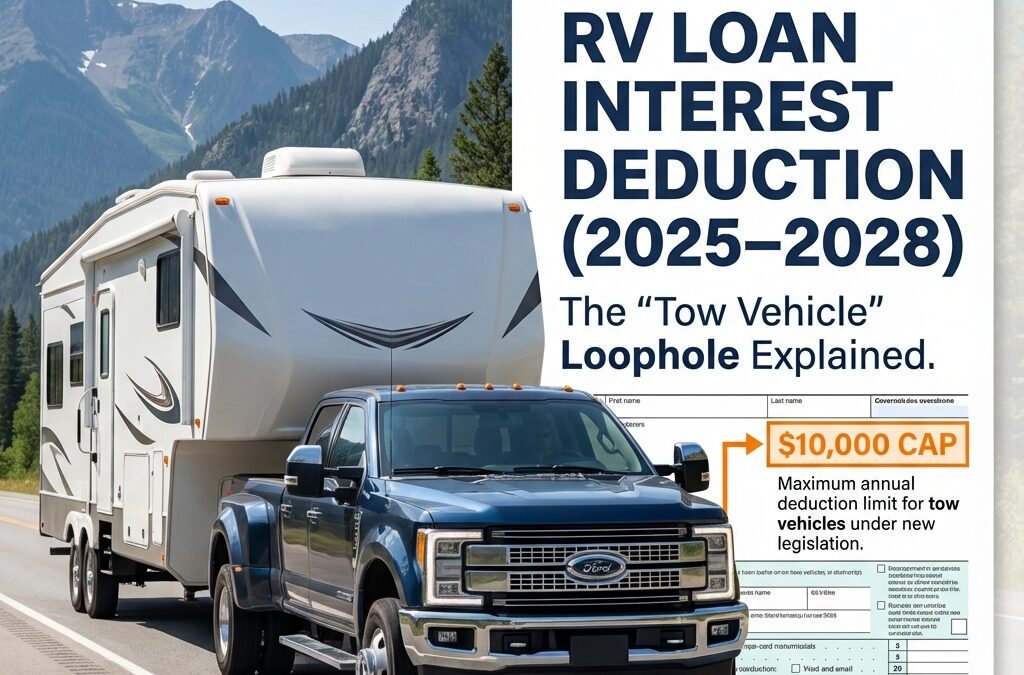
- Where RVers win: A new U.S.-assembled pickup or SUV used as your tow vehicle may qualify if it is under 14,000 lbs GVWR and the loan meets the rules.
- Time window: Tax years 2025 through 2028, for loans originated after Dec. 31, 2024.
- Max benefit: Up to $10,000 per year of deductible interest, with an income phaseout above certain MAGI levels.
- Compliance detail: You must include the VIN on your return for any year you claim the deduction.
What has changed since the rumor posts
If you have seen the viral line about a “$10,000 RV loan interest deduction,” here is the clean version.
The law created a new deduction for car loan interest on certain new vehicles.
The IRS issued public guidance on Dec. 31, 2025, and the Treasury and IRS published proposed regulations in the Federal Register on Jan. 2, 2026.
These documents clarify key details that most social posts leave out.
- Congress.gov legislative record: H.R. 1 became Public Law 119-21 on July 4, 2025.
Congress.gov (H.R. 1, all info) - IRS news release (Dec. 31, 2025): Treasury and IRS guidance and a link to proposed regulations.
IRS newsroom guidance - Federal Register proposed regulations (Jan. 2, 2026): details and comment deadlines.
Federal Register proposed rule
The actual rule in plain English
For tax years 2025 through 2028, you may be able to deduct the interest you paid on a loan used to buy a qualified vehicle for personal use.
This is available whether you take the standard deduction or itemize.
Key points you should remember
- Annual cap: Up to $10,000 of interest (the proposed regs clarify this is capped per return).
- Loan timing: The loan must originate after Dec. 31, 2024.
- New only: The vehicle must be originally used by you (used purchases do not qualify).
- Secured debt: The loan must be secured by a lien on the vehicle.
- Personal use: This is for nonbusiness use.
- Income phaseout: IRS states a phaseout above MAGI thresholds (single and joint).
- VIN required: You must include the VIN on the return for any year you claim the deduction.
Primary IRS rule page: IRS: One, Big, Beautiful Bill provisions, Section 70203
Which vehicles qualify
IRS lists a qualified vehicle as a car, minivan, van, SUV, pickup truck, or motorcycle that:
- Has a GVWR under 14,000 pounds
- Underwent final assembly in the United States
How to verify final assembly
- Check the vehicle label at the dealership (often called the Monroney label).
- Use the VIN.
- Use NHTSA’s VIN decoder tool to help verify assembly location: NHTSA VIN Decoder
What this means for RVers
1) Towable RV loans are out (for this deduction)
Travel trailers, fifth wheels, and most trailer-style campers are not in the IRS list of qualified vehicles.
So the loan for the trailer itself does not qualify for this new deduction.
2) New tow vehicles can qualify
If you buy a new pickup truck or SUV that is U.S.-assembled, under 14,000 lbs GVWR, and financed with a liened loan that starts after Dec. 31, 2024, the interest on that tow vehicle loan may qualify.
This is the core “RVer benefit” most people are actually talking about.
3) Van-based rigs can qualify, but do not assume
Many Class B builds start as a van.
The IRS definition is based on vehicle category, GVWR, and U.S. final assembly.
Before you plan around this deduction, verify (1) how the vehicle is classified, (2) GVWR, and (3) U.S. final assembly for the vehicle you are actually buying.
4) Refinance is not an automatic “no” anymore
IRS states that if a qualifying vehicle loan is later refinanced, interest paid on the refinanced amount is generally eligible for the deduction.
That is a meaningful change from the simplistic “refinance never qualifies” answer you see online.
The older RV interest rule still exists (and why it often does not help)
Separate from the new car-loan-interest deduction, there is a long-standing rule that can allow RV loan interest as home mortgage interest if the RV qualifies as a first or second home and the loan is secured.
The practical problem is that this typically requires itemizing.
Many taxpayers take the standard deduction instead.
For 2025, IRS published standard deduction amounts of $31,500 for married filing jointly (and other amounts by filing status).
If you do not itemize, the “second home” route may not move the needle for you.
- Home mortgage interest and second home rules: IRS Publication 936
- 2025 standard deduction amounts (IRS): IRS standard deduction (2025)
Note: This article is general information, not tax advice. Rules can vary by filing status, usage, and documentation.
Real-world math (use this formula)
The deduction reduces your taxable income, not your loan balance.
Your approximate tax savings usually looks like this:
Estimated tax savings = (deductible interest you paid, up to the cap) x (your marginal tax rate)
Examples:
| Loan Interest Paid | Marginal Tax Rate | Est. Federal Tax Savings |
| $3,000 | 12% | $360 |
| $5,000 | 22% | $1,100 |
| $10,000 (Cap) | 24% | $2,400 |
Your actual outcome depends on your return, income, phaseout rules, and what is ultimately finalized in IRS instructions.
How to claim it without getting sloppy
- Confirm the vehicle is on the IRS qualified list (car, minivan, van, SUV, pickup, motorcycle) and is under 14,000 lbs GVWR.
- Verify U.S. final assembly. Use the dealership label, VIN, and NHTSA VIN tools as needed.
- Confirm the loan originated after Dec. 31, 2024 and is secured by a lien on the vehicle.
- Keep lender documentation. The IRS rule framework relies on lender reporting and taxpayer statements of interest paid.
(Expect an annual statement from the lender once the reporting system is fully implemented.) - Include the VIN on your return for any year you claim the deduction.
IRS explanation of lender reporting and taxpayer eligibility: IRS newsroom guidance (Dec. 31, 2025)
Quick-hit FAQs
Do I have to itemize to claim the new deduction?
No. IRS states it is available to both itemizing and non-itemizing taxpayers.
Does my 2023 loan qualify?
Not for this new deduction. IRS requires the loan to originate after Dec. 31, 2024.
Does refinancing kill eligibility?
Not always. IRS states that interest on the refinanced amount is generally eligible if the original loan was qualifying.
Does this cover my new fifth wheel or travel trailer loan?
Not under the new “car loan interest” deduction because trailers are not in the qualified vehicle list.
A different rule may apply if your RV qualifies as a second home and you itemize, but that is a separate analysis.
Does my new tow truck qualify?
Potentially, yes, if it is new, U.S.-assembled, under 14,000 lbs GVWR, financed with a liened loan after Dec. 31, 2024, and used for personal use.
You also must include the VIN on your return for any year you claim the deduction.
IRS core rules: IRS provisions page, Section 70203
Bottom line
The social posts got one thing right: there is a new deduction tied to vehicle loan interest.
They got the big part wrong: it is not a blanket RV loan interest write-off.
If you are buying a new tow vehicle, this is where it can matter.
If you are financing a towable RV, this specific deduction does not apply to the trailer loan.
If you are planning a purchase based on this deduction, verify GVWR, verify U.S. final assembly, and keep clean lender documentation.
Then talk to a qualified tax pro before you file.
| Key Fact | Legal/IRS Reference |
| Enacting Law | Public Law 119-21 (Signed July 4, 2025) |
| IRC Section | New Section 163(h)(4)(B) & Section 6050AA |
| Max Deduction | $10,000 (Above-the-line) |
| Phaseout Start | $100k Single / $200k MFJ (MAGI) |
| Qualified Vehicle | GVWR < 14,000 lbs; Final Assembly in USA |
Sources
- Internal Revenue Service. (2025, December 31). Treasury, IRS provide guidance on the new deduction for car loan interest under the One, Big, Beautiful Bill.
https://www.irs.gov/newsroom/treasury-irs-provide-guidance-on-the-new-deduction-for-car-loan-interest-under-the-one-big-beautiful-bill - Internal Revenue Service. (2025). One, Big, Beautiful Bill provisions: No tax on car loan interest (Section 70203).
https://www.irs.gov/newsroom/one-big-beautiful-bill-provisions - Federal Register. (2026, January 2). Car Loan Interest Deduction (REG-113515-25).
https://www.federalregister.gov/documents/2026/01/02/2025-24154/car-loan-interest-deduction - Congress.gov. (2025). H.R. 1 (119th): Actions overview and public law status (Public Law 119-21).
https://www.congress.gov/bill/119th-congress/house-bill/1/all-info


