
Last updated: | Author: Chuck Price, 35+ years of RV camping and boondocking, featured on CBC Radio’s Cost of Living.
A first-person breakeven analysis of the America the Beautiful Senior Pass, AARP, Good Sam, Escapees, Passport America, and state park senior programs, with the math shown so you can run it against your own calendar.
Quick answer
- Must-know: The America the Beautiful Senior Pass pays for itself in about 7 nights of federal camping. It costs $80 for life.
- Biggest ROI killers: Blackout dates, a park network that does not match your route, and forgetting to ask for the rate at check-in.
- Best for: Seniors 62 and older who camp on federal land, plus one low-cost membership matched to how you actually travel.
- Confirm before you buy: Current pass and membership prices, since they change. Verify at each source before you join or renew.
Why the Math Matters More Than the Marketing
Senior camping discounts are sold on headline percentages, and the headline rarely matches your receipt. The America the Beautiful Senior Pass can take 50% off camping fees at many federal sites. Passport America advertises 50% off at participating parks. AARP lists hotel, car rental and cruise discounts but no campground program. Those numbers look strong on a brochure. They look different once you run them against the parks you actually visit and the blackout dates in the fine print.
I have camped and boondocked for more than 35 years and carried most of these memberships at one point or another. The ones that paid off were not always the ones with the biggest advertised discount. They were the ones whose park network matched where I travel and whose breakeven I could clear in a normal season.
This is not a roundup of everything labeled a senior discount. It is a breakeven breakdown of the programs that move the needle, with the math shown so you can run it against your own numbers.
A note on boondocking. When this guide says boondocking, it means camping without hookups, usually on public land managed by the Bureau of Land Management (BLM) or the U.S. Forest Service. You handle your own power, water, and waste. It is quieter, often free, and flexible once you know the rules. New to it? Start with our boondocking guide.
The America the Beautiful Senior Pass: Breakeven in About 7 Nights
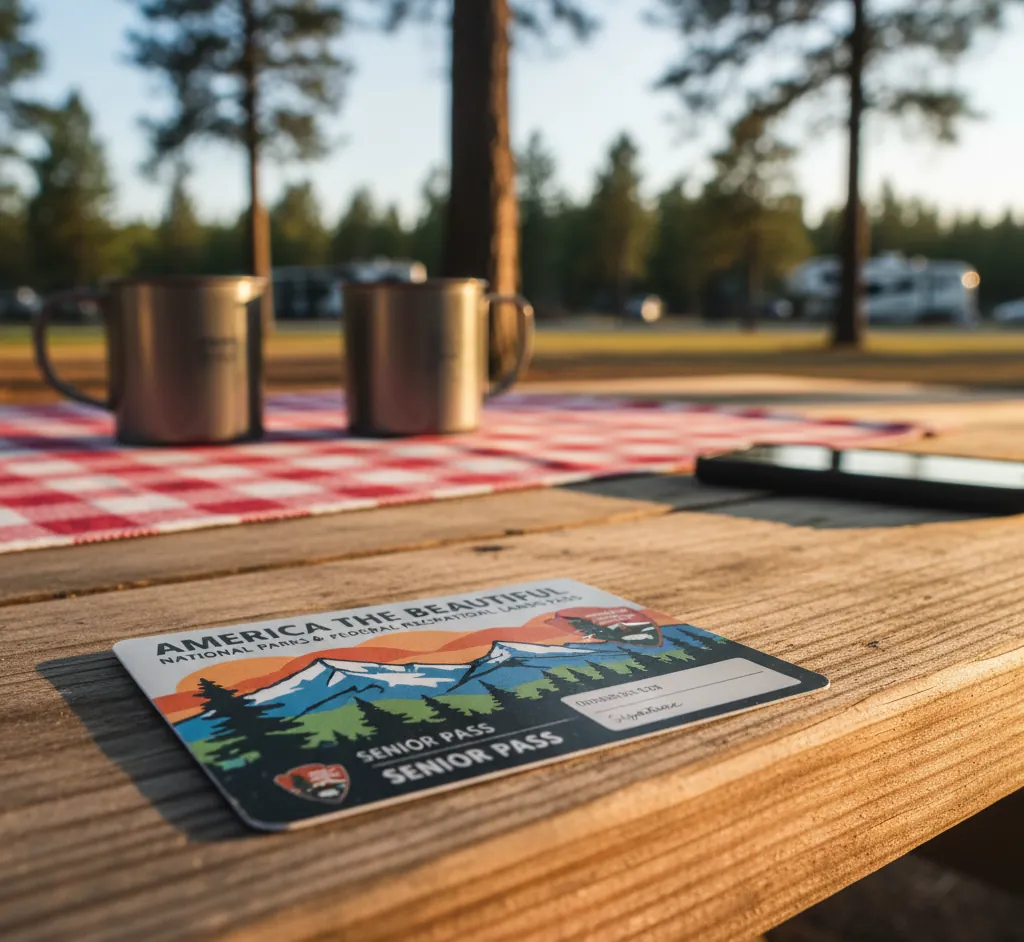
The Senior Pass breaks even in about 7 nights at federal campgrounds. At $80 for a lifetime pass, or $20 a year, it gives free entrance to most federal recreation sites and 50% off camping fees at sites run by six federal agencies. The National Park Service states the Senior Pass “may provide a 50 percent discount on some amenity fees” such as camping. U.S. citizens and residents age 62 and older qualify. The discount does not apply to utility surcharges, cabins, or flat-rate group sites. Prices are current as of September 2026, so verify before buying.
The six agencies that honor the pass for camping discounts:
- National Park Service (NPS)
- U.S. Forest Service (USFS)
- Bureau of Land Management (BLM)
- U.S. Army Corps of Engineers (USACE)
- Bureau of Reclamation
- U.S. Fish and Wildlife Service
The Senior Pass gives 50% off expanded amenity fees at most participating federal sites. Most basic federal sites without hookups run $15 to $30 a night. Using the midpoint, the pass saves roughly $11 a night where it applies, an estimate rather than a guarantee.
Breakeven calculation (illustrative estimate)
Lifetime pass cost: $80
Assumed average savings per night: about $11 (50% off the $22.50 midpoint of a $15 to $30 site fee)
Breakeven: $80 divided by $11.25 equals about 7 nights
Result: at roughly $11 a night, seven or eight qualifying federal nights repays the lifetime pass in full. Your actual breakeven depends on the sites you use and current fees.
Most RVers hit that breakeven in their first season, not over a decade. Every discounted federal night after that is money back for the rest of your camping life.
Common misconception. Many RVers assume the biggest Senior Pass value is free park entrance.
The correction. In real RV use, camping discounts save far more than entrance waivers. A $25 entrance fee waived is a one-time benefit. A 50% cut on a $30 site saves $15 every night you are parked. Run enough nights and the camping discount dwarfs the entrance benefit.
One point that trips people up. The camping discount belongs to the Senior Pass and the Access Pass, not to the free Military or Veterans passes. Recreation.gov notes the standard pass “does not cover expanded amenity fees such as camping”. For the full pass-by-pass breakdown, including the military and veterans rules and Corps of Engineers specifics, see our America the Beautiful pass guide.
What the Senior Pass does not cover
The discount does not apply to:
- Utility surcharges for electricity or sewer billed separately from the site fee
- Cabins, yurts, or lodge rooms
- Group sites billed at a flat rate rather than per night
- State park systems, which run their own separate senior programs
The discount covers the single site you occupy. If you caravan with other rigs, each site needs its own qualifying pass holder to get the discount.
Annual pass or lifetime pass
The $20 annual pass is a fair starting point if your volume is uncertain. The switch to lifetime is simple math:
- Annual pass for 4 years: $20 times 4 equals $80
- Lifetime pass: $80 once
If you plan to camp more than four more seasons, the lifetime pass wins on day one of year five, assuming the annual price holds. Any future price increase moves that crossover sooner. For most RVers over 62, it is an easy call.
Where to buy it
Buy it in person at a participating federal recreation site or office, or order it from the USGS Store. A USGS Store order adds a $5 document processing fee and a $7.50 handling fee, so the lifetime pass costs $92.50 and the annual pass $32.50 delivered. NPS says online orders can take up to three weeks to arrive. A digital version is also available on Recreation.gov. Keep the pass with your registration and show it with photo ID where fees are charged.
If you mostly boondock on free BLM land
The Senior Pass math shifts for full-time boondockers who rarely use developed campgrounds. Where it still pays off:
- Developed federal sites for dump station access, water fill, and laundry
- A few hookup nights to recharge after long off-grid stretches
- Popular parks where dispersed options are limited, crowded, or seasonal
Even five or six discounted nights a year keep the lifetime ROI climbing. For how BLM land and dispersed camping work in practice, our BLM camping guide covers the rules.
RV Membership ROI: AARP, Good Sam, Escapees, Passport America, and AAA
No RV membership pays off unless you camp enough participating nights to beat its annual cost. Real savings per night differ from advertised percentages, because acceptance rates, blackout dates, and eligible-site rules cut into what you collect. AARP costs $20 a year, or $15 the first year with auto-renew, per aarp.org. AARP lists no campground discount, so there is no camping breakeven to run unless a park chooses to honor your card. Canadian travelers see different park lists and should check our Canadian camping membership guide.
Five programs dominate the senior RV conversation, and each fits a different traveler. The table runs the breakeven math on a common basis. Prices were last verified September 2026. Confirm current rates before joining.
| Membership | Annual cost* | Primary benefit | Avg savings/night (real-world) | Breakeven (nights) | Best use case |
|---|---|---|---|---|---|
| AARP | $20 a year, or $15 the first year with auto-renew | No campground discount listed. Hotel, car rental, cruise and flight discounts | None listed for camping | Not applicable for camping | Seniors who also book hotels, rental cars or cruises. Not a camping card |
| AAA | About $65 (varies by region) | 10% campground discount, roadside assistance, travel booking | $5 to $8 (used consistently) | 9 to 13 nights | RVers who need bundled roadside coverage and use travel discounts |
| Escapees RV Club | About $49.95 | 15% to 50% at partner parks, member parks, mail forwarding, community | $10 to $15 | 4 to 5 nights | Full-timers and long-haul RVers who travel 60+ nights a year |
| Good Sam | About $39 | 10% at affiliated parks, fuel discounts, Camping World savings | $4 to $5 (camping only) | 8 to 10 nights | High-mileage RVers who drive often and shop at Camping World |
| Passport America | About $44 to $49 | 50% off participating parks (peak-season and weekend limits apply) | $15 to $20 (when accepted) | 3 to 4 nights | Flexible travelers who camp midweek and off-peak consistently |
| *Prices last verified September 2026. Confirm current rates before joining or renewing: AARP, Good Sam, Escapees, Passport America, AAA. Average savings per night reflects illustrative real-world discounts at parks that accept each membership. Actual savings vary. Assumes a typical $40 to $45 nightly rate. | |||||
AARP: a travel card, not a camping discount
AARP membership costs $20 a year, or $15 the first year with auto-renew. AARP’s travel benefits page lists hotel, car rental, cruise, flight and rail discounts. It does not list a campground or RV park program. KOA says most KOA campgrounds do not offer AARP discounts. Treat AARP as a travel card and ask each park whether it honors it.
Choose AARP when you also book hotels, rental cars or cruises and want the member rates on those.
Skip it as your camping card if your goal is cheaper campsites. Use the Senior Pass for federal sites and a campground program such as KOA Rewards or Good Sam for private parks.
Escapees RV Club: deep discounts for full-timers
Escapees discounts run 15% to 50% off at partner parks, plus member-owned parks with low flat rates. Full-timers who have dropped a fixed address need mail forwarding, and that service alone can cover the membership.
Choose Escapees when you camp more than 60 nights a year, are full-timing or close to it, or need mail forwarding and domicile support.
Skip it as your only card if you camp fewer than 30 nights a year and do not need mail forwarding. The math still works, but the value is thinner.
Good Sam: fuel savings change the math
Good Sam’s camping discount alone, about 10% at affiliated parks, puts breakeven at 8 to 10 nights. That is reasonable, not exceptional. Where it turns into an easy yes is for high-mileage RVers who burn a lot of fuel. A discount of $0.05 to $0.08 a gallon at participating stations adds up. At $0.06 a gallon, 2,000 gallons saves $120, more than triple the membership. At $0.05 a gallon the same mileage saves $100, still twice the fee.
Choose Good Sam when you drive 5,000+ RV miles a year and fuel up at participating chains.
Skip it as your primary card if you move rarely and do not shop at Camping World. The campground-only ROI is middling.
Passport America: fastest breakeven, strictest limits
Passport America’s 50% headline gives it the fastest breakeven at 3 to 4 nights. The catch is peak-season blackouts, weekend limits, and a park network that needs route planning. When the pieces line up, midweek and off-peak at participating parks, the savings are real and large.
Choose Passport America when your travel is genuinely flexible and mostly midweek and off-peak.
Skip it as a core card if most of your camping falls on weekends or in July and August, when blackout dates block the discount.
AAA: roadside first, camping second
AAA pricing varies by region, so the $65 figure is a baseline. At that price, the camping discount needs 9 to 13 participating nights just to cover the fee before you count roadside value. The case for AAA is the bundle: roadside coverage, trip planning, hotel and cruise discounts, and the camping discount together. Bought for campground savings alone, it is hard to justify over AARP.
Choose AAA when you have no separate roadside coverage and you use hotel or travel discounts.
Skip it if your RV or insurance already provides roadside coverage and you want campground-only value. AARP delivers comparable camping discounts at a lower cost.
To keep the framework straight as you read on: the Senior Pass is the near-certain win for federal camping, one low-cost membership matched to your route covers private and chain parks, and state programs fill the gap for regional stays. Everything below is a matter of matching each tool to how you actually travel.
State Park Senior Discounts: The Underused Tool
Dozens of state park systems offer senior camping discounts that rival or beat private membership savings. Unlike the federal Senior Pass, state discounts are set by each state, so eligibility, amounts, and residency rules vary widely and change without notice. State discounts do not stack with the America the Beautiful Senior Pass. Always verify current terms at the official state site before booking. As two examples, Florida State Parks gives Florida residents age 65 and older 50% off the base campsite fee; reservation and utility fees are excluded. West Virginia State Parks provides West Virginia residents age 62 and older a 50% campground reduction during the statutory off-season, while a separate lodging discount may apply from age 60. Confirm current terms before booking.
| State | Age requirement | Discount type | Residency required? | Key restriction | RV infrastructure |
|---|---|---|---|---|---|
| Florida | 65+ | 50% off the base campsite fee | Yes | Florida residency and proof of age required; reservation and utility fees excluded | Excellent, full hookups common |
| Louisiana | 62+ | Significant camping discounts at many parks | Often no | Verify park by park | Good mix of full and partial hookups |
| West Virginia | 62+ camping; 60+ lodging | 50% off-season campground reduction for eligible residents; separate lodging savings may apply | Yes for the statutory camping discount | Camping reduction runs from the day after Labor Day to four days before Memorial Day; verify current booking instructions | Mountain settings, mix of hookups |
| Maryland | 62+ | Low-cost senior passes, plus camping discounts | Often no | One-time pass fees apply in some cases | Good coastal and inland options |
| Georgia | 62+ | Discounted annual passes, plus camping at many parks | Often no | Some purchases must be made in person | Very good, many RV-friendly parks |
| Idaho | 62+ | Significant discounts at select parks and seasons | Often no | May require a special pass | Scenic, hookups available but not universal |
| Arkansas | 62+ | Better discounts Sun to Thu, reduced on weekends | Partial residency rules apply | Discounts vary by night and season | Solid facilities, improving infrastructure |
| Washington | 62+ | Strong off-season senior deals at many parks | Often no | Peak-season availability is limited | Excellent scenery, high demand in summer |
| Pennsylvania | 62+ | Senior discounts at many parks, amount varies | Often no | Check each park’s current policy | Strong mix of lakes, forests, historic sites |
| California | 62+ | Modest per-night discounts against high base rates | Often no | Limited availability in popular parks | World-class locations, competitive reservations |
| Illustrative overview based on publicly available program information, last reviewed September 2026. State policies, residency rules, amounts, and availability change without notice. Verify current terms at the official site before booking: Florida, Louisiana, West Virginia, Maryland, Georgia, Idaho, Arkansas, Washington, Pennsylvania, California. | |||||
The pattern I see in RV communities is consistent. Snowbirds and regional travelers quietly build their whole calendar around a handful of senior-friendly state systems. Florida and Louisiana get the most attention. Maryland, Georgia, and Washington draw seniors willing to travel in shoulder seasons, April into May and September into October, when availability is better and discounts stack with off-peak rates.
If your travel allows 7 to 14 nights in one park at a stretch, state senior discounts can out-earn most private memberships, especially when the locations are ones you would visit anyway and hiking, paddling, and ranger programs come with the site fee.
For extended stays on BLM land at the other end of the spectrum, our LTVA camping guide covers the federal long-term visitor area programs that run parallel to state senior discounts.

Stacking Discounts: Getting Below $30 a Night
Stacking a senior rate, a membership discount, and a weekday rate can cut a $42 site to under $29. Independent parks allow stacking more often than chains or federal campgrounds. The federal Senior Pass rate is not stackable, since the 50% is the final rate and no extra percentage comes off. The move that works is to ask one clear question rather than negotiating each discount.
How the sequence works
At independent private parks, the common stacking order is:
- Senior discount applied to the base nightly rate.
- Membership discount (AARP, Good Sam, or Escapees) applied to the new lower rate.
- Off-season or weekday special layered on top when the park allows it.
Worked example: senior plus membership plus weekday
Base rate (full hookups): $42 a night
Senior discount (10%): $42 times 0.90 equals $37.80
Good Sam (10% on the lower rate): $37.80 times 0.90 equals $34.02
Weekday rate (15% off Sun to Thu): $34.02 times 0.85 equals $28.92
Result: $42 down to $28.92 a night. Savings of $13.08 a night, or $91.56 over 7 nights.
Combinations that usually do not stack
- Passport America plus Good Sam: both are network discounts. Parks pick one program, not both.
- AARP plus AAA at one property: most parks honor one or the other, not both at once.
- Federal Senior Pass plus extra percentages: the 50% federal rate is final. No further percentage applies.
How to ask without making it awkward
The framing I use is one honest question:
“I’m over 62 and I have a Good Sam card. I’ll be staying midweek for several nights. What’s the lowest rate you can offer?”
Park staff know which levers they can pull. If stacking is possible, they will do it. If not, they will say so. No need to negotiate each discount one by one.
Managers are more flexible midweek and in shoulder seasons, April into May and September into October. In July and on holiday weekends, demand removes any reason to discount. At a half-empty park in November or early spring, the math changes.
Worth asking about separately:
- Weekly rates: a flat weekly fee often beats even aggressively stacked daily discounts.
- Monthly rates: parks at $700 to $800 a month can undercut daily stacking for longer stays.
For finding the parks where stacking is most likely, our guide to finding free and low-cost camping covers the tools worth building into pre-trip research.
The Self-Audit: Is Your Membership Actually Paying Off
Every RV membership either pays you back each year or it does not. The breakeven is annual cost divided by real savings per night at parks where the discount is accepted. Real means the actual dollars you got back, not the advertised percentage. Brochure percentages overstate savings, because acceptance rates, blackout dates, and eligible-only-on-select-sites clauses cut what you collect.
Breakeven formula
Breakeven nights equals annual membership cost divided by average real savings per night
Step 1: know your actual camping nights
Most people overestimate. Pull your last 12 months of card statements, highlight every campground charge, and count nights from reservations or trip notes. Weekend campers usually land at 20 to 40 nights a year. Serious part-timers hit 50 to 80. Full-timers can clear 200.
Step 2: track real savings, not brochure percentages
Track 10 to 15 stays. Write down the pre-discount rate and the final charge. Subtract. Average those differences. If a membership advertises 10% but one park gives 10%, another 5%, and a third only on weekdays, your real average might be $4 a night, not the $5 you get from 10% of a $50 rate.
Step 3: run the calculation
Good Sam Standard example (illustrative, verify current price at goodsam.com/club)
Annual cost: $39
Average real savings: 10% of a $50 night, or $5
Breakeven: $39 divided by $5 equals about 8 nights
At 30 qualifying nights a year: 30 times $5 equals $150 saved. Net after the membership: $111 ahead.
Step 4: count the shadow benefits
Some memberships pay off in ways that never hit a campground receipt:
- Good Sam fuel discounts: 2,000 gallons times $0.06 a gallon equals $120 back, triple the membership on fuel alone.
- Escapees mail forwarding: price a comparable commercial service and treat the difference as savings.
- Roadside assistance: one avoided tow can cover years of fees.
Once a year, run this on every active membership and ask one question: knowing what I know now, would I buy this again today? If the answer is no, cancel it. Habit is expensive. A card that made sense at 60 nights a year does not automatically justify renewal at 25.
Membership Traps: When Best on Paper Fails in Practice
Expensive resort-style RV memberships often fail to deliver when your travel style does not match their network. Blackout dates, a footprint concentrated near cities and coasts, and peak-season limits cut real access below the brochure. The pattern is consistent in RV communities. The problem is not the discount, it is a mismatch between the membership’s designed use and how the buyer actually travels.
Three factors account for most disappointments:
- Geography: the network sits in regions you rarely visit, coastal resorts and major metros, while you prefer forests, mountains, or the Southwest.
- Timing: blackout dates block the discount in July, August, and holiday weekends, which is when you camp.
- Style drift: you bought a resort membership and then shifted toward boondocking and state parks, leaving the network irrelevant.
The fix is simple. Start with how you already like to travel, then add memberships and senior discounts that amplify that pattern. Do not buy a membership hoping it will change your behavior. It usually does not, and the math rarely works when you have to force yourself to use it.
Passport America’s 50% headline with peak-season blackouts is the most common version of this trap for seniors. The discount is real when accepted, but if 60% of your camping falls on peak weekends, your effective rate is far below 50%.
Your Senior RV Discount Action Plan
Six steps cover most of what senior RVers need. The order matters: federal pass first, then a low-cost membership, then niche programs matched to your travel. Some discounts start at 55, while the federal Senior Pass and most state programs start at 62. Confirm age thresholds before assuming you qualify.
- Get the America the Beautiful Senior Pass. Buy it in person at a federal site to skip the processing fee. Keep it in the glove box. At $80 for life, it is one of the few one-time RV purchases with near-certain positive ROI. Price is current as of September 2026, so confirm it at store.usgs.gov.
- Add one low-cost membership that matches your route. KOA Rewards ($39 a year) fits frequent KOA stays. Good Sam Standard ($39 a year) fits Good Sam Campgrounds and Pilot Flying J fuel. AARP ($20 a year) adds hotel and travel discounts but lists no campground discount.
- Check state programs for every state where you will spend a week or more. Look for senior passes, off-season deals, and residency rules that help or hurt eligibility.
- Add one or two memberships that match your travel. Escapees for full-timers or near-full-timers. Good Sam if you drive far and fuel at participating chains. Selective Passport America if your schedule is genuinely midweek and off-peak.
- Ask for the lowest rate, not just the discount. One clear question, “I’m over 62 and have [membership], what’s the lowest rate for a midweek stay,” gives the park room to stack what it is allowed to.
- Run the annual self-audit. Every membership either clears breakeven in a normal year or it does not. Cancel what does not. Do not carry dead weight into the next season.
For travelers who camp often at qualifying sites, stack discounts where allowed, and use both federal and state programs, senior discounts can cut an estimated 30% to 50% off annual paid camping. On an illustrative $4,000 campsite budget, that is roughly $1,200 to $2,000 back, enough to fund a trip or two, bring family along, or add a month to a season. Actual savings vary. Casual RVers with fewer nights will see proportionally smaller savings.
Found a combination that works for your rig and style? Share it in the comments below, since more real data makes this page more useful for the next person running the numbers. For our full set of low-cost camping resources, start at the Boondock or Bust resources hub, or the 35-year RVer’s guide to free and cheap campsites for the databases and apps worth having before you book.
Frequently Asked Questions About Senior RV Camping Discounts
At what age do senior discounts start for RV camping?
Most RV camping discounts begin between ages 55 and 62. Many private parks honor AARP-style 55-plus discounts, while the America the Beautiful Senior Pass and most state park systems use 62 as the cutoff. Always confirm age requirements with each park when you book, since thresholds are not always posted clearly online.
Can I combine senior discounts with memberships like Good Sam or AARP?
Often, yes. Many independent campgrounds will stack a senior discount with one membership discount and sometimes an off-season rate. Corporate chains and federal campgrounds tend to be stricter. The most effective ask is: “I’m over 62 and have a membership. What’s the lowest rate you can do?” That frames it as one question instead of a line-by-line negotiation, and it lets the park tell you what they allow.
Does the America the Beautiful Senior Pass work at state parks?
No. The Senior Pass provides entrance and fee discounts at federal recreation lands, including national parks, national forests, and most Corps of Engineers campgrounds. State parks are run by individual states with entirely separate pass systems and senior rules. A handful of states have their own senior passes that are equally valuable within their system, but those are distinct from the federal pass and are not interchangeable with it.
How much can I realistically save each year with senior RV discounts?
It depends on how often you camp and how consistently you use available discounts. A casual RVer camping 25 to 30 nights a year with one or two memberships can save several hundred dollars annually. A heavier traveler who leans on state park discounts, the Senior Pass, and stacked membership deals can reach four figures in a busy year. The self-audit formula in this guide gives you the exact calculation for your own numbers.
Are senior RV discount memberships worth the cost?
They are worth it when you camp enough nights at participating parks to cross the breakeven point. A low-cost membership like AARP can pay for itself in 3 to 5 nights. Higher-priced memberships need more nights or stronger secondary benefits, such as fuel discounts, mail forwarding, or roadside assistance, to be worthwhile. The honest answer comes from running your own numbers once a year using actual nights and real savings per night, not brochure percentages.
Do I always need to show ID to get senior camping discounts?
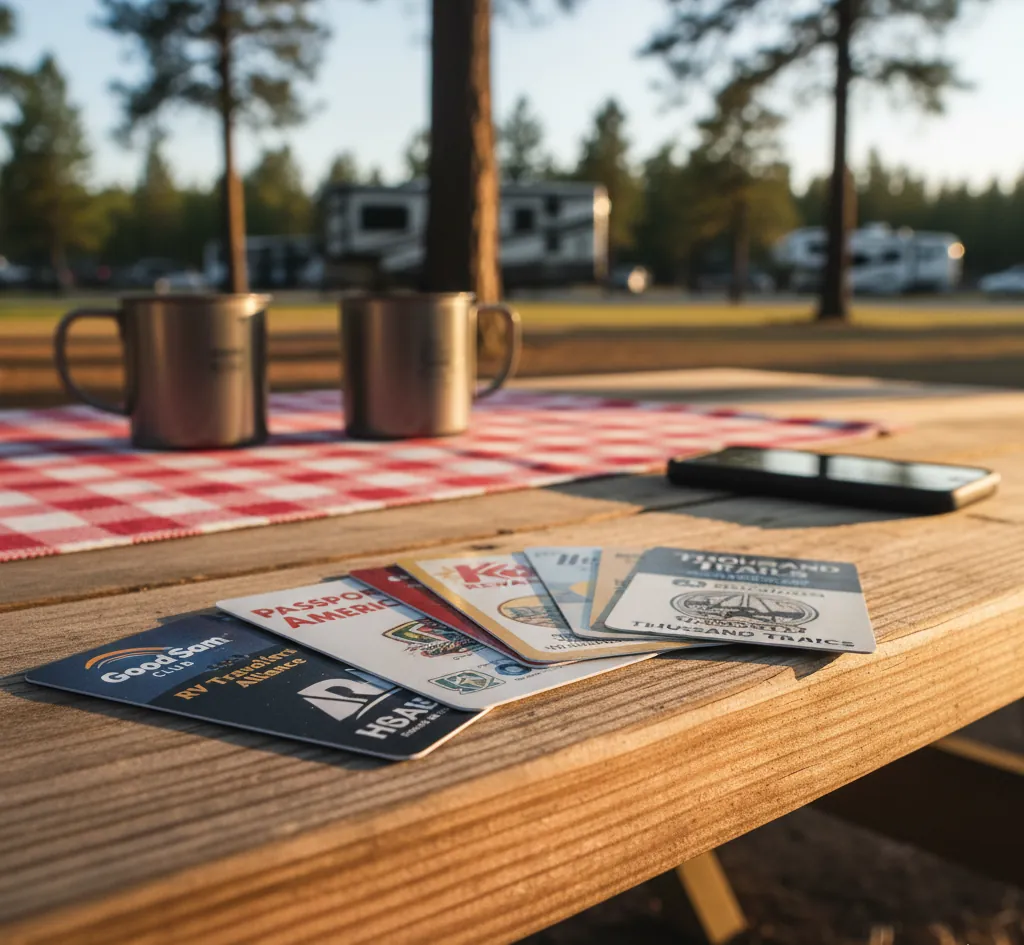
Almost always. Expect to show a driver’s license or other photo ID to prove your age, and present the physical pass or membership card when a discount program is involved. Keeping a small folder in the RV with your senior pass, membership cards, and ID copies makes check-in faster and saves digging through the rig at the registration window.
Is the America the Beautiful Senior Pass still $80 for a lifetime pass?
As of September 2026, the lifetime pass is $80 and the annual pass is $20. Prices are set by Congress under the Federal Lands Recreation Enhancement Act, Public Law 108-447 (2004), and are subject to change. Verify current pricing at store.usgs.gov before purchasing. Buying in person at a federal recreation site avoids the processing fee charged for online orders.
Sources and references
- National Park Service. (2026, January 5). Entrance passes. Retrieved October 4, 2026, from https://www.nps.gov/planyourvisit/passes.htm
- Recreation.gov. Passes. Accessed September 2026. recreation.gov/pass
- U.S. Geological Survey. Recreational passes (America the Beautiful). Accessed September 2026. store.usgs.gov/recreational-passes
- Bureau of Land Management. Camping. Accessed September 2026. blm.gov/programs/recreation/camping
- U.S. Geological Survey. (n.d.). Senior lifetime pass and Senior annual pass [USGS Store]. Retrieved October 4, 2026, from https://store.usgs.gov/lifetime-senior-pass and https://store.usgs.gov/senior-annual
- AARP. (n.d.). AARP membership. Retrieved October 4, 2026, from https://www.aarp.org/membership/
- AARP. (n.d.). AARP travel discounts, deals and benefits for members. Retrieved October 4, 2026, from https://www.aarp.org/membership/benefits/travel/
- Kampgrounds of America. (n.d.). Full list of discounts you can get at KOAs. Retrieved October 4, 2026, from https://koa.com/blog/koa-discounts/
- Kampgrounds of America. (n.d.). KOA Rewards. Retrieved October 4, 2026, from https://koa.com/rewards/
- Good Sam. (n.d.). Good Sam Club membership. Retrieved October 4, 2026, from https://www.goodsam.com/club
- Federal Lands Recreation Enhancement Act, Public Law 108-447 (2004). Governs pass program pricing and eligibility. congress.gov
Membership pricing for AARP, Good Sam, Escapees, Passport America, and AAA was last verified September 2026. Costs and terms change. Verify current rates with each organization before joining or renewing. State park data is illustrative, so verify at each state’s official site before booking.
About the author. Chuck Price has more than 35 years of RV camping and boondocking experience across the United States, including extended travel in a 2018 Hymer Aktiv Class B motorhome. He has been featured on CBC Radio’s Cost of Living discussing full-time RV expenses. He runs Boondock or Bust with his partner Cindy Price.


