
17 Places You Can Still Park Your RV Free in 2026 (Risk-Rated)
Last updated: February 8, 2026
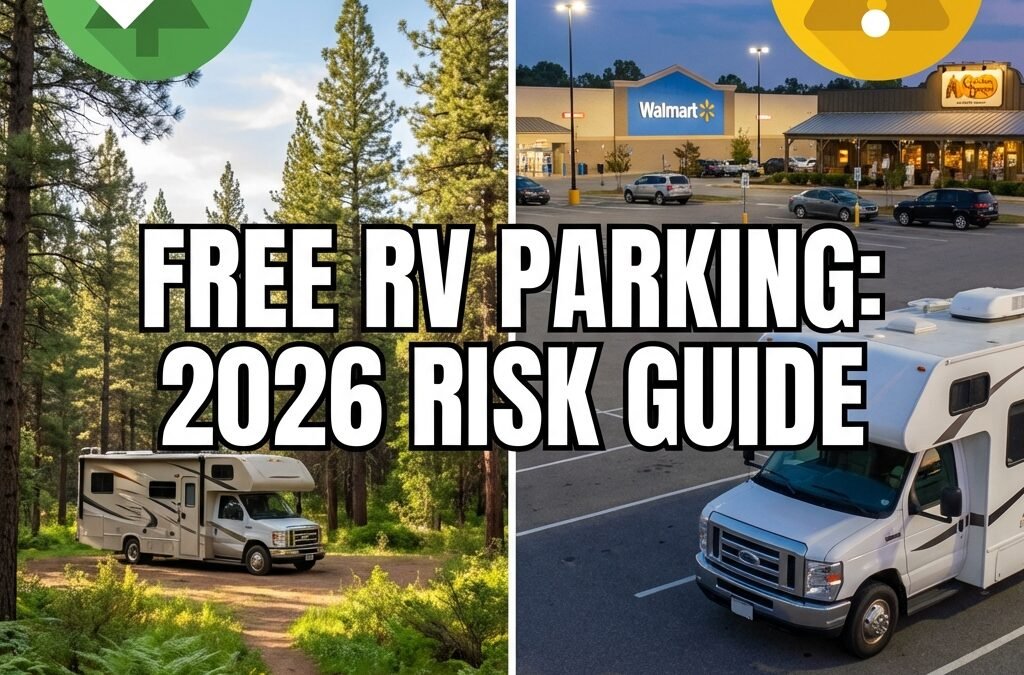
Free RV parking is disappearing fast. Between 2020 and 2025, Walmart reduced RV-friendly locations from approximately 90% to 70% of stores due to municipal restrictions and capacity concerns. BLM tightened dispersed camping rules in high-traffic zones, and rest area enforcement increased in multiple states. This guide identifies 17 verified free parking options still available in 2026, rated by legal risk and accessibility. You can park legally at BLM land (14-day limit), National Forest dispersed sites (14-day limit in most regions), and designated rest areas in states permitting overnight parking. Risk levels range from 🟢 low-risk public lands with explicit authorization to 🔴 high-risk options requiring advance permission. Each location includes current regulations, time restrictions, and verification sources updated for 2026.
Understanding the Risk Rating System
This guide uses a three-tier risk classification system to help you evaluate free RV parking options. Risk assessment considers legal authorization, enforcement patterns, and violation consequences reported by RVers through 2025.
- 🟢 Low Risk: Explicitly legal with federal or state authorization. Examples include BLM dispersed camping sites, National Forest Service areas, and rest areas in states with posted overnight parking rules. Enforcement focuses on compliance with time limits and distance requirements, not removal.
- 🟡 Moderate Risk: Privately allowed but policies vary by location or require advance verification. Walmart, Cracker Barrel, and truck stops fall here because individual store managers control overnight parking decisions. Always call ahead to confirm current policy.
- 🔴 High Risk: No explicit authorization or active enforcement by property owners and law enforcement. Street parking in residential zones, shopping mall lots without permission, and expired time limits at public facilities carry towing and citation risk. Avoid unless you obtain written permission.

1. BLM Land Dispersed Camping 🟢
Bureau of Land Management (BLM) administers 245 million acres of public land across the western United States where dispersed camping is explicitly authorized under the Federal Land Policy and Management Act. You can camp free for 14 consecutive days on most BLM land, with a requirement to move at least 25 miles before returning to the same area. BLM dispersed camping is legal in Arizona, California, Colorado, Idaho, Montana, Nevada, New Mexico, Oregon, Utah, and Wyoming. Sites must be located more than 300 feet from water sources and existing roads unless otherwise posted. Source: BLM Recreation Guidelines.
Popular BLM camping zones include Arizona’s La Posa Long-Term Visitor Areas (permit required October-April, approximately $180-200 for season based on 2025 LTVA pricing), California’s Carrizo Plain National Monument, and Nevada’s Valley of Fire periphery. Some high-traffic BLM areas now require permits during peak season to manage overcrowding. Check the BLM state office website for your destination before arrival to verify current restrictions.
2. National Forest Dispersed Camping 🟢
The U.S. Forest Service manages 193 million acres across 154 National Forests where dispersed camping is permitted under Title 36 Code of Federal Regulations Part 261. Standard stay limit is 14 days per 30-day period, enforced by forest rangers through periodic patrols. You must camp at least 100 feet from water sources and one site-length (typically 50-75 feet) from roads unless parking in a designated dispersed camping site. This rule applies to all National Forests in the continental United States, Alaska, and Puerto Rico. Source: U.S. Forest Service Camping Guidelines.
Notable National Forest dispersed camping areas include Colorado’s Pike National Forest (restricted during fire season May-September), Montana’s Custer Gallatin National Forest, and North Carolina’s Pisgah National Forest. Some forests prohibit dispersed camping during hunting season or implement seasonal closures due to wildlife protection. Always check with the local ranger district office for current conditions and restrictions.
3. Designated Rest Areas (Many States Allow Overnight) 🟢
Interstate rest areas in many states explicitly permit overnight RV parking for periods ranging from 3 to 24 hours, enforced through posted signage at facility entrances. State Departments of Transportation manage rest areas as highway safety facilities where tired drivers can stop to combat fatigue under federal highway safety regulations. Overnight parking policies vary significantly by state. States permitting overnight parking typically post time limits at facility entrances. Source: Federal Highway Administration Rest Area Information.
Time limits vary by state. California permits 8 hours, Texas allows 24 hours, and Ohio restricts parking to 3 hours. Florida prohibits overnight parking (3-hour maximum). Always check posted signage at the specific rest area because states prohibit overnight stays at select high-traffic locations. State highway patrol monitors compliance and may issue warnings or citations for exceeding posted time limits.
4. Walmart Store Parking (Verify Before Parking) 🟡
Walmart corporate policy generally permits overnight RV parking at many locations, but individual store managers have authority to prohibit it based on local ordinances and property considerations. Industry reports and RVer databases suggest approximately 70% of Walmart stores allowed overnight RV parking as of 2025, a decrease from earlier years due to municipal parking restrictions and lot capacity issues. Before parking, call the store manager during business hours to confirm overnight parking is permitted at that specific location. Park away from the store entrance in areas designated for RV or truck parking when available.
Many California and Oregon locations prohibit overnight parking due to state and municipal vehicle dwelling regulations. Use the Walmart Locator RV Parking Database to identify stores with RV-friendly policies reported by the RV community before arrival. Never set up camp chairs, awnings, or grills in Walmart parking lots as this violates corporate policy and may result in towing.
5. Cracker Barrel Restaurants (Most Locations) 🟡
Cracker Barrel corporate policy welcomes overnight RV parking at participating locations. RVer reports suggest a high percentage of stores permit overnight stays as of 2025. Unlike Walmart, Cracker Barrel maintains more consistent policies because most locations are in highway-adjacent zones with fewer municipal restrictions. Call ahead to confirm, especially in California and Oregon where municipal codes may prohibit overnight parking regardless of corporate policy. Park in designated areas away from customer parking and patronize the restaurant when parking overnight as a courtesy. Source: Cracker Barrel Restaurant Locations.
Cracker Barrel typically posts signage at store entrances indicating whether overnight RV parking is permitted. If no signage exists, ask inside before parking. Most locations have designated RV parking sections along the lot perimeter.
6. Cabela’s and Bass Pro Shops 🟡
Outdoor retail chains Cabela’s and Bass Pro Shops have traditionally permitted overnight RV parking at many locations. Policy varies by individual store manager and local ordinance, requiring advance verification before parking. Call the store manager during business hours to confirm current policy. Park in designated areas away from customer parking, typically along the far edges of the lot. Both chains request that RVers limit stays to one night and patronize the store when possible. Source: Individual store verification required (no centralized corporate policy published).
Some urban locations prohibit overnight parking due to municipal codes or property management restrictions. Always confirm before arrival to avoid towing or citations.
7. Truck Stops (TA, Loves, Pilot Flying J) 🟡
National truck stop chains permit RV parking in designated areas, typically separated from commercial truck parking zones. Policies vary by location based on lot capacity and municipal regulations. Travel Centers of America (TA), Love’s Travel Stops, and Pilot Flying J welcome RVers but request you park in automobile or RV designated sections, not truck parking lanes where commercial drivers need space to comply with federal hours-of-service regulations. Most locations permit overnight stays with no time limit, but high-traffic urban truck stops may prohibit overnight parking. Verify policy by calling ahead or checking posted signage at the facility entrance. Source: TA RV Services.
Truck stops provide amenities including restrooms, showers (for fee), dump stations (for fee), and fuel. Park away from diesel pumps and truck idling areas to minimize noise and fumes overnight.
8. Casino Parking Lots (Many Allow Free Overnight) 🟡
Many casinos in Nevada, Arizona, Oklahoma, and other states with tribal gaming properties permit overnight RV parking to attract potential customers. Policies vary by property, with some offering designated RV parking sections and others prohibiting overnight stays due to space limitations. Large destination casinos in Las Vegas, Reno, and tribal properties typically allow overnight parking, while smaller urban casinos may prohibit it. Call the casino security or property management office to confirm policy before parking. Casinos that permit overnight RV parking expect guests to patronize the property, not just use the parking lot. Source: Individual casino verification required.
Casino parking lots are well-lit and monitored by security, providing safer overnight parking compared to isolated public areas. Park in areas designated for oversized vehicles when available, and avoid blocking traffic lanes or taking up multiple spaces.

9. Harvest Hosts Membership Sites 🟢
Harvest Hosts operates a membership network connecting RVers with 5,000+ farms, wineries, breweries, museums, and attractions that offer free overnight parking to members. Annual membership costs $99 for 2026 and includes access to all participating properties. This is not truly “free” parking due to membership cost, but individual stays have no nightly fee. Properties expect guests to purchase products or services during their visit as courtesy reciprocation. Stays are limited to one night per visit with advance reservation required through the Harvest Hosts app or website. Source: Harvest Hosts Official Website.
Harvest Hosts properties do not provide hookups, dump stations, or other RV amenities. This is overnight parking only, not full campground services. Properties suitable for self-contained RVs with onboard fresh water, waste tanks, and power generation.
10. Boondockers Welcome Network 🟢
Boondockers Welcome connects RVers with property owners who offer free overnight parking on private land. Annual membership costs approximately $30-50 for 2026, providing access to 3,000+ host locations across the United States and Canada. Unlike Harvest Hosts, Boondockers Welcome hosts are private individuals sharing driveways, yards, and land parcels, not commercial properties. Some hosts provide water and electric hookups, while others offer dry camping only. Advance reservation required through the Boondockers Welcome platform. Source: Boondockers Welcome Official Website.
Boondockers Welcome operates on reciprocity and community principles. Hosts expect respectful guests who follow property rules, limit stays to agreed duration, and leave no trace. Many hosts become long-term connections for return visits.
11. Church Parking Lots (Ask Permission) 🔴
Some churches permit overnight RV parking on weekdays when lots are unused, but this requires advance permission from church leadership. Church parking is not authorized by default and qualifies as trespassing without explicit consent. Call the church office during business hours to request permission, explaining your need and proposed dates. Be prepared for refusal, as many churches prohibit overnight parking due to liability concerns or insurance restrictions. Never park at a church without permission, as this may result in towing or police contact. Source: Individual church permission required.
Churches that grant permission typically request you park in areas away from main entrances, limit stays to one or two nights, and make a donation to the church as courtesy. Always leave the property cleaner than you found it to maintain good relationships for future RVers.
12. Hotel and Restaurant Parking (24-Hour Establishments) 🔴
24-hour restaurants like Denny’s and IHOP occasionally tolerate overnight RV parking for customers dining at the establishment, but this is not authorized parking and carries towing risk. Hotel parking lots are private property reserved for guests and prohibit unauthorized overnight parking. Some hotels near interstate highways tolerate RV parking overnight, but this varies by property and management policy. Always ask permission from property management before parking. Unauthorized parking in hotel or restaurant lots may result in towing at owner expense, particularly in urban areas. Source: Private property, no legal authorization.
If parking at a 24-hour restaurant, patronize the establishment and inform staff of your presence. Park in areas away from customer parking, preferably along lot perimeters with other RVs if present.
13. Residential Street Parking 🔴
Street parking in residential areas is subject to municipal codes that typically prohibit RVs from parking on public streets for extended periods. Most cities and towns restrict RV street parking to 2-72 hours depending on local ordinance, with some communities banning it entirely. Violations result in parking citations (typically $50-200 based on common municipal fine schedules) and escalating to towing for repeat violations. Never park an RV on residential streets without verifying local ordinances at the city clerk’s office or police department. Source: Municipal code (varies by jurisdiction).
Even in areas where short-term RV street parking is legal, neighborhood complaints may prompt enforcement action. Park with awareness of local sentiment and move before exceeding posted time limits. Better options include campgrounds, private property with permission, or public lands with legal authorization.
14. Army Corps of Engineers Day Use Areas 🔴
U.S. Army Corps of Engineers (USACE) manages 400+ recreation areas across the United States, but overnight parking in day-use areas is prohibited unless explicitly authorized by posted signage. Most USACE facilities require camping in designated campgrounds with fees ranging from $20-40 per night. Some USACE properties permit overnight parking at boat launch areas or day-use lots during non-peak seasons, but this requires verification with the local project office before parking. Unauthorized overnight parking violates 36 CFR 327.14 and may result in citations. Source: USACE Recreation Policies.
USACE campgrounds provide amenities including hookups, dump stations, and restrooms at rates competitive with private campgrounds. If you plan to stay at USACE facilities, budget for campground fees rather than attempting unauthorized overnight parking in day-use areas.
15. Business Parking Lots (Grocery, Shopping Centers) 🔴
Shopping centers, grocery stores (except specific chain policies like Walmart), and business parking lots prohibit overnight RV parking unless explicitly authorized by property management. Private parking lots are monitored by security and towing companies that remove unauthorized vehicles. Some businesses permit overnight parking for customers, but this requires advance permission from store management. Parking without authorization constitutes trespassing and may result in towing, police contact, and trespass warnings. Source: Private property, no legal authorization.
If you need to park at a business overnight due to emergency or vehicle breakdown, contact property management immediately to request permission and explain the situation. Most businesses accommodate emergency situations with advance notice but prohibit routine overnight parking.
16. Park-and-Ride Lots (Some 24-Hour Facilities) 🟡
State and local transportation authorities operate park-and-ride facilities where commuters leave vehicles while using public transit. Some park-and-ride lots operate 24 hours and tolerate overnight RV parking for one night, while others prohibit overnight parking through posted signage and active enforcement. Policies vary by state and individual facility. Check posted signage at the lot entrance for overnight parking restrictions. If no signage prohibits it and the lot operates 24 hours, overnight parking may be tolerated. However, this is not explicit authorization and carries moderate towing risk. Source: State/local transportation authority (varies by location).
Park-and-ride lots provide no amenities and are designed for vehicle storage only. Use only for emergency overnight stops, not routine free camping. Many park-and-ride facilities have security cameras and regular patrols by law enforcement.
17. Racetracks and Fairgrounds (Event-Dependent) 🟡
Racetracks, county fairgrounds, and event venues occasionally permit overnight RV parking outside scheduled events, particularly for large RVs that support event attendance. Policies are property-specific and event-dependent. Some facilities welcome RVers outside event dates, while others prohibit parking year-round except during scheduled events. Call the facility office to inquire about overnight parking policies and any associated fees. Source: Individual facility verification required.
During events, fairgrounds and racetracks typically charge camping fees ranging from $30-60 per night. Outside events, some facilities permit free overnight parking for one or two nights as a courtesy to travelers, but this is discretionary and subject to change.
Quick Reference: Overnight RV Parking by State
The following table summarizes overnight RV parking rules at interstate rest areas by state. Laws change frequently, so verify current regulations with state transportation authorities before relying on this information.
| State | Rest Area Overnight Parking | Time Limit |
|---|---|---|
| Alabama | Permitted | Check posted signage |
| Arizona | Permitted | Check posted signage |
| California | Permitted | 8 hours maximum |
| Colorado | Permitted | Check posted signage |
| Florida | Prohibited | 3 hours maximum |
| Georgia | Varies by location | Check posted signage |
| Illinois | Permitted | Check posted signage |
| New York | Prohibited | 4 hours maximum |
| Ohio | Permitted | 3 hours maximum |
| Texas | Permitted | 24 hours maximum |
| Washington | Permitted | 8 hours maximum |
Note: This table covers 11 of 50 states as examples. State rest area policies change frequently. Always check posted signage at the specific rest area for current time limits and restrictions. Contact state Department of Transportation for official policy information.
Decision Framework: Choosing the Right Free Parking Option
Use this framework to match parking options to your specific needs and risk tolerance.
If You Need Multi-Night Stays
Best Options: BLM land (14 days), National Forest dispersed camping (14 days), Harvest Hosts rotation (1 night per property, unlimited properties). Avoid: Rest areas (3-24 hour limits vary by state), Walmart (1 night courtesy), truck stops (may have multi-night restrictions).
If You Need Hookups (Water/Electric)
Best Options: Select Boondockers Welcome hosts (verify amenities before arrival), fairgrounds outside event dates (call ahead). Avoid: BLM land (no hookups), National Forests (no hookups), rest areas (no hookups). Reality Check: Free parking rarely includes hookups. Budget for occasional campground stays with full amenities.
If You’re Crossing Multiple States
Best Options: Rest areas (check state-by-state rules in table above), truck stops (consistent policies nationwide), Walmart (call ahead at each location). Avoid: State-specific options like BLM land (limited to western states), National Forests (not interstate-adjacent).
If You Need Urban Overnight Parking
Best Options: Walmart (if permitted in that city), Cracker Barrel (highway locations), casino parking (Las Vegas, regional casinos). Avoid: Residential street parking (municipal codes restrict RVs), shopping centers (active towing), business parking lots (no authorization). Reality: Urban free parking is increasingly difficult due to municipal codes. Budget for urban campgrounds or park outside city limits.
If You Need Stealth Overnight Parking
Best Options: 24-hour business parking with permission, park-and-ride lots without posted restrictions, residential driveways with homeowner permission. Avoid: Anything in 🔴 high-risk category without explicit permission. Caution: “Stealth camping” in urban areas risks towing and citations. Better to ask permission or pay for authorized parking.

Frequently Asked Questions (FAQ)
Can you sleep at rest stops overnight?
Overnight sleeping at rest stops is permitted in many states but prohibited in others. States that permit overnight parking typically allow 3-24 hours depending on posted time limits. Florida, New York, and several other states prohibit overnight rest area parking, limiting stays to 2-4 hours. Check posted signage at the specific rest area for time limits because rules vary by state and individual facility. Source: State Department of Transportation rest area policies and posted facility signage.
Is it legal to park an RV at Walmart overnight?
Walmart corporate policy generally permits overnight RV parking, but individual store managers can prohibit it based on local ordinances and property management decisions. Before parking, call the specific store manager to confirm current policy. Many locations in California and Oregon prohibit overnight RV parking due to state and municipal vehicle dwelling regulations. Always verify policy at your intended location. Source: Walmart corporate policy and local store management.
How long can you stay on BLM land for free?
You can camp free on most BLM land for 14 consecutive days, after which you must move at least 25 miles before returning to the same area under standard BLM dispersed camping rules. Some BLM Long-Term Visitor Areas (LTVAs) in Arizona and California permit stays up to 7 months with a seasonal permit (approximately $180-200 based on 2025 LTVA pricing). BLM camping is legal in western states including Arizona, California, Colorado, Idaho, Montana, Nevada, New Mexico, Oregon, Utah, and Wyoming. Source: Bureau of Land Management dispersed camping regulations.
What states prohibit sleeping in your car at rest areas?
States prohibiting overnight sleeping at rest areas include Florida (3-hour maximum), New York (4-hour maximum), Virginia (2-hour maximum at some facilities), North Carolina (4-hour maximum for cars), South Carolina (90-minute maximum at some facilities), Massachusetts (4-hour maximum), and Connecticut (commercial vehicle restrictions). Posted time limits at facility entrances indicate whether overnight sleeping is prohibited. States with no posted time limits or limits exceeding 8 hours generally permit overnight rest area sleeping. Source: State rest area signage and Department of Transportation policies.
Are truck stops safe for overnight RV parking?
Major truck stop chains (TA, Love’s, Pilot Flying J) are generally safe for overnight RV parking due to 24-hour lighting, security cameras, and high traffic volume. Park in designated RV or automobile sections away from truck parking lanes where commercial trucks idle overnight. Truck stops provide restrooms, food service, and security presence that make them safer than isolated parking areas. However, theft from unattended RVs can occur at any public parking facility. Lock doors and windows, secure valuables inside, and maintain awareness of surroundings. Source: Truck stop security practices and RVer community safety reports.
Can you camp for free in National Forests?
You can camp free in National Forests through dispersed camping at sites located at least 100 feet from water sources and one site-length from roads. Standard stay limit is 14 days per 30-day period. Dispersed camping is permitted in 154 National Forests across the United States except where prohibited by posted signage due to fire danger, wildlife protection, or resource damage. Some forests require permits during peak seasons. Always check with the local ranger district office for current regulations before camping. Source: U.S. Forest Service dispersed camping regulations (36 CFR 261).
Do casinos allow free RV parking?
Many casinos permit free overnight RV parking to attract customers, but policies vary by property. Large destination casinos in Nevada, Arizona, Oklahoma, and tribal gaming properties commonly allow overnight parking in designated areas. Smaller urban casinos may prohibit overnight parking due to space constraints. Casinos that permit RV parking expect guests to patronize the property, not just use parking. Call casino security or property management before parking to confirm current policy. Source: Individual casino policies (no universal standard exists).
What is the penalty for illegal RV parking?
Penalties for illegal RV parking include parking citations (typically $50-200 based on common municipal fine schedules), towing fees ($150-500 plus daily storage fees), and trespass warnings that prohibit return to the property. Municipal codes typically impose escalating penalties for repeat violations. In extreme cases, illegal RV parking in areas with explicit prohibitions can result in misdemeanor charges. Private property owners can request immediate towing of unauthorized vehicles. Always verify parking authorization before leaving your RV unattended to avoid these penalties. Source: Municipal codes and private property law (varies by jurisdiction).
Can you park an RV on residential streets?
Most cities and towns prohibit or severely restrict RV parking on residential streets through municipal codes. Time limits range from 2 hours to 72 hours, with many communities banning street-parked RVs entirely. Parking violations result in citations (typically $50-200 based on common municipal schedules) and escalating to towing for repeat offenses. Some municipalities prohibit RV street parking but allow it in residential driveways. Always check municipal codes at the city clerk’s office or police department before parking an RV on residential streets. Source: Municipal vehicle parking codes (varies by city).
Are Harvest Hosts and Boondockers Welcome worth the membership cost?
Harvest Hosts ($99/year) and Boondockers Welcome ($30-50/year) provide value if you camp overnight more than 2-3 times per month during travel season. Break-even analysis: Harvest Hosts requires 3-4 nights per year to match typical campground costs (approximately $30/night average), while Boondockers Welcome breaks even after 1-2 nights. Both services offer unique experiences (farms, wineries, private properties) beyond basic parking. However, neither provides hookups or traditional campground amenities. Best for self-contained RVers who prioritize location variety over amenities. Source: Membership pricing and RVer cost-benefit analysis.
Resources and Verification Sources
- Bureau of Land Management Official Website – BLM dispersed camping regulations, maps, and contact information for state offices
- U.S. Forest Service Official Website – National Forest camping regulations, ranger district contact information, and seasonal restrictions
- Federal Highway Administration Rest Areas – State-by-state rest area policies and overnight parking regulations
- Walmart RV Parking Locator – Community-sourced database of Walmart stores with RV parking policies reported by travelers
- Harvest Hosts Official Website – Membership information, property search, and reservation system
- Boondockers Welcome Official Website – Host network, membership pricing, and community guidelines
- RV Parky – Comprehensive RV parking and campground database with user reviews
- Allstays Camp & RV – Subscription app with nationwide RV parking options including free and low-cost sites
Responsible Free Parking Practices
Free RV parking depends on RVer responsibility and respect for property, environment, and local communities. Follow these practices to preserve free parking access for future travelers.
Leave No Trace Principles
Pack out all trash, food scraps, and waste. Never dump gray water or black water on public land or in parking lots. Use designated dump stations. Leave the parking area cleaner than you found it. Bury human waste in cat holes 6-8 inches deep and 200 feet from water sources if camping on dispersed public land without facilities.
Respect Time Limits
Comply with posted time limits at rest areas, parking lots, and public lands. Exceeding time limits leads to enforcement actions that result in parking bans and loss of free access for all RVers. Move before time limits expire, even if enforcement appears lax.
Support Businesses When Using Their Parking
When parking overnight at Walmart, Cracker Barrel, truck stops, or other businesses, patronize the establishment by purchasing fuel, food, or products. Businesses tolerate overnight RV parking as a customer service, not a right. Supporting these businesses helps maintain their RV-friendly policies.
Be a Good Neighbor
Park in designated areas away from customer parking and building entrances. Avoid blocking traffic lanes or taking multiple spaces. Keep noise to minimum during evening and early morning hours. Never set up camp chairs, awnings, grills, or other camping equipment in business parking lots. Maintain a low profile to avoid complaints that lead to policy changes.
Verify Local Ordinances
Municipal codes and property rules change frequently. Always verify current regulations before parking, even at locations where you parked successfully in the past. Call ahead, check posted signage, or consult local authorities to confirm overnight parking is still permitted.
Conclusion: Free RV Parking Requires Planning and Flexibility
Free RV parking remains available across the United States through public lands, business parking, and membership networks, but access is tightening due to increased RV travel, municipal restrictions, and property management policies. Success requires advance research, willingness to verify policies location-by-location, and understanding of legal risk levels. Prioritize 🟢 low-risk options like BLM land and National Forest dispersed camping for multi-night stays. Use 🟡 moderate-risk options like Walmart and truck stops for single-night interstate travel. Avoid 🔴 high-risk unauthorized parking that puts you at risk of towing, citations, and legal trouble.
Download the Free Parking Location Log above to build your personal database of successful free parking locations. Document what works, share information with the RV community, and adapt your travel plans as policies evolve. Free RV parking depends on responsible behavior and mutual respect between RVers, property owners, and public land managers. Follow Leave No Trace principles, support businesses that welcome RVers, and comply with posted regulations to preserve free parking access for future travelers.


