
Choosing the Right RV Rental: A 2026 Guide to Real Costs and Reliability

By Chuck Price, Founder of Boondock or Bust | Last updated: February 5, 2026 | 10 min read
About the author: Chuck Price has been RV camping for 35+ years across 47 states and currently travels full-time in a 2018 Hymer Aktiv Class B van. He founded Boondock or Bust to provide evidence-based RV research and has been featured on CBC Radio’s “Cost of Living” podcast for expertise in RV travel economics.
Bottom line: Total RV rental cost runs 20-60% higher than advertised nightly rates once you add mileage, generator use, insurance, and cleaning fees. For a 7-day trip covering 1,500 miles, expect $2,900-$5,100 depending on vehicle class and camping choices.
Quick Reference: Decision Criteria
- Top Filter: Budget capacity eliminates 70% of options (calculate all-in cost first)
- Second Filter: Group size eliminates 40% (count actual sleeping spots, not marketing claims)
- Path Split: First-timers → fleet companies (Cruise America) | Budget hunters → peer-to-peer with vetting (RVshare, Outdoorsy)
- Deal-Breaker: Liability under $1M, deductible over $3,000, hosts with under 10 reviews and ratings below 4.5
- Transparency Test: If provider won’t give itemized quote within 24 hours, eliminate them
Who This Guide Is For
Best fit if you:
- Need to compare fleet companies vs peer-to-peer platforms with real cost examples
- Want measurable criteria to eliminate bad options fast (not just feature lists)
- Need verification checklist to avoid hidden fees and policy surprises
- Have 7-14 days for trip planning (requires quote requests and vetting)
Not ideal if:
- You need to book within 48 hours (insufficient vetting time)
- You only want luxury RV recommendations (this covers all segments)
- You’re looking for specific route planning (this focuses on provider selection)
Why RV Rental Pricing Is Deliberately Confusing
RV rental marketing emphasizes nightly rates ($75-$350) while major cost drivers stay buried in fine print. The U.S. RV rental market reached approximately $942.6M in 2025 according to IBISWorld, growing as travelers embrace outdoor road trips. But advertised rates represent only 35-50% of final cost.
The four major cost drivers that turn “$150/night” into “$3,700 total” (as of February 2026):
- Mileage charges ($0.35-$0.50/mile at most companies): 1,500-mile trip = $525-$750 added cost
- Generator fees ($3-$4/hour): 40 hours over one week = $120-$160 if camping without hookups
- Insurance/protection plans ($35-$60/night): $245-$420 for 7 days, often mandatory
- Cleaning and prep kits ($75-$250 flat fee): One-time charge at pickup or return
Traditional fleet companies (like Cruise America) offer standardization and predictable support at 20-30% higher base cost. Peer-to-peer platforms (like Outdoorsy, RVshare) offer variety and competitive pricing with more variance between individual listings.
This guide uses verified fee examples from company websites (checked February 2026) to help you calculate realistic budgets, identify deal-breakers upfront, and verify terms before booking.
We compare fleet vs peer-to-peer trade-offs, outline deal-breaker thresholds with measurable criteria, provide red flags and green flags for vetting providers, and give you a pre-trip verification checklist.
The Financial Reality: What RV Rentals Actually Cost
Rule of thumb: Total trip cost typically runs 20-60% above the advertised nightly rate once you add mileage, generator, insurance, and cleaning. The exact uplift varies with route length, pickup location, and season.
Mileage charges commonly run $0.35-$0.50/mile as of February 2026. Cruise America currently charges $0.38/mile (verified February 2026). Generator use typically costs $3-$4/hour at fleet companies. Peer-to-peer listings set their own policies.
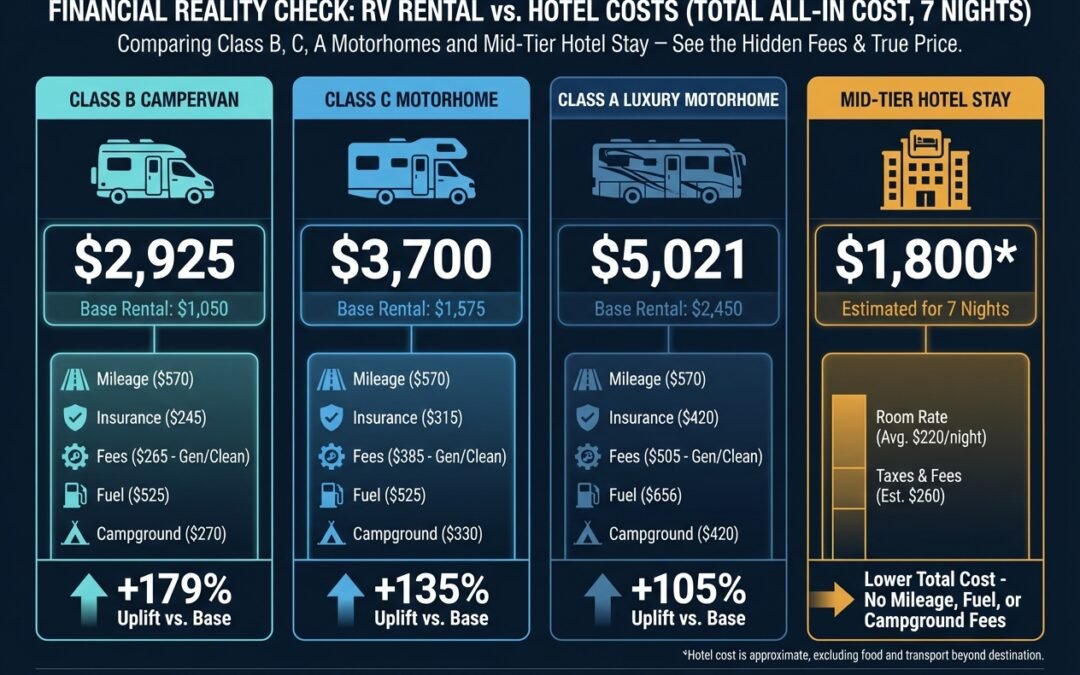
All-In Cost Breakdown: 7-Day Example (1,500 Miles)
Methodology: This example uses published fee ranges from Cruise America’s website (verified February 2026) and transparent assumptions. Your actual quote will vary based on dates, location, and route.
Assumptions: 1,500 miles total, fuel at $3.50/gallon, fuel economy of 10 mpg for Class B/C and 8 mpg for Class A, 6 campground nights with full hookups.
| Cost Category | Class B Campervan | Class C Motorhome | Class A Luxury |
|---|---|---|---|
| Base Rental (7 nights) | $1,050 | $1,575 | $2,450 |
| Mileage (1,500 miles @ $0.38/mi) | $570 | $570 | $570 |
| Insurance/Protection (typical range) | $245 | $315 | $420 |
| Generator/Amenity Fees (example) | $140 | $210 | $280 |
| Cleaning/Prep Fees (typical) | $125 | $175 | $225 |
| Subtotal: RV Costs | $2,130 | $2,845 | $3,945 |
| Fuel Costs (estimated) | $525 | $525 | $656 |
| Campground Fees (6 nights avg $45-$70) | $270 | $330 | $420 |
| TOTAL ALL-IN COST | $2,925 | $3,700 | $5,021 |
| Uplift vs base rate | +179% | +135% | +105% |
Important: This example represents a moderate-to-high uplift scenario. Actual costs vary based on: included miles in your rental (some include 100-150 miles/day), generator usage (zero if using hookup campsites), and seasonal pricing. Fee examples reference Cruise America’s published rates as of February 2026 (generator $3.50/hour, mileage $0.38/mile). Fuel calculation: Class B/C at 10 mpg = 150 gallons × $3.50 = $525; Class A at 8 mpg = 187.5 gallons × $3.50 = $656. Peer-to-peer listings set their own policies. Always request itemized quote for your specific dates and route.
The Hotel Alternative: When Hotels Cost Less
For short trips with couples, hotels often cost 30-40% less than RVs. A 7-night mid-tier hotel stay averages $1,750-$3,500 ($250-$500/night for comparable comfort).
RVs make more financial sense for:
- Groups of 4+: Hotel costs scale linearly with occupancy; RV costs plateau
- Trips over 10 days: Per-day cost advantage compounds over time
- Destinations without hotel supply: National parks, remote areas
- Flexibility value: Dispersed camping, ability to cook meals, no checkout times

The value proposition includes access and experience, not just nightly accommodation savings. For couples on 3-5 day urban trips, hotels typically deliver better value.
How to Choose the Right RV Rental: Decision Framework
The key to choosing well is eliminating bad options fast. Apply criteria in order of elimination power, not alphabetically or by popularity.
Criteria Hierarchy: Ranked by Filtering Power
These factors are ordered by how many options they eliminate. Apply in sequence to narrow choices efficiently.
- Budget Capacity (eliminates ~70% of options)
- What it measures: Your total trip cost tolerance, not just nightly rate
- How to verify: Calculate all-in cost using the table above for your specific route, dates, and vehicle class
- Why it’s first: Immediately rules out vehicle classes and premium listings outside your range
- Threshold: Eliminate options where total cost exceeds your maximum by more than 10%
- Group Size Requirements (eliminates ~40% of remaining options)
- What it measures: Number of travelers plus sleeping arrangements needed
- How to verify: Count actual sleeping spots in floor plan diagrams (not marketing capacity claims)
- Why it’s second: Determines vehicle class before other factors matter
- Threshold: Eliminate if vehicle sleeps fewer people than your party size
- Support and Predictability Needs (eliminates ~50% of remaining options)
- What it measures: Your risk tolerance for owner variance vs corporate consistency
- How to verify: Assess your RV experience level and comfort with troubleshooting on the road
- Why it’s third: Splits decision between traditional fleet vs peer-to-peer platforms
- Threshold: First-timers and high-anxiety travelers should eliminate peer-to-peer; experienced and budget-conscious should eliminate fleet
- Location Coverage (eliminates ~30% of remaining options)
- What it measures: Pickup and return locations available for your route
- How to verify: Check company location maps against your departure city
- Why it’s fourth: Geographic availability constraint
- Threshold: Eliminate if nearest pickup is more than 2 hours travel from your starting location
- Vehicle Amenities (refinement factor, not elimination)
- What it measures: Luxury features vs basic functionality
- How to verify: Review floor plans, appliances, vehicle age, and interior condition
- Why it’s last: Preference optimization after hard constraints are satisfied

Fleet Companies vs Peer-to-Peer: The Trade-offs
Market context: The U.S. RV rental market reached approximately $942.6M in 2025, up from $833.4M in 2024 according to IBISWorld. Precise market share splits between fleet and peer-to-peer aren’t publicly standardized, so avoid unverified share claims.
Traditional Fleet Companies: Standardization vs Premium Pricing
Fleet operators like Cruise America offer standardized vehicles, corporate roadside support, in-person orientation, and broad pickup networks. Cruise America operates 130+ locations nationwide (verified February 2026).
Advantages:
- Predictable processes and vehicle condition
- Corporate roadside support with 24/7 access
- In-person orientation and walkthrough
- Vehicle substitution if mechanical problems arise
- Standardized insurance and liability coverage
Trade-offs:
- Base costs typically 20-30% higher than peer-to-peer
- Utilitarian interiors (basic functionality, not luxury)
- Seasonal price spikes during summer and holidays
- Limited vehicle variety (standard floor plans only)
Best fit for: First-time renters, high-anxiety travelers, those who value predictability over customization, anyone uncomfortable with owner-dependent support.
Peer-to-Peer Platforms: Variety vs Variance
Marketplaces like Outdoorsy and RVshare provide inventory variety, geographic coverage, and competitive base rates. As of early 2026, combined peer-to-peer inventory across major platforms exceeds 250,000 active listings in North America.
Advantages:
- Base rates typically 20-40% lower than fleet companies
- Luxury vehicles and specialized rigs unavailable from fleets
- Broader geographic coverage (including remote areas)
- Flexible policies (some hosts include miles, waive cleaning fees)
Trade-offs:
- Quality varies significantly by owner and listing
- Cancellations and damage disputes involve owner, platform, and insurer
- Vehicle condition and maintenance depend on owner diligence
- Policies and add-ons differ by listing (requires careful reading)
- Orientation typically via video or owner meeting (not standardized)
Best fit for: Budget-conscious travelers willing to vet carefully, luxury seekers wanting high-end interiors, those needing specialized vehicles (off-road capable, toy haulers), experienced RVers comfortable with variance.
Insurance and Liability: What to Verify
| Coverage Factor | Traditional Fleet | Peer-to-Peer Platform |
|---|---|---|
| Liability Coverage | Typically included; limits vary by company | Up to ~$1M on major platforms (plan-dependent) |
| Comprehensive/Collision | Fleet policies vary by company | Up to ~$300k typical (plan-dependent) |
| Deductible Range | $500-$2,500 typical | $500-$3,000 typical (higher in 2026) |
| Dispute Process | Direct with company | Owner + platform + insurer coordination |
| Personal Property | Often limited or excluded | Often limited or excluded |
| Mechanical Breakdowns | Fleet roadside/support programs | Varies by host and plan; verify upfront |
| Vehicle Substitution | Often available if problems arise | Depends on owner and platform policy |
Critical: Coverage limits, deductibles, and remedies differ by company, listing, jurisdiction, and plan tier. Always review actual policy documents, not marketing summaries. Call your personal auto insurer to confirm what they cover or exclude for RV rentals.
Deal-Breakers: Thresholds That Eliminate Options Immediately
These are absolute disqualifiers with specific, measurable thresholds. If an option fails any of these tests, eliminate it immediately.
1. Budget Capacity Mismatch
Threshold: Total trip cost exceeds your maximum spend by more than 10%
Why it eliminates: Financial stress ruins the experience; unexpected overages create anxiety mid-trip
Verification test: Use the cost breakdown table above with your actual route miles and camping nights. Add 15% buffer for unforeseen expenses (toll roads, extra generator use, campground upgrades).
2. No Local Pickup Location
Threshold: Nearest pickup point is more than 2 hours travel from your starting location
Why it eliminates: Adds transportation costs, time, and complexity to trip start and end; may require overnight hotel before/after rental
Verification test: Check company location map against your ZIP code or departure city. Factor in airport transfer time if flying.
3. Sleeping Capacity Mismatch
Threshold: Vehicle sleeps fewer people than your party size (count actual sleeping spots, not marketing claims)
Why it eliminates: Comfort and safety issue; sleeping arrangements can’t be improvised safely
Verification test: Review floor plan diagrams and count: beds, convertible dinettes, overhead bunks, and fold-out sofas. Verify weight capacity if using overhead bunks for adults.
4. Insurance and Deductible Gap
Threshold: Liability coverage less than $1M aggregate OR comprehensive/collision coverage less than RV stated value OR deductible exceeding $3,000
Why it eliminates: Financial exposure exceeds acceptable risk for most travelers; 2026 peer-to-peer deductibles have increased industry-wide
Verification test: Read actual policy documents (not summaries). Request written confirmation of coverage limits and deductible amounts. Call your personal auto insurer to verify what they cover.
5. Insufficient Host Reputation (Peer-to-Peer Only)
Threshold: Fewer than 10 reviews OR average rating below 4.5 stars OR no response to inquiry within 24 hours
Why it eliminates: Insufficient track record creates unacceptable quality variance; slow response predicts poor support during trip
Verification test: Check platform reviews, send inquiry message testing response time and detail level. Read negative reviews specifically for patterns (hidden fees, condition issues, support problems).
Deal-Breaker Application Example
Scenario: You’re a family of 4 with $4,500 total budget planning a 7-day trip covering 2,000 miles.
Apply filters in sequence:
- Calculate all-in cost for Class C: $1,575 base + $760 mileage (2,000 × $0.38) + $315 insurance + $210 generator + $175 cleaning + $525 fuel + $330 camping = $3,890 total. Within budget threshold ($4,500 + 10% = $4,950 max). ✓ Continue
- Check sleeping capacity: Class C sleeps 6. Party size is 4. ✓ Continue
- Verify pickup location: Cruise America location 45 minutes from home. ✓ Continue
- Check insurance: $1M liability included, deductible $1,500. ✓ Continue
- Proceed to red/green flag screening.
Company Analysis: What to Verify Before Booking
Peer-to-Peer Platform Leaders
Outdoorsy
Large marketplace covering North America and international locations. Protection pages cite up to ~$1M liability and up to ~$300k comprehensive/collision (plan-dependent; verify your specific coverage tier before booking). Quality varies significantly by listing.
BBB rating: A+ as of February 2026 (ratings can change; verify current status at bbb.org before booking)
Best for: Travelers seeking variety and geographic coverage, those wanting mid-to-high-end inventory
Verify before booking: Host reviews (15+ minimum with 4.8+ rating), included miles, generator policy, cancellation terms, breakdown procedures
RVshare
High-volume peer-to-peer platform. Protection pages describe up to ~$1M liability and up to ~$300k comprehensive/collision (plan-dependent; verify your specific tier). Customer experience depends heavily on individual host and listing quality.
Best for: Budget-conscious travelers willing to vet hosts thoroughly, those seeking competitive pricing
Verify before booking: Host response time (under 24 hours), itemized fee breakdown, mileage policy, insurance deductible, roadside assistance specifics
Traditional Fleet Example
Cruise America
Founded in 1972 with 130+ locations nationwide. Public pages show generator use at $3.50/hour and mileage charges at $0.38/mile (rates verified February 2026; confirm current pricing in your quote).
Strengths: Predictability, in-person orientation, corporate roadside support, ability to swap vehicles if problems arise
Trade-offs: Higher base pricing (20-30% above peer-to-peer), utilitarian interiors, seasonal price swings
Best for: First-time renters, travelers who value predictable processes over customization
Verify before booking: Total cost with mileage and generator estimates for your route, insurance deductible, cancellation policy, pickup/return hours and location
Red Flags and Green Flags: Quality Verification
Use these observable, verifiable criteria to screen companies and hosts. Red flags eliminate options; green flags confirm quality probability.

Red Flags: Warning Signs to Eliminate Options
- Host/Company: Under 10 reviews OR rating below 4.5 stars
- Verification method: Check BBB (bbb.org), Google reviews, platform reviews (RVshare, Outdoorsy)
- Why it matters: Insufficient sample size or poor track record indicates higher risk of problems
- Quote: Mileage policy unlisted OR generator rate buried in fine print
- Verification method: Request itemized breakdown; if they won’t disclose upfront, eliminate them
- Why it matters: Hidden fees indicate lack of transparency; checkout surprises are likely
- Insurance: Deductible above $2,500 OR liability coverage below $1M
- Verification method: Read actual policy documents (not marketing summaries)
- Why it matters: Financial exposure exceeds risk tolerance for most travelers
- Contract: Non-refundable cancellation with zero flexibility window
- Verification method: Read cancellation section in rental agreement before payment
- Why it matters: No grace period for weather, emergencies, or mechanical issues creates unacceptable risk
- Photos: Only exterior shots OR heavily filtered images without interior views
- Verification method: Demand interior photos or video walkthrough before booking
- Why it matters: If host refuses interior documentation, likely hiding condition issues
Green Flags: Quality Indicators
- Company: A+ BBB rating held consistently for 2+ years
- Verification method: Check bbb.org and review complaint resolution patterns over time
- Correlation: Indicates consistent dispute resolution and customer service
- Host: 25+ reviews averaging 4.8+ with detailed host responses
- Verification method: Read negative reviews specifically and host responses to gauge communication style
- Correlation: High-volume hosts with consistent positive feedback and engaged communication
- Quote: Itemized breakdown provided within 24 hours of request
- Verification method: All fees disclosed upfront without prompting
- Correlation: Transparent pricing reduces likelihood of checkout surprises
- Insurance: Protection plan includes roadside assistance PLUS towing PLUS vehicle substitution remedy
- Verification method: Confirm remedies in policy documents (not just coverage limits)
- Correlation: Comprehensive support infrastructure means smoother breakdown handling
- Orientation: In-person walkaround offered (fleet) OR detailed video provided with systems demonstration (peer-to-peer)
- Verification method: Confirmation of pre-departure training or video access
- Correlation: Proper orientation reduces likelihood of damage claims and user error
Common Mistakes That Increase Costs or Risk
Mistake 1: Assuming Personal Auto Insurance Covers RV Rentals
Many personal auto policies exclude motorhomes entirely or limit coverage to specific scenarios. Don’t assume coverage.
How to avoid: Call your auto insurer before booking. Ask specifically: “Does my policy cover liability and physical damage for a rented motorhome? What are the limits and exclusions?” Get written confirmation.
Mistake 2: Underestimating Route Miles
RV-safe routing (avoiding low bridges, weight-restricted roads) plus unplanned side trips adds 25-30% to straight-line distance calculations. This directly affects mileage charges.
How to avoid: Use RV-specific GPS or apps (RV LIFE, Roadtrippers with RV settings) to plan realistic routes. Add 25% buffer to Google Maps distance for mileage charge calculations.
Mistake 3: Ignoring Generator Costs When Camping Without Hookups
Air conditioning requires generator when camping without electrical hookups. Metered fees add up quickly: 56 hours over 7 nights = $196 at $3.50/hour.
How to avoid: Compare generator costs vs campground hookup fees. Full hookups eliminate generator costs but add nightly site fees ($35-$70/night). Choose based on total cost trade-offs.
Mistake 4: Booking Peer-to-Peer Based Only on Price or Photos
Low price or attractive photos without checking reviews, response time, and itemized policies creates avoidable problems.
How to avoid: Spend 15 minutes vetting each potential host using green flags checklist. Check reviews, send inquiry testing response time, verify all fees in writing before booking.
Pre-Trip Verification Checklist
Complete before final payment:
- Get itemized quote in writing (all fees listed: nightly, mileage, generator, protection, cleaning)
- Confirm coverage limits and deductible amounts in actual policy documents
- Plan realistic miles using RV-safe routing with 25% buffer
- Save 24/7 roadside contact numbers in phone before departure
- Verify cancellation terms and refund windows
- Confirm breakdown procedures and vehicle substitution policy
FAQ: Quick Answers to Common Questions
What’s the real all-in cost of renting an RV for a week?
For a 7-day trip with 1,500 miles, expect $2,900-$5,100 total depending on vehicle class. Base rates ($150-$350/night) represent only 35-50% of final cost. Major add-ons: mileage ($570 at $0.38/mile), insurance ($245-$420), generator fees ($140-$280), and cleaning ($125-$225). Compare to mid-tier hotels at $1,750-$3,500 for same dates.
Should I choose fleet companies like Cruise America or peer-to-peer platforms like RVshare?
Choose fleet companies if you need predictability, corporate support, and standardized vehicles at 20-30% higher cost. Choose peer-to-peer if you accept owner variance for 20-40% savings, want luxury options, or need specialized vehicles. First-time renters benefit from fleet orientation and swap options.
What are absolute deal-breakers when choosing an RV rental?
Eliminate options with: total cost exceeding budget by more than 10%, no pickup within 2 hours, insufficient sleeping capacity, liability coverage under $1M, deductibles over $3,000, or hosts with under 10 reviews and ratings below 4.5 stars. These thresholds represent unacceptable risk.
How do I avoid hidden fees in RV rentals?
Request itemized quote showing: nightly rate, included miles and overage rate (typically $0.35-$0.50/mile), generator rate ($3-$4/hour), cleaning fees ($75-$250), insurance cost and deductible, taxes, and cancellation terms. If provider won’t disclose within 24 hours, eliminate them.
Are RV rentals cheaper than hotels for families?
For groups of 4+ on trips over 7 days, RVs can cost less per person than hotels when including accommodation and meals. For couples on 3-5 day trips, hotels typically cost 30-40% less. Value proposition includes flexibility and remote access, not just nightly savings.
What happens if the RV breaks down during my trip?
Fleet companies manage repairs through corporate roadside programs and may substitute vehicles. Peer-to-peer involves owner, platform, and insurer coordination. Before booking, verify: 24/7 contact numbers, vehicle substitution policy, towing coverage, and repair authorization process.
What red flags eliminate RV rental options immediately?
Warning signs: under 10 reviews or ratings below 4.5, no itemized pricing within 24 hours, mileage buried in fine print, insurance deductibles above $2,500, zero-flexibility cancellation, or listings showing only exterior photos. Any of these justifies elimination.
What green flags indicate quality RV rental providers?
Quality indicators: A+ BBB rating held 2+ years, 25+ reviews averaging 4.8+, itemized quotes within 24 hours, insurance including roadside plus towing plus vehicle substitution, and detailed orientation (in-person for fleets, video for peer-to-peer).
Which RV rental option is best for first-timers?
First-time renters benefit from fleet companies like Cruise America offering: predictable processes, standardized vehicles, in-person orientation, corporate roadside support, and vehicle swap capability. Higher base cost (20-30%) offsets reduced anxiety and support access.
Can I trust peer-to-peer RV rentals like Outdoorsy and RVshare?
Yes, with verification. Select hosts with 15+ reviews, 4.8+ ratings, and sub-24-hour response times. Confirm in writing: included miles, generator policy, cleaning fees, insurance deductible, cancellation terms, and breakdown procedures before booking.
Use-Case Recommendations by Situation
Match your primary needs to the recommended option, then verify quality using red/green flags.
| Your Situation | Primary Needs | Recommended Option | Why This Works |
|---|---|---|---|
| First-Time Renters | Predictability, orientation, hand-holding | Traditional fleets (Cruise America) | Corporate support, standardized process, vehicle swaps if problems, in-person orientation |
| Budget-Conscious Travelers | Lowest all-in cost | Peer-to-peer with heavy vetting | 20-40% lower base rates if you screen carefully using green flags |
| Luxury Experience Seekers | High-end amenities, modern interiors | Peer-to-peer top-tier listings | Fleets offer utilitarian interiors only; peer-to-peer has luxury options unavailable elsewhere |
| Large Groups (4+) | Space plus cost-per-person optimization | Class C or Class A from either channel | Hotel costs scale linearly with occupancy; RV costs plateau, making large vehicles economical for 4+ people |
| Short Urban Trips (Couples) | Convenience plus flexibility | Class B campervans | Easier parking, lower fuel costs, hotel-competitive pricing for short trips |
Making the Right Choice for Your Trip
Choose the right provider by applying criteria in order of elimination power. Budget capacity and group size eliminate most options immediately. Support needs determine fleet vs peer-to-peer path. Screen remaining options using red/green flags to verify quality.
Budget with all-in numbers (not just nightly headlines), confirm all policies in writing, and verify insurance remedies before payment. The time invested in proper vetting prevents trip-ruining surprises and financial stress.
Ready to Book Your RV Rental?
Use this one-page checklist to surface every fee and avoid common pitfalls before you book.
Disclaimer: Prices, fees, insurance terms, and roadside support policies differ by company, listing, location, and dates. Examples here are illustrative (verified February 2026 from company websites and public pages). Always rely on your written quote and rental agreement for specifics. Market size data from IBISWorld (2025), fee examples from Cruise America public pages, insurance coverage from RVshare and Outdoorsy protection plan pages (February 2026).
References
- IBISWorld. (2025). RV & Camper Van Rental in the US — Market Size. https://www.ibisworld.com/united-states/market-size/rv-camper-van-rental/5841/
- Cruise America. (2026). RV Rental FAQs. https://www.cruiseamerica.com/rv-rentals/renters-resources/rv-rental-faqs
- Cruise America. (2026). How Much to Rent an RV? https://www.cruiseamerica.com/rv-rentals/renters-resources/how-much-to-rent-an-rv
- Outdoorsy. (2026). Protection Packages. https://support.outdoorsy.com/hc/en-us/articles/37646881475355-Protection-Packages
- RVshare. (2026). Protection Plan. https://rvshare.com/insurance
- RVshare Owner Toolkit. (2026). Insurance and How It Works. https://owner-toolkit.rvshare.com/insurance-and-how-it-works/
- BBB. (Verified February 2026). Outdoorsy, Inc. Profile. https://www.bbb.org/us/tx/austin/profile/camper-rental/outdoorsy-inc-0825-1000146342
- Cruise America. (2026). Locations. https://www.cruiseamerica.com/rv-rental-locations


