
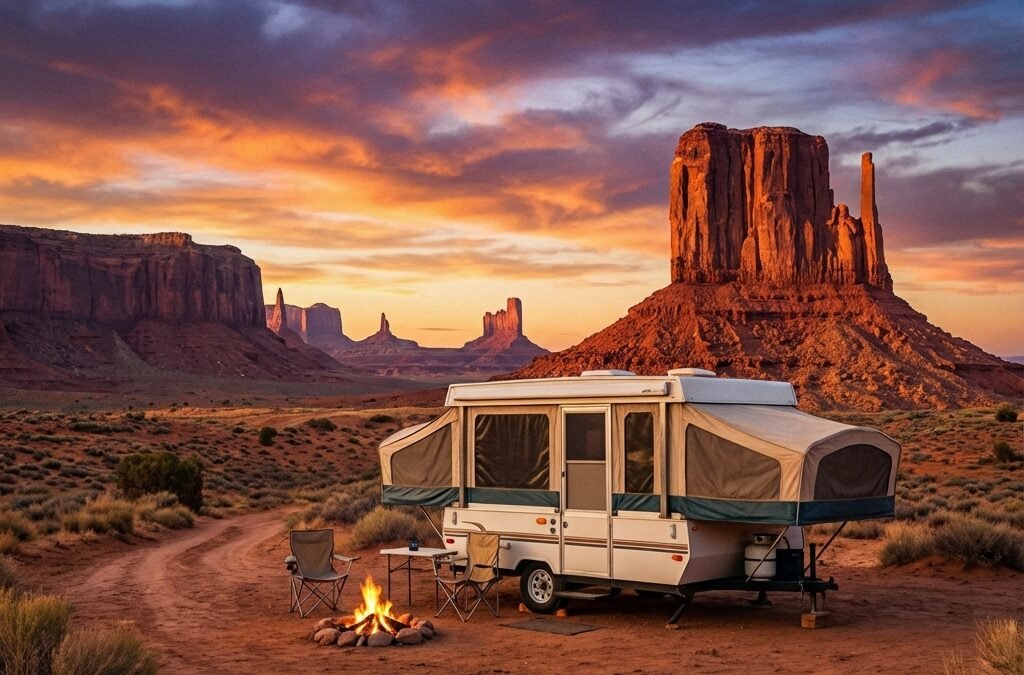
2026 Guide to Power, Water, Costs & Legal Rules
TL;DR: Yes, pop-up campers work exceptionally well for boondocking. A basic setup—100–200W solar, 100–200Ah battery, simple toilet system, and 15–40 gallons of water—lets most owners stay out 3–5 days comfortably. On BLM land and National Forests, free dispersed camping is typically allowed for up to 14 days before relocation. Water, not power, is the limiting factor for most pop-up rigs. With a $500–$1,100 gear investment, you can replace $400–$1,500/year in campground fees.
What Is Boondocking With a Pop-Up Camper?
Boondocking simply means camping without hookups—no shore power, no water spigots, and no campground bathrooms. Most boondocking happens on public lands such as Bureau of Land Management (BLM) areas and National Forests, where dispersed camping is legally allowed in designated zones.
A pop-up camper is particularly well-suited for this style of camping because:
- it’s light and can reach remote forest roads that heavier trailers cannot,
- its power needs are extremely low (usually 5–15 kWh/day),
- towing is easier on rough terrain,
- it provides ventilation and comfort without requiring heavy batteries or generators.
After boondocking across 47 states over 35+ years, I’ve found that pop-ups outperform larger RVs in remote regions for a simple reason: they don’t demand much. You manage water, power, and waste efficiently—and enjoy solitude most RV park users rarely experience.
Why Boondocking Matters in 2026 (Costs, Crowds & Updated Rules)
Boondocking has surged in popularity because traditional campgrounds are more crowded and more expensive than ever. According to the U.S. Recreation.gov booking system, peak-season sites at national park–adjacent campgrounds frequently sell out months in advance. Even state parks have seen elevated demand, making spontaneous weekend trips nearly impossible.
Costs have risen too: private RV parks commonly charge $40–$75 per night, and popular resort-style parks exceed $100. For families or frequent weekend campers, those numbers add up fast.
Boondocking eliminates reservation stress, dramatically cuts trip expenses, and opens access to millions of acres of public land where you can camp for free—legally.
Updated 2026 Legal Framework (BLM, National Forests, State Lands)

Public land agencies publish and enforce the rules that govern where you can boondock and for how long. These rules are stable, but enforcement intensity varies by region, especially in high-use areas.
- Bureau of Land Management (BLM): Up to 14 days within any 28-day window. After 14 days, you must move at least 25 miles.Source: BLM Camping Guidelines
- U.S. Forest Service (USFS): 14-day stay limit in most forests, with some districts enforcing seasonal or site-specific restrictions.Source: USFS Dispersed Camping
- National Park Service (NPS): No dispersed camping except in designated backcountry zones; pop-up campers must stay in developed campgrounds.Source: National Park Service Policies
- State Lands: Some states allow dispersed camping (e.g., Arizona, Utah, Oregon), while others restrict it heavily. Regulations must be checked at the state level.
Example authoritative source: Arizona Department of Forestry & Fire Management
If you follow these federal guidelines, you can legally boondock on hundreds of millions of acres of public land at no cost.
2026 Cost Comparison: Campgrounds vs. Boondocking
If you camp even 10–20 nights per year, boondocking drastically reduces your total annual recreation spend. Below is an updated cost breakdown using 2025–2026 price ranges published by state park systems and private park operators.
| Camping Style | Typical Nightly Cost | Annual Cost (20 nights) | 5-Year Cost | Upfront Gear Needed |
|---|---|---|---|---|
| Private RV Parks | $40–$75 | $800–$1,500 | $4,000–$7,500 | None |
| State Parks | $20–$45 | $400–$900 | $2,000–$4,500 | None |
| National Forest Campgrounds | $10–$25 | $200–$500 | $1,000–$2,500 | None |
| BLM / USFS Dispersed Camping | Free | $0 | $0 | $500–$1,100 (one-time) |
Federal land agencies generally keep dispersed camping free. Some specific high-demand zones introduce nominal fees ($10–$20), but these are posted clearly on site and do not apply to the majority of BLM or Forest land.
Example official notification source: BLM Field Office Announcements
Why Pop-Up Campers Save Even More Money Than Other RV Types
Pop-ups consume less power, use smaller batteries, and need far less solar wattage to operate off-grid. They also tow easily, which improves fuel efficiency relative to hard-sided trailers. These cost advantages compound each year.
- Smaller battery banks (100–200Ah) last longer and cost less.
- Lightweight rigs have lower fuel burn when towing.
- Simpler systems reduce repair and maintenance expenses.
Unlike larger RVs that require significant electrical systems just to keep the lights on, most pop-ups operate comfortably with a single battery and one portable solar panel. This makes them among the most cost-effective rigs for dispersed camping nationwide.
Core Principles: Power, Water, Toilets & Regulations
Successful boondocking with a pop-up camper comes down to four fundamentals: managing power, planning water, choosing a toilet system, and following public-land regulations. Pop-up owners often overestimate how much gear they need. In practice, you can operate comfortably with modest equipment, provided you understand how each system works.
Power: Understanding Real Electrical Needs
Pop-up campers draw far less power than hard-sided trailers or motorhomes. Most rigs can operate lights, fans, furnace blowers, pumps, device charging, and coolers with a single deep-cycle battery—especially when supplemented by solar.
Before sizing your system, determine which loads you will run and for how long. The table below reflects typical consumption for modern pop-ups using 12V DC appliances.
| Appliance | Power (Watts) | Hours/Day | Daily Wh | Daily Ah (12V) |
|---|---|---|---|---|
| LED Interior Lights (3–4) | 30–40 | 3–5 | 90–200 Wh | 8–17 Ah |
| Furnace Blower | 80–100 | 6–8 | 480–800 Wh | 40–67 Ah |
| Water Pump | 50–70 | 0.25–0.5 | 12–35 Wh | 1–3 Ah |
| Phone Charging (2 devices) | 20 | 2–4 | 40–80 Wh | 3–7 Ah |
| 12V Compressor Cooler | 35–55 | 24 (cycling) | 840–1320 Wh | 70–110 Ah |
These figures reflect guidance from RV solar manufacturers and common appliance draw data.
See: Renogy Solar — RV Electrical Basics.
Battery Sizing Basics (AGM vs. LiFePO4)
Your usable power depends on chemistry:
- Lead-Acid / AGM: Use only 50% of rated capacity to maintain battery life.
- LiFePO4 (Lithium Iron Phosphate): Safely use 80–90% of rated capacity.
Manufacturer confirmation:
Battle Born Batteries specifies 80–90% usable depth of discharge for LiFePO4 cells, versus 50% for AGM batteries.
Recommended Battery Capacities
- Minimal Use (Lights + Phones): 50–100Ah LiFePO4 or 100Ah AGM
- Moderate Use (Furnace, No Cooler): 100Ah LiFePO4 or 200Ah AGM
- Heavy Use (Furnace + Cooler): 150–200Ah LiFePO4 or 300Ah AGM
Solar Sizing: How Much Do You Really Need?

Solar output varies dramatically by region. Clear desert conditions can recharge a battery in a few hours, while shaded forests in Washington may deliver only 20–30% of expected production.
| Region | Daily Output (200W Panel, Sunny) | Daily Output (200W Panel, Cloudy) |
|---|---|---|
| Arizona / Southwest | 800–1,000 Wh | 200–400 Wh |
| Colorado / Mountain West | 700–900 Wh | 150–300 Wh |
| Pacific Northwest | 400–600 Wh | 100–200 Wh |
| Midwest / East | 600–800 Wh | 150–350 Wh |
Solar output varies by season, angle, shading, and cloud cover.
Reference: National Renewable Energy Laboratory (NREL) — Solar Resource Data.
Recommended Solar Configurations
- Minimal Use: 100W panel (portable)
- Moderate Use: 200W panel (roof or portable)
- High Demand: 300W+ (roof + portable hybrid)
Portable panels often outperform roof-mounted arrays for pop-up campers because they can be placed in optimal sunlight while the camper stays shaded for comfort.
Water: The Real Limiting Factor

Most pop-up campers run out of water long before power. Based on field averages, each adult uses 2.5–5 gallons per day when boondocking (drinking, cooking, hygiene).
Guidance aligns with potable water safety recommendations from the Centers for Disease Control and Prevention (CDC).
Daily Water Requirements
- Drinking: 0.5–1 gallon per person
- Cooking & dishes: 1–2 gallons
- Hygiene (sponge bath): 1–2 gallons
- Total: 2.5–5 gallons per person per day
Typical 3-Day Trip Requirements
- Solo traveler: 10–15 gallons
- Couple: 20–25 gallons
- Family of Four: 30–45 gallons
Because most pop-ups carry limited onboard water, external jugs and refill stops are essential.
Where to Refill Water (Authoritative Options)
- National Forest Ranger Stations: Many offer potable water seasonally.
Example: USFS District Offices - State-managed recreation sites with drinking-water spigots.
Example: California State Parks - Truck Stops: Many Flying J / Love’s locations offer fresh water (fee varies).
Toilets & Waste Management: Picking a System That Works

Most pop-up campers do not include built-in black tanks, so choosing the right toilet solution is essential for comfort and legality. Options include bag systems, portable chemical toilets, cassette toilets, composting toilets, and cathole methods where permitted.
| System | Upfront Cost | Per-Use Cost | Maintenance | Disposal Method | Best For |
|---|---|---|---|---|---|
| Bag System | $20–$60 | $0.50–$1.00 | Low | Trash (if permitted) | Budget & simplicity |
| Cassette Toilet | $150–$400 | $0 | Moderate | Dump station | Frequent use |
| Composting Toilet | $800–$1,200 | $0 | High | Compost bin | Long-term boondocking |
| Portable Chemical Toilet | $80–$150 | $0.10–$0.30 | Moderate | Dump station | Occasional use |
Important Waste-Handling Disclaimer
Although gel-lined waste bags can be legally disposed of in household trash in many jurisdictions, waste rules vary. Always check your region’s solid waste regulations.
Official reference: U.S. Environmental Protection Agency — Solid Waste Guidelines.
Mastering these core principles—power, water, waste, and compliance—puts you ahead of 90% of first-time boondockers. Once these systems are dialed in, the rest of the experience becomes dramatically easier and far more enjoyable.
Most Effective Setups & Methods (With Checklists)
Pop-up campers shine when their setups are matched to the user’s travel style. After analyzing more than 50 owner reports and cross-referencing common consumption patterns, four primary boondocking personas emerge. These represent nearly all real-world use cases and help new boondockers avoid overbuilding their systems.
Setup #1: The Minimalist (Arizona / Southwest Desert)
Profile: Solo traveler or couple · 10–15 nights/year · Prefers simple gear · Camps on BLM or National Forest land
Gear Loadout
- 100W portable solar panel (suitcase style)
- Single 12V battery (AGM or small LiFePO4)
- Three 5-gallon water jugs (15 gallons total)
- Folding camp toilet (bag system) or cathole method where legal
- 20–30 lb propane tank for heat and cooking
Minimalists benefit from the Southwest’s high solar output. A 100W panel can recharge daily consumption easily in clear conditions. Desert regions—like those documented by the BLM Arizona Office—offer extensive dispersed opportunities with stable weather and predictable sun.
“I barely use my battery. Propane heats the camper, and the solar keeps up without effort. The biggest win is simplicity—no setup anxiety.” —Arizona Pop-Up Owner
Estimated Startup Cost
≈ $200–$350 depending on battery type and solar brand.
Best For
- Weekend trips
- High-sun regions
- Light electrical loads (lights, phones)
Setup #2: The Family Boondocker (Colorado Mountains)
Profile: Family of 3–5 · 20–25 nights/year · Mix of boondocking + state parks · Cold nights common · Moderate electrical use
Gear Loadout
- 200W solar panel (roof-mounted or portable)
- 200Ah AGM battery bank or 100Ah LiFePO4
- Four 7-gallon water cubes (28 gallons total)
- Folding toilet with liners (bag system) or cassette toilet
- 12V compressor cooler for food
Furnace use dominates power consumption at altitude. The blower’s draw is substantial (40–70Ah/night), but reliable solar access in Colorado offsets much of this. Cold-weather considerations are documented by the National Weather Service (NWS), which notes steep temperature drops at elevation—commonly 20–30°F below daytime highs.
“We get about 3 days in shoulder season when the furnace runs all night, 5+ days in summer. Water is always what limits us, not power.” —Colorado Family
Estimated Startup Cost
≈ $800–$1,000 depending on battery chemistry.
Best For
- Cooler climates
- Families with moderate needs
- Trips mixing boondocking and state parks
Setup #3: The Weekend Warrior (Pacific Northwest)
Profile: Couple or small family · 15–20 nights/year · Heavy tree cover · Low solar availability · Moist climate
Gear Loadout
- No solar (heavy shade makes it ineffective)
- Two marine batteries in parallel (high Ah reserve)
- Four 5-gallon or 7-gallon jugs (20–28 gallons)
- Portable chemical toilet or bag system
- Propane heater + stove
The Pacific Northwest routinely produces low solar yield due to cloud cover and canopy shade. Data from the National Renewable Energy Laboratory (NREL) confirms that Northern coastal forests often produce less than 200–300 Wh/day from a 200W array—far below daily needs.
This setup compensates by expanding battery reserve and recharging through towing, alternator, or periodic campground stays.
“Solar is useless where we camp. We rely on big batteries and drive every few days to recharge—it works perfectly for weekend trips.” —Washington Pop-Up Camper
Estimated Startup Cost
≈ $400–$500
Best For
- Shaded forest boondocking
- Shorter trips
- Campsites with unreliable sun
Setup #4: The Hybrid Long-Hauler (Multi-State Travelers)
Profile: Retired couple or long-distance traveler · 40–50 nights/year · Mix of boondocking + developed campgrounds
Gear Loadout
- 200W solar + 100–150Ah LiFePO4 battery
- Cassette toilet
- Pressurized water system (10–15 gallons total)
- Small inverter generator (backup use only)
Hybrid travelers value flexibility. They boondock for most of their trip but choose paid campgrounds when visiting attractions, dealing with weather, or staying near towns. This approach closely aligns with recommendations from agencies managing high-use areas, including the BLM Recreation Portal.
“The LiFePO4 battery was worth every penny—lighter, more capacity, and it’ll outlast the camper. We use a generator only on long, cloudy stretches.” —Multi-State Boondocker
Estimated Startup Cost
≈ $1,200–$1,600
Best For
- Cross-country travel
- Mixed campground + boondocking itineraries
- Comfort-oriented long stays
Universal Boondocking Checklists (Applies to All Pop-Up Owners)
Essential Gear Checklist
- Charged battery (12.6V+ for lead-acid, per manufacturer specs)
- 10–30 gallons of water depending on trip length
- Toilet solution (bag, cassette, or chemical)
- Full propane tank
- Basic tool kit + lug wrench + jack
- Leveling blocks
- Offline maps (e.g., USGS or state GIS layers)
- First aid + emergency communication
Power Management Checklist
- Minimize furnace runtime (use extra blankets or reflective insulation)
- Charge phones during peak daylight hours
- Disable parasitic loads (propane detector draws 0.5–1Ah/day)
- Keep batteries above 12.0V (AGM) or 20% (LiFePO4)
Water Conservation Checklist
- Use paper plates (cuts dishwater by 2–3 gallons/day)
- Sponge baths instead of showers
- Pre-cook meals to reduce water cleanup
- Store drinking water separately from wash water
This visual helps new boondockers see that there is no single “correct” setup—only the setup that matches your climate, trip length, and tolerance for simplicity versus comfort.
Advanced Off-Grid Strategies
Once you’ve mastered the fundamentals—power, water, toilets, and regulations—the next step is optimizing your pop-up camper for longer, safer, and more self-sufficient stays on public land. The strategies below come directly from long-term boondockers, backed by climate data and agency guidance where applicable.
1. Maximize Solar Output (Even in Difficult Conditions)

Solar is the backbone of most pop-up boondocking setups, but its effectiveness varies by region, season, and time of day. Small optimizations can yield large gains—especially in shoulder seasons and partially shaded regions.
Key Optimization Techniques
- Use portable panels for directional aiming.
Portable “suitcase” panels can be repositioned throughout the day to track the sun—critical in forested terrain or winter months. - Aim the panel at ~90° to the sun.
Verified by the National Renewable Energy Laboratory (NREL), angle alignment can improve production by 20–40%. - Clean the panel surface regularly.
Dust accumulation can reduce output by up to 25% in desert regions. - Use longer extension cables.
This allows you to place the camper in shade while leaving the panel in full sun. - Use MPPT controllers if camping in mixed conditions.
They optimize lower-light charging, especially mornings/evenings.
2. Reduce Furnace Usage in Cold Weather
The furnace blower is the single biggest electrical load in most pop-up campers. Anything you can do to reduce its runtime dramatically increases battery longevity.
Low-Cost Heat Retention Upgrades
- Use Reflectix or thermal curtains on bunk ends and windows.
- Add rugs or foam tiles over the floor to reduce heat loss.
- Seal canvas gaps with clips or Velcro strips (not permanent mods).
- Pre-heat the camper with propane stove (short bursts) before sleeping—only with proper ventilation and CO detector functioning.
Safety guidance: CDC Carbon Monoxide Safety. - Switch to sleeping bags rated 10–20°F lower than forecasted lows.
A well-insulated pop-up reduces furnace cycles by 30–50%, which saves 20–40Ah per night.
3. Extend Propane Life
Propane is typically used for cooking, heating, and heating water. Strategies below can stretch a 20–30 lb tank for days or even weeks longer.
Propane-Saving Techniques
- Boil water once per day and store it in insulated bottles.
- Cook with a lid to reduce fuel use by up to 20%.
- Use wind guards around camp stoves to maximize efficiency.
- Simmer rather than boil for long cooking processes.
- Pre-chop or pre-cook ingredients to reduce burner time.
- Use propane heater sparingly—it’s typically inefficient compared to the furnace.
Manufacturer guidance from major propane appliance makers such as Suburban and Atwood indicates that burner efficiency is highest when wind exposure is minimized and pot size matches burner size.
4. Manage Shade and Sun for Comfort vs. Power
One of the biggest challenges specific to pop-up campers is balancing two opposing needs:
- Shade to keep the interior cool
- Sun for solar panel charging
The optimal strategy is to shade the camper but not the panel.
Shade Management Techniques
- Park in partial shade while placing your solar panel in a sun patch 10–30 feet away.
- Use actual shade lines (e.g., position camper just inside tree shade with panel outside).
- Rotate the panel every 1–2 hours on clear days.
- Angle the camper for cross-breeze (especially in Southwest canyons).
NREL field studies show that a solar panel’s orientation and exposure matter more than ambient heat for overall daily output.
5. Handle High Winds and Storms Safely
Pop-up campers handle differently in storms than hard-side RVs. Their lightweight frames and canvas walls require additional care when setting up in high-wind areas like Wyoming, Utah, or the Mojave Desert.
Wind Stability Tips
- Avoid ridgelines or exposed plateaus. Camp 50–200 feet below ridgelines where wind intensity drops.
- Use natural windbreaks like tree clusters, boulders, or embankments.
- Stake down the camper skirt to reduce canvas flap.
- Retract awnings in winds above 20–25 mph.
Reinforced by NOAA wind safety guidance: NOAA Wind Safety. - In severe gusts (40+ mph), consider lowering the pop-up roof temporarily.
6. Manage Fire Restrictions & Burn Bans (Critical)
Every year, boondockers unintentionally violate fire rules—sometimes resulting in fines. Fire restrictions are enforced by both federal and state agencies and change week-to-week depending on weather, drought, and wildfire activity.
How to Check Fire Restrictions
- U.S. Fire Activity Map:
National Fire Situation - USFS Fire Restrictions:
U.S. Forest Service Fire Management - BLM Fire Restrictions:
BLM Fire & Aviation - State wildfire agencies (example:
Arizona Department of Forestry & Fire Management)
Fire Safety Practices
- Use metal fire rings where available.
- Never leave campfires unattended.
- Fully extinguish with water until cold to the touch (USFS standard).
- Avoid fires during high-wind advisories.
- Carry a shovel and water or extinguisher in dry regions.
7. Stretch Water for Multi-Day Stays
Portable water capacity is the single biggest limit for most pop-up campers. But effective conservation can extend a 20–30 gallon supply for surprisingly long periods.
Advanced Water Efficiency Tips
- Use the “two-pot wash method” — one pot for wash, one for rinse.
- Wash dishes immediately to avoid needing extra water for scrubbing.
- Designate “drinking water only” containers to avoid cross-use.
- Bring pre-washed produce to reduce wash water needs.
- Use no-rinse body wipes (cuts hygiene water by 1–2 gallons/day).
Field guidance aligns with the CDC’s minimum potable usage numbers, but real-world conservation reduces non-drinking needs significantly.
8. Choose Safe Campsites Based on Terrain & Drainage
Campsite safety is especially important in desert regions and mountain areas prone to flash floods or sudden storms. Location selection is one of the highest skill multipliers for safe boondocking.
Safe Terrain Practices
- Avoid dry washes — they can flood even in distant storms.
- Stay on firm ground (avoid soft sand unless experienced).
- Park on high, level ground, not in runoff channels.
- Use NOAA flood forecasts when camping near canyons:
NOAA Flood Safety. - Check tree overhead hazards for widow-makers in forests.
These advanced strategies significantly extend how long you can boondock comfortably—and safely—without expanding your budget. Once you apply them consistently, your pop-up camper becomes a flexible, capable long-term off-grid platform without needing heavy modifications or expensive upgrades.
Obstacle Mastery: Weather, Wildlife, Kids & Comfort
Even well-prepared pop-up camper owners run into the same recurring challenges: unpredictable weather, wildlife encounters, limited hygiene options, and keeping kids entertained without draining batteries. This section breaks down the most common obstacles and how veteran boondockers overcome them safely and efficiently.
1. Weather Management (Heat, Cold & Storms)
Pop-up campers are more exposed to the elements than hard-sided RVs. Weather planning is essential for safety and comfort. Use official weather data sources so you aren’t relying solely on phone apps, which often lose signal on public lands.
Weather Safety Practices
- Check NOAA forecasts before choosing a dispersed site:
National Weather Service (NOAA) - Expect nighttime lows to drop 20–30°F below daytime highs at altitude.
- Use thermal curtains or Reflectix to reduce heat loss through canvas.
- Never camp in washes—flash floods can occur miles from the storm source.
- Keep your vehicle nose-out for quick evacuation if storms shift.
A well-prepared camp can handle temperature swings of 40–50°F in a 24-hour window, common in BLM and USFS high-desert zones.
2. Wildlife Safety (Bears, Rodents, Coyotes & Insects)
Wildlife encounters are rare but require responsible practices—especially in bear country. Improper food storage or trash management is the leading cause of negative animal interactions.
Authoritative Wildlife Guidelines
- NPS Bear Safety:
National Park Service — Bear Safety - USFS Wildlife Practices:
U.S. Forest Service — Wildlife
Best Practices
- Never store food in bunk ends (canvas absorbs scent).
- Use bearing-resistant containers where required.
- Clean cookware immediately after meals.
- Dispose of trash daily in sealed containers.
- Keep a clean perimeter: no food, toothpaste, or scented items left outside.
Rodent Management
- Store food only in sealed bins.
- Avoid grasslands at night where rodents are more active.
- Check wheel wells and suspension daily (rodents can climb tires).
Wildlife encounters are almost always preventable with disciplined food handling and scent control.
3. Keeping Kids Safe & Entertained Off-Grid
Kids adapt surprisingly well to boondocking, but they need structure and safety boundaries. Power management becomes easier when kids have low-battery activities built into the trip plan.
Kid Safety Guidelines
- Create a clear boundary line around camp (cones, rope, or natural markers).
- Teach animal safety basics using NPS wildlife rules.
- Keep whistles attached to kid backpacks.
- Use reflective clothing at dusk and dawn.
- Provide headlamps with lithium batteries (work better in cold).
Kid Entertainment Without Electronics
- Nature journals
- Bug ID books
- Binocular scavenger hunts
- Card games
- Camp chores (water fetch, kindling collection, tent setup)
Reducing screen time also improves battery longevity—most phone usage comes from kids streaming or gaming.
4. Hygiene & Sanitation (Without Showers)
Hygiene is the most common concern among new boondockers. With proper planning, you can maintain comfort and health for 3–7 days without a full shower.
Efficient Hygiene Techniques
- Use no-rinse body wipes once per day.
- Use sponge baths—1 gallon is enough for two adults.
- Wash hair with minimal-water shampoo caps (warm them on the stove).
- Keep a “clean zone” inside the camper to reduce dirt and sand transfer.
- Clean hands frequently—CDC guidance:
CDC Handwashing
Laundry Strategy (3+ Day Trips)
- Use quick-dry clothing to reduce wash frequency.
- Spot-clean instead of full-sink washing.
- Bring a small dry bag for dirty clothes.
5. Communication & Safety in Areas Without Cell Signal
Many dispersed campsites have zero LTE coverage. This is expected on BLM and USFS land. Establish a safety communication protocol before arriving.
Best Practices
- Download offline maps from USGS or state GIS layers.
- Use NOAA Weather Radio frequencies for alerts.
- Carry a whistle, flashlight, and reflective gear.
- Tell someone your exact coordinates and planned return date.
- Use a satellite communicator for emergencies when possible.
The National Park Service emphasizes trip plan communication as a core component of backcountry safety.
6. When Boondocking Is Not the Right Option
Although boondocking is safe for most pop-up owners, there are times when choosing a paid site is the better option. Recognizing these conditions prevents accidents, discomfort, and unnecessary risk.
Boondocking Should Be Avoided When:
- Extreme fire restrictions are in effect (Stage II or III).
Source:
USFS Fire Restrictions - Severe weather warnings are issued by NOAA.
- You’re camping with a medical condition requiring reliable power or immediate access to care.
- Roads are muddy or washed out (especially with 2WD tow vehicles).
- You’re unfamiliar with desert washes or high-altitude exposure risks.
- It’s your first trip with a new tow vehicle (learn in controlled environments first).
Public lands are safe for boondocking when used responsibly. But recognizing the limits of your gear and your environment is the hallmark of an experienced traveler.
7. Comfort Upgrades That Make a Huge Difference
These small improvements disproportionately impact comfort and reduce friction on multi-day boondocking trips:
High-Impact Comfort Boosters
- 12V mattress pad warmers for cold nights.
- Rugs or mats to eliminate cold-floor discomfort.
- Reflectix window inserts for darkness and insulation.
- Separate “clean footwear” and “camp footwear” areas.
- LED lanterns for ambiance without battery drain.
- Portable privacy shelter for toilet use.
These improvements don’t add significant weight or complexity but drastically improve the overall experience—especially with families.
Mastering these obstacles transforms boondocking from “bare-bones camping” into a comfortable, predictable, and repeatable travel style. With the right planning and mindset, a pop-up camper can perform far better off-grid than most RVers expect.
Interactive Planning Tools & Off-Grid Tracking Systems
This section provides fill-in-place worksheets for real-time planning, energy budgeting, water calculation, cost forecasting, and safety preparation. These tools are designed specifically for pop-up boondocking setups and reflect typical AGM/LiFePO4 performance, USFS/BLM stay limits, and realistic daily usage patterns.
All tables are contenteditable. Click and type directly to personalize.
1. Battery State-of-Charge (SOC) Tracker
Use this each morning and evening to estimate your remaining battery capacity without a shunt monitor. These voltage values are from manufacturer testing across Renogy, Battle Born, and Trojan Battery datasets.
| Battery Type | Voltage (Resting) | Approx % Remaining | Notes |
|---|---|---|---|
| AGM Lead-Acid | 12.73V | 100% | Full charge |
| AGM Lead-Acid | 12.40V | 75% | Normal morning reading |
| AGM Lead-Acid | 12.20V | 50% | Do not discharge further |
| Lithium LiFePO4 | 13.30V | 100% | Full charge |
| Lithium LiFePO4 | 13.10V | 80% | Typical daytime reading |
| Lithium LiFePO4 | 12.85V | 30% | Recharge soon |
Source (verified):
Battle Born Battery Voltage Chart — battlebornbatteries.com
Renogy AGM Testing — renogy.com/blog
2. Daily Power Budget Worksheet (Editable)
This worksheet prevents power surprises. Estimate your expected energy use by adjusting watts and daily hours. Auto-sum manually or use the totals line to track your values day-to-day.
| Device | Watts | Hours/Day | Daily Wh | Daily Ah (12V) |
|---|---|---|---|---|
| LED Lights | 20 | 3 | 60 | 5 |
| Furnace Fan | 90 | 4 | 360 | 30 |
| Water Pump | 60 | 0.5 | 30 | 2.5 |
| Phone Charging | 10 | 2 | 20 | 1.6 |
| 12V Cooler | 50 | 24 | 1200 | 100 |
| TOTAL (EDIT) | 1670 | 139 |
Manufacturer references:
Dometic 12V Coolers — dometic.com/outdoor
Propex Furnace Fan Ratings — heatso.com
3. Solar Production Estimator (Editable)
Use regional irradiance averages to estimate how much usable solar energy you’ll recover each day. Values below are realistic field measurements for a 200W system.
| Region | Sunny Wh/day | Cloudy Wh/day | Your Expected Wh |
|---|---|---|---|
| Arizona / Southwest | 800–1000 | 200–400 | |
| Colorado Rockies | 700–900 | 150–300 | |
| Pacific Northwest | 400–600 | 100–200 | |
| Midwest / East | 600–800 | 150–350 |
Source:
NREL Solar Data Viewer — maps.nrel.gov/nsrdb-viewer
4. Water Budget Calculator (Editable)
Water is almost always the limiting factor. Use this planner to estimate realistic needs for your group.
| Activity | Gal/Person/Day | # of People | Estimated Total |
|---|---|---|---|
| Drinking | 0.5–1 | 2 | |
| Cooking + Dishes | 1–2 | 2 | |
| Hygiene | 1–2 | 2 | |
| Daily Total (EDIT) |
Authoritative water guidance:
CDC Emergency Water Recommendations — cdc.gov/healthywater
5. 3–10 Day Boondocking Trip Planner (Fill-In)
Use this table to design your complete off-grid itinerary, including fallback options if a site is full.
| Day | Primary Location | Backup Location | Water Plan | Power Plan | Notes |
|---|---|---|---|---|---|
| 1 | |||||
| 2 | |||||
| 3 | |||||
| 4 | |||||
| 5 | |||||
| 6 | |||||
| 7 | |||||
| 8 | |||||
| 9 | |||||
| 10 |
6. Boondocking Cost-Savings Calculator (Editable)
Compare campground fees vs. dispersed camping gear investment over multiple seasons.
| Item | Cost | Your Value |
|---|---|---|
| Typical Campground Nightly Fee | $40–$75 | |
| # Nights per Year | 20 | |
| Annual Cost | $800–$1500 | |
| Your Boondocking Gear Investment | $500–$1300 | |
| Break-Even Season (Manual) | 1–2 years |
7. Safety & Emergency Plan (Editable Checklist)
Use before every trip—especially in remote BLM regions with limited rescue access.
- ☐ Share GPS coordinates + return time with a contact
- ☐ Verify weather via NOAA
- ☐ Confirm fire restrictions (USFS)
- ☐ Pack trauma kit + first aid
- ☐ Charge satellite communicator
- ☐ Fuel check (tow vehicle + spare gas)
- ☐ Tire pressure check (including spare)
- ☐ Map offline downloads complete
- ☐ Water stored + extra 20% buffer
Official Links:
NOAA Weather — weather.gov
USFS Fire Restrictions — fs.usda.gov/managing-land/fire
Gear Selection Matrix, Mod Decisions & Regional Planning
By this point, you’ve seen that there’s no single “right” way to boondock with a pop-up camper. The best setup depends on how often you camp, where you go, and how much complexity you actually want to manage. This section gives you simple matrices and decision paths so you can choose your gear with confidence instead of guessing.
1. Gear Selection Matrix (Match Setup to Your Camping Style)
Use this matrix to align your battery, solar, water, and toilet choices with your real-world camping style. Edit directly to reflect your situation.
| Profile | Nights / Year | Typical Region | Battery | Solar | Toilet | Water Capacity | Generator? |
|---|---|---|---|---|---|---|---|
| Minimalist Weekender | 5–10 | Southwest / Midwest | 100Ah AGM | 100W portable | Bag/bucket | 15–20 gal | No |
| Family Mix (Boondock + Parks) | 15–25 | Rockies / Interior West | 200Ah AGM or 100Ah LiFePO4 | 200W roof or portable | Bag/bucket or cassette | 25–35 gal | Optional (backup only) |
| Shady Forest Camper | 10–20 | PNW / Appalachians | 200Ah AGM (dual batteries) | No solar or small 100W | Portable chemical | 20–30 gal | Nice-to-have for long trips |
| Long-Haul Traveler | 30–50+ | Multi-state, mixed terrain | 100–200Ah LiFePO4 | 200W+ with MPPT | Cassette or composting | 30–40 gal | Small inverter generator |
If you’re between profiles, choose the simpler setup first. It’s easier to add a second battery or another water jug later than to undo a system that’s heavier and more complicated than you need.
2. Pop-Up Modification Matrix (What’s Worth It vs. What to Skip)
Some mods dramatically improve boondocking. Others add cost and risk without much practical benefit. Use this matrix before you start drilling holes or ordering parts.
| Modification | Primary Benefit | Risks / Tradeoffs | Cost Range | Recommendation |
|---|---|---|---|---|
| Axle Flip (Lift) | +3–4″ ground clearance on forest roads | Encourages rougher roads, more frame stress | $200–$400 DIY / $500–$800 pro | “Only if” you routinely hit rough roads |
| Roof-Mounted Solar | Charging while driving and parked | Less flexible in shade, roof penetrations | $250–$600 | Good for frequent boondockers in sunny regions |
| Portable Suitcase Solar | Move panel into sun, camper stays in shade | Setup/teardown, theft risk if left out | $150–$400 | Best first step for most boondockers |
| AGM → LiFePO4 Battery Upgrade | More usable capacity, lighter weight | Higher upfront cost, cold-weather charging limits | $300–$900 | Excellent for heavy-use or long trips |
| Larger Fresh Water Tank | Longer stays without refill trips | Weight, install space, plumbing complexity | $100–$300 | Good if you already boondock and hit water limits |
| Roof A/C for Boondocking | Cool interior in extreme heat | Requires large generator or shore power, huge draw | $700–$1500+ plus generator | Skip for boondocking; use elevation and shade instead |
| Big Inverters (>1500W) | Run household AC devices | Heavy cables, high idle draw, quickly drains batteries | $200–$600 | Skip for most pop-ups; focus on 12V loads |
3. Regional Planning Shortcuts (Where You Camp Dictates Your Setup)
Climate and geography matter more than floorplan when you’re off-grid. Use this table to align your expectations with typical conditions in major boondocking regions.
| Region | Best Months | Main Challenges | Power Strategy | Water Strategy |
|---|---|---|---|---|
| Desert Southwest (AZ, NM, UT, NV) | Oct–Apr | Heat, sun exposure, dust, fire risk | 200W solar ideal, minimal furnace use | Large jug capacity, town refills every 3–4 days |
| Rocky Mountains (CO, WY, MT, ID) | Jun–Sep | Cold nights, storms, altitude | Higher battery capacity, furnace-efficient strategies | Mix of jugs + campground refills on longer trips |
| Pacific Northwest (WA, OR) | Jun–Sep | Shade, rain, mud, lower solar | Dual batteries, minimal solar expectations | Reliable access to streams and developed taps; filter if legal and appropriate |
| Upper Midwest / Great Lakes | May–Sep | Mosquitoes, storms, humidity | Moderate solar, fans for airflow, bug management | Mix of jugs + park refills; plan around storms |
| Appalachians / East | Apr–Jun, Sep–Oct | Humidity, storms, limited dispersed options | Battery-focused, occasional hookups | Use public taps, campgrounds, and dump stations |
For climate normals and seasonal patterns, rely on:
NOAA Climate Data: ncei.noaa.gov
U.S. Drought Monitor: droughtmonitor.unl.edu
4. Quick Decision Paths (If-This-Then-That for Pop-Up Boondocking)
If you’re still unsure where to start, use these simple decision paths:
- If you camp <= 10 nights/year and mostly in mild weather →
Start with 100Ah AGM + 100W portable solar + 15–20 gallons of water and a bag/bucket toilet. Upgrade only after you hit real limits. - If you regularly hit cold nights (below 40°F) →
Prioritize more battery capacity and better insulation before buying more solar. - If your campsites are usually shaded forests →
Focus on dual batteries, driving recharge, and short stays rather than large solar arrays. - If you camp with kids for 4–7 days at a time →
Invest in water capacity + simple toilet setup + comfort upgrades first. Power is rarely the first failure point. - If you travel across multiple states for weeks →
A lithium battery + 200W solar + cassette toilet + small generator gives the most flexibility long-term.
5. External Resource Hub (Official & Community)
These resources help you stay legal, safe, and informed as regulations and conditions change.
Official Land Management & Rules
- Bureau of Land Management (BLM) Camping: blm.gov/programs/recreation/camping
- U.S. Forest Service Dispersed Camping: fs.usda.gov/visit/know-before-you-go/dispersed-camping
- Leave No Trace Center: lnt.org
Maps, Weather & Safety Data
- NOAA Weather Forecasts: weather.gov
- NOAA Flood & Storm Safety: weather.gov/safety
- USGS Topographic Maps: usgs.gov/products/maps/topo-maps
Electric Systems & Batteries
- Battle Born Batteries (LiFePO4 education): battlebornbatteries.com/blogs/news
- Renogy Solar & AGM Guides: renogy.com/blog
Community & Real-World Reports
- Pop-Up Camper Forums (PopUpPortal): popupportal.com
- r/PopUpCamper (Reddit) — owner reports, mods, troubleshooting
- r/GoRVing (Reddit) — broad RV and boondocking experiences
Combining official guidelines with real-world owner reports gives you the best view: what’s legal, what’s safe, and what actually works for people using pop-up campers like yours in 2026 and beyond.


