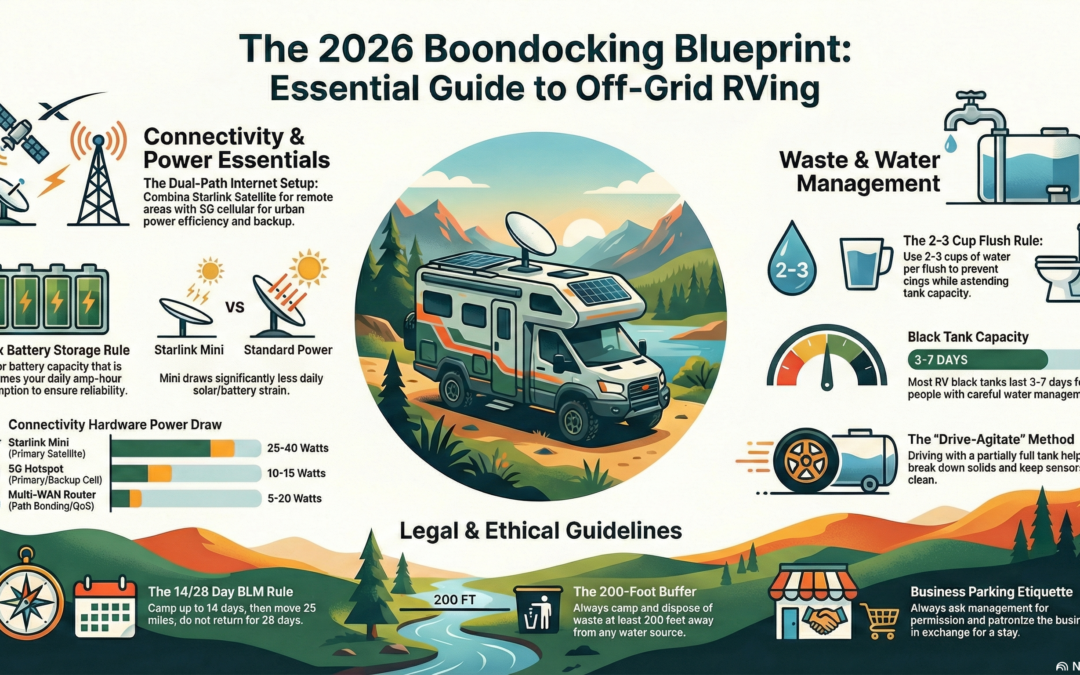
Off-Grid RV Systems & 14-Day Rules
Master off-grid RV camping with proven strategies from 35+ years of boondocking across 47 states
Estimated read time: 18 minutes
📋 Quick Reference (TL;DR)
- Time Required: 2-3 days to prepare your RV and systems, then start with 1-2 night trips to build confidence
- Difficulty Level: Beginner-friendly if you have a self-contained RV with working systems
- Prerequisites: Fresh water tank (30+ gallons), grey and black waste tanks, independent power source (solar or generator)
- Success Metric: Complete 3+ nights off-grid without needing hookups, resupply, or rescue
Boondocking lets RV owners camp free on public lands and private property by operating self-sufficiently without hookups. Success requires three elements: a self-contained RV with 30+ gallon fresh water capacity, power management through solar or generator, and knowledge of legal camping locations.
What Is Boondocking? (Free Camping Explained)
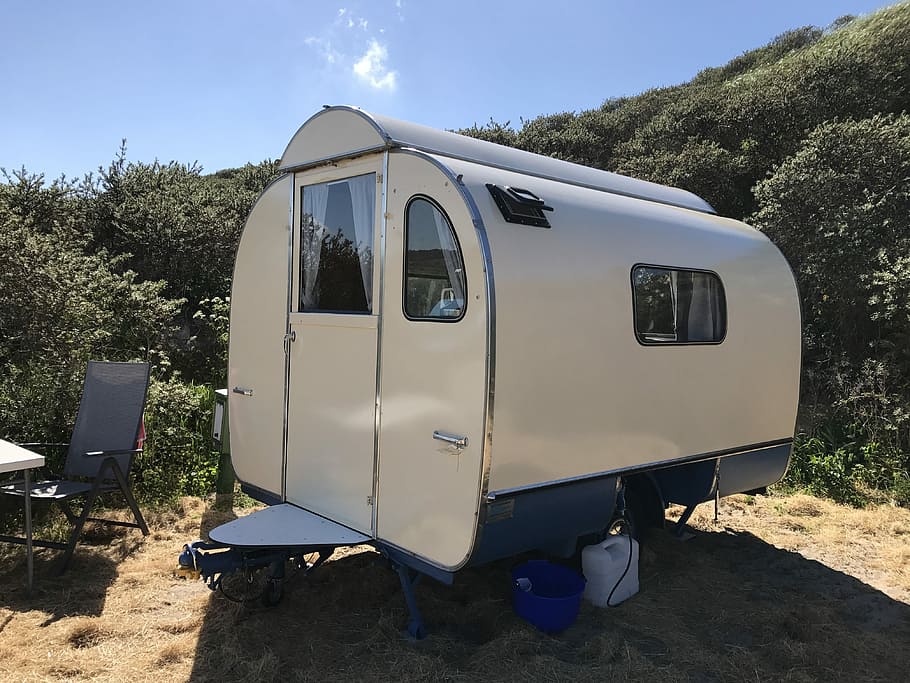
Boondocking refers to camping in a recreational vehicle without hookups to water, electric, or sewer services. The term originated with RVers camping “out in the boonies” on public lands managed by the Bureau of Land Management, which oversees 245 million acres open to dispersed camping across the western United States.
The practice goes by several names. “Dry camping” technically means camping without hookups anywhere, including paid campgrounds. “Dispersed camping” is the official term used by the US Forest Service for camping outside designated campgrounds on National Forest land. “Boondocking” typically implies free or low-cost camping on public land or with permission on private property.
The Bureau of Land Management allows camping on most of its land for up to 14 consecutive days without fees or permits. The US Forest Service maintains similar policies on National Forest land, though some popular areas charge $5-10 per night or require free permits during peak seasons. Combined, these two agencies manage over 400 million acres where boondocking is generally permitted.
Success requires operating your RV as a self-contained unit. You carry all the water you’ll use, generate your own electricity through solar panels or a generator, and store all wastewater in holding tanks until you can dump at a proper facility. This self-sufficiency lets you camp almost anywhere legal access exists.
Essential Prerequisites: What You Need Before Your First Trip
Your RV must function as a complete household independent from external utilities. The RV Industry Association defines a self-contained recreational vehicle as one with fresh water storage, waste holding tanks, and an independent power source. These aren’t optional upgrades but minimum requirements for responsible boondocking.
⚠️ Not Ideal for Boondocking Without:
- Fully functional holding tanks (fresh water minimum 30 gallons, grey and black tanks minimum 20 gallons each)
- Independent power source (solar panels producing 200+ watts or reliable generator)
- RV mechanical reliability (no active water leaks, functional propane system, working batteries)
- Basic self-sufficiency skills (can operate all RV systems, perform minor troubleshooting)
Fresh water capacity determines how long you can stay off-grid. A 30-gallon tank supports two people for 2-3 days with conservative use. Larger tanks (50-100 gallons) or supplemental containers extend this to a week or more. Calculate 3-5 gallons per person per day for drinking, cooking, and limited washing when boondocking.
Grey water tanks collect sink and shower drainage. Black water tanks hold toilet waste. The Leave No Trace Center for Outdoor Ethics recommends both tanks match or exceed fresh water capacity to prevent the need to dump before you run out of fresh water. Most factory RV configurations meet this standard, but verify your specific tank sizes before planning extended trips.
Power independence comes from solar panels, generators, or both. Solar works silently and requires no fuel, but output depends on weather and season. Generators provide consistent power but consume fuel, create noise, and may violate quiet hours at some locations. Budget $600-2,000 for a basic solar setup or $500-2,000 for a quality generator.
Test all systems before leaving developed campgrounds. Fill your fresh tank, run water through all fixtures, flush the toilet multiple times, and verify your grey and black tank sensors work. Charge batteries fully and measure how long they power your typical usage. Practice dumping tanks at an RV park before attempting it at a public dump station. These dry runs prevent frustrating discoveries in remote locations.
Cost Savings: Real Numbers from Full-Time Boondocking
Private RV parks charge $40-80 per night depending on location and amenities. KOA campgrounds average $55-75 per night for full hookups. Good Sam parks offer member discounts but still typically cost $35-50 nightly. These costs accumulate rapidly on extended trips or full-time travel.
Boondocking on Bureau of Land Management or US Forest Service land costs nothing in most locations. Some high-demand areas charge $5-10 per night, and a few require free permits available online or at ranger stations. Even accounting for occasional paid camping to access services, boondockers typically spend under $10 per night on average.
A full-time RVer paying campground fees 365 nights annually spends $14,600-29,200 per year ($40-80 nightly). That same RVer boondocking primarily and only paying for camping occasionally might spend $1,000-3,650 annually. The difference of $13,600-25,550 per year covers most RV maintenance, fuel, and travel expenses.
Initial equipment investment requires budgeting. A 300-watt solar system with batteries costs $1,500-2,500 installed. Quality generators run $800-2,000. Water management tools (extra containers, filtration, conservation devices) add $200-400. LED lighting upgrades cost $50-100. Total startup: $1,000-3,000 for a basic but functional setup.
The break-even calculation favors boondocking quickly. At $50 average nightly savings, a $2,000 equipment investment pays for itself in 40 nights. Weekend boondockers reach break-even in one season. Full-timers recover costs in under two months. After break-even, every night boondocked instead of paying campground fees puts money back in your travel budget.
Hidden savings compound the advantage. Campgrounds in popular destinations charge premium rates during peak season. National Parks near popular RV parks might cost $80-120 nightly, while boondocking nearby on Forest Service land costs nothing. Holiday weekends and special events drive campground prices even higher, but boondocking prices stay constant at zero.
Solar Power and Energy Management
Solar panels convert sunlight into electricity to charge your RV batteries without noise or fuel consumption. Renogy and similar manufacturers offer complete systems ranging from 100-watt portable panels ($200-300) to 600-watt permanent roof installations ($2,000-3,000). Most boondockers find 200-400 watts sufficient for moderate power needs.
Panel output varies by season and location. Winter sunlight produces 20-30% less power than summer due to shorter days and lower sun angles. Desert locations in Arizona and Nevada deliver optimal solar performance year-round. Heavily forested areas or frequent overcast skies reduce output significantly. Calculate power needs conservatively based on worst-case scenarios for your typical camping locations.
Battery capacity determines how many days you can operate between full charging cycles. Battle Born and similar lithium batteries offer 200 amp-hours (Ah) of usable capacity, roughly double the usable power of equivalent lead-acid batteries. Two 200Ah lithium batteries store enough power for 3-5 days of moderate use without recharging, providing cushion for cloudy weather.
Energy conservation extends your boondocking duration more effectively than adding panels or batteries. LED bulbs use 80% less power than incandescent bulbs they replace. Switching from twelve 20-watt incandescent bulbs to LED drops nightly lighting consumption from 240 watts to 48 watts. At that rate, lighting alone drains 20 amp-hours daily with incandescent but only 4 amp-hours with LED.
| Appliance | Watts | Hours on 200Ah Battery | Daily Amp-Hours (2hr use) | Recommended Use |
|---|---|---|---|---|
| LED lights (total) | 20W | 1,200 hours | 3.3 Ah | Unlimited – minimal drain |
| Water pump | 50W | 480 hours | 8.3 Ah | Normal use, fix leaks promptly |
| Furnace fan | 75W | 320 hours | 12.5 Ah | Use sparingly, layer clothing |
| Refrigerator (12V mode) | 40W | 600 hours | 80 Ah (cycling) | Switch to propane when boondocking |
| Laptop charging | 65W | 369 hours | 10.8 Ah | Charge during peak sun hours |
| Microwave | 1000W | 24 hours | 13.9 Ah (10 min) | Generator only, not on battery |
Phantom drain from devices in standby mode steals 5-10% of battery capacity daily. Unplug phone chargers, laptops, and other electronics when not actively charging. Turn off inverters powering AC outlets you aren’t using. These small leaks compound over multiple days, potentially draining 20-40 amp-hours you’ll need later in your stay.
High-power appliances require generators or shore power. Microwaves, hair dryers, air conditioners, and electric heaters draw 1,000-1,500 watts each. Running these on batteries drains your bank in minutes. Save high-power cooking and grooming for generator hours or skip them entirely. Most boondockers adapt to stovetop cooking and air-drying hair.
Water Management: Conservation Strategies That Work
Water weighs 8.3 pounds per gallon and RVs carry limited quantities. A 30-gallon fresh tank adds 249 pounds fully loaded. This weight affects fuel economy and handling, so RVers often travel with tanks partially full and refill at destinations. Understanding consumption helps plan refill frequency and locations.
Average American households use 80-100 gallons per person daily. RV living with full hookups typically reduces this to 8-10 gallons per person per day. Boondocking demands further reduction to 3-5 gallons per person daily. This dramatic decrease requires changing habits around showering, dishwashing, and general water use.
Navy showers cut shower water use by 90% compared to continuous flow. Turn water on to wet your body (10 seconds), turn off while soaping and shamming (1-2 minutes), then rinse thoroughly (30-60 seconds). Total water use: under 1 gallon versus 10-15 gallons for a conventional shower. Some boondockers shower every other day or use gym facilities to preserve tank capacity.
Dishwashing technique matters as much as volume. Fill one basin with soapy water for washing, another with clean water for rinsing. Scrape plates thoroughly before washing. This two-basin method uses 2-3 gallons versus 5-8 gallons running water continuously. Alternatively, use biodegradable wipes for basic cleaning and save full washing for items that touched raw meat.
Low-flow faucet aerators reduce water consumption 40% without changing habits. Standard RV faucets flow at 2.2 gallons per minute. A 1.5 GPM aerator costs under $10 and cuts flow without noticeably reducing pressure for handwashing or tooth brushing. Install these in kitchen and bathroom sinks before your first boondocking trip.
The Fresh Water Tank Institute recommends water filtration for extending time between refills when safe sources exist. Portable water filters let you refill from streams, lakes, or questionable spigots instead of driving to certified water sources. Sawyer Mini filters cost $25-35 and remove 99.9% of bacteria and protozoa. Combine filtration with 5-gallon Aqua-Tainer containers to supplement your main tank.
Monitor tank levels daily when boondocking. Most RVs include panel displays showing fresh, grey, and black tank percentages. Check these each morning to track consumption rates and project when you’ll need services. First-time boondockers often misjudge usage and run out of fresh water while still having empty waste tanks, forcing an early departure.
Grey water fills faster than most RVers expect. Kitchen sinks and showers drain into this tank, and cooking three meals daily adds up. A family of two typically fills a 30-gallon grey tank in 3-4 days with conservative habits. When grey fills before fresh empties, you can drain grey water on the ground in dispersed camping areas away from water sources, following Leave No Trace guidelines. Black tanks must always be dumped at proper facilities.
Finding Legal Boondocking Locations: Apps and Resources
Smartphone apps have revolutionized boondocking by crowdsourcing location information from thousands of RVers. These platforms provide GPS coordinates, user reviews, photos, and updates about road conditions, cell coverage, and recent closures. Most work offline after downloading maps, critical for areas without cell service.
Campendium leads the category with detailed user reviews and photos from its community of RVers. The free app covers campgrounds and boondocking sites across the United States and Canada. Reviews specify RV size limitations, road conditions, and whether solar panels can operate effectively given tree coverage. Site photos help you visualize what to expect before arrival.
iOverlander operates globally, making it valuable for travelers beyond North America. The app catalogs boondocking sites, paid campgrounds, dump stations, water refill locations, and propane sources. Offline maps download by region, so you can navigate without cell coverage. The global user base updates information frequently, though remote areas may have sparse listings compared to popular routes.
| App | Coverage Area | Offline Maps | Cost | Best For |
|---|---|---|---|---|
| Campendium | US, Canada, Mexico | No | Free (Pro $36/year) | Detailed user reviews, site photos, cell coverage reports |
| iOverlander | Global | Yes (regional downloads) | Free | International travel, comprehensive services (dump, water, propane) |
| AllStays | US, Canada | Partial (cached data) | $9.99 one-time | Comprehensive database including truck stops, rest areas, services |
| FreeRoam | US (public lands) | Yes (full offline) | Free | BLM and National Forest boundaries, official dispersed camping areas |
| The Dyrt | US | No | Free (Pro $36/year) | Polished interface, strong photo galleries, booking integration |
AllStays provides the most comprehensive database for $9.99 one-time purchase. Beyond boondocking sites, it lists truck stops, rest areas, Walmart locations, and all RV services. The app helps plan entire routes by showing where you can camp, dump, refill water, and buy propane. Some data works offline after caching, though it requires periodic online updates.
FreeRoam specializes in public land boundaries and official dispersed camping areas on Bureau of Land Management and US Forest Service land. The app overlays BLM and USFS boundaries on maps, showing exactly where you can legally camp. This prevents accidental trespassing on adjacent private land, a common mistake in areas with checkerboard ownership patterns.
The Dyrt combines campground reservations with free site listings in a polished interface. The free version provides basic information and reviews. Pro membership ($36/year) adds offline maps, advanced search filters, and the ability to save unlimited favorites. Photo galleries help visualize sites, though most images come from paid campgrounds rather than dispersed camping areas.
Cross-reference multiple apps for reliable information. A site with five positive reviews on Campendium and recent check-ins on iOverlander likely remains accessible. A site with one old review and no recent activity might have closed, changed ownership, or deteriorated. Reading recent reviews (within 60-90 days) provides the most accurate picture of current conditions.
Boondockers Welcome and Harvest Hosts: Private Property Programs
Boondockers Welcome connects RVers with private property owners who offer free overnight parking on their land. Members pay $50 annually for access to approximately 2,800 host locations across North America. Hosts range from rural homeowners with acreage to suburban residents with large driveways. Most locations accommodate one RV for 24 hours without hookups.
The program works on mutual respect and community. Hosts welcome travelers because they enjoy meeting people and supporting the RV lifestyle, not for profit. Guests arrive self-contained, respect property rules, and often share conversation or travel stories. Some hosts offer amenities like water hookups or electricity, but you should expect nothing beyond a safe parking spot.
Harvest Hosts operates on a similar model with 5,000+ locations at farms, wineries, breweries, museums, and attractions. Annual membership costs $99 for unlimited stays. The value proposition includes supporting small businesses while gaining unique overnight locations. Many hosts offer product tastings, farm tours, or discounts on purchases.
Etiquette expectations differ from public land boondocking. Arrive during posted hours (usually after 3 PM), depart by check-out time (typically by noon), and purchase something from business hosts when possible. Think of the membership fee as access to the network, not payment to individual hosts. Purchasing wine at a vineyard or cheese at a dairy farm shows appreciation for their hospitality.
Location quality varies significantly between hosts. Read recent reviews before booking. Five-star hosts typically offer level parking, safe neighborhoods, and welcoming attitudes. Lower-rated hosts might have difficult access, unlevel sites, or minimal interaction. Both programs let you filter by RV length, view photos, and read guest reviews before requesting stays.
Booking requires advance planning. Popular hosts fill up weeks ahead, especially in desirable locations or during peak travel seasons. Request stays 3-7 days before your arrival date. Have backup options ready since hosts can decline requests or cancel due to emergencies. The programs work best for travelers with flexible itineraries who can adjust plans based on availability.
Both programs restrict consecutive nights at the same location. Boondockers Welcome and Harvest Hosts limit stays to 24 hours unless the host specifically invites you to remain longer. This keeps the programs sustainable for hosts and prevents guests from treating locations as extended parking. For multi-night stays, alternate between different program locations or combine them with public land boondocking.
Public Land Boondocking: BLM and National Forest Rules
The Bureau of Land Management manages 245 million acres of public land, primarily in western states including Arizona, California, Nevada, Utah, New Mexico, Oregon, Idaho, and Wyoming. Most BLM land allows dispersed camping free for up to 14 consecutive days. You can camp anywhere vehicle access exists unless signs specifically prohibit it.
The 14-day limit resets when you move at least 25 miles from your previous location. This rule prevents permanent occupancy while allowing extended travel through a region. Snowbirds often circuit between several favorite spots in an area, staying 14 days at each before moving to the next. The BLM rarely enforces exact mileage, but moving to a distinctly different area demonstrates compliance.
Long-Term Visitor Areas (LTVAs) in Arizona and California offer an exception to 14-day limits. For $180 (2026 season rate), you can stay up to seven months (September 15 – April 15) in designated LTVAs near Quartzsite and Yuma, Arizona, plus several California locations. Popular with snowbirds, these areas provide dump stations and water refills but no hookups. The fee works out to approximately $0.86 per night.
The US Forest Service manages 193 million acres of National Forest land with similar dispersed camping policies. Most forests allow free camping for up to 14 days, though some require free permits available online or at ranger stations. Heavily used areas near popular cities may designate specific dispersed sites or restrict camping to established locations only.
Road access determines where you can physically camp. National Forest land often has more restrictions than BLM land. The Forest Service may limit camping to areas 100 feet from trails, prohibit camping within sight of roads, or require minimum distances from water sources. Check specific forest regulations, which vary by district and change seasonally.
Fire restrictions vary by season and location. The National Park Service, BLM, and Forest Service issue fire restrictions based on drought conditions and wildfire risk. Stage 1 restrictions typically prohibit ground fires but allow gas stoves. Stage 2 restrictions ban all open flames including charcoal and may restrict generator hours. Check current restrictions before arrival and monitor for changes during your stay.
Some high-demand areas charge fees for dispersed camping. Popular locations near Moab, Utah, Sedona, Arizona, and other tourist destinations may charge $5-10 per night even for boondocking sites without amenities. The agencies use fee revenue to maintain roads, provide vault toilets, and staff ranger patrols. Payment uses honor envelopes at fee posts.
Cell coverage varies from excellent to nonexistent on public lands. Apps like Campendium show user-reported cell coverage by carrier, but this information can be outdated. Assume no cell service when planning trips to unfamiliar areas. Download offline maps, save important phone numbers, and inform someone of your planned location and return date before heading to remote spots.
Safety and Security: Real Risks vs Perceived Risks
RV theft rates run 0.8 per 1,000 vehicles according to National Crime Information Center data, compared to 2.4 per 1,000 for passenger vehicles. The hard-shell construction, multiple locks, and ability to relocate quickly make RVs less attractive targets than cars or tents. Occupied RVs face even lower risk since someone is always present.
Remote boondocking locations have lower crime rates than populated campgrounds or urban areas. The RV Safety & Education Foundation reports most RV-related incidents occur in developed campgrounds near population centers, not dispersed camping areas. Thieves prefer locations with multiple targets and escape routes, conditions rarely found on dirt roads miles from highways.
Wildlife encounters depend on location and precautions. Bears inhabit many western forests and mountains but rarely approach RVs when food is stored properly. Keep all food, toiletries, and scented items inside your locked RV. Never leave food outside overnight. Bears can smell food through RV walls but typically won’t attempt entry into an occupied vehicle with lights and sounds.
Lock your doors at night even in remote locations. This basic precaution costs nothing and prevents the rare opportunistic intrusion. Most RVs include deadbolts on entry doors and locks on storage compartments. Use them consistently, especially when you leave the RV to explore or hike.
Choose well-traveled areas for your first boondocking trips. Popular spots near established roads have more traffic, better cell coverage, and often host other RVers overnight. This built-in community provides security through proximity without the crowds and fees of developed campgrounds. Graduate to more remote locations as you gain confidence and experience.
Arrive during daylight hours whenever possible. This lets you evaluate the site condition, level your RV properly, and verify no hazards exist before dark. Late arrivals force setup in darkness, increasing injury risk from tripping, misjudging clearances, or missing problematic ground conditions. Plan to arrive 2-3 hours before sunset.
Trust your instincts about locations and people. If a spot feels wrong, leave and find another. Unlimited free locations exist, so never feel obligated to stay somewhere uncomfortable. Boondocking should feel peaceful and secure, not anxious or risky. Your comfort matters more than saving one night’s camping fee.
Emergency communication requires planning in areas without cell service. Satellite communicators like Garmin inReach ($350-450 plus $12-65/month service) send messages and share GPS coordinates from anywhere. These devices can summon help when needed and provide peace of mind for solo travelers or those with medical conditions. Cell signal boosters improve coverage in marginal areas but don’t work where zero signal exists.
Essential Gear Checklist (By Priority Level)
Equipment needs differ from traditional campground camping because you provide all utilities and services yourself. Prioritize gear that extends your self-sufficiency, starting with items that solve immediate problems before adding convenience items. Build your boondocking kit gradually based on actual needs discovered during initial trips.
Solar power ranks as the highest priority investment for regular boondockers. A 200-watt solar panel kit with charge controller costs $600-800 and generates 40-80 amp-hours daily in good sun. This powers lights, water pump, fans, and phone charging indefinitely without noise or fuel costs. Amazon and specialty retailers like REI stock complete kits, though many RVers choose professional installation to ensure proper wiring and roof mounting.
| Item | Priority | Why Essential | Typical Cost | Use Case |
|---|---|---|---|---|
| Solar panels (200-400W) | Critical | Only renewable, silent power source for multi-day stays | $600-2,000 | All multi-day boondocking trips |
| Extra water containers (10-20 gal) | Critical | Extends capacity beyond built-in tanks, emergency backup | $50-200 | Every boondocking trip |
| LED bulb conversion | High | Reduces lighting power consumption by 80%, pays for itself in weeks | $30-60 | All boondocking, year-round benefit |
| Portable generator | High | Backup power for cloudy weather, high-draw appliances | $500-2,000 | Winter camping (furnace fan), charging on cloudy days |
| Water filter system | Medium | Allows refilling from questionable sources, extends range | $25-150 | Remote areas without certified water sources |
| Tire pressure monitoring | Medium | Prevents blowouts on rough roads, early warning system | $200-400 | Accessing remote sites on rough roads |
| Leveling blocks | Medium | Critical for refrigerator function, comfort, water drainage | $30-100 | Nearly every boondocking site (rarely perfectly level) |
| Cell signal booster | Medium | Improves marginal cell coverage for work/emergency contact | $300-500 | Remote work, staying connected in fringe coverage areas |
| Portable solar panels | Low | Supplements roof panels when parked in shade | $200-600 | Heavily forested areas, winter sun angle optimization |
| Composting toilet | Low | Extends black tank capacity significantly for long-term stays | $900-1,200 | Extended stays (14+ days), areas far from dump stations |
Extra water containers multiply your fresh capacity affordably. Five-gallon Aqua-Tainer jugs ($15-20 each) stack easily and let you carry 20-30 extra gallons at minimal cost. This extends a 30-gallon tank to 50-60 gallons total capacity. Store containers full when traveling to high-quality water sources, then meter out refills to your main tank as needed.
LED lighting conversion delivers immediate return on investment. Replacing twelve incandescent bulbs with LEDs costs $30-60 but cuts lighting power consumption from 240 watts to 48 watts. This single upgrade extends battery life by days and allows longer stays between generator runs or cloudy periods when solar output drops.
Generators provide backup power insurance for extended trips or winter camping. A 2,000-watt inverter generator ($500-800) runs quietly enough for most boondocking locations and produces sufficient power to charge batteries, run a microwave, or operate the furnace fan during extreme cold. Fuel consumption runs 0.5-1 gallon per hour depending on load.
Leveling equipment prevents refrigerator damage and improves comfort. RV absorption refrigerators require level positioning (within 3 degrees) to function properly and avoid costly damage. Plastic leveling blocks cost $30-50 and stack to level side-to-side or front-to-back. Perfectly level sites rarely exist in dispersed camping areas, making these blocks nearly essential equipment.
Cell signal boosters improve marginal coverage but don’t create signal where none exists. WeBoost and similar brands amplify weak signals by 2-5 times, turning one bar into usable coverage for calls and data. Expect to pay $300-500 for quality boosters. These help most in fringe coverage areas but won’t work in true dead zones miles from towers.
Leave No Trace Principles for Boondockers
The Leave No Trace Center for Outdoor Ethics developed seven principles to minimize environmental impact during outdoor recreation. These principles apply directly to boondocking on public lands and help preserve access for future travelers. Land managers increasingly restrict or prohibit dispersed camping in areas where users damage resources or create unsanitary conditions.
Plan ahead and prepare by researching regulations, weather, and special concerns for your destination. Download offline maps before leaving cell coverage. Carry adequate water, food, and supplies to avoid needing rescue. Know your vehicle’s limitations and avoid roads beyond its capabilities. Preparation prevents poor decisions forced by emergencies or lack of information.
Travel and camp on durable surfaces means using existing roads and previously disturbed campsites instead of creating new ones. Park on gravel, rock, or compacted dirt rather than vegetation. Avoid wet or muddy roads that your tires will rut and damage. Choose established sites over pristine areas even if the perfect sunset view beckons from untouched ground.
Dispose of waste properly by packing out all trash, leftover food, and litter. This includes cigarette butts, food scraps, and packaging. Grey water from sinks and showers can disperse on the ground at least 200 feet from water sources, but only in dispersed camping areas. Black water must always be dumped at designated facilities. Leave your site cleaner than you found it by picking up previous visitors’ trash.
Leave what you find applies to natural objects, cultural artifacts, and vegetation. Don’t collect rocks, antlers, or wildflowers even though they seem abundant. Archaeological sites and historical artifacts receive legal protection on public lands. Take photos instead of souvenirs. Future visitors deserve the same discovery experience you enjoyed.
Minimize campfire impacts by using existing fire rings when available or foregoing fires entirely. Dead and downed wood provides habitat for insects, nutrients for soil, and homes for small animals. Collecting it for fires damages ecosystems. Use a camp stove for cooking. If you build fires, keep them small, burn wood completely to ash, and scatter cool ashes before leaving.
Respect wildlife by observing from a distance and never feeding animals. Store food, trash, and toiletries inside your locked RV to prevent habituation. Animals that learn to associate humans with food lose their natural wariness and may need to be destroyed by wildlife managers. Keep pets on leash and under control at all times. Watch for wildlife from your windows rather than approaching on foot.
Be considerate of other visitors by maintaining quiet hours (typically 10 PM to 8 AM), keeping generator use reasonable, and respecting others’ privacy and space. Park at least 50-100 feet from other RVs unless the area is specifically designated for closer spacing. Keep music and voices low. Some people seek absolute solitude in dispersed camping areas.
Seasonal Considerations: Winter vs Summer Boondocking
Temperature extremes affect both comfort and RV system performance during boondocking trips. Summer heat increases water consumption through more frequent showers and drinking. Winter cold drives propane usage for heating and requires protecting water systems from freezing. Planning for seasonal challenges prevents equipment damage and uncomfortable nights.
Summer boondocking works best at higher elevations where temperatures stay moderate. Locations at 5,000-8,000 feet elevation in states like Colorado, Utah, and Montana offer comfortable 60-75°F daytime temperatures while lower elevations bake in 90-100°F heat. Mountain locations also provide better solar performance due to thinner atmosphere and longer daylight hours.
Solar panels perform 20-30% better in summer than winter due to longer days and higher sun angles. A 200-watt panel producing 40 amp-hours daily in December might generate 65 amp-hours in June. This extra power cushion allows running fans for cooling without depleting batteries. Summer’s abundant solar makes it the ideal season for learning power management before tackling winter’s challenges.
Winter boondocking concentrates in southern locations where freezing rarely occurs. Quartzsite, Arizona hosts thousands of RVers November through March, with daytime temperatures in the 60-70°F range. Similar winter destinations include Yuma, Arizona, Ajo, Arizona, and areas around Lake Havasu. These locations offer BLM land, LTVAs, and a strong RV community.
Propane consumption skyrockets in freezing temperatures. RV furnaces can burn 2-4 gallons daily when maintaining 65°F interior temperature with outside temperatures near freezing. A standard 7-gallon propane tank lasts 2-4 days under heavy use. Budget for frequent refills or consider locations where temperatures rarely drop below 40°F to avoid excessive propane costs.
Water system protection becomes critical below 32°F. Fresh water tanks located inside heated RV compartments rarely freeze, but external plumbing, water pumps, and grey tanks can freeze overnight. Insulated water hose covers protect supply lines. Tank heaters (powered by 12V or propane) keep systems above freezing. Most winter boondockers drain their systems when temperatures will drop below 20°F for extended periods.
Battery performance degrades in cold weather. Lithium batteries maintain 80-90% capacity at freezing temperatures but lead-acid batteries can lose 50% capacity below 32°F. Cold batteries also charge more slowly from solar panels. Winter boondockers often insulate battery compartments or use battery blankets to maintain performance. Generator runtime increases to compensate for reduced solar output and battery capacity.
Shoulder seasons (April-May and September-October) offer the best combination of comfortable temperatures, strong solar performance, and fewer crowds. Desert locations work well in spring and fall when summer heat hasn’t arrived or has subsided. Mountain areas become accessible in late spring and remain pleasant through early fall before snow closes access roads.
Connectivity: Internet and Cell Signal Solutions
Reliable internet access requires planning when boondocking in remote areas. Cell coverage varies dramatically by location and carrier. AT&T and Verizon typically offer the widest rural coverage in the western United States, though T-Mobile has improved significantly in recent years. Check coverage maps for your specific carriers before selecting boondocking locations if connectivity matters for work or staying in touch.
Cell signal boosters amplify weak signals to create usable connections. WeBoost Drive Reach ($450-500) and similar systems use an external antenna to capture distant signals and amplify them inside the RV. These work well in fringe coverage areas where your phone shows 1-2 bars. Expect 2-5x signal improvement, potentially turning unusable coverage into workable connectivity.
Signal boosters cannot create coverage where none exists. If you park 50 miles from the nearest cell tower with zero bars, boosters won’t help. They improve weak signals, not create signals from nothing. Use coverage maps and apps like Campendium that report actual user experience with specific carriers at locations.

Starlink satellite internet provides coverage almost anywhere in North America for $150 per month with unlimited data (RV/roaming plan). The system requires clear sky view to the north and draws 40-100 watts of power continuously, creating a significant drain on battery systems. Starlink works well for full-time travelers who need reliable internet regardless of location, but the cost and power requirements exceed casual users’ needs.
Mobile hotspot plans through cell carriers offer 15-50 GB monthly data allowances at costs ranging from $20-80 monthly. These work anywhere your cell phone works and draw minimal power from a phone or dedicated hotspot device. Data limits require managing streaming video, large downloads, and cloud backups. Most remote workers can operate within 30-40 GB monthly with conscious usage habits.
Public WiFi at nearby towns provides free alternatives for large downloads or video calls. Many boondocking areas sit 10-30 miles from towns with coffee shops, libraries, or fast food restaurants offering free WiFi. Schedule weekly town runs for groceries, propane, and internet-intensive tasks. This approach saves money compared to satellite internet while maintaining connectivity for essential communication.
Offline capability matters more than internet access for essential apps. Download offline maps for navigation before leaving cellular coverage. Save important documents, entertainment, and work files locally rather than depending on cloud storage. Many apps including Campendium, iOverlander, and mapping software offer offline functionality that works without any cell signal.
Common Mistakes and How to Avoid Them
First-time boondockers typically underestimate water consumption, reported by approximately 68% of beginners in RV forum surveys and Good Sam Roadside Assistance calls from stranded boondockers. The jump from unlimited water on city hookups to 30-50 gallons total capacity creates culture shock. Track your actual usage for the first few trips by checking tank levels daily and calculating gallons used per day.
Inadequate power planning ranks as the second most common mistake. RVers accustomed to shore power forget that boondocking requires budgeting every amp-hour. Running the furnace fan all night, watching TV for hours, or leaving multiple devices charging simultaneously drains batteries faster than solar can replenish. Calculate your daily power needs before installing solar to ensure adequate capacity.
Arriving after dark forces setup in dangerous conditions. You can’t evaluate site suitability, level properly, or spot hazards like rocks, holes, or low-hanging branches at night. Late arrivals often result in unlevel parking, tree damage to RVs, or getting stuck in soft soil. Plan to arrive 2-3 hours before sunset even if it means shorter daily driving distances.
Ignoring weather forecasts leads to uncomfortable or dangerous situations. Sudden storms can make dirt roads impassable, creating multi-day delays waiting for roads to dry. Flash floods threaten RVs parked in washes or low areas. High winds can damage awnings or tip tall RVs. Check extended forecasts before selecting locations and have alternate plans ready.
Parking too close to other boondockers violates unwritten etiquette and creates conflicts. Unless an area designates specific sites, maintain at least 50-100 feet from other RVs. Popular spots might have less spacing, but arriving first gives you the right to reasonable privacy. Don’t park directly in someone’s view, block their access, or create noise that affects their experience.
Overstaying welcome at Walmart or retail parking happens when RVers treat overnight courtesy parking as free long-term camping. One night maximum respects the business’s generosity and keeps the privilege available for other travelers. Setting up chairs, grills, or awnings transforms courtesy parking into camping and often results in bans that hurt everyone. Keep it simple: arrive late, leave early, and purchase something from the store when possible.
Dumping grey water illegally in developed areas damages the environment and RV community reputation. Grey water can disperse on the ground in remote dispersed camping areas away from water sources, following Leave No Trace guidelines. But dumping in parking lots, rest areas, or near campgrounds creates health hazards and often triggers new restrictions against RV parking. Always dump at designated facilities when in developed areas.
The learning curve averages 3-5 trips before most RVers optimize their boondocking systems and habits. First trips reveal water and power consumption rates, equipment gaps, and personal comfort requirements. Second and third trips refine procedures and add missing gear. By the fifth trip, most boondockers develop reliable routines and accurate predictions of how long they can stay before needing services.
Frequently Asked Questions
Is boondocking legal?
Yes, when done on Bureau of Land Management land, National Forest land, or with property owner permission. Most BLM and USFS land allows 14-day stays. Always verify local regulations, as some areas restrict camping. Private property requires explicit permission. Walmart and some retailers allow overnight parking at manager’s discretion.
Is boondocking safe?
Boondocking is statistically safer than traditional campgrounds when you follow basic precautions. RVs provide locked shelter, and remote locations have lower crime rates than populated areas. Choose well-traveled areas for your first trips, arrive during daylight, inform someone of your location, and trust your instincts if a spot feels wrong.
What equipment do you need for boondocking?
Minimum requirements: self-contained RV with 30+ gallon fresh water tank, functioning grey and black water tanks, and independent power source (200+ watts solar or generator). Critical additions include LED lighting, water conservation tools, basic tools for repairs, and offline maps. First-aid kit and emergency communication device recommended.
How much does boondocking cost?
Most boondocking is free on public lands. Optional costs: Harvest Hosts membership ($99/year), Boondockers Welcome ($50/year), BLM Long-Term Visitor Areas ($180 for 7 months), and occasional fees on National Forest land ($5-10/night). Initial equipment investment: $1,000-3,000 for solar and water management pays back within one season.
Where can you boondock for free?
Free boondocking locations include 245 million acres of Bureau of Land Management land, National Forest dispersed camping areas, some National Grasslands, and select Bureau of Reclamation areas. Apps like Campendium, iOverlander, and FreeRoam help locate specific coordinates. Some Walmart, Cracker Barrel, and Cabela’s locations allow overnight parking with manager permission.
How long can you boondock in one location?
Most BLM and National Forest land enforces 14-day limits per location. After 14 days, you must move 25+ miles. Long-Term Visitor Areas (LTVAs) in Arizona and California allow 7-month stays for $180. Boondockers Welcome and Harvest Hosts typically limit stays to 24 hours. Private property duration depends on owner permission.
What is the hardest part of boondocking?
Water management proves most challenging for new boondockers. The average person uses 8-10 gallons daily at home but must reduce to 3-5 gallons when boondocking. This requires shorter showers, conservative dish washing, and planning. Power management follows closely, requiring monitoring battery levels and adjusting usage patterns based on available sunlight.
Can you boondock in winter?
Yes, winter boondocking works well in southern locations like Arizona, New Mexico, and southern California where temperatures stay moderate. Cold-weather boondocking requires extra propane (2-4 gallons daily for heating), insulated water hoses, tank heaters, and higher power consumption for furnace fans. Southern snowbirds flock to Quartzsite, Arizona and similar winter destinations November through March.
Start Your Boondocking Adventure
Boondocking transforms RV travel from an expensive vacation into an affordable lifestyle. The initial learning curve and equipment investment pay dividends through years of free camping in locations that surpass any developed campground. Your first trip won’t be perfect, but each outing builds skills and confidence.
Begin with short trips near home while systems remain unfamiliar. Choose well-reviewed locations with easy access and other RVers nearby. Test your water capacity, power management, and comfort level with 2-3 night stays before committing to longer durations. Gradually extend your trips and venture to more remote locations as experience grows.
The boondocking community welcomes newcomers and shares information freely. Chat with neighboring RVers about their setups and lessons learned. Join Facebook groups focused on boondocking to ask questions and learn from others’ experiences. Most importantly, embrace the freedom and flexibility that boondocking provides. The ability to wake up in different locations without reservations or fees opens possibilities traditional camping can’t match.